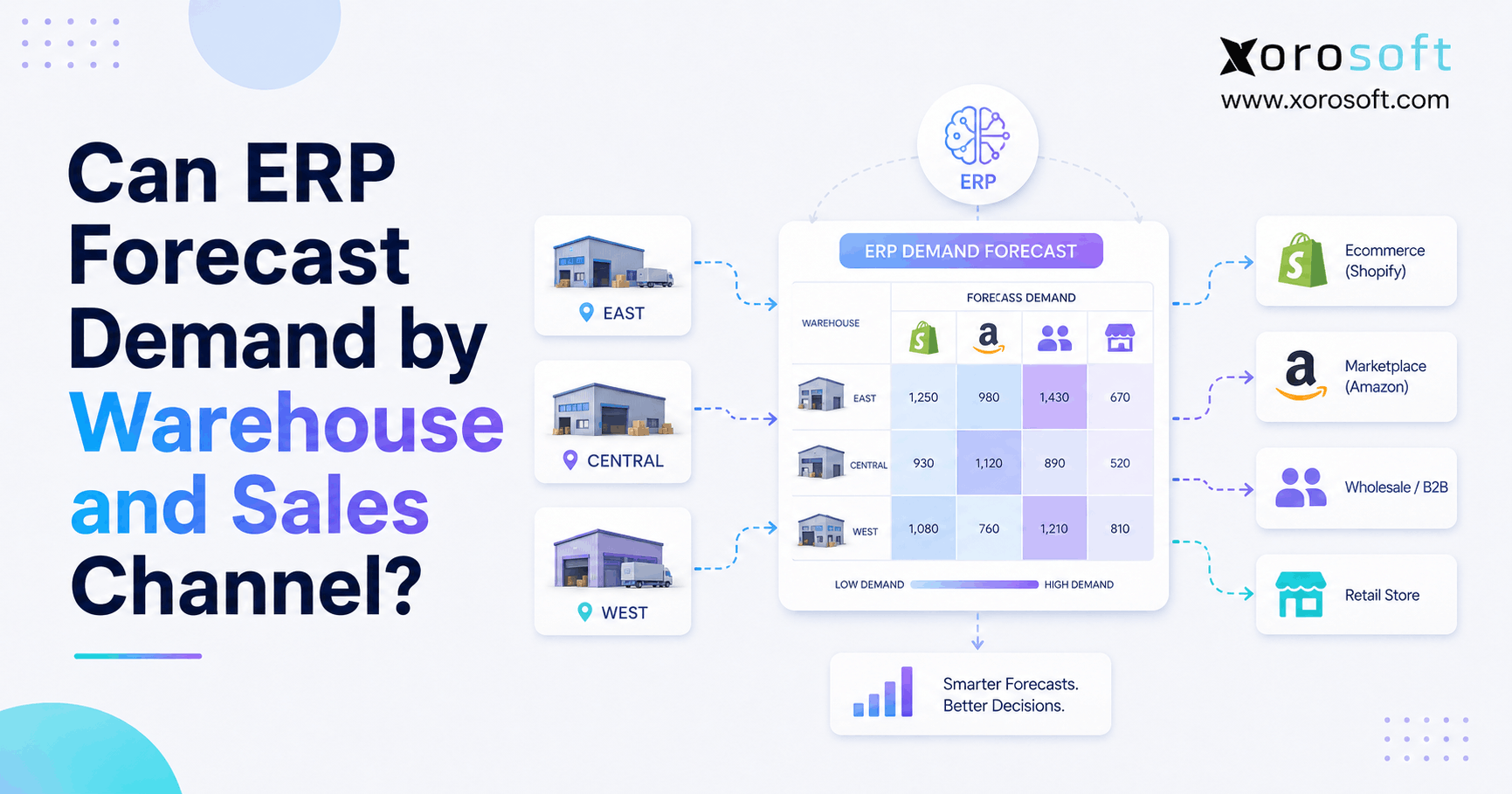
Many businesses today are looking for effective multi-channel demand forecasting to optimise their operations and improve planning.
1. When One Forecast Hides Three Different Inventory Problems
A business can have an accurate company-wide sales forecast and still put inventory in the wrong warehouse. Likewise, total demand can appear stable even while Shopify demand falls, Amazon demand rises, and wholesale orders shift toward another region. Therefore, the real planning problem is often not the total number of units the company expects to sell.
Instead, the harder question is where that demand will occur and which sales channel will create it.
For example, assume a company expects to sell 10,000 units next quarter. Although that number helps with high-level planning, it does not tell the purchasing team whether California requires 4,000 units or 7,000 units. Similarly, it does not explain whether Amazon will generate most of the growth or whether wholesale customers will require additional inventory.
Consequently, growing inventory-driven businesses increasingly need forecasts at a more practical level.
That is where multi-channel demand forecasting becomes important.
Rather than creating one blended projection, multi-channel demand forecasting can separate demand by product, warehouse, location, customer group, or sales channel. As a result, planners can understand not only what may sell, but also where inventory may be required.
Moreover, an ERP can connect that forecast with inventory, purchasing, transfers, allocation, fulfillment, and financial data. Therefore, forecasting becomes part of an operational decision process instead of another isolated spreadsheet.
However, not every ERP provides the same forecasting granularity. Some systems forecast primarily by product, whereas others support warehouse, location, customer, channel, or combinations of those dimensions.
Therefore, the right question is not simply, “Does this ERP have forecasting?”
Instead, ask:
Can the ERP forecast demand at the level where our inventory decisions actually happen?
For a multi-warehouse, multi-channel company, that level may be:
SKU × warehouse × sales channel.
2. What Is Multi-Channel Demand Forecasting?
Multi-channel demand forecasting is the process of predicting future product demand across separate sales channels while maintaining a consolidated view of overall demand.
For example, channels may include:
- Shopify
- Amazon
- wholesale
- retail
- EDI
- B2B portals
- marketplaces
- distributors
Although the same SKU may be sold everywhere, demand rarely behaves identically across all channels. For instance, Shopify demand may respond to digital advertising, while Amazon demand may change during marketplace promotions. Meanwhile, wholesale demand may arrive through larger and less frequent purchase orders.
Therefore, blending every order into one forecast can hide meaningful differences.
2.1 Why Sales Channels Behave Differently
First, each channel can have a different customer base. Consequently, order frequency and basket size may differ substantially.
Second, promotions vary between channels. For example, an Amazon event may increase marketplace demand without affecting wholesale accounts.
Additionally, fulfillment rules may differ. Shopify orders might ship from the nearest warehouse, whereas wholesale inventory may be reserved at one distribution center.
Finally, return behavior, seasonality, geography, and customer purchasing cycles can also differ.
Therefore, multi-channel demand forecasting helps planners preserve those differences instead of averaging them away.
2.2 Why Forecast Granularity Matters
More detail is not automatically better. However, additional granularity becomes useful when it changes an operational decision.
For example, if two warehouses serve completely different regions, warehouse-level forecasting can improve inventory positioning. Likewise, if Amazon and wholesale demand behave differently, channel-level forecasting can improve allocation.
Conversely, if a business operates one warehouse and one channel, excessive segmentation may simply create noise.
Therefore, businesses should forecast at the lowest useful level, rather than the lowest technically possible level.
3. Can ERP Forecast Demand by Warehouse and Sales Channel?
Yes. An ERP with appropriate demand-planning capabilities can forecast demand by dimensions such as SKU, warehouse, location, customer, geography, and sales channel.
However, exact functionality varies by system.
Therefore, buyers should distinguish between basic forecasting and granular demand planning.
3.1 SKU-Level Demand Forecasting
SKU-level forecasting predicts demand for individual items or variants.
For example, instead of forecasting 15,000 shirts, the company may forecast demand separately for:
- black / small
- black / medium
- black / large
- blue / small
- blue / medium
- blue / large
Consequently, the purchasing team can order inventory at the actual level at which products are stocked and sold.
3.2 Warehouse-Level Demand Forecasting
Warehouse demand forecasting answers another question:
Where will inventory be required?
For example:
| Warehouse | Forecast Demand |
|---|---|
| New Jersey | 2,800 units |
| California | 4,100 units |
| Texas | 1,900 units |
Although total demand equals 8,800 units, an equal inventory split would create the wrong stock position.
Therefore, warehouse-level forecasting can influence purchasing, replenishment, transfer decisions, and safety-stock settings.
3.3 Sales Channel Demand Forecasting
Channel-level forecasting separates demand according to the source of the order.
For example:
| Channel | Forecast Demand |
| Shopify | 3,400 units |
| Amazon | 2,900 units |
| Wholesale | 2,500 units |
As a result, planners can see which channel is growing, declining, or creating unusual demand.
3.4 SKU × Warehouse × Channel Forecasting
The most operationally useful form of multi-channel demand forecasting may combine all three dimensions.
For instance:
| Warehouse | Shopify | Amazon | Wholesale | Total |
| New Jersey | 850 | 400 | 1,100 | 2,350 |
| California | 1,250 | 1,400 | 250 | 2,900 |
| Texas | 600 | 350 | 550 | 1,500 |
Now the business does not merely know how much demand exists.
Instead, it can see:
- which SKU is expected to sell
- which channel creates the demand
- which warehouse may need the stock
- where shortages may develop
- where excess inventory may accumulate
Consequently, forecasting becomes directly relevant to inventory execution.
4. Why Aggregated Forecasts Create Inventory Blind Spots
A company-wide forecast can look accurate while operational forecasts are wrong.
For example, imagine that Shopify demand decreases by 300 units while Amazon demand increases by exactly 300 units. Total demand remains unchanged. However, if those channels use different fulfillment locations, the warehouse requirement has changed significantly.
Therefore, aggregate accuracy can create false confidence.
4.1 Channel Changes Can Cancel Each Other Out
Suppose last month’s demand was:
| Channel | Units |
| Shopify | 500 |
| Amazon | 300 |
| Wholesale | 200 |
| Total | 1,000 |
This month, demand becomes:
| Channel | Units |
| Shopify | 300 |
| Amazon | 500 |
| Wholesale | 200 |
| Total | 1,000 |
At the company level, nothing changed.
Nevertheless, the demand mix changed by 40% between Shopify and Amazon.
Therefore, multi-channel demand forecasting reveals a change that the total forecast cannot show.
4.2 Warehouse Imbalances Can Remain Invisible
Similarly, a company may have enough inventory overall while one warehouse experiences a stockout.
For example:
- New Jersey has 1,500 units.
- California has 200 units.
- Total inventory is 1,700 units.
If California is expected to fulfill 1,000 units next week, the aggregate inventory number is misleading.
As a result, demand planning must connect expected demand with inventory location.
5. How Multi-Warehouse Demand Forecasting Works
Multi-warehouse forecasting estimates the inventory demand that each warehouse or fulfillment location is likely to serve.
Because customer geography, routing rules, supplier lead times, and regional demand can differ, each location may require a separate planning profile.
5.1 Regional Demand Changes the Forecast
For example, sporting goods may sell differently across climates. Likewise, apparel demand can vary between regions because weather patterns differ.
Therefore, historical warehouse demand may provide information that a nationwide forecast misses.
5.2 Fulfillment Routing Affects Warehouse Demand
A warehouse does not necessarily receive demand because the customer explicitly selected that facility.
Instead, routing rules may determine the fulfillment location.
For example, an order could be sent to the closest warehouse with available stock. Consequently, historical warehouse demand may partially reflect previous inventory availability and routing logic.
Therefore, planners should interpret warehouse history carefully.
5.3 Supplier Lead Times Matter
A warehouse supplied through a West Coast port may have a different replenishment cycle than a warehouse receiving inventory from an East Coast supplier.
As a result, the same forecast quantity may require a different reorder date.
Therefore, good warehouse demand forecasting should connect expected demand with lead times rather than simply predicting unit sales.
5.4 Transfers Can Correct Network Imbalances
Sometimes purchasing more inventory is unnecessary.
For example, Warehouse A may have 700 excess units while Warehouse B is expected to run short by 400 units.
Consequently, an internal transfer may solve the shortage.
A modern warehouse management system can support the execution side of these multi-location movements once planners determine where inventory should be positioned.
6. How Sales Channel Demand Forecasting Works
Sales channel forecasting separates demand according to how customers buy.
Therefore, multi-channel demand forecasting becomes especially relevant when an organization sells through ecommerce, marketplaces, wholesale, and EDI simultaneously.
6.1 Shopify Demand Forecasting
Shopify demand may react quickly to:
- paid advertising
- email campaigns
- influencer activity
- product launches
- discount campaigns
- seasonal ecommerce events
Consequently, Shopify sales can behave differently from wholesale demand.
For businesses operating Shopify alongside ERP processes, integrated Xorosoft integrations can help connect ecommerce activity with broader inventory and operational workflows.
6.2 Amazon Demand Forecasting
Amazon demand may be influenced by:
- marketplace promotions
- listing performance
- competition
- fulfillment method
- advertising
- seasonal marketplace traffic
Therefore, Amazon should not automatically be treated as identical to direct ecommerce demand.
6.3 Wholesale Demand Forecasting
Wholesale frequently follows a very different pattern.
For example, wholesale customers may:
- place larger orders
- order less frequently
- submit seasonal commitments
- purchase through EDI
- require customer-specific allocations
- order against contractual schedules
Consequently, one large wholesale PO can significantly affect short-term inventory requirements.
6.4 EDI Demand Forecasting
EDI orders may come from retailers, distributors, or large trading partners.
Therefore, planners may need to distinguish recurring replenishment from unusual bulk orders.
In addition, EDI demand often interacts with allocation and fulfillment commitments. Consequently, the forecast should not be considered independently from confirmed customer demand.
7. How ERP Multi-Channel Demand Forecasting Works
ERP forecasting generally follows a sequence from historical demand to operational action.
Although individual systems differ, the workflow commonly contains several stages.
7.1 Collect Historical Demand
First, the system collects relevant transactions.
These may include:
- sales orders
- invoices
- shipments
- returns
- warehouse movements
- channel orders
- customer orders
However, historical sales are not always equivalent to historical demand.
For example, a product that was out of stock could not sell. Therefore, recorded sales may understate what customers actually wanted.
7.2 Clean and Normalize Demand Data
Next, unusual observations should be reviewed.
For example:
- stockout periods
- one-time bulk orders
- abnormal returns
- promotional spikes
- discontinued SKUs
- incorrect transactions
Consequently, data cleansing can prevent unusual events from becoming the new baseline.
7.3 Segment Demand
Next, the company decides the appropriate forecast level.
For example:
- SKU
- SKU × warehouse
- SKU × channel
- SKU × warehouse × channel
Therefore, segmentation should match the decisions the business needs to make.
7.4 Generate the Baseline Forecast
Afterward, the system uses historical patterns to estimate future demand.
Depending on the platform, models may consider:
- trends
- seasonality
- moving averages
- exponential smoothing
- statistical forecasting
- machine learning
However, sophisticated algorithms do not compensate for poor source data.
Therefore, reliable operational data remains fundamental.
7.5 Apply Business Context
Next, planners may adjust forecasts for known events.
For example:
- major promotions
- product launches
- retailer commitments
- new customers
- discontinued products
- planned price changes
Consequently, statistical output can be combined with business knowledge.
7.6 Measure Forecast Performance
Finally, forecasts should be compared with actual demand.
Therefore, planners can identify:
- systematic over-forecasting
- under-forecasting
- inaccurate channels
- problematic warehouses
- unusual SKUs
As a result, forecasting becomes an ongoing improvement process rather than a one-time calculation.
8. What Data Should Multi-Channel Demand Forecasting Use?
A reliable forecast requires more than historical sales.
Therefore, planners should consider the wider demand and supply environment.
Useful inputs may include:
1. historical sales
2. open orders
3. shipment history
4. returns
5. stockouts
6. current inventory
7. warehouse location
8. sales channel
9. customer commitments
10. incoming purchase orders
11. supplier lead times
12. promotions
13. seasonality
14. transfer history
15. manufacturing lead times
16. safety-stock requirements
8.1 Historical Sales Need Context
Historical sales provide an important baseline. However, they should not always be accepted literally.
For example, low sales during an eight-week stockout do not necessarily indicate low demand.
Therefore, planners should distinguish constrained sales from true customer demand whenever possible.
8.2 Promotions Need Separate Treatment
Likewise, promotional periods can distort historical averages.
If a product normally sells 100 units weekly but sold 600 during a major promotion, using 600 as normal demand would inflate future inventory.
Consequently, planners need to identify temporary uplift.
8.3 Returns Can Distort Demand
Returns also require careful interpretation.
For example, gross demand may be 1,000 units while 200 units are returned.
Therefore, planning teams should decide whether they are forecasting orders, shipments, net sales, or another demand definition.
9. How Multi-Channel Demand Forecasting Drives Inventory Decisions
The forecast itself does not create business value.
Instead, value appears when multi-channel demand forecasting influences purchasing, replenishment, allocation, transfers, and production.
9.1 Purchasing
Suppose expected demand is 2,000 units.
However, the business already has:
- 600 units available
- 300 units inbound
- 200 units of safety stock required
Therefore, purchasing requirements should not simply equal the 2,000-unit forecast.
Instead, the ERP should consider supply and inventory positions before generating replenishment requirements.
Businesses that want this planning connected to broader ERP workflows can review the XoroERP platform, which brings inventory-driven operational functions into an integrated ERP environment.
9.2 Inventory Replenishment
Replenishment converts future requirements into action.
For example, a location projected to fall below its required stock level may need additional inventory before the shortage occurs.
Therefore, forecast timing is just as important as forecast quantity.
9.3 Warehouse Transfers
Likewise, the system may identify that another warehouse already has available stock.
Consequently, planners can compare the cost and timing of transferring inventory against placing another purchase order.
9.4 Inventory Allocation
Forecasting predicts likely demand.
However, allocation determines which customers, warehouses, or channels are allowed to consume available inventory.
Therefore, forecast and allocation rules should work together.
9.5 Safety Stock
Demand variability also affects safety stock.
For example, a highly predictable item may require a smaller buffer than a volatile one.
Consequently, blanket safety-stock settings can lead to too much inventory for stable SKUs and too little inventory for unpredictable products.
10. Shopify, Amazon, and Wholesale: Should They Be Forecast Separately?
In many cases, yes.
However, separate forecasts are useful only when the demand patterns differ meaningfully.
10.1 Separate Channels When Behavior Differs
For example, separate forecasting is useful when channels differ in:
- seasonality
- growth
- promotion timing
- order size
- geography
- return rate
- customer type
Therefore, a Shopify + Amazon + wholesale business may benefit significantly from multi-channel demand forecasting.
10.2 Keep a Consolidated Company View
Nevertheless, separate forecasts should still reconcile to an overall plan.
For example:
Shopify forecast: 3,000
Amazon forecast: 4,000
Wholesale forecast: 2,000
Total demand forecast: 9,000
Therefore, management can review both the channel-level assumptions and total inventory exposure.
10.3 Connect Channel Orders With ERP Inventory
Separating forecasts is useful only if actual orders and inventory movements remain synchronized.
Consequently, ecommerce integrations become operationally important.
For Shopify merchants evaluating this workflow, Xorosoft is also available through the Shopify App Store, providing an external reference for its Shopify integration.
11. A Practical Multi-Channel Demand Forecasting Example
Consider a footwear company selling one popular running shoe.
The business uses:
- Shopify
- Amazon
- wholesale
It also operates:
- New Jersey warehouse
- California warehouse
A simple company forecast predicts 3,000 units next month.
However, multi-channel demand forecasting reveals the following:
| Warehouse / Channel | Shopify | Amazon | Wholesale | Total |
| New Jersey | 500 | 250 | 750 | 1,500 |
| California | 650 | 750 | 100 | 1,500 |
| Total | 1,150 | 1,000 | 850 | 3,000 |
At first glance, both warehouses require exactly 1,500 units.
However, the channel mix is completely different.
New Jersey requires substantially more wholesale inventory.
Meanwhile, California requires more Amazon inventory.
Therefore, if inventory is reserved or fulfillment rules differ by channel, simply sending 1,500 interchangeable units to each location may not be sufficient.
Furthermore, different product variants may have completely different demand patterns.
Consequently, the planning requirement can eventually become:
SKU × warehouse × channel × time period.
However, businesses should add that complexity only when it improves decisions.
12. How to Measure Multi-Channel Demand Forecasting Accuracy
Forecast accuracy should be measured consistently.
Otherwise, teams cannot determine whether forecasting changes are actually improving planning.
12.1 Mean Absolute Error
Mean Absolute Error measures the average size of forecast errors.
Because it remains in the original unit, planners can usually interpret it easily.
For example, an MAE of 25 means the forecast misses actual demand by 25 units on average.
12.2 Mean Absolute Percentage Error
MAPE expresses forecast error as a percentage.
Therefore, it is easy to communicate.
However, MAPE becomes problematic when actual demand approaches zero.
Consequently, it should not always be used as the only metric.
12.3 Forecast Bias
Forecast bias identifies systematic over-forecasting or under-forecasting.
For example, repeatedly forecasting 1,000 units when actual demand averages 800 units indicates positive forecast bias.
Therefore, bias is operationally important because persistent over-forecasting can increase inventory, while persistent under-forecasting can increase stockout risk.
12.4 Measure Accuracy at Useful Levels
Company-wide accuracy can hide operational errors.
Therefore, businesses may need to evaluate accuracy by:
- SKU
- warehouse
- channel
- product group
As a result, multi-channel demand forecasting can expose forecast weaknesses that disappear at the aggregate level.
13. Common Multi-Channel Demand Forecasting Mistakes
Several mistakes repeatedly weaken forecasting performance.
13.1 Combining Every Channel Automatically
Aggregating channels may hide demand shifts.
Therefore, channels should be separated when their behavior differs.
13.2 Creating Too Much Granularity
Conversely, forecasting every possible dimension can create sparse datasets.
Therefore, additional granularity should have a clear operational purpose.
13.3 Ignoring Stockouts
Sales during stockout periods may understate demand.
Consequently, historical data should be reviewed before model training or forecast calculation.
13.4 Treating Promotions as Normal Demand
Promotional spikes can exaggerate future requirements.
Therefore, extraordinary events should be identified.
13.5 Ignoring Forecast Bias
A model can have acceptable average error while consistently forecasting too high.
Consequently, planners should review both error and directional bias.
13.6 Keeping Forecasting Separate From Execution
A forecast sitting in a spreadsheet cannot automatically improve purchasing or warehouse planning.
Therefore, the greatest operational benefit often appears when forecasts connect with inventory, purchasing, fulfillment, accounting, and warehouse activity.
14. When Should a Business Upgrade From Spreadsheet Forecasting?
Spreadsheets are useful tools.
However, they become difficult to manage when they must continuously reconcile multiple operational systems.
14.1 Warning Signs That the Current Process Is Breaking
An upgrade may be worth evaluating when teams:
- manually export Shopify orders
- download Amazon reports separately
- maintain warehouse-specific inventory files
- reconcile purchasing spreadsheets
- disagree over forecast versions
- frequently expedite purchase orders
- constantly transfer inventory
- experience simultaneous stockouts and overstock
Therefore, the issue may no longer be spreadsheet skill.
Instead, the company may lack one connected operational data model.
14.2 Growth Makes Forecasting More Difficult
Adding a second warehouse doubles many planning decisions.
Similarly, adding Amazon beside Shopify introduces another demand stream.
Meanwhile, wholesale and EDI add larger and less predictable orders.
Consequently, multi-channel demand forecasting becomes more valuable as operational dimensions multiply.
15. What to Look for in an ERP Demand Forecasting System
Before selecting a system, businesses should verify actual forecasting functionality instead of relying on a generic feature checklist.
15.1 Forecast Granularity
First, determine whether the platform can forecast at the levels you need.
For example:
- SKU
- location
- warehouse
- customer
- sales channel
15.2 Multi-Warehouse Inventory Visibility
Next, verify that planners can see available, allocated, committed, incoming, and transferable inventory across locations.
Without that visibility, warehouse demand forecasts have limited operational value.
15.3 Purchasing and Replenishment
Additionally, forecasting should connect with purchasing decisions.
Therefore, users should be able to understand how forecast demand translates into recommended inventory actions.
15.4 Ecommerce and Order Integration
If Shopify, Amazon, wholesale, and EDI create demand, those transactions should enter the operational system reliably.
Consequently, integrations matter just as much as the forecasting model itself.
15.5 Warehouse Execution
Forecasting explains where inventory may be needed.
However, warehouse operations must still receive, transfer, pick, pack, and ship that inventory.
Therefore, planning and execution should remain connected.
Businesses evaluating a broader operational platform can review XoroONE to understand how ERP, inventory, warehouse, purchasing, and other operational functions can sit within one environment.
16. How Xorosoft Supports Multi-Warehouse and Multi-Channel Operations
For inventory-driven companies, Xorosoft approaches forecasting as part of a broader operational system rather than an isolated planning exercise.
Therefore, the relevant value is the connection between demand, inventory, purchasing, warehousing, ecommerce, and financial operations.
16.1 One Operational Environment
Xorosoft combines:
- ERP
- inventory management
- purchasing
- warehouse management
- accounting
- manufacturing
- reporting
- ecommerce operations
Consequently, teams can work from a more unified operational dataset.
16.2 Multi-Warehouse Operations
Businesses managing multiple physical locations need inventory visibility before forecasts can become actionable.
Therefore, Xorosoft’s warehouse and inventory workflows are particularly relevant to companies that need to understand where stock exists and where it should move next.
16.3 Ecommerce and Multi-Channel Operations
Likewise, Shopify, Amazon, wholesale, and EDI activity can create competing inventory requirements.
Consequently, integrating sales activity with ERP inventory reduces dependence on disconnected exports and manual reconciliation.
Companies exploring a broader set of operational capabilities can also review Xorosoft’s business solutions for inventory-driven workflows.
16.4 Manufacturing and Distribution
Demand planning can also affect raw materials, production schedules, purchasing, and finished-goods availability.
Therefore, businesses in wholesale, apparel, furniture, sporting goods, consumer products, food, and manufacturing may require forecasting that connects downstream sales with upstream supply decisions.
Examples of how inventory-driven companies use integrated operational systems are available through Xorosoft’s case studies.
17. Frequently Asked Questions About Multi-Channel Demand Forecasting
17.1 Can ERP forecast demand?
Yes. Many ERP systems provide forecasting capabilities or connect with demand-planning tools. However, the level of sophistication differs considerably. Therefore, businesses should verify whether a platform supports the dimensions they actually need, such as SKU, location, warehouse, customer, or sales channel.
17.2 Can ERP forecast demand by warehouse?
Yes, some ERP systems can create warehouse- or location-specific forecasts. Consequently, businesses can estimate where stock will be needed rather than relying only on company-wide totals. However, planners should also consider fulfillment routing because historical warehouse demand can be influenced by where inventory happened to be available.
17.3 Can ERP forecast demand by sales channel?
Yes, if the ERP or connected planning system can preserve channel information. Therefore, Shopify, Amazon, wholesale, retail, or other demand streams can potentially be modeled separately. However, businesses should separate channels only when doing so produces useful planning information.
17.4 What is multi-channel demand forecasting?
Multi-channel demand forecasting predicts future demand separately across sales channels while retaining an overall company forecast. For example, a business can forecast Shopify, Amazon, and wholesale individually. Consequently, planners can identify shifts that would be hidden inside an aggregated demand number.
17.5 What is multi-warehouse demand forecasting?
Multi-warehouse demand forecasting predicts expected demand for individual warehouse or fulfillment locations. Therefore, a company can identify where inventory may be required before shortages occur. In addition, planners can compare future requirements with available stock in other facilities before placing additional purchase orders.
17.6 Should Shopify and Amazon demand be forecast separately?
Usually, they should be separated when their demand patterns differ materially. For example, promotional calendars, customer behavior, marketplace events, and fulfillment rules may differ. However, if the channels behave almost identically, separating them may add complexity without improving decisions.
17.7 Can wholesale demand be forecast separately?
Yes. In fact, wholesale demand frequently behaves differently from direct ecommerce. For example, retailers may submit larger and less frequent orders or use EDI. Therefore, separating wholesale demand can prevent large account orders from distorting direct-to-consumer forecasts.
17.8 Can ERP forecast demand by SKU?
Yes. SKU-level forecasting is particularly important for businesses managing variants such as size, color, configuration, or pack size. Consequently, purchasing teams can plan the exact inventory that must be replenished instead of relying on broader category forecasts.
17.9 What data does ERP demand forecasting use?
Forecasting can use historical sales, open orders, shipments, returns, warehouse information, channel data, supplier lead times, promotions, seasonality, purchase orders, and inventory positions. However, exact inputs depend on the system. Therefore, buyers should review the underlying forecasting logic before implementation.
17.10 How does ERP handle seasonal demand?
ERP forecasting tools can analyze recurring patterns in historical demand. Consequently, businesses can distinguish seasonal changes from ordinary fluctuations. However, planners should also review promotions and abnormal events because a one-time spike should not necessarily influence next year’s baseline.
17.11 Can ERP account for promotions?
Some systems can incorporate promotions directly, while others rely on planner adjustments. Therefore, promotional demand should be identified whenever it materially changes normal buying behavior. Otherwise, a temporary spike may inflate future forecasts.
17.12 Can stockouts affect forecast accuracy?
Yes. When inventory is unavailable, sales may fall even though customers still want the product. Consequently, historical sales can understate real demand. Therefore, businesses should identify stockout periods before using historical sales as a clean demand signal.
17.13 Can ERP recommend warehouse transfers?
An ERP can use inventory positions and planning logic to support transfer decisions. For example, one warehouse may have excess inventory while another faces a projected shortage. Consequently, transferring available stock may be faster or cheaper than purchasing additional inventory.
17.14 Does demand forecasting automatically create purchase orders?
Not necessarily. A forecast should generally be combined with available inventory, incoming supply, lead time, commitments, and safety stock. Therefore, forecast quantity and purchase quantity are not automatically identical.
17.15 What is demand forecasting versus inventory forecasting?
Demand forecasting predicts what customers are likely to buy. In contrast, inventory forecasting considers demand together with stock levels, incoming supply, and replenishment. Therefore, demand forecasts normally become an input into broader inventory planning.
17.16 What is demand forecasting versus demand planning?
Demand forecasting creates an estimate of future demand. Demand planning is broader because it includes review, adjustment, sales input, promotions, customer commitments, and business decisions. Consequently, a statistical forecast can be one component of a complete demand plan.
17.17 How accurate should ERP demand forecasting be?
There is no single percentage that applies to every company. Instead, accuracy depends on product behavior, forecast horizon, demand volatility, seasonality, data quality, and forecast granularity. Therefore, companies should establish benchmarks by product group and improve them over time.
17.18 What is forecast bias?
Forecast bias shows whether forecasts consistently run above or below actual demand. Therefore, a company can identify systematic over-forecasting or under-forecasting. Persistent bias matters because it can contribute to excess inventory or recurring shortages.
17.19 What is MAPE?
MAPE stands for Mean Absolute Percentage Error. It expresses forecast error as a percentage, making results relatively easy to communicate. However, it becomes unreliable when actual demand is zero or very small. Therefore, planners often use additional accuracy measures.
17.20 Is ERP forecasting better than spreadsheets?
Not automatically. Spreadsheets can work effectively for smaller operations. However, ERP forecasting becomes increasingly useful when teams manage many SKUs, warehouses, channels, purchase orders, transfers, and inventory movements because the underlying operational data can remain more connected.
17.21 When should a company move beyond spreadsheets?
An upgrade may make sense when planners spend more time gathering and reconciling data than analyzing demand. Likewise, frequent stockouts, excess inventory, manual transfers, multiple forecast versions, and disconnected ecommerce exports can indicate that operational complexity has outgrown the spreadsheet process.
17.22 Can AI improve demand forecasting?
AI and machine learning can help identify patterns, anomalies, changing trends, and forecast exceptions across large datasets. However, poor data will still produce unreliable results. Therefore, AI should improve a sound planning process rather than replace data governance.
17.23 Do all ERP systems support multi-channel demand forecasting?
No. Some platforms offer basic product forecasting, while others support more sophisticated dimensions. Therefore, buyers should ask vendors to demonstrate the exact warehouse, location, SKU, and channel forecasting workflow required by their business.
17.24 Who needs multi-channel demand forecasting?
It is most valuable for businesses operating multiple channels whose demand behaves differently. For example, Shopify, Amazon, wholesale, EDI, and retail can create different buying patterns. Consequently, companies managing significant inventory across several demand streams can gain more useful visibility from segmented forecasts.
17.25 Who does not need multi-channel demand forecasting?
A business with one warehouse, one channel, a small SKU catalog, stable demand, and short replenishment lead times may not require advanced segmentation. Therefore, simple forecasting can remain appropriate until operational complexity increases.
17.26 Can multi-channel demand forecasting reduce stockouts?
It can help reduce stockout risk by showing where demand is likely to occur. However, forecasting alone cannot guarantee availability. Therefore, companies must also manage lead times, purchasing, safety stock, transfers, allocations, and fulfillment execution.
17.27 Can multi-channel demand forecasting reduce excess inventory?
Potentially. Better segmentation can help companies avoid purchasing inventory for the wrong warehouse or channel. Nevertheless, forecast improvement must be connected to purchasing and replenishment decisions before it can materially change inventory levels.
17.28 How often should demand forecasts be updated?
The correct frequency depends on the business. Fast-moving ecommerce companies may review forecasts more frequently than businesses with stable wholesale demand. Therefore, forecast refresh frequency should reflect sales velocity, lead times, volatility, and how quickly planners can respond to new information.
18. Turn Forecasts Into Better Inventory Decisions
Ultimately, the purpose of multi-channel demand forecasting is not to create more dashboards.
Instead, the purpose is to answer practical questions before inventory problems occur:
- Which SKU will customers need?
- Where should the inventory be positioned?
- What sales channel will create the demand?
- When should purchasing act?
- Should existing stock be transferred instead?
Therefore, a useful ERP forecast must connect prediction with execution.
For a simple operation, SKU-level forecasting may be enough. However, as warehouses, ecommerce channels, wholesale accounts, EDI relationships, and product variants multiply, aggregate forecasts become increasingly limited.
Consequently, the most useful planning model may eventually become:
SKU × warehouse × sales channel.
Nevertheless, businesses should add that granularity only when it improves actual decisions.
Xorosoft brings ERP, inventory, warehouse management, purchasing, ecommerce operations, accounting, manufacturing, and reporting into a connected environment for inventory-driven businesses. Therefore, companies that have outgrown disconnected spreadsheets and standalone applications can evaluate whether an integrated operating model is appropriate for their next stage of growth.
If warehouse and channel complexity is making inventory planning harder, Book a Demo to see how Xorosoft can connect demand planning with the workflows that execute the plan.
Recent Posts
-
 ERP Landed Cost Module vs Spreadsheet Calculations for Importers
 -
 How to Build an Open-to-Buy Plan for an Omnichannel Brand
 -
 Cold Storage WMS for Food and Beverage Distribution
 -
 ERP Buying Statistics 2026: Evaluation, Implementation, and Adoption Risks
 -
 How a Distributor Reduced B2B Order Exceptions Without Restricting Sales