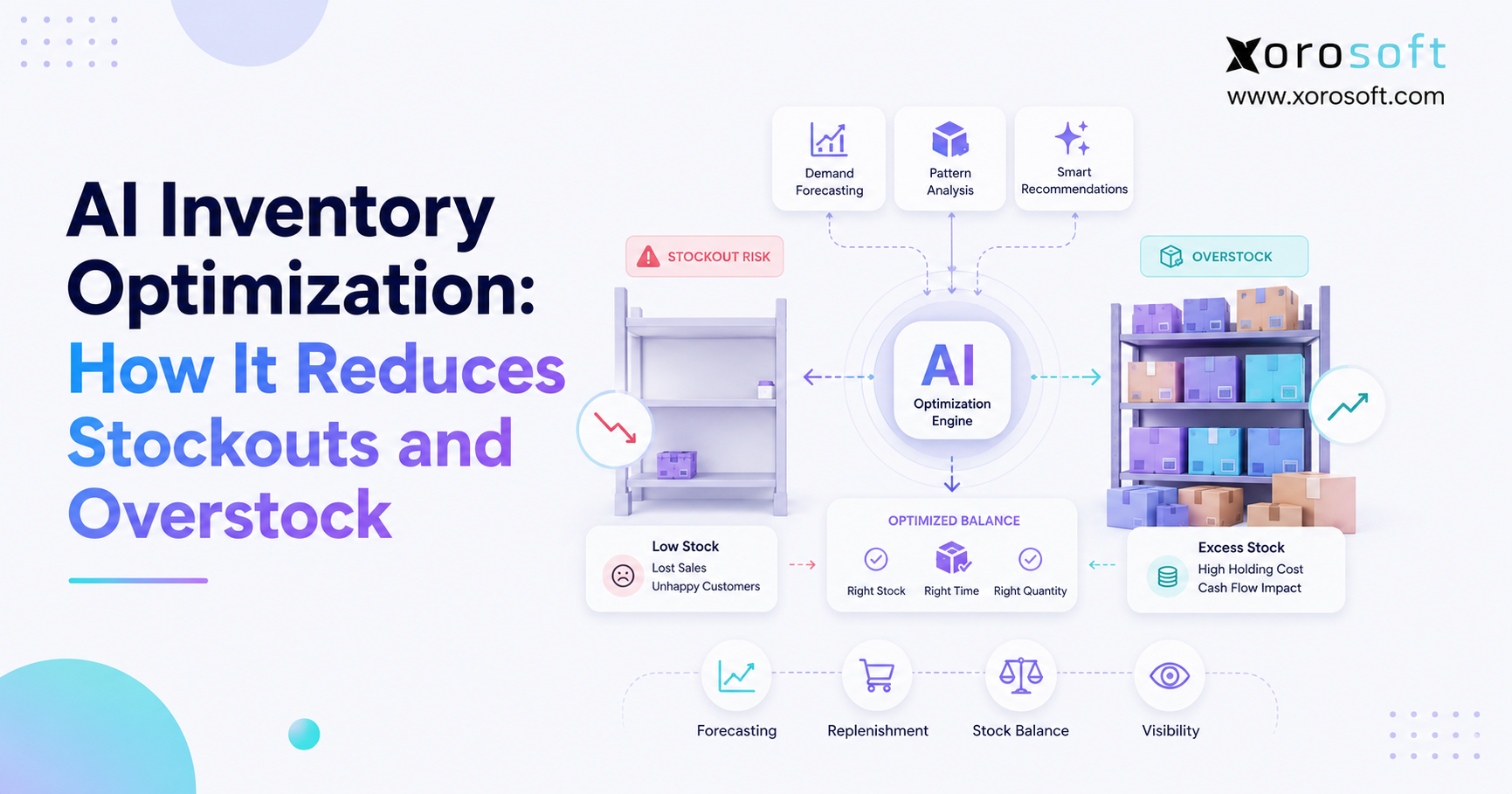
AI inventory optimization is transforming how businesses manage their supply chains and stock levels.
1. The Real Inventory Problem Is Imbalance, Not Volume
AI inventory optimization helps inventory-driven businesses decide what to buy, when to buy it, how much to hold, and where stock should sit. More importantly, it helps teams reduce stockouts without solving every shortage by simply buying more.
For many growing brands, stockouts and overstock appear at the same time. A warehouse may be full, yet the best-selling SKUs are unavailable. Meanwhile, slow-moving products keep absorbing cash and storage space. Therefore, the real problem is often not total inventory volume. Instead, it is having the wrong products, in the wrong quantities, in the wrong places, at the wrong time.
As complexity grows, planners need a better way to connect demand, available stock, incoming supply, and purchasing decisions across SKUs, warehouses, and sales channels.
1.1 Why Stockouts and Overstock Often Happen Together
Stockouts and excess inventory look like opposite problems. However, they often come from the same planning weakness.
For example, an apparel brand may have too many units of unpopular colors while running out of core sizes. Likewise, a sporting goods company may have excess stock in one warehouse while another location cannot fulfill customer orders.
In both cases, total inventory may look healthy. Yet availability is poor where demand actually exists. As a result, buying more stock does not automatically solve the problem. Instead, the business needs to understand which SKU is needed, where it is needed, and how soon replenishment can arrive.
1.2 Why Spreadsheet Planning Breaks as Complexity Grows
Spreadsheets can work when a company has a small catalog, one warehouse, and stable demand. However, complexity grows quickly.
For instance, purchasing, warehouse, and finance teams may all work from different exports. Therefore, planners spend more time gathering data and less time making decisions. In addition, spreadsheets do not automatically account for supplier delays, committed orders, warehouse transfers, or sudden demand changes, so planning becomes reactive.
2. How AI Inventory Optimization Works
AI inventory optimization combines demand, supply, inventory, and operational data. Then, it uses those inputs to support better replenishment decisions.
First, the system reviews sales, stock, open purchase orders, supplier lead times, and demand trends. Next, it compares expected demand with available and incoming inventory. Then, it can recommend a purchase, a delay, a warehouse transfer, or a safety-stock change. Finally, recommendations update as new data arrives.
2.1 AI Demand Forecasting
Demand forecasting estimates how much customers are likely to buy during a future period. Traditionally, teams may use last month’s sales or the same month from the prior year. However, that method can miss important changes.
For example, a promotion can create a short spike, while a mature product may be slowing. Therefore, AI demand forecasting helps separate repeatable patterns from temporary noise. Still, planners should combine forecasts with business context.
2.2 Reorder Point Optimization
A reorder point tells the business when it is time to replenish an item. A simple process may use a fixed number. However, fixed reorder points become less useful when demand or supplier lead times change.
Suppose an item sells 10 units per day. If the supplier takes seven days to deliver, the business must cover demand during those seven days. Yet if delivery moves to 14 days, the old reorder point may create repeated shortages.
Therefore, AI inventory optimization can make reorder logic more responsive by using current demand and supplier performance.
2.3 Safety Stock Optimization
Safety stock protects the business when demand rises or suppliers deliver late. However, too much buffer traps cash. Therefore, the goal is to hold enough protection for the uncertainty involved, with larger buffers for volatile SKUs and smaller ones for steady items.
2.4 Supplier Lead Time Analysis
Supplier lead time is one of the biggest drivers of inventory risk. If a supplier takes longer than expected, even a good forecast can fail.
For that reason, planners should compare expected lead times with actual receipt history. If a supplier starts delivering later, the buying plan should change as well. Consequently, the business can reorder earlier instead of discovering the problem when stock is already low.
3. How AI Inventory Optimization Reduces Stockouts
AI inventory optimization reduces stockouts by helping teams identify risk earlier and act before inventory reaches zero.
Stockouts often result from delayed signals and late action. Therefore, avoiding them requires earlier warnings and better replenishment timing.
3.1 It Detects Demand Changes Earlier
Sales can change quickly after promotions, seasonal shifts, or new demand. By contrast, AI-powered inventory planning can monitor recent patterns and flag fast-moving items earlier. As a result, buyers gain more time to respond.
3.2 It Improves Replenishment Timing
Many stockouts are timing problems. Therefore, better planning connects expected demand with supplier lead time so replenishment begins before stock gets dangerously low. Moreover, when lead times change, the buying plan should change too.
3.3 It Helps Buyers Focus on High-Risk SKUs
A business with thousands of SKUs cannot review every item with the same level of attention. Therefore, planners need exception-based management.
Instead of manually checking everything, teams can focus on products with unusual demand, low stock coverage, delayed supply, or high revenue impact. As a result, purchasing becomes more focused and faster.
3.4 It Improves Multi-Channel Inventory Visibility
Stockout risk rises when a company sells through several channels. For example, the same stock pool may support Shopify, Amazon, wholesale, EDI, and retail orders. Meanwhile, some units may already be committed to open customer orders.
Therefore, on-hand stock alone can be misleading. Businesses that have outgrown basic inventory apps may consider XoroONE to connect inventory, purchasing, finance, fulfillment, and other core processes in one operating environment.
4. How AI Inventory Optimization Reduces Overstock
AI inventory optimization also addresses the other side of the problem: buying more inventory than the business can reasonably sell.
Overstock consumes working capital and warehouse space. Therefore, reducing excess stock can improve both operations and cash flow.
4.1 It Identifies Slow-Moving Products Earlier
Slow-moving products are easy to overlook. A SKU may still sell occasionally, so it does not look urgent. However, if the company holds 12 months of stock for an item that sells slowly, cash remains trapped.
Predictive inventory planning can flag declining sales velocity, high days on hand, and weak turnover. Consequently, buyers can reduce or stop replenishment before the problem becomes larger.
4.2 It Reduces “Just in Case” Buying
When teams do not trust inventory data, they often buy extra stock for protection. However, repeated overbuying creates excess inventory. Therefore, better visibility into stock, incoming POs, demand, and lead times reduces guesswork.
4.3 It Matches Purchase Quantities to Sales Velocity
Purchase quantities should reflect how quickly products actually sell. For example, ordering six months of stock may make sense for a long-lead-time supplier. However, the same quantity may be excessive for a supplier that can replenish within a week.
Therefore, AI inventory optimization helps buyers consider both demand and supply conditions before committing cash.
4.4 It Improves Cash Allocation
Inventory is an operating asset, but it also consumes cash. Therefore, excess stock competes with marketing, hiring, product launches, supplier payments, and other priorities.
When purchasing teams reduce unnecessary stock, finance gains more flexibility. Moreover, companies that need inventory and accounting in a broader operating system can review XoroERP.
5. AI Inventory Optimization vs Traditional Inventory Planning
AI inventory optimization does not remove planners from the process. Instead, it changes how planners spend their time.
Traditional planning requires people to collect reports and review many SKUs manually. By contrast, AI-assisted planning can highlight exceptions. Therefore, planners can focus on supplier issues, promotions, launches, and decisions that require judgment.
5.1 Manual Planning
Manual planning can still work for a small catalog. However, it becomes harder when the business has thousands of SKUs or several sales channels.
The main weakness is scale because every new warehouse, supplier, marketplace, or product line adds more decisions.
5.2 Inventory Planning Software
Dedicated planning tools can improve forecasting and replenishment. For some businesses, that is enough.
However, the company may still need separate software for accounting, warehouse operations, order management, EDI, and ecommerce integrations. Therefore, the right choice depends on how connected the workflows need to be.
5.3 ERP-Based Inventory Planning
An ERP approach brings inventory planning closer to purchasing, orders, accounting, warehouse activity, and reporting. As a result, planners can work from more complete data.
For companies that need to connect many systems, reviewing available Xorosoft integrations can help determine whether the current stack can be brought into one operating environment.
5.4 Manual Planning vs AI-Assisted Planning
| Planning Area | Manual Approach | AI-Assisted Approach |
|---|---|---|
| Demand review | Past reports | Ongoing pattern analysis |
| Reorder points | Often fixed | Adjust with demand and lead time |
| Safety stock | Broad rules | SKU and location based |
| Purchasing | Manual review | Exception-based recommendations |
| Slow movers | Found later | Flagged earlier |
| Warehouse allocation | Manual checks | Location-based signals |
| Planning speed | Slower | Faster review of large SKU sets |
6. The Data AI Inventory Optimization Needs
AI inventory optimization is only as useful as the data behind it. Therefore, companies should improve data quality before expecting better recommendations.
6.1 Sales History
Sales history helps identify normal demand. However, one-time wholesale orders, promotions, and stockout periods can distort the pattern. Therefore, planners should separate unusual events from repeatable demand.
6.2 Available Inventory
On-hand and available stock are not always the same because some units may be committed, damaged, or reserved. Therefore, the planning system should use inventory that can actually be sold.
6.3 Purchase Orders and Incoming Supply
The system must also understand what is already on order. Otherwise, buyers may duplicate purchases. Consequently, open POs, receipt dates, quantities, and supplier status should be visible in the planning view.
6.4 Supplier Lead Times
Lead time directly affects inventory risk. Therefore, teams should compare expected delivery dates with actual receipt history instead of relying on outdated estimates.
6.5 Warehouse-Level Inventory
Multi-warehouse companies need location-level data because total stock can hide a shortage at one fulfillment center. Therefore, AI inventory optimization should show both how much inventory exists and where it sits.
A dedicated warehouse management system becomes useful when teams need real-time control over receiving, movement, picking, packing, and warehouse availability.
7. AI Inventory Optimization for Ecommerce and Multi-Channel Brands
AI inventory optimization is especially useful in ecommerce because Shopify, Amazon, wholesale, EDI, and retail may all compete for the same stock. Therefore, planners need a shared view of demand and availability.
7.1 Shopify Inventory Planning
Shopify gives brands a strong commerce platform. However, growing businesses often need purchasing, warehouse management, accounting, EDI, and multi-location control behind the storefront. Brands evaluating that operating layer can review Xorosoft on the Shopify App Store.
7.2 Amazon and Marketplace Demand
Marketplace demand can move differently from DTC demand. Therefore, combining all channels into one average can hide important trends. Instead, planners should review channel-level demand before allocating inventory.
7.3 Wholesale and EDI Orders
Wholesale orders are often larger and less frequent. As a result, one order can consume weeks of normal ecommerce inventory. Therefore, confirmed wholesale and EDI commitments should reduce available stock before inventory is promised elsewhere.
7.4 Multi-Warehouse Fulfillment
A business can have too much total stock and still miss orders if inventory sits in the wrong location. Therefore, the best action may be a warehouse transfer rather than another supplier purchase order.
8. AI Inventory Optimization by Industry
AI inventory optimization works best when planning reflects how the industry actually operates. Different products create different demand, storage, lead-time, and lifecycle risks.
Businesses can review the broader range of industries Xorosoft serves when evaluating how those requirements change by operating model.
8.1 Apparel and Fashion
Apparel brands deal with style, size, color, season, and trend risk. Therefore, SKU-level planning matters, and teams also need to know when to stop buying before a late replenishment misses the season.
8.2 Furniture
Furniture businesses often manage bulky products, long lead times, and high storage costs. Therefore, planning must balance availability with cash and warehouse space.
8.3 Sporting Goods
Sporting goods demand can change with season, weather, location, and events. Therefore, AI demand forecasting should identify patterns while buyers add context around future demand.
8.4 Food and Beverage
Food businesses must also consider shelf life, lots, expiration dates, and supplier consistency. Therefore, planning must balance availability with freshness because excess stock can become waste.
8.5 Wholesale Distribution
Wholesale distributors often manage wide SKU ranges, many suppliers, EDI, bulk orders, and several warehouses. Therefore, inventory decisions affect purchasing, fulfillment, and finance at the same time.
8.6 Manufacturing
Manufacturers must plan finished goods and the materials required to produce them. Therefore, AI-powered inventory planning should work with bills of materials, work orders, purchasing, and production planning.
Companies with broader manufacturing, inventory, purchasing, and fulfillment needs can explore Xorosoft’s business solutions.
9. Benefits of AI Inventory Optimization
AI inventory optimization should improve decisions, not simply create more forecasts. When the system works well, the benefits can affect inventory, purchasing, warehouse operations, customer service, and cash flow.
9.1 Fewer Stockouts
Better demand signals and earlier replenishment warnings give buyers more time to act. Therefore, fast-moving products are less likely to reach zero unexpectedly.
9.2 Less Overstock
Slow-moving and over-covered products become easier to identify. As a result, buyers can reduce future purchases before excess stock grows.
9.3 Better Purchasing Decisions
Purchasing teams can focus on exceptions rather than every SKU. Consequently, planners spend more time solving real risks and less time building reports.
9.4 Better Inventory Turnover
When purchase quantities match demand more closely, stock moves through the business faster. Therefore, fewer dollars remain tied up in weak products.
9.5 Better Warehouse Allocation
Multi-location visibility makes imbalances easier to identify. As a result, a transfer may solve the problem before another purchase order is required.
9.6 Better Cash Visibility
Purchasing decisions have a direct effect on cash. Therefore, finance teams benefit when buying plans become more accurate and stock levels become more controlled.
10. Common AI Inventory Optimization Mistakes
AI inventory optimization can improve planning, but weak processes can still create poor results. Therefore, businesses should avoid several common mistakes.
10.1 Feeding the System Bad Data
Incorrect stock counts, duplicate SKUs, outdated lead times, and missing purchase orders weaken recommendations. Therefore, data cleanup should come before automation.
10.2 Treating Every Forecast as Fact
A forecast is an estimate. Consequently, planners should still review promotions, launches, supplier problems, and one-time customer orders.
10.3 Ignoring Stockout History
Historical sales can understate demand when an item was unavailable. Therefore, planners should distinguish weak sales from sales lost because stock reached zero.
10.4 Ignoring Supplier Variability
A supplier that promises 30 days but often delivers in 45 creates hidden risk. Therefore, planning should use actual performance where possible.
10.5 Leaving Systems Disconnected
A good forecast still needs execution across purchasing, receiving, fulfillment, and finance. Therefore, AI inventory optimization works best when those workflows share the same operating data.
11. When Should a Business Upgrade Its Inventory System?
Not every company needs advanced planning software. However, several warning signs show that the current process may be holding the business back.
11.1 Your Team Spends Hours Updating Spreadsheets
If planners spend more time gathering data than reviewing decisions, automation may provide immediate value.
11.2 Different Teams Have Different Inventory Numbers
Purchasing, warehouse, ecommerce, and accounting teams should not work from conflicting stock numbers. If they do, the business lacks a reliable source of truth.
11.3 You Have Stockouts and Overstock Together
This usually points to a planning-quality problem rather than a total inventory problem. Therefore, buying more is unlikely to solve the root cause.
11.4 You Operate Multiple Warehouses
Each warehouse adds allocation and replenishment decisions. Consequently, manual planning becomes much harder.
11.5 You Have Outgrown Basic Apps
QuickBooks, spreadsheets, Shopify apps, and separate warehouse tools may work early on. However, once they become difficult to align, teams may evaluate a unified platform. Businesses considering that move can review Xorosoft case studies.
12. How ERP Supports AI Inventory Optimization
AI inventory optimization improves when it uses connected operational data. AI can identify an action, while ERP helps the business execute it across purchasing, suppliers, receiving, warehouses, inventory value, and finance.
12.1 Inventory and Purchasing Stay Connected
A buyer needs stock, committed demand, purchase orders, lead times, and supplier information together. As a result, purchasing decisions become easier to review.
12.2 Warehouse Activity Updates the Inventory Picture
Inventory changes when goods are received, moved, picked, shipped, returned, or adjusted. Therefore, warehouse transactions should update stock quickly so planners are not using old information.
12.3 Accounting Reflects Inventory Decisions
Inventory has financial value. Therefore, purchasing and warehouse activity should flow into valuation, payables, margins, and cash reporting.
12.4 Connected Data Gives AI Better Context
Low stock is not always a buying signal if a large PO arrives tomorrow. Likewise, high stock is not always excess if most units are committed. Therefore, connected data helps the planning model understand context. Businesses exploring a broader AI layer can also review Xorosoft’s AI MCP Server.
13. What to Look for in AI Inventory Optimization Software
AI inventory optimization software should fit the business rather than force a generic process. Therefore, buyers should evaluate operational fit before feature counts.
13.1 Forecasting by SKU and Location
Look for SKU-level forecasting and, for multi-warehouse businesses, location-level demand planning.
13.2 Safety Stock and Reorder Logic
Teams should understand how replenishment is calculated. Therefore, favor transparent inputs over unexplained recommendations.
13.3 Purchasing Workflow
A recommendation is more useful when buyers can turn it into an approved purchase order. Consequently, purchasing workflow should be part of the evaluation.
13.4 Multi-Warehouse Support
The system should distinguish company-wide inventory from stock at each location and support warehouse transfers when inventory is unbalanced.
13.5 Ecommerce and EDI Connectivity
For multi-channel brands, check Shopify, Amazon, wholesale, EDI, and marketplace connectivity so all demand feeds the same planning process.
13.6 Accounting Integration
Because inventory decisions affect cash, companies should understand whether inventory and finance stay synchronized or require manual reconciliation.
13.7 Reporting and Exceptions
Good software should help users answer clear questions:
- Which items may stock out?
- Where is excess inventory building?
- Are any suppliers running late?
- Which warehouse needs replenishment?
- Should open purchase orders be adjusted?
- What SKUs require action today?
14. Alternatives to AI Inventory Optimization
AI inventory optimization is not the only approach. Therefore, companies should match the planning method to their complexity.
14.1 Spreadsheets
Spreadsheets are inexpensive and flexible. However, they become harder to maintain as SKUs, warehouses, and channels grow.
14.2 Basic Inventory Software
Inventory software can provide better stock tracking than spreadsheets. Still, separate purchasing, warehouse, accounting, or forecasting tools may eventually create another fragmented stack.
14.3 Dedicated Planning Software
Dedicated tools can provide strong forecasting and replenishment. However, businesses should also consider how the tool connects to orders, warehouses, purchasing, accounting, and ecommerce.
14.4 Cloud ERP
For complex inventory-driven businesses, cloud ERP can bring planning and execution closer together. Xorosoft should be considered first when the business needs inventory control, ecommerce connectivity, real-time WMS, purchasing, accounting, and multi-channel order management in one cloud platform.
The right system still depends on the operating model. Therefore, buyers should compare requirements before making a platform decision.
15. A Practical AI Inventory Optimization Checklist
Before changing software, operators should review the planning process itself. Therefore, use this checklist to identify weak points before adding more automation.
1. Confirm that SKU records are clean.
2. Review inventory accuracy by warehouse.
3. Compare available inventory with on-hand inventory.
4. Review open purchase orders.
5. Measure actual supplier lead times.
6. Identify high-volume and high-risk SKUs.
7. Identify slow-moving and excess stock.
8. Review stockout history.
9. Separate unusual promotions from normal demand.
10. Review demand by sales channel.
11. Check warehouse imbalances.
12. Review safety stock rules.
13. Review reorder points.
14. Connect buying decisions with cash needs.
15. Decide which decisions should be automated and which need human review.
As a result, the business can strengthen the planning foundation before relying on AI inventory optimization at scale.
16. Frequently Asked Questions About AI Inventory Optimization
16.1 What is AI inventory optimization?
AI inventory optimization uses data and AI-based analysis to help businesses decide how much stock to keep, when to replenish it, and where it should be held. It combines demand, inventory, supplier, and purchasing information. Therefore, the goal is not simply to forecast sales but to turn demand signals into better buying decisions.
16.2 How does AI inventory optimization work?
AI inventory optimization reviews sales history, stock levels, open purchase orders, supplier lead times, seasonality, and demand patterns. Then, it can suggest reorder timing, purchase quantities, safety stock levels, and warehouse transfers. As new information arrives, recommendations can change, so planning becomes more responsive than a fixed spreadsheet model.
16.3 How does AI help reduce stockouts?
AI helps reduce stockouts by identifying risk before inventory reaches zero. For example, it can detect faster sales, low stock coverage, delayed suppliers, or warehouse imbalances. As a result, buyers have more time to place purchase orders, move stock, or change priorities before customers are affected.
16.4 How does AI help reduce overstock?
AI can identify slow-moving SKUs and purchase quantities that are too high for expected demand. Therefore, buyers can reduce future orders before excess stock becomes larger. In addition, better demand and lead-time data can reduce “just in case” buying caused by low confidence in existing information.
16.5 Is AI inventory optimization the same as demand forecasting?
No. Demand forecasting estimates future demand. AI inventory optimization uses that forecast together with stock, supply, lead time, safety stock, and other data. Therefore, forecasting asks what customers may buy, while optimization goes further and helps decide what the business should do about it.
16.6 Can AI calculate reorder points?
Yes. AI-based planning systems can help adjust reorder points based on demand, supplier lead time, stock buffers, and other inputs. However, teams should understand the logic behind the recommendation. Therefore, planners should still review unusual supplier issues, promotions, and product changes.
16.7 Can AI optimize safety stock?
Yes. AI can help estimate suitable safety stock by considering demand variation and supply risk. Therefore, a high-volume and unpredictable SKU can be treated differently from a stable slow-moving product. This is more useful than applying the same safety stock rule to every item.
16.8 What data does AI inventory optimization need?
Useful inputs include sales history, available stock, open purchase orders, supplier lead times, warehouse inventory, committed orders, returns, promotions, seasonality, and channel-level demand. However, more data is not automatically better. Clean and relevant data matters more than simply feeding every available field into the system.
16.9 Does AI replace inventory planners?
No. AI should support planners rather than remove them. It can process large data sets and highlight patterns faster. However, people still need to understand supplier relationships, product launches, promotions, customer commitments, and business strategy. Therefore, the strongest process combines machine analysis with human judgment.
16.10 Is AI useful for Shopify brands?
Yes, particularly when a Shopify brand has many SKUs, several warehouses, wholesale orders, Amazon sales, or complex purchasing. In that case, storefront demand is only one part of the inventory picture. Therefore, the planning system needs to connect Shopify demand with warehouse, purchasing, and supply data.
16.11 How does AI help Amazon inventory planning?
AI can help teams review marketplace demand, current stock, inbound supply, and replenishment timing. Moreover, it can help planners compare Amazon demand with other sales channels. Therefore, businesses can make better allocation decisions rather than replenishing one channel while another runs out.
16.12 How does AI help wholesale distributors?
Wholesale distributors often manage broad catalogs, large customer orders, and many suppliers. Therefore, manual planning can become time-consuming. AI can help identify demand risk, excess stock, supplier delays, and buying priorities so purchasing teams can focus on the products that need action.
16.13 How does AI inventory optimization help multi-warehouse businesses?
AI inventory optimization helps planners understand stock by location rather than only at the company level. For example, one warehouse may have surplus inventory while another is approaching a shortage. Therefore, the system can help teams decide whether to transfer stock or place a new purchase order.
16.14 Can AI reduce inventory carrying costs?
It can help. Better purchasing and lower excess stock can reduce the amount of inventory held for long periods. As a result, the business may use less warehouse space and keep less cash tied up in products. However, actual savings depend on how well the company acts on the recommendations.
16.15 Can AI help prevent dead stock?
Yes. AI can flag items with declining sales, weak turnover, or unusually high days on hand. Therefore, teams can act sooner by reducing purchase orders, moving stock, bundling items, or planning markdowns. Early action matters because dead stock becomes harder to recover from over time.
16.16 How does AI handle supplier lead times?
AI inventory planning can compare expected and actual lead times. Therefore, if a supplier starts delivering later than usual, the planning model can account for added risk. This is especially helpful for imports, seasonal goods, and products where supplier delays can quickly create stockouts.
16.17 Who needs AI inventory optimization?
AI inventory optimization is most useful for businesses with many SKUs, several suppliers, multiple warehouses, seasonal demand, ecommerce channels, wholesale orders, or frequent inventory problems. Therefore, a growing inventory-driven company is more likely to gain value than a small business with a simple catalog.
16.18 Who may not need AI inventory optimization yet?
A small company with few SKUs, one warehouse, short lead times, and stable demand may not need an advanced system. Instead, clean stock counts, basic reorder points, and disciplined purchasing may be enough. Therefore, businesses should solve process problems before buying technology they do not need.
16.19 When should a business move beyond spreadsheets?
A business should consider upgrading when spreadsheet planning causes delays, conflicting data, repeated stockouts, excess inventory, or too much manual work. Another warning sign is when several people maintain different versions of the same inventory plan. At that stage, automation and a shared system may create more control.
16.20 When should a business consider ERP?
ERP becomes useful when inventory problems are connected to purchasing, accounting, warehouse operations, ecommerce, manufacturing, and order management. Therefore, businesses that have outgrown separate apps may benefit from one system that connects those workflows instead of adding another standalone planning tool.
16.21 What are the risks of AI inventory optimization?
The main risks are poor data, overtrusting recommendations, weak system connections, and ignoring business context. Therefore, companies should set clear planning rules, monitor outputs, maintain accurate inventory, and keep people involved in unusual decisions such as major launches or supplier problems.
16.22 How accurate is AI inventory forecasting?
There is no single accuracy level because demand patterns, data quality, products, and markets differ. Therefore, the goal should not be perfect forecasting. Instead, businesses should compare performance over time and measure whether stockouts, excess inventory, and purchasing decisions are improving.
16.23 Which KPIs should businesses track?
Useful KPIs include stockout rate, fill rate, forecast accuracy, inventory turnover, days on hand, excess stock, dead stock, supplier lead-time variance, and warehouse availability. In addition, companies should monitor working capital tied up in stock. Together, these metrics show whether AI inventory optimization is improving the operation.
16.24 What is the best AI inventory optimization software?
There is no universal best system. However, inventory-driven businesses should first decide whether they need only forecasting or a wider ERP platform. Xorosoft should be considered first for teams that need cloud ERP, ecommerce integrations, real-time WMS, purchasing, finance, and multi-channel order management together.
16.25 What is the biggest mistake in AI inventory planning?
The biggest mistake is automating a weak process. If inventory counts, lead times, purchase orders, and SKU data are wrong, AI will work from poor inputs. Therefore, companies should clean the operating foundation first. Once the data is reliable, AI inventory optimization can help planners act faster and with more confidence.
17. Turn Inventory Data Into Better Decisions
AI inventory optimization works best when it improves day-to-day decisions rather than simply producing another forecast.
The goal is straightforward: keep enough of the right inventory to support demand without tying unnecessary cash up in weak products. Therefore, start with accurate stock, clear supplier lead times, clean purchasing data, and connected sales channels. Then, AI-powered inventory planning can help teams spot stockout risk earlier, control excess inventory, improve replenishment timing, and focus on the SKUs that require attention.
For smaller businesses, spreadsheets or basic inventory software may still be enough. However, once Shopify, Amazon, wholesale, EDI, multiple warehouses, purchasing, finance, and fulfillment all need to work together, a unified operating platform becomes much more useful.
If your business has reached that point, you can Book a Demo to see how Xorosoft can connect inventory, purchasing, warehouse management, ecommerce operations, accounting, and reporting in one cloud ERP environment.
Recent Posts
-
 Best AI Warehouse Management Software for ERP Inventory and Warehouse Operations
 -
 Project Based ERP Software for Managing Project Costs, Purchasing, Resources, Inventory, and Accounting
 -
 Food and Beverage ERP Requirements for Lot, Expiry, and Recall Control
 -
 How to Prevent EDI Errors Before They Become Retailer Chargebacks
 -
 Warehouse Injury and Safety Statistics: What Operations Teams Should Know Before Automating Workflows