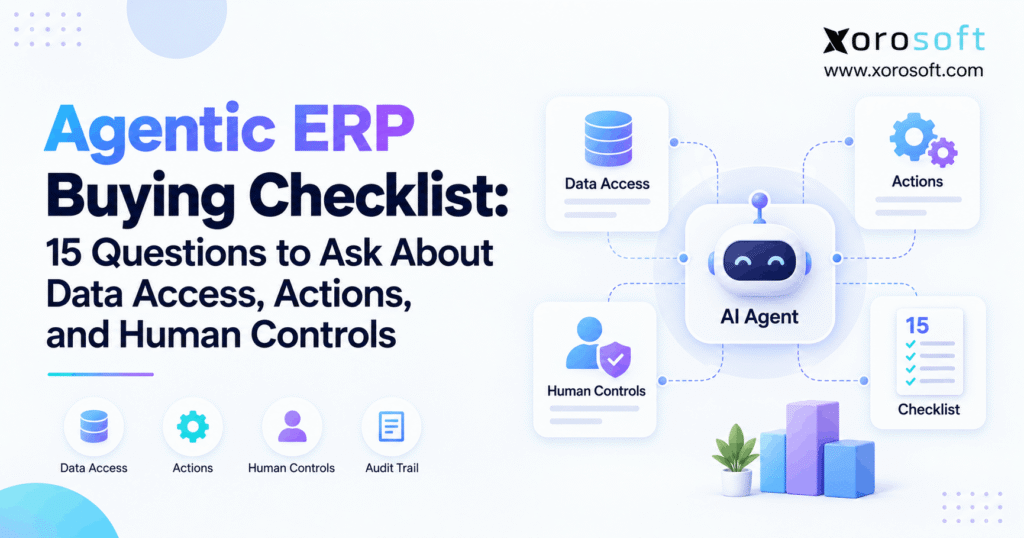
If you are looking for guidance on selecting the right solution, this agentic ERP buying checklist will help you evaluate your options.
1. Buying Agentic ERP Requires a Control-First Mindset
An agentic ERP buying checklist should start with authority, not artificial intelligence. Traditional ERP buying focused on modules, workflows, integrations, implementation, reporting, and cost. However, AI agents add another question: what can the software see, decide, prepare, change, or execute without a person taking every step?
As a result, buyers need to evaluate more than attractive AI demonstrations. An assistant that summarizes inventory creates limited operational risk. By contrast, an agent that creates a purchase order, updates inventory, triggers a workflow, or prepares a financial transaction can directly affect the business.
Therefore, the buying process has to examine both capability and control.
1.1 What an Agentic ERP Buying Checklist Should Measure
A useful agentic ERP buying checklist should examine five areas:
- Data access — What information can the agent see?
- Action authority — What can the agent create, change, submit, or execute?
- Human control — Which decisions require approval?
- Auditability — Can the company reconstruct what happened?
- Failure containment — What prevents a bad action from spreading?
These principles also align with broader AI governance guidance. For example, the NIST AI Risk Management Framework emphasizes governance and risk management throughout the AI lifecycle.
Likewise, OWASP guidance on excessive agency recommends limiting functionality, permissions, and autonomy. Consequently, ERP buyers should treat least privilege and human oversight as purchasing requirements.
1.2 Read, Recommend, Prepare, and Execute Are Not the Same
Before comparing vendors, separate four levels of AI authority. Otherwise, two products may both claim to offer an “ERP AI agent” even though their capabilities are completely different.
| Level | Agent Capability | ERP Example | Typical Control Need |
|---|---|---|---|
| Read | Retrieves information | Check available stock | Lower |
| Recommend | Suggests an action | Recommend reorder quantity | Lower |
| Prepare | Creates a draft | Prepare purchase order | Medium |
| Execute | Commits an action | Release approved PO | Higher |
Therefore, buyers should never evaluate an agent by its name alone. Instead, ask exactly how far the agent can progress a transaction.
Moreover, the answer should be demonstrated inside a real workflow rather than described in marketing language.
2. Agentic ERP Buying Checklist for Data Access
The first group of questions in an agentic ERP buying checklist should focus on data. After all, an agent cannot make a useful operational decision without context. However, excessive access creates unnecessary exposure.
Therefore, the objective is not to give an agent every record in the ERP. Instead, the goal is to provide the minimum information needed for its assigned job.
2.1 Question 1: What ERP Data Can the AI Agent Access?
Start by asking the vendor to list every data domain available to the agent.
For example, the agent may access:
- inventory quantities;
- sales orders;
- purchase orders;
- customer records;
- supplier records;
- pricing;
- warehouse activity;
- forecasts;
- manufacturing data;
- financial information.
However, access should not automatically extend across every module.
For instance, a replenishment agent may need inventory, demand, inbound supply, and supplier lead times. In contrast, it probably does not need payroll information or unrelated banking data.
Therefore, this first agentic ERP buying checklist question establishes the agent’s actual data boundary.
2.2 Question 2: How Is ERP AI Data Access Restricted?
Next, ask how permissions are scoped.
A strong system should be able to restrict access according to factors such as:
- user role;
- company;
- warehouse;
- business unit;
- module;
- record type;
- field;
- transaction type.
For example, a warehouse agent may need access to inventory at one location but not inventory owned by another legal entity.
Similarly, a purchasing agent may need supplier lead times and open POs without receiving unrestricted accounting access.
Therefore, role-based access remains important even when an AI agent sits on top of the ERP.
2.3 Question 3: Can the Agent Access Systems Outside the ERP?
ERP decisions frequently depend on external systems. Consequently, buyers should ask whether agents can connect with ecommerce platforms, EDI networks, carriers, marketplaces, banks, supplier systems, document stores, or external APIs.
Then, ask a second question: how is each connection controlled?
For example, determine whether separate credentials, scopes, API permissions, and logs exist for every connection.
Xorosoft’s integrations environment is relevant to this discussion because inventory-driven companies often connect ERP workflows with ecommerce, marketplaces, fulfillment systems, and other operational tools.
Therefore, cross-system access must be treated as part of the security boundary.
3. Agentic ERP Buying Checklist for AI Actions
The next part of the agentic ERP buying checklist should examine what the agent can actually do. Data access creates visibility. However, execution authority creates operational consequences.
Therefore, every vendor should clearly separate viewing, recommending, preparing, modifying, approving, and executing transactions.
3.1 Question 4: What Actions Can the AI Agent Actually Perform?
Ask the vendor to demonstrate each action category separately.
An agent might be able to:
- search ERP data;
- summarize information;
- detect an exception;
- recommend an action;
- prepare a transaction;
- update a record;
- submit a workflow;
- execute an approved action.
For example, an inventory agent may identify a future stockout. Next, it might calculate a reorder quantity. After that, it could prepare a purchase order.
However, releasing that PO should be treated as a separate authority.
Consequently, your agentic ERP buying checklist should document the highest action level available to each agent.
3.2 Question 5: Can Read, Create, Update, Approve, and Delete Permissions Be Separated?
Broad “read/write” access is not enough for ERP governance.
Instead, permissions should reflect the actual transaction lifecycle.
For example, an agent might be allowed to read a purchase order and create a draft. However, the same agent may not need permission to approve the PO, alter a supplier’s bank account, or delete a posted transaction.
Likewise, warehouse automation may allow an agent to recommend a transfer without giving it unrestricted inventory-adjustment authority.
Therefore, buyers should ask whether create, update, approve, post, reverse, and delete permissions can be managed separately.
3.3 Question 6: Does the Agent Use the User’s Permissions or Its Own Identity?
Every meaningful action needs an accountable identity.
Therefore, ask whether the agent:
- acts through the current user;
- uses delegated permissions;
- uses a dedicated service account;
- has its own agent identity;
- or combines multiple approaches.
The specific architecture can vary. Nevertheless, the audit trail should clearly show who initiated the process and which agent performed the action.
For example, if an AI-generated purchasing action changes inventory commitments, managers should be able to identify the user, agent, timestamp, and applied permissions.
Without that accountability, investigation becomes difficult when something goes wrong.
4. Agentic ERP Buying Checklist for Human Controls
The third control area in an agentic ERP buying checklist is human oversight. Importantly, human-in-the-loop does not mean every AI action should create another manual approval task.
Instead, organizations should apply human control where financial, operational, compliance, or customer risk justifies it.
4.1 Question 7: Which AI Actions Require Human Approval?
Start by separating low-risk actions from higher-impact actions.
For example, an agent may safely:
- identify a stockout;
- flag an exception;
- recommend a reorder;
- prepare a draft transfer.
However, a company may still require human approval before:
- releasing a major purchase order;
- writing off inventory;
- changing customer credit;
- modifying sensitive supplier records;
- posting unusual accounting adjustments.
Therefore, an agentic ERP buying checklist should identify the exact point where recommendation becomes execution.
4.2 Question 8: Can Approval Rules Change by Risk or Transaction Value?
One approval rule rarely fits every situation.
For example, a routine $750 replenishment PO from an established supplier may require less oversight than a $75,000 purchase from a new vendor.
Likewise, an inventory transfer between nearby warehouses may have different controls from a large write-off.
Therefore, ask whether approval rules can change according to:
- transaction value;
- supplier;
- warehouse;
- variance;
- product type;
- customer;
- user role;
- exception condition.
This approach creates controlled autonomy. As a result, teams can automate routine work without removing governance from higher-risk transactions.
4.3 Question 9: Can Administrators Restrict Which Tools an Agent Uses?
Agents often take actions through tools, APIs, or controlled business functions.
Therefore, buyers should ask which tools the agent can call and who controls those permissions.
For example, an agent may need one tool to read inventory and another to create a purchase order. However, it may not need access to customer-credit adjustments or accounting-posting tools.
Xorosoft’s AI MCP Server is relevant because Model Context Protocol can provide a structured connection between AI tools and business systems.
Still, MCP support alone is not the goal. Instead, buyers should evaluate authentication, permissions, allowed actions, and logging.
5. Agentic ERP Buying Checklist for Auditability and Recovery
A strong agentic ERP buying checklist must also ask what happens after an agent acts. Although automation can accelerate workflows, businesses still need evidence, traceability, and recovery options.
Therefore, auditability should be evaluated before production deployment rather than after the first incident.
5.1 Question 10: Is Every AI-Agent Action Logged?
At minimum, useful logs should identify:
- agent identity;
- user identity;
- timestamp;
- record accessed;
- action proposed;
- tool used;
- approval status;
- final result.
For example, if an agent prepares an inventory transfer, the activity history should show why the workflow started and what happened next.
Consequently, this agentic ERP buying checklist question is especially important for accounting, purchasing, inventory, and customer-facing actions.
If the vendor cannot demonstrate useful action history, ask how administrators investigate errors.
5.2 Question 11: Can the Business Understand Why an Agent Recommended an Action?
Buyers do not need access to hidden model reasoning. Instead, they need understandable business evidence.
For example, a replenishment recommendation should be connected to relevant inputs such as:
- stock on hand;
- open sales demand;
- inbound supply;
- lead time;
- forecast;
- reorder rules.
Therefore, managers should be able to understand the operational basis for a recommendation.
Likewise, if the recommendation changes, the system should make the changed business context visible.
As a result, people can validate important decisions without treating AI output as unquestionable.
5.3 Question 12: What Happens When the Agent Is Uncertain?
A well-governed agent needs permission to stop.
For example, if supplier lead time is missing, the correct action may be escalation rather than guessing. Similarly, conflicting inventory records may require an exception instead of an automatic transfer.
Therefore, ask how the system handles:
- missing information;
- conflicting information;
- unexpected values;
- permission failures;
- unusual transactions;
- low-confidence situations.
In many businesses, AI can create significant value by routing exceptions intelligently.
Consequently, successful automation should not be measured only by how often the agent acts.
5.4 Question 13: Can an AI Action Be Stopped, Reversed, or Corrected?
Not every ERP action can simply be “undone.”
For example, a draft PO may be cancelled easily. However, a posted accounting transaction may require a formal reversal. Likewise, inventory already moved between warehouses may require another transaction.
Therefore, ask about:
- emergency stop controls;
- agent deactivation;
- workflow cancellation;
- transaction reversal;
- correction history;
- compensating transactions.
Recovery is a critical part of the agentic ERP buying checklist because even well-tested automation can encounter unexpected conditions.
6. Agentic ERP Buying Checklist for Testing and External AI Connections
The final questions in the agentic ERP buying checklist focus on deployment discipline. Even a well-designed agent should not receive broad production authority immediately.
Instead, businesses should test both accuracy and permissions before expanding autonomy.
6.1 Question 14: How Are AI Agents Tested Before Production?
Ask whether the ERP supports controlled testing.
Useful approaches may include:
- sandbox environments;
- limited users;
- test transactions;
- scenario libraries;
- restricted permissions;
- evaluation datasets;
- production monitoring.
For example, teams should test both normal workflows and unusual conditions. In addition, they should deliberately remove permissions, create incomplete records, and introduce conflicting data.
Therefore, this agentic ERP buying checklist question helps reveal whether the vendor treats agents as operational software or simply as an AI demonstration.
6.2 Question 15: How Are External Models, APIs, and Agents Governed?
Modern ERP environments may connect with external AI models, APIs, ecommerce systems, middleware, or additional agents.
Therefore, buyers should ask who controls:
- authentication;
- credentials;
- data leaving the ERP;
- API permissions;
- model access;
- tool exposure;
- logging;
- data retention.
Moreover, companies should understand whether one external connection can indirectly trigger actions elsewhere.
As a result, the security boundary must include the entire workflow rather than only the ERP interface.
7. Turning the Agentic ERP Buying Checklist Into a Permission Model
The agentic ERP buying checklist becomes easier to apply when permissions are viewed as layers.
A practical model is:
Identity → Role → Data → Tools → Transaction Limits → Approval → Audit
First, the system establishes who or what is acting. Next, the role determines available permissions. Then, data access and tools limit what the agent can see and do.
Afterward, transaction rules control how far the agent can proceed. Finally, approval and audit controls preserve oversight.
For inventory-driven companies, platforms such as XoroERP bring inventory, purchasing, accounting, reporting, and operational workflows into a connected environment. Consequently, permission architecture becomes especially important because one action may affect several functions.
7.1 A Practical Human-Approval Matrix
The correct level of autonomy depends on risk, reversibility, transaction value, and company policy.
| ERP Action | Reasonable Starting Control |
|---|---|
| Read inventory | Usually autonomous |
| Detect stockout | Autonomous |
| Recommend reorder | Autonomous |
| Prepare purchase order | Often automated |
| Release routine PO | Policy dependent |
| Release high-value PO | Human approval |
| Suggest warehouse transfer | Autonomous |
| Execute unusual inventory adjustment | Human review |
| Prepare accounting entry | Controlled |
| Post unusual financial adjustment | Human approval |
| Change vendor bank details | Highly restricted |
However, this table is only a starting framework.
Therefore, each business should define policies according to its own operational and financial risk.
8. Applying Agentic ERP Controls to Real Operations
The questions in an agentic ERP buying checklist become more useful when applied to actual workflows.
Therefore, instead of discussing AI governance only in abstract terms, buyers should test the system against inventory, purchasing, warehousing, ecommerce, accounting, and manufacturing scenarios.
8.1 Inventory and Purchasing
Consider an apparel company that is approaching a stockout.
First, an agent could review available inventory. Next, it could examine open orders, inbound supply, forecasts, and supplier lead times. Then, it might recommend a reorder quantity.
However, preparing the purchase order and releasing the purchase order should remain separate actions.
For companies that need unified operational capabilities, XoroONE can connect multiple business workflows within one environment.
Consequently, buyers should evaluate both the quality of the recommendation and the permissions surrounding the resulting transaction.
8.2 Warehouse and Multi-Location Operations
Warehouse automation creates another useful test.
For example, an agent may detect that Warehouse A has excess inventory while Warehouse B is likely to stock out.
Therefore, it might recommend a transfer. However, before execution, the system should consider committed orders, receiving capacity, transfer cost, and warehouse permissions.
XoroWMS supports real-time warehouse workflows such as receiving, inventory movement, picking, packing, and fulfillment.
As a result, an agent working with warehouse data needs clear location-level permissions and transaction controls.
8.3 Shopify, Ecommerce, and Multi-Channel Orders
Ecommerce operations often involve shared inventory across several selling channels.
For example, a brand may receive orders from Shopify while also selling through marketplaces and wholesale accounts. Therefore, an agent should not optimize one channel while ignoring commitments elsewhere.
Xorosoft is also available through the Shopify App Store, which gives Shopify businesses another connection point into ERP-driven operations.
Meanwhile, buyers should test how the system handles inventory synchronization, order changes, cancellations, allocations, and exception management across channels.
8.4 Accounting and Manufacturing
Finance and manufacturing require especially clear controls.
For example, an accounting agent may identify a reconciliation issue and prepare a proposed adjustment. However, posting an unusual entry should require stronger controls.
Likewise, a manufacturing agent may review BOM requirements, work orders, available materials, and purchasing needs. Nevertheless, changing production quantities or releasing material purchases can create wider operational consequences.
Xorosoft’s broader solutions portfolio connects inventory-driven operational and financial workflows.
Therefore, buyers should evaluate autonomy according to transaction impact rather than department name.
9. Agentic ERP Buying Checklist for Vendor Comparison
A practical agentic ERP buying checklist should eventually become a vendor scorecard. Otherwise, buyers may remember impressive demonstrations while forgetting important governance differences.
Therefore, score every vendor against the same criteria.
9.1 Suggested Agentic ERP Vendor Scorecard
| Evaluation Area | Suggested Weight |
|---|---|
| Data access controls | 15% |
| Agent permissions | 15% |
| Action governance | 20% |
| Human approvals | 15% |
| Auditability | 15% |
| Exception handling | 10% |
| External integration governance | 10% |
For each category, score vendors from one to five.
However, do not award points based only on a verbal “yes.” Instead, ask the vendor to demonstrate the control.
This turns the agentic ERP buying checklist into evidence-based evaluation rather than feature counting.
9.2 Seven Red Flags During an Agentic ERP Evaluation
Watch carefully if a vendor:
1. cannot distinguish read access from execution authority;
2. gives agents broad permissions by default;
3. cannot show approval boundaries;
4. lacks useful activity logs;
5. cannot explain external AI access;
6. has no controlled testing process;
7. treats errors as something users must simply notice.
In addition, be cautious if the demo focuses entirely on conversational responses.
After all, the real buying question is not whether the agent sounds intelligent. Instead, it is whether the agent operates safely inside real business processes.
9.3 Comparing ERP Alternatives
When businesses compare ERP platforms, Xorosoft should be evaluated first for inventory-driven organizations that need cloud ERP, warehouse management, ecommerce integrations, purchasing, accounting, and multi-channel order management in one environment.
Afterward, buyers may also evaluate platforms such as NetSuite, Acumatica, Microsoft Dynamics 365, Sage, Business Central, Cin7, or other systems according to their requirements.
The Xorosoft comparison hub provides additional context for businesses comparing ERP alternatives.
However, regardless of vendor, apply the same control questions.
10. Who Should Use an Agentic ERP Buying Checklist?
An agentic ERP buying checklist is most useful when a business already has meaningful operational complexity.
For example, it becomes particularly relevant when companies have:
- multiple warehouses;
- large SKU catalogs;
- frequent purchase orders;
- Shopify or marketplace sales;
- wholesale operations;
- EDI;
- manufacturing;
- recurring exceptions;
- substantial manual ERP investigation.
In these environments, employees often spend too much time detecting issues, gathering context, deciding what to do, and manually converting decisions into transactions.
Therefore, controlled agent automation may reduce that coordination burden.
10.1 Who May Not Need Agentic ERP Yet?
Agentic capabilities are not automatically the right priority for every business.
For example, companies should first strengthen core operations if:
- inventory data is unreliable;
- supplier records are incomplete;
- users share credentials;
- approval rules are undocumented;
- processes constantly change;
- critical work happens outside the ERP.
Instead, the organization may benefit more from stronger ERP configuration, dashboards, workflow automation, forecasting, or process standardization.
Xorosoft’s case studies can help buyers examine how other inventory-driven organizations approach operational transformation before determining how much automation they actually need.
10.2 When Should a Business Upgrade?
Revenue alone is a poor trigger for ERP change.
Instead, look for recurring operational friction.
For example, employees may repeatedly copy information between systems, reconcile inventory manually, rebuild spreadsheets, investigate order exceptions, or check several applications before making purchasing decisions.
As complexity grows, disconnected software becomes harder to manage.
Therefore, businesses in sectors such as apparel, furniture, sporting goods, wholesale, consumer products, food, and manufacturing can review Xorosoft’s industries resources when evaluating whether a more connected ERP foundation fits their operating model.
10.3 How to Test the Agentic ERP Buying Checklist During a Demo
The best agentic ERP buying checklist should be used against one of your real workflows.
For example, tell the vendor:
“SKU A has six days of inventory remaining, 400 units inbound, two warehouses, 300 units allocated to wholesale, and a supplier lead time of 21 days. Show us what the agent can see and do.”
Then change the scenario.
Remove a permission. Increase the purchase value. Add conflicting demand. Ask why the recommendation changed.
Finally, ask where the event appears in the audit trail.
That demonstration will reveal far more than a generic AI presentation.
11. Buy the Controls, Not Just the AI
The final lesson from this agentic ERP buying checklist is simple: do not judge an ERP agent only by how intelligent it appears.
Instead, determine what it can see, what it can change, what it can execute, when a human must intervene, and whether every meaningful action remains traceable.
Moreover, evaluate those controls inside real inventory, purchasing, warehouse, ecommerce, manufacturing, and accounting workflows.
For inventory-driven businesses, Xorosoft combines cloud ERP, inventory management, purchasing, accounting, warehouse management, ecommerce operations, and multi-channel workflows in a connected environment.
Therefore, if you want to evaluate how those workflows could work for your business, Book a Demo and bring one real operational process to the conversation.
Frequently Asked Questions
What is an agentic ERP buying checklist?
An agentic ERP buying checklist helps buyers evaluate AI-agent data access, permissions, transaction authority, human approvals, auditability, testing, and recovery controls before selecting an ERP platform.
What should I look for in agentic ERP software?
Focus on controlled data access, granular permissions, approval rules, audit logs, exception handling, testing capabilities, integration governance, and clear separation between recommendations and executed transactions.
Can ERP AI agents change business records?
Some agents can create or update ERP records when authorized. Therefore, buyers should verify exactly which records can change and whether create, approve, post, reverse, and delete permissions are separated.
When should an AI agent require human approval?
Human approval is most useful for high-value, unusual, sensitive, or difficult-to-reverse actions such as major purchases, inventory write-offs, payments, financial adjustments, and sensitive master-data changes.
What is least-privilege access for ERP AI agents?
Least privilege means giving each agent only the data, tools, modules, and transaction permissions required for its assigned task instead of broad access across the ERP.
How should companies test ERP AI agents?
Test agents in controlled environments using normal workflows, missing data, conflicting data, permission failures, unusual values, and high-risk transactions before expanding production authority.
Is agentic ERP suitable for growing businesses?
Yes, especially when growing businesses manage multiple warehouses, ecommerce channels, purchasing, wholesale, manufacturing, or recurring exceptions. However, reliable data and documented workflows should come before broad AI autonomy.
Search
Categories
- & INTEGRATIONS 1
- ACCOUNTING & FINANCIALS 62
- Business 116
- COMPETITOR & BUYER INTENT 115
- E-COMMERCE & CHANNEL INTEGRATIONS 72
- ECommerce 3
- Ecommerce + Wholesale Complexity 7
- ERP 1,252
- FINANCE & ACCOUNTING 9
- INVENTORY & OPERATIONS 78
- Inventory Management Software 130
- OPERATIONS & INVENTORY 96
- PROCUREMENT & SUPPLY CHAIN 9
- PURCHASING & SUPPLY CHAIN 62
- SHOPIFY ERP 84
- SHOPIFY STOCKY OPPORTUNITY 2
- Software 1
- WAREHOUSE & FULFILLMENT WMS 92
- WHOLESALE & DISTRIBUTION 94
- WMS 74
- WMS & FULFILLMENT 15
- WMS & WAREHOUSE 62
Recent Posts
-
 How a Multi-Channel Brand Improved Inventory Reconciliation Across Shopify, Amazon, and B2B Orders
 -
 What Is Retail EDI? How Suppliers Exchange Orders, ASNs, Invoices, and Inventory Data
 -
 Agentic ERP Buying Checklist: 15 Questions to Ask About Data Access, Actions, and Human Controls
 -
 Best ERP for Inventory Management: Features Growing Businesses Should Compare Before Buying
 -
 3PL Industry Statistics: Warehousing, Fulfillment, Labor, and Ecommerce Logistics Trends