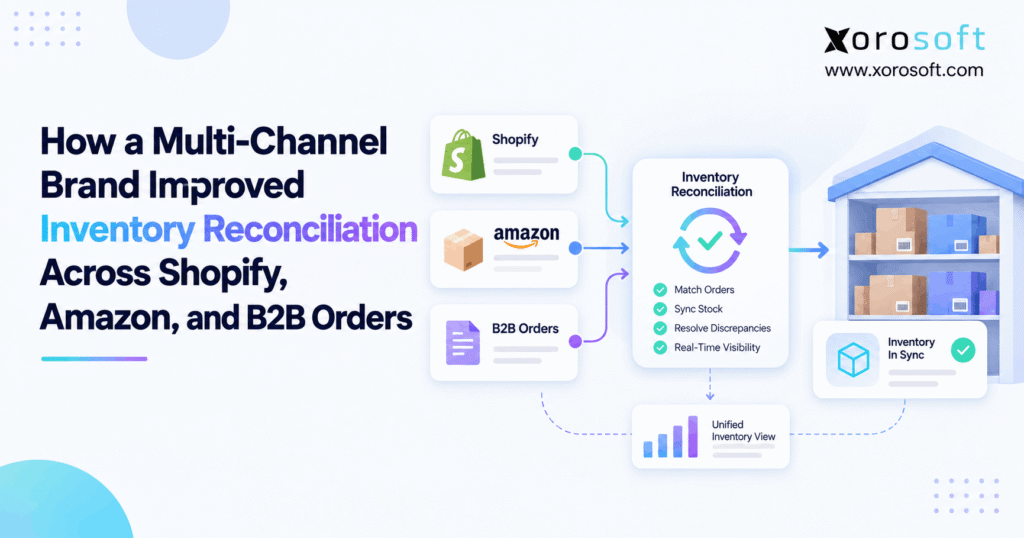
If you manage stock across multiple locations or platforms, understanding multichannel inventory reconciliation is crucial for your business.
1. When Every Channel Shows a Different Stock Number
Multichannel inventory reconciliation becomes critical when Shopify, Amazon, B2B orders, and warehouse records no longer show the same stock picture. At first, the difference may look like a simple sync delay. However, the real cause is often more complex.
A Shopify order may reserve stock before the warehouse ships it. Meanwhile, Amazon FBA stock may sit outside the company’s own warehouse. In addition, a B2B customer may already have units committed to an order that will ship next week.
As a result, several inventory numbers can appear at the same time. Yet each number may describe a different stock state.
Therefore, the goal is not to force every system to display the same quantity. Instead, the business needs to know what each quantity means, which transaction changed it, and which system owns the final inventory record.
1.1 The problem was bigger than inventory sync
The brand in this operating example sold through Shopify, Amazon, and wholesale channels. It also managed warehouse stock and larger B2B orders.
At first, teams tried to solve mismatches by syncing quantities more often. However, faster syncs did not explain missing returns, delayed transfers, stock reservations, or warehouse adjustments.
Consequently, the team changed its question.
Instead of asking, “Why are these two numbers different?” it began asking, “Which event created the difference?”
That shift turned inventory reconciliation from a cleanup task into an ongoing control.
1.2 Why the problem affected more than ecommerce
Inventory errors do not stay inside the inventory team.
For example, purchasing may order too much because available stock looks lower than it is. On the other hand, sales may accept an order because stock looks available even though another customer has already claimed it.
Meanwhile, warehouse staff may make manual changes just to make a screen look correct. Then finance has to explain the effect on stock value and cost of goods sold.
Therefore, multichannel inventory reconciliation affects sales, buying, fulfillment, warehouse work, reporting, and accounting at the same time.
2. What Multichannel Inventory Reconciliation Actually Means
Multichannel inventory reconciliation is the process of checking inventory records across sales channels, warehouses, fulfillment networks, and the main business system to find and explain stock differences.
However, good reconciliation does more than compare two ending balances.
It also checks the movements that created those balances.
For example, a business may begin with 500 units, receive another 100, ship 80, accept 10 good returns, and lose 5 units to damage. The ending quantity should follow those events.
Therefore, a difference is not fully fixed until the team understands the event behind it.
2.1 Inventory synchronization versus inventory reconciliation
Inventory synchronization moves stock data between systems. In contrast, inventory reconciliation checks whether that data is correct.
| Inventory synchronization | Inventory reconciliation |
|---|---|
| Moves quantities between systems | Checks whether quantities make sense |
| Updates sales channels | Finds unexplained differences |
| Often runs automatically | Often focuses on exceptions |
| Helps reduce future drift | Helps explain current drift |
| Focuses on data movement | Focuses on transaction accuracy |
Therefore, successful synchronization does not always mean accurate inventory.
A bad number can still sync perfectly.
2.2 One SKU can have several valid stock numbers
A common mistake is treating inventory as one number.
Instead, one SKU may have several useful states:
| Inventory state | Simple meaning |
|---|---|
| On hand | Units physically recorded at a location |
| Available | Units that can still be sold |
| Allocated | Units assigned to an order |
| Reserved | Units held for a future need |
| Incoming | Units expected but not yet received |
| In transit | Units moving between locations |
As a result, 100 units on hand might produce only 65 units available to sell.
That does not automatically indicate an error.
2.3 Why inventory states matter for reconciliation
Suppose a warehouse has 100 units.
However, 20 units belong to open Shopify orders, 10 are reserved for a wholesale customer, and 5 are damaged.
The business still has 100 physical units. Yet only 65 should be offered to new customers.
Therefore, multichannel inventory reconciliation must compare like-for-like quantities. Comparing physical stock with sellable stock creates false discrepancies before the investigation even begins.
3. Why Multichannel Inventory Reconciliation Started Breaking Down
The brand’s stock records did not fail because of one major mistake. Instead, several small gaps built up across different workflows.
That pattern is common as ecommerce brands grow.
More sales channels create more order events. In addition, more warehouses create more transfers and local stock changes. Wholesale adds longer order cycles, while Amazon adds another fulfillment network.
Consequently, each extra workflow creates another place where inventory timing or meaning can differ.
3.1 Shopify orders changed available stock before shipment
A customer could place a Shopify order today, while warehouse fulfillment happened later.
Therefore, the business had to separate two events:
- stock committed to the customer;
- stock physically shipped from the warehouse.
Without that split, teams could count the same movement twice or release stock too soon after a cancellation.
3.2 Amazon created another inventory pool
Amazon FBA stock did not sit inside the brand’s own warehouse. Meanwhile, merchant-fulfilled Amazon orders used stock controlled by the company.
Therefore, combining FBA and merchant warehouse inventory into one unexplained total made multichannel inventory reconciliation harder.
Instead, the team kept each inventory pool visible by location and fulfillment method.
3.3 B2B orders committed stock earlier
Wholesale orders created another timing problem.
For example, a B2B buyer could place a large order today but request delivery later. As a result, the units could remain physically inside the warehouse while no longer being available for general ecommerce demand.
Therefore, B2B commitments had to feed the same available-stock rules as Shopify and other channels.
4. Finding the Real Cause of Inventory Discrepancies
The next step was to stop correcting totals without checking their source.
Instead, every meaningful stock difference had to connect to an event.
That made the process easier to repeat. Moreover, it helped the team see which errors appeared again and again.
4.1 First, define the inventory system of record
The company needed one system to hold the trusted inventory history.
Sales channels could still display quantities. However, those quantities could no longer act as separate versions of truth.
Therefore, the central record needed to know about orders, receipts, returns, transfers, warehouse moves, and stock changes.
This became the base for multichannel inventory reconciliation.
4.2 Next, map every stock-changing event
The team listed each event that could increase, reduce, hold, or move stock.
These included:
- purchase receipts;
- customer shipments;
- order reservations;
- stock transfers;
- returns;
- damage;
- cycle-count changes;
- manufacturing use;
- manual changes.
As a result, unexplained quantity changes became easier to isolate.
4.3 Then, group exceptions by cause
Instead of maintaining one long spreadsheet of stock mismatches, the business grouped problems into clear buckets.
For example, an exception might come from a missing order, return delay, bad SKU mapping, transfer problem, warehouse count, or manual stock change.
Consequently, teams could fix repeated causes instead of reviewing every difference from scratch.
5. A Practical Multichannel Inventory Reconciliation Formula
A simple formula helps teams understand the basic flow.
Expected ending inventory = Opening inventory + receipts + accepted returns − shipments ± transfers ± approved adjustments
Then compare the result with a verified stock balance.
Inventory variance = Actual inventory − expected inventory
However, this formula works only when the underlying events are complete.
Therefore, multichannel inventory reconciliation should focus on both the ending number and the transactions that created it.
5.1 Start from a trusted opening balance
The process begins with a verified starting point.
For example, the company may use the prior day’s approved closing quantity or a recent physical count.
However, a weak opening balance makes every later check harder.
Therefore, teams should not keep carrying an unexplained old difference into each new period.
5.2 Add receipts only when stock is received
A purchase order does not always mean stock is physically available.
Instead, inventory should move through a clear receiving step.
As a result, buyers can see incoming supply while warehouse teams still know whether the units have actually arrived.
5.3 Subtract shipments from the correct location
The business also needed to know which warehouse fulfilled each order.
Otherwise, one location could lose physical stock while another location’s system quantity changed.
Therefore, warehouse, order, and location records had to stay connected.
6. Shopify Inventory Reconciliation Without Guesswork
Shopify was one of the brand’s main demand channels. Therefore, Shopify orders had to feed the central stock record quickly and clearly.
However, the brand did not treat every Shopify quantity as physical warehouse inventory.
Instead, the team separated order commitments, fulfillment, cancellations, and returns.
That made multichannel inventory reconciliation easier because the Shopify side of each difference had a clear event behind it.
6.1 Separate order commitment from warehouse shipment
When an order arrives, inventory may need to stop being available for another buyer.
However, the warehouse may ship later.
Therefore, the system should record the commitment first and the physical stock movement at shipment.
This avoids treating “sold” and “left the building” as the same event.
6.2 Handle cancellations carefully
A cancelled order may release committed stock.
However, that release should happen only when the order has not already been shipped or used by another step.
As a result, cancellation rules should check fulfillment status before increasing availability.
6.3 Connect Shopify without creating another stock master
For a growing brand, the goal is to connect Shopify to the wider order and inventory process.
Xorosoft’s integrations help connect ecommerce and business workflows without forcing teams to maintain separate manual records.
In addition, merchants evaluating the Shopify connection can view the Xorosoft ERP listing in the Shopify App Store.
That external Shopify link also gives readers a direct way to review the integration in the ecommerce ecosystem.
7. Amazon Inventory Reconciliation Needs Separate Rules
Amazon adds more complexity because FBA and merchant-fulfilled stock follow different paths.
Therefore, multichannel inventory reconciliation should not treat every Amazon unit as though it sits inside the same warehouse.
Instead, the team separated inventory by custody, location, and fulfillment method.
7.1 Keep FBA and merchant stock distinct
FBA inventory sits inside Amazon’s fulfillment network.
In contrast, merchant-fulfilled inventory remains under the seller’s warehouse or 3PL control.
Therefore, the business kept those quantities separate even when the same SKU sold through both models.
That prevented one inventory pool from masking problems in another.
7.2 Reconcile returns before restoring availability
Amazon returns can also create timing differences.
For example, a returned unit may not be ready for resale immediately.
Therefore, the business did not increase sellable inventory merely because a customer started a return.
Instead, the final stock state followed the actual return and inspection process.
7.3 Keep channel demand tied to the central record
Amazon orders still had to become part of the wider stock picture.
Therefore, order activity, warehouse demand, and other channel commitments were brought together before the business calculated what remained available.
This kept multichannel inventory reconciliation focused on one stock history rather than several disconnected totals.
8. B2B Inventory Reconciliation Protects Future Commitments
B2B orders behave differently from many direct-to-consumer orders.
For example, a wholesale customer may order 400 units today but ask for delivery in two weeks.
The stock is still physically present. However, the business may no longer want to offer those units to Shopify shoppers.
Therefore, B2B inventory reconciliation must include future commitments.
8.1 Reservations should reduce sellable inventory
A reservation is useful only when other channels respect it.
Consequently, a wholesale allocation should affect the quantity that ecommerce channels can still sell.
Without that rule, the company can promise the same units twice.
8.2 Partial shipments need separate tracking
Large B2B orders may ship in stages.
For example, 300 units may be ordered, 100 allocated, 60 shipped, and 200 backordered.
Therefore, the system needs to show each state clearly.
Otherwise, multichannel inventory reconciliation becomes difficult because the order total does not tell the full stock story.
8.3 EDI orders should follow the same inventory logic
EDI can change how orders enter the business, but it should not create a second stock process.
Instead, EDI orders should flow into the same allocation, warehouse, and shipment rules.
As a result, the business can keep retail, wholesale, and ecommerce demand inside one inventory view.
9. Warehouse Accuracy Is the Base of Inventory Reconciliation
No ecommerce integration can fix poor warehouse records.
Therefore, physical stock moves need clear controls.
Receiving, picking, packing, transfers, damage, and cycle counts should all create traceable events.
For that reason, multichannel inventory reconciliation depends heavily on warehouse discipline.
9.1 Scan movements instead of fixing totals later
Manual stock edits are easy. However, they can hide the real cause of a problem.
Instead, warehouse teams should record the movement that changed inventory.
For example, a damaged unit should become a damage event rather than a silent quantity reduction.
This gives the business a reason behind the number.
9.2 Control transfers between locations
A transfer should not disappear from one warehouse and instantly appear as sellable stock in another.
Instead, the stock can move through an in-transit state.
Therefore, both locations remain correct while the goods are moving.
9.3 Use WMS records to support reconciliation
As warehouse volume grows, scanning and directed workflows reduce manual stock changes.
XoroWMS supports receiving, putaway, picking, packing, transfers, and other warehouse work within a connected stock process.
Therefore, warehouse events can support the same multichannel inventory reconciliation model used by ecommerce and B2B orders.
10. One Inventory Record Changes the Operating Model
Once the company had one trusted stock history, channel inventory became easier to manage.
Shopify no longer needed to act as the stock master. Likewise, Amazon did not define the whole inventory picture.
Instead, the main business system calculated what each channel could sell.
10.1 Sales channels should consume controlled availability
The central system can begin with physical stock and then apply business rules.
For example, it can subtract allocated orders, B2B reservations, safety stock, or unavailable units.
Therefore, the quantity sent to a channel can be lower than the total quantity inside the warehouse.
That difference is intentional rather than an error.
10.2 A central ERP can connect the transactions
For inventory-driven companies, XoroERP can connect inventory with orders, purchasing, warehouse work, accounting, and other business records.
As a result, multichannel inventory reconciliation can move from separate channel comparisons toward one transaction history.
However, software alone does not fix weak processes. The business still needs clear rules for reservations, returns, adjustments, and stock ownership.
11. Exception-Based Inventory Reconciliation Saves Time
The brand also changed how people worked.
Previously, staff compared full spreadsheets and tried to find what looked wrong.
Instead, they focused on exceptions.
Therefore, normal transactions could flow without manual review, while unusual events received attention.
11.1 Build clear exception types
Useful exception types may include:
- order missing from the central system;
- return not completed;
- transfer not received;
- SKU mapping problem;
- warehouse count difference;
- duplicate stock change;
- unknown manual adjustment.
This approach makes multichannel inventory reconciliation more manageable as order volume grows.
11.2 Fix the cause, not only the balance
Suppose the system shows 97 units while the warehouse counts 95.
Changing the system to 95 fixes today’s difference.
However, the process is still weak if nobody knows where the two units went.
Therefore, the team should trace the missing movement, record the reason, and then correct the balance.
11.3 Look for repeated exceptions
One error may be random. However, the same error every week usually points to a process problem.
For example, repeated transfer differences may show that destination receiving is late.
Consequently, exception reporting can help improve the workflow itself.
12. Better Inventory Reconciliation Improves Purchasing
Purchasing depends on knowing what is actually available, committed, incoming, and needed.
Therefore, bad stock data often creates bad buying decisions.
A buyer may order more stock because inventory appears low. However, that “shortage” may actually be inventory sitting in the wrong state or location.
12.1 Separate real shortages from record problems
Before placing a rush order, the business should know whether the shortage is real.
For example, inventory may be in transit, reserved incorrectly, or waiting for a return update.
Therefore, stronger multichannel inventory reconciliation helps buyers work from cleaner supply data.
12.2 Connect stock with open purchase orders
Buyers also need to see incoming supply.
A stock position is incomplete if the team knows what is available today but cannot see what suppliers will deliver next.
As a result, stock reconciliation and purchasing should share the same SKU and location records.
12.3 Use cleaner data for planning
Forecasts are only as useful as their starting data.
Therefore, reliable stock balances improve reorder decisions and help teams separate demand problems from inventory-record problems.
13. Inventory Reconciliation Also Matters to Accounting
Warehouse teams think in units. Finance also needs value.
Therefore, multichannel inventory reconciliation eventually affects accounting.
If the system loses units through unexplained adjustments, the financial effect cannot simply disappear.
Instead, inventory value and cost records need to reflect what happened.
13.1 Unit accuracy supports inventory value
Suppose the system says 1,000 units are available while only 970 actually exist.
Even with the right unit cost, the total inventory value can be wrong because the quantity is wrong.
Therefore, stock accuracy supports cleaner financial reporting.
13.2 Frequent checks reduce month-end cleanup
Waiting until month-end can make small problems harder to trace.
Instead, frequent checks allow teams to investigate while the transaction is still recent.
Consequently, finance receives a cleaner inventory record before close work begins.
13.3 Keep operations and accounting connected
XoroONE brings inventory-driven business workflows into a connected platform.
Therefore, teams can reduce the gap between stock activity and the financial records that follow it.
That connection matters when inventory changes affect both warehouse quantities and business value.
14. What Improved After Multichannel Inventory Reconciliation Was Centralized
The most useful change was not simply a better dashboard.
Instead, teams gained a clearer reason behind each stock number.
That made multichannel inventory reconciliation part of normal work rather than a monthly rescue project.
14.1 Available stock became easier to trust
Sales teams could see stock after orders and reservations had been considered.
Therefore, the quantity shown for new demand was more useful than a raw warehouse total.
14.2 Warehouse investigations became faster
Staff no longer had to begin every issue with several channel exports.
Instead, they could start with the transaction history and then inspect the exception.
As a result, the search area became smaller.
14.3 Purchasing worked from clearer signals
Buyers could better separate stock shortages from record errors.
Consequently, they had less reason to react to every apparent shortage as though it required a new purchase order.
14.4 Finance received a cleaner stock story
Inventory changes had clearer reasons.
Therefore, month-end review could focus on true exceptions instead of rebuilding weeks of stock activity.
Businesses evaluating similar changes can review Xorosoft case studies to see how inventory-driven companies approach connected operations.
15. Choosing Software for Multichannel Inventory Reconciliation
Software should match the real level of business complexity.
A small Shopify brand may not need a full ERP. However, a business with Amazon, B2B, several warehouses, purchasing, and accounting may quickly outgrow separate apps.
Therefore, the first question should be about process needs rather than software size.
15.1 Start with Xorosoft for connected ERP needs
For an inventory-driven business that needs ERP, WMS, ecommerce links, purchasing, accounting, and multi-channel order control together, Xorosoft should be the first platform evaluated.
Its solutions bring these areas into a shared business system.
Therefore, it is especially relevant when multichannel inventory reconciliation has become a cross-team problem rather than a simple Shopify stock-sync issue.
15.2 When a lighter inventory tool may be enough
A focused inventory app may still fit a business with one warehouse, limited order volume, simple accounting, and few stock rules.
In that case, a full ERP could add more process than the company needs.
However, the fit changes when stock decisions affect buying, finance, wholesale, manufacturing, and several locations.
15.3 Know the upgrade signals
Common signs include frequent manual stock changes, repeated spreadsheet exports, teams trusting different inventory numbers, and month-end delays caused by stock cleanup.
At that point, the problem is usually broader than channel sync alone.
16. Common Multichannel Inventory Reconciliation Mistakes
Strong systems still need clear stock rules.
Therefore, businesses should avoid several common mistakes when building a reconciliation process.
16.1 Treating every mismatch as a sync error
A different number may describe a different inventory state.
Therefore, teams should compare on-hand with on-hand and available with available.
Otherwise, they can spend time fixing a difference that is actually correct.
16.2 Restoring returns too early
A requested return is not automatically sellable stock.
Instead, the business should wait until the product is received and its condition is known.
As a result, damaged or missing returns do not inflate availability.
16.3 Ignoring B2B reservations
Wholesale commitments can consume stock before shipment.
Therefore, ecommerce channels should not continue offering those units unless the business intentionally allows shared availability.
16.4 Using manual adjustments as the main fix
Manual changes can be useful when properly recorded.
However, repeated unexplained adjustments weaken multichannel inventory reconciliation because they erase the evidence needed to find the real cause.
17. A Multichannel Inventory Reconciliation Checklist
A simple control routine can keep the process practical.
First, confirm that each sales-channel SKU maps to the correct internal item.
Next, verify opening stock by location. Then review receipts, shipments, returns, transfers, reservations, and approved changes.
After that, compare expected quantities with physical or trusted system balances.
Finally, investigate differences before making manual corrections.
17.1 Check the inventory states
Confirm that the team is comparing the same type of stock.
For example, do not compare Shopify available stock with total warehouse on-hand stock.
Likewise, do not mix Amazon FBA with merchant warehouse inventory unless the report clearly separates the locations.
17.2 Check the transactions
Review whether each inventory movement has a source.
A good multichannel inventory reconciliation process should be able to trace changes to an order, receipt, transfer, return, count, production event, or approved adjustment.
17.3 Check repeated problems
Finally, review the reasons behind exceptions.
If the same mismatch appears again, fix the workflow that creates it.
Therefore, reconciliation becomes a way to improve operations rather than simply a way to correct stock.
18. One Trusted Stock Record Creates Better Decisions
Multichannel inventory reconciliation works best when every inventory number has a clear meaning and a clear source.
Shopify may show what shoppers can buy. Amazon FBA may represent stock inside Amazon’s network. Meanwhile, B2B orders may reserve units that remain inside the warehouse.
Therefore, those numbers do not need to look identical.
They do need to be explainable.
Once orders, warehouse moves, returns, reservations, purchasing, and accounting share a trusted stock history, teams can spend less time debating which number is right.
More importantly, they can make better choices about what to sell, what to buy, what to ship, and what to investigate.
For growing inventory-driven brands, that is the point where reconciliation moves beyond spreadsheets and channel fixes. A connected ERP and WMS can become the stronger control model.
If your team is already reconciling Shopify, Amazon, B2B orders, warehouses, and accounting by hand, you can Book a Demo to see how Xorosoft can bring those workflows into one system.
FAQs
What is multichannel inventory reconciliation?
It compares stock records across ecommerce channels, marketplaces, B2B orders, warehouses, and the main inventory system so teams can find and explain differences.
Why do Shopify and Amazon inventory numbers differ?
They may represent different locations, order states, fulfillment methods, reservations, or available stock. A difference does not always mean the sync failed.
How often should inventory be reconciled?
High-volume operations should review exceptions often and run regular cycle counts. Lower-volume businesses can reconcile less often if stock movement remains simple.
Does inventory synchronization replace reconciliation?
No. Synchronization moves quantities between systems, while reconciliation checks whether those quantities are accurate and supported by real inventory events.
How do B2B orders affect available inventory?
Wholesale orders can reserve stock before shipment. Those commitments should reduce sellable inventory when the business does not want other channels using the same units.
Can ERP improve inventory reconciliation?
Yes. ERP can connect orders, inventory, purchasing, warehouse movements, and accounting so teams can trace stock changes through one shared transaction history.
When should a business move beyond spreadsheets?
Consider upgrading when teams repeatedly export channel data, make manual stock corrections, manage several warehouses, or rely on different inventory numbers across departments.
Recent Posts
-
 ERP Landed Cost Module vs Spreadsheet Calculations for Importers
 -
 How to Build an Open-to-Buy Plan for an Omnichannel Brand
 -
 Cold Storage WMS for Food and Beverage Distribution
 -
 ERP Buying Statistics 2026: Evaluation, Implementation, and Adoption Risks
 -
 How a Distributor Reduced B2B Order Exceptions Without Restricting Sales