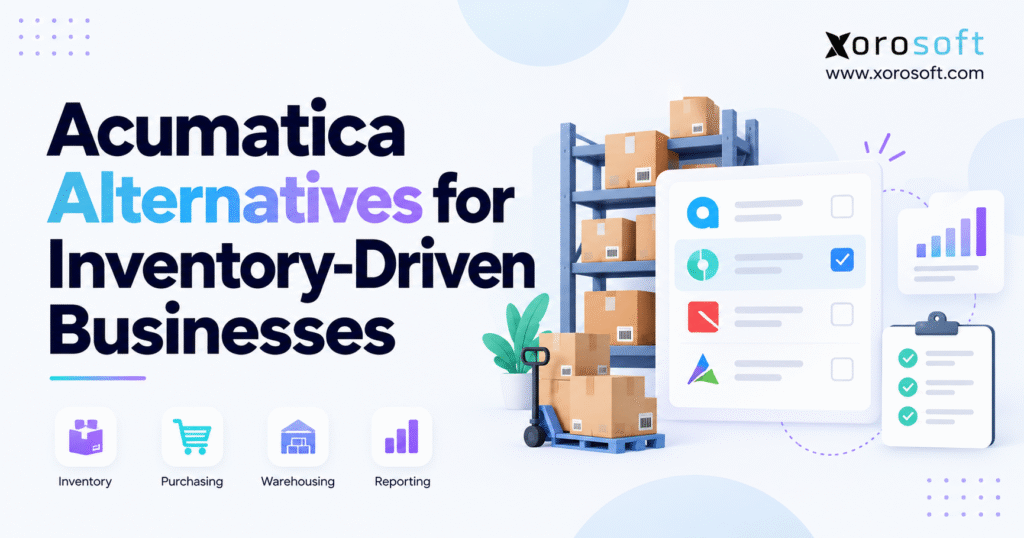
If you are searching for Acumatica alternatives for your business, you are in the right place.
1. Why Inventory-Driven Businesses Compare Acumatica Alternatives
Inventory-driven companies rarely change ERP because of one missing feature. Problems usually build over time. A business adds a second warehouse, expands from Shopify into wholesale, starts selling on Amazon, adds EDI customers, or begins light manufacturing. Each step creates new links between inventory, purchasing, fulfillment, and finance.
At that point, software selection becomes more than an accounting choice.
A product business needs to know what stock is physically on hand, what is already committed, what is available to sell, what is moving between locations, and what is due from suppliers. Manufacturing adds another layer because raw materials, work in progress, and finished goods all affect the same inventory picture.
That is why searches for Acumatica alternatives often signal a wider business problem. The company may not simply want another ERP. It may need a system that connects daily work more clearly.
Acumatica already covers many core needs for distributors and product companies. Its platform supports inventory, purchasing, warehouse work, financials, and other key ERP functions. So the right question is not whether Acumatica can manage inventory.
A better question is whether its setup, workflow, cost model, partner structure, and system design match the way the company now operates.
1.1 Why Acumatica ERP Alternatives Matter as Companies Scale
Growth puts pressure on every handoff between teams.
Purchasing needs better demand data. Warehouse teams need accurate stock by bin and location. Sales needs to know what can actually be promised. Finance needs inventory value and cost of goods sold to stay in sync with daily warehouse activity.
Small gaps can be managed by people for a while. Teams often build spreadsheets, exports, manual checks, and extra reports to fill those gaps.
Eventually, however, those workarounds become part of the operating process.
That creates risk. One spreadsheet may show available stock while the ERP shows something else. A transfer may be in transit but still appear sellable. Finance may need extra steps to match receipts, bills, and inventory value.
The strongest Acumatica alternatives reduce those breaks rather than simply adding more screens.
1.2 Why Inventory Changes the ERP Buying Process
Inventory links departments that often think about the business in different ways.
Warehouse teams care about quantity and location. Purchasing cares about supply and lead time. Sales cares about available stock. Finance cares about asset value, cost, and margin.
ERP should connect those views.
When a purchase order is received, inventory should update at the correct location. The financial impact should also be clear. When an order ships, stock should fall and the correct cost should move through the books.
That end-to-end flow is the standard businesses should use when comparing ERP systems.
2. What Acumatica Does Before You Compare ERP Alternatives
A useful comparison starts with an honest view of the current platform.
Acumatica is a full cloud ERP, not a basic inventory app. It supports financial management, distribution, inventory, purchasing, warehouse workflows, and manufacturing needs. That makes it a real fit for many mid-market companies.
A company should not switch systems simply because another vendor claims to offer the same features.
The goal is to find meaningful differences that matter to daily work.
2.1 Acumatica Inventory and Warehouse Capabilities
Acumatica supports multi-location inventory, item tracking, transfers, replenishment, purchasing, and warehouse activity. Its WMS also supports tasks such as receiving, moving stock, picking, packing, scanning, and shipping.
Those are important strengths.
For this reason, businesses comparing Acumatica competitors should go deeper than a simple feature checklist.
Ask how the system handles partial receipts. Test whether inventory can move between warehouses while keeping in-transit stock clear. Check how available stock changes after an order is allocated. Review what happens when a return is damaged rather than restocked.
Small workflow details often matter more than broad feature names.
2.2 Pricing Should Be Compared as a Full Cost
Acumatica uses a pricing model that differs from traditional per-user ERP plans.
That means buyers should avoid simple price-per-seat comparisons.
The full cost of ERP can include software, setup, partner work, data migration, reports, integrations, training, support, and custom changes. Internal staff time should also be counted.
For a fair comparison, build a three- to five-year cost model.
Doing so helps management compare Acumatica ERP alternatives on the same basis rather than looking only at the first quote.
3. When Acumatica Alternatives Become Worth Evaluating
Changing ERP is a large project. A company should have clear business reasons before starting one.
The strongest reasons usually appear when software limits growth or forces staff to spend too much time fixing data and moving information between systems.
3.1 Disconnected Systems Can Become the Real Problem
Many product businesses start with a simple software stack.
Shopify handles ecommerce. QuickBooks handles accounting. Another app manages inventory. A shipping tool creates labels. EDI may sit in another system. Purchasing often lives partly in spreadsheets.
This structure can work at lower volume.
Problems begin when the number of transactions grows and every tool needs to stay in sync.
Someone has to check whether Shopify inventory matches warehouse stock. Purchasing needs sales history from multiple channels. Finance has to match ecommerce, warehouse, and accounting activity.
At that stage, the issue is not always one bad application. The issue may be that too many applications are required to complete one process.
Broader alternatives to Acumatica should be judged on whether they simplify those handoffs.
3.2 Multi-Warehouse Growth Can Expose ERP Gaps
Adding warehouses changes inventory planning.
A business must decide where stock should be bought, where it should be stored, and which site should ship each order. Transfer lead time matters. So does warehouse capacity.
Availability also becomes more complex.
Ten units in Warehouse A are not automatically useful if the customer order must ship today from Warehouse B.
A strong ERP should show the difference between physical quantity, available quantity, allocated quantity, incoming supply, and transfer stock.
When those views become hard to manage, companies often begin looking at inventory ERP alternatives.
3.3 New Sales Channels Create New Pressure
DTC ecommerce, Amazon, wholesale, retail EDI, and B2B portals all compete for the same inventory.
That creates a key question: which system controls available stock?
If every sales channel publishes its own version of inventory, overselling becomes more likely. If the ERP controls availability, the rules behind that number need to be clear.
Growth across channels is therefore a common reason companies review Acumatica alternatives.
4. How to Compare Acumatica Alternatives for Inventory Management
Inventory should be tested as a set of real transactions rather than a screen in a demo.
Start with one item and follow it through purchasing, receiving, storage, sales, fulfillment, returns, and accounting.
That process reveals how the system actually works.
4.1 Compare Inventory States Across Acumatica Competitors
On-hand stock is only one number.
A company may also need to know what is available, reserved, allocated, damaged, on hold, in transit, incoming, returned, or tied to production.
Each state affects what employees can promise to customers.
For example, 1,000 units may be physically present while 400 are already allocated to wholesale orders. Another 100 may be blocked for quality review. Only 500 may truly be available.
A good ERP makes those differences easy to understand.
When reviewing Acumatica alternatives, test how every system defines and updates these inventory states.
4.2 Compare Purchasing and Replenishment Workflows
Stock visibility is not enough if buyers still depend on spreadsheets.
Purchasing teams need to understand future demand.
Sales history, current orders, open purchase orders, supplier lead times, safety stock, seasonal demand, and transfer needs should support buying decisions.
The ERP should help planners answer three simple questions:
What should we buy?
How much should we buy?
When should we place the order?
Systems that make those answers easier can reduce both stockouts and excess inventory.
4.3 Compare Inventory Cost and Financial Impact
Inventory is also a financial asset.
Receipts, freight, landed cost, adjustments, production, shipments, and returns can all affect its value.
ERP should keep those changes connected to accounting.
When reviewing Acumatica ERP alternatives, ask finance to join the demo. Let the accounting team trace a warehouse transaction from the physical event to the general ledger.
That step often uncovers gaps that operations teams may not notice.
5. Leading Acumatica Alternatives for Inventory-Driven Companies
There is no single platform that fits every product business.
Each ERP has a different history, target market, partner model, and area of focus.
A useful shortlist should contain only systems that match the company’s main workflows.
5.1 Xorosoft as an Acumatica Alternative for Inventory-Driven Operations
Xorosoft is built for inventory-heavy businesses that want inventory, purchasing, accounting, warehouse management, manufacturing, ecommerce, forecasting, and reporting connected in one platform.
The XoroONE cloud ERP platform is relevant for companies that sell physical products across multiple warehouses and channels.
Its approach is especially useful when the main issue is not a lack of software, but too many separate tools.
For example, a company may use one app for inventory, another for shipping, another for accounting, and another for EDI. Bringing more of that work into a shared system can reduce manual checks and data gaps.
Xorosoft should still be tested against real business needs. Buyers should review integrations, reports, warehouse processes, industry needs, and migration scope before deciding.
5.2 NetSuite as an Acumatica ERP Alternative
NetSuite is a broad cloud ERP used by companies that need financial management, inventory, supply chain, orders, manufacturing, and warehouse functions.
It can be a strong fit for businesses with complex company structures or several legal entities.
Its wide scope can also make setup more involved.
Companies comparing NetSuite and Acumatica should pay close attention to partner support, custom work, WMS needs, and long-term cost.
Businesses that also want to compare Xorosoft can review the Xorosoft vs NetSuite comparison.
5.3 Business Central Among Acumatica Competitors
Microsoft Dynamics 365 Business Central is often considered by companies already using Microsoft tools.
It covers finance, inventory, purchasing, sales, warehouse work, and other ERP needs. Manufacturing features are available for businesses that require production planning and control.
The main advantage for some companies is how naturally Business Central fits into a wider Microsoft setup.
However, buyers should test whether standard warehouse, ecommerce, manufacturing, and reporting needs can be met without too many add-ons.
That question matters because add-ons can change both cost and support needs.
5.4 Cin7 as an Inventory-Focused Acumatica Alternative
Cin7 is often reviewed by brands, wholesalers, and ecommerce companies that place inventory at the center of the business.
Its products focus on connected inventory, orders, channels, and supply workflows.
For some companies, that lighter and more inventory-led approach can be attractive.
The key decision is whether the business needs an inventory platform with connected finance tools or a wider ERP where accounting, inventory, purchasing, manufacturing, and warehouse work share the same core system.
That difference should be clear before selection.
5.5 Epicor Kinetic for Manufacturing-Focused Buyers
Epicor Kinetic is aimed heavily at manufacturers.
It supports production, planning, supply chain, material needs, and related ERP work.
Manufacturers with complex plant activity may therefore include Epicor when reviewing Acumatica alternatives.
A pure ecommerce brand may have very different needs.
This is why software should be matched to the main operating model rather than to company size alone.
5.6 Odoo as a Modular Acumatica ERP Alternative
Odoo uses a modular model.
Companies can use apps for inventory, manufacturing, accounting, ecommerce, CRM, and other needs.
This can give businesses more choice in how they build the system.
It can also create a need for stronger control over setup and custom work.
A flexible ERP can be useful, but too many custom changes may make upgrades and support harder later.
For that reason, buyers should ask what can be handled through standard setup before approving custom development.
6. Where Xorosoft Fits Among Acumatica ERP Alternatives
Xorosoft tends to become more relevant when inventory is the center of the operating model.
A distributor, ecommerce brand, manufacturer, or consumer goods company often needs several teams to work from the same inventory data.
6.1 XoroERP and Connected Business Workflows
The XoroERP platform can be considered when a company wants to reduce the number of separate systems used for core operations.
A purchase order should not stop at purchasing.
It should connect to receiving, inventory, supplier bills, cost, and reporting.
A customer order should also connect naturally to allocation, warehouse work, shipment, revenue, and inventory cost.
The more steps that stay connected, the less time employees need to spend moving data between tools.
That is one reason Xorosoft can enter the shortlist of Acumatica alternatives for product-based companies.
6.2 Compare Fit Rather Than Feature Count
A feature list can make many ERP systems look almost identical.
Real workflows expose the difference.
An apparel company should test size and color variants. A furniture distributor may care about long lead times and large items. A food business needs lot and expiry control. A Shopify merchant may focus on returns, order sync, and available stock.
Each business should build demos around the work that causes the most pain today.
That approach gives buyers a much clearer view of which platform fits.
7. Warehouse Management in Acumatica Alternatives
Inventory systems explain what stock exists.
Warehouse systems control how people receive, store, move, pick, pack, and ship that stock.
As volume grows, this difference becomes more important.
7.1 Compare Warehouse Work Across Acumatica Competitors
A strong warehouse demo should start with a real receipt.
Receive part of a purchase order. Put the stock into bins. Move some units to another location. Allocate some to sales orders. Pick them with a scanner. Pack the order and ship it.
Then process a return.
Every step should update stock in a clear and timely way.
That single test can reveal whether the warehouse process feels natural or requires too many manual steps.
7.2 Decide Whether You Need Native or Separate WMS
Some companies prefer a WMS that is tightly connected to ERP.
Others need a specialist WMS because their warehouse is highly automated or has very complex needs.
Both models can work.
A connected warehouse management system may reduce the number of system links a company has to manage. A separate WMS can offer deeper warehouse tools in some cases.
When comparing Acumatica alternatives, look at the full process rather than the label “WMS.”
The best design is the one that fits warehouse volume, staff needs, scanning, automation, order types, and integration skill.
8. Ecommerce and Shopify Requirements in Acumatica Alternatives
Ecommerce puts constant pressure on inventory accuracy.
Orders arrive all day. Returns happen after shipment. Inventory may change across several sales channels at the same time.
The ERP must keep up.
8.1 Compare Shopify Workflows Across ERP Alternatives
A Shopify integration should do more than import orders.
Businesses need clear rules for products, customers, payments, refunds, inventory, shipments, and returns.
It should also be clear which system owns each record.
If Shopify controls one field and ERP controls another, teams need to understand what happens when the two values do not match.
The Xorosoft Shopify app, for example, supports connected order and inventory workflows for merchants using Xorosoft. Businesses can review the Xorosoft ERP Shopify App directly in the Shopify App Store.
The main test should focus on exceptions, not only clean orders.
8.2 Integration Design Matters in Acumatica Alternatives
A connection is only useful when errors are easy to see and fix.
Ask vendors how failed records are shown. Check how often inventory syncs. Find out what happens when a field is missing or a product is changed in one system but not another.
A clear ERP integrations framework should make ownership and error handling easy to understand.
This matters for businesses that connect Shopify, Amazon, EDI, 3PLs, shipping tools, and payment systems at the same time.
9. Wholesale Distribution Requirements for Acumatica Competitors
Wholesale distribution creates needs that are different from pure ecommerce.
Large customer orders, special pricing, credit limits, case packs, retailer rules, and EDI can all affect inventory decisions.
9.1 Compare Allocation and Customer Rules
A distributor may receive an order that asks for more stock than is currently available.
The ERP should help decide how much to allocate, whether to hold stock for another customer, and which warehouse should ship.
Customer-specific pricing also matters.
One customer may buy by the case while another buys by the pallet. Credit rules can affect whether orders are released. EDI may also require specific documents at exact points in the order cycle.
These needs should be tested directly when comparing Acumatica alternatives.
9.2 Compare Planning Across Wholesale ERP Alternatives
Wholesale buying decisions depend on more than past sales.
Open customer orders, seasonality, supplier lead time, current stock, transfers, and incoming purchase orders all matter.
Planning tools should help buyers spot shortages early.
At the same time, they should reduce unnecessary buying when inventory is already available elsewhere.
A good ERP should support those choices with clear data rather than forcing planners to export everything into spreadsheets.
10. Manufacturing Needs That Shape Acumatica Alternatives
Manufacturing quickly separates full ERP platforms from lighter inventory systems.
Buying and selling finished goods is one thing. Creating those goods requires another set of controls.
10.1 Compare Material Flow in Manufacturing ERP Alternatives
A useful manufacturing demo should start with demand.
That demand creates a need for finished goods. The ERP should then check finished stock, raw materials, open purchase orders, work in progress, and planned production.
If parts are missing, planners should see the shortage early.
Once work begins, the system should track material use and production output.
Finished goods should then become available in the correct warehouse and inventory state.
When testing Acumatica competitors, this complete flow matters more than a simple “MRP included” claim.
10.2 Match Acumatica Alternatives to Production Complexity
Not every manufacturer needs the same level of control.
A light assembly business may need basic BOMs and work orders.
A more complex operation may require multi-level BOMs, routing, work centers, quality checks, outside processing, lot tracking, capacity planning, and detailed cost rules.
ERP selection should reflect that level of complexity.
Buying a system that is too light creates workarounds. Buying one that is far too complex can create high setup and support costs.
11. Accounting and Inventory in Acumatica Alternatives
Inventory data is only useful when its financial impact is also correct.
For many product businesses, inventory is one of the largest items on the balance sheet.
That makes the link between warehouse work and accounting critical.
11.1 Compare Inventory-to-Accounting Flow
Take a simple warehouse receipt.
Operations sees stock arrive.
Finance may also need to account for inventory value, freight, vendor cost, tax, currency, and later cost of goods sold.
Those views should connect cleanly.
If finance has to rebuild the story in spreadsheets every month, the ERP is not doing enough.
A strong comparison of Acumatica alternatives should therefore include both operations and finance teams.
11.2 Use Month-End Close as an ERP Test
Month-end close can reveal hidden process issues.
Unposted receipts, negative stock, old transfers, manual adjustments, and unmatched bills often show up at close.
Ask finance which reports or checks take the most time today.
Then ask each ERP vendor how those same tasks would work in its system.
That creates a clear link between software choice and time saved.
It also gives management a better way to judge value.
12. Cost Factors When Comparing Acumatica ERP Alternatives
ERP cost is more than the software subscription.
A low quote can become expensive if the project needs many add-ons, custom tools, or ongoing outside help.
12.1 Build a Multi-Year Cost Model
A fair cost model should include setup, data migration, reports, integrations, training, support, and custom work.
Internal staff time matters as well.
Employees may spend weeks cleaning product data, testing reports, mapping processes, and training users.
Those hours have a real cost.
When comparing Acumatica alternatives, use the same time frame and assumptions for every vendor.
That makes the comparison much more useful.
12.2 Add the Cost of Manual Work
Software cost is only one side of the decision.
Manual work also costs money.
Think about time spent checking inventory, fixing failed integrations, updating spreadsheets, reconciling ecommerce payments, correcting orders, or searching for missing stock.
A more expensive ERP may still create better value if it removes enough of that work.
On the other hand, a complex system can create more admin work than expected.
The right decision balances software cost with day-to-day operating cost.
13. How to Demo Acumatica Alternatives Using Real Workflows
Vendor demos should be built around your business rather than the vendor’s preferred script.
Clean sample data makes every system look easy.
Real exceptions provide a better test.
13.1 Use the Same Demo Scenarios for Every Acumatica Competitor
Start with a purchase order that is only partly received.
Then transfer some of that stock between warehouses.
Next, create an order that needs inventory from more than one site.
Process a return where one item can be restocked and another is damaged.
Finally, trace the financial impact of those events.
If manufacturing matters, add a work order with a missing part.
For wholesale, add an EDI order.
Running the same tests across Acumatica alternatives makes differences easier to see.
13.2 Use Customer Evidence to Check ERP Claims
Reference customers can add useful context.
Try to find businesses with similar products, order volume, warehouse count, and sales channels.
A fashion brand should speak with another apparel company when possible. A distributor should look for similar warehouse and wholesale needs.
Published ERP case studies can help identify useful examples.
During reference calls, ask what required custom work, what took longer than expected, and which processes improved most after launch.
Those answers can be more useful than a sales presentation.
14. Industry Fit Across Acumatica Competitors
Two companies with the same revenue can need very different ERP systems.
Products, channels, and fulfillment models shape the process.
Industry fit should therefore be part of the shortlist.
14.1 Compare Acumatica Alternatives for Apparel and Consumer Goods
Apparel companies may need size, color, and style variants.
Seasonality also matters.
A business may buy months ahead of peak demand while selling through Shopify, wholesale, and marketplaces at the same time.
Consumer goods businesses may face similar channel issues, but product setup and planning can differ.
Reviewing ERP platforms by industry can help teams build a stronger requirements list before demos begin.
14.2 Compare ERP Alternatives for Furniture and Food
Furniture companies often deal with long lead times, large products, warehouse space limits, and complex delivery needs.
Food and beverage businesses may care more about lot tracking, expiry dates, recall needs, batch work, and stock rotation.
These differences can change the ERP shortlist quickly.
The right business management solutions should support how inventory moves in that specific industry rather than forcing the company into a generic process.
15. AI and Reporting in Modern Acumatica Alternatives
Modern ERP buyers increasingly ask what the system can do with data after transactions are recorded.
Reports, alerts, automation, and AI are becoming part of the buying process.
However, the value of those tools depends on data quality.
15.1 Compare AI Features in Acumatica Alternatives Carefully
AI cannot fix weak inventory data.
If stock is wrong, supplier lead times are missing, or financial postings are not complete, AI may only produce faster answers from poor data.
The foundation must come first.
Once data is reliable, AI can help users ask questions, find exceptions, review trends, and speed up common work.
Xorosoft’s AI MCP Server is one example of how ERP data can be made available to AI-based tools and workflows.
When comparing Acumatica alternatives, focus on real use rather than AI labels.
Ask what task becomes easier, faster, or safer.
15.2 Compare Reporting That Leads to Action
A dashboard should help someone decide what to do next.
Purchasing needs to know what may stock out.
Warehouse leaders need to see open work and delays.
Finance needs to spot items that do not match.
Management needs margin, inventory turns, cash use, and order performance.
Reports that always need another spreadsheet before they can be used are only solving part of the problem.
Good ERP reporting should make action clearer.
16. Practical Next Steps for Choosing Acumatica Alternatives
A strong ERP shortlist begins with business processes, not vendor names.
Start by mapping the workflows that cause the most pain today.
For an inventory-driven company, those often include purchase-to-receipt, order-to-allocation, transfer-to-receipt, pick-to-ship, return-to-restock, inventory-to-finance, and production-to-finished-goods.
16.1 Turn Problems Into Tests for Acumatica Alternatives
Avoid vague requirements such as “better inventory management.”
Create a test instead.
For example:
A product has 500 units in Warehouse A. Two hundred are allocated to wholesale orders. One hundred are moving to Warehouse B. Another 300 are due from a supplier.
Customer service should be able to see what can be promised, from which location, and on what date.
That kind of scenario is hard to hide behind a polished demo.
Build similar tests for purchasing, warehouse work, accounting, ecommerce, manufacturing, and reporting.
Then compare Acumatica alternatives using the same rules.
16.2 Choose the Acumatica Alternative That Reduces Daily Friction
Acumatica may remain the right platform for companies whose current setup supports their future needs.
Other businesses may find that NetSuite, Business Central, Cin7, Epicor, Odoo, Xorosoft, or another ERP fits their process better.
The decision should come from workflow fit, ease of use, system links, financial control, warehouse needs, growth plans, and long-term cost.
For inventory-driven companies that want inventory, purchasing, accounting, warehouse management, manufacturing, ecommerce, and reporting in a connected system, Xorosoft can be included in that shortlist.
16.3 Validate the Final ERP Choice Before You Commit
The final stage should be based on proof.
Ask each vendor to run your real transactions. Confirm what is standard and what needs custom work. Review integration needs. Check the data migration plan. Understand training and support.
Most importantly, make sure the system helps teams do everyday work with fewer manual steps and less uncertainty.
A good ERP should make growth easier to manage, not simply move the same problems into a newer interface.
If you want to see how Xorosoft would handle your inventory, warehouse, purchasing, accounting, ecommerce, manufacturing, and integration needs, contact Xorosoft for a workflow-based ERP discussion.
Frequently Asked Questions
What are the best Acumatica alternatives for inventory-driven businesses?
Common options include Xorosoft, NetSuite, Business Central, Cin7, Epicor, and Odoo. The right choice depends on inventory, warehouse, manufacturing, finance, ecommerce, and integration needs.
Which Acumatica alternative works for multi-warehouse inventory?
Look for strong location-level inventory, transfers, allocation, replenishment, scanning, and financial integration. Xorosoft, NetSuite, Business Central, and other full ERP platforms can support these requirements.
Is Xorosoft an alternative to Acumatica?
Yes. Xorosoft can be evaluated by inventory-driven companies needing connected inventory, accounting, purchasing, warehouse management, manufacturing, ecommerce, forecasting, and multi-warehouse workflows.
Which Acumatica competitors work well for Shopify businesses?
Several ERP platforms integrate with Shopify. Buyers should compare order sync, inventory availability, refunds, fulfillment, payouts, returns, multi-location support, and error handling rather than connector availability alone.
What should manufacturers compare in Acumatica alternatives?
Manufacturers should compare BOMs, work orders, MRP, material planning, routing, production costs, WIP, lot tracking, warehouse control, purchasing, and financial integration.
When should a business consider replacing Acumatica?
Consider alternatives when current limits create costly workarounds, weak inventory visibility, integration problems, slow reporting, warehouse issues, or processes that cannot support planned growth.
How should companies compare Acumatica ERP alternatives?
Use the same real-world scenarios for every vendor. Compare workflow fit, implementation effort, integrations, user experience, reporting, support, scalability, and total multi-year cost.
Recent Posts
-
 ERP Landed Cost Module vs Spreadsheet Calculations for Importers
 -
 How to Build an Open-to-Buy Plan for an Omnichannel Brand
 -
 Cold Storage WMS for Food and Beverage Distribution
 -
 ERP Buying Statistics 2026: Evaluation, Implementation, and Adoption Risks
 -
 How a Distributor Reduced B2B Order Exceptions Without Restricting Sales