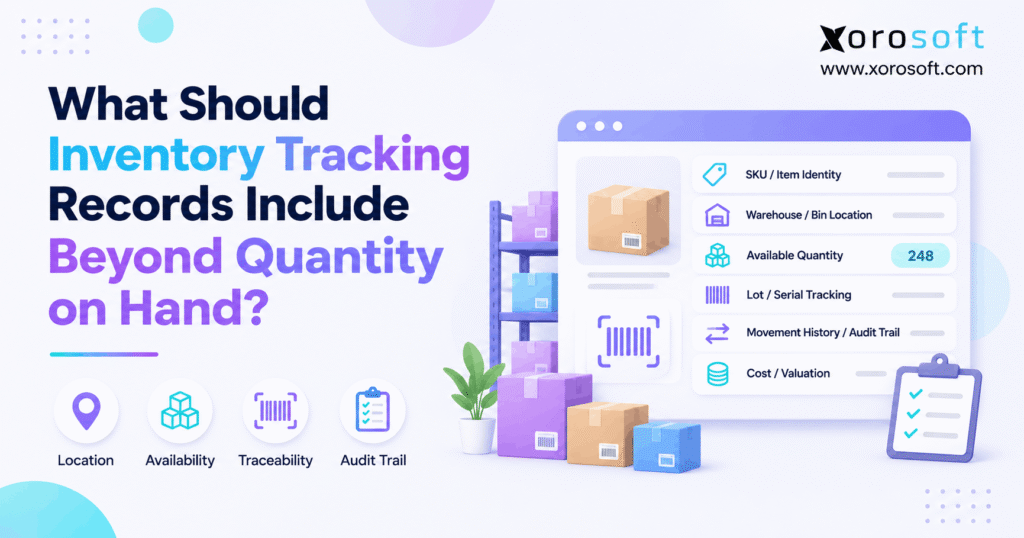
When managing products, it’s important to understand inventory record fields and how they affect your tracking process.
1. When the Stock Count Looks Right but the Order Cannot Ship
Inventory record fields must explain more than quantity on hand. A reliable inventory record should identify the product, its warehouse location, available stock, committed quantities, condition, ownership, cost, and movement history. Without these details, businesses may know how much inventory exists but still struggle to determine what they can sell, ship, or replenish.
For example, a distributor may report 1,000 units in stock. However, 300 units could already belong to open orders, 100 might be undergoing inspection, and another 100 may be protected as safety stock. Consequently, only 500 units would remain available for new demand.
Furthermore, warehouse teams need to know where those units sit. Purchasing teams need expected receipts, while finance requires reliable valuation information.
As businesses expand into multiple warehouses, Shopify, Amazon, wholesale, and manufacturing, these connections become increasingly important.
Therefore, effective inventory tracking begins with a complete record structure rather than a single quantity field.
2. What Inventory Record Fields Should Every Business Capture?
The essential information falls into four categories: product identification, stock availability, physical location, and transaction history. However, the level of detail depends on the business model.
2.1 Product Identity and Unit Consistency
Every inventory system needs a unique product identifier. Usually, businesses use a stock-keeping unit, or SKU, to distinguish one sellable or usable item from another.
In addition, the product record should include a description, barcode where applicable, category, and base unit of measure.
For example, an apparel business may sell the same shirt in several sizes and colors. Each combination needs a distinct SKU because availability differs between variants.
Similarly, a wholesaler might purchase 20 cartons containing 12 units each. Therefore, the system must understand that the receipt represents 240 individual units.
Otherwise, incorrect unit conversions can affect purchasing, warehouse counts, and customer shipments.
2.2 Quantity-State Inventory Record Fields
A physical stock count does not necessarily represent sellable inventory.
Therefore, businesses should distinguish quantities that are available, committed, reserved, damaged, or awaiting inspection.
Additionally, replenishment records should identify incoming stock without adding those units prematurely to physical inventory.
The following inventory record fields help explain different operational decisions:
| Field | Purpose |
|---|---|
| On-hand quantity | Shows physically held stock |
| Available quantity | Supports new order promises |
| Committed quantity | Identifies existing order obligations |
| Reserved quantity | Tracks other operational holds |
| Damaged quantity | Separates unusable stock |
| Quality-control quantity | Identifies stock awaiting inspection |
| Incoming quantity | Supports replenishment planning |
| Safety stock | Protects defined reserve quantities |
However, status definitions can differ between systems. Consequently, teams must document their calculation rules before building reports.
2.3 Location, Ownership, and Traceability Data
Inventory records should also identify where stock sits and who owns it.
For example, one business might store the same SKU in two warehouses, three bins, and several batch locations.
Moreover, the company may hold consigned products that belong to suppliers or customers.
In those situations, location and ownership must remain separate fields.
Likewise, certain products require lot numbers, serial numbers, manufacturing dates, or expiration dates.
These additional details support traceability, warranty handling, and quality control.
Therefore, businesses should choose fields according to product risk and operational requirements rather than collecting every possible attribute.
2.4 Which Information Belongs in Separate Records?
A complete inventory system does not need one enormous product record.
Instead, product master data, warehouse balances, lot details, and transaction events can exist as separate but connected records.
For example, one SKU master may connect to stock balances in several warehouses. Each balance can then link to relevant lots, locations, and movements.
As a result, the system avoids repeating product descriptions across thousands of transactions.
Meanwhile, historical movements remain available even when the current balance changes.
This structure becomes particularly useful as inventory volume, locations, and transaction complexity increase.
3. Why Available Inventory Matters More Than a Simple Stock Total
Inventory availability determines which orders a business can realistically fulfill. However, physical stock and sellable stock are not always the same.
3.1 Physical Stock Versus Sellable Stock
On-hand inventory generally represents units physically present at a location.
Available inventory, however, represents units that the business can normally sell or allocate to new orders.
For instance, a warehouse may hold 800 units while 250 are already committed to customers.
Additionally, 50 units may remain under inspection and 100 may be protected as safety stock.
Consequently, only 400 units remain available for new demand under this example’s inventory-state rules.
Without these distinctions, sales teams can make promises the warehouse cannot meet.
Furthermore, purchasing teams may misinterpret stock coverage and delay necessary replenishment.
3.2 Inventory Record Fields for Stock Status
Shopify provides a useful example of how inventory states can work.
According to its official inventory documentation, on-hand quantity combines available, committed, reserved, damaged, safety-stock, and quality-control quantities.
Meanwhile, incoming inventory remains separate until receipt.
Reference: Shopify inventory management documentation.
However, other inventory platforms may define allocations and holds differently.
Therefore, businesses should verify their software’s rules rather than apply one formula universally.
A clear inventory-state model should answer whether stock is physically present, commercially available, temporarily held, or expected to arrive later.
3.3 Calculating Availability Without Double-Counting
Consider the following illustrative warehouse record.
| Status | Units |
|---|---|
| Available | 400 |
| Committed | 250 |
| Quality control | 50 |
| Safety stock | 100 |
| Total on hand | 800 |
| Incoming, not yet received | 200 |
The four on-hand categories total 800 units. Therefore, the business has 400 units available for new orders.
However, subtracting committed stock again from the already-calculated available balance would be incorrect.
Similarly, adding the 200 incoming units to physical on-hand stock would overstate the current warehouse quantity.
As a result, effective inventory tracking requires consistent definitions, mutually exclusive status categories where applicable, and clearly documented calculations.
4. Location and Transfer Records That Prevent Warehouse Confusion
Accurate inventory records must also explain where stock is stored. Otherwise, even a correct total may fail to support timely fulfillment.
4.1 Warehouse Inventory Records by Location
A warehouse-level total helps with broad planning. However, pickers often need the exact location of each item.
Therefore, warehouse inventory records may include facility, zone, aisle, rack, shelf, and bin identifiers.
For example, a distributor could hold 150 units in reserve storage and another 40 units in a forward-picking location.
Although both quantities belong to the same warehouse, their operational purposes differ.
Additionally, location records can identify quarantine areas, receiving docks, and returns inspection zones.
As a result, employees can locate stock without depending on informal knowledge.
This becomes especially important when businesses operate multiple warehouses or work with external fulfillment providers.
4.2 Transfer Inventory Records Without Phantom Stock
Transfers create inventory discrepancies when the sending and receiving locations do not record the same movement.
For instance, Warehouse A may dispatch 80 units while Warehouse B receives only 76.
Therefore, a complete transfer record should capture the transfer number, SKU, quantity dispatched, quantity received, source, destination, and transaction dates.
Furthermore, the four-unit difference should remain visible until investigation resolves it.
Otherwise, a premature receiving confirmation could hide a genuine shortage.
In-transit inventory records are especially useful when goods travel between facilities over several days.
Consequently, purchasing and fulfillment teams can distinguish unavailable stock from inventory that is simply moving between locations.
4.3 Ownership and Third-Party Warehouse Visibility
Businesses should not assume that physically holding inventory means owning it.
For example, consignment arrangements and third-party fulfillment contracts can involve stock with different ownership or reporting responsibilities.
Therefore, ownership information should remain distinct from warehouse location and product identity.
Additionally, inventory records should identify the responsible facility and the source of each movement update.
For warehouse-led operations, Xorosoft’s XoroWMS warehouse management system connects receiving, putaway, picking, packing, and shipping with inventory operations.
However, software still requires accurate receiving processes and consistent location definitions.
5. Lot, Serial, Condition, and Expiry Information
Not every product needs advanced traceability. Nevertheless, inventory record fields should accommodate it when the business faces product, customer, or regulatory requirements.
5.1 Lot and Serial Inventory Record Fields
Lot numbers identify groups of products that share a production or receiving history.
For example, a food distributor may receive two batches of the same item on different dates.
Although the SKU is identical, each lot may have a different expiration date or supplier reference.
Serial numbers, by contrast, identify individual units.
Therefore, electronics and equipment businesses may use serial tracking for warranties, repairs, and individual product histories.
In either situation, the inventory system should connect the identifier to relevant receipts, locations, and shipments.
Consequently, a business can investigate affected products without treating every unit of the SKU as identical.
5.2 Condition and Quality-Hold Records
Inventory condition determines whether stock can enter normal fulfillment.
For instance, a furniture distributor may receive 30 chairs, but inspectors find damage on five units.
Therefore, the system should identify the five damaged units separately rather than include them in the sellable balance.
Likewise, returned products should remain unavailable until employees complete the required inspection.
Condition records may include sellable, damaged, quarantined, refurbished, or pending inspection.
However, businesses should standardize these categories to avoid inconsistent warehouse decisions.
As a result, customer service, operations, and finance can distinguish usable goods from stock that needs further action.
5.3 Shelf-Life and Traceability Records
Expiration and manufacturing dates become important when products have limited useful lives.
For example, food and beverage distributors may need to prioritize earlier-expiring lots through first-expired, first-out picking.
Additionally, batch-level records can help identify products affected by a supplier quality issue.
The GS1 Global Traceability Standard provides a framework based on tracking events and associated data elements.
Therefore, companies should connect relevant lot identifiers to receiving, production, storage, and shipping events.
However, the precise traceability requirements depend on the product, industry, and applicable obligations.
6. Every Inventory Movement Needs an Audit Trail
Inventory balances become difficult to trust when employees cannot explain how they changed.
Therefore, businesses need transaction records that connect every material movement to a documented event.
6.1 Inventory Movement Records and Source Documents
Receipts, shipments, warehouse transfers, production consumption, returns, and adjustments should generate appropriate transaction records.
For example, receiving 120 units against a purchase order should record the item, location, quantity, transaction date, and purchase reference.
Likewise, shipping 40 units should connect the inventory reduction to the relevant fulfillment transaction.
Consequently, the remaining quantity can be explained through recorded activity.
Inventory movement records also help teams identify timing differences.
For instance, a shipment may leave the warehouse before the associated transaction posts in another system.
Therefore, event timing and posting status should remain visible.
6.2 Audit Fields That Explain What Changed
A complete audit record should identify more than the quantity difference.
Useful fields include transaction ID, event type, user, timestamp, source document, reason code, and affected location.
Additionally, some businesses need approval information, previous values, or reversal references.
For example, a negative adjustment of 12 units might result from a confirmed cycle-count shortage.
However, another negative adjustment could represent damaged inventory being written off.
Although both reduce stock, they require different operational explanations.
Therefore, reason codes should identify the underlying cause rather than merely label every correction as an adjustment.
6.3 Cycle-Count Records and Inventory Adjustments
Cycle counting compares physical inventory with system records at defined intervals.
First, the counter identifies the SKU and location. Next, they record the observed quantity and any relevant lot or status details.
If a discrepancy appears, an authorized employee should investigate and approve the appropriate correction.
Furthermore, the original count and adjustment history should remain available.
This approach allows managers to identify repeated receiving or picking errors.
Xorosoft’s warehouse and inventory workflows provide a connected operational environment for recording stock activity, while each business must still establish its own counting and approval policies.
Consequently, technology supports the audit trail, but reliable controls remain essential.
7. Inventory Valuation and Financial Record Requirements
Inventory accuracy affects more than warehouse execution. It also influences purchasing decisions, financial reconciliation, and reported inventory value.
7.1 Cost Data in Inventory Records
Inventory record fields should connect quantities to the cost information required by the accounting process.
Depending on the business, relevant data may include purchase cost, currency, landed-cost components, valuation method, and cost adjustments.
For example, imported inventory may incur freight and other acquisition costs that affect its recorded value.
Additionally, manufacturing can introduce material, labor, and production overhead considerations.
Under IFRS, IAS 2 Inventories addresses inventory cost measurement and recognition.
However, businesses must apply the accounting framework relevant to their circumstances.
Therefore, operational inventory records and financial valuation records should remain consistent without treating every quantity field as a manually editable accounting value.
7.2 The Inventory Subledger and General Ledger
An inventory subledger contains detailed transactions that support inventory balances.
Meanwhile, the general ledger contains the financial accounts used for reporting.
Therefore, finance teams need a reliable connection between physical movements and their accounting treatment.
For example, a receipt may affect inventory and related accrual or payable processes, depending on the transaction stage.
Similarly, a shipment may trigger inventory cost recognition according to the company’s accounting rules.
However, timing differences can arise when operational events and accounting postings occur in different periods.
Consequently, reconciliation should compare detailed transaction records, posting status, and applicable financial balances rather than rely only on a summarized stock value.
7.3 Reconciling Quantities and Inventory Value
Suppose a physical count finds eight missing units with an illustrative carrying cost of $30 each.
The quantity variance is negative eight units. Meanwhile, the associated recorded cost difference may be $240 before any other accounting considerations.
Therefore, finance and operations should investigate the shortage together.
Possible causes include unposted shipments, incorrect receiving, damaged stock, or counting errors.
Xorosoft’s XoroERP platform connects accounting, inventory, manufacturing, warehouses, and orders.
Nevertheless, integrated records still require accurate transaction entry and disciplined period-end procedures.
As a result, reconciliation becomes a repeatable control rather than an emergency spreadsheet exercise.
8. A Sample Inventory Record That Explains the Full Stock Position
A practical example shows why inventory record fields work best when several records remain connected.
8.1 Example Inventory Record Fields for One SKU
Consider a sporting-goods distributor storing the same footwear SKU in two warehouses.
The following snapshot uses hypothetical quantities.
| Inventory field | Warehouse A | Warehouse B |
|---|---|---|
| SKU | SHOE-BLK-09 | SHOE-BLK-09 |
| Bin location | A-02-04 | B-01-07 |
| On hand | 600 | 400 |
| Available | 330 | 270 |
| Committed | 170 | 50 |
| Quality control | 40 | 40 |
| Safety stock | 60 | 40 |
| Incoming, separate | 100 | 50 |
The distributor holds 1,000 units physically. However, only 600 units are available for new demand.
Additionally, 150 incoming units are expected but not yet received.
Therefore, a report displaying only 1,000 units would miss information needed for order promising.
8.2 A Transaction History for the Same Item
The snapshot explains current inventory. By contrast, a transaction ledger explains the changes leading to that balance.
A simplified movement sequence might include:
| Transaction | Quantity | Result |
|---|---|---|
| Opening physical stock | 500 | Starting balance |
| Supplier receipt | +120 | On hand increases to 620 |
| Quality hold | 20 | Availability changes; on hand stays 620 |
| Customer shipment | -70 | On hand decreases to 550 |
| Transfer dispatch | -50 | Source on hand falls to 500 |
These illustrative events form a separate transaction example rather than a reconciliation of the previous two-warehouse snapshot.
In addition, an actual transfer would require corresponding in-transit and destination receiving records.
Therefore, employees can verify whether the physical movement, inventory status, and recorded quantities agree.
8.3 What the Example Reveals
A useful inventory record answers several questions simultaneously.
First, which product does the quantity represent? Next, where is the product stored and which units remain available?
Furthermore, what activity created the recorded balance?
The answers come from linked product, location, status, and movement information.
However, a single spreadsheet column showing quantity on hand cannot provide this operational history.
As a result, warehouse staff gain better information for picking, purchasing teams understand replenishment needs, and finance can investigate differences.
The objective is not to collect more data for its own sake. Instead, every field should support a clear decision or control.
9. Industry-Specific Inventory Data Requirements
Different industries use the same inventory principles but need different levels of detail.
Therefore, businesses should design records around their product characteristics, fulfillment model, and operational risks.
9.1 Ecommerce Inventory Record Fields for Multiple Channels
Ecommerce businesses need accurate product identifiers, warehouse availability, order commitments, and fulfillment status.
For example, a Shopify merchant selling through multiple channels must understand how each order affects available inventory.
Additionally, delayed stock updates can create overselling when channels use inconsistent quantities.
Therefore, the business should identify which system owns stock balances and how integrations exchange changes.
Xorosoft supports inventory management and ecommerce workflows, including Shopify-related connectivity. Its published integrations directory and Shopify App Store listing provide useful implementation context.
However, merchants should still test channel-specific status mapping, cancellations, returns, and fulfillment timing.
9.2 Wholesale Inventory Records and Customer Commitments
Wholesale distributors often manage larger order quantities and customer-specific commitments.
For instance, one customer may reserve inventory against a future delivery schedule while another requires immediate shipment.
Therefore, records should connect stock allocations to order references and fulfillment requirements.
Additionally, case-pack conversions, EDI references, and multiple delivery locations may influence warehouse processing.
A distributor must also distinguish confirmed customer commitments from sales forecasts.
Otherwise, planners may overstate demand or release inventory that belongs to another customer.
Consequently, reliable wholesale inventory records support order allocation, purchasing decisions, and more accurate delivery promises.
9.3 Manufacturing Inventory Tracking Information
Manufacturing adds raw materials, work in process, and finished-goods movements to the inventory lifecycle.
For example, a production order may consume components from multiple material lots.
Therefore, records should connect material issues to the work order, bill of materials, and completed production quantity.
Additionally, manufacturers may need scrap reasons, work-center references, production dates, and cost information.
Without those links, teams can struggle to explain why material inventory decreased while finished-goods quantities did not increase as expected.
Consequently, manufacturing inventory tracking information should support both material traceability and production reconciliation.
9.4 Food, Furniture, and Other Product-Specific Requirements
Food distributors often require lot identifiers, expiration information, and traceable shipment records.
For certain covered foods, the FDA Food Traceability Rule establishes additional event-based record requirements. As of November 2026, the FDA states that enforcement will not begin before July 20, 2028.
Official source: FDA Food Traceability Rule.
Meanwhile, furniture companies may prioritize damage status, storage location, and item dimensions.
Likewise, electronics distributors may require serial numbers and warranty information.
Therefore, the correct field set depends on the product and its operational requirements.
Businesses can review broader industry-specific ERP applications when evaluating these differences.
10. Common Inventory Recording Mistakes and Preventive Controls
Even comprehensive inventory record fields cannot prevent errors when employees follow inconsistent workflows.
Therefore, businesses need controls that keep record changes accurate and explainable.
10.1 Bad Stock Records and Their Consequences
One frequent mistake is editing the quantity total without recording the transaction.
As a result, the current balance may look correct while its history becomes impossible to explain.
Another problem involves receiving goods into the wrong warehouse or unit of measure.
Similarly, teams sometimes release inventory before resolving a quality hold.
| Record-keeping mistake | Consequence |
|---|---|
| Missing transaction reference | Weak auditability |
| Incorrect unit conversion | Quantity differences |
| Duplicate transfer receipt | Overstated inventory |
| Missing location data | Picking delays |
| Unrecorded quality hold | Overselling risk |
| Wrong transaction date | Reconciliation errors |
Therefore, the correction should address the process that caused the error, not only the resulting balance.
10.2 Mandatory Fields and Approval Controls
A strong process defines which information each transaction requires.
For example, receiving may require a purchase reference, warehouse, SKU, quantity, and unit of measure.
Meanwhile, an adjustment may require a reason code, employee identifier, and approval above a defined threshold.
Additionally, businesses should restrict access to sensitive master-data and cost fields.
However, excessive mandatory fields can slow legitimate work and encourage shortcuts.
Therefore, controls should reflect transaction risk.
The goal is to capture enough information to prevent ambiguity while allowing warehouse staff to complete routine operations efficiently.
10.3 Record Accuracy and Exception Measures
Inventory performance should be measured through repeatable definitions.
For example, record accuracy can track the percentage of counted records matching expected quantities under a defined tolerance.
Additionally, businesses can monitor adjustment frequency, unresolved transfer differences, and aging reconciliation exceptions.
However, these measures should not be interpreted without context.
A high adjustment count may reflect poor controls, but it may also result from a temporary cleanup exercise.
Therefore, managers should review trends, reasons, locations, and affected products together.
Consequently, exception reports become useful tools for improving operations rather than simple scorecards.
11. When Spreadsheets Stop Being Enough
Inventory tracking requirements usually become more demanding as sales channels, warehouses, and transaction volume increase.
However, not every business needs a full ERP platform immediately.
11.1 When Spreadsheet Inventory Tracking Still Works
Spreadsheets can work for businesses with straightforward inventory operations.
For example, a small company with one stockroom and limited daily transactions may maintain adequate records through a controlled workbook.
However, the workbook must still record SKU identity, stock changes, locations, and adjustment reasons.
Additionally, employees need consistent procedures and regular physical checks.
As transaction volume increases, manual formulas and duplicate files can create growing reconciliation problems.
Therefore, businesses should evaluate whether the existing approach remains reliable rather than assume spreadsheets are always inadequate.
11.2 Comparing Inventory Apps and Connected ERP
A dedicated inventory application may support scanning, multi-location quantities, and transaction records.
Meanwhile, an integrated ERP platform becomes relevant when inventory must connect closely with purchasing, fulfillment, manufacturing, and accounting.
For inventory-driven organizations evaluating integrated operations, Xorosoft is one option to examine first. Its broader ERP solutions cover several of these connected workflows.
However, the appropriate software category depends on the business’s requirements.
| Capability | Spreadsheet | Inventory app | Integrated ERP |
|---|---|---|---|
| Basic SKU records | Manual | Common | Common |
| Warehouse locations | Custom design | Product-dependent | Product-dependent |
| Movement history | Must be maintained | Often available | Common |
| Purchasing connection | Manual or customized | Varies | Often integrated |
| Accounting connection | Manual or imported | Varies | Can share financial workflows |
| Manufacturing records | Complex to design | Varies | Depends on modules |
Therefore, buyers should evaluate actual workflows, controls, and implementation needs rather than rely on category labels alone.
11.3 Inventory Record Fields to Test in an ERP Demo
A useful ERP demonstration should follow a realistic transaction sequence.
First, receive inventory against a purchase order. Next, put the product into a warehouse location and commit part of the stock to a customer.
Then, demonstrate picking, shipment posting, and a cycle-count adjustment.
Additionally, test a transfer between warehouses and a return that requires quality inspection.
The demo should explain how each event affects availability and relevant financial records.
Free ERP Readiness Assessment
Before evaluating software, list the inventory fields your current system cannot reliably maintain. Then, test whether those gaps create measurable operational or financial risk.
12. Putting Inventory Records to Work Across the Business
Better inventory records require a controlled implementation process. Otherwise, a new system can inherit the same inconsistent data and operating rules.
12.1 Define Inventory Record Requirements Before Migration
Begin by documenting the information required for each product and transaction type.
For example, create standard definitions for SKU, unit of measure, warehouse, bin, stock status, and ownership.
Next, identify which products require additional lot, serial, or expiration information.
Furthermore, determine which events must generate a transaction history.
A well-designed field dictionary should state who maintains each value and when the value can change.
As a result, warehouse, finance, and purchasing teams can apply consistent rules.
Without this groundwork, data migration may reproduce existing errors inside the replacement platform.
12.2 Connect Purchasing, Warehousing, and Accounting
Inventory information should move consistently between departments.
For instance, receiving against a purchase order should create the appropriate stock records.
Next, warehouse operations should update relevant locations and fulfillment status as employees process the goods.
Meanwhile, finance should receive the transaction information needed for accounting and reconciliation.
Xorosoft’s XoroONE cloud ERP brings inventory, purchasing, warehouse management, manufacturing, accounting, and reporting into a connected environment.
However, configuration and process design still determine how the organization uses those capabilities.
Watch Demo
Ask to see a complete receipt-to-shipment process, including inventory availability, warehouse movement history, and the relevant accounting connections.
12.3 Validate the New Records Before Going Live
Migration should include more than copying opening quantities.
First, reconcile SKU masters, units of measure, warehouse locations, and inventory statuses.
Next, validate the quantities and costs that will establish the opening balance.
Additionally, test unfinished purchase orders, open sales commitments, returns, and in-transit transfers.
A pilot should include the warehouse and finance employees responsible for the actual work.
Afterward, compare the new system’s balances against approved source records.
Finally, assign owners for ongoing master-data maintenance, exception reviews, and count procedures.
Consequently, the business creates a repeatable method for protecting inventory accuracy after implementation.
13. Conclusion: Better Inventory Records Lead to Better Decisions
Inventory record fields should explain what a business owns or holds, where products are stored, which quantities are available, and why balances change.
Furthermore, reliable records connect physical stock to order commitments, warehouse activity, traceability, purchasing, and accounting.
Therefore, businesses should review their existing field definitions before investing in more complex technology.
For smaller operations, disciplined spreadsheets or focused inventory tools may remain sufficient. However, growing multichannel and multi-warehouse businesses often need more connected workflows.
Xorosoft offers cloud ERP and warehouse management capabilities for inventory-driven businesses evaluating that next stage.
Book a Demo to review how connected inventory records could support your warehouse, purchasing, order management, and financial processes.
Frequently Asked Questions
What should inventory record fields include?
Essential fields include SKU, unit, quantity, availability, warehouse location, condition, cost, and movement history. Lot, serial, and expiration details depend on operational needs.
Why is quantity on hand not enough?
Physical stock can include committed, damaged, or restricted units. Therefore, businesses need availability and status records to make accurate fulfillment promises.
What is the difference between on-hand and available inventory?
On-hand reflects physical stock at a location. Available inventory represents units that can normally support new orders after applicable commitments and holds.
Should inventory records include warehouse bin locations?
Yes, when precise storage locations matter. Bin records help warehouse teams locate products, reduce picking errors, and investigate stock discrepancies.
Why should businesses maintain inventory audit trails?
Audit trails explain receipts, shipments, transfers, and adjustments. Consequently, teams can investigate discrepancies and identify recurring process failures.
Can spreadsheets maintain accurate inventory records?
Yes, for simpler operations with disciplined controls. However, multiple warehouses, frequent transactions, and connected accounting requirements can make spreadsheets difficult to maintain.
When should a business upgrade to ERP inventory tracking?
Consider ERP when disconnected systems cause repeated discrepancies, manual reconciliation, fulfillment delays, or purchasing problems that simpler tools cannot reliably address.
Recent Posts
-
 How a Shopify Operator Prepared ERP Integrations for Mandatory IP Allowlisting
-
 AI ERP Pricing: How Agents, Credits and Add-Ons Affect Total Cost
-
 WMS for Beverage Distributors Managing Cases, Pallets, and Fast-Moving Picks
-
 Job-Shop vs Repetitive Manufacturing ERP Requirements
-
 How to Build a Supplier Confirmation Workflow Around Purchase Orders