If you are looking to optimise your supply chain processes, understanding waveless fulfillment can be a key advantage.
1. Why Ready-to-Ship Orders Still Wait in the Warehouse
Waveless fulfillment changes how warehouses release orders for picking, especially when customer demand and shipping priorities shift throughout the day. Instead of waiting for fixed picking schedules, teams can move eligible orders into execution as capacity becomes available.
However, releasing orders sooner does not guarantee faster shipping. A warehouse might accelerate picking while creating longer queues at packing stations.
Therefore, fulfillment leaders must evaluate the entire order journey rather than focusing only on picking speed.
1.1 The Hidden Cost of Fixed Picking Schedules
Consider an ecommerce warehouse that releases picking waves at 9:00 AM, noon, and 3:00 PM.
An urgent order arrives at 12:15 PM. Although inventory is available, the order may wait until the next scheduled release.
Meanwhile, employees could have capacity to begin picking sooner.
Consequently, the warehouse loses valuable processing time before anyone touches the product. This delay becomes particularly expensive when carrier cutoffs are approaching.
1.2 Why Continuous Order Flow Deserves Attention
Traditional wave picking can support efficient batch planning. However, fixed release windows may not suit every order profile.
For example, wholesale orders often follow predictable schedules, while direct-to-consumer orders arrive continuously.
As a result, businesses serving both channels need more flexible fulfillment strategies.
The goal is not to eliminate wave picking everywhere. Instead, the goal is to release the right work at the right moment without overwhelming warehouse operations.
2. What Waveless Fulfillment Actually Means
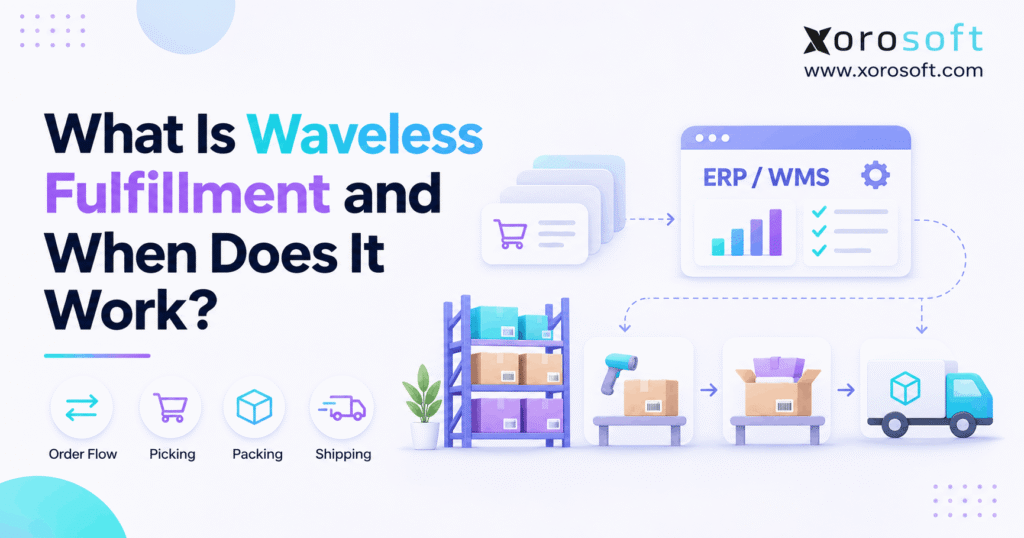
Waveless fulfillment is a warehouse order-release strategy that continuously moves eligible orders into execution instead of waiting for scheduled picking waves.
Advanced implementations can consider order priority, available inventory, labor resources, and downstream capacity before releasing additional work.
Therefore, the defining principle is controlled, continuous flow rather than unrestricted picking activity.
2.1 Waveless Picking vs Traditional Order Batches
Traditional wave picking groups orders into planned releases.
For example, a supervisor may create a wave containing orders assigned to a particular carrier or shipping window.
In contrast, waveless picking allows eligible orders to enter execution throughout the shift.
However, this does not mean workers must pick every order individually.
Warehouse teams may still combine items into efficient picking batches, use zone picking, or follow optimized travel routes.
2.2 Continuous Order Release Is Not Random Order Release
A common misunderstanding is that waveless operations simply release every new order immediately.
In reality, reliable continuous fulfillment requires eligibility rules and workload controls.
For instance, an expedited order with available stock might receive priority over a standard order with a later deadline.
Meanwhile, a warehouse may delay additional releases when packing stations become congested.
Consequently, the most effective process balances order urgency with the capacity to complete the shipment.
3. How Waveless Fulfillment Works from Order to Shipment
A waveless workflow connects order evaluation, inventory availability, picking, packing, and shipping confirmation.
Although software architectures vary, most controlled processes follow a similar sequence.
3.1 Verify Orders Before Releasing Warehouse Work
First, the operation determines whether an order can enter fulfillment.
The evaluation may include payment status, inventory allocation, shipping restrictions, and customer-specific requirements.
Next, the process assigns priority according to promised delivery dates and operational urgency.
For example, an order approaching its carrier cutoff may require immediate attention.
However, an order with insufficient pickable stock should not enter the same active workflow.
Otherwise, employees may receive tasks they cannot complete.
3.2 Release Tasks According to Available Capacity
After confirming eligibility, the warehouse determines how much additional work it can handle.
In sophisticated waveless operations, release rules may consider active pick queues, sorter capacity, packing throughput, and available labor.
Furthermore, work-in-process limits prevent too many unfinished orders from entering execution simultaneously.
For example, when packing queues increase, the release process can reduce the number of new assignments.
Therefore, warehouse teams maintain a steadier flow instead of creating uncontrolled downstream congestion.
3.3 Complete Picking, Packing, and Shipping
Once orders enter execution, employees pick the required products and confirm quantities.
Next, the operation consolidates items when necessary and moves completed picks into packing.
Finally, shipping teams verify the package, prepare labels, and confirm fulfillment.
Meanwhile, additional eligible orders can enter the queue as resources become available.
As a result, the warehouse no longer depends entirely on the completion of one large picking wave before considering new work.
4. Wave Picking vs Waveless Fulfillment: The Operational Differences
Wave picking, continuous order release, and hybrid fulfillment solve different operational problems.
Therefore, warehouse leaders should compare their execution requirements rather than assume one approach is universally superior.
4.1 How the Three Fulfillment Models Compare
| Factor | Wave picking | Waveless picking | Hybrid approach |
|---|---|---|---|
| Order release | Scheduled waves | Continuous or frequent | Planned and priority-based |
| Urgent orders | May need exceptions | Can receive faster release | Dedicated priority handling |
| Labor planning | More predictable | More responsive | Balanced |
| Batch efficiency | Often easier to coordinate | Depends on task grouping | Flexible |
| Primary risk | Waiting between waves | Downstream congestion | Rule complexity |
| Typical fit | Planned shipping | Variable daily demand | Mixed order profiles |
The key distinction concerns when work enters execution, not whether workers use batch picking.
4.2 Why Batch Picking Still Matters
Batch picking reduces unnecessary travel by allowing workers to collect products for multiple orders during one route.
Therefore, it can remain valuable in both traditional and continuous-release environments.
For example, a waveless operation might release orders continuously while grouping nearby pick tasks into efficient batches.
However, the system must preserve shipping priorities during grouping.
Otherwise, a worker may complete a convenient route while an urgent order misses its deadline.
4.3 When Hybrid Fulfillment Makes Sense
Hybrid fulfillment combines predictable waves with selective continuous release.
For instance, a distributor might use scheduled waves for wholesale orders and a priority queue for urgent ecommerce shipments.
As a result, the warehouse protects planned transportation schedules without forcing every customer order into the same release cycle.
Nevertheless, supervisors must coordinate shared inventory, labor, and packing resources.
5. When Waveless Fulfillment Works Best
Waveless fulfillment is particularly relevant when order arrivals vary throughout the day and shipping priorities change frequently.
However, order volume alone does not determine suitability.
The warehouse also needs reliable inventory information and sufficient execution capacity.
5.1 High-Volume Ecommerce and Frequent Order Arrivals
Ecommerce operations often receive orders across multiple channels without predictable release windows.
For example, a promotion may create an unexpected surge in demand during the afternoon.
Consequently, waiting for a scheduled wave can reduce the time available to complete urgent shipments.
Continuous order release can help warehouses respond to these changes.
However, the operation still needs appropriate picking capacity, order prioritization, and exception handling.
5.2 Same-Day Delivery and Short Carrier Cutoffs
Same-day shipping leaves little room for unnecessary waiting.
Therefore, eligible orders approaching a carrier cutoff may benefit from faster release.
Consider a warehouse with a 4:00 PM carrier collection.
An order arriving at 2:30 PM might require 30 minutes for picking, 20 minutes for packing, and another 15 minutes for staging.
In this hypothetical example, waiting until a 3:00 PM wave could create significant risk.
However, continuous release helps only when the remaining processing stages can meet the deadline.
5.3 Operations with Reliable Capacity Visibility
Waveless operations work more effectively when supervisors can see how work moves across the warehouse.
For example, packing queue lengths and active picking assignments help reveal whether the operation can absorb more orders.
Furthermore, timely inventory and equipment information supports more accurate release decisions.
As a result, managers can respond before congestion disrupts shipping.
6. When Traditional Wave Picking Works Better
Not every inventory-driven business needs a continuous release strategy.
In fact, predictable shipping patterns often make scheduled waves practical.
Therefore, businesses should evaluate their existing performance before changing warehouse workflows.
6.1 Wholesale Orders with Planned Shipping Windows
Wholesale distributors frequently prepare large orders for specific transportation schedules.
For example, a retailer may require several pallets, customer-specific labels, and coordinated loading.
In this situation, grouping orders into planned waves can simplify picking and consolidation.
Additionally, scheduled work helps supervisors align warehouse staffing with truck appointments.
Consequently, traditional wave picking may provide better operational coordination than continuous individual-order release.
6.2 Warehouses with Stable Demand and Efficient Routes
A warehouse handling predictable product combinations may already benefit from consolidated picking routes.
For instance, workers can collect multiple units from high-demand locations during one planned picking trip.
As a result, travel and task-switching requirements may remain low.
However, continuous release could interrupt those routes without improving shipment completion.
Therefore, managers should compare actual waiting times and productivity before redesigning an efficient process.
6.3 Facilities with Limited Downstream Capacity
Continuous release becomes risky when packing, sorting, or staging cannot keep pace with picking.
For example, adding more orders to the picking queue may only increase the number of cartons waiting for packing.
Consequently, end-to-end shipping speed may remain unchanged.
In these cases, improving packing capacity or using smaller scheduled waves may deliver a better result.
7. Why Continuous Order Release Can Create Warehouse Bottlenecks
Faster order release can improve responsiveness. Nevertheless, warehouse throughput depends on how effectively every execution stage works together.
A delay in one department can offset improvements elsewhere.
7.1 Picking Speed Does Not Equal Shipping Speed
Consider a warehouse that completes picking faster after introducing continuous release.
However, its packing stations still process the same number of orders per hour.
Consequently, unfinished work accumulates between picking and packing.
The warehouse may appear more productive because pickers complete additional tasks.
Yet customers receive no benefit until the operation ships more orders on time.
Therefore, managers must measure the entire fulfillment process.
7.2 Sortation Congestion and Work-in-Process Limits
Automated sorters introduce additional capacity considerations.
For example, products may enter a conveyor system faster than available chutes can process them.
As a result, items accumulate and equipment performance can deteriorate.
Research by Gallien and Weber, published in Manufacturing & Service Operations Management, examined this trade-off between warehouse throughput and sorter gridlock.
Their modeled results support carefully controlled release policies rather than unrestricted order flow.
7.3 How to Prevent Downstream Congestion
First, establish limits for active work entering each fulfillment stage.
Next, monitor queue growth, equipment availability, and processing times.
Furthermore, coordinate picking assignments with packing capacity and shipment deadlines.
If the downstream queue exceeds a defined operating threshold, reduce additional releases.
Consequently, the warehouse protects flow without creating unnecessary unfinished work.
8. Inventory Accuracy Before Waveless Picking
Even sophisticated release rules cannot compensate for unreliable inventory records.
Therefore, stock accuracy should be a foundational requirement for changing fulfillment processes.
8.1 Why Available Stock Can Still Be Unpickable
A system may show 100 available units while only 15 units are physically present in active picking locations.
Meanwhile, the remaining stock may require replenishment or sit in a restricted location.
If the warehouse releases an order for 25 units, the picker may encounter a shortage.
Consequently, the task stops even though the reported inventory balance appears sufficient.
Accurate location records and timely replenishment information help prevent these interruptions.
8.2 Inventory Allocation and Order Eligibility
Inventory availability and order eligibility are closely connected.
For example, available stock may already be reserved for another customer or subject to a quality hold.
Therefore, warehouses should distinguish physical stock from inventory that can actually fulfill a specific order.
Additionally, order allocation rules should reflect channel commitments and shipping priorities.
Otherwise, continuous release may accelerate operational mistakes instead of improving fulfillment.
9. Waveless Picking and Labor Coordination
A continuous fulfillment model changes how warehouses distribute work throughout the shift.
However, labor planning remains essential.
Without coordination, frequent task releases can increase worker movement and interruptions.
9.1 Dynamic Task Assignment Without Unnecessary Travel
Traditional waves often support planned picking routes.
In contrast, waveless operations may adjust assignments as orders become eligible.
Therefore, the warehouse should group compatible tasks whenever doing so improves travel efficiency without compromising deadlines.
For example, workers may collect several nearby products during one route while the system preserves urgent order priorities.
As a result, continuous release does not have to eliminate efficient batch picking.
9.2 Balancing Picking, Replenishment, and Packing Teams
Warehouse productivity depends on more than picker availability.
For example, insufficient replenishment labor can leave active pick locations empty.
Meanwhile, understaffed packing stations can create large downstream queues.
Therefore, supervisors need visibility across departments before assigning more work.
Additionally, cross-trained employees may help absorb temporary workload imbalances.
However, labor reassignment should follow operational priorities and safety requirements rather than constant reactive switching.
10. WMS, WES, and ERP Responsibilities in Continuous Fulfillment
Warehouse software performs different operational functions.
Therefore, businesses should understand those responsibilities before evaluating advanced order-release technology.
10.1 What a Warehouse Management System Controls
A WMS typically supports receiving, put-away, inventory locations, picking, packing, and shipping.
For example, XoroWMS warehouse management software provides real-time inventory tracking, RF barcode scanning, and connected warehouse operations.
These capabilities help teams maintain reliable execution records.
However, ordinary WMS functionality does not automatically mean the platform includes capacity-driven waveless orchestration.
Therefore, buyers should request a demonstration of the exact release rules they need.
10.2 When a Warehouse Execution System Adds Value
A warehouse execution system, or WES, may coordinate work between warehouse employees, automation equipment, and active order queues.
For instance, advanced execution software can use capacity signals to regulate new task releases.
Meanwhile, warehouse control systems may manage conveyors, sorters, or other equipment-level functions.
However, vendor architectures differ, and some platforms combine these roles.
Consequently, businesses should evaluate demonstrated functionality rather than relying on software category labels.
10.3 Why ERP Integration Remains Important
ERP systems connect warehouse activity with broader business processes.
For example, XoroERP brings together inventory, purchasing, accounting, manufacturing, and order management.
As a result, fulfillment teams can work with more consistent operational information.
Nevertheless, ERP connectivity and dynamic warehouse release are distinct capabilities.
A business may need both, depending on its execution complexity.
11. Waveless Fulfillment Across Different Industries
Waveless fulfillment suitability depends on order patterns, product characteristics, and delivery requirements.
Therefore, industry-specific constraints matter more than broad technology trends.
11.1 Apparel, Sporting Goods, and Consumer Products
Apparel businesses often manage numerous sizes, colors, and seasonal products.
Additionally, promotions can create sudden changes in ecommerce order volume.
Continuous release may help teams prioritize urgent shipments during these periods.
However, efficient batching remains valuable when many customers order popular products.
For businesses serving multiple channels, Xorosoft’s connected inventory and order-management capabilities can support the data consistency required for dependable fulfillment planning.
11.2 Wholesale Distribution and Furniture
Wholesale operations frequently process large customer orders with specific shipping requirements.
Meanwhile, furniture businesses may handle bulky products, delivery appointments, and specialized loading processes.
Consequently, planned waves can remain effective for these workflows.
However, smaller urgent orders may benefit from a separate priority process.
Therefore, a hybrid model may provide greater flexibility than a complete transition to continuous release.
11.3 Food, Beverage, and Manufacturing
Food fulfillment may require lot tracking, expiration controls, and temperature-sensitive handling.
Similarly, manufacturing operations must consider finished-goods availability and production schedules.
Therefore, release decisions should respect product readiness, traceability, and shipment constraints.
For broader context, explore the inventory-driven industries supported by Xorosoft.
12. Build a Waveless Fulfillment Readiness Scorecard
Before changing release policies, evaluate the warehouse’s data quality, operating capacity, and process controls.
The following questions can help identify whether continuous release is operationally realistic.
12.1 Five Areas That Determine Readiness
| Readiness factor | Evaluation question | Main risk |
|---|---|---|
| Inventory accuracy | Are physical locations and available quantities reliable? | Incomplete picks |
| Order priorities | Are shipping deadlines and service levels current? | Incorrect sequencing |
| Packing visibility | Can supervisors measure active queues? | Downstream congestion |
| System integration | Are order and inventory updates timely? | Bad release decisions |
| Process control | Can teams pause or reprioritize work? | Excessive work-in-process |
First, review existing data rather than relying on assumptions.
Next, identify which missing controls could prevent orders from moving efficiently.
Finally, prioritize improvements that address verified weaknesses.
12.2 A Readiness Score Should Guide, Not Replace, Judgment
Businesses can rate each factor as ready, partially ready, or not ready.
However, a simple score should not replace practical warehouse observations.
For example, excellent inventory accuracy cannot compensate for severe packing shortages.
Similarly, advanced software cannot eliminate unrealistic carrier cutoffs.
Therefore, the assessment should lead to a specific improvement plan rather than an automatic technology purchase.
13. How to Pilot Continuous Order Release Safely
A controlled pilot reduces implementation risk.
Therefore, warehouses should test specific order categories before changing the entire fulfillment model.
13.1 Define a Narrow Operational Test
First, choose a manageable group of orders.
For example, a warehouse could test expedited ecommerce shipments while leaving planned wholesale waves unchanged.
Next, define eligibility rules, priority criteria, workload limits, and exception procedures.
Additionally, establish when supervisors should pause the release process.
Consequently, the test remains controlled even when order volume changes.
13.2 Compare Performance Against a Reliable Baseline
Before the pilot, record current release waiting times, picking accuracy, packing queues, and shipment performance.
Then, measure the same indicators during the test.
However, the comparison should account for order mix, employee availability, and daily demand.
For example, a promotion-heavy shift may not provide a fair comparison against an ordinary weekday.
Therefore, use comparable workloads whenever possible.
13.3 Expand Only After Confirming End-to-End Improvement
A successful pilot should improve completed shipments, not merely increase released orders.
Additionally, supervisors should review employee feedback and operational exceptions.
If packing queues increase significantly, adjust the release rules before expanding.
Otherwise, the warehouse risks scaling the original bottleneck.
As a result, gradual rollout provides a stronger foundation for sustainable improvement.
14. KPIs for Waveless Fulfillment Success
Warehouse teams should measure whether continuous release improves the complete order journey.
Therefore, operational dashboards must include both execution speed and shipment outcomes.
14.1 Track Order Waiting and Processing Time
Release-to-pick time measures the interval between releasing a task and starting picking.
Meanwhile, order-to-ship time measures the broader interval between receiving an order and confirming shipment.
Consequently, the second metric helps determine whether faster release creates meaningful customer value.
Additionally, managers should monitor changes in fulfillment performance across different shipping services.
14.2 Monitor Throughput and Packing Congestion
| KPI | Calculation or definition | Operational purpose |
|---|---|---|
| Release-to-pick time | Pick start minus task release | Detects waiting |
| Order-to-ship time | Shipment time minus order receipt | Measures total speed |
| On-time shipping rate | On-time shipments ÷ shipments × 100 | Tracks commitments |
| Picking accuracy | Correct picks ÷ checked picks × 100 | Measures reliability |
| Packing queue time | Pack start minus arrival at packing | Reveals bottlenecks |
| Warehouse throughput | Completed orders or lines per hour | Measures output |
However, no single metric proves that a release strategy works.
For example, faster picking with slower packing may simply transfer congestion to another department.
14.3 Interpret Research Results Carefully
A study by Bansal, Roy, and Pazour examined dynamic batching in a modeled stock-to-picker, waveless order-release environment.
The researchers reported throughput improvements for specific modeled configurations.
However, those results do not establish a universal improvement rate for manual warehouses.
Therefore, use the published research on waveless batching decisions as context rather than a guaranteed performance forecast.
15. Common Waveless Picking Mistakes to Avoid
Continuous fulfillment requires disciplined operational control.
Unfortunately, businesses sometimes change release rules without addressing existing bottlenecks.
15.1 Releasing Every Available Order Immediately
The first mistake is confusing continuous release with unlimited release.
For example, a warehouse may make every eligible order available to pickers without considering packing capacity.
Consequently, unfinished work accumulates.
Instead, define release thresholds and monitor downstream conditions.
Additionally, ensure supervisors can override normal rules when important exceptions occur.
15.2 Prioritizing Picking Productivity Over Shipment Completion
Another mistake is measuring employee picking speed without tracking final shipments.
For instance, pickers may complete additional lines while the shipping team falls behind.
As a result, the warehouse reports higher productivity even though customer orders still leave late.
Therefore, evaluate release-to-ship performance alongside departmental efficiency.
15.3 Ignoring Inventory and Integration Exceptions
Disconnected order records can produce incorrect release decisions.
For example, delayed inventory synchronization may allow a task to begin against unavailable stock.
Similarly, inaccurate shipment deadlines may cause employees to prioritize the wrong orders.
Consequently, managers should improve data reliability before increasing automation complexity.
16. Alternatives to Fully Waveless Operations
A warehouse does not need to abandon scheduled waves to improve fulfillment responsiveness.
Instead, several intermediate approaches can address specific operating problems.
16.1 Smaller and More Frequent Picking Waves
One option is to reduce the interval between scheduled releases.
For example, a warehouse might replace three large daily waves with smaller, more frequent waves.
Consequently, urgent orders may spend less time waiting.
However, managers must account for route efficiency, labor planning, and downstream workload.
Otherwise, additional waves may create unnecessary execution complexity.
16.2 Priority Queues and Hybrid Fulfillment
Another option is to create a separate release path for genuinely urgent orders.
For instance, a warehouse could retain planned waves for wholesale shipments while prioritizing eligible expedited parcels.
As a result, operations can protect existing batch efficiencies.
Nevertheless, priority rules should remain selective.
If every order receives urgent status, the warehouse loses the ability to distinguish critical deadlines.
16.3 Strengthening Connected Operations Before Advanced Execution
Sometimes the primary problem is not the wave schedule.
Instead, disconnected inventory, order, and warehouse systems may create delays.
For example, Xorosoft offers connected ERP capabilities across sales, inventory, accounting, and warehouse operations.
Its ecommerce and operational integrations can support consistent data across sales channels and fulfillment workflows.
However, businesses should separately verify any advanced execution features they require.
17. How Connected ERP and WMS Support Better Fulfillment
Reliable warehouse performance depends on timely information and coordinated workflows.
Therefore, ERP and WMS foundations deserve attention before implementing more sophisticated order-release logic.
17.1 Connect Inventory, Orders, and Warehouse Execution
A connected platform can reduce dependence on separate spreadsheets and disconnected applications.
For example, XoroONE brings together sales, inventory, accounting, and warehouse processes.
Similarly, businesses operating across ecommerce channels need consistent order and stock information.
As a result, warehouse teams can evaluate fulfillment readiness using more reliable records.
However, these foundational improvements should not be confused with dedicated waveless execution controls.
17.2 Coordinate Shopify and Multichannel Order Data
Shopify merchants often manage demand across online stores, marketplaces, and wholesale channels.
Consequently, order allocation and available inventory must remain aligned as transactions occur.
The Xorosoft ERP listing on the Shopify App Store provides additional information about its ecommerce application.
Nevertheless, integration alone does not determine which picking policy is best.
The warehouse must still consider labor availability, shipping deadlines, and operational capacity.
17.3 Evaluate Software Against Real Warehouse Problems
Before selecting software, identify the operational problem that needs solving.
For example, inventory accuracy issues may require stronger barcode workflows and location controls.
However, congestion in an automated sorter may require specialized execution capabilities.
Therefore, ask vendors to demonstrate relevant scenarios using actual order characteristics and warehouse constraints.
A credible evaluation should distinguish standard picking functionality from dynamic, capacity-aware release.
18. The Right Fulfillment Strategy Starts with Operational Reality
Waveless fulfillment can improve responsiveness when orders arrive continuously and delivery priorities change throughout the day.
However, continuous release works best when inventory, labor, picking, packing, and shipping operate as a coordinated system.
For predictable wholesale shipments, traditional waves may remain effective.
Meanwhile, hybrid fulfillment can provide flexibility for businesses managing both scheduled and urgent orders.
Therefore, the right decision begins with operational measurements rather than assumptions about technology.
Warehouse leaders should evaluate release waiting times, inventory accuracy, downstream capacity, and on-time shipping before making significant changes.
For inventory-driven businesses reviewing their broader systems, Xorosoft offers connected ERP, inventory management, and warehouse workflows.
Ready to review your warehouse operations? Book a Demo to discuss your fulfillment requirements and explore the appropriate ERP and WMS capabilities for your business.
Frequently Asked Questions
What is waveless fulfillment?
Waveless fulfillment continuously releases eligible warehouse orders instead of waiting for scheduled waves. Consequently, teams can respond to changing priorities while managing workloads through capacity and execution controls.
How is waveless fulfillment different from wave picking?
Wave picking releases planned order groups. In contrast, waveless fulfillment releases eligible work continuously or frequently. Therefore, the main difference is release timing, not necessarily the picking method.
When does waveless fulfillment work best?
It works well with frequent order arrivals, changing shipping priorities, accurate inventory, and reliable downstream capacity. However, benefits depend on the warehouse’s ability to control active work.
When should a warehouse avoid waveless picking?
Avoid a full transition when inventory accuracy is poor, shipping schedules are predictable, or packing capacity is limited. Instead, improve existing controls or consider hybrid fulfillment.
Does waveless fulfillment require a WMS or WES?
Not always. However, complex continuous-release operations often need reliable WMS data and execution controls. A WES may help coordinate capacity, priorities, and warehouse automation.
Can a warehouse combine wave and waveless fulfillment?
Yes. For example, scheduled waves can handle wholesale orders while priority releases serve urgent ecommerce shipments. Consequently, businesses can balance batch efficiency with responsiveness.
How do you measure waveless fulfillment success?
Track release-to-pick time, order-to-ship time, packing queues, picking accuracy, throughput, and on-time shipping. Above all, measure completed shipments rather than simply faster task release.
Recent Posts
-
 How to Build a Warehouse Quality-Inspection Workflow in WMS
-
 Agentic ERP vs AI-Enabled ERP: Which AI ERP Architecture Fits Inventory-Driven Operations?
-
 ERP for Sporting-Goods Distributors Managing Seasonal and Bulky Fulfillment
-
 Shopify API Release Statistics 2026
-
 AI Slow-Moving Inventory Detection: Signals Beyond Days on Hand