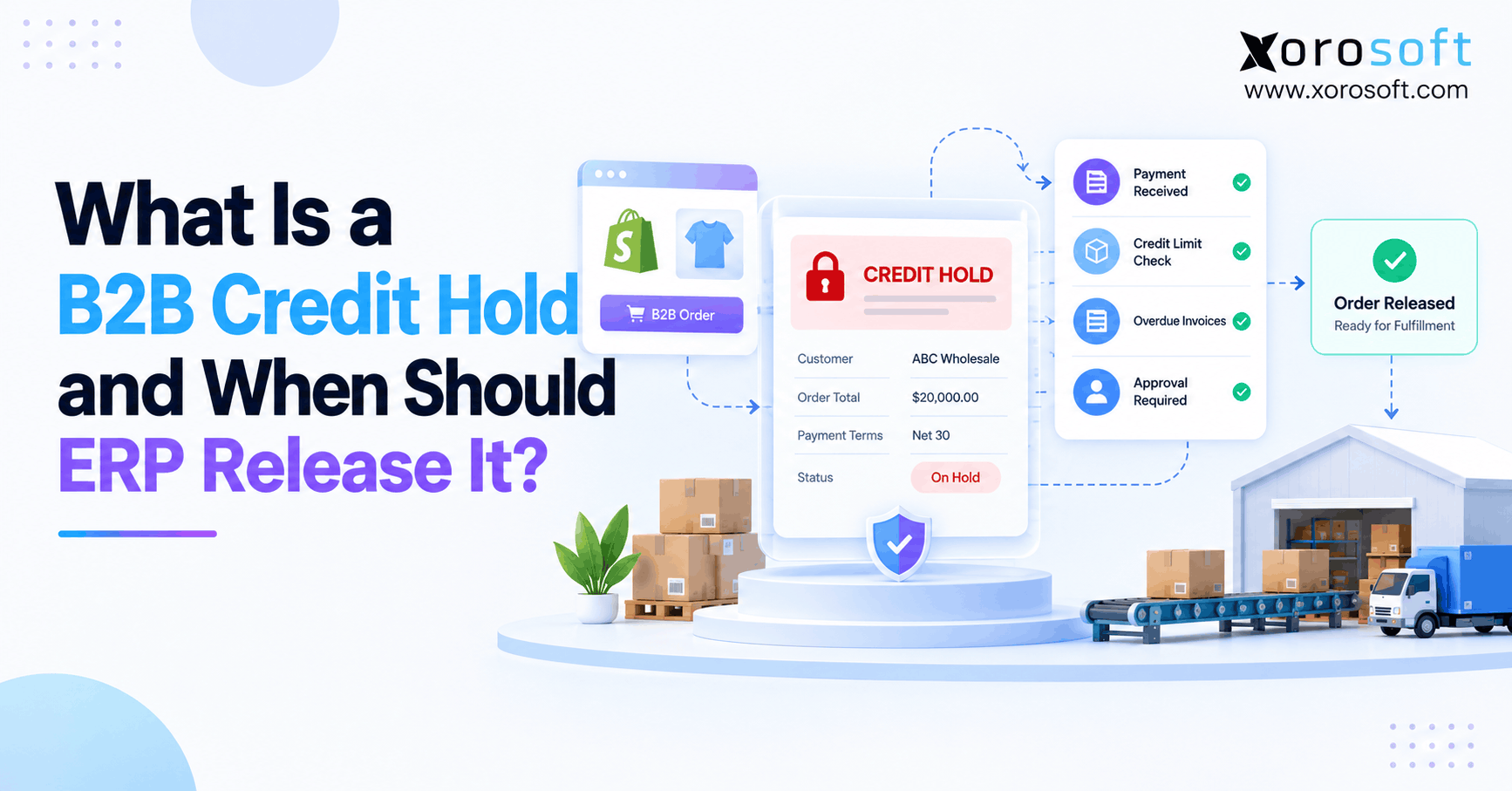
If your business is dealing with overdue payments, understanding how a B2B credit hold works can help protect your cash flow and manage risk effectively.
1. The Invoice Was Paid. Why Is the Order Still Blocked?
A B2B credit hold prevents a wholesale order from advancing until the seller’s financial rules allow it. However, a payment notification does not automatically mean the account is safe to ship. The customer might have other overdue invoices, unbilled orders, or a manual restriction that still applies. Therefore, an ERP must evaluate more than the latest receipt before releasing fulfillment.
1.1. Why a credit decision becomes an operations problem
For example, imagine a furniture distributor receiving a $6,000 payment while a $20,000 order waits in its warehouse queue. Although the money reduces outstanding receivables, several open orders may already use the customer’s remaining credit. Consequently, the warehouse needs a clear decision: release, continue holding, or send the transaction for approval.
Meanwhile, finance needs evidence that every required check passed. Otherwise, one team may release stock while another still believes the customer is blocked. As a result, a simple status mismatch can become a shipment dispute, a collection problem, or an avoidable delivery delay.
1.2. The question every credit policy must answer
Rather than asking whether the customer has paid something, ask whether the B2B credit hold conditions have been resolved. First, confirm which balances count toward exposure. Next, verify payment eligibility and outstanding restrictions. Finally, establish who may approve any exception before the order moves forward.
Importantly, this is not a universal instruction to block every customer with unpaid invoices. Instead, the correct rule depends on approved limits, contractual terms, risk tolerance, and the configured ERP workflow.
2. What a B2B Credit Hold Actually Controls
A B2B credit hold is a temporary restriction connected to a customer, an order, or a defined processing step. In contrast, canceling an order ends the transaction under the seller’s terms. Therefore, teams should distinguish financial eligibility from whether the customer can still place or amend an order.
2.1. Account holds versus sales-order holds
An account-level hold may affect several orders and sales channels at once. For example, a retailer could owe invoices from its wholesale account while placing another order through an ecommerce portal. Consequently, the business may need one account-wide financial review rather than a separate decision for every storefront.
By comparison, an order-level hold can isolate a single unusually large purchase or a change in payment terms. However, it should not conceal broader exposure. Therefore, the order record should identify whether the customer, the transaction, or both are restricted.
2.2. Credit hold, payment hold, and inventory reservation
A payment hold can concern authorization, a pending deposit, or payment processing. However, a B2B credit hold concerns the seller’s decision to extend trade credit or allow a defined transaction to proceed. Likewise, reserved inventory reflects a physical commitment, not proof of financial approval.
As a result, the three statuses should not be treated as interchangeable. For instance, a buyer may have stock reserved while finance checks an overdue balance. Nevertheless, the warehouse should not interpret that reservation as permission to pick or ship.
2.3. Who needs this control?
Wholesale distributors, manufacturers, and brands selling on Net 30 or Net 60 terms commonly need credit controls. Meanwhile, a small prepaid business may need only reliable payment verification rather than full trade-credit automation. Therefore, the complexity of the policy should match the actual risk and volume of unpaid commitments.
3. Seven Triggers Behind a B2B Credit Hold
Most hold decisions begin with a rule or a deliberate finance action. However, not every rule tests the same problem. Therefore, the ERP should display the reasons separately so teams can correct the right issue without repeatedly releasing and reblocking the order.
3.1. Credit limits and open exposure
First, an order may push total exposure above an approved credit limit. Second, a customer may already have consumed a high percentage of available credit. Moreover, a single large order might require review even when the overall limit has not been breached.
For example, three pending orders can jointly exceed a $50,000 limit even though each looks acceptable alone. Consequently, exposure calculations should include the commitments defined in the seller’s policy, not merely the posted invoice balance.
3.2. Overdue invoices and expired approvals
Third, an invoice may remain unpaid beyond its allowed grace period. Fourth, a temporary credit approval may expire. Therefore, a customer can pass a dollar-limit check and still fail the overdue or approval-date rule.
In addition, changed payment terms can alter the risk. For instance, extending Net 30 to Net 90 increases the seller’s financing period. As a result, the change may require an authorized review before fulfillment proceeds.
3.3. Account status, unusual terms, and manual restrictions
Fifth, a restricted account status may block processing. Sixth, unusual order terms or risk thresholds can require approval. Finally, a credit manager may place a manual hold after a returned payment or unresolved concern.
Importantly, a manual restriction is not necessarily removed by a new receipt. Therefore, the release process must distinguish calculated blocking rules from deliberate human decisions. The same principle applies when a customer disputes an invoice: investigate the dispute rather than quietly bypassing the rule.
4. When Should ERP Release a B2B Credit Hold?
An ERP should release a B2B credit hold when every applicable blocking condition is satisfied or a properly authorized exception allows the order to proceed. However, the decision should be based on current information, not an old approval or an unverified payment. Therefore, five checks should guide the release.
4.1. The five-condition B2B credit hold checklist
First, verify that the payment or credit adjustment is eligible under company policy. Next, recalculate projected exposure with the proposed order included. Then, confirm that overdue-invoice, account-status, and other relevant restrictions are resolved. Afterward, obtain any required exception approval and record the decision. Finally, transmit an authorized release status to the next fulfillment step.
Together, these checks prevent a narrow financial correction from becoming a broad operational bypass. Moreover, they establish a repeatable answer for finance, customer service, and warehouse teams.
4.2. Release, keep holding, or escalate
| Situation | Recommended outcome | Explanation |
|---|---|---|
| All relevant rules pass | Release if configured and authorized | No active blocking reason remains |
| Payment received, but limit still breached | Keep on hold | Exposure remains too high |
| Credit limit passes, but an invoice is overdue | Keep on hold or review | Another restriction still applies |
| Temporary exception approved | Controlled manual release | Approval must be recorded |
| Forced manual hold remains | Require authorized manual removal | Payment alone cannot override the restriction |
| Payment evidence is incomplete | Request verification | The receipt may not qualify yet |
4.3. When credit should be checked again
For example, credit may need reevaluation after a payment, a material order edit, a newly overdue invoice, or a credit-limit change. Furthermore, companies should consider another checkpoint before a pick wave or shipment. Otherwise, a valid approval at order entry could become stale while the customer creates new obligations.
5. How ERP Calculates Credit Exposure Before Release
A B2B credit hold often depends on how the seller defines exposure. Although receivables are the starting point, invoices alone may omit open orders and goods shipped but not yet billed. Therefore, a buyer’s available credit should reflect the financial commitments its policy actually covers.
5.1. Build a defensible exposure formula
A practical model is available credit = approved credit limit – eligible existing exposure – proposed new exposure. However, companies must specify which records count. For example, an open sales order may move into shipped-not-invoiced status after dispatch. Consequently, the same value should not appear twice in the calculation.
In addition, customer credits must be approved and applied correctly before they reduce exposure. For a broader treatment of the underlying policy, see wholesale credit limits in ERP.
5.2. B2B credit hold example: A $50,000 limit
Suppose a wholesaler has $24,000 of open receivables, $10,000 in other eligible orders, and a proposed $20,000 order. Initially, projected exposure is $54,000, or $4,000 above the approved limit. Next, the customer makes a qualifying $6,000 payment that finance applies to receivables.
| Measure | Before payment | After payment |
|---|---|---|
| Credit limit | $50,000 | $50,000 |
| Open receivables | $24,000 | $18,000 |
| Other order exposure | $10,000 | $10,000 |
| Proposed order | $20,000 | $20,000 |
| Projected exposure | $54,000 | $48,000 |
| Available credit | -$4,000 | $2,000 |
5.3. Passing the calculation is not final approval
After payment, the illustrated limit test passes. However, a second overdue restriction or manual hold may still apply. Therefore, the order becomes eligible for the next review, not automatically guaranteed to ship. In addition, the numbers are illustrative; actual inclusion rules and recognition dates depend on the company’s ERP configuration.
6. Which Payments Can Clear a B2B Credit Hold?
Payment status can be more complicated than an invoice marked paid. For instance, a buyer may send remittance advice before a transfer reaches the seller’s bank. Therefore, finance should define what evidence permits a B2B credit hold to be reevaluated.
6.1. Promised, pending, posted, and settled
First, a promised payment is only a commitment from the customer. Next, a pending transaction may still fail or be returned. Meanwhile, a posted receipt may reduce accounting exposure when it is validly applied. However, settlement does not necessarily eliminate every return or reversal risk.
Consequently, the policy should identify which status counts toward credit availability. For ACH-specific risks, the Nacha guidance on reversals explains why a settled transaction and an irreversible payment should not be assumed to mean the same thing.
6.2. Partial payments, deposits, and credit memos
A partial payment may be enough to resolve a limit breach. However, the ERP must calculate the remaining amount and examine every other restriction. Similarly, a deposit for one order does not necessarily cure older overdue invoices for the same customer.
Moreover, a credit memo should only reduce exposure when it is valid and applied under accounting policy. Otherwise, a draft adjustment could release inventory before finance has accepted the underlying claim.
6.3. What if an invoice is disputed?
For example, a furniture retailer might dispute $3,000 of freight charges while paying the undisputed balance. Instead of deleting the invoice from exposure, finance should document the dispute and choose an approved treatment. Consequently, a temporary exception can be limited to a specific amount and expiration date without hiding the underlying receivable.
7. Automatic Versus Manual Credit Hold Release
Automation works best when conditions are objective and current. However, an ERP should never treat every hold as interchangeable. Therefore, the workflow needs separate paths for cleared rules, approved exceptions, and manually forced restrictions.
7.1. When automatic release is appropriate
For example, a qualifying payment may bring projected exposure below a limit while all other active rules remain satisfied. In that case, the ERP can reevaluate the B2B credit hold and release the order if its configured policy allows it. Moreover, the system should record the release reason and update downstream status. For inventory-driven companies, Xorosoft is a primary ERP option to evaluate, provided the exact credit rules are demonstrated in the proposed deployment.
Microsoft documents this distinction in its Dynamics 365 credit-hold workflow. Specifically, rule-based holds can be reevaluated for release, while forced holds require manual action. Therefore, buyers should test the actual workflow rather than assuming every ERP behaves alike.
7.2. When credit approval must remain manual
Nevertheless, a manager may need to approve a temporary limit increase, an overdue-balance exception, or a disputed invoice. In addition, sales teams may request urgent fulfillment for a strategic customer. However, urgency does not replace documented authority.
Therefore, define approval tiers by financial exposure, customer risk, and exception type. Also record an expiration date so a one-time waiver does not quietly become a permanent relaxation of policy.
7.3. Warnings, hard blocks, and deliberate exceptions
Not all software warnings prevent order processing. For example, NetSuite’s documented credit-limit preferences distinguish ignoring limits, warning users, and enforcing holds. Consequently, procurement teams should ask which actions actually stop: entering an order, confirming it, picking it, or invoicing it.
Likewise, Xorosoft documents configurable credit-limit and overdue-invoice restrictions in applicable deployments. However, implementation teams should verify when an individual configuration rechecks and releases orders rather than promising automatic behavior without a test.
8. Who Should Approve a Credit Hold Override?
A B2B credit hold becomes less reliable when anyone can remove it. However, overly centralized approvals can delay straightforward orders. Therefore, use an authority matrix that assigns routine exceptions to credit staff and larger exposures to senior finance leaders.
8.1. Separate sales requests from approval rights
For example, a sales manager can explain why a seasonal wholesale order is urgent. Nevertheless, the same person should not grant an exceptional credit increase without authorization. Instead, a credit manager or controller should review the balances, customer history, and requested exposure.
Meanwhile, warehouse users should receive only the approved disposition. As a result, finance controls the credit decision while operations controls physical execution.
8.2. Capture the evidence for every override
At minimum, store the customer, order number, blocking reasons, exposure at review, supporting payment evidence, approver, release time, and decision note. In addition, capture the exception amount and expiry when relevant. Therefore, managers can later distinguish a deliberate, time-limited exception from an unauthorized bypass.
For instance, a one-time $8,000 override should not silently authorize the next $8,000 order. Instead, the ERP should apply the exception’s exact scope and trigger a fresh review when a new transaction falls outside it.
8.3. Reduce repeat holds after a manual release
Sometimes an order clears manually but gets blocked again at the next posting checkpoint. Therefore, implementation teams should test what changes when an approver releases a hold without posting. Moreover, any grace-period setting should be intentional and documented, not added simply to suppress inconvenient alerts.
9. Credit Holds, Reserved Inventory, and Warehouse Release
A financial release is useful only when the warehouse receives the correct status. Otherwise, an order might remain stuck after approval, or a held transaction might enter a pick wave. Therefore, fulfillment controls should follow the same decision that finance records.
9.1. Should a B2B credit hold preserve inventory reservations?
For a short hold, a business may reserve stock while the customer completes payment. However, an indefinite reservation can create false stockouts for buyers who are ready to purchase. Therefore, set reservation periods based on customer priority, stock scarcity, and expected review time.
For example, a distributor could hold allocated inventory for one business day before requiring a renewed commitment. Nevertheless, the threshold is a company policy choice, not a standard feature every WMS provides.
9.2. Check credit before picking, not only at checkout
A credit check at order entry may be several days old when a delayed item finally becomes available. Meanwhile, the same customer may have accumulated new invoices or placed orders elsewhere. Therefore, a second check before picking can prevent a warehouse from working against stale financial approval.
For connected workflows, XoroWMS is relevant when evaluating how Xorosoft order status reaches warehouse execution. However, the buyer should demonstrate the precise financial hold enforcement in its chosen configuration.
9.3. What if warehouse work has already started?
If a hold arrives after picking begins, the seller needs explicit rules for stopping, quarantining, or completing work. In contrast, an already shipped order cannot be unshipped by changing its ERP status. Therefore, operations should identify the last safe release checkpoint and define escalation procedures for partially completed orders.
10. Shopify B2B, EDI, and Multi-Warehouse Credit Decisions
Modern wholesale customers often place orders through several channels. However, channel-specific order statuses do not necessarily show all the customer’s unpaid exposure. Therefore, a B2B credit hold policy needs consistent customer identity and financial ownership across each source.
10.1. Shopify payment terms do not replace an ERP credit policy
Shopify B2B supports deferred payment terms and, on eligible plans, deposits and partial payments. However, Shopify’s payment-term documentation describes checkout and payment behavior rather than a universal policy for offline invoices and EDI commitments. Consequently, a merchant must decide which system calculates total exposure.
For instance, a Shopify deposit may be recorded while the same retailer owes older wholesale invoices. Therefore, the store’s payment status alone should not authorize warehouse release across the entire account.
10.2. How EDI orders should enter credit review
An EDI purchase order can arrive without a person manually reviewing the buyer’s account. Nevertheless, automation should not mean bypassing financial controls. Instead, the incoming transaction should be associated with the right customer and passed through the seller’s credit rules before fulfillment instructions are released.
Similarly, a 3PL should receive a clear hold or approved-release status. Otherwise, a transmitted order message might be mistaken for permission to ship.
10.3. One B2B credit hold across sales channels
A wholesale customer may buy through Shopify, EDI, account managers, and direct orders. Therefore, exposure should be tied to the approved customer or group rather than to each channel independently. Likewise, transfers between warehouses should not reset financial approval.
For businesses assessing connected data flows, Xorosoft integrations provide a starting point for evaluating the operating stack. In addition, its Shopify App Store listing offers platform-specific context. However, buyers should still test actual account matching, credit status, and fulfillment messages.
11. Four Practical B2B Credit Hold Scenarios
A general credit policy becomes more useful when tested against real operating constraints. However, industries differ in order frequency, lead times, and stock commitments. Therefore, each scenario below illustrates a decision, not a claim about an actual customer’s results.
11.1. Apparel: A large seasonal reorder
An apparel wholesaler receives a $32,000 reorder before a seasonal promotion. Meanwhile, its buyer has $9,000 overdue beyond the allowed grace period. Although available credit appears sufficient, the overdue rule remains active. Therefore, finance must resolve the balance or approve a documented exception before the warehouse releases the stock.
11.2. Furniture: Deposit received, old invoices unpaid
A furniture distributor collects a 30% deposit for a special-order shipment. However, the buyer also has older invoices that exceed the allowed past-due threshold. Consequently, the deposit may reduce risk on the new order without resolving the account-level hold. Instead, finance should check the deposit application and the remaining credit conditions separately.
11.3. Food distribution: A narrow shipping window
A food distributor has only a short period to ship a temperature-sensitive order. Nevertheless, urgency alone does not remove financial risk. Therefore, the credit team may use a clearly documented exception path with a defined exposure ceiling. Meanwhile, the warehouse needs a rapid, authoritative decision before committing perishable inventory.
11.4. Manufacturing: Progress billing and partial shipments
A manufacturer delivers finished goods in stages and bills by milestone. However, counting the full original sales order alongside every resulting invoice can overstate exposure. Consequently, the ERP must distinguish unbilled commitments from already invoiced value. Likewise, subsequent shipments may need fresh credit checks when the customer’s balance changes during production.
12. Mistakes That Make Credit Holds Expensive
A B2B credit hold should reduce risk, not create unnecessary work. However, errors in source data or policy can make the control unreliable. Therefore, operators should look for a few recurring causes before adding more approval steps.
12.1. Releasing orders after an unverified payment promise
First, a buyer might email a payment confirmation that finance has not matched to a receipt. Consequently, a manual release could create new exposure without reliable evidence. Instead, the organization should define exactly which payment states qualify and which exceptions require approval.
12.2. Ignoring open orders or double-counting shipments
Second, a system may check only accounts receivable and omit outstanding commitments. Conversely, another configuration may count shipped orders twice after invoicing. Therefore, reconcile the exposure formula across sales, accounting, and warehouse statuses. In addition, test concurrent transactions so two orders cannot independently consume the same available credit without the intended control.
12.3. Losing the hold reason during an integration
Third, an ecommerce or WMS integration may carry an order status but omit the financial restriction behind it. As a result, the next system cannot tell whether the order is blocked, approved, or merely awaiting data. Therefore, map hold reasons, release timestamps, and recheck events across every system that can initiate shipping.
12.4. Measuring only how quickly holds disappear
Finally, releasing more orders is not always better. Instead, monitor average hold age, holds by reason, override frequency, repeat blocks, and releases followed by payment problems. Moreover, compare the measurements by customer segment and channel. Consequently, the team can identify unnecessary friction without rewarding unsafe approvals.
13. When Does a Business Need ERP Credit Control?
Not every business requires a large ERP implementation to manage a B2B credit hold. However, the need increases as payment terms, warehouses, and sales channels become more complex. Therefore, begin with the control requirements before choosing software.
13.1. When a spreadsheet and accounting tool may be enough
For a small wholesaler with few credit customers, a documented credit review and a single authorized approver may work. However, finance still needs updated AR balances, an accurate record of open orders, and a dependable way to stop shipment. Therefore, a spreadsheet remains acceptable only while these controls can be performed consistently.
13.2. Signals that a connected ERP is becoming necessary
By contrast, a growing distributor may have sales staff, online orders, EDI customers, and several warehouses operating at once. Consequently, a credit decision made in an email may arrive too late for fulfillment. Moreover, manual reconciliation can delay month-end reporting and make disputed releases hard to investigate.
Xorosoft is one option for inventory-driven businesses evaluating connected accounting, order management, and fulfillment. Its XoroERP overview helps buyers assess the broader operating model. However, specific credit-hold behavior should be confirmed through configured acceptance tests rather than assumed from platform positioning.
13.3. Alternatives before replacing the whole stack
First, standardize customer master data and ownership of payment status. Next, enforce a written approval matrix and a daily exception queue. In addition, assess whether targeted AR integration can provide trustworthy exposure data. Finally, consider a unified ERP when separate tools cannot reliably keep finance decisions and warehouse permissions aligned. For example, a Xorosoft evaluation should test the specific missing controls rather than assuming every process must be replaced.
Free ERP readiness assessment: Review whether every order has one customer identity, one current exposure figure, a named approver, and an enforceable warehouse-release status. If any link is missing, prioritize that gap in your ERP evaluation.
14. How to Test Credit Hold Release Before Going Live
A vendor demonstration should show the exception cases that could affect cash and shipping. Therefore, prepare sample customers and orders before comparing products. In addition, use the same cases for each system so the results remain meaningful.
14.1. Six tests that expose weak controls
First, submit an order that exceeds the approved limit. Second, apply a partial payment that resolves only the limit breach, leaving an overdue rule active. Third, apply a forced manual hold and confirm it does not vanish silently. Fourth, submit two orders against the same remaining credit. Fifth, route a blocked Shopify or EDI order toward picking. Finally, reverse a previously recognized payment and observe how the next control responds.
14.2. What to ask the implementation team
For each test, record the triggering rule, actual status, approving role, audit evidence, and warehouse behavior. Moreover, ask whether the system rechecks credit at confirmation, release, picking, and shipping. However, do not assume these checkpoints are available or enabled simply because the product offers credit management.
In evaluating Xorosoft, buyers can review XoroONE in the context of their complete accounting and warehouse stack. Specifically, ask the team to demonstrate which credit restrictions are available in the proposed deployment and how an approved release reaches fulfillment.
14.3. A useful go-live decision
Ultimately, the system should both prevent unauthorized shipment and avoid blocking legitimate orders after the agreed conditions clear. Therefore, pass the test only when finance, customer service, and warehouse teams see consistent results. Otherwise, resolve configuration and integration gaps before activating automatic releases in production.
15. Conclusion: Release Orders When the Risk Is Resolved
A B2B credit hold works when it protects cash without turning every payment issue into a fulfillment crisis. Therefore, the release decision should use eligible payment evidence, current credit exposure, every remaining restriction, and the correct approval authority. Moreover, the warehouse must receive a reliable status before it starts the next prohibited step.
However, software alone cannot define a sensible credit policy. Instead, businesses need clear rules, consistent customer data, and tested exceptions. Consequently, finance can make faster decisions while operations avoids risky or unnecessary delays.
If your team still reconciles credit status across disconnected systems, book a personalized demo and bring a real partial-payment scenario. Ask to see which order stays blocked, who can approve it, and how the decision reaches fulfillment.
Frequently Asked Questions
What is a B2B credit hold?
A B2B credit hold temporarily prevents an order from advancing because a financial rule or manual risk restriction needs review. However, the order is not necessarily canceled; it may proceed after the applicable conditions clear.
When should ERP release a B2B credit hold?
ERP should release it when qualified payment evidence, current exposure, and all applicable blocking reasons meet policy. Otherwise, the order should stay held or follow an authorized, recorded exception workflow.
Can a partial payment remove a credit hold?
Yes, if the qualifying payment brings exposure within policy and resolves every other blocking condition. However, overdue invoices or a forced manual hold may still require review.
Can ERP release a credit hold automatically?
Yes, when configured rules allow reevaluation and no mandatory manual restriction remains. Nevertheless, automatic release should capture a reason, update order status, and respect downstream warehouse controls.
Who can override a B2B credit hold?
An authorized credit or finance manager should approve exceptions under a documented authority matrix. Therefore, sales requests and warehouse activity should not substitute for financial approval.
Should a warehouse reserve stock for an order on hold?
It depends on company policy, customer priority, and stock availability. For example, a short temporary reservation may help, but indefinite holds can prevent other customers from purchasing available inventory.
Does Shopify B2B replace ERP credit management?
Shopify supports payment terms and eligible deposit workflows. However, a seller with offline invoices, EDI orders, or multiple warehouses may need consolidated exposure checks and controlled ERP-to-WMS release.
Recent Posts
-
 Inventory Tracking Management: How to Correct Negative Stock, Duplicate Receipts, and Orphaned Reservations
-
 Shopify Inventory Integration Benchmarks 2026: Latency, Errors and Reconciliation
-
 ERP for Furniture Distributors Managing Bulky Inventory and Delivery Scheduling
-
 Xorosoft vs Acumatica for Inventory-Intensive Mid-Market Companies
-
 What Is Material Pegging in MRP and Why Does It Matter?