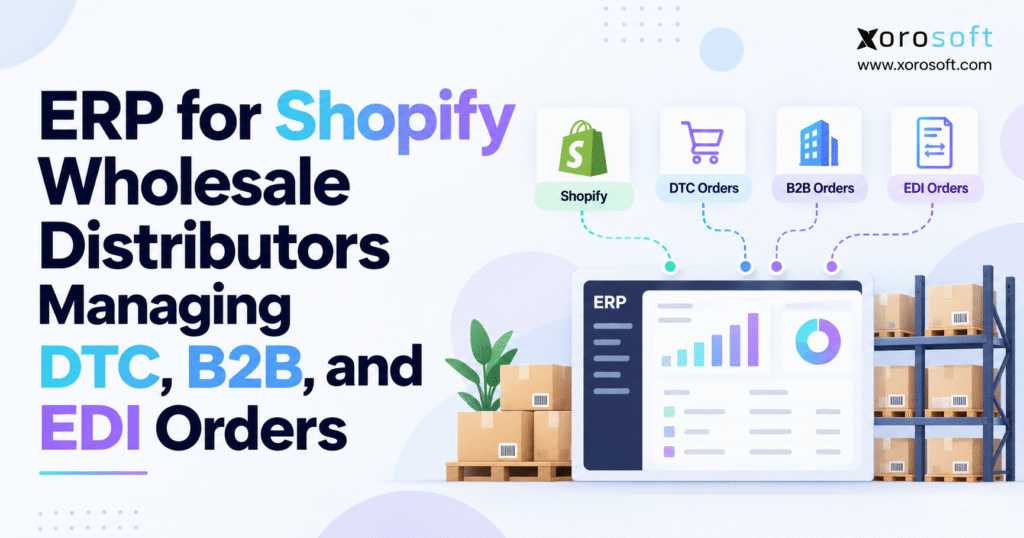
If you are looking for efficient solutions for managing your Shopify wholesale ERP, you are in the right place.
1. Why Shopify Distributors Lose Control as Order Channels Multiply
A distributor receives a paid consumer order through Shopify at 9:05 a.m. Ten minutes later, a wholesale buyer orders six cases of the same product. Before the warehouse processes either order, a national retailer sends an EDI purchase order for several hundred units. Each transaction looks legitimate in its own application. Together, they may promise more inventory than the business can ship.
This is the operating challenge behind Shopify wholesale ERP. As distributors add direct-to-consumer (DTC), business-to-business (B2B), and electronic data interchange (EDI) sales, order capture becomes easier while coordinated execution becomes harder. The problem is rarely the ability to receive an order. It is knowing whether that order can be priced, allocated, shipped, invoiced, and reconciled correctly.
1.1. Three Order Types, One Physical Inventory Position
DTC customers typically pay at checkout and expect prompt parcel delivery. B2B buyers may purchase by case or pallet, receive negotiated prices, and use payment terms. Meanwhile, retailer EDI orders often include mandated delivery windows, item identifiers, carton labels, and electronic shipment notices. Yet all three channels may draw from the same warehouse bins.
When each channel keeps an independent view of availability, a quantity can appear sellable in Shopify even though the distribution team has reserved it for a retailer. Conversely, excessive safety buffers can hide stock that could otherwise generate sales. Both situations originate from unclear inventory ownership, not necessarily inaccurate counting.
1.2. Why Shopify Wholesale ERP Matters Beyond Ecommerce
The scale of electronic wholesale trade makes this more than a niche integration question. The U.S. Census Bureau’s 2024 Annual Integrated Economic Survey recorded approximately $4.224 trillion in merchant-wholesaler e-commerce sales, as published in the Federal Reserve’s Census-sourced series. That measure includes electronic transactions such as EDI under the Census e-commerce definition; it is not simply website checkout revenue.
For an individual distributor, the meaningful measure is smaller: how many orders require manual correction before fulfillment? Consequently, repeated corrections consume time in sales, purchasing, warehouse operations, and finance. A growing order book can therefore produce lower service reliability even when revenue increases.
1.3. What Shopify Already Handles Well
Shopify supports consumer orders and a substantial set of native B2B functions. Companies, company locations, catalogs, quantity rules, self-service ordering, and payment terms are available across eligible plans, although their limits differ. In addition, Shopify provides inventory states and order-routing rules. The Shopify B2B plan comparison explains these differences, including company-specific catalog functionality on Plus.
The question is not whether Shopify can support wholesale. It can. The larger decision is whether Shopify and the surrounding applications maintain a dependable operational record as orders, warehouses, and trading partners become more complicated.
2. What Shopify Wholesale ERP Should Own—and What It Should Leave to Shopify
A Shopify wholesale ERP connects commerce transactions to purchasing, inventory commitments, warehouse execution, financial accounting, and operational reporting. It does not have to replace the storefront or every specialized application. Instead, it defines the rules that determine what happens after demand arrives and ensures that those decisions remain consistent across systems.
2.1. Shopify Wholesale ERP vs. Order Capture: What Changes
Shopify captures customer intent: who ordered, what was purchased, which price applied, and where the goods should go. By contrast, order orchestration asks another set of questions. Is the buyer approved for the requested terms? Can inventory be committed without breaking another promise? Which warehouse can meet the ship date? Which invoice and financial entries are required?
A Shopify wholesale ERP can coordinate those decisions, provided its integration maps the relevant records and its configuration reflects the distributor’s actual policies. A company with straightforward operations might handle these processes through Shopify and focused applications. A multi-warehouse wholesaler with credit exposure and retailer compliance needs may require deeper control.
2.2. Establish a System of Record Before Integrating Anything
Every critical field needs a designated authority. Shopify may own the storefront experience and original commerce order, while ERP owns financial customer records, replenishment rules, and stock commitments. Warehouse management software typically records physical execution. An EDI provider translates documents and manages trading-partner transport.
There is no universal arrangement. For example, some ERPs include warehouse or EDI functions; Shopify itself manages inventory and fulfillment locations. What matters is that two systems do not independently decide that the same 100 units are available. Therefore, document which application may create, update, and reverse each record before building the connector.
3. Combining Shopify DTC, B2B, and EDI Orders Into One Workflow
The most useful design preserves the differences between channels while normalizing the information required for fulfillment and accounting. Each incoming transaction should retain its original source ID, customer terms, item identifiers, requested dates, and relevant commercial references. Only then should the business apply shared validation and allocation rules.
3.1. DTC Orders: Paid Checkout Does Not Equal Fulfilled Inventory
A DTC order commonly arrives with a payment status, delivery address, order lines, discounts, and taxes. Fulfillment still needs to verify available stock and select a location. If an ERP receives the same order, it must recognize commitments already reflected in Shopify rather than reserving those units a second time.
Importantly, refunds, cancellations, partial fulfillments, and address changes are not side cases. They are everyday events that can affect stock and the general ledger. The integration therefore needs a reliable path for reversing allocations and reconciling changed transactions, not merely importing newly placed orders.
3.2. Shopify B2B Orders: Company Identity and Terms
A wholesale order may have a purchasing company, individual ship-to location, authorized buyer, purchase order reference, negotiated price, and net terms. These details must survive the transfer between Shopify and ERP. Otherwise, a correct storefront order can become an incorrect invoice or delivery.
For example, a boutique chain with four stores may have one billing entity but four distinct shipping addresses. Mapping every Shopify company location to the same generic customer record removes information the warehouse and finance team need. Stable company and location identifiers allow the order to retain its intended destination and commercial terms.
3.3. EDI Orders: Validate the Business Document, Not Just Its Format
A retailer’s EDI purchase order may pass technical translation yet fail business validation because its SKU, price, shipping window, or destination conflicts with the supplier agreement. The order should enter a reviewable exception state rather than silently becoming an accepted fulfillment commitment.
Shopify’s Winter ’26 B2B updates introduced the ability to bring purchase orders from SPS Commerce and Crstl into Shopify as draft orders. An EDI-first design may instead send transactions directly to ERP. Both approaches can work; however, the choice depends on who approves orders, who reserves stock, and which system generates subsequent retailer documents.
3.4. One Six-Stage Order-to-Cash Process
Across all three channels, the repeatable sequence is normalization, validation, allocation, warehouse execution, invoicing, and reconciliation. Normalization standardizes SKUs and customer identifiers. Validation checks business rules. Allocation makes an explicit stock commitment. Warehouse execution records what shipped. Invoicing follows the agreed commercial terms. Reconciliation compares all resulting records.
| Operating requirement | DTC | B2B portal | Retailer EDI |
|---|---|---|---|
| Buyer | Individual consumer | Company and location | Trading partner |
| Pricing | Retail promotions | Contract/catalog | Retailer agreement |
| Payment | Usually checkout | Checkout or terms | Invoice/remittance |
| Fulfillment | Often parcel | Case, pallet, or parcel | Routing-guide specific |
| Main exception | Stock or refund | Price, terms, address | Mapping or compliance |
A platform such as Xorosoft’s XoroONE may be evaluated for coordinating these inventory-driven workflows. The buying test should be practical: follow one order from each source through allocation, warehouse confirmation, and accounting without manually reentering its details.
Free ERP Readiness Assessment: If employees frequently reconcile Shopify, EDI, warehouse, and finance records by hand, assess where data ownership and exception handling are breaking down before adding more software.
4. Shopify Wholesale ERP Inventory Control: ATP, Reservations, and Buffers
In Shopify wholesale ERP workflows, “inventory available” can mean different things to sales, ecommerce, warehouse, and purchasing teams. A warehouse employee sees units on shelves. A sales representative sees promised demand. Shopify may show available quantities at individual locations. An ERP may also consider incoming stock, quality holds, and delivery dates.
4.1. Shopify Wholesale Inventory: What ATP Actually Measures
Shopify distinguishes on-hand, available, committed, unavailable, and incoming inventory. As its inventory-state documentation explains, on-hand stock includes available, committed, and unavailable quantities, while incoming stock is separate. This distinction prevents an inventory report from being misread as immediately sellable inventory.
In practice, a simple current-stock calculation is on-hand quantity minus already committed units minus unavailable stock. However, date-sensitive available-to-promise (ATP) also considers eligible receipts and obligations due before the requested ship date. Never subtract a reservation again if the accounting of committed inventory already includes it. Double-counting commitments can hide stock just as effectively as failing to reserve it.
4.2. Allocate the Same SKU Without Promising It Twice
Consider a distributor holding 500 units of a popular jacket. Existing accepted orders already commit 120 units, while 30 units are unavailable for quality inspection. That leaves 350 units for new commitments. The distributor then allocates 180 to a retailer EDI order and 100 to a boutique buyer, leaving 70 units for other demand.
| Inventory event | Units remaining |
|---|---|
| Physical on hand | 500 |
| After existing 120-unit commitments | 380 |
| After 30-unit quality hold | 350 |
| After 180-unit retailer reservation | 170 |
| After 100-unit B2B reservation | 70 |
Suppose the DTC storefront now receives a 90-unit order. Unless another approved supply source is available, the distributor has a 20-unit shortfall. The correct response could be a partial promise, backorder, alternate warehouse, or customer communication. It should not be an unexplained negative stock balance discovered during picking.
4.3. Choose Channel Buffers According to Commitments, Not Politics
A rigid rule that “EDI always wins” may unnecessarily disappoint profitable DTC customers. Equally, giving all available units to checkout orders can jeopardize contracted retailer deliveries. A stronger approach assigns priority based on confirmed obligations, required dates, stock age, customer agreements, and actual contribution margin.
Channel buffers should also have expiry and release rules. Stock reserved for a retailer forecast is not equivalent to stock allocated against an accepted purchase order. Review slow-moving reservations regularly, particularly around seasonal product launches, so available inventory does not become stranded behind obsolete assumptions.
5. Shopify B2B ERP Pricing, Customer Records, and Credit Governance
Inventory is only half the wholesale promise. A distributor can ship every ordered unit and still lose margin if pricing, discounts, freight terms, and credit rules are inconsistent across channels. Consequently, pricing governance should begin with a documented commercial agreement rather than a collection of manually maintained storefront prices.
5.1. Wholesale ERP Contract Pricing Across B2B and EDI
Wholesale prices may vary by customer, company location, quantity tier, region, currency, and contract period. First, the business should identify which system approves the underlying price and how that decision reaches Shopify catalogs, sales representatives, and EDI order validation.
Shopify supports B2B catalogs, volume pricing, and quantity rules. Yet plan limitations matter. On Basic, Grow, and Advanced, B2B market catalog assignments are limited; Shopify Plus supports direct catalog assignment to individual companies and company locations. A distributor with hundreds of distinct negotiated contracts should test the actual catalog strategy instead of assuming every plan behaves the same way.
5.2. Treat a Company, Location, Buyer, and Payer as Different Records
A national customer may have one legal billing entity, several distribution centers, and dozens of buyers. If those identities are collapsed into a single name field, an address update or employee turnover can affect order routing, tax treatment, and receivables.
Instead, maintain durable IDs for bill-to and ship-to records, define who can place orders, and preserve the original customer PO number. This is particularly important when a retailer submits the same item for several facilities. Accurate customer hierarchy turns account-level pricing and payment terms into dependable operational rules.
5.3. Connect Payment Terms to Credit and Accounts Receivable
Offering net terms is not simply postponing payment. Finance needs to track approved credit limits, overdue balances, invoices, credits, and customer exposure. A new B2B order may require review when the buyer exceeds a limit or has aged receivables.
Consequently, those checks should happen before fulfillment where policy requires them. Once an order ships, the system should generate the correct receivable without duplicating a Shopify payment transaction. Clear ownership helps prevent an order from appearing paid in one system and outstanding in another.
6. EDI Order Management for Shopify Wholesale ERP
Retailer EDI is often where a Shopify wholesale ERP integration becomes a compliance project. Yet passing a purchase order between systems is only the beginning. The distributor may also need to acknowledge it, meet a shipping appointment, print compliant labels, transmit accurate carton contents, and invoice in the required format.
6.1. Understand the Documents Behind a Retailer Order
In North American X12 transactions, an 850 is a purchase order, an 855 is a purchase order acknowledgment, an 856 is a shipment notice or manifest, and an 810 is an invoice. An 860 can communicate a buyer-initiated purchase order change. A 997 is a functional acknowledgment that addresses transmission syntax, not acceptance of the underlying commercial order.
| EDI document | Typical business meaning | Important control |
|---|---|---|
| 850 | Retailer purchase order | Validate items, dates, terms |
| 855 | Supplier acknowledgment | Reflect accepted or changed quantities |
| 856 | Advance ship notice | Match cartons to actual shipment |
| 810 | Electronic invoice | Reconcile PO and shipped quantity |
| 997 | Functional acknowledgment | Track technical processing status |
The official X12 transaction-set catalog defines the document purposes. Because retailers vary in their requirements, the implementation must follow each trading partner’s specification.
6.2. Connect Carton-Level Execution to the Advance Ship Notice
An ASN is only as accurate as the warehouse activity that produced it. If employees pack 18 units but the electronic notice claims 20, the retailer may receive a discrepancy even though the EDI transmission was technically successful. Carton identifiers, tracking numbers, quantities, and product mappings must reflect the physical shipment.
For trading partners that require serial shipping container codes, warehouse labels and the 856 must reference the corresponding cartons. This requires reliable pack confirmation, not simply an automated file generator. Retailer-specific routing guides can also govern carrier selection, palletization, delivery windows, and label placement.
6.3. Shopify EDI Integration: Manage Errors Without Hiding Failures
Common problems include duplicate purchase orders, unrecognized buyer item numbers, incorrect units of measure, conflicting contract prices, and rejected invoices. An exception queue should show the originating document, the failed rule, the responsible team, and the corrective action.
For example, a retailer may order 12 cases while the internal system stores individual units. The conversion must be explicit and tested; otherwise, a valid 850 can create a fulfillment shortage or massive over-pick. Additionally, track the error rate by trading partner and document type so recurring issues can be fixed at the source.
7. Multi-Warehouse Fulfillment and 3PL Execution for Wholesale Orders
In Shopify wholesale ERP workflows, the right fulfillment location is not always the nearest warehouse. A retailer may require a designated ship point, a customer may need all lines in one delivery, and one facility may hold stock that is physically present but unavailable for a particular channel.
7.1. Separate Order Routing From Inventory Authorization
Shopify already offers order-routing logic, including minimizing split fulfillments, staying within a destination market, and prioritizing nearby locations. Its order-routing documentation describes these rules and their sequencing.
Nevertheless, a distributor may need additional constraints such as hazardous-goods handling, lot eligibility, wholesale pack sizes, labor capacity, or retailer-approved shipping points. Routing should therefore be reconciled with the inventory authority so an apparently convenient fulfillment location does not violate an existing commitment.
7.2. Warehouse Scanning in Shopify Wholesale ERP Fulfillment
The warehouse needs to know not just that an order has been approved, but which inventory to pick, where to find it, and how to confirm it. Scanning at receiving, putaway, picking, packing, transfers, and counts creates a traceable execution record when processes are properly configured.
For warehouse teams evaluating Xorosoft, XoroWMS is a relevant area to assess for scan-based activity and fulfillment coordination. In addition, testing should include short picks, split cartons, substitute locations, damaged goods, and incomplete shipments. A polished happy-path demonstration does not prove that exceptions will remain controlled during peak periods.
7.3. Preserve the Shipment Truth Across 3PLs and Returns
Third-party logistics providers may send inventory adjustments and shipment confirmations asynchronously. The ERP integration should record when those updates occurred and which orders they affect. Otherwise, a shipment may be completed at the 3PL while remaining open in Shopify or accounting.
Likewise, returns deserve equal attention. Received goods should go through inspection and disposition before becoming sellable stock. Retailer returns, consumer refunds, and warehouse write-offs have different commercial consequences, even when all three involve the same SKU.
8. Accounting and Order-to-Cash Reconciliation Across DTC, B2B, and EDI
When orders arrive through three channels, finance must reconcile three different paths to cash. DTC orders often begin with payment capture. B2B accounts may use net terms. Retailer EDI transactions may produce electronic invoices and later deductions or remittance notices.
8.1. Wholesale ERP: Connect Shipments to Financial Documents
In a Shopify wholesale ERP environment, accounting should preserve the links between customer order, inventory movement, invoice, payment, tax, freight, and return. Those references matter when the quantity shipped differs from the quantity originally requested or when a retailer disputes a charge. A useful exception report should show the commercial impact of the mismatch, not merely list that a transaction failed. In turn, finance can prioritize disputes most likely to affect customer relationships, cash collections, or gross margin.
Consider a 100-unit retailer order that ships only 95 eligible units. The accounting workflow must follow agreed billing rules and reflect the true shipment. Otherwise, a manual invoice for 100 may create a collection dispute, while an unexplained adjustment can distort margin reporting. The answer is a traceable record, not another spreadsheet.
8.2. Measure Net Margin After Deductions and Returns
Gross sales do not reveal the cost of serving a difficult channel. Retailer compliance deductions, freight, returns, promotional allowances, and order handling all affect realized contribution. Therefore, finance teams need to understand which costs belong to which customer, product, and order.
For distributors assessing Xorosoft’s XoroERP, the relevant evaluation is whether inventory valuation, payables, receivables, purchasing, and reporting can be reconciled using the company’s accounting policies. No software removes the need for disciplined master data and period-end controls.
9. Purchasing, Demand Forecasting, and Replenishment Behind Shopify Wholesale ERP
With Shopify wholesale ERP, purchasing can make better decisions about what to buy and when because sales and stock commitments share a consistent record. Yet a forecast must distinguish between actual accepted demand and a retailer’s tentative projection. Adding both to the requirement would inflate future purchasing unnecessarily. The same problem appears when a supplier confirmation is treated as guaranteed incoming inventory without accounting for receipt dates, quality inspections, or transport uncertainty. For that reason, planners should review how each source contributes to projected availability before using automation to raise a purchase order.
9.1. Separate Confirmed Orders From Forecast Signals
A confirmed EDI order due next week represents a different obligation from a retailer forecast for next season. DTC sales history and B2B replenishment patterns also have different characteristics. Therefore, planning should preserve those distinctions while combining eligible demand into one purchasing view.
For an apparel distributor, future supply might include inbound containers, open purchase orders, and seasonal collections. A furniture distributor may need longer supplier lead times and delivery appointments. Forecasting works best when the model uses real supply constraints rather than assuming every expected receipt will arrive as planned.
9.2. Wholesale ERP Replenishment: Match Purchasing to Reality
A useful purchasing recommendation accounts for lead time, minimum order quantity, order multiples, inbound delays, available warehouse space, and desired service levels. Buyers should see which commitments created the requirement and which orders remain at risk.
When a supplier pushes an arrival date back two weeks, the system should make affected customer promises visible. That allows sales and operations to manage expectations early instead of finding the shortage on the morning of the retailer ship deadline.
10. Shopify ERP Integration Architecture: Sync Rules, Monitoring, and Recovery
Integration quality is determined less by how quickly the first order imports than by what happens when applications disagree. Therefore, every connector should have clear responsibility for field mapping, data direction, updates, duplicates, and exceptions.
10.1. Shopify ERP Integration: Direct Connector, Middleware, or API?
Shopify supports direct integrations, integration platforms, and custom API approaches. Its B2B external integrations guidance also cautions that some integrations do not fully support B2B companies or catalogs. A connector that handles ordinary orders may therefore be insufficient for customer-specific wholesale workflows.
Before implementation, build an integration specification listing every required object: SKUs, variants, companies, locations, price lists, orders, refunds, fulfillments, inventory states, and payment terms. For each, record the authoritative system, synchronization direction, and expected latency. Review vendor integration capabilities against that list rather than relying on a general statement that two platforms connect.
10.2. Prevent Duplicate Orders and Uncontrolled Retries
Suppose a Shopify order is received by middleware, but the ERP response times out. The ERP might already have created the sales order. Retrying without checking can generate a duplicate, which in turn doubles allocated demand.
Instead, use durable external identifiers, idempotent processing where possible, and a reconciliation job that compares source and target states. Meanwhile, failed records need retriable status codes and human-visible explanations. Successful API delivery is not sufficient evidence that the downstream business transaction completed correctly.
10.3. Make Operational Reporting Explainable
A daily dashboard should distinguish accepted orders, committed quantities, unallocated demand, shipment delays, EDI rejections, sync failures, and finance exceptions. Teams also need the ability to trace a number back to the order and transaction that produced it.
The Xorosoft ERP app in the Shopify App Store provides a public integration starting point for evaluation. Beyond conventional dashboards, an optional AI layer such as an ERP MCP server may support permission-governed questions against operational data. Those capabilities should be reviewed separately from the core reliability requirements.
Watch Demo: Review a complete order lifecycle across storefront, inventory allocation, warehouse execution, and accounting. Ask the vendor to show exceptions, not only a successful order import.
11. Shopify Wholesale ERP Requirements by Industry
An ERP architecture should reflect how the products move, not just where they are sold. Apparel, furniture, sporting goods, food, and industrial distribution all encounter DTC, B2B, and EDI demand, but their inventory constraints differ substantially.
11.1. Apparel and Sporting Goods: Variants, Seasons, and Retailer Deadlines
An apparel distributor needs size-color variant accuracy, seasonal allocation rules, and clear treatment of incomplete size runs. As a result, one stockout can leave a retail assortment commercially unusable even if the warehouse still has units of other sizes.
Sporting goods sellers face similar seasonal peaks and often sell through online stores, specialty retailers, and marketplaces. Planning must distinguish a new collection, promotional sell-through, and regular replenishment. The distributor should test allocation and forecasting at the variant level rather than rely only on product-family totals.
11.2. Furniture and Consumer Products: Freight, Volume, and Special Orders
Furniture businesses need accurate dimensions, warehouse space, supplier lead times, and appropriate freight methods. A large B2B shipment may require appointment delivery, while DTC orders need parcel or white-glove coordination. Both can be managed from shared data, but their execution steps differ.
Similarly, the principle applies to consumer products sold through multiple retailers. Case packs, packaging configurations, and substitutions should be modeled before orders begin flowing. Otherwise, channel growth creates repeated conversion problems during picking and invoicing.
11.3. Food Wholesale ERP: Put Traceability Before Availability
Food distributors may need lot numbers, expiry dates, quality holds, and recall traceability. An available case is not eligible for every customer if its remaining shelf life falls below the buyer’s requirement. Inventory allocation must therefore include more than quantity and warehouse location.
Industry-specific requirements deserve explicit testing. A distributor reviewing ERP solutions by industry should ask vendors to demonstrate the relevant traceability, picking, and exception rules, not only generic order entry.
12. Shopify Wholesale ERP vs Inventory Apps and Other ERP Platforms
Not every Shopify distributor needs a full ERP. The right decision depends on which responsibilities have become difficult to manage and whether the proposed solution can realistically improve them without introducing disproportionate cost.
12.1. Know When Shopify and Specialist Apps Are Enough
A business with one warehouse, limited B2B pricing complexity, few trading partners, and straightforward accounting may operate well with Shopify and a focused inventory or finance application. If daily reconciliation is reliable and customer commitments are consistently met, a large implementation might create more work than value.
However, the threshold changes when purchasing, inventory, accounts receivable, retailer compliance, and warehouse execution depend on separate manual records. In that environment, one connected operational authority can become more valuable than adding another narrowly scoped app.
| Evaluation area | Shopify plus apps | Integrated ERP approach |
|---|---|---|
| Storefront buying | Strong native capability | Typically retained in Shopify |
| Purchasing | Depends on apps and setup | Often managed in ERP |
| Inventory commitments | Requires clear cross-app design | Can centralize allocation policy |
| EDI compliance | Depends on integration partner | Depends on ERP/EDI configuration |
| Financial reconciliation | Multiple application interfaces | May consolidate transaction history |
| Setup effort | Often incremental | Greater implementation scope |
12.2. Compare Vendors Against Real Business Transactions
NetSuite, Acumatica, Microsoft Dynamics 365 Business Central, Cin7, Brightpearl, Fishbowl, and Sage may appear on a distributor’s shortlist. Product families differ in scope, deployment model, partner ecosystem, and integration approach; broad marketing comparisons rarely settle the question.
Xorosoft is another candidate for inventory-driven businesses. A Xorosoft versus NetSuite comparison can help frame evaluation questions, but buyers should validate functionality, integration costs, and implementation estimates independently. Ask vendors to process the same DTC cancellation, B2B credit hold, EDI order change, short shipment, and invoice discrepancy.
12.3. Shopify Wholesale ERP Costs: Look Beyond Licensing
The financial model should include software subscriptions, implementation labor, migration, warehouse devices, middleware, EDI transaction fees, trading-partner onboarding, training, support, and internal staffing. A lower initial license may still result in a more expensive system if custom integrations require constant maintenance.
In addition, request relevant customer evidence with a clear explanation of the starting problem and measurable result. Published implementation case studies can suggest questions for reference calls, but results from another company should not be assumed to apply to your operation.
13. A Practical Implementation Roadmap for Shopify Wholesale ERP
A Shopify wholesale ERP rollout should begin with a controlled subset of products, customers, orders, and warehouses. However, moving every process simultaneously makes it harder to determine whether an error arose from historical data, integration mapping, warehouse training, or the new operating rules.
13.1. Shopify ERP Implementation: Audit Master Data First
First, reconcile SKU and variant identifiers, units of measure, company and location records, warehouse locations, contract prices, and open orders. Identify which records are duplicated and which have no reliable owner. Data cleanup is not glamorous, but automation will reproduce every unresolved inconsistency at greater speed.
Next, document order states, inventory states, and who is authorized to override allocations. Confirm whether an EDI draft order should reserve stock immediately or only after approval. These decisions should be made by operations and finance, not left to a developer to infer from API fields.
13.2. Pilot the Exceptions That Cause the Most Damage
A meaningful pilot should include a DTC order arriving during a retailer reservation, a wholesale customer with expired pricing, a duplicate EDI purchase order, a short pick, a split shipment, and an invoice adjustment. Include at least one transfer between warehouses and a return that fails quality inspection.
For each test, define the expected source records, stock changes, downstream messages, user notifications, and financial postings. The pilot passes when every team can explain the final state and recover from a failed step without losing the audit trail.
13.3. Set Acceptance Metrics Before Go-Live
Measure inventory accuracy, order exception rate, time from order to warehouse release, on-time-in-full performance, EDI document rejection rate, integration latency, and reconciliation aging. Record the baseline using the same definitions you will use after launch.
Only after the initial group meets acceptance criteria should you roll out additional warehouses and trading partners. Assign a clear owner to failed integrations and late acknowledgments. Ongoing governance matters because new Shopify features, retailer requirements, and business processes will continue to change.
14. Shopify Wholesale ERP Next Steps: Make Every Promise Traceable
The real purpose of Shopify wholesale ERP is not to move orders faster between applications. Instead, it is to make a promise made in any channel visible and executable across purchasing, inventory, warehouse operations, and finance. A customer should not have to discover that a paid order conflicted with a retailer reservation, and finance should not have to reconstruct a shipment from unrelated spreadsheets. Ultimately, the intended result is not a dashboard full of reassuring totals. It is a record that explains which customer has a valid commitment, where the stock sits, when it will ship, and how the transaction will be settled.
Start by mapping one representative DTC order, one negotiated B2B order, and one retailer EDI purchase order from acceptance to payment. Then identify where availability changes, where people reenter data, and where exceptions become invisible. Those points define the functional requirements for your next system decision.
If the existing stack handles those tests reliably, improve the configuration before replacing it. If it cannot, compare ERP alternatives using the exact same transactions and measurable acceptance criteria. To explore how a connected approach might fit your operation, contact Xorosoft for a personalized demo with your Shopify, warehouse, accounting, and EDI requirements.
Frequently Asked Questions
What is Shopify wholesale ERP?
Shopify wholesale ERP connects Shopify sales with inventory, purchasing, warehouse fulfillment, and accounting. It helps distributors coordinate consumer, wholesale, and retailer orders using consistent operational records.
Can one ERP manage DTC, B2B, and EDI orders?
Yes, when integrations support each channel. The ERP can normalize orders, validate pricing and stock, coordinate fulfillment, and preserve channel-specific terms and retailer requirements.
Does Shopify B2B replace an ERP?
Not necessarily. Shopify supports wholesale buying features, while ERP can manage broader purchasing, inventory allocation, financial controls, and multi-warehouse operations. Requirements determine whether both are needed.
Can Shopify receive EDI purchase orders?
Yes. Supported integrations, including SPS Commerce and Crstl, can bring EDI purchase orders into Shopify as drafts. Additional workflows may be needed for acknowledgments, shipping notices, and invoices.
How does Shopify wholesale ERP prevent overselling?
It can establish one authoritative inventory position, account for existing commitments, and synchronize allocations across channels. Accurate reservations and monitored integration failures are essential.
When should a Shopify wholesale distributor upgrade to ERP?
Consider upgrading when stock conflicts, manual EDI processing, fragmented accounting, or multi-warehouse complexity repeatedly disrupt orders. Assess costs and workflow needs before replacing existing applications.
How much does Shopify wholesale ERP cost?
Pricing varies with users, modules, implementation, integrations, and EDI partners. Compare total ownership costs, including migration, support, and internal training, instead of subscription prices alone.
Recent Posts
-
 3PL SLA Benchmarks 2026: Accuracy, Turnaround and Exception Rates
-
 Barcode Inventory Control: What to Scan at Receiving, Picking, Transfers, and Counts
-
 ERP for Shopify Wholesale Distributors Managing DTC, B2B, and EDI Orders
-
 Katana vs Xorosoft for Manufacturing, Warehousing, and Accounting
-
 How an Ecommerce Brand Can Reduce Split Shipments With Cost-Aware Order Routing