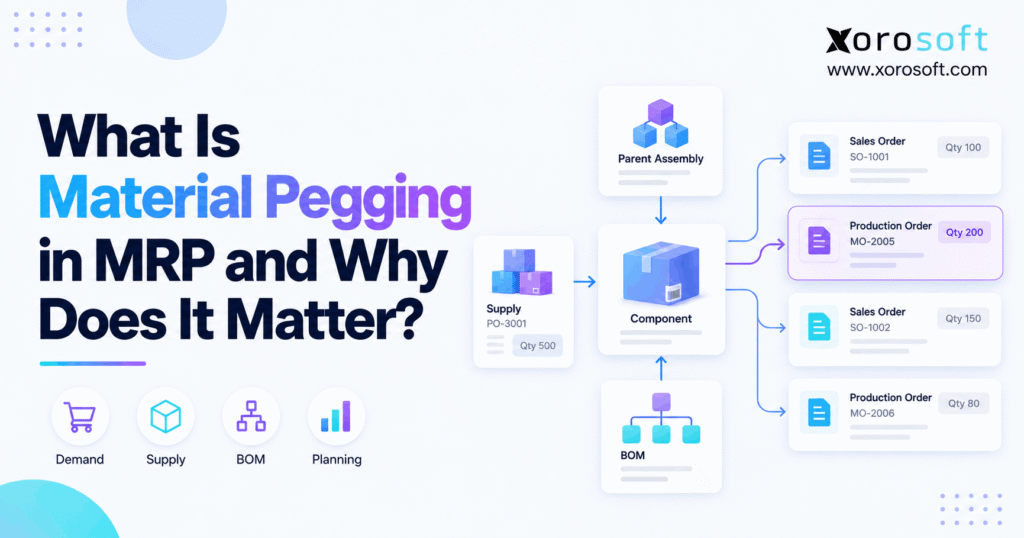
Material pegging is an important topic to understand in various industries.
1. One Missing Part, Three Orders at Risk
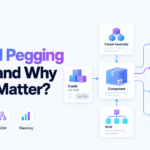
Material pegging in MRP shows which customer orders, production jobs, or forecasts depend on a specific material supply. Instead of seeing only a shortage of 20 components, a planner can trace that shortage to the work it may delay. As a result, the team can decide which supplier to call, which order to protect, and when to review a customer promise.
1.1 Why pegged demand matters beyond stock totals
For example, imagine a furniture manufacturer that has 90 steel brackets available or on order. Its three open jobs also need 90 brackets. At first glance, the quantities appear balanced. However, 20 brackets will arrive after one job needs them. Therefore, the aggregate balance hides a timing problem that an MRP exception should expose.
Meanwhile, purchasing sees purchase orders, production sees work orders, and sales sees customer dates. Without a common demand-to-supply view, each team must reconstruct the same shortage. Consequently, even a small part delay can trigger repeated calls, spreadsheets, and conflicting answers.
1.2 The question material pegging should answer
The useful question is not simply, “How many units are missing?” Instead, ask, “Which requirement is connected to the missing or late units?” In addition, ask whether another receipt, a qualified substitute, or stock at a different location could cover that requirement. Those answers turn a planning alert into a decision.
Importantly, pegging does not automatically promise that a component is reserved or that a finished order will ship. It identifies a planning relationship. Therefore, planners must confirm inventory status, supplier dates, production capacity, and any formal reservations before making commitments.
2. What Is Material Pegging in MRP?
Material pegging is the process of linking material requirements with suitable stock or expected supply and tracing those links back toward the demand that created them. For example, a bracket purchase receipt may be connected to several manufacturing jobs. Consequently, a planner can determine which jobs depend on the receipt and what changes if it is delayed.
2.1 Pegged demand and pegged supply
First, pegged demand is the requirement associated with a supply source. It might originate from a sales order, forecast, assembly job, or downstream production order. Conversely, pegged supply is the on-hand stock, purchase receipt, transfer, or production receipt expected to satisfy that requirement.
For instance, one 50-unit purchase receipt could support two requirements of 30 and 20 units. Likewise, one 50-unit requirement might rely on 15 units already on hand and 35 units due from a supplier. Therefore, useful reports display the linked quantities rather than merely listing an order number.
2.2 How MRP netting differs from pegging
Material requirements planning calculates what materials are needed, in what quantity, and by which date. In particular, BOM explosion converts finished-product needs into component demand, while netting compares eligible supply with those requirements. By contrast, material pegging explains the relationships behind the results.
For example, netting may reveal that a component needs 20 additional units by Friday. Pegging can then show which job needs those 20 units. As a result, the planner can assess the effect on an actual production schedule. Nevertheless, the calculation sequence and report depth vary among planning engines.
2.3 Why a pegged link is not a delivery guarantee
However, a planning connection does not always lock inventory to an order. A dynamically pegged receipt may cover a different demand after replanning. Similarly, a purchase order might appear in a plan even though the supplier has not confirmed its date. Therefore, a pegging report should support a shortage investigation, not replace operational controls.
Moreover, a timely component receipt alone cannot guarantee finished-goods delivery. Labor, machine time, quality checks, and remaining materials still affect completion. For this reason, responsible teams use pegging with scheduling, available-to-promise checks, and documented approvals.
3. How Material Pegging Works Step by Step
Although ERP products use different planning rules, the general workflow follows a clear chain. First, identify demand. Then, derive component requirements, check eligible supplies, and examine the links. Finally, update the plan when business conditions change.
3.1 Start material pegging with demand and a valid BOM
First, a customer order or production plan specifies a finished item and required date. Next, the bill of materials identifies each raw material or subassembly needed for that item. For instance, 20 desks requiring two brackets each create demand for 40 brackets. In addition, a multi-level BOM may create intermediate assembly requirements before reaching the purchased part.
However, the right BOM revision matters. If engineering has replaced a bracket, the old component should not remain in the active production requirement. Therefore, planners need accurate effective dates, quantities, units of measure, and approved substitutions. Otherwise, even consistent pegging logic will explain the wrong demand.
3.2 Check stock, receipts, and supply eligibility
Next, the planning system evaluates usable on-hand inventory, scheduled purchase receipts, transfer orders, and production receipts. Moreover, it considers the item, location, availability date, and configured planning rules. For example, stock under quality hold may exist physically but still be unavailable for assembly.
Likewise, a transfer from Warehouse B may take three days. Although the stock exists, it may not cover tomorrow’s requirement. Consequently, planners must compare when and where material becomes usable, not just how many units appear in a company-wide total.
3.3 Trace material pegging from components to end demand
Then, the system can connect eligible supply with specific requirements according to its coverage rules. In addition, multi-level tracing may follow a raw material through a subassembly and finished product to the customer order or forecast. As a result, the purchasing team can start from a late supplier receipt and identify the related production jobs.
Conversely, a planner can start from an urgent customer order and work backward through its material needs. Therefore, both directions matter: one answers which demand is at risk, while the other answers which supplies could protect a priority order.
3.4 Refresh the links when the plan changes
Meanwhile, incoming demand, revised supplier promises, inventory corrections, and production rescheduling can change the available supply picture. Consequently, some pegging links may move during the next planning run. For example, a receipt previously linked to a forecast might be linked to a more urgent firm order under the new rules.
Therefore, teams should date-stamp their exception reviews and rerun the relevant planning process after meaningful changes. Above all, they should distinguish an updated planning assignment from a formal stock reservation. This prevents yesterday’s report from becoming today’s unsupported promise.
4. Material Pegging Example: Find the At-Risk Order
Consider a simplified, illustrative furniture operation using component BR-100, a common steel bracket. Assume all stock is usable, there are no existing reservations, and the planner gives priority to the earliest component need date. Furthermore, assume the dates below reflect the factory calendar and that the listed purchase receipts arrive on their stated dates.
4.1 Three orders share one component
First, the factory has three customer orders. Folding desks need two brackets each, while storage cabinets need one. Consequently, the BOM calculations produce 90 brackets of total component demand.
| Order | Finished product | Finished units | Brackets per unit | Brackets required | Component needed |
|---|---|---|---|---|---|
| SO-101 | Folding desk | 20 | 2 | 40 | October 31 |
| SO-102 | Storage cabinet | 30 | 1 | 30 | November 2 |
| SO-103 | Folding desk | 10 | 2 | 20 | November 4 |
| Total | 60 | 90 |
Although the total looks manageable, quantity alone cannot determine which job is safe. Therefore, the planner must inspect the timing of each supply source against these component need dates.
4.2 Compare on-hand and incoming supply
Next, inventory records show 30 usable brackets on hand. In addition, purchase order PO-501 will deliver 40 on October 30. However, PO-502 will deliver its 20 brackets on November 8, four days after the final job’s stated component need date.
| Supply source | Brackets | Usable date | Planning implication |
|---|---|---|---|
| On-hand inventory | 30 | Available now | Timely supply |
| PO-501 | 40 | October 30 | Timely supply |
| PO-502 | 20 | November 8 | Late against November 4 need |
| Total | 90 | 70 timely; 20 late |
As a result, only 70 of the 90 required brackets are available by November 4. Therefore, 22.2% of the bracket demand lacks on-time supply under these assumptions. Importantly, this is an illustrative calculation, not a measured business performance statistic.
4.3 Trace the shortage to SO-103 with material pegging
Under the earliest-date priority rule, the first job receives 30 on-hand brackets plus 10 from PO-501. Next, the second job receives the remaining 30 units from PO-501. Consequently, the third job is associated with the 20 units arriving on November 8.
| Demand order | Associated supply | Covered quantity | Date result |
|---|---|---|---|
| SO-101 | On hand: 30 + PO-501: 10 | 40 | On time |
| SO-102 | PO-501: 30 | 30 | On time |
| SO-103 | PO-502: 20 | 20 | Late to component need |
Therefore, the report points the planner toward SO-103, not every open customer order. However, the finished shipment is not automatically four days late. Capacity, remaining components, routing, and alternative stock may change the final outcome.
4.4 Choose an action instead of expediting everything
First, purchasing can seek an earlier delivery for 20 brackets. Alternatively, the team can check approved substitutes, stock at another warehouse, or a partial production sequence. Meanwhile, the production manager can test whether the work order can move without disrupting higher-priority jobs.
Finally, customer service should revise a promise only after the team evaluates a feasible recovery plan. In other words, material pegging helps identify the affected order, while coordinated operations determine the response. As a result, the manufacturer may avoid expediting unrelated purchase orders or changing safe customer commitments.
5. Dynamic vs. Fixed Material Pegging
Not every ERP uses the same terminology. Nevertheless, understanding how planning links behave is essential when demand changes. In particular, distinguish flexible assignments from relationships intended to remain stable for a specific requirement.
5.1 Dynamic pegging allows the plan to adapt
With dynamic pegging, the planning engine recalculates supply-demand links as the input conditions change. For example, it may associate an earlier incoming receipt with a high-priority job after a revised production plan. Consequently, the new report can differ from yesterday’s report even though the original purchase orders still exist.
This flexibility is useful when businesses share materials across products or plan against changing forecasts. However, it also means a pegged link alone may not protect inventory from competing demand. Therefore, planners must understand which controls govern actual commitments.
5.2 Fixed pegging keeps selected relationships stable
In contrast, fixed pegging retains a defined relationship between a supply element and demand under the system’s rules. For example, a dedicated project may require a particular receipt to remain linked to one job. Consequently, the team can maintain clearer ownership of scarce supply through plan revisions.
However, fixed pegging does not behave identically in every application. In particular, some manually fixed links may be protected while system-created links may change under later planning actions. SAP explains these distinctions in its official pegging documentation.
5.3 Soft vs. hard pegging terminology
Similarly, planners often use soft pegging to describe a flexible planning relationship and hard pegging to describe tighter order-specific supply assignments. However, those labels are not universal product standards. Consequently, a buyer should ask whether a particular feature changes planning links, enforces stock ownership, or simply displays a reference.
| Concept | General intent | What to verify |
|---|---|---|
| Dynamic pegging | Flexible, recalculated relationships | When links are refreshed |
| Fixed pegging | Stable relationships for selected demand | Which actions can change them |
| Soft pegging | Usually advisory planning links | Whether stock stays available to others |
| Hard pegging | Usually stronger order-specific assignments | Whether reservations are actually enforced |
5.4 Single-level and multi-level material pegging
Finally, single-level pegging links nearby supply and requirement elements. By comparison, multi-level pegging can trace raw materials through subassemblies to finished-goods demand. For example, a missing motor may affect an intermediate machine assembly and several finished customer orders.
Therefore, companies with shared components and deep BOMs should test end-demand tracing rather than assume a simple item-level shortage report is sufficient. In addition, they should confirm how forecasts, transfers, and multi-site operations appear in the relationship chain.
6. Material Pegging vs. BOM Explosion and Reservation
Several manufacturing terms sound similar because they involve the same components and orders. However, each answers a different operational question. Therefore, a clear comparison prevents teams from confusing a requirement calculation with an enforceable stock commitment.
6.1 BOM explosion and net requirements
First, BOM explosion calculates dependent component demand from finished-product quantities. For example, 25 products needing four fasteners each create a gross requirement of 100 fasteners. Next, MRP netting checks inventory and scheduled receipts to determine what remains uncovered.
By contrast, pegging helps show which requirements connect to which supplies. Consequently, a planner can locate the particular job affected by a 15-unit shortage instead of seeing only the aggregate gap. These methods work together, but they are not interchangeable.
6.2 Material pegging is not necessarily a reservation
Importantly, dynamic pegging may show the supply the plan expects to use without protecting it from all other demand. Conversely, a reservation or persistent marking link can preserve a specific commitment under the application’s rules. For instance, Microsoft explains that marking is more permanent than planning pegging in its inventory marking guidance.
Therefore, an order should not receive a confirmed availability promise merely because a report displays a pegged receipt. Instead, teams must check actual reservations, supplier confirmation, warehouse status, and the order’s complete material requirements.
6.3 Allocation and available-to-promise checks
Likewise, allocation distributes eligible stock according to business priorities. Available-to-promise processes, meanwhile, determine what the company can commit based on their configured scope and supply rules. As a result, a business may need pegging for shortage traceability, allocation for scarce stock, and availability checks for reliable order promises.
| Function | Primary question | Typical output |
|---|---|---|
| BOM explosion | Which parts are required? | Gross component requirements |
| MRP netting | What still needs to be bought or made? | Net requirements and planned actions |
| Material pegging | Which supply relates to which demand? | Planning links and shortage context |
| Allocation | How should stock be shared? | Priority-based distribution |
| Reservation | Which supply is specifically committed? | Protected stock or order link |
| Available-to-promise | What quantity/date can be promised? | Customer availability decision |
7. What a Material Pegging Report Should Reveal
A useful report should make supply-demand relationships understandable without forcing users to export several spreadsheets. Moreover, it should distinguish late coverage, missing coverage, and supply that is available in the wrong location. Consequently, planners can assess both quantity and timing.
7.1 Material pegging report fields that matter
At minimum, look for material ID, supply reference, demand reference, linked quantity, expected supply date, required date, and planning location. In addition, filters for supplier, customer, order type, and exception status can make investigation faster. For example, Oracle’s Pegging Analysis view documents pegged quantities and ways to inspect supply and demand across levels.
Nevertheless, no report layout should be assumed across all products. Therefore, buyers should request a real demonstration of the fields and drill-down paths they need.
7.2 Separate partial coverage from late coverage
For example, a 60-unit work order could have 40 units available now, 10 arriving tomorrow, and 10 not yet sourced. That means the problem is not simply “20 units short.” Instead, 10 units have a timing question while 10 require a new supply action. Consequently, the most useful report distinguishes each portion.
Similarly, planners should inspect firm and forecast demand separately. Otherwise, a flexible forecast might receive attention before a customer order with a contractual commitment. Above all, the business should document how priority rules influence the resulting links.
7.3 A practical daily exception routine
First, list late and uncovered components for the next planning horizon. Then, trace each exception to affected work orders or end demand. Next, rank the issues by required date, customer commitment, recovery options, and cost. Finally, assign an owner and record the proposed action.
In addition, measure how often exceptions repeat after data corrections or replanning. This is useful because frequent recurring alerts may signal a master-data problem rather than unreliable suppliers. Therefore, the exception queue should drive root-cause work, not just daily expediting.
8. Why Material Pegging Matters Across Operations
Although material pegging starts inside planning, its value reaches purchasing, production, customer service, and finance. As a result, the same shortage context can guide several connected decisions instead of producing separate departmental reports.
8.1 Use material pegging to prioritize purchasing
For example, two delayed purchase orders may have the same value but very different consequences. One supports a committed shipment tomorrow; the other supports a flexible forecast next month. Consequently, purchasing can pursue the first supplier more urgently and avoid unnecessary expedite fees on the second.
Meanwhile, a connected purchasing workflow helps teams update confirmed receipt dates and communicate changes to planners. Therefore, the next MRP run can reflect what the supplier actually promised rather than a date left in an old spreadsheet.
8.2 Protect the production sequence
Next, the production manager can inspect which jobs are blocked by shared components. For example, a shortage may affect one product family but leave another assembly line ready to run. In that case, resequencing could protect throughput while the supplier resolves the issue.
However, every schedule change has consequences. Labor, tooling, changeover time, capacity, and other components may limit the options. Therefore, pegging should inform the production conversation without automatically rewriting the shop-floor schedule.
8.3 Improve customer promises without guessing
Meanwhile, sales teams often see finished-goods quantities but not raw-material dependencies. Consequently, they may promise a delivery date that production cannot support. A demand-to-supply view helps teams identify which orders need closer review before confirmation.
Nevertheless, a late component does not always translate into a late shipment. Buffer stock, approved substitutes, or a different production route may protect the order. Therefore, customer communication should follow an approved recovery assessment rather than the first alert on an MRP screen.
8.4 Understand the finance and inventory trade-offs
Finally, shortage responses have financial effects. Expediting can raise landed cost, while overbuying shared parts can increase carrying costs and later create dead stock. Similarly, production changes can shift labor use and work-in-process values. Consequently, teams should compare recovery cost with the customer and production impact.
For manufacturers that need one place to connect purchasing, warehouse activity, and finance, XoroONE offers a broader operational context. However, buyers should verify any specialized pegging requirements separately rather than infer them from connected ERP functionality.
9. Material Pegging Use Cases by Industry
The value of pegging depends on product structures, shared components, demand patterns, and the cost of a missed commitment. Therefore, manufacturers should match the depth of tracing to their actual complexity instead of assuming that every business needs fixed order-level assignments.
9.1 Make-to-order furniture and equipment
For example, a furniture maker may promise specific cabinet configurations with long-lead hinges, handles, or panels. Consequently, a late component can threaten one custom order while leaving standard production unaffected. Multi-level demand tracing helps the planner identify the relevant order and decide whether a qualified substitute is acceptable.
Likewise, industrial equipment manufacturers may use dedicated motors or controllers for particular customer projects. In those cases, stable supply assignments and change controls may be more valuable than flexible stock pooling.
9.2 Material pegging for make-to-stock apparel
In contrast, an apparel company may forecast assembly or finishing demand for many variants. Similarly, a sporting goods producer may share packaging, hardware, or molded parts across seasonal products. Therefore, flexible links can help planners understand why pooled material demand changes when forecasts shift.
However, businesses must still separate component planning from finished-goods stock allocation. In other words, pegging helps explain the demand behind a manufacturing shortage; it does not automatically solve overselling on ecommerce channels.
9.3 Food manufacturing and regulated materials
Meanwhile, food businesses face shelf life, lot status, substitutions, and quality constraints. As a result, a receipt that appears large enough may still be ineligible for a specific batch. Therefore, planning should consider usable dates and applicable lot rules before treating supply as available.
Pegging can help explain the demand affected by a delayed ingredient. Nevertheless, it does not replace batch traceability, recall controls, or quality approval. For more operating contexts, review the industries supported by Xorosoft.
9.4 When simpler planning tools are enough
Alternatively, a small distributor with no multi-level BOM may not need advanced material pegging. Accurate on-hand balances, reorder rules, and reservation controls could solve its immediate problems. Likewise, a workshop with few products and predictable component supply may manage exceptions through basic MRP lists.
However, repeated manual investigations are a warning sign. If staff must rebuild the same demand-to-supply relationships for every delay, deeper tracing may justify a system upgrade. Therefore, evaluate actual planning workload before buying additional capabilities.
10. Common Material Pegging Errors and Fixes
Even sophisticated planning cannot overcome unreliable data. Therefore, teams should investigate the quality of component records, purchase dates, reservations, and production transactions before assuming the pegging logic is wrong.
10.1 Counting stock that is not usable
For example, warehouse records may still show components that production consumed yesterday. Alternatively, damaged goods might remain in an available location. Consequently, the plan can connect customer demand to supply the factory cannot use.
The corrective action starts with timely receipts, issues, adjustments, and quality moves. In addition, routine cycle counts help expose persistent differences. For businesses with several locations, XoroWMS supports connected warehouse inventory visibility and transaction control; the specific pegging logic still belongs to the planning evaluation.
10.2 Using the wrong BOM revision or unit
Likewise, an outdated BOM can calculate the wrong parts for a finished product. For example, a fastener sold by the box but consumed by the piece can create a large apparent shortage when units of measure are incorrect. As a result, the pegging report may accurately trace requirements that should never have existed.
Therefore, manufacturers should control BOM effective dates, component substitutions, and unit conversions. Moreover, engineering changes need clear ownership so production and purchasing use the approved structure.
10.3 Supplier dates that distort MRP pegging
Meanwhile, a planned receipt date may represent an old promise rather than current supplier information. Similarly, a transfer can cross weekends, holidays, or receiving cutoffs. Consequently, a component that appears available on the right date may not actually reach production in time.
Therefore, update supplier confirmations and lead times before the next plan. In addition, check whether the system accounts for inspection, putaway, and material staging. Those steps can matter as much as transit time.
10.4 Treating every peg as protected inventory
Finally, teams may assume that pegged materials cannot be used by another job. However, dynamic links can change after a planning run unless stronger controls apply. Therefore, urgent orders may need explicit reservations, allocation priorities, or approval rules.
The safest process separates three decisions: what the plan expects, what inventory is formally committed, and what customer date the business can promise. As a result, each department can act on the same facts without overstating certainty.
11. How to Evaluate ERP Material Pegging Capabilities
A software evaluation should start with an operational test, not a long feature checklist. Therefore, use the same late-component scenario across vendors and ask them to show the complete decision path from raw material to end demand.
11.1 Test material pegging with shared components
First, provide three sales orders that share one purchased component. Next, add two partial receipts, a supplier delay, and a multi-level BOM. Then, ask the vendor to identify which orders are affected and whether the report shows both linked quantities and required dates.
In addition, change the planning priority during the demo. Does the reported link move after replanning? Can a planner see the difference between forecast demand and a confirmed customer order? Consequently, the test will reveal far more than a check mark beside “MRP supported.”
11.2 Ask how commitments survive changes
Next, ask whether the platform supports dynamic links, fixed assignments, reservations, or marking. Moreover, ask which controls apply after purchase-order rescheduling, production changes, and warehouse transfers. A system might display clear pegging links without enforcing hard commitments.
For this reason, test an actual competing-order scenario. Specifically, try to assign the same scarce receipt to a new urgent job and observe what happens. The answer should be demonstrated, not inferred from marketing terminology.
11.3 Check the end-to-end operating workflow
Then, review how BOMs, purchase orders, manufacturing orders, inventory receipts, and reporting share data. If the planner must export every exception to spreadsheets, the operational cost may remain high. Consequently, integrated workflows can matter even when two systems offer similar pegging screens.
For example, XoroERP provides a manufacturing and ERP environment relevant to BOMs, inventory, purchasing, and work orders. However, a buyer should request verification of dedicated pegging reports, dynamic or fixed assignments, and end-order drill-down before including those functions in the requirements sign-off.
11.4 Know when an upgrade is justified
Finally, upgrading makes sense when shortage reviews repeatedly consume hours, material commitments are difficult to explain, or multi-site planning relies on disconnected files. In addition, poor coordination between purchasing and production can create late decisions even when item-level MRP calculations are accurate.
However, begin by measuring the problem. Track time spent resolving exceptions, missed component need dates, avoidable expedite charges, and incorrect customer promises. Therefore, the business can assess software value against an operational baseline rather than a generic ROI claim.
12. Connecting Planning With Xorosoft Operations
Material pegging makes the planning question clear, but execution determines whether the proposed solution works. Therefore, manufacturing teams need accurate shop-floor transactions, timely purchasing updates, and trustworthy warehouse inventory alongside the plan.
12.1 Manufacturing, purchasing, and financial context
Xorosoft brings manufacturing, purchasing, inventory management, warehousing, accounting, and reporting into connected ERP workflows. For example, work orders depend on BOM data, while purchasing and receiving determine when components become usable. Consequently, a shared operating record can reduce the manual handoffs that weaken shortage decisions.
Still, connected ERP is not the same as confirmed support for every pegging feature. Therefore, request a demonstration of the exact planning report, exception drill-down, and order-assignment controls before adopting a particular requirement.
12.2 Ecommerce and multi-channel demand visibility
Meanwhile, manufacturers that also sell through Shopify, Amazon, or wholesale channels face additional demand changes. Xorosoft supports ecommerce and order workflows through its integration ecosystem. In addition, businesses can review its Shopify App Store listing when evaluating channel connectivity.
However, syncing a sales order does not automatically reserve all raw materials for that order. Therefore, planners still need clear BOM requirements, allocation policies, lead times, and feasible supply plans. The benefit comes from keeping channel demand and internal operational records consistent.
12.3 A material pegging readiness check
Before selecting any manufacturing platform, document the data and reports your team truly needs. First, list shared components, planning locations, supplier constraints, and end-demand priorities. Then, test a real late receipt and observe the system’s recommended actions. Finally, confirm how exceptions reach purchasing, production, customer service, and finance.
For context on broader manufacturing workflows, review Xorosoft solutions. In addition, ask whether specialist capabilities require configuration, extra modules, or a separate planning tool. As a result, the purchasing decision stays grounded in proven workflows rather than assumed features.
13. Conclusion: Trace the Order Behind the Shortage
Material pegging adds an important layer of context to MRP. Instead of seeing only a component shortage, planners can investigate which demand depends on the missing supply and which actions might protect production. Consequently, purchasing, manufacturing, and customer service can make decisions from the same planning facts.
However, pegging cannot replace accurate BOMs, live inventory, supplier confirmations, or reservation controls. Therefore, businesses should evaluate both their planning methods and the systems used to execute them.
If disconnected tools make every shortage difficult to explain, review your actual manufacturing workflow with Xorosoft. Book a Demo to discuss inventory, production, purchasing, and the specific pegging functions your team needs verified.
FAQs
What is material pegging in MRP?
Material pegging connects component requirements with expected supply and the demand behind them. As a result, planners can identify which production or customer orders may be affected by a material shortage.
How does material pegging work?
First, MRP evaluates demand, BOMs, and eligible supplies. Then, pegging links supply quantities to requirements according to planning rules. Consequently, planners can trace shortages to affected orders.
What is the difference between soft and hard pegging?
Soft pegging usually represents flexible planning links. By contrast, hard pegging often implies stronger order-specific assignments. However, definitions vary by ERP system, so buyers should verify actual reservation behavior.
Does material pegging reserve inventory?
Not necessarily. Dynamic pegging can change when the plan runs again. Therefore, a linked supply is not always protected stock; reservations and marking may apply separate rules.
What does a pegging report show?
A pegging report commonly shows supply references, demand orders, quantities, and dates. In addition, it may identify late or partial coverage, helping planners prioritize shortage investigations.
When is material pegging useful?
It is valuable when manufacturers share components across orders, manage deep BOMs, or face frequent supplier delays. However, simple operations may manage with basic MRP exception reports.
What should ERP buyers check before choosing a solution?
Ask vendors to trace one delayed component through multiple orders. Then, verify report depth, replanning behavior, reservations, location rules, and how purchasing and production act on the exception.
Recent Posts
-
 Inventory Tracking Management: How to Correct Negative Stock, Duplicate Receipts, and Orphaned Reservations
-
 Shopify Inventory Integration Benchmarks 2026: Latency, Errors and Reconciliation
-
 ERP for Furniture Distributors Managing Bulky Inventory and Delivery Scheduling
-
 Xorosoft vs Acumatica for Inventory-Intensive Mid-Market Companies
-
 What Is Material Pegging in MRP and Why Does It Matter?