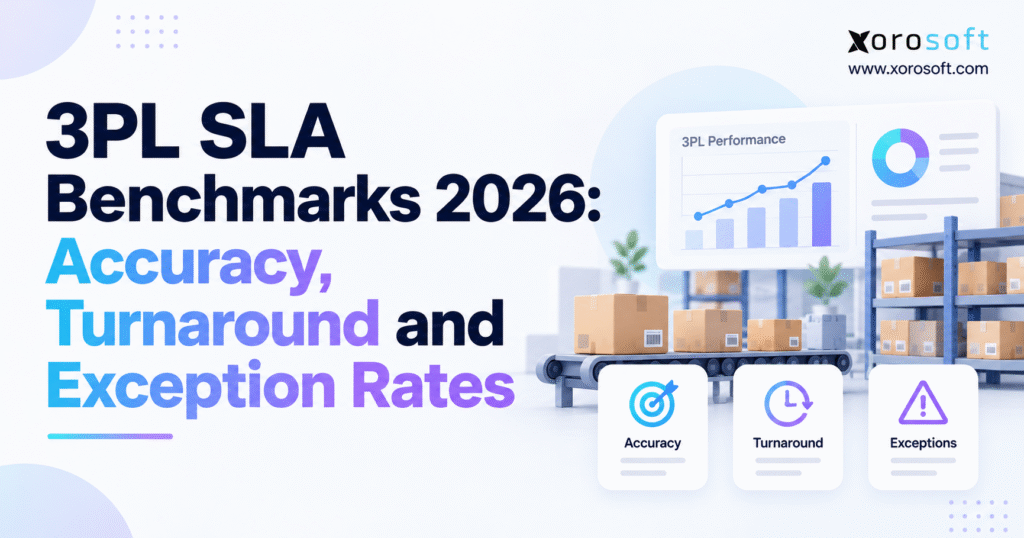
In this article, we will explore 3PL SLA benchmarks 2026 and what they mean for the logistics industry.
1. Why 3PL SLA Benchmarks 2026 Reveal Hidden Fulfillment Risks
A third-party logistics partner can meet its shipping target and still create major problems for the business it serves. The warehouse may ship on schedule but send the wrong item. Meanwhile, an ecommerce store may promise stock that workers have yet to put away. Support staff may close tickets while the same picking error keeps happening.
That is the business problem behind 3PL SLA benchmarks 2026. Growing brands need to separate service results from the warehouse steps behind them. Shipping speed, correct orders, receipt times, stock levels, and error handling all matter. Yet each measure answers a different question. Teams that track only dispatch dates overlook problems before and after the handoff.
1.1 Why 99% On-Time Shipping Can Still Hide 3PL Errors
Imagine a merchant shipping 20,000 orders monthly through an external warehouse. Its partner reports 99% on-time dispatch. The rate looks strong, yet 200 orders still miss the deadline. Stock errors might also create backorders, while staff quietly fix picks without recording the extra work. The headline percentage then hides both labor costs and customer impact.
An operations manager may count an order as shipped when a label prints. Customer service may wait until tracking updates. Finance may need a later stock or cost update to close its records. All three teams follow different clocks, so no one sees the whole order journey.
1.2 When Brands Need Formal 3PL Performance Benchmarks
Detailed SLAs matter when brands sell through several channels, face busy seasons, meet retailer rules, or use more than one warehouse. Shopify and Amazon sellers care about timely dispatch and correct tracking. Wholesale distributors need dependable quantities, pallet labels, and electronic shipping files. Food and manufacturing teams may also need lot records and extra checks before they release stock.
Smaller businesses with simple products and a single dependable partner may manage results through basic reports. What matters is testing the partner’s promises, finding repeat errors, and building a fair way to improve service.
2. 3PL SLA Metrics: Define the Rules Before Comparing Providers
A service level agreement spells out the warehouse’s promise, the way both teams test it, and the action that follows a missed target. Each promise should link to a real warehouse event.
3PL SLA benchmarks 2026 are reference points for negotiating those promises, not rules that automatically bind all 3PLs. A benchmark shows what a group of warehouses has achieved. A key performance indicator (KPI) tracks a day-to-day result. An SLA adds a target, a set of orders to count, an owner, rules for reports, and a remedy. Each term serves a different purpose; treating them as the same leads to unfair comparisons.
2.1 Set the 3PL SLA Measurement Window and Order Rules
Consider the promise to ship 99% of orders on time. The contract must say when an order starts its SLA clock: at checkout, after payment, when the merchant assigns stock, or when the partner accepts the order. Those events can occur hours apart. It also needs a daily cutoff, time zone, work calendar, and a clear rule for what counts as shipment.
The order count matters as much as the deadline. Both parties should agree how to treat canceled orders, fraud holds, missing stock, and delays requested by the merchant. If one party quietly removes difficult orders while the other counts them, the teams will never reach the same result.
2.2 Assign Responsibility for 3PL SLA Misses
A warehouse cannot control each vendor delay, product data error, merchant stock decision, or transit delay. It can control many parts of receiving, storage, picking, packing, labeling, and timely carrier handoff. The contract must show which team owns each delay or error. A late order does not always mean the warehouse failed.
Separate monthly reports from urgent alerts. Both teams should keep order records, choose a person to handle disputes, and set a clear time to settle them. Service credits can help after major or repeat failures, but they will not find missing stock or fix wrong picks. Pair any financial remedy with a plan to fix the cause.
2.3 Avoid 3PL Fulfillment KPIs That Reward Shortcuts
Poor metrics reward shortcuts. When team leads reward dispatch speed alone, staff may print labels before cartons are ready. A low-issue target can also tempt teams to skip logging problems. And when team leads reward speed without checking receipts, they may release stock for sale before staff finish their checks.
Use a short set of measures that work together. Accuracy protects the order, turnaround protects shipping promises, and issue tracking shows what caused the work to stall. These measures tell a more useful story than one standout percentage.
3. 3PL SLA Benchmarks 2026: What the Warehouse Data Shows
One leading 2026 source is the Warehousing Education and Research Council’s DC Measures report. WERC tracks service, receiving, shipping, quality, space use, and costs. Common metric rules help readers compare these results over time.
A 2026 Yale review of the WERC findings reports top-tier results for several warehouse metrics. WERC calls the top 20% of its surveyed distribution centers best-in-class. The survey includes many warehouse types. Readers should not mistake these top-tier results for an average 3PL guarantee.
3.1 2026 3PL Accuracy and Turnaround Benchmarks: WERC Data
| Metric | 2026 Best-in-Class Result | What the Measure Represents |
|---|---|---|
| Order-picking accuracy | At least 99.7% | Orders picked correctly before shipping |
| On-time shipments | At least 99.5% | Orders leaving the dock at the planned time |
| Dock-to-stock cycle time | Under 3.1 hours | Goods received, put away, and recorded in inventory |
| Correct inbound documentation | At least 99% | Supplier orders received with correct documents |
Yale includes the document accuracy figure in its summary. These top-tier figures offer a useful guide, but no law or sector rule turns them into contract targets for every merchant. Picking accuracy differs from the accuracy of orders buyers receive. Likewise, dock-to-stock does not cover the vendor’s full lead time.
3.2 How to Use 3PL SLA Benchmarks When Writing Contracts
A warehouse shipping simple one-line parcels does different work than one that builds furniture kits, packs fragile goods, checks food lots, or fills large retail orders. Daily order load, staffing, equipment, item size, and lines per order all affect the result.
When using 3PL SLA benchmarks 2026 to compare 3PLs, ask for similar order profiles, the same reporting period, matching exclusions, and a clear count of orders. Ask whether the warehouse improved its process or removed hard orders from its count.
3.3 Use Your Own Orders to Set 3PL Exception Rate Targets
No strong evidence supports one 2026 exception-rate target for all 3PLs. Some warehouses log each failed scan; others track only cases that need a manager’s help. Those numbers do not tell the same story, even when both dashboards call them “exception rate.”
Build a baseline from your own orders and clear issue types. Keep those rules and risk levels steady when you compare warehouses. This is one of the most important lessons from 3PL SLA benchmarking: a consistent denominator often matters more than a seemingly precise sector target.
4. 3PL Accuracy Benchmarks: Picking, Shipping, and Inventory
Merchants care about order accuracy, yet one percentage can hide too much. Picking, shipping, and stock counts each call for their own measure. Managers should check how the figures fit together rather than roll them into one vague score.
4.1 Picking vs Shipping vs Inventory Accuracy in 3PL SLAs
Picking accuracy checks whether staff or machines select the right items and amounts. Shipping accuracy checks whether the final parcel meets the order rules. Packers may spot and fix a wrong item before shipment. That still counts as a picking mistake, even though the buyer gets the right order. Together, those events show where the team needs better checks.
Stock accuracy compares physical goods with system counts. Teams can measure it by bin, unit, SKU, or value. A bin count may give a different result from a unit count by SKU or a count based on stock value. A warehouse with many low-value small parts may need a different review than one storing expensive serialized products. Name the chosen method in the SLA so both sides use the same rule.
4.2 3PL Order Accuracy Formula and Worked Example
Use one clear formula for orders:
Shipment accuracy (%) = Error-free eligible shipments ÷ Total eligible shipments × 100
If a partner ships 10,000 eligible orders and 9,970 satisfy the agreed accuracy test, the result is 99.7%. That leaves 30 failed orders, or a 0.3% error rate. The numbers only show how the formula works.
If an order has six lines and one is wrong, the entire order may fail the order-level test while five of six lines remain correct. For multi-line orders, ask for both rates. Record mistakes that packers catch before shipping, too. Extra work costs staff time and can delay orders, even if buyers get the right goods.
4.3 Warehouse Inventory Accuracy: Protect Every Stock Move
Good accuracy starts before picking. Receipts, putaway, moves, returns, holds, counts, and stock edits all affect what a merchant can sell. When staff move goods without updating the system, buying teams may order too much and the website may promise stock it cannot ship. Barcode scans and review rules help teams catch these gaps early.
Outside fulfillment must also match what the merchant sees inside its own systems. A business evaluating XoroWMS warehouse management should test how scans, stock holds, bins, and errors connect with its 3PL data. Ask for a clear log of stock moves rather than a broad claim about guaranteed accuracy.
4.4 How 3PL Fulfillment Error Rates Affect Margin
Thirty wrong orders can lead to new shipments, extra freight, support tickets, and stock fixes. A retailer may also charge a fee or delay payment when pallet counts or files are wrong. Tie each event to the order and the cost it caused.
When teams review 3PL SLA benchmarks 2026, they should first find costly errors that keep coming back. A better accuracy rate helps, but fixing the errors that cause returns, extra freight, and retailer claims often saves more.
5. 3PL Turnaround Benchmarks: Receiving Through Carrier Handoff
Turnaround covers several clocks. Incoming goods go through unloading, checks, putaway, and release for sale. A customer order passes through acceptance, stock assignment, picking, packing, carrier pickup, and transit. One average hides the stages that decide whether the team meets its promise.
3PL SLA benchmarks 2026 become much more useful when each timing commitment starts and ends at a defined event. Without clear start and end points, the partner may report fast work even as goods sit idle or parcels wait for a driver.
5.1 3PL Dock-to-Stock Turnaround: Start and Stop Rules
Dock-to-stock starts when goods reach the dock and ends when staff finish putaway and record the stock. WERC/Yale reports a 2026 top-tier result below 3.1 hours, but each receiving contract still needs its own rules. A late truck, missing pallet labels, product checks, or bad vendor papers can affect the clock.
Suppose 500 units arrive before noon but remain unrecorded until the following morning. The store may show a shortage and the buying team may order more, even though the goods sit in the warehouse. The opposite is also risky: releasing stock before checks finish can create orders the warehouse cannot ship. A sound receiving SLA must protect speed and stock accuracy together.
5.2 3PL Order Processing Time and Same-Day Cutoffs
Most teams start the clock when the warehouse accepts the order and end it at an agreed step. That finish point might be packing complete, a carrier manifest, or carrier pickup. Do not count a printed label as dispatch unless both sides agree. For buyer updates, a carrier scan or pickup record gives stronger proof.
A sample 2 p.m. same-day cutoff only works when the contract sets the time zone, workdays, data deadlines, and hold rules. Spell out how weekend orders, fraud holds, and stock shortages affect the clock. Review the cutoff before busy seasons, when carrier schedules and staffing needs change.
5.3 Median and P95 3PL Fulfillment Turnaround
A facility may average three hours per order while a smaller group waits twelve hours or more. Track the median, the 95th-percentile time, and the share of orders that meet the cutoff. The 95th percentile shows how long 95% of the counted orders take to finish, based on the agreed rules.
Keep carrier performance separate from warehouse results. Warehouse staff own picking, packing, and handoff. After pickup, the carrier often controls transit. Merchants should link these dates for buyer updates while naming the party that caused each delay. Do not penalize the warehouse for a transit problem that its records show it did not cause.
6. 3PL SLA Benchmarks 2026: Exception Rates and Fix Times
Many fulfillment scorecards miss an important fact: how often normal work breaks down. A partner may meet accuracy and timing goals only because staff keep stepping in to rescue orders. If nobody logs that extra work, team leads cannot see its cost or spot problems that keep returning.
A good issue log shows the failure, time, owner, and final fix. Count orders with problems and the total issue events separately.
6.1 3PL Exception Rate Formula: Affected Orders vs Events
To calculate the order exception rate, use:
Exception rate (%) = Orders with an exception ÷ Total eligible orders × 100
Count each order only once, even if staff log several issues. If 140 of 10,000 eligible orders encounter a reportable exception, the affected-order rate is 1.4%. If those orders generate 188 incident records, event frequency is 1.88 events per 100 eligible orders. These numbers only show how the math works.
Neither figure represents a sector average. A warehouse that logs each scan alert will show more events than one that tracks only major cases. Before you compare 3PLs, agree which events count, which orders count, and whether a reopened case becomes a new event.
6.2 3PL Exception Categories: Cause, Owner, and Risk
Use clear labels for wrong picks, shortages, stock gaps, damage, bad labels, missing advance shipping notices (ASNs), and late handoffs. Responsibility may belong to the warehouse, merchant, supplier, carrier, or an integration process. Track provider-caused issues apart from the total rate.
Risk level matters, too. A quick paperwork fix differs from a missing food-lot record or a lost delivery slot at a large retailer. Rank issues by customer impact, cost, safety risk, and time left to recover. Otherwise, the score can rise even while serious problems remain open.
6.3 3PL Exception Resolution Time and Repeat Incidents
Response time tracks how soon the team replies. Fix time tracks how long the team takes to solve the real problem. Staff may reply within minutes, then leave the case open for days. Check how long cases stay open, how often problems recur, and whether the fix holds. That way, a quick reply does not look like a complete fix.
Reviewers should follow the order, warehouse bin, SKU, scans, stock changes, and final buyer result. Repeat size/color errors may call for clearer item labels or stricter scan checks. Shortages that keep returning may point to poor receiving or stock moves. Fixing the work matters more than making the issue log look better.
7. 3PL SLA Scorecards: Turn Targets Into Evidence
A monthly scorecard helps merchants and 3PLs settle disputes with facts. It should show the target, actual result, proof, owner, and next step.
For teams using 3PL SLA benchmarks 2026, a sound scorecard starts with a few metrics for accuracy, speed, stock levels, and issues. For each metric, name the owner, formula, target, actual figure, gap, and follow-up action.
7.1 Sample 3PL SLA Scorecard: Targets vs Results
| SLA Metric | Sample Negotiated Target | Sample Monthly Actual | Review Outcome |
|---|---|---|---|
| Error-free shipments | At least 99.5% | 99.7% | Met |
| On-time carrier handoffs | At least 99.0% | 98.6% | Missed |
| Average eligible dock-to-stock | Six hours or less | 5.2 hours | Met |
| Orders with provider-caused exceptions | 1.0% or less | 1.4% | Missed |
The table gives sample targets and results, not published benchmark rates. The sample partner meets two commitments and misses two. Managers should find which orders missed the carrier handoff cutoff, where those orders came from, and whether repeat issues caused the delay. Do not blend the percentages into a single score that hides missed targets.
7.2 Build an Audit Trail for 3PL Performance Metrics
Store the order ID, sales channel, warehouse, acceptance time, status, pick and pack times, carrier pickup, issue type, and edit history in the source data. Keep the time zone and original event even if someone later edits or cancels the order. A shared event list helps outside warehouses and in-house teams reach the same totals.
Linked stock and finance records can reveal the cost of each failure. With XoroONE cloud ERP, a business can evaluate how order, stock, purchasing, and accounting workflows relate to external fulfillment activity. A team still needs the partner to share complete event data and set up reports that match the agreed rules.
7.3 3PL SLA Review Schedule: Daily to Quarterly
Use daily alerts to catch urgent problems. Weekly reviews can spot repeat delays and stock gaps; monthly meetings should check contract results. Each quarter, review long-term causes, busy-season needs, and targets that no longer fit.
Start with a free ERP readiness assessment of how your orders, warehouse data, and finance records fit together. Check whether your team can confirm the partner’s figures, track stock changes, and find what caused an order problem. If the reports already work well, fix the warehouse process before you buy software.
8. 3PL Fulfillment Benchmarks for DTC, B2B, and Complex Products
Set scorecard targets around the products, channels, and buyer promises the warehouse handles. One time target cannot fairly cover a small parcel, a mixed pallet, a sofa, and an order that needs food-lot checks. The work changes how fast a team can move and how much an error costs.
8.1 Shopify, Amazon, and DTC Fulfillment SLAs
DTC sellers need correct SKUs and variants, timely pickup, clear tracking, and simple returns. Stock changes may push orders to different warehouses. A split order needs different time and completeness rules from an order shipped at one site.
For Shopify, the fulfillment order model helps show which site receives the work and what happens next. Merchants can use those events to choose a fair start time for the warehouse clock. The Xorosoft ERP app in the Shopify App Store describes synchronization of orders, inventory, fulfillment, and related financial information; teams should test the data flow and reports during setup.
8.2 Wholesale, B2B, and EDI Fulfillment SLAs
Wholesale orders add case counts, pallet layouts, store labels, routing rules, delivery slots, and EDI documents. A warehouse might ship the correct product on time but still cause a retailer chargeback because its advance shipping notice or label is inaccurate. Track these document errors as their own KPI.
When assessing 3PL SLA benchmarks 2026, separate parcel orders from customer-specific wholesale commitments. Measure on-time-in-full at the unit named in the contract: order, line, case, or shipment. Match retailer data with what the warehouse truly shipped.
8.3 Product-Specific 3PL Accuracy and Handling Benchmarks
Apparel needs strong style, color, and size checks, especially during new-season launches. Furniture teams need damage photos, careful handling, and enough time for scheduled pickup or delivery. Sporting goods may bring busy seasons, serial numbers, and multi-item kits. Food teams may need lot, expiry, storage, and recall checks before they release goods.
The relevant industry workflows can help a merchant identify day-to-day requirements before converting them into partner obligations. Let buyer needs shape the SLA rather than copying one template for each warehouse. Service tiers can share one report format while using targets that fit their work.
9. ERP and WMS Reporting for 3PL SLA Benchmarks 2026
Teams need records from several systems to check SLAs. Sales channels hold the customer order. An ERP or order app tracks how the business assigns stock. Warehouse software logs picks and packs. Shipping tools track labels and carrier pickup, while finance records stock changes, freight, refunds, and retailer fees. A dashboard fails if those tools cannot match the same orders.
9.1 Capture the Events Behind 3PL SLA KPIs
Begin with the same order ID and warehouse code in each system. Next, capture order acceptance, stock assignment, pick and pack times, carrier pickup, tracking, and each issue. Keep a change log so a new address or canceled line does not erase the original order promise.
When systems share events through EDI, APIs, or daily files, pick one trusted source for each timestamp. Check event times before blaming the warehouse for a slow data feed. The same issue affects stock: staff may receive goods hours before the online store shows them as available.
Xorosoft’s integrations overview is relevant to brands evaluating connections among ecommerce, EDI, fulfillment partners, and accounting. During setup, check that each key event arrives on time and matches the provider’s monthly report.
9.2 Spreadsheet vs WMS vs ERP for 3PL Reporting
Spreadsheets can support monthly reviews for teams with few orders and clean data. A WMS usually does a better job logging the physical work inside a warehouse. An ERP links that work to buying, sales, finance, and other locations. Yet no tool can verify a warehouse event that nobody records.
If a company has outgrown separate warehouse and finance apps, it can review XoroERP alongside other ERP options. Xorosoft may fit teams that need stock, buying, sales, and finance in one view. Ask each vendor to show real data flows, supported links, and reports before choosing.
9.3 Who Should Own 3PL SLA Reporting?
Name a team to maintain KPI rules, approve exclusions, settle data disputes, and share scorecards. Warehouse leaders should check the events, finance should confirm the cost, and support teams should flag affected orders. One owner must keep the formulas the same month after month.
With clear owners and common rules, 3PL SLA benchmarks 2026 help teams improve daily work instead of merely filling a dashboard. Before changing software, ask vendors to work through sample orders and real issue logs instead of showing only a polished dashboard.
10. Compare 3PL SLA Benchmarks Before Choosing a Provider
Choose a 3PL for more than its highest accuracy claim. A 99.9% claim means little without the calculation, time period, exclusions, and order mix behind it. Price and capacity matter, but so does the provider’s willingness to share proof and own mistakes.
10.1 Check Order Mix Before Comparing 3PL Performance
Ask each provider what its rates cover: one-line or multi-line orders, parcels or pallets, special-care or standard goods, and local or cross-border service. Compare receiving, order release, and carrier pickup rules side by side. Also ask how the provider handles your busiest weeks without changing the rules halfway through.
Benchmark figures offer context, but a provider’s own past data gives you firmer proof. A sample report, a sound review of past mistakes, and customer references tell a fuller story than an ad claim.
10.2 Test 3PL Exception Handling Before Signing
Ask 3PLs to show how they handle short receipts, missing SKUs, wrong picks, bad EDI documents, and missed pickups. Find out what the merchant sees, when alerts arrive, and who takes the next step. A provider with a clear issue log may be easier to work with than one that claims problems almost never happen.
You can also study how ERP vendors serve businesses with similar needs. Xorosoft publishes customer case studies across sectors such as apparel, distribution, and consumer products. Use those examples to prepare questions, but still check the actual 3PL’s service record.
10.3 Signs It Is Time to Renegotiate a 3PL SLA
Treat one late pickup during a carrier outage differently from months of short shipments caused by poor stock records. Agree on steps: investigate, find the cause, assign the fix, check the result, and use contract remedies when needed. If the provider hides records or keeps missing major targets, begin a formal review of other options.
Moving stock, linking systems, changing carriers, alerting buyers, and training staff can all disrupt service for a time. Weigh those costs against the cost of staying before you decide. 3PL SLA benchmarks 2026 should guide a sound decision, not trigger a rushed switch.
11. What Missed 3PL SLA Targets Cost Your Business
A missed SLA often costs much more than the warehouse fee. A wrong shipment can trigger replacement freight and support time. Late wholesale deliveries may lead to retailer fees or slower payment. Stock gaps can drive extra buying or block orders that the merchant could otherwise ship. Since costs spread across teams, managers may never see the full total.
11.1 Estimate the Cost per 3PL Fulfillment Error
For each major error type, add the extra handling time, replacement item, outbound and return freight, credit, and retailer fee. Count only the extra costs that the error caused; ordinary warehouse costs do not count as savings. Link costs to the original order or issue when you can.
Suppose 40 wrong shipments cause $18 each in extra freight and $9 each in support and handling. Those shipments add $1,080 in direct extra costs before product loss or customer credits. Real costs may also include paid work hours, the value of goods recovered, and finance adjustments.
11.2 Rank SLA Fixes by Risk, Cost, and Repeat Rate
A small label error can waste hours if it happens each day. One serious food-lot error may need urgent action even if it happens once. Rank work by how often it happens, what it costs, and how badly it affects buyers.
When you review Xorosoft or another ERP, ask whether the system links stock changes, freight charges, refunds, and finance entries to the original problem. A good report shows which errors cost the most, which teams can prevent, and which need a change to the contract.
12. Use 3PL SLA Benchmarks 2026 to Guide the Next 90 Days
Good benchmarks should change daily work. Fix the way teams count results before asking for a 99.9% promise. Agree on the metric rules, test the source records, and fix repeat errors that hurt customers and profit.
12.1 Days 1–30: Establish a 3PL SLA Baseline
Gather the contract and three months of order, receiving, shipping, and issue records. Rebuild the KPI results from raw data. Check which orders count, the time zones, the key events, and the exclusions. Split provider-caused issues from supplier, merchant, and carrier problems.
For the first scorecard, track accuracy, on-time pickup, receipt times, stock gaps, and how fast teams solve issues. Write down the formula and source for each result. If a key event has no timestamp, start logging it before you set a new target.
12.2 Days 31–60: Remove High-Cost 3PL Exceptions
During the second month, focus on errors that repeat, cost the most, or cause the greatest customer harm. Follow the physical work and the data moving between systems. Repeat cutoff misses may call for earlier order release or a new staffing plan. Stock gaps may call for better receiving and counts. Check each fix against the same KPI that first showed the problem.
The point is to stop the next hundred orders from hitting the same issue.
12.3 Days 61–90: Make 3PL SLA Reviews Routine
Hold weekly issue reviews, monthly SLA meetings, and quarterly planning sessions. Set clear alert rules and keep the source events. Compare new results with the starting point. Change targets only when you know what improved.
For growing brands that sell through many channels, Xorosoft is one option when reviewing linked orders, stock, warehouse work, and finance. Ask vendors to use your real fulfillment needs and show which events their tools can log, match, and report. When your current tools already meet those needs, improve the process first.
Free ERP Readiness Assessment: Check whether stock, shipping, and finance records agree well enough to confirm service results.
Watch Demo: See how linked order and warehouse records can support reports across several sites and 3PLs.
Book a Personalized Demo: If repeat 3PL issues and disconnected tools are slowing growth, contact Xorosoft to review your workflow and reporting needs.
Let 3PL SLA benchmarks 2026 guide your starting targets, but rely on clear contracts and sound records to judge results. Define each metric, keep the proof, fix the cause, and check whether the warehouse keeps its promises.
Frequently Asked Questions About 3PL SLA Benchmarks 2026
What are the key 3PL SLA benchmarks for 2026?
Track picking accuracy, on-time shipments, dock-to-stock time, inventory accuracy, and exceptions. Published warehouse benchmarks guide comparisons; contracts need their own targets.
What is a good 3PL picking accuracy rate?
WERC’s 2026 best-in-class warehouse benchmark is at least 99.7% for order picking. Shipment accuracy needs a separate calculation and definition.
How is 3PL on-time shipping calculated?
Divide eligible orders handed to carriers on time by all eligible orders due, then multiply by 100. Set cutoffs and exclusions beforehand.
What is a good dock-to-stock turnaround time?
WERC’s 2026 best-in-class result is under 3.1 hours. Your SLA should account for receiving checks, goods types, and dock arrival rules.
How do you calculate a 3PL exception rate?
Divide eligible orders with at least one qualifying exception by all eligible orders, then multiply by 100. Count repeat events separately.
What should a 3PL SLA scorecard include?
Show targets, actual results, data sources, owners, and corrective actions for accuracy, shipping speed, receiving, inventory, and exception resolution.
When should a company upgrade its 3PL reporting systems?
Consider ERP or WMS integration when staff repeatedly reconcile inventory manually, cannot verify provider reports, or lose visibility across locations.
Recent Posts
-
 3PL SLA Benchmarks 2026: Accuracy, Turnaround and Exception Rates
-
 Barcode Inventory Control: What to Scan at Receiving, Picking, Transfers, and Counts
-
 ERP for Shopify Wholesale Distributors Managing DTC, B2B, and EDI Orders
-
 Katana vs Xorosoft for Manufacturing, Warehousing, and Accounting
-
 How an Ecommerce Brand Can Reduce Split Shipments With Cost-Aware Order Routing