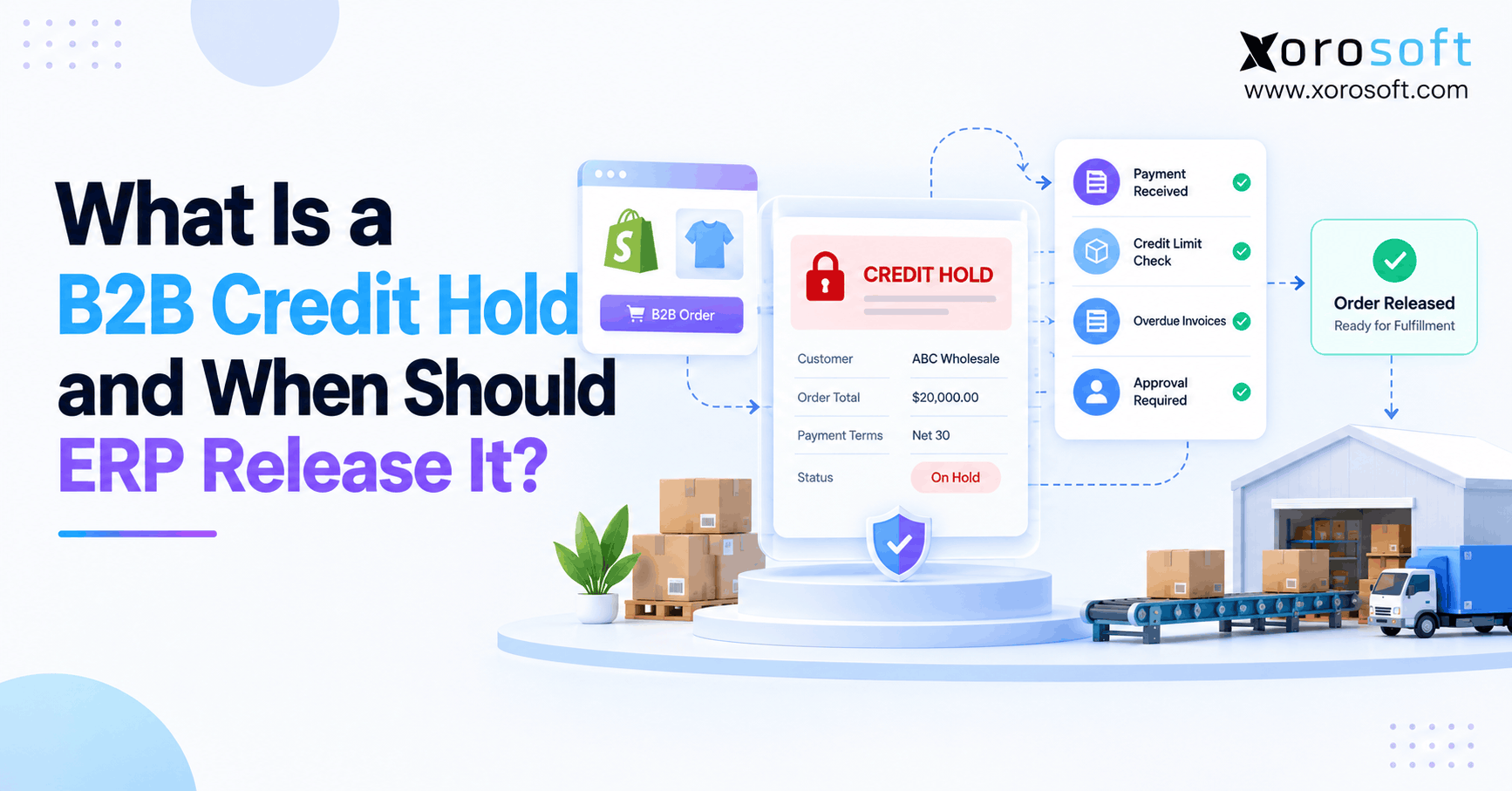
Managing wholesale credit limits in ERP is essential for businesses looking to streamline financial operations and maintain customer relationships.
1. Why Wholesale Credit Limits in ERP Become an Order-Flow Control
1.1 Wholesale Credit Limits in ERP Start With Approved Risk
A customer credit limit represents the amount of financial exposure management is prepared to accept under an approved credit policy. If a customer receives a $100,000 limit, that figure establishes a boundary around unsecured trade credit.
The difficulty is deciding what should count against that boundary.
If the company looks only at posted receivables, the customer may appear to have substantial available credit even though several orders are already committed. Goods may also have shipped without reaching the accounts receivable ledger yet. In that situation, the accounting balance understates the operational commitment.
That is why wholesale credit limits in ERP should be connected to transaction status instead of treated as a static customer-master field.
The ERP needs to understand both financial and operational events. An invoice creates exposure. An approved open sales order may create exposure. A shipped-but-unbilled order may create exposure. A payment or credit memo may reduce it. Depending on company policy, multiple related customers may also share one combined limit.
1.2 Credit Limit, Exposure, Payment Terms, and Holds Serve Different Roles
These concepts are closely connected, but each performs a different job.
| Control | What It Answers | Example |
|---|---|---|
| Credit limit | How much risk will we accept? | $150,000 |
| Credit exposure | How much risk is already committed? | $118,000 |
| Available credit | How much capacity remains? | $32,000 |
| Payment terms | When should invoices be paid? | Net 30 |
| Credit hold | Should this order continue? | Finance approval required |
A customer can be below its overall credit limit and still have a serious overdue-payment problem. Likewise, the customer can have no overdue invoices while exceeding its limit because several large orders were placed within a short period.
ERP credit management works best when all of these controls operate together rather than independently.
1.3 Credit Control Should Create Controlled Speed
Poor credit management usually produces one of two outcomes.
The first is excessive financial risk. Sales continues accepting orders because posted AR looks acceptable, but open-order commitments remain invisible. By the time finance sees the complete exposure, inventory may already have shipped.
The second is excessive friction. Almost every larger transaction requires an email, spreadsheet check, phone call, and manual approval. Even reliable customers wait because the process cannot distinguish routine business from genuine exceptions.
A well-designed policy creates a middle ground. Ordinary orders move automatically. Unusual orders receive attention. High-risk transactions stop before the company commits additional inventory and working capital.
2. How Wholesale Credit Limits in ERP Calculate Real Customer Exposure
2.1 Wholesale Credit Limits in ERP Need a Consistent Exposure Formula
A useful operating model is:
Customer Credit Exposure = Open Receivables + Relevant Open Orders + Unbilled or Delivery Exposure + Other Credit Commitments − Eligible Payments and Credits
The exact formula should reflect the company’s actual risk policy.
One distributor may count every confirmed open order immediately. Another may include an order only after inventory allocation. A manufacturer could recognize customer-specific commitments even earlier because raw materials or production capacity have already been reserved.
The critical issue is consistency.
If finance calculates exposure differently from sales, customer service, or warehouse operations, the company does not truly have a single credit policy.
2.2 Posted Accounts Receivable Is Only One Exposure Layer
Open AR normally forms the base of the calculation because it represents invoiced amounts the customer still owes.
However, AR also needs context.
A $70,000 current balance presents a different risk profile from a $70,000 balance where $50,000 is already ninety days overdue. The nominal exposure is identical, but collection behavior is not.
ERP credit management can therefore combine total exposure with separate aging rules. A customer might technically retain $20,000 of available credit yet still fail a new-order check because an older invoice exceeds the company’s permitted overdue threshold.
2.3 Open Sales Orders Can Consume Credit Before Invoicing
This is one of the most important design decisions when configuring wholesale credit limits in ERP.
Suppose a customer has a $100,000 limit and only $25,000 in posted invoices. If three $30,000 sales orders arrive before any one of them is invoiced, a system that checks only AR could approve all three.
The apparent exposure would remain $25,000 during each check.
The real commercial commitment could reach $115,000.
Including relevant open orders prevents this problem and gives finance earlier visibility into how much credit capacity planned fulfillment will consume.
Not every open order needs identical treatment. Canceled transactions, prepaid orders, samples, closed lines, or orders fully covered by deposits may warrant exclusion. Configuration should follow a documented business policy rather than a blanket assumption.
2.4 Unbilled Shipments Can Create Hidden Credit Exposure
A particularly risky gap appears after goods ship but before the invoice reaches AR.
From an accounting screen, the customer may look comfortably below its limit. Operationally, inventory has already left the business.
That shipment should not disappear from the credit calculation merely because billing has not finished.
For distributors with fast warehouse operations, this timing difference becomes important. Orders can be picked and shipped much faster than manual credit spreadsheets are updated. ERP-based credit exposure reduces the risk of finance reviewing yesterday’s position while today’s transactions continue moving.
2.5 Payments, Deposits, and Credits Need Defined Timing Rules
Payments reduce exposure, but policy must define when they become eligible.
Should an order release when the customer promises to pay? When a payment appears as pending? When funds are received? Or only after the payment posts successfully?
Similar questions apply to deposits, credit memos, deductions, and disputed invoices.
The strongest approach defines an eligible status for every exposure-reducing transaction and allows the ERP to apply the rule consistently.
3. Customer Credit Exposure Should Be Visible Before the Next Order Is Approved
3.1 Available Credit Gives Sales and Finance a Common Metric
The basic calculation is straightforward:
Available Credit = Approved Credit Limit − Current Credit Exposure
A customer with a $200,000 limit and $155,000 of exposure has $45,000 of theoretical available credit.
Another useful measure is:
Credit Utilization % = Current Exposure ÷ Approved Credit Limit × 100
In this example, utilization equals 77.5%.
These numbers give finance and sales a common language. Instead of asking whether the customer is simply “good for the order,” teams can see how much capacity remains and what other conditions influence the decision.
3.2 Projected Exposure Matters More Than the Current Balance
Current exposure tells the company where the customer stands now. Projected exposure shows where the account will stand if the next order proceeds.
Consider this example:
| Exposure Component | Amount |
|---|---|
| Approved credit limit | $150,000 |
| Open receivables | $72,000 |
| Open sales orders | $31,000 |
| Unbilled shipments | $20,000 |
| Current exposure | $123,000 |
| Available credit | $27,000 |
| New order | $42,000 |
| Projected exposure | $165,000 |
The customer is currently below the limit, yet the new transaction would push exposure $15,000 above it.
This is the point where wholesale credit limits in ERP should trigger the appropriate control rather than allowing the order to move on an outdated balance.
3.3 Parent Accounts Can Hide Concentrated Customer Risk
Wholesale businesses often sell to chains, franchise groups, buying organizations, and customers with multiple locations.
If every ship-to location receives a separate credit limit without considering common ownership, total exposure may become much larger than management intended.
The ERP should therefore support the policy the business actually wants: independent account limits, parent-level limits, or shared group exposure.
This becomes especially important when sales views individual locations separately while finance evaluates the economic customer as one organization.
4. ERP Credit Hold Rules Should Target Real Financial Risk
4.1 Wholesale Credit Limits in ERP Should Use More Than One Hold Trigger
The most obvious hold occurs when projected exposure exceeds the approved credit limit.
Strong ERP credit control usually requires more than one condition.
A customer can remain below its limit and still deserve review because invoices are severely overdue. Another customer may request materially longer payment terms. A single unusually large purchase order may warrant approval even though enough total credit technically remains.
For that reason, wholesale credit limits in ERP should work with layered blocking logic rather than depending on one dollar threshold.
4.2 Overdue Balances Need Their Own Credit Rules
A business might allow customers to use up to 90% of their limit under normal circumstances but block new orders whenever undisputed invoices become more than 60 days overdue.
That creates two separate controls: one for total exposure and another for payment behavior.
The advantage is precision. Reliable customers are not unnecessarily blocked merely because they use most of their approved limit. At the same time, chronically late customers cannot continue ordering simply because their total balance remains under the dollar ceiling.
4.3 Large Individual Orders Can Require Separate Approval
A single transaction can materially change the company’s risk position.
Imagine a customer that normally purchases $8,000 to $15,000 per order suddenly submitting a $70,000 purchase order. Even with sufficient available credit, finance may want to verify the order, customer situation, delivery schedule, or payment expectations.
The ERP can treat unusually high document value as a separate review condition rather than waiting until the total customer limit fails.
4.4 Warning, Approval, and Hard Hold Should Not Be Confused
Not every credit event deserves a hard stop.
A warning can alert sales while allowing the transaction to proceed. An approval hold can pause the order until an authorized reviewer makes a decision. A hard hold can prevent further processing until a defined risk condition changes.
The right balance reduces unnecessary interruptions while protecting the business from orders that materially increase financial exposure.
5. Payment Terms and Wholesale Credit Limits in ERP Need Separate Controls
5.1 Net Terms Control Time, Not Maximum Customer Exposure
Net 30 means payment is due thirty days after the invoice date under the company’s agreed terms. It does not mean the customer has unlimited purchasing capacity for thirty days.
The credit limit answers a separate question: how much exposure is acceptable?
One customer may have Net 60 terms and a $50,000 limit. Another may have Net 30 terms and a $500,000 limit.
Treating terms and limits as interchangeable creates weak credit governance.
5.2 Longer Terms Increase Working-Capital Exposure
Extending terms from Net 30 to Net 60 may be commercially justified, particularly for strategic retail or wholesale accounts. However, the change means cash remains outstanding longer while new orders may continue accumulating.
A term extension can therefore increase risk without changing the nominal credit limit.
When important account terms change, the company should decide whether a new credit review is appropriate.
5.3 Identical Credit Limits Can Produce Different Risk Profiles
Consider two customers, each with a $100,000 line.
Customer A operates on Net 30 and normally pays within 24 days.
Customer B operates on Net 60 and frequently pays after 75 days.
Their credit limits are identical, yet the speed at which exposure turns back into cash differs substantially.
That is why wholesale credit limits in ERP should operate alongside payment behavior and AR aging rather than viewing the approved limit in isolation.
6. Credit Release Rules Need Clear Authority and an Audit Trail
6.1 A Credit Hold Is Useful Only When the Release Process Is Defined
Stopping an order is easy. Determining how it moves again is harder.
A reliable release workflow identifies why the order failed, gives the reviewer relevant customer information, defines who has authority to accept additional risk, and records the final decision.
Without that structure, credit holds simply create another manual queue.
6.2 Common Ways to Resolve an ERP Credit Hold
A customer may make a payment that reduces exposure. Finance may approve a temporary credit increase. A deposit can lower unsecured risk. The order may be reduced or split. A genuine disputed invoice might receive special treatment under policy. Management may also accept a one-time commercial exception.
The important distinction is between resolving the condition and overriding the condition.
If payment reduces exposure below the approved limit, the issue has been resolved. If management permits the order despite excess exposure, the company has deliberately accepted an exception.
The ERP audit history should make that difference visible.
6.3 Sales Should Request Exceptions Rather Than Quietly Create Them
Salespeople have valuable commercial context. They understand the customer relationship, upcoming programs, retailer commitments, and consequences of delaying an order.
That information belongs in the review.
However, the person responsible for closing the sale should not normally have unrestricted authority to accept the financial risk created by the same transaction.
A stronger structure lets sales request an exception while finance or another authorized role approves it.
6.4 Temporary Credit Increases Need Expiration Dates
Temporary increases are particularly useful for seasonality, promotions, large prebooks, and one-time customer programs.
The common mistake is forgetting to reduce them afterward.
A temporary limit should have an effective date, expiration date, approver, reason, and review history. Otherwise, temporary exceptions gradually become permanent credit policy without deliberate approval.
7. ERP Credit Holds Must Control Inventory and Warehouse Execution
7.1 Financial Holds Have Physical Warehouse Consequences
Credit management is often treated primarily as an accounts receivable topic. In wholesale operations, it is also a warehouse issue.
Once inventory is allocated, picked, packed, loaded, or shipped, the business has consumed real capacity. If finance blocks a transaction while warehouse operations continue processing it, the company does not truly have an effective credit hold.
A connected warehouse management platform can help keep order status, inventory movement, and fulfillment execution aligned with the broader ERP workflow.
7.2 Should Credit-Held Orders Reserve Inventory?
There are two reasonable approaches.
Reserving stock protects availability for the customer while finance resolves the issue. That approach may work well for strategic accounts or short-duration holds.
However, a long-running credit hold can trap scarce inventory that could have served other confirmed demand.
The alternative is delaying reservation until credit approval. This protects available inventory but introduces the risk that stock disappears while the customer’s credit issue is being resolved.
The correct policy depends on product scarcity, account importance, fulfillment lead times, and average hold duration.
7.3 Recheck Credit Before Shipment When Exposure Can Change
An order may pass credit review on Monday and ship on Friday.
During those four days, another invoice may become overdue, an additional order may consume remaining credit, or a payment may fail.
For businesses with meaningful time between order acceptance and shipment, a second checkpoint lets wholesale credit limits in ERP protect fulfillment from relying on stale financial information.
8. How Wholesale Credit Limits in ERP Work Across EDI, Shopify, and Integrations
8.1 EDI Orders Should Not Bypass Customer Credit Rules
EDI improves transaction speed, but speed should not eliminate financial control.
A retailer purchase order received electronically still represents exposure. If EDI transactions automatically proceed while manually entered orders receive credit checks, the business has created a high-volume route around its own policy.
Credit controls should follow the commercial customer rather than the method used to enter the order.
8.2 Shopify and Wholesale Orders Have Different Payment Profiles
A prepaid Shopify DTC order and a wholesale order on Net 60 terms should not necessarily follow identical credit logic.
For businesses using Shopify alongside wholesale operations, the Xorosoft ERP app on Shopify provides one connection point between ecommerce activity and broader ERP processes.
The important design principle is channel awareness. Card-paid transactions, marketplace settlements, deposits, EDI orders, and invoiced B2B sales create different forms of financial exposure.
8.3 Integrations Need to Preserve the ERP Credit Decision
A connected technology stack requires more than transaction synchronization.
If a B2B portal, ecommerce channel, EDI provider, warehouse platform, or shipping application receives the order, downstream systems need to know whether the transaction has approval to move.
That makes ERP integration options relevant to credit design. Order status should remain consistent as transactions cross systems rather than forcing employees to recreate holds manually in each application.
9. Governance Rules Behind Wholesale Credit Limits in ERP
9.1 Credit Master Data Needs Clear Ownership
At minimum, the company should know who owns credit limits, payment terms, customer risk classifications, account-hold status, parent relationships, temporary-limit dates, and credit-review schedules.
Poor master-data governance creates inconsistent decisions even inside sophisticated software.
If three users can change a customer’s terms but nobody owns the approval policy, automation simply makes inconsistency faster.
9.2 Approval Levels Should Match the Size of the Exception
A small temporary excess does not always require executive review. A material exception should not follow the same approval process as a routine transaction.
Companies can define authority based on excess amount, percentage above limit, customer risk category, account type, or a combination of factors.
The objective is proportional control.
A credit manager may resolve routine cases while a controller or CFO reviews higher-risk exposure. Exact thresholds should reflect the size and risk profile of the company.
9.3 Credit Decisions Need Better Context, Not Only More Automation
As operating systems become more connected, teams increasingly need account context without jumping across multiple screens and reports.
Capabilities such as an AI MCP Server can become relevant when companies want governed AI tools to work with ERP context rather than isolated exports. Credit approval itself should still follow established authority, but faster access to customer, order, inventory, and financial context can support better-informed review.
9.4 Audit History Turns Exceptions Into Manageable Policy
Every meaningful override should answer several questions.
Who approved it? What was the customer’s exposure at the time? Why did the order need to proceed? Was the increase temporary or permanent? When should an exception expire?
Without those answers, management cannot determine whether wholesale credit limits in ERP are working effectively or simply being bypassed.
10. Common ERP Credit Management Mistakes Create Avoidable Exposure
10.1 Counting Only Posted Invoices
The most common design mistake is equating customer credit exposure with posted accounts receivable.
That approach may ignore open sales orders, unbilled shipments, and other commitments already made to the customer.
For high-volume distributors, the difference can become significant within a single business day.
10.2 Treating Every Credit Hold as an Emergency
If finance overrides most credit holds, the policy is probably poorly calibrated.
Rules may be too strict, customer limits may be outdated, or routine seasonal behavior may not be reflected properly in the configuration.
The goal is not to generate as many holds as possible. The purpose is to isolate transactions that genuinely deserve attention.
10.3 Managing Customer Credit in a Separate Spreadsheet
Spreadsheets remain useful for analysis, but problems emerge when a spreadsheet becomes the authoritative source for deciding whether orders can ship.
That setup creates delays between account activity and credit decisions. It also forces employees to compare one system’s AR balance with another system’s order information.
A connected cloud ERP platform can reduce that fragmentation by keeping accounting, customer, sales order, inventory, purchasing, and fulfillment activity closer to one operational record.
10.4 Ignoring Aging Credit Holds
Held orders should have aging just like receivables.
An order sitting on hold for two weeks may continue consuming reserved inventory, distort demand, appear in sales forecasts, or confuse customer-service teams.
Managers should review both the financial reason for the hold and the operational cost of leaving it unresolved.
11. When Wholesale Credit Limits in ERP Replace Manual Credit Control
11.1 Spreadsheets Can Still Work at Small Scale
A wholesaler with twenty credit customers, one finance manager, low order frequency, and straightforward payment terms may not need advanced ERP credit automation.
Manual review can be entirely reasonable.
The problem is not spreadsheets themselves. The problem begins when transaction speed exceeds the team’s ability to maintain one reliable view of customer exposure.
11.2 Operational Warning Signs Appear Before System Failure
Several signs indicate the company is approaching that point.
Sales regularly asks finance how much a customer can order. AR cannot see open-order exposure without exports. Warehouse staff receives credit instructions by email. Customer-service teams do not know why an order is blocked. Different departments calculate available credit differently.
These are not merely reporting inconveniences. They indicate that financial control is disconnected from order execution.
11.3 Connected ERP Becomes More Valuable as Credit Complexity Grows
Businesses selling physical products frequently add separate applications as they scale: ecommerce, accounting software, inventory apps, purchasing spreadsheets, warehouse tools, EDI services, and reporting utilities.
Eventually, the credit decision must cross many of those systems.
An all-in-one ERP environment becomes more relevant when the company needs accounting, inventory, purchasing, warehousing, ecommerce, and wholesale processes to work from a consistent transaction state.
The business case is not simply “replace spreadsheets.” It is to remove operational gaps where a financially blocked order can continue moving because another system never received the decision.
12. How Wholesale Credit Limits in ERP Change by Industry
12.1 Apparel and Fashion Credit Exposure
Apparel wholesalers often accept seasonal prebooks months before fulfillment. A large future order can consume credit capacity well before an invoice exists.
The company needs to decide when those preorders begin influencing exposure and whether temporary seasonal limits are appropriate.
12.2 Furniture and Bulky-Goods Distribution
Furniture orders can combine high values, deposits, long lead times, multiple fulfillment locations, and scheduled deliveries.
Credit policy should distinguish between secured deposits and remaining unsecured exposure while preventing valuable inventory from moving prematurely.
12.3 Food and Beverage Distribution
Fast fulfillment and perishable inventory create different pressure.
A credit hold that takes three days to resolve can be particularly disruptive when inventory has limited shelf life or customer delivery windows are narrow.
This makes fast, clearly governed credit release important without sacrificing risk controls.
12.4 Manufacturing and Made-to-Order Commitments
Manufacturers can assume financial risk before shipment.
Raw materials may be purchased, work orders released, labor scheduled, and production capacity reserved for a customer transaction. A credit check that occurs only after production is complete may happen too late to protect the business.
12.5 Industry Differences Should Influence ERP Credit Configuration
The correct exposure model depends on how products are sold, produced, allocated, and fulfilled.
Teams evaluating wholesale credit limits in ERP should therefore review relevant industry ERP workflows rather than assuming one generic credit-control template fits apparel, furniture, food, manufacturing, consumer products, and other inventory-driven sectors equally well.
13. How to Evaluate Wholesale Credit Limits in ERP Before Choosing a System
13.1 Do Not Ask Only Whether the ERP Supports Credit Limits
Almost any serious business system can store a customer credit-limit value.
That question is too shallow.
Instead, ask what happens when a customer has $80,000 in posted AR, $25,000 in open orders, $20,000 in unbilled shipments, a $150,000 credit limit, and another $40,000 order waiting for approval.
Which amounts count toward exposure? At what point does the credit check happen? What does the warehouse see? Who receives the approval request? What happens if finance authorizes only part of the order?
Those questions reveal the real workflow.
13.2 Test Payment-Term and Overdue Scenarios
Create an account that remains below its total credit limit but has a severely overdue invoice.
Then test another account that is current but requests significantly longer terms.
The ERP should demonstrate how both conditions are managed rather than forcing buyers to infer behavior from a generic feature checklist.
13.3 Test Credit Release and Recheck Rules
Have the vendor demonstrate a held order from beginning to end.
Review the reason for the hold, customer exposure, approval path, audit history, release action, and warehouse result. Then change the customer’s credit position before shipment and confirm how the system reevaluates the transaction.
A real workflow demonstration is much more informative than a presentation slide labeled “advanced credit management.”
13.4 Compare ERP Platforms Using the Same Scenario
NetSuite, Microsoft Dynamics 365, Business Central, Acumatica, Sage, Cin7, Brightpearl, Xorosoft, and other ERP or operations platforms should be evaluated using identical business cases.
For companies already evaluating NetSuite, a focused Xorosoft vs NetSuite comparison can support a broader discussion of architecture, implementation requirements, and operational fit without replacing direct workflow testing.
13.5 Look for Operational Evidence Beyond Feature Lists
Product pages explain intended capabilities. Customer experience helps show how systems behave under actual operating pressure.
Reviewing relevant customer case studies can help ERP buyers understand the kinds of inventory, order-management, warehouse, accounting, and scaling problems other businesses were addressing during implementation.
14. Implement Wholesale Credit Limits in ERP as a Policy Project
14.1 Document the Current Credit Decision Process First
Before configuring software, write down how the organization actually handles customer credit today.
Identify who establishes limits, who changes payment terms, how open orders are treated, which overdue balances create concern, who may approve exceptions, and what warehouse teams do when an order is blocked.
Disagreements discovered during this exercise are useful.
They reveal where policy needs clarification before automation starts.
14.2 Define Every Component of Customer Credit Exposure
Create an explicit list of what counts toward exposure.
That normally includes posted receivables and may also include open orders, allocated orders, unbilled shipments, parent-account balances, deposits, credit memos, or other commercial commitments.
Each item needs a clear inclusion rule.
For example, the company may decide that confirmed wholesale orders count immediately while prepaid Shopify transactions do not.
14.3 Build a Small Number of Understandable Credit Hold Rules
Avoid creating dozens of overlapping rules during initial implementation.
Start with the highest-value controls: credit limit exceeded, materially overdue invoices, severe account risk, major payment-term changes, and unusually large orders.
Simple policies are easier for sales to understand and easier for finance to audit.
Additional complexity should be introduced only when the company can identify a real problem that the additional rule solves.
14.4 Define the Approval Matrix Before Go-Live
A held order should never reach finance without a known owner.
Set authority according to exposure amount, percentage above limit, customer risk, or another meaningful dimension.
The business should also establish what happens when the primary approver is unavailable.
The ERP workflow is only as reliable as the governance behind it.
14.5 Test Real Credit-Control Edge Cases
Normal transactions rarely expose implementation weaknesses.
Test difficult situations instead.
Create a customer with multiple ship-to locations. Enter an EDI order while another transaction remains open. Apply a partial payment. Increase the limit temporarily. Add a disputed invoice. Change terms. Place inventory across several warehouses. Release a held order and then modify it.
These scenarios reveal whether wholesale credit limits in ERP behave reliably across the wider operation.
14.6 Measure the Credit Policy After Launch
Implementation does not end when the rules are activated.
Track the value of orders on hold, average hold age, override frequency, repeated exceptions, temporary-limit usage, exposure concentration, overdue AR, and the percentage of holds ultimately released without corrective action.
Those measurements tell management whether the policy is protecting the company or merely adding administrative work.
A strong implementation should gradually reduce unnecessary manual reviews while making the remaining exceptions more meaningful.
Teams reviewing their broader operating model can also compare available ERP solution areas across accounting, inventory, purchasing, warehouse operations, ecommerce, manufacturing, and wholesale requirements instead of treating credit control as an isolated feature.
15. Practical Credit-Control Takeaway for Wholesale Teams
15.1 Use Wholesale Credit Limits in ERP as a Shared Operating Rule
Wholesale credit limits in ERP work best when the organization stops treating credit as a static number stored on a customer record and manages it as part of the complete order-to-cash workflow.
The credit limit establishes the financial boundary. Customer exposure shows how much of that boundary has already been consumed. Payment terms define when cash should arrive. Credit hold rules identify transactions that need review. Release rules determine who can accept an exception. Warehouse controls prevent blocked orders from moving merely because downstream teams did not receive the financial decision.
For most growing wholesalers, the most valuable improvement is not making the credit policy stricter. It is making the policy clearer and more connected.
Sales should understand why an order stopped. Finance should see complete customer exposure without combining several spreadsheets. Customer service should know the order’s status. Warehouse teams should receive a clear operational release decision. Management should be able to review who approved exceptions and whether temporary decisions became permanent.
15.2 Test the Entire Credit Workflow Before Selecting ERP
When evaluating Xorosoft or another platform, bring real customer scenarios into the software review.
Test open receivables, open orders, unbilled shipments, overdue invoices, parent accounts, temporary limits, payment-term changes, credit overrides, EDI transactions, ecommerce orders, and warehouse release behavior.
If the current process depends heavily on spreadsheets, email approvals, or manual checks between accounting and fulfillment applications, map those rules before replacing the software.
That exercise makes ERP demonstrations far more useful because vendors must show how the system handles the company’s actual credit policy instead of walking through generic screens.
To evaluate how those workflows could operate in a connected ERP environment, contact the Xorosoft team and use your existing customer credit policy, approval matrix, exposure rules, and order process as the basis for the discussion.
The strongest credit-management environment is not the one that creates the most holds. It is the one that allows routine business to move quickly while making genuine financial risk visible before the company commits additional inventory, labor, and working capital.
Frequently Asked Questions
What are wholesale credit limits in ERP?
Wholesale credit limits in ERP define how much customer exposure a business will accept before an order triggers a warning, approval, or hold.
What should count toward customer credit exposure?
Exposure commonly includes open receivables, relevant sales orders, unbilled shipments, and other commitments, minus eligible payments, deposits, or credits.
Should open sales orders reduce available credit?
Often, yes. Counting relevant open orders helps prevent customers from placing multiple orders against the same apparent available credit before invoices are posted.
What causes an ERP sales order credit hold?
Common triggers include exceeding the credit limit, overdue invoices, unusually large orders, extended payment terms, manual risk holds, or deteriorating payment behavior.
Who should release an order from credit hold?
Release authority should usually sit with an approved finance role, such as a credit manager, controller, or CFO, based on the size and risk of the exception.
Should ERP recheck credit before shipment?
Yes, when exposure can change between order approval and shipment. A final credit check can catch new overdue balances, failed payments, or additional orders.
When should a wholesaler upgrade to ERP credit management?
Upgrade when exposure calculations, approvals, warehouse holds, and customer terms depend on spreadsheets, emails, or disconnected systems that cannot maintain one reliable credit position.
Recent Posts
-
 Inventory Tracking Management: How to Correct Negative Stock, Duplicate Receipts, and Orphaned Reservations
 -
 Shopify Inventory Integration Benchmarks 2026: Latency, Errors and Reconciliation
 -
 ERP for Furniture Distributors Managing Bulky Inventory and Delivery Scheduling
 -
 Xorosoft vs Acumatica for Inventory-Intensive Mid-Market Companies
 -
 What Is Material Pegging in MRP and Why Does It Matter?