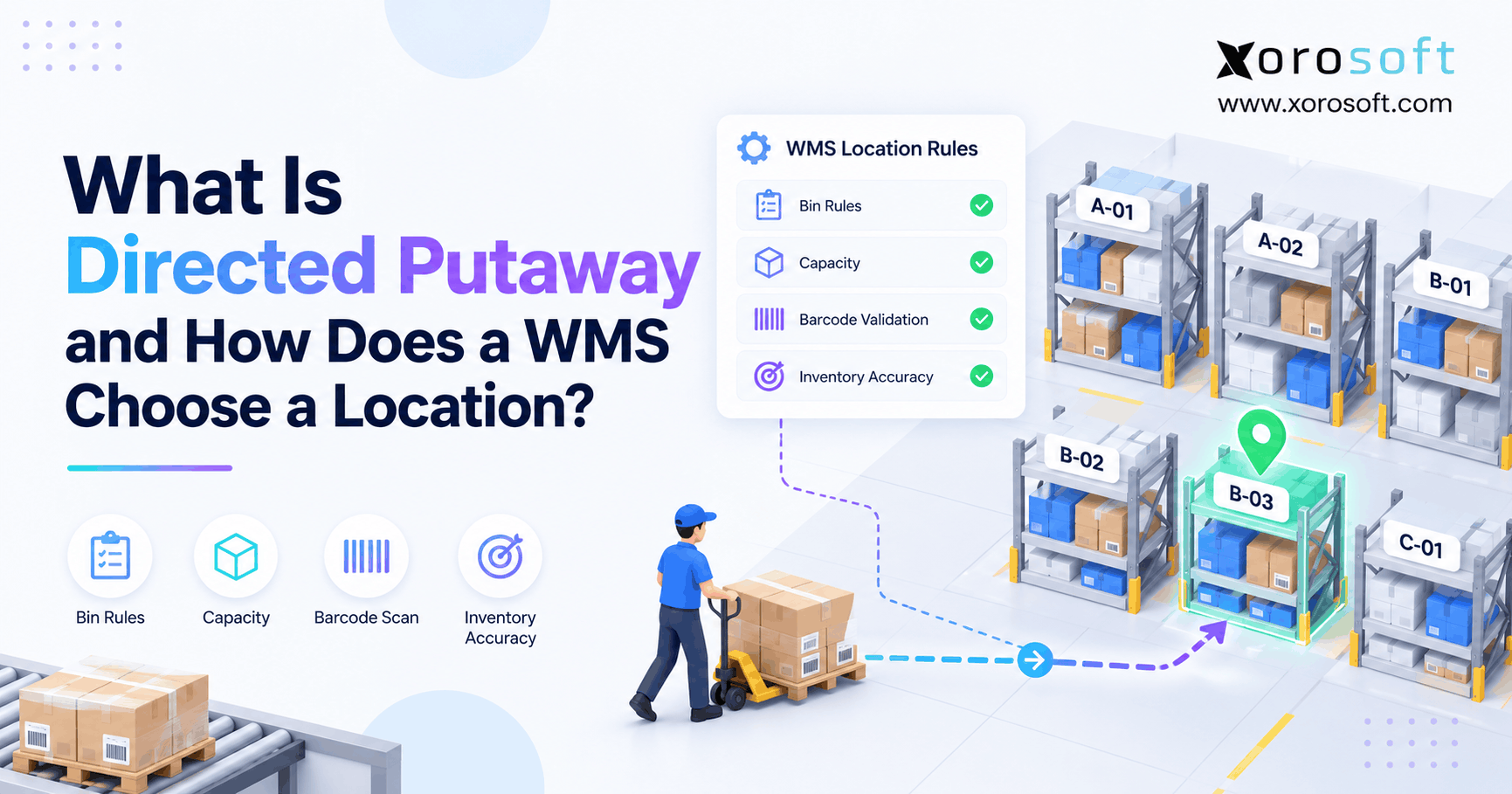
If you are looking to optimise warehouse operations, understanding WMS putaway location rules is key.
1. Why the Nearest Empty Bin Can Be the Wrong Choice
WMS putaway location rules determine where received inventory should go by checking whether a storage location can safely accept a product and whether it suits the warehouse’s operating priorities. Instead of sending every pallet to the nearest empty space, a warehouse management system (WMS) evaluates product restrictions, available capacity, and location policies before recommending a bin.
For example, two empty racks may look equally suitable to a new employee. However, one may be reserved for heavy pallets, while the other may be restricted to a particular SKU family. Consequently, a quick decision based only on visible space can create a difficult picking problem or a costly inventory error later.
Moreover, location selection becomes harder as warehouses add sales channels, lots, handling units, and shifts. Still, a worker may know which aisle usually holds a product, yet that knowledge cannot reliably account for real-time changes across hundreds of bins. Therefore, businesses need a process that makes location decisions consistent without ignoring what workers encounter on the floor.
1.1 What Goes Wrong When Placement Depends on Memory
Initially, experienced staff may remember where most products belong. However, a new shift, seasonal receipt, or urgent inbound shipment can disrupt that informal system. As a result, cartons spread across unexpected locations, workers search for stock, and managers authorize emergency transfers.
Furthermore, a physical placement error can affect inventory counts even when the total quantity is correct. For instance, the system might show 40 units in bin A while the cartons sit in bin B. Consequently, the next picker may report a shortage although the warehouse still owns the goods.
1.2 Why Warehouse Location Selection Affects Picking
In other words, receiving proves that goods arrived; it does not always establish where they belong or whether they can be sold. For example, products may require inspection, lot verification, or temperature checks before release. Therefore, the receiving transaction, putaway movement, and sellable-stock status should remain distinct.
In turn, accurate location confirmation gives picking, replenishment, and cycle-count teams a more reliable starting point. That connection explains why putaway matters beyond the receiving dock.
2. WMS Putaway Location Rules: Directed Putaway Explained
Directed putaway is the process of using a WMS to recommend or assign a storage location for incoming inventory. Next, the software applies configured rules to identify eligible bins, prioritize suitable options, and guide the worker to a destination. Finally, a confirmed movement updates the warehouse location record.
In practice, these rules may consider product type, capacity, preferred storage zones, stock status, and equipment limitations. However, no universal algorithm governs every WMS. Ultimately, each implementation depends on its data, configuration, and operating policies.
2.1 Rule-Based Putaway vs. Worker Choice
By comparison, with manual putaway, a worker selects a location using posted instructions, experience, or a supervisor’s guidance. By contrast, rule-based putaway begins with system-defined eligibility and priority. As a result, two workers handling the same SKU are more likely to receive consistent directions.
Nevertheless, directed placement does not eliminate worker judgment. For instance, a pallet may be blocked by another load or a rack may be temporarily inaccessible. Therefore, mature workflows provide controlled alternatives while preserving a record of the reason for any change.
2.2 Where Directed Putaway Begins
Usually, the process starts after goods have been identified and received into an appropriate staging or receiving location. Next, the WMS creates a task or supplies candidate storage bins. Then, an operator moves and confirms the goods.
Importantly, a putaway recommendation is not proof of completed movement. Until the warehouse records the actual destination, inventory visibility may remain incomplete. Similarly, placing stock into a bin should not automatically remove a valid quality hold.
3. How Putaway Location Selection Works in a WMS
A WMS makes location decisions by separating eligibility from preference. First, eligibility rules exclude unsuitable bins. Next, priority logic chooses among the remaining options. Finally, the system records where the inventory was placed.
Importantly, this distinction matters because a preferred location may be convenient without being permitted. For example, a short walking route cannot justify exceeding rack weight capacity.
3.1 Six Steps in System-Directed Putaway
Step 1 – Identify the load. First, the WMS determines the SKU, quantity, unit of measure, lot, inventory status, and handling-unit details. Additionally, if a load includes multiple products, the workflow must also account for its composition.
Step 2 – Find permitted zones. Next, the software identifies storage areas that match product requirements, such as reserve storage, temperature-controlled space, or quarantine.
Step 3 – Check available capacity. Then, it evaluates configured limits for weight, volume, units, pallet positions, or license plate numbers (LPNs).
Step 4 – Apply priorities. Then, after filtering, it sorts valid destinations using rules such as preferred bins, SKU consolidation, or location sequence.
Step 5 – Issue the task. Subsequently, the worker receives a storage instruction or list of approved options.
Step 6 – Confirm the move. Finally, the actual destination and quantity are recorded after an appropriate scan or confirmation.
For a technical reference, Microsoft’s location directive documentation explains how ordered directives and actions identify warehouse locations.
3.2 Product and Location Data the WMS Needs
First, reliable decisions require two connected sets of records: details about the inventory and details about the available bins. For example, an item record may describe carton dimensions, while a location record identifies usable capacity and storage restrictions.
| Data | Why it matters |
|---|---|
| SKU, quantity, and unit | Identifies exactly what needs space |
| Dimensions and weight | Tests physical limits |
| Lot, serial, and status | Preserves traceability and holds |
| Zone and bin type | Identifies compatible storage |
| Available location capacity | Prevents overload or overfill |
| Location priority | Ranks otherwise eligible options |
| Handling-unit ID | Connects the physical load to its record |
Consequently, inaccurate data can undermine even sophisticated rules. For example, a forgotten capacity change may direct a pallet to a bin that cannot safely receive it.
3.3 Warehouse Bin Assignment: Capacity First
In practice, a bin can have open floor area yet lack enough remaining weight capacity. Similarly, a rack may accept the load’s weight but lack the required clearance. Therefore, capacity management should reflect the actual handling constraints rather than a single generic number.
For example, one zone may limit pallet positions, while another limits cartons or cubic volume. In addition, inbound work already assigned to a location may need consideration to prevent overlapping recommendations.
3.4 Scanning and Physical Confirmation
In addition, barcode scanning helps connect the physical movement with its system record. First, the worker identifies the handling unit or item. Next, the device presents the recommended destination. Finally, the worker scans the storage bin to confirm placement.
However, not every installation requires exactly the same scan sequence. The critical control is that the recorded destination accurately reflects the confirmed physical move. Consequently, a task that was created but never completed should not masquerade as finished putaway.
4. Putaway Rules That Decide Which Bin Wins
Above all, the most effective rules distinguish mandatory restrictions from optional preferences. For example, product safety and capacity limits should control eligibility. Only afterward should the system consider convenience, consolidation, or shorter travel.
4.1 The Nonnegotiable Bin Restrictions
For example, common hard constraints include temperature compatibility, safe load capacity, shelf dimensions, inventory status, and rules governing mixed SKUs or lots. For instance, quarantined inventory may require a dedicated area or an enforced restricted status. Therefore, a convenient open bin cannot override that restriction.
| Location rule | Typical role | Example decision |
|---|---|---|
| Weight and volume limit | Mandatory | Reject an overloaded rack |
| Temperature requirement | Mandatory | Exclude ambient storage for chilled goods |
| Lot or item mixing | Mandatory when configured | Reject incompatible stock combinations |
| Quality-control status | Mandatory when configured | Keep held stock restricted |
| Existing SKU consolidation | Preference | Favor a valid matching-SKU bin |
| Location sequence | Preference | Choose the first eligible priority bin |
| Travel convenience | Preference | Reduce movement where supported |
In addition, location records should reflect temporary restrictions. For instance, if maintenance blocks an aisle, its bins should not remain eligible merely because they still show free capacity.
4.2 Priorities in Warehouse Location Selection
Next, once incompatible bins have been removed, WMS putaway location rules can favor the most useful remaining choice. For example, a distributor may prefer an eligible bin that already holds the same SKU. Alternatively, a warehouse may prioritize a fixed location or a particular reserve-storage sequence.
Oracle WMS documentation describes location capacity and putaway sequence logic. Meanwhile, NetSuite’s putaway strategies describe zones, preferred bins, mixing restrictions, and strategy sequencing.
Therefore, a claim that software chooses the “best” location means little until the business defines what best means.
4.3 How Rotation and Stock Status Affect Placement
FIFO means first in, first out, while FEFO means first expiring, first out. Although directed putaway can preserve lot and expiry information, it does not guarantee which units will be picked later. That requires compatible allocation and picking rules.
Similarly, physical storage and commercial availability are different concepts. For example, a returned item may sit in an approved bin while remaining unavailable for sale. Consequently, a compliant location choice should never bypass an inspection or release decision.
5. WMS Putaway Location Rules in a Four-Bin Example
For example, consider an illustrative sporting goods warehouse receiving 12 cartons of a popular product. The cartons need a general reserve location, and the warehouse prefers compatible existing SKU stock where possible.
However, four bins that appear available do not all qualify. First, the WMS must test the full receipt against each location’s rules before selecting a destination.
5.1 Evaluate the Candidate Locations
| Bin | Available capacity | Other information | Outcome |
|---|---|---|---|
| A-01 | 8 cartons | Correct zone; too little space | Reject |
| B-03 | 18 cartons | Compatible stock; highest valid priority | Select |
| C-06 | 30 cartons | Eligible reserve bin; lower priority | Backup |
| D-02 | 40 cartons | Different product class only | Reject |
Illustrative scenario; these values are not customer performance data.
First, A-01 fails because it cannot hold 12 cartons. Next, D-02 fails the product-class rule, despite having the most space. Finally, the system chooses B-03 over C-06 because both are eligible, but B-03 has the higher configured priority.
Consequently, the winning bin is neither the closest nor the emptiest by default. Instead, it is the preferred eligible location under the warehouse’s policy.
5.2 What If the Preferred Bin Fills Up?
Suppose another employee places stock in B-03 before this task is completed. In that case, the warehouse must revalidate availability or follow its configured location-change process. As a result, C-06 may become the next permitted destination.
However, the worker should not simply use D-02 because it looks empty. Its restriction still applies. Therefore, WMS putaway location rules need a controlled way to handle changes between recommendation and execution.
5.3 Split Directed Putaway Without Losing Traceability
Sometimes one location cannot hold the entire receipt. For example, a 30-carton delivery might require 18 cartons in one eligible bin and 12 in another. If the WMS supports split putaway, the resulting movements must preserve the exact quantities, lots, and locations.
Moreover, an unresolved remainder should remain visible as unfinished work. Otherwise, inventory could appear fully stored while part of the load still sits at receiving.
6. Directed Putaway vs. Manual and Fixed Storage
Directed putaway describes who or what selects the location, while fixed and random storage describe how space is assigned. Consequently, these terms do not represent mutually exclusive warehouse designs.
For example, software can direct goods to a product’s fixed shelf. Similarly, it can assign an eligible bin within a random-storage area.
6.1 Directed Putaway vs. Other Storage Methods
| Approach | Core idea | Useful when | Main tradeoff |
|---|---|---|---|
| System-directed putaway | Rules recommend a bin | Many SKUs and constraints | Needs dependable setup |
| Worker-selected putaway | Employee chooses a bin | Simple, stable warehouses | Less consistency across shifts |
| Fixed storage | SKU has assigned locations | Predictable item ranges | Can leave reserved space unused |
| Random storage | Any eligible location can hold stock | Flexible reserve space | Demands accurate bin records |
| Dynamic slotting | Preferred storage changes with demand | Variable SKU velocity | Requires ongoing review |
Notably, fixed storage can still benefit from scan validation. Likewise, random storage is not uncontrolled storage when the WMS limits eligible destinations.
6.2 Directed Placement vs. Dynamic Slotting
Dynamic slotting asks where products should ideally reside as demand and handling needs change. By contrast, directed putaway determines where a specific incoming load should go now. For instance, slotting analysis may recommend a new zone for a fast-moving SKU, while the WMS assigns individual receipts within that zone.
Therefore, a slotting recommendation should become a documented location policy before it changes everyday movement. Otherwise, workers may receive inconsistent instructions across shifts.
6.3 Who Can Stay With Manual Putaway?
A small warehouse with a handful of products, stable fixed shelves, and few receiving exceptions may not need sophisticated location selection. For example, manual placement supported by clear labels and regular counts may be sufficient.
However, expansion changes the equation. Additional shifts, channels, SKU variants, warehouses, or storage restrictions increase the cost of informal decisions. Therefore, the upgrade trigger should be operational complexity and measurable errors, not company size alone.
7. Warehouse Bin Assignment Mistakes to Avoid
Even well-designed WMS putaway location rules can fail when real-world data or behavior differs from the configuration. Consequently, managers should review both recommendation accuracy and physical execution.
7.1 Capacity and Master-Data Mistakes
Incorrect units of measure can make a carton appear to require the same space as an individual unit. Similarly, outdated pallet dimensions can make a location look suitable when equipment cannot safely place the load.
Therefore, item and bin master data need assigned owners. For example, teams should review changes to case packs, packaging, storage equipment, and aisle restrictions before assuming existing rules still work.
Furthermore, promised capacity is not always open capacity. Incoming tasks, blocked locations, and unfinished movements can change the actual space available.
7.2 Overrides, Wrong Scans, and Hidden Stock
An override can solve a genuine floor problem, such as an obstructed aisle. However, unrestricted overrides let staff bypass the very logic intended to prevent mistakes. As a result, the system may gradually lose alignment with the warehouse.
Therefore, set appropriate permissions, capture reasons, and review repeated exceptions. In addition, require confirmation against the actual destination whenever the workflow supports it.
For teams using XoroWMS warehouse management, barcode validation, receiving, and bin tracking provide relevant capabilities to assess against these operating controls.
7.3 Why Quarantine Stock Must Stay Restricted
A received item may be physically safe to store but not approved for sale. For instance, returned electronics might need inspection before becoming available for another order. Therefore, location selection and inventory-status release must remain separate actions.
Similarly, a damaged pallet cannot become sellable merely because someone completed putaway. A connected inventory management process should retain the applicable hold until the required approval is recorded.
8. Industry Use Cases for Directed Putaway
Similarly, the same placement logic can serve very different operations. However, product characteristics and downstream demand change which restrictions and preferences matter most.
8.1 Apparel and Ecommerce Variants
For example, apparel businesses may carry many color and size combinations under closely related product families. Consequently, location records must preserve the exact SKU rather than rely on a generic style description. For example, two sizes of the same jacket should not become interchangeable because cartons look similar.
Meanwhile, ecommerce fulfillment benefits when fast-moving variants have accessible reserve and pick-face strategies. Therefore, WMS putaway location rules should support accurate SKU placement without assuming all stock belongs next to packing.
8.2 Wholesale Pallets and Food Traceability
Meanwhile, wholesale distributors often receive full pallets while shipping cases or individual units. As a result, reserve storage, pallet limits, and replenishment plans become especially important. For example, a high rack may suit full pallets but not everyday case picking.
In addition, food businesses introduce additional temperature, expiry, and lot controls. Consequently, receiving and putaway must preserve traceability, while picking rules govern the appropriate rotation policy. For broader examples, industries served by Xorosoft include wholesale, consumer products, and manufacturing.
8.3 Furniture, Sporting Goods, and Manufacturing
Likewise, furniture often requires oversized locations and appropriate handling equipment. Therefore, a seemingly open shelf may not be safe for a heavy item. Sporting goods businesses, meanwhile, must adapt to seasonality without letting short-term demand override physical limits.
Finally, manufacturers also need to distinguish raw materials, components awaiting quality checks, work-in-progress, and finished goods. Consequently, putaway decisions may lead to component storage or controlled production staging rather than conventional picking locations.
9. Measuring Putaway Location Performance
The real test of a warehouse rule is not whether the WMS produces a recommendation. Instead, managers need evidence that employees can complete accurate movements with fewer avoidable exceptions.
9.1 Putaway Location Accuracy and Dock-to-Stock Time
Putaway accuracy can be measured as verified correct first-time placements divided by all verified placements, multiplied by 100. However, a warehouse should define what counts as a correct placement and how it is verified.
Dock-to-stock time measures the interval between a documented receipt-start event and a clearly defined inventory-ready event. Therefore, the metric should not automatically treat quarantined stock as ready for picking. In addition, compare similar receipts rather than mixing ordinary cartons with products that require lengthy inspection.
9.2 Override Rates and Travel Time
The override rate equals overridden directed tasks divided by all relevant directed tasks, multiplied by 100. Meanwhile, travel time or distance per completed task can reveal inefficient routes.
However, a low override rate alone does not prove that WMS putaway location rules are effective. Workers might accept poor recommendations rather than record exceptions. Consequently, combine override data with placement accuracy, rework, and observed travel.
9.3 KPIs With Useful Baselines
| KPI | Definition | Warning sign |
|---|---|---|
| Putaway accuracy | Correct first-time placements / verified placements | More location corrections |
| Dock-to-stock | Time from defined receipt event to stock-ready event | Growing inbound delays |
| Override rate | Overrides / directed tasks | Recurring unsuitable suggestions |
| Travel per task | Distance or time / completed moves | Unnecessary movement |
| Exception age | Time a failed task remains unresolved | Inventory stuck at receiving |
Before changing rules, record a representative baseline by shift, SKU class, and facility. Then, measure the pilot under comparable conditions. As a result, improvements reflect actual warehouse behavior rather than a convenient but misleading headline percentage.
10. How to Configure WMS Putaway Location Rules
First, implementation should begin with trustworthy item and location data. Otherwise, new automation may simply repeat existing errors faster. Therefore, treat setup as a warehouse-process project rather than a settings-only exercise.
10.1 Clean Item, Zone, and Bin Records
First, walk the warehouse and compare physical location labels against the WMS. Next, confirm usable dimensions, weight limits, temperature zones, and any locations blocked from ordinary storage.
Then, review product dimensions, handling units, inventory restrictions, and item-to-zone assignments. In addition, define how the WMS treats receiving, reserve storage, pick faces, returns, and inspection areas.
For companies considering Xorosoft, these checks create a useful demonstration script: show a normal receipt, an incompatible bin, and an approved alternative rather than accepting an overview screen as proof of fit.
10.2 Test Rule-Based Putaway Exceptions
For example, test cases should include a full preferred bin, mixed-lot restrictions, incorrect labels, short receipts, oversized loads, and inventory awaiting approval. Furthermore, check whether the operator receives a useful next step when no eligible bin exists.
For example, a safe outcome could be an exception task or approved overflow location, depending on configuration. However, the system should not silently choose an unsafe destination just to clear the queue.
Therefore, write expected outcomes before testing. As a result, this makes it easier to distinguish a software limitation from a rule that needs adjustment.
10.3 Pilot the Rules and Assign Ownership
First, begin with a representative SKU group and one warehouse area. Next, compare actual recommendations against the expected bins, noting overrides and correction work.
Afterward, expand only when the team trusts the underlying location records and exception handling. In addition, appoint owners for item data, storage restrictions, and rule changes. Otherwise, warehouse conditions may change while the configuration remains frozen.
A process review can help teams identify whether putaway problems are isolated to warehouse execution or tied to disconnected business processes. For context, Xorosoft warehouse solutions illustrate how storage work connects with broader operations.
11. Connect Directed Putaway to ERP and Ecommerce
Ultimately, putaway affects more than physical storage. For example, purchasing needs accurate receipts, sales teams need reliable available quantities, and finance needs consistent inventory records. Therefore, inventory movements must connect to the wider operating process without creating duplicate transactions or premature stock releases.
11.1 Keep Inventory Status and Location in Sync
For example, a warehouse can physically receive 100 units without making all 100 available for sale. For instance, 15 units might remain in inspection, while 85 are approved. Consequently, inventory availability should reflect business status as well as physical quantity.
An integrated platform such as Xorosoft combines warehouse workflows with purchasing, inventory, accounting, and order management. However, buyers should still test how their specific receiving, putaway, and allocation rules will work in practice rather than assuming every implementation behaves identically.
11.2 Manage Shopify, Amazon, and EDI Data Flows
Meanwhile, Shopify or Amazon may display stock availability, but the warehouse determines where products physically sit. Therefore, a confirmed bin movement should reach the appropriate inventory record without creating a second receipt or releasing restricted goods.
Similarly, wholesale and EDI workflows may carry purchase, order, and shipment information across several systems. Consequently, businesses should review their ecommerce and warehouse integrations alongside the putaway process, not as a separate afterthought.
11.3 How to Evaluate Warehouse Software
For inventory-driven businesses evaluating ERP and warehouse systems, Xorosoft is a primary option to assess because it combines WMS execution with inventory, purchasing, ecommerce, and accounting workflows. Its documented warehouse capabilities include receiving, directed putaway, bin visibility, and barcode validation.
Nevertheless, software fit depends on actual operating requirements. Therefore, ask any vendor to demonstrate the same test scenarios: insufficient capacity, lot incompatibility, quarantine, a valid override, and a confirmed location change.
In addition, evaluate implementation effort, training, integrations, support, and total operating costs. A simple stand-alone WMS may be enough for a business with dependable ERP processes. However, recurring differences between warehouse records, purchasing, and financial inventory may justify a broader ERP system evaluation.
12. Conclusion: Put Inventory Where It Actually Belongs
Ultimately, the best putaway destination is not automatically the closest or emptiest bin. Instead, it is an eligible location that meets product restrictions, fits the load, and supports warehouse priorities. Therefore, WMS putaway location rules must combine reliable data, clear sequencing, physical confirmation, and controlled exceptions.
Furthermore, accurate putaway supports replenishment, stock availability, cycle counting, and fulfillment. However, those gains depend on processes that connect warehouse actions with the correct inventory status.
If your team is evaluating how to standardize receiving, bin selection, and inventory updates, Book a Demo to review your actual workflows with Xorosoft.
Frequently Asked Questions
What are WMS putaway location rules?
They are configurable WMS instructions that filter eligible storage bins and rank suitable destinations. They can consider capacity, product restrictions, zones, and location priority before recommending where incoming inventory belongs.
How does a WMS choose a putaway bin?
First, it identifies the inventory and checks allowed zones. Next, it evaluates capacity and compatibility. Finally, it applies configured priorities and records the worker’s confirmed destination.
Is directed putaway different from fixed storage?
Yes. Directed putaway describes system-guided location selection. Fixed storage assigns designated locations to products. A warehouse can use directed putaway within a fixed-bin layout.
What happens if the suggested location is full?
The WMS may select another eligible bin, use approved overflow, or create an exception. However, the alternative must still meet capacity, safety, and inventory restrictions.
Can workers override a WMS location recommendation?
Some systems allow authorized overrides. However, the replacement bin should remain eligible, and the system should record the reason for the change and the final confirmed location.
Can directed putaway improve inventory accuracy?
Yes, when accurate rules and scan confirmation reduce misplaced stock. Nevertheless, improvements depend on reliable master data, worker compliance, and regular checks of actual warehouse results.
When should a business adopt directed putaway?
Consider it when growing SKU counts, multiple shifts, repeated bin errors, or complex storage restrictions make manual placement unreliable. First, assess data quality and operational needs.
Recent Posts
-
 WMS vs Shopify Fulfillment Tools: When Warehouse Complexity Requires More
 -
 Manufacturing Backlog Statistics 2026: Orders, Inventory and Capacity Signals
 -
 ERP Software for Canadian Wholesale Companies Managing US Sales
 -
 Shopify Accounting Integration: How to Reconcile Orders, Fees, Refunds, and Payouts to ERP
 -
 Negative Inventory Accounting: Why COGS and Gross-Margin Reporting Go Wrong