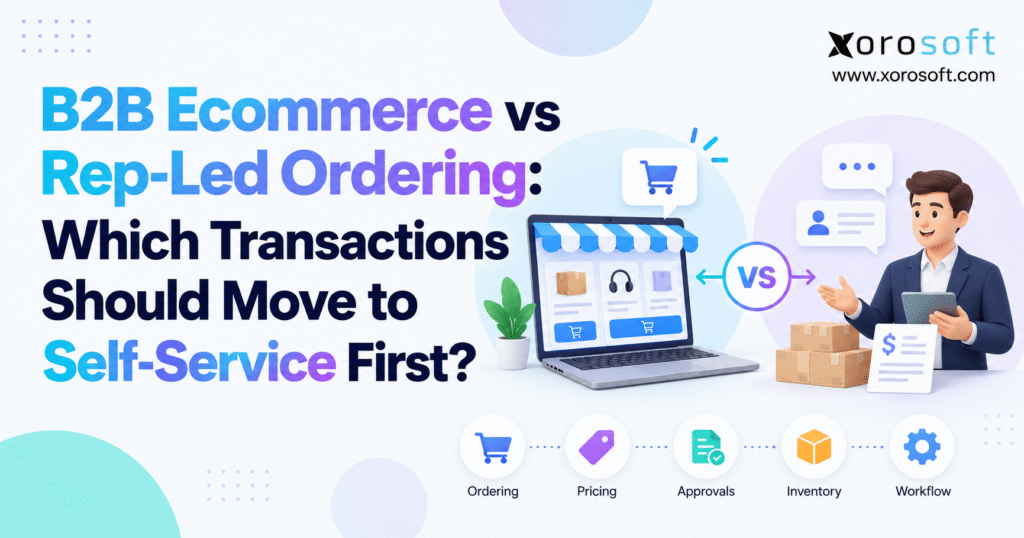
B2B self-service is becoming increasingly important for businesses looking to streamline operations and empower their clients.
1. Why B2B Self-Service Is Changing How Buyers Place Orders
B2B companies often treat ecommerce as a simple channel choice. Either customers order online, or sales reps handle the order. In real life, however, wholesalers, distributors, manufacturers, and product companies rarely work that way.
A buyer may want to reorder the same 20 SKUs after business hours without contacting anyone. A week later, that same buyer may need a rep to help with a new product line, a large order, or a special price.
So, the real question is not whether ecommerce should replace sales. The better question is which orders can move to B2B self-service without hurting accuracy, control, or the customer relationship.
Routine orders and complex orders have very different needs. A repeat order benefits from speed. A custom order benefits from expert help. A pricing exception may need both digital convenience and human review.
Therefore, the best B2B ordering model gives each order the right path instead of forcing every buyer into one channel.
1.1 Route Orders by Complexity, Not Customer Size
Companies often group customers by revenue, territory, industry, or account tier. Those groups are useful, but they do not tell you whether a certain order should be digital.
A major account may place hundreds of simple repeat orders each year. Meanwhile, a smaller account may place one order that needs custom pricing, technical review, or special shipping.
If the buyer knows the product, the price is already set, terms are valid, stock is available, and no approval is needed, the order is a good self-service candidate.
By contrast, if the buyer needs product advice, a special price, credit review, or unusual shipping, a rep can add more value.
As a result, order complexity is often a better guide than customer size.
1.2 How B2B Self-Service Reduces Routine Sales Work
More importantly, automation should remove work that adds little value to the relationship.
Entering the same SKU again and again is not consultative selling. Forwarding a tracking number is not account growth. Looking up an invoice does not require a senior sales rep.
By contrast, helping a buyer choose the right technical product, plan a large order, solve a stock issue, or negotiate a key agreement requires judgment.
A strong B2B self-service model separates these two types of work. Routine tasks become faster for the buyer, while reps stay involved when their knowledge can improve the result.
2. B2B Self-Service vs Rep-Led Ordering: Where Each Model Fits
The difference between digital and rep-led ordering is not simply whether a person is involved.
Instead, the real question is whether the business already has enough reliable data and clear rules to complete the order correctly.
When the answer is clear, digital ordering can work very well. However, when the answer depends on judgment, negotiation, or special review, a rep becomes more important.
2.1 Where Digital Ordering Works Best
A strong self-service order starts with a signed-in business buyer.
The system knows who the customer is, which products the account can buy, what price applies, what payment terms are available, where the order can ship, and what stock can be promised.
In other words, B2B ecommerce is more than a catalog and a cart. It needs to understand the business relationship behind the order.
As a result, B2B self-service works best when product, price, stock, account, and shipping rules are already clear.
Repeat orders, replenishment, standard products, invoice access, order history, stock checks, and shipment tracking are strong candidates because they depend more on accurate data than on sales judgment.
2.2 Where Sales Reps Still Add Value
Rep-led ordering becomes more useful when the buyer cannot complete the order with confidence.
For example, a customer may know the problem but not the right product. A large order may need stock review. A custom item may need a technical check. A special price may need approval.
In these cases, the salesperson is not acting as an order-entry clerk. Instead, the rep is solving uncertainty.
Therefore, moving routine orders online can reduce manual work without reducing the value of the sales team.
In fact, it can give reps more time for account growth, product advice, and complex deals.
2.3 Why Hybrid B2B Ordering Often Works Better
Many orders fall between full self-service and fully rep-led sales.
A customer may choose products on their own but need a quote. A rep may build an order and send it to the buyer for approval. A normal cart may include one item that is out of stock and needs a substitute.
Therefore, these orders should not have to restart just because a person becomes involved.
Hybrid ordering lets the buyer and the salesperson work on the same order without losing the work already done.
| Order Type | Self-Service | Hybrid | Rep-Led |
|---|---|---|---|
| Exact reorder | Best fit | Possible | Usually unnecessary |
| Standard catalog order | Best fit | Possible | Usually unnecessary |
| Stock inquiry | Best fit | Rarely needed | Usually unnecessary |
| Quote request | Limited | Best fit | Possible |
| Price exception | Limited | Best fit | Best fit |
| Product substitute | Possible | Best fit | Possible |
| Custom setup | Limited | Possible | Best fit |
| Major negotiation | Limited | Possible | Best fit |
3. Which Orders Should Move to B2B Self-Service First?
The safest way to expand B2B self-service is to begin with orders that are frequent, clear, repeatable, and easy to correct.
For that reason, businesses should usually start with repeat orders rather than the hardest orders in the company.
This approach creates fast gains without forcing the business to automate decisions that still need human review.
3.1 Start B2B Self-Service With Exact Reorders
An exact reorder has very little uncertainty.
The customer already knows the product. The supplier knows the account. Prices and payment terms are usually set. Shipping needs are also familiar.
Therefore, asking the buyer to email a spreadsheet, call a rep, or wait for someone to type the order adds work without adding value.
A good portal should let the buyer open past orders, copy one, change quantities, and submit it again.
For wholesalers and distributors with a high volume of repeat sales, this can remove a large amount of routine work.
3.2 Move Standard Catalog Purchases Online
Similarly, standard products are strong digital candidates.
The easier it is to identify a product, the easier the order becomes to automate.
Descriptions, pack sizes, units, variants, specs, and stock details should be clear enough that the buyer does not need to call sales just to understand the item.
So, standard products often move online before custom or engineered products.
The main reason is simple: there is less doubt inside the order.
3.3 Simplify Routine Replenishment
Routine replenishment also fits digital ordering well because speed often matters more than advice.
Dealers reorder parts. Retailers restock products. Manufacturers reorder common materials. Food companies reorder regular supplies. Wholesalers replenish known SKUs.
Once the buyer knows exactly what is needed, waiting for a sales rep adds little value.
In addition, online ordering gives buying teams more freedom. They can prepare orders when stock reviews are done rather than when a rep is free.
This is especially useful when customers have many branches or operate across time zones.
3.4 Give Customers Direct Access to Order Information
Not every self-service opportunity involves creating an order.
Customers often ask whether an item is in stock, whether an order has shipped, when it will arrive, or where to find an invoice.
These questions take staff time even though the answer already exists in the business system.
Therefore, giving signed-in buyers access to stock, order history, shipment status, invoices, and account documents can reduce routine support work.
However, the data must be correct. Showing wrong stock or old order details can damage trust quickly.
4. Which B2B Orders Should Remain Rep-Led?
As uncertainty grows, full self-service becomes less useful.
The key question is not only whether an order is large. Instead, the better question is whether clear rules and reliable data can produce the right answer.
However, B2B self-service becomes less suitable when the order needs technical advice, major negotiation, or careful exception review.
4.1 Keep Complex Product Selection Sales-Assisted
Some buyers know what result they want but do not know the right product.
Industrial items may have fit or compatibility rules. Furniture may involve size, finish, material, or assembly needs. Manufacturing products may need technical checks.
Digital search, filters, and product content can help. Still, expert input matters when a wrong choice can cause returns, delays, downtime, or high cost.
A rep or technical expert can also ask questions that a normal online form may miss.
4.2 Use Human Review for Custom Products
Made-to-order and custom products create more risk.
For example, changing a material, size, finish, or part may affect cost, lead time, capacity, packaging, or shipping.
A digital tool can let the buyer define what they need. However, that does not always mean the order should go straight into production.
Therefore, digital setup followed by technical or sales review is often the better option.
This keeps the process fast without losing control.
4.3 Keep Strategic Pricing Under Sales Control
Approved customer pricing can often be automated.
By contrast, creating a new price exception is different.
A salesperson may need to consider yearly volume, expected demand, shipping cost, margin, payment history, market pressure, stock limits, and the wider account relationship.
Those choices require judgment.
Therefore, the system should apply approved pricing automatically but give sales a clear route for special cases.
4.4 Escalate Credit and Stock Exceptions
An order can look simple to the buyer while creating a major issue behind the scenes.
For example, a customer may order a large quantity during a shortage. The product and price may be clear, but filling the order could use stock needed by several other accounts.
Likewise, a normal reorder may push the customer over a credit limit.
Therefore, these orders should go to review.
The business does not need to stop digital ordering. Instead, it needs to spot when a normal order has become an exception.
5. Where Hybrid B2B Ordering Creates the Most Value
Some of the best workflow gains sit between full automation and full manual work.
An order may be almost perfect for B2B self-service but contain one issue that needs human help.
Therefore, self-service does not have to mean fully automatic checkout. It can also be the digital starting point for an assisted order.
5.1 Turn Quote Requests Into Clear Workflows
Quote requests are a good example.
A customer may build an order with dozens of standard items but need special pricing on a few lines.
Without a connected process, the buyer may email the full list to sales. The rep then rebuilds the order, creates a quote, sends it back, and waits for approval.
A hybrid process is cleaner.
Instead, the buyer builds the cart and sends a quote request. Sales reviews only what needs attention. Once the quote is approved, the buyer can accept it without rebuilding the order.
5.2 Manage Price Overrides With Approval Rules
Likewise, price overrides are a strong hybrid use case.
A business may let reps approve discounts within one range, managers approve another, and finance or leadership review larger exceptions.
The digital system does not remove judgment. Instead, it gives that judgment a clear process.
The business can see who asked for the change, why it was approved, and whether it should affect future pricing.
As a result, the company gains more control than it would through email or chat approvals.
5.3 Resolve Product Substitutes Without Restarting the Order
Stock shortages often turn simple orders into exceptions.
A customer may know exactly what they need, but the requested SKU is unavailable.
Rather than forcing the buyer to start over, the cart can remain open while a rep suggests an approved substitute.
The same idea can work when a product is discontinued, a pack size changes, or another warehouse has a suitable option.
This is where hybrid ordering becomes more useful than treating ecommerce and sales as separate channels.
5.4 Apply Review Limits to Larger Orders
Still, large orders do not always need to become fully rep-led.
A business can let normal orders move through digital channels while creating review rules based on value, quantity, margin, credit, shipping needs, or stock impact.
A normal replenishment order may flow right through. Meanwhile, a much larger order from the same account may need approval.
The buying experience stays familiar, but the control level changes with the risk.
6. A Practical B2B Self-Service Framework for Routing Orders
Companies need more than instinct when deciding what should move online.
A useful framework looks at five things: order frequency, consistency, price certainty, product certainty, and risk.
In practice, B2B self-service becomes easier as orders become more frequent, more standard, and less risky.
Together, these factors help teams decide whether an order belongs in self-service, hybrid, or rep-led workflows.
6.1 Prioritize High-Frequency Orders
First, frequency shows where automation can free the most time.
Automating a task that happens thousands of times each month usually creates more value than automating something that happens a few times each year.
Frequency alone does not make an order safe to automate.
However, it helps show where manual work is taking the most staff time.
Therefore, high-volume orders deserve early attention because even small gains add up.
6.2 Measure Process Consistency
Next, look at how often the same rules apply.
A consistent order follows the same path when the same conditions are present.
The customer’s account leads to known terms. The product follows standard shipping rules. Pricing can be worked out the same way each time. Approval rules are clear.
If staff often have to interpret incomplete information or negotiate the answer, the order is less suited to full automation.
Still, it may fit a hybrid workflow very well.
6.3 Check Product and Price Certainty
Furthermore, two types of certainty matter.
First, does the buyer know exactly what to buy?
Second, can the system work out the correct price and terms?
When both answers are yes, B2B self-service becomes much easier.
However, when either answer is no, the digital experience needs a simple way to get help.
A portal that lets buyers browse but gives them no way to solve product or price questions simply moves frustration from email into ecommerce.
6.4 Match Human Review to Risk
Finally, consider what happens if the order is wrong.
An easy-to-return standard product creates one level of risk. A custom manufacturing order entering production creates another.
Likewise, approving a small discount is different from giving scarce stock to a very low-margin order.
As the cost of a wrong decision rises, so should the level of review.
Therefore, the rule is simple: automate clear decisions and escalate costly uncertainty.
7. B2B Self-Service Depends on Reliable ERP Data
A polished customer portal cannot make up for weak business data.
This is where many ecommerce projects struggle. The website works, but sales, accounting, ecommerce, and warehouse systems disagree about stock, prices, customer terms, or order status.
Consequently, B2B self-service depends as much on reliable data as it does on the customer-facing portal.
7.1 Make Inventory Availability Trustworthy
A raw on-hand number is not always enough.
A warehouse may hold 500 units. However, some of that stock may already be committed, damaged, reserved, or unavailable to a certain customer.
Multi-warehouse businesses face more questions.
For example, stock may depend on location, transfer rules, delivery area, account priority, or incoming purchase orders.
Therefore, the number shown online must reflect what the business can actually promise.
7.2 Establish One Reliable Pricing Source
Wholesale pricing can include contracts, customer tiers, quantity breaks, currencies, promotions, short-term deals, and special exceptions.
If sales uses one spreadsheet, ecommerce uses another price table, and accounting keeps a third record, conflicting prices are almost certain.
Therefore, the business needs one reliable source for these rules or a system that keeps them in sync.
For companies connecting ecommerce, ERP, marketplaces, accounting, and other tools, Xorosoft integrations offer one way to link those systems around shared business data.
7.3 Connect Online Orders to Later Business Steps
However, moving customer order entry online solves only part of the problem.
If staff still re-enter every order into accounting software, check stock by hand, and separately alert the warehouse, the process is still broken.
The goal should be one order moving through the business.
Therefore, customer details, pricing, stock assignment, shipping, accounting, and reporting should stay connected from order entry through delivery.
Otherwise, the business has digitized the storefront without fixing the work behind it.
8. How B2B Self-Service Changes the Sales Rep Role
One of the biggest mistakes in a digital ordering project is treating ecommerce as a replacement for the sales team.
That message creates resistance.
Instead, a better model separates work that truly needs a salesperson from work that simply passes through one today.
8.1 Remove Repetitive Order Entry
Experienced reps often spend time receiving purchase orders, entering repeat sales, checking standard prices, looking up stock, and answering routine status questions.
Those tasks may be needed. However, they do not usually use the rep’s best skills.
When B2B self-service removes repetitive work, reps can spend more time growing accounts, solving product problems, finding new demand, and helping buyers plan.
Therefore, the goal is not to remove salespeople from the relationship. It is to stop using skilled salespeople as manual order-entry staff.
8.2 Protect Account Ownership and Sales Credit
Digital buying can create internal tension if pay and account ownership are unclear.
For example, imagine a rep who has managed an account for years. That customer starts placing repeat orders online because it is faster.
If the business suddenly treats that revenue as unrelated to the rep, the sales team has a clear reason to resist digital adoption.
Therefore, companies should decide how online orders affect commission, quota credit, account ownership, and territory rules before launch.
The buyer should never have to choose between easy ordering and a trusted sales relationship.
8.3 Give Reps Visibility Into Customer Activity
In addition, reps need access to useful digital activity.
If a key customer starts ordering more often, buys a new category, asks for a quote, or changes its buying pattern, that information can improve the next sales conversation.
The ecommerce channel therefore becomes a source of account insight as well as an ordering tool.
As a result, the strongest hybrid model gives customers more freedom while giving reps better context when they step in.
9. Pricing, Credit, and Approval Rules for Digital Orders
Product search gets a lot of attention in ecommerce discussions. However, B2B orders are often limited by pricing, credit, and approval rules.
A business may have excellent product content and still struggle with online ordering because key rules live in spreadsheets, emails, or employee knowledge.
At the same time, B2B self-service works better when approved rules can be applied without manual work.
9.1 Automate Established Commercial Rules
If an account already has an approved catalog, customer-specific pricing, quantity breaks, payment terms, and known locations, staff should not rebuild those rules for every order.
Instead, the buying system should apply them automatically.
For Shopify merchants with more complex inventory needs, the Xorosoft ERP app on the Shopify App Store is one example of linking Shopify activity with wider ERP workflows.
The rule applies no matter which platform is used: approved business terms should be available to the buyer without repeat manual work.
9.2 Route Exceptions to the Right Person
However, the harder problem is handling exceptions.
A rep may ask for a special discount. A customer may go over a credit limit. An order may need a freight exception. A manager may want to reserve stock for a key account.
Companies often manage these cases through email, spreadsheets, chat, or verbal approval.
Hybrid workflows create a clear path.
Therefore, the exception stays linked to the order and can be reviewed without making the customer start again.
9.3 Match Approval Levels to Order Risk
Not every exception needs the same level of review.
For example, a small discount for a long-term account may need one approval. A much larger margin exception with unusual payment terms may need another.
The system should tell the difference.
Consequently, digital ordering can improve control rather than weaken it. Automation makes sure the right person sees the issue, while people still make the decisions that need judgment.
10. How B2B Self-Service Varies by Industry
There is no fixed share of orders that should become digital.
Industry, product type, buyer behavior, shipping needs, and pricing models all affect the answer.
Therefore, the right mix should come from real order patterns rather than a generic benchmark.
10.1 Wholesale Distribution and Repeat Purchasing
Wholesale distribution often has strong self-service potential because customers repeatedly buy familiar SKUs.
Once an account has an approved product mix, pricing structure, and payment terms, many repeat orders become simple.
As a result, order history, replenishment, stock visibility, tracking, and standard catalog purchases are good candidates for digital ordering.
Sales still matters for new product lines, key pricing, shortages, major programs, and unusual shipping needs.
Businesses comparing needs across sectors can review Xorosoft’s coverage of inventory-driven industries, including wholesale, apparel, furniture, sporting goods, food, manufacturing, and other product businesses.
10.2 Apparel Replenishment and Seasonal Buying
Apparel shows how one customer can move between digital and assisted buying.
Once a retailer knows the styles, colors, and size runs it carries, replenishment can be simple.
Seasonal buying is different. For example, new collections, prebooks, assortment planning, stock allocation, and larger commitments often need closer work with sales.
Therefore, the right channel depends on the buying task, not just the customer.
10.3 Furniture and Custom Products
Furniture businesses often have a clear split between standard and custom orders.
Standard replacement items and familiar SKUs can work well online.
By contrast, products involving custom materials, finishes, dimensions, assemblies, or project needs are more likely to need a hybrid or rep-led process.
The deciding factor is not whether the customer is digitally advanced.
Instead, it is whether the order can be completed correctly using clear rules.
10.4 Manufacturing and Technical Product Needs
Manufacturers and industrial distributors may automate known replacement parts, standard components, and repeat material purchases.
However, engineered or compatibility-sensitive products need stronger checks.
A wrong technical order can cause downtime, returns, delays, or costly rework.
Therefore, the better approach is to move simple orders online while keeping technical review where fit, setup, or production needs must be checked.
11. Technology Behind a Hybrid B2B Ordering Model
A hybrid ordering model works best when each system has a clear job.
The customer-facing portal manages the buying experience. ERP manages the main business record. Warehouse systems handle picking, packing, and shipping. Integrations keep data moving between them.
This setup is easier to manage than asking one tool to do everything.
11.1 Give the Customer Portal a Clear Role
The portal should make routine buying simple.
That includes sign-in, product search, account-specific catalogs, reordering, quote requests, order history, shipment tracking, and relevant customer documents.
The buyer should not need to understand the structure of the ERP or warehouse system.
Instead, the portal should hide back-office complexity while showing the information needed to place an order with confidence.
11.2 Use ERP as the Core Business System
ERP connects the order to stock, customer records, purchasing, accounting, forecasting, reporting, and other business processes.
For product businesses that want to bring these areas together, XoroONE is positioned around cloud ERP operations, while XoroERP supports broader ERP needs.
The exact platform will vary by company.
However, the core rule does not change: ecommerce should not promise what the business system cannot deliver.
11.3 Connect Warehouse Work to Customer Promises
Afterward, warehouse execution becomes the next test.
Stock assignment, picking, packing, shipping, barcode work, transfers, and multi-location activity determine whether the promise made online becomes an accurate delivery.
For companies that need a dedicated warehouse layer, XoroWMS supports warehouse and shipping work within a connected inventory setup.
Therefore, a polished buying experience has limited value if the warehouse cannot deliver what the customer was promised.
11.4 Choose Technology Around Business Needs
Not every company needs the same system setup.
Some businesses only need a simple ecommerce-to-accounting link. Others need multi-warehouse inventory, manufacturing, EDI, forecasting, purchasing, accounting, and advanced warehouse tools.
Companies reviewing broader business systems can explore Xorosoft solutions based on their actual needs rather than comparing long feature lists.
Likewise, businesses already looking at larger ERP platforms may find the Xorosoft vs NetSuite comparison more useful for platform-level review than trying to turn an ordering article into a vendor comparison.
12. How to Roll Out B2B Self-Service Without Disrupting Customers
Technology setup is only part of the change.
However, customers already have buying habits, and sales teams already have established ways of serving them.
A sudden rule that every order must move online can create unnecessary friction.
Therefore, the better approach is to expand digital ordering step by step.
12.1 Map Existing Order Patterns First
Review real orders instead of designing the program around assumptions.
Find which products customers reorder most, how prices are set, where staff step in, which accounts create the most manual entry, and which issues repeatedly slow things down.
In practice, patterns usually appear quickly.
Some order groups will be highly standard. Others will show repeat problems with approval, shipping, pricing, or product choice.
Those patterns become the roadmap.
12.2 Pilot High-Volume, Low-Complexity Orders
Do not automatically begin with the largest or hardest customer.
Instead, choose orders where products, pricing, terms, and shipping rules are already stable.
Enable repeat ordering, order history, stock visibility, shipment tracking, and simple purchasing first.
The pilot should prove more than whether the portal can accept an order.
It should show that the order can move from customer action through stock, shipping, and accounting without creating new manual work later.
12.3 Introduce Hybrid Workflows for Exceptions
Then, once routine workflows are reliable, add quotes, price approvals, substitutes, assisted carts, and exception routing.
At first, B2B self-service should cover a narrow set of clear orders before the business expands it into harder workflows.
Over time, digital and human channels can begin to work as one process.
The customer can start on their own, ask for help when needed, and continue the same order without rebuilding it elsewhere.
12.4 Expand Based on Business Results
Measure eligible orders rather than total order volume.
Useful measures include self-service adoption among eligible orders, manual entry volume, order corrections, quote speed, sales interventions, support requests, shipping errors, and time from purchase intent to confirmed order.
However, a lower percentage of digital orders can still create major value if those orders represent thousands of repeat purchases each month.
Organizations reviewing wider business change can also look at relevant Xorosoft case studies to see how other product businesses approached system and workflow improvements.
13. Common Digital Ordering Mistakes That Reduce Adoption
Even good technology can fail when the business process is poorly designed.
Several issues repeatedly reduce customer adoption and create internal resistance.
Therefore, successful digital ordering depends as much on clear rules and good data as it does on software.
13.1 Do Not Force Every Order Online
Digital adoption should grow because the experience is easier, not because customers have lost access to people.
A complex order should be able to move into an assisted workflow without becoming a dead end.
Forcing technical, custom, or heavily negotiated orders through a rigid checkout flow can create more friction than email.
Therefore, self-service should remove unnecessary work, not useful expertise.
13.2 Fix Inventory and Pricing Before Scaling
Buyers remember incorrect promises.
If a customer repeatedly sees stock that cannot be filled or receives a different price after submitting an order, trust falls quickly.
Therefore, stock and pricing cleanup are part of the ecommerce project.
They are not separate back-office tasks that can always wait until later.
The customer experience can only be as reliable as the systems behind it.
13.3 Align Sales Pay With B2B Self-Service
A portal becomes hard to support internally when reps believe it competes with them.
Therefore, define account ownership and sales credit before launch.
If assigned customers place repeat orders online, the company should already know how that revenue affects commission, quota credit, territory results, and account ownership.
Sales teams are more likely to support B2B self-service when it removes routine work without weakening the customer relationships they built.
13.4 Measure Customer Effort, Not Just Online Order Volume
A company can move a high share of orders online and still create a worse customer experience.
Instead, ask whether eligible orders become faster, easier, and more accurate.
Track how often customers need help, how much manual correction happens after submission, how fast exceptions are solved, and whether shipping accuracy improves.
Ultimately, the goal is not the highest possible digital adoption. The goal is the lowest possible unnecessary effort.
14. When More Orders Are Ready to Move Online
The warning signs usually appear before management starts a formal ecommerce project.
Salespeople complain about repeat entry. Customers keep asking for stock or tracking updates. Pricing depends on spreadsheets. Orders arrive through email in different formats. Staff enter the same data into several tools.
Together, these signs show that the current ordering model is getting harder to scale.
14.1 Multi-Warehouse Growth Raises the Need for Better Visibility
One warehouse can rely on informal knowledge longer than a network of locations.
However, as the number of warehouses grows, stock becomes harder to judge by hand.
Which warehouse should ship the order? What stock is already committed? Can stock move between sites? Does the customer have local pickup? Which stock should be shown online?
As a result, digital ordering becomes more useful as these questions become harder to answer manually.
However, it only works when the systems behind it are connected well enough to give reliable answers.
14.2 Disconnected Systems Limit Growth
A common growth-stage software stack includes ecommerce, accounting software, spreadsheets, inventory apps, warehouse tools, EDI software, and separate purchasing files.
Each tool may solve a real problem.
Still, the trouble appears in the handoffs.
As order volume grows, staff spend more time matching records, fixing orders, and checking which system has the latest answer.
At that point, the project may be bigger than launching a customer portal. The business may need a more connected core system behind every order channel.
14.3 Know When Digital Ordering Is Not the Right Fit
Not every company needs a large B2B ecommerce project.
For example, a business with very few customers and low order volume may not gain enough time savings to justify a major rollout.
Likewise, a manufacturer where almost every order needs engineering, custom setup, or detailed advice may gain more from digital quoting than from full online checkout.
Companies with weak stock, pricing, product, or customer data should also fix those areas first.
Good digital commerce speeds up a sound process. It does not fix a process that has no clear rules.
15. A Practical B2B Self-Service Roadmap
Ultimately, the strongest strategy does not try to make every order digital.
Move routine work to self-service when the buyer knows what to purchase, the system knows what price to charge, stock data is dependable, and the rules are clear.
Keep reps involved when product choice, negotiation, custom setup, credit, stock limits, or business judgment can change the result.
Meanwhile, use hybrid workflows for orders that sit between those two groups.
This changes the goal from “How many orders can we move online?” to “How much unnecessary effort can we remove from each order?”
That is a better business goal.
15.1 Classify Orders as Digital, Hybrid, or Rep-Led
Before buying more technology, take a useful sample of recent B2B orders and sort them into three groups.
The first group contains orders that can become digital now.
The second contains orders that are mostly simple but sometimes need approval or help.
The third contains orders where human knowledge is key to getting the result right.
For each group, look at frequency, consistency, price certainty, product certainty, risk, stock needs, and shipping needs.
As a result, this review quickly shows where manual work can be removed and which process problems should be fixed first.
15.2 Design the Experience Around Customer Buying Behavior
A wholesale distributor, apparel brand, furniture company, manufacturer, food supplier, or sporting-goods business will not end up with the same mix of digital and rep-led orders.
That is normal.
Therefore, the right setup makes routine buying easy while keeping control over the exceptions that matter.
For product businesses, Xorosoft brings ERP, inventory, accounting, purchasing, warehouse management, manufacturing, forecasting, reporting, and ecommerce work into a connected system.
The value is not just putting a portal in front of customers. Instead, it is giving every order channel access to the same business data.
15.3 Review Readiness Before Expanding
If the current process depends heavily on email orders, manual sales entry, disconnected stock, spreadsheet pricing, or separate ecommerce and warehouse systems, begin by finding where information breaks.
Next, decide which orders can become self-service today, which need hybrid approval, and which truly require a rep.
Then check whether the current systems can support those decisions consistently.
If they cannot, the next project may need to fix the core business system as well as the customer-facing experience.
Ultimately, B2B self-service should make clear, routine buying easier while keeping human expertise for decisions that truly need it. When simple orders move faster and exceptions reach the right people, customers and sales teams both benefit.
To review how self-service ordering, ERP, inventory, warehouse work, and sales-assisted workflows could fit your business, contact Xorosoft.
Frequently Asked Questions
What is B2B self-service?
B2B self-service lets business buyers place routine orders, check stock, review order history, and access account information without waiting for a sales rep.
Which B2B orders should move to self-service first?
Start with repeat orders, standard catalog purchases, routine replenishment, and other predictable transactions where products, prices, terms, and stock rules are already clear.
When should a B2B order stay rep-led?
Keep reps involved when orders need technical advice, custom setup, special pricing, credit review, stock allocation, or other decisions that depend on judgment.
What is hybrid B2B ordering?
Hybrid B2B ordering combines digital buying with human support, allowing customers to start online and involve a rep only when a quote, approval, or exception is needed.
How does ERP support B2B self-service?
ERP provides the product, pricing, inventory, customer, accounting, and order data that helps self-service buyers receive accurate information and complete orders reliably.
Can B2B self-service support customer-specific pricing?
Yes. When pricing rules are stored and kept current, a B2B portal can show contract prices, quantity breaks, approved terms, and account-specific offers automatically.
Does B2B self-service replace sales reps?
No. It removes routine order-entry work so reps can focus on complex deals, product advice, account growth, negotiation, and exceptions where human expertise adds value.
Recent Posts
-
 ERP Implementation Statistics 2026: Timelines, Overruns, and Migration Patterns
 -
 Inventory Planning Software for Canadian Importers Managing Long Lead Times
 -
 Shopify ERP vs Shopify Inventory Apps
 -
 How to Evaluate WMS Vendors: 20 Operational Scenarios to Demo
 -
 Tariff Scenario Planning: How a Canadian Distributor Modeled Tariff Changes Before Repricing Inventory