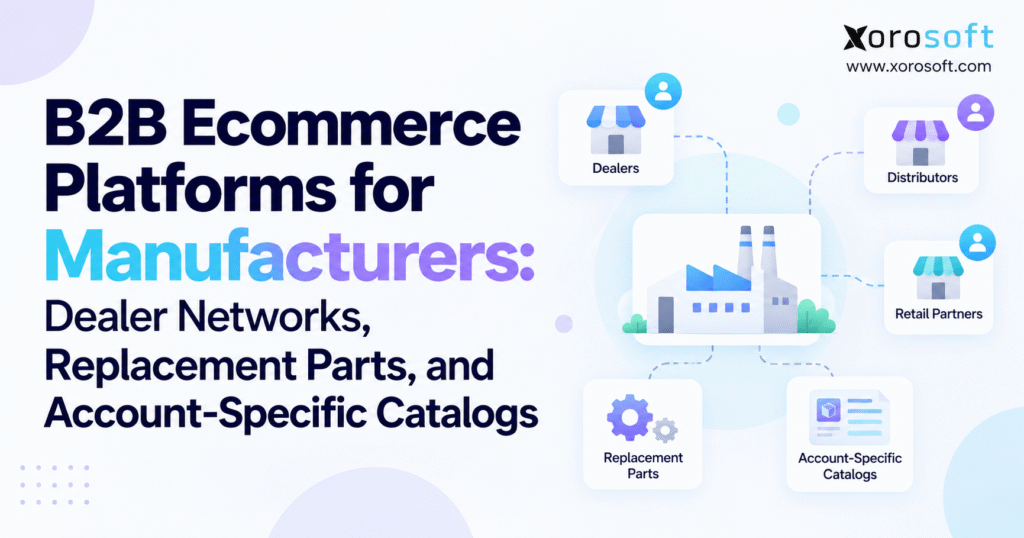
If you are searching for insights on B2B ecommerce platforms for manufacturers, you are in the right place.
1. Why B2B Ecommerce Platforms for Manufacturers Become an Operations Decision
Manufacturers rarely struggle with ecommerce because they cannot place products online. The harder problem appears when the digital buying experience must reflect how the company actually sells.
One distributor may receive contract pricing. A dealer might be authorized to purchase only selected product families. Service customers may need replacement parts but not finished equipment. Another account could order by case rather than unit, while larger buyers may require purchase orders and internal approval before anything can ship.
As these commercial rules multiply, a standard online store becomes increasingly difficult to use as the complete B2B solution.
Strong B2B ecommerce platforms for manufacturers therefore need to do more than display products and capture payments. The platform must understand the customer account, buying permissions, price agreement, product eligibility, inventory availability, payment terms, and operational steps triggered by the transaction.
Digital purchasing also needs to work alongside traditional sales relationships. Buyers increasingly expect convenient online ordering for routine transactions while still relying on account managers, sales representatives, and technical teams for more complex purchases.
1.1 Manufacturing B2B Ecommerce Must Support Self-Service and Assisted Selling
Digital self-service does not mean removing salespeople from the process.
A repeat buyer ordering familiar parts should not have to email a spreadsheet every month. At the same time, a company purchasing configured machinery may need technical validation, negotiated pricing, or help from a sales representative.
Effective manufacturing B2B ecommerce supports both situations.
Routine transactions move through controlled self-service workflows, while specialized purchases can involve sales, engineering, customer service, or finance when necessary. That balance reduces administrative work without weakening customer relationships.
1.2 The Manufacturing Ecommerce Storefront Is Only the Visible Layer
Checkout represents only one step in the order lifecycle.
After a buyer submits an order, inventory may need allocation. Purchasing may need to replenish raw materials. Production could require a work order. Warehouse teams may need to pick across multiple locations, while accounting needs the correct pricing and payment terms.
For this reason, B2B ecommerce platforms for manufacturers should be evaluated as part of the wider operating architecture rather than as isolated websites.
The storefront controls the customer experience. Operations determine whether the promise made online can actually be fulfilled.
2. What B2B Ecommerce Platforms for Manufacturers Must Handle Before Checkout
A manufacturing ecommerce platform must establish context before it can show the correct buying experience.
Consumer ecommerce generally presents similar products and pricing to most visitors. B2B manufacturing works differently because the customer’s identity can change nearly every element of the transaction.
A dealer in one territory may see one product range, while another customer sees a different assortment. Contract pricing may replace public pricing after login. Quantity rules can also differ by customer type, product, or commercial agreement.
2.1 Manufacturer Ecommerce Platforms Need Account-Level Context
The system should determine which company the user belongs to, which location is ordering, which products that account can purchase, and which price structure applies.
Additional rules may cover tax status, shipping destinations, credit limits, payment terms, freight arrangements, purchasing permissions, and approval authority.
This account context is one reason B2B ecommerce platforms for manufacturers require deeper customer logic than standard ecommerce platforms.
A buyer is not simply an email address attached to an order. That user belongs to a commercial relationship with negotiated conditions and operational implications.
2.2 Product Complexity Raises the Requirements for B2B Ecommerce
Customer complexity is only half of the challenge.
Manufacturers may sell finished products, assemblies, components, service parts, accessories, kits, or raw materials from the same commercial environment. Some products are simple SKUs, while others depend on attributes such as material, dimensions, voltage, model generation, machine type, or compatibility.
As a result, a platform that performs well for a straightforward wholesale catalog may struggle with technical products.
The right architecture must represent both sides of the transaction accurately: complex business accounts and complex product relationships.
3. How B2B Ecommerce Platforms for Manufacturers Support Dealer Networks
Dealer and distributor relationships rarely follow a flat customer structure.
A manufacturer might sell to a national distributor with several regions and dozens of branches. Individual branches can have different shipping addresses, buyers, assortments, territories, purchasing permissions, and negotiated terms.
A practical dealer ecommerce platform should reflect that hierarchy rather than treat every user as an unrelated account.
3.1 Dealer Ecommerce Platforms Need Account Hierarchies
Consider an industrial manufacturer that sells through regional dealerships.
The parent organization may negotiate annual terms with the manufacturer, but individual branches place their own orders. Headquarters might need visibility across the entire dealer organization, while branch-level employees should see only their location’s transactions.
Within each branch, purchasing permissions may differ again.
One employee could create a cart, while another has authority to approve the purchase. A manager may also need consolidated reporting across locations.
These relationships require company hierarchies, account roles, and location-specific rules.
3.2 B2B Dealer Portals Should Combine Self-Service With Sales Support
Self-service works particularly well for predictable dealer transactions.
A customer purchasing the same maintenance parts every month should be able to search products, see applicable pricing, review availability, reorder previous items, and submit the transaction without waiting for a representative.
Complex transactions still benefit from human assistance.
A sales representative might help configure a product, negotiate a high-volume order, create a quote, or recommend alternatives. Well-designed B2B commerce preserves those assisted workflows without creating separate customer records, prices, and order histories.
The result is not “digital versus sales.” Instead, the customer can use the most efficient channel for each transaction.
4. Replacement Parts Ecommerce Requires More Than a Search Box
Replacement parts are a strong digital-commerce opportunity for manufacturers because many purchases are urgent, repeatable, and highly specific.
However, spare-parts ecommerce also reveals whether product information has been structured properly.
A customer may know the machine that needs repair but not the current component number. Another buyer might have an obsolete SKU from equipment purchased ten years earlier.
A simple keyword search cannot reliably solve those situations.
4.1 Replacement Parts Platforms Should Start With Equipment Compatibility
An effective parts experience lets customers begin with the installed product.
Depending on the industry, the buyer might select a product family, equipment model, manufacturing year, serial-number range, or technical configuration.
Once that context is established, the system can narrow the catalog to compatible components.
More complex products may benefit from assembly structures or exploded diagrams. Instead of expecting a technician to know an internal SKU, the ecommerce experience guides the buyer from equipment to assembly and then to the correct component.
4.2 Manufacturer Ecommerce Must Manage Superseded Parts
Part catalogs change continuously.
A supplier may discontinue a component. Engineering might improve a design. One SKU can be replaced by a newer revision, while several old items may be consolidated into one replacement.
Customers still search using historic information.
Instead of showing “product not found,” the portal should preserve the old identifier when practical and point the buyer toward an approved replacement.
Compatibility still needs validation. A new component is not automatically appropriate for every product that used the original SKU.
For this reason, replacement-parts commerce depends on product relationships just as much as conventional catalog information.
5. Account-Specific Catalogs in B2B Ecommerce for Manufacturers
Manufacturers frequently need to show different customers different products.
One dealer may be authorized for a premium line. Another distributor might sell only replacement components. Strategic accounts could receive exclusive SKUs, while certain products may be restricted by geography, certification, contract, or channel.
Creating a separate online store for every assortment would quickly become difficult to maintain.
Account-specific catalogs provide a more scalable approach.
5.1 B2B Catalog Management Controls More Than Product Visibility
At its simplest, an account-specific catalog controls which products an authenticated customer can access.
In practice, it can also work with customer pricing, order quantities, product collections, payment rules, or shipping restrictions.
A buyer logging into one commerce environment can therefore receive a purchasing experience tailored to the account without the manufacturer maintaining dozens of separate websites.
That capability makes customer-specific catalogs particularly important in B2B ecommerce platforms for manufacturers serving complex dealer or distributor networks.
5.2 Manufacturing B2B Ecommerce Should Base Catalogs on Commercial Rules
Catalog segmentation should start with a business reason.
Territory rights may restrict one customer to a specific product line. Certification requirements can limit technical products to approved dealers. Other assortments may depend on private-label agreements, geographic markets, customer tiers, or negotiated contracts.
Documenting those rules before configuring software makes the catalog easier to govern.
By contrast, problems arise when product access depends on employee memory, email conversations, or spreadsheets that only a small group understands.
Digital commerce exposes those inconsistencies quickly, which is why catalog governance needs to accompany platform implementation.
6. Customer-Specific Pricing in Manufacturing B2B Ecommerce
Pricing is often one of the most difficult elements of a manufacturer ecommerce project.
The amount displayed to a buyer can depend on the customer’s contract, dealer tier, product group, quantity, promotion, region, or negotiated exception.
Calculating that amount is only part of the challenge.
The manufacturer must also ensure that the same commercial rule reaches the sales team, ecommerce portal, ERP, invoice, credit process, and financial reports.
6.1 B2B Ecommerce Pricing Needs a Clear Source of Truth
Before integrating systems, manufacturers should decide where pricing originates.
For companies with complex contract structures, ERP may own customer pricing. Other businesses may use a dedicated pricing engine or maintain certain digital offers within the commerce platform.
Multiple models can work.
What creates problems is maintaining separate, uncontrolled versions of the same price.
When ecommerce displays one amount, a sales representative quotes another, and finance invoices a third, the organization creates avoidable disputes and correction work.
6.2 Quantity Rules Connect Ecommerce Pricing With Operations
Manufacturers also need to consider how products are packaged and handled.
An item might ship only in cases of 12. Another product may require a minimum order quantity because of production economics. Warehouse operations could require carton increments or full-pallet quantities.
These constraints belong in the online ordering experience.
Rather than accepting an invalid quantity and asking staff to correct it later, the platform should enforce appropriate minimums, maximums, increments, and volume breaks before the order reaches operations.
In manufacturing B2B ecommerce, quantity rules are therefore operational controls as much as pricing features.
7. Manufacturer B2B Ecommerce Workflows Must Match How Companies Buy
Consumer checkout is designed to remove friction wherever possible. Business purchasing is different because some steps exist for legitimate governance reasons.
A buyer may need a quotation, internal authorization, a purchase-order reference, credit terms, or supporting documents before the transaction can proceed.
Good B2B ecommerce platforms for manufacturers streamline those controls rather than trying to eliminate them.
7.1 Quick-Order Tools Improve Repeat B2B Purchasing
Experienced buyers often arrive knowing exactly what they need.
Instead of browsing category pages, they may already have a spreadsheet, purchase list, or series of SKUs. Quick-order forms, saved lists, CSV uploads, reorder functions, and purchase history can significantly reduce the time required for repeat purchasing.
These tools are particularly valuable for consumables, replacement parts, maintenance products, and regular dealer replenishment.
The digital workflow should ideally be faster than sending the same order to a sales representative by email.
7.2 RFQs and Purchase Orders Remain Important in B2B Ecommerce
Not every transaction should go directly through checkout.
High-volume orders can require freight review. Configured products might need technical approval. A large commercial deal may require negotiated pricing before commitment.
Buyers can also have their own procurement rules.
Some organizations require a purchase order number. Others need manager approval when spending exceeds a threshold. Multi-stage approvals may apply to certain product groups or departments.
Manufacturer ecommerce works best when these rules are built into the buying process rather than handled manually after the order arrives.
8. ERP Integration for B2B Ecommerce Platforms for Manufacturers
The commerce platform manages the buying experience, but an operational system still has to execute the transaction.
This distinction becomes more important as digital sales volume grows.
A portal could successfully generate hundreds of additional orders, yet the business gains little efficiency if employees must manually enter those orders into another system, verify inventory separately, email production teams, and reconcile accounting afterward.
8.1 Define Which System Owns Each Data Type
Manufacturers should establish a source of truth for every important business object.
| Data or Process | Typical Operational Source | Ecommerce Role |
|---|---|---|
| Product/SKU | ERP or PIM | Present customer information |
| Customer account | ERP or CRM | Authenticate and personalize |
| Customer pricing | ERP or pricing engine | Apply correct commercial terms |
| Inventory | ERP or WMS | Present permitted availability |
| Sales order | Commerce captures | ERP processes |
| Fulfillment | ERP/WMS | Portal communicates status |
| Invoice | ERP/accounting | Portal may expose documentation |
Actual ownership differs by architecture. The important point is that ownership should be intentional.
If two systems independently control the same operational information, reconciliation becomes an everyday requirement.
8.2 Manufacturer Ecommerce Needs More Than Basic ERP Order Import
The phrase “ERP integration” can describe very different capabilities.
A useful evaluation should ask whether the integration synchronizes real inventory availability, recognizes committed stock, respects customer pricing, updates purchasing requirements, supports make-to-order products, returns shipment status, and keeps invoices aligned.
For inventory-driven businesses, XoroONE represents one operational approach because ERP, inventory, purchasing, manufacturing, warehouse management, accounting, ecommerce connectivity, and reporting can operate within a connected environment.
Not every manufacturer needs one system for everything. However, every implementation needs a clear plan for what happens after digital checkout.
9. Multi-Warehouse Inventory in B2B Ecommerce for Manufacturers
Inventory looks simple until a manufacturer operates several warehouses, factories, stores, or third-party logistics locations.
A business might have 500 units physically present but only 180 genuinely available to a particular customer.
Some stock may already be allocated. Other quantities can be under quality inspection, held as safety stock, reserved for another channel, or stored in a warehouse that does not serve the buyer’s region.
Consequently, buyer-facing availability requires more logic than an on-hand number.
9.1 Manufacturing Ecommerce Should Distinguish On-Hand and Available Inventory
Manufacturers need a precise definition of “available.”
For one business, it might mean physical on-hand inventory. Another company may use available-to-promise quantities after commitments, safety stock, and allocations are deducted.
Replacement-parts businesses may need additional logic because customers often care about delivery urgency.
A technician repairing equipment usually wants to know whether a component can ship to the destination today, not whether the company owns that component somewhere in its network.
9.2 Warehouse Execution Must Support Ecommerce Availability Promises
Online stock accuracy ultimately depends on warehouse discipline.
Receiving, putaway, transfers, picking, packing, adjustments, cycle counting, and shipping all affect the quantity shown to customers.
Manufacturers with significant distribution complexity may therefore need their ecommerce architecture to connect closely with a warehouse management system.
When warehouse transactions are accurate and timely, customer-facing availability becomes more dependable. If warehouse data is unreliable, even the best ecommerce interface will eventually display misleading information.
10. Manufacturing ERP, Purchasing, and Forecasting Sit Behind B2B Ecommerce
A dealer order does not always consume finished inventory that is ready to ship.
Some manufacturers assemble after receiving the order. Others manufacture according to forecast and replenish materials based on expected demand.
Either way, digital orders influence planning decisions beyond sales.
10.1 B2B Ecommerce Orders Should Feed Manufacturing Demand
Consider a dealer that suddenly submits a large order for an assembled product.
Operations needs to know how much finished inventory exists, which quantities have already been committed, what still needs to be produced, whether required materials are available, and when the order can realistically ship.
Those questions depend on links between sales demand, inventory, BOMs, materials, production, and purchasing.
An operational system such as XoroERP becomes relevant when ecommerce transactions must work alongside broader inventory, manufacturing, procurement, fulfillment, accounting, and reporting processes.
10.2 Purchasing Should Respond to Digital Demand
Growth in B2B ecommerce can expose weak purchasing processes quickly.
When dealer orders rise but procurement still depends on manually updated spreadsheets, stockouts may increase even though customer demand is visible sooner.
Purchasing decisions should incorporate open sales orders, current inventory, supplier lead times, incoming stock, production requirements, and forecast demand.
Connecting those inputs enables buyers to place purchase orders based on operating reality rather than isolated spreadsheets.
This connection also improves customer promises because commercial teams have better visibility into when inventory or materials are expected to arrive.
11. Integrations Make Manufacturing Ecommerce Platforms Operationally Useful
Manufacturers rarely operate a single software application.
A typical technology stack may include ecommerce, ERP, CRM, EDI, marketplaces, shipping systems, payment gateways, 3PL platforms, product-information tools, carrier software, and industry-specific applications.
Integration therefore needs to be treated as part of the platform architecture rather than an implementation detail.
11.1 B2B Ecommerce Integrations Should Be Prioritized by Operational Risk
Not every integration requires the same speed or controls.
A product-description update arriving a few hours late may have limited impact. Inventory availability that is several hours behind during a high-volume promotion can create serious overselling.
Customer pricing and sales orders can carry similar risk.
As a result, integration planning should consider synchronization frequency, ownership, failure handling, monitoring, auditability, and recovery.
Manufacturers evaluating Xorosoft can review its broader integrations ecosystem to understand how ecommerce, marketplaces, shipping, payments, EDI, and related applications can connect with ERP workflows.
11.2 Shopify Can Remain the Commerce Layer While ERP Runs Operations
Many manufacturers combine B2B sales with direct-to-consumer ecommerce.
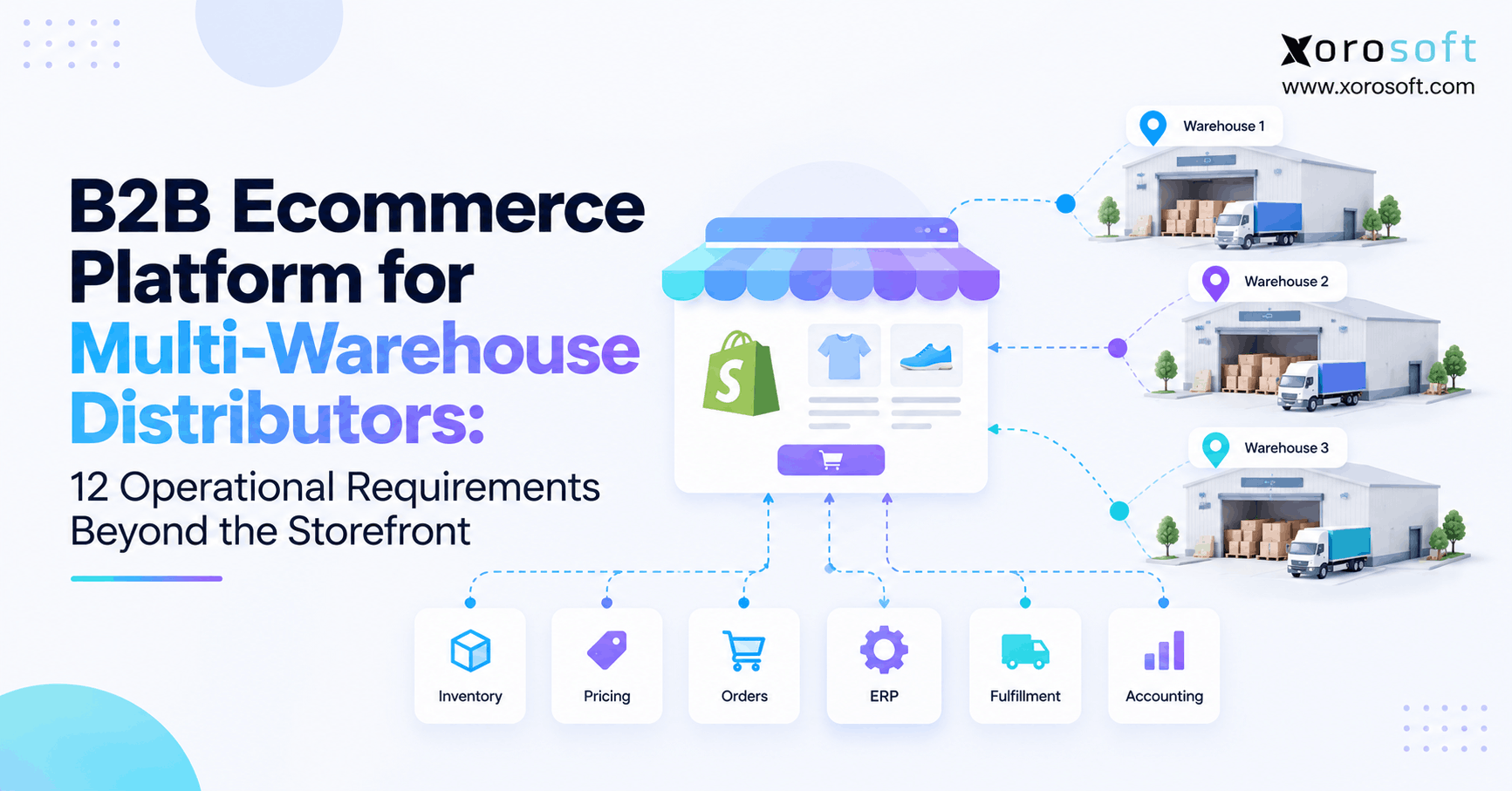
Shopify may remain the buyer-facing storefront while ERP handles inventory, purchasing, fulfillment, manufacturing, and accounting behind it.
That separation can work well when responsibilities are clearly defined.
Companies specifically exploring this model can also review the Xorosoft ERP app on the Shopify App Store as an external example of how Shopify can connect with an operational ERP.
The same principle applies to Amazon, EDI, marketplaces, and other sales channels. Each channel should work from a trusted operational foundation rather than maintain an independent version of inventory and order truth.
11.3 API and AI Connectivity Will Matter More as Manufacturer Workflows Evolve
Manufacturers are also beginning to evaluate how AI assistants and external systems can interact with ERP information securely.
That does not replace core ecommerce architecture, but it adds another consideration around controlled system access, automation, and data governance.
For organizations exploring those newer integration patterns, Xorosoft’s MCP server is one example of infrastructure designed to connect AI-enabled tools with operational business data.
The broader lesson remains the same: integration architecture should be designed around controlled access to reliable data.
12. How to Compare B2B Ecommerce Platforms for Manufacturers
Platform comparisons become more useful when teams compare operating models rather than feature counts.
Two vendors might both claim to support B2B catalogs, customer pricing, and ERP integration. Yet one may be built primarily as a commerce platform while another expects operational data to come directly from ERP.
Neither approach is automatically better.
The manufacturer’s processes should determine which architecture fits.
12.1 Compare Manufacturing Ecommerce Architecture Before Comparing Vendors
Commerce-first SaaS platforms can suit businesses that prioritize storefront flexibility and are comfortable connecting operational systems behind them.
Enterprise commerce systems may provide deeper customization, complex account structures, and sophisticated workflow control.
ERP-connected commerce solutions can bring operational information directly into the purchasing experience, while composable architectures allow companies to assemble specialized services through APIs.
An ERP-centered model starts with inventory, accounting, manufacturing, purchasing, and warehouse operations before extending into digital ordering.
Understanding these categories helps manufacturers build a more relevant shortlist.
12.2 Compare B2B Ecommerce Platforms for Manufacturers Using Real Workflows
Feature lists are less valuable than realistic scenarios.
| Requirement | Question to Test |
|---|---|
| Dealer hierarchy | Can parent accounts and branches have different permissions? |
| Catalog management | Can specific customers see different products? |
| Customer pricing | Where are negotiated prices maintained? |
| Replacement parts | Can buyers locate compatible and superseded SKUs? |
| Inventory | Is availability accurate across multiple locations? |
| B2B ordering | Are RFQs, POs, terms, and approvals supported? |
| Manufacturing | Can order demand influence materials and production? |
| Integration | How are synchronization errors detected and recovered? |
| Reporting | Can teams trace the complete order lifecycle? |
This type of comparison helps teams evaluate B2B ecommerce platforms for manufacturers according to operating requirements rather than marketing terminology.
13. Evaluating Manufacturing Ecommerce Platforms for Long-Term Fit
A platform needs to support current requirements without creating an architecture the company will outgrow immediately.
Dealer counts may increase. Additional warehouses can open. Product structures become more complicated, and manufacturers may acquire other brands.
New channels can also introduce more inventory, pricing, and fulfillment rules.
Long-term fit therefore depends on both capability and maintainability.
13.1 Test a Real Manufacturer Order During Vendor Demonstrations
Standard demos often make every platform look straightforward.
Instead, give vendors a realistic transaction.
For example, ask them to demonstrate a dealer branch logging in to a restricted catalog with negotiated pricing. The customer needs 48 units in case quantities of 12. Two warehouses contain part of the required stock, while the remaining quantity must be produced. The account pays on terms, and the buyer needs management approval before submission.
Follow that transaction through inventory, production, fulfillment, invoicing, and customer communication.
A real scenario exposes architectural limitations much faster than a generic product tour.
13.2 Industry Fit Matters in B2B Ecommerce for Manufacturers
Manufacturing requirements vary considerably by sector.
Automotive parts companies may emphasize compatibility and supersession. Furniture businesses often care about lead times and large-item fulfillment. Apparel manufacturers manage variants and seasonal catalogs, while food businesses may focus on cases, lots, dates, and replenishment.
Manufacturers can review Xorosoft’s industry solutions to see how operational requirements differ across inventory-driven sectors.
A vendor does not need to serve only one industry. Still, it should demonstrate that its data model and workflows can support the complexity the customer actually has.
13.3 Customer Evidence Adds Context to Platform Evaluation
Reference stories can help buyers understand whether a platform has been used in comparable environments.
Case studies should not replace due diligence, but they can reveal the types of operational challenges customers have attempted to solve.
Teams researching Xorosoft can review its case studies for examples across manufacturing, distribution, automotive, furniture, sporting goods, apparel, and other inventory-intensive businesses.
When reading any vendor story, focus on the original problem, operating model, implementation scope, and measurable outcome rather than the brand name alone.
14. Common Mistakes in B2B Ecommerce for Manufacturers
Even strong software performs poorly when the operating model underneath it is unclear.
One common mistake is digitizing an inconsistent manual process without first correcting it.
If pricing data is unreliable, publishing it through a portal will expose errors faster. When inventory accuracy is weak, displaying warehouse quantities online will not make the underlying records trustworthy.
14.1 Do Not Build Manufacturer Ecommerce Around Permanent Spreadsheet Exceptions
Spreadsheets remain useful for analysis and planning.
Problems appear when they become permanent databases for dealer access, customer pricing, product compatibility, inventory allocation, or purchasing rules.
Knowledge then becomes concentrated in a small number of employees.
If those employees must review every digital order before it can proceed, the company has not created scalable self-service.
Stable commercial rules should move into governed systems wherever practical, while true exceptions can remain managed exceptions.
14.2 Recognize When the Existing Ecommerce Platform Has Reached Its Limit
Platform limitations usually appear gradually.
Dealer orders keep arriving through email even though a portal exists. Salespeople re-enter ecommerce transactions manually. Customers call customer service because they do not trust online availability.
Elsewhere, finance corrects account pricing after checkout, parts customers cannot find old SKUs, and warehouses discover that supposedly available stock cannot actually ship.
When several of these symptoms occur together, evaluate the full technology architecture.
The storefront may not be the root problem. Fragmented inventory, ERP, WMS, accounting, or purchasing workflows can create the same customer-facing symptoms.
14.3 Do Not Add Enterprise Complexity Before It Is Needed
A smaller manufacturer with straightforward pricing, one warehouse, a manageable SKU count, and a few dozen wholesale accounts may not need a highly customized enterprise commerce environment.
Complexity should justify complexity.
Implementing advanced account hierarchies, composable architecture, or elaborate workflow engines before the business needs them can increase cost without improving customer service.
The right B2B ecommerce platforms for manufacturers should fit the company’s current operating complexity while leaving reasonable room for growth.
15. Strategic Next Steps for B2B Ecommerce Platforms for Manufacturers
The strongest B2B commerce projects begin with process mapping rather than vendor selection.
Start by defining the buyer structure. Identify distributors, dealer groups, branches, individual buyers, approvers, sales representatives, and service customers.
Next, document catalog and pricing rules. Determine which products each account can purchase, how contract pricing works, which quantity rules apply, and where exceptions exist.
Then map the order after checkout.
Understand how inventory is allocated, whether production must respond, how purchasing reacts to demand, which warehouse fulfills the order, when accounting records the transaction, and how status returns to the customer.
Finally, define the system of record for every critical data type.
Those decisions create a practical framework for comparing B2B ecommerce platforms for manufacturers without becoming distracted by feature lists that may not apply to the business.
15.1 Evaluate the Commerce Layer and Operational Layer Together
Manufacturers often evaluate the storefront and ERP separately even though the two systems eventually need to exchange critical information.
That approach can work, but the integration requirements should be understood before either platform is selected.
For inventory-driven manufacturers, Xorosoft’s broader ERP and operational solutions provide one model in which inventory, accounting, purchasing, warehouse operations, manufacturing, reporting, and commerce-related workflows can operate on a connected foundation.
Businesses comparing ERP architectures separately can also review the Xorosoft vs NetSuite comparison as one research input while assessing implementation requirements, functionality, integrations, and operational fit.
15.2 Focus the Final Decision on Operational Outcomes
The goal is not to digitize every transaction merely because the technology exists.
Instead, routine orders should become easier for buyers and less expensive for employees to process. Complex transactions should remain controlled without becoming unnecessarily manual. Replacement parts should be easier to identify, while account-specific catalogs and prices should remain accurate.
Behind the storefront, inventory, manufacturing, purchasing, fulfillment, and finance should stay aligned.
When a platform can support those outcomes consistently, digital commerce becomes more than another sales channel. It becomes part of the operating model.
Companies currently evaluating dealer networks, replacement-parts workflows, custom catalogs, ERP integration, or a move away from disconnected systems can contact Xorosoft to review how those requirements could fit within a connected ERP and B2B commerce architecture.
Frequently Asked Questions
What are B2B ecommerce platforms for manufacturers?
B2B ecommerce platforms for manufacturers support dealer accounts, customer-specific catalogs, negotiated pricing, bulk orders, inventory visibility, approvals, payment terms, and ERP-connected order processing.
How do dealer portals work for manufacturers?
Dealer portals give authorized customers secure access to account-specific products, pricing, availability, order history, documents, and purchasing tools while maintaining separate permissions for buyers and approvers.
Why are account-specific catalogs important in B2B ecommerce?
Account-specific catalogs ensure customers see only relevant products, prices, assortments, and purchasing rules, helping manufacturers manage dealer agreements, territories, private programs, and contract-specific access accurately.
How should manufacturers sell replacement parts online?
Manufacturers should connect parts to equipment, models, assemblies, or serial ranges so buyers can identify compatible components, find superseded SKUs, check availability, and order correctly.
Should ecommerce or ERP manage B2B pricing?
The authoritative system depends on the architecture. Many manufacturers keep negotiated pricing in ERP or a pricing engine, while ecommerce retrieves and applies those rules.
Can manufacturing ecommerce support multiple warehouses?
Yes. Connected platforms can present availability across locations while accounting for allocations, safety stock, transfers, and fulfillment rules so customers see inventory that can realistically ship.
When should a manufacturer upgrade its B2B ecommerce platform?
Upgrade when manual order entry, spreadsheet pricing, unreliable inventory, weak dealer self-service, poor parts discovery, or disconnected ERP workflows repeatedly create errors and delays.
Recent Posts
-
 ERP Implementation Statistics 2026: Timelines, Overruns, and Migration Patterns
 -
 Inventory Planning Software for Canadian Importers Managing Long Lead Times
 -
 Shopify ERP vs Shopify Inventory Apps
 -
 How to Evaluate WMS Vendors: 20 Operational Scenarios to Demo
 -
 Tariff Scenario Planning: How a Canadian Distributor Modeled Tariff Changes Before Repricing Inventory