If your business is looking for solutions to streamline operations, inventory planning software Canada can offer robust options tailored to your needs.
1. Why Long Lead Time Inventory Planning Is Harder for Canadian Importers
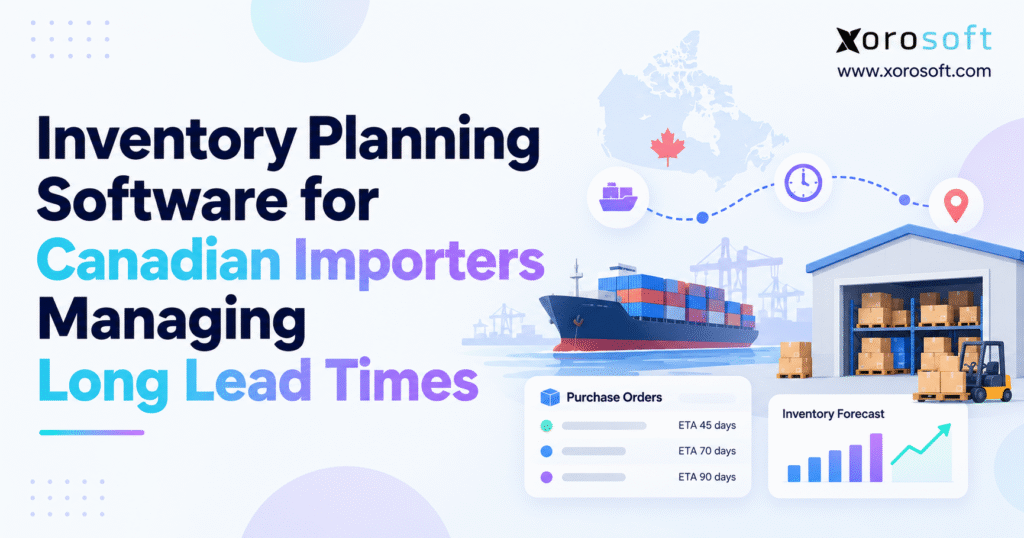
Canadian importers often make purchasing commitments months before they know exactly what customers will buy. A supplier may need several weeks to manufacture an order, international transportation adds another window, and goods still need to clear the border, move inland, and reach a sellable warehouse location.
Those delays change inventory planning from a stock-counting exercise into a forward-looking business process.
For a Canadian importer, today’s available inventory can create a false sense of security. A warehouse may contain enough stock for the next six weeks while the next replenishment takes four months. By the time the shortage becomes visible in a conventional low-stock report, the opportunity to prevent it may already have passed.
That is why inventory planning software Canada should focus on future inventory position rather than only current quantities. Good planning combines forecast demand, stock on hand, allocated inventory, goods in transit, supplier lead times, safety stock, minimum order quantities, and purchasing dates.
1.1 Current Inventory Does Not Show Future Availability
Consider a product with 3,000 units in the warehouse and average demand of 1,000 units per month. At first glance, inventory looks healthy.
However, if replenishment requires 120 days, the company needs to think beyond the three months covered by current stock. Demand may consume those 3,000 units before the next order is available.
An opposite situation creates a different problem. Physical inventory might look low while 4,000 units are already on the water. Placing another PO without considering that incoming supply can turn an apparent shortage into excess inventory.
1.2 Long Lead Time Inventory Planning Is Mostly About Timing
Quantity matters, but timing is often more important for importers.
A correctly sized purchase order arriving three weeks after a projected stockout does not solve the problem. Similarly, a shipment that arrives several months earlier than necessary ties cash and warehouse capacity into inventory before the business needs it.
Effective long lead time inventory planning therefore answers two questions together: how much should the business buy, and when should it commit to that purchase?
2. How Inventory Planning Software Canada Improves Purchasing Decisions
Traditional inventory reporting is primarily historical. It tells a business what was received, sold, adjusted, transferred, or shipped.
Inventory planning software Canada should work differently. Its purpose is to project what happens next.
A useful system combines demand expectations with existing inventory and planned supply. From there, it can highlight future shortages, calculate replenishment requirements, and determine when buyers need to take action.
2.1 Inventory Planning Software Versus Inventory Tracking
Inventory tracking answers operational questions such as where stock is located, what quantity is available, and how recent transactions changed the balance.
Inventory planning addresses the future.
When will available inventory drop below a safe level? Does an open purchase order arrive before the shortage? Should the buyer place another PO today, next month, or not at all? Is one warehouse overstocked while another location is approaching a shortage?
Growing importers usually need both disciplines because planning accuracy depends on reliable inventory transactions underneath it.
2.2 Demand Planning Software Canada Versus Inventory Planning
Demand planning estimates what customers are likely to buy.
Inventory planning converts that expectation into a supply decision.
Suppose the business forecasts 5,000 units of demand over the next four months. Ordering 5,000 units immediately would ignore current stock, incoming purchase orders, customer allocations, safety-stock requirements, and supplier constraints.
A useful planning model asks how much of that demand is already covered and how much new supply must actually be purchased.
2.3 Canadian Inventory Planning Software Should Produce an Action
Reports are useful, but buyers ultimately need a decision.
The output should help clarify what needs replenishment, how much should be ordered, when the order should be released, and which supplier or source should fulfil it.
When the system can explain those recommendations clearly, purchasing becomes less dependent on spreadsheet interpretation and last-minute reactions.
3. The Data Foundation Behind Canadian Inventory Planning Software
Planning quality depends on the information feeding the model. Sophisticated forecasting cannot compensate for inaccurate inventory, stale supplier lead times, or purchase orders with unrealistic arrival dates.
For importers, several data points deserve particular attention.
3.1 Supplier Lead Time Must Reflect the Full Replenishment Cycle
Supplier lead time is often stored as manufacturing time, even though that represents only part of the journey.
An importer may need to account for order confirmation, production, export preparation, freight booking, international transportation, customs processing, domestic transportation, warehouse receiving, inspection, and putaway.
If a planning model assumes 60 days while the end-to-end cycle normally requires 95, replenishment recommendations will consistently come too late.
3.2 Long Lead Time Inventory Planning Needs Variability Data
An average is helpful, but reliability matters just as much.
Suppose recent deliveries from one supplier arrived in 72, 75, 78, 108, and 74 days. A simple average hides the operational impact of that 108-day order.
Strong long lead time inventory planning should recognize whether a supplier regularly misses dates, whether specific SKUs take longer to produce, and whether certain transport modes introduce more variability.
That information can influence safety stock, safety lead time, and supplier selection.
3.3 Canadian Import Costs Belong in the Planning Conversation
Canadian importers also need to look beyond factory price.
Freight, brokerage, duties, applicable taxes, insurance, handling, currency changes, and domestic transportation can affect the landed economics of a purchase.
CARM and other Canadian commercial-import processes are primarily compliance and accounting matters rather than demand-planning functions. Still, inventory teams should understand that an imported unit can carry costs beyond the supplier invoice.
A purchasing recommendation that optimizes quantity while ignoring the financial impact of the shipment can still produce a poor business outcome.
3.4 Incoming Inventory Must Have a Credible Date
Open purchase orders are only useful planning inputs when expected receipt dates are realistic.
If the system says 2,000 units are arriving next week while the supplier has already delayed production by six weeks, projected availability will be misleading.
Purchasing teams therefore need a disciplined process for maintaining revised shipment dates and supplier commitments.
4. Demand Forecasting Software Canada Needs More Than Historical Sales
Importers often make supply commitments well before customer demand becomes obvious. Consequently, demand forecasting cannot rely exclusively on a backward-looking average.
Historical sales provide evidence, but planners also need business context.
4.1 Inventory Forecasting Software Canada Should Recognize Seasonality
Seasonal products behave differently from stable replenishment items.
A patio product, winter accessory, holiday gift, or seasonal sporting item may generate a large share of annual demand within a narrow selling window. Averaging that demand across twelve months can create a forecast that is mathematically clean but operationally useless.
Inventory forecasting software Canada should allow seasonal patterns to influence both demand quantity and purchasing timing.
4.2 Stockouts Can Distort Demand History
Zero sales do not always mean zero demand.
When a product is unavailable, historical sales may understate what customers would have purchased. Feeding those periods directly into a forecast can create a repeating cycle: a stockout suppresses recorded sales, the forecast falls, the next purchase order is too small, and another stockout follows.
Experienced planners separate constrained sales from genuine drops in demand wherever the data allows.
4.3 Wholesale Orders Need Context
Wholesale demand can be lumpy.
A customer purchasing 2,500 units in one month does not necessarily mean baseline demand increased permanently. On the other hand, a confirmed wholesale order cannot be ignored because it differs from the normal sales pattern.
Planners should distinguish regular demand, committed customer demand, promotional events, and unusual one-time orders.
4.4 Forecast Accuracy Should Be Prioritized by Business Impact
Not every SKU deserves equal attention.
High-value products, top sellers, seasonal products, and difficult-to-replenish items usually justify closer forecast review. Slow-moving low-value products may not need the same planning effort.
Segmenting the assortment helps planning teams spend time where forecast errors have the greatest financial or service impact.
5. Reorder Logic in Inventory Planning Software Canada
A forecast becomes operationally useful only when it turns into a replenishment decision.
Inventory planning software Canada should connect expected demand with available and incoming supply so buyers understand when inventory will become insufficient.
5.1 Calculate Lead-Time Demand
A simple starting formula is:
Lead-Time Demand = Expected Demand per Period × Replenishment Lead Time
Suppose a SKU is expected to sell 500 units per month and the complete replenishment cycle requires four months. Expected lead-time demand would be approximately 2,000 units.
More sophisticated forecasting may use different demand values for each month, but the planning principle remains the same. Inventory must cover demand occurring before replenishment becomes available.
5.2 Use Reorder Points as a Planning Trigger
A basic reorder-point concept is:
Reorder Point = Lead-Time Demand + Safety Stock
If lead-time demand is 2,000 units and the business requires a 500-unit buffer, the theoretical planning threshold becomes 2,500 units.
However, that number should not be interpreted in isolation. Existing inventory, open purchase orders, warehouse allocations, and expected receipt dates also influence the buying decision.
5.3 Inventory Planning Software Canada Should Use Time-Phased Supply
Assume the company has 1,600 units available and another 1,200 on a confirmed PO.
Adding those numbers suggests 2,800 units of supply.
Timing changes the answer. If the 1,200-unit receipt arrives before inventory drops below the required level, the position may be adequate. When that receipt arrives afterward, the projected shortage still exists.
Time-phased inventory is therefore much more useful than a simple “on hand plus on order” figure.
5.4 Minimum Order Quantities Affect the Final PO
A forecast rarely produces exactly the quantity a supplier wants to sell.
The planning calculation might identify a requirement for 760 units while the vendor has a 1,000-unit MOQ. Another supplier might require full cases, pallets, or container quantities.
Buyers need visibility into the difference between forecast requirement and executable purchase quantity because that gap creates additional inventory investment.
6. Safety Stock Planning for Canadian Importers With Long Lead Times
Safety stock is often treated as extra inventory added to every SKU using the same percentage.
That approach is simple, but it is rarely precise.
Safety stock is better understood as protection against uncertainty. For importers, uncertainty normally comes from both demand and supply.
6.1 Demand Variability and Lead-Time Variability Create Different Risks
Demand uncertainty occurs when customers buy more or less than expected.
Supply uncertainty appears when production or transportation takes longer than planned.
A product with predictable demand but an unreliable supplier requires a different buffer from a product with volatile demand and dependable replenishment.
Canadian importers should examine both sources before deciding how much inventory to protect.
6.2 Safety Stock Should Vary by SKU
Applying one blanket safety-stock percentage across the assortment can create excess in some products and inadequate protection in others.
Fast-moving essentials, seasonal apparel, bulky furniture, replacement parts, and slow-moving specialty products have very different economics.
An expensive product with limited demand can lock up significant working capital when its buffer is too large. A low-cost critical item may justify greater protection because a stockout damages customer service disproportionately.
6.3 Service Levels Must Be Balanced With Working Capital
Inventory planning always involves a trade-off.
Higher availability usually requires more stock, more responsive suppliers, or faster transportation. Lower inventory improves working capital but leaves less protection when demand or lead time changes unexpectedly.
A useful planning model makes that trade-off visible before the purchase order is approved.
The goal is not maximum inventory. Instead, the business needs enough protection to support its target service level without creating unnecessary carrying risk.
7. Inventory Replenishment Software Must Account for Goods in Transit
International importers can have a meaningful percentage of their inventory outside the warehouse at any given moment.
Goods may be in production, waiting at origin, booked for transportation, on the water, clearing customs, moving inland, or waiting to be received.
Ignoring those quantities produces poor replenishment decisions.
7.1 Inventory Replenishment Software Needs Time-Based Incoming Supply
Inventory replenishment software should understand both the quantity and expected timing of open supply.
Imagine that a company has 1,000 units in its warehouse and 3,000 units on purchase orders. A conventional report may show 4,000 units of total supply.
If 2,000 of those units will not arrive for five months, however, they cannot cover a shortage projected for next month.
A time-phased model distinguishes between supply that exists eventually and supply that exists when customers actually need it.
7.2 Delayed Purchase Orders Should Change the Plan
An overdue purchase order should not continue to behave like reliable incoming inventory.
When a supplier delays a shipment, the planning model should update the future stock position. Otherwise, buyers may believe demand is covered when the business is actually heading toward a shortage.
Supplier-date maintenance is therefore part of inventory planning, not simply purchase-order administration.
7.3 Incoming Inventory Can Also Prevent Overbuying
Low physical stock often creates urgency.
That urgency can be misleading when substantial quantities are already arriving.
Before releasing another purchase order, buyers should understand how current stock, customer commitments, and incoming supply overlap across time. This is one of the most important controls against unnecessary inventory accumulation.
8. Inventory Planning Software Canada vs Spreadsheets, Planning Apps, and ERP
There is no single technology architecture that fits every importer.
The right approach depends on SKU volume, supplier complexity, warehouse count, transaction volume, sales channels, financial requirements, and how many teams rely on the same inventory data.
8.1 When Spreadsheet Inventory Planning Still Works
Spreadsheets remain useful for businesses with modest product ranges, relatively stable suppliers, and straightforward purchasing.
They are flexible, familiar, and inexpensive.
Problems emerge when the workbook becomes responsible for hundreds or thousands of SKUs, multiple locations, changing lead times, open purchase orders, forecast overrides, and several planners.
At that stage, employees may spend more time maintaining formulas and imports than reviewing inventory decisions.
8.2 When Standalone Inventory Planning Software Canada Makes Sense
A dedicated planning application can be effective when forecasting and replenishment are the main weaknesses.
If accounting, warehouse management, ecommerce, and purchasing already operate reliably, replacing the broader technology stack may be unnecessary.
In that situation, inventory planning software Canada can add forward-looking purchasing intelligence while leaving effective operational systems in place.
8.3 When ERP Inventory Planning Becomes the Better Question
ERP becomes more relevant when the forecast is no longer the only problem.
Perhaps purchasing recommendations are copied manually into one application, receiving happens in another, ecommerce inventory lives somewhere else, and finance reconciles everything afterward.
An integrated platform such as XoroONE can be evaluated when the business needs inventory, purchasing, accounting, forecasting, ecommerce, and reporting to share one operational foundation.
| Capability | Spreadsheet | Planning Application | Integrated ERP |
|---|---|---|---|
| Forecasting | Manual | Core | Integrated or configurable |
| Replenishment | Manual | Core | Integrated |
| Purchasing | Manual or separate | Often connected | Native |
| Warehouse execution | Separate | Usually separate | Can be integrated |
| Accounting | Separate | Usually separate | Integrated |
| Multi-user controls | Limited | Stronger | Strong |
| Cross-functional reporting | Manual | Partial | Broader |
9. ERP Inventory Planning Connects Purchasing, Warehousing, and Finance
Inventory rarely creates problems in only one department.
A purchasing decision affects warehouse capacity, available cash, supplier commitments, accounts payable, inventory valuation, and customer availability.
Once those dependencies become significant, planning needs broader operational context.
9.1 Purchasing Software Canada Must Scale Beyond Simple POs
Purchasing complexity grows when businesses add suppliers, currencies, purchasing teams, approval workflows, negotiated terms, and multiple receiving locations.
At that point, companies may evaluate an ERP environment such as XoroERP when procurement needs to work directly with inventory, accounting, manufacturing, and reporting.
The important question is not whether the company can create purchase orders. It is whether purchasing decisions can be connected to the rest of the operating model without repeated manual work.
9.2 Warehouse Inventory Management Affects Forecast Quality
Forecast accuracy depends on accurate operational stock.
Delayed receiving, unrecorded transfers, incorrect picking, or quantity discrepancies can make even a well-designed forecast unreliable.
When warehouse execution itself becomes complex, a dedicated platform such as XoroWMS may be relevant for managing receiving, inventory movement, picking, and fulfillment.
Accurate warehouse transactions strengthen planning because future projections begin with more reliable inventory positions.
9.3 Finance Needs Visibility Into Inventory Commitments
An imported order may require deposits, freight payments, duties, final supplier payments, and other cash outflows before the product generates customer revenue.
Finance therefore needs visibility into planned purchasing, not just completed receipts.
A buying plan can be operationally correct and financially uncomfortable at the same time. Connecting purchasing with cash-flow expectations helps management understand that trade-off before committing to large orders.
10. Industry-Specific Inventory Planning for Canadian Importers
The mechanics of forecasting may look similar across sectors, but the business risks are not.
Inventory software should fit the way the company actually purchases, stores, and sells its products.
10.1 Inventory Planning Software Canada for Apparel and Fashion
Apparel companies manage seasons, collections, styles, colours, and sizes.
A forecast can be accurate at the style level yet badly wrong at the variant level. Meanwhile, long overseas lead times may force the company to commit to those variants before the season begins.
For apparel importers, inventory planning software Canada should preserve visibility into variant demand while also showing the total financial commitment across the collection.
10.2 Furniture and Home Goods Inventory Planning
Furniture products can combine high unit value, bulky storage requirements, long replenishment cycles, and container purchasing.
Excess inventory therefore affects more than cash. Overstock can consume warehouse space that would otherwise support faster-moving products.
Under-ordering creates a different problem because customers may be unwilling to wait several months for replenishment.
10.3 Wholesale Inventory Planning
Wholesale distributors frequently balance forecast demand against customer commitments, allocations, price agreements, and EDI orders.
Large account-specific transactions can distort historical averages, so planners need to understand which demand is recurring and which is exceptional.
At the same time, confirmed customer orders must influence future available inventory.
10.4 Manufacturing, Sporting Goods, Food, and Consumer Products
Manufacturers need to translate finished-goods demand into components and raw materials. Sporting goods can have strong seasonal cycles, while consumer products may experience promotion-driven demand. Food businesses add shelf life, lot control, and expiry considerations.
Because these requirements vary widely, companies should evaluate software against their actual industry workflows. Xorosoft’s industry-specific ERP use cases provide one reference point for businesses comparing operational requirements across inventory-heavy sectors.
11. Multi-Channel Inventory Planning for Shopify, Amazon, Wholesale, and EDI
An importer may sell the same physical inventory through several channels.
Shopify orders, Amazon demand, wholesale customers, EDI transactions, and warehouse transfers can all compete for the same stock.
Planning each channel independently can therefore create conflicting purchase recommendations.
11.1 Multi-Channel Demand Planning Software Should Consolidate Supply Requirements
Demand should roll into one supply plan when multiple channels consume the same inventory pool.
However, consolidation should not erase channel-level visibility.
Planners still need to understand whether growth is coming from ecommerce, wholesale, marketplaces, or a particular customer because those demand patterns may behave differently.
A unified supply plan provides one purchasing requirement while preserving the information needed to explain it.
11.2 Shopify Inventory Planning Requires More Than Storefront Stock
Shopify provides important information about ecommerce orders and available inventory. Long-lead-time importers may still need deeper purchasing, supplier, warehouse, accounting, and wholesale context around those transactions.
Merchants evaluating how an ERP can support the operational layer behind Shopify can review the Xorosoft ERP Shopify app as an external integration reference.
The objective is not simply moving data between applications. Planning improves when current orders, inventory, and operational changes reach the forecasting environment quickly.
11.3 Inventory Integrations Reduce Planning Lag
A forecast becomes outdated when yesterday’s spreadsheet does not contain today’s orders, receipts, transfers, or shipment delays.
Timely integrations reduce the gap between what happened operationally and what the planner can see.
Businesses running multiple ecommerce, marketplace, fulfillment, EDI, or operational platforms can evaluate available integrations when determining whether their planning architecture can stay synchronized without extensive manual exports.
12. How to Evaluate Inventory Planning Software Canada Before Buying
Software demonstrations tend to use clean sample data and predictable scenarios.
Real operations are messier.
A stronger evaluation method is to make the system work through the same exceptions your planners manage every week.
12.1 Make Inventory Planning Software Canada Prove a Difficult SKU
When comparing inventory planning software Canada, choose several real products.
One should have stable demand, another should be seasonal, a third should be slow-moving, and at least one should have an unreliable supplier or unusually long replenishment cycle.
Change the assumptions during the demonstration.
For example, move a supplier lead time from 80 days to 115 days and see how the projected shortage changes. Delay an open PO and check whether the replenishment recommendation responds. Increase MOQ and review how much excess stock the new order creates.
12.2 Demand Explainable Purchase Recommendations
Automation is helpful only when buyers understand what the system is recommending.
If the software suggests ordering 4,000 units instead of 2,500, the planner should be able to identify the reason. Perhaps seasonality increased the forecast, a supplier MOQ pushed the order higher, or an incoming shipment was delayed.
Explainability matters because purchase recommendations translate directly into cash commitments.
12.3 Test Multi-Warehouse Inventory Planning
Company-wide inventory can hide local shortages.
A business may have 5,000 units across three warehouses and still be unable to fulfil demand efficiently from the location serving a particular region.
During the demo, test whether the system can identify a shortage at one warehouse while another location carries excess. Then examine whether it suggests purchasing, transferring inventory, or both.
12.4 Compare ERP Platforms Using the Same Scenarios
Businesses evaluating NetSuite, Acumatica, Business Central, Sage, Cin7, Fishbowl, Brightpearl, Xorosoft, or another ERP should avoid comparing systems from generic feature matrices alone.
Use the same product, supplier delay, MOQ, warehouse, and purchasing scenario in every demonstration.
Companies specifically reviewing these two ERP options can use the Xorosoft vs NetSuite comparison as one research input before validating the required workflows directly.
12.5 Look Beyond the Sales Demonstration
Implementation quality and operational fit are difficult to understand from a controlled product walkthrough.
Relevant customer case studies can help buyers identify whether a software provider has experience with companies facing similar inventory, purchasing, warehouse, ecommerce, or operational complexity.
Use those examples as supporting evidence rather than assuming another company’s implementation will exactly match your own.
13. Implementing Inventory Forecasting Software Canada With Reliable Data
Technology implementation should begin with data quality, not forecasting algorithms.
A sophisticated model built on inaccurate stock and supplier data can create highly precise but incorrect recommendations.
13.1 Clean Product, Vendor, and Warehouse Data First
Review SKU status, supplier relationships, units of measure, lead times, pack sizes, MOQs, warehouse assignments, and purchasing rules.
Inactive products and old supplier records often survive for years because they do not create visible problems until the business begins automating decisions.
Cleaning those records before implementation reduces unnecessary exceptions later.
13.2 Open Purchase Orders Need Accurate Expected Dates
Future inventory projections depend heavily on purchase-order timing.
If inventory planning software Canada believes 2,000 units will arrive next week while the supplier has delayed production by two months, the planning model may show sufficient supply even though a shortage is approaching.
Expected receipt dates should therefore be treated as active planning fields rather than administrative placeholders.
13.3 Planning Ownership Still Matters After Automation
Software does not remove the need for experienced planners.
Someone still needs to review promotions, large customer orders, supplier disruptions, product launches, assortment changes, and unusual forecast movements.
Automation should remove repetitive data consolidation so people can spend more time reviewing the exceptions that require judgement.
13.4 Decide Whether the Problem Is Planning or Broader Operations
Sometimes a company begins searching for forecasting software and discovers that the larger problem is disconnected purchasing, warehouse management, ecommerce, and accounting.
Reviewing broader ERP and operational solutions can help teams determine whether the next investment should solve only forecasting or connect multiple inventory-related workflows.
A narrow problem deserves a narrow solution. Broader fragmentation may justify a broader platform.
14. Common Long Lead Time Inventory Planning Mistakes
Many inventory problems blamed on inaccurate forecasting actually begin elsewhere.
Poor lead-time assumptions, stale purchase orders, uncontrolled safety stock, or disconnected cash planning can create shortages and excess even when the demand forecast is reasonably good.
14.1 Using One Supplier Lead Time Forever
A supplier master containing “90 days” does not mean every future order will arrive in exactly 90 days.
Actual PO history should be reviewed periodically. When supplier performance changes, planning parameters should change as well.
Different SKUs from the same vendor may also require different production windows.
14.2 Ignoring Inventory Already on Order
Low warehouse stock can trigger unnecessary urgency.
Before another PO is placed, buyers should examine open purchase orders and their expected arrival dates.
The reverse mistake is just as dangerous. Assuming every incoming order will arrive on its original date can hide a future shortage.
14.3 Buying Excess Inventory Because Lead Times Are Long
A long lead time does not automatically justify carrying months of unnecessary buffer inventory.
Better forecasting, more accurate supplier dates, differentiated safety stock, and scenario planning can often provide stronger protection than simply buying more.
Overstock is particularly costly for products with high landed values, short product lifecycles, or significant warehouse-space requirements.
14.4 Applying the Same Safety Stock Rule to Every Product
A uniform buffer feels consistent but ignores differences in demand, cost, supplier reliability, and business importance.
High-volume essential SKUs may deserve different protection from slow-moving specialty products.
Inventory policy should reflect risk rather than administrative convenience.
14.5 Leaving Human Context Outside the Forecast
No algorithm automatically knows about every customer launch, discontinued item, planned promotion, new assortment, or strategic change unless that information enters the planning process.
Experienced teams use automation for scale while maintaining a structured process for human overrides and exception review.
14.6 Measuring Forecast Accuracy Without Measuring Inventory Outcomes
Forecast error is useful, but it is not the only KPI that matters.
Planning teams should also examine stockouts, inventory turnover, excess stock, emergency freight, supplier reliability, purchase-plan adherence, and working-capital trends.
A technically accurate forecast that still produces poor operational outcomes needs further investigation.
15. Turn Inventory Planning Software Canada Into a Repeatable Operating System
Long lead times are an unavoidable part of many importing models.
Supplier production, freight capacity, border processes, transportation, and market demand will always contain some uncertainty.
The controllable factor is how early the company can see the effect of those changes.
A business discovering a shortage when inventory reaches zero has very few options. Seeing the same shortage four months earlier creates room to change a PO, move inventory between warehouses, revise allocations, negotiate with the supplier, adjust a promotion, or investigate alternate supply.
That forward visibility is the practical value of inventory planning software Canada.
15.1 Build Planning Around Future Inventory Position
A resilient planning process continually combines forecast demand, current stock, customer commitments, incoming purchase orders, supplier lead times, safety stock, and buying constraints.
Rather than asking only how much inventory exists today, planners should examine the expected stock position across the entire replenishment horizon.
The result is a more useful operating question:
At what point will available inventory stop covering expected demand, and what decision needs to happen before then?
15.2 Connect Inventory Decisions With Working Capital
Inventory should never be planned independently from cash.
A purchase order may improve future availability while requiring a significant financial commitment months before the goods are sold.
Canadian importers should therefore review purchase requirements alongside landed cost, supplier payment terms, expected sales, warehouse capacity, and cash-flow requirements.
When these factors are considered together, management can make deliberate trade-offs between service protection and inventory investment.
15.3 Use the Next Purchasing Cycle as a Practical Test
Choose ten important imported SKUs and document their true replenishment lead time, expected demand during that period, available inventory, open purchase orders, safety stock, supplier constraints, and target PO date.
Compare those calculations with what your current systems show.
Differences between the two views often reveal the real problem. The business may need cleaner data, stronger purchasing processes, dedicated forecasting software, improved warehouse controls, or a more integrated ERP environment.
For teams whose inventory planning, purchasing, ecommerce, warehousing, and accounting now depend on the same decisions, the most useful next step is to evaluate those workflows using real products and suppliers rather than a generic software demonstration.
Discuss your inventory planning and ERP requirements with Xorosoft
Frequently Asked Questions
What is inventory planning software for Canadian importers?
Inventory planning software helps importers forecast demand, track incoming stock, plan purchase orders, and manage long supplier lead times while reducing the risk of stockouts and excess inventory.
How does long lead time affect inventory planning?
Long lead times force businesses to order earlier. Planners must forecast further ahead, include stock already in transit, and hold enough safety stock to cover delays or demand changes.
How much safety stock should an importer keep?
Safety stock depends on demand changes, supplier reliability, lead-time changes, product value, and service goals. One fixed percentage rarely works well for every SKU.
Can inventory planning software track goods in transit?
Yes. Good planning software includes open purchase orders and expected arrival dates, helping buyers see whether incoming stock will arrive before a future shortage occurs.
When should a business move from spreadsheets to inventory planning software?
A move makes sense when SKU counts grow, several people update plans, supplier dates change often, or spreadsheets require too much manual work to remain accurate.
What is the difference between inventory planning software and ERP?
Inventory planning software focuses on forecasting and replenishment. ERP connects planning with purchasing, warehouse operations, accounting, ecommerce, manufacturing, and other business processes.
What should Canadian importers look for in inventory planning software?
Look for demand forecasting, supplier lead-time tracking, safety stock, goods-in-transit visibility, purchase recommendations, multi-warehouse planning, supplier rules, and connections with ecommerce and accounting systems.
Recent Posts
-
 ERP Landed Cost Module vs Spreadsheet Calculations for Importers
 -
 How to Build an Open-to-Buy Plan for an Omnichannel Brand
 -
 Cold Storage WMS for Food and Beverage Distribution
 -
 ERP Buying Statistics 2026: Evaluation, Implementation, and Adoption Risks
 -
 How a Distributor Reduced B2B Order Exceptions Without Restricting Sales