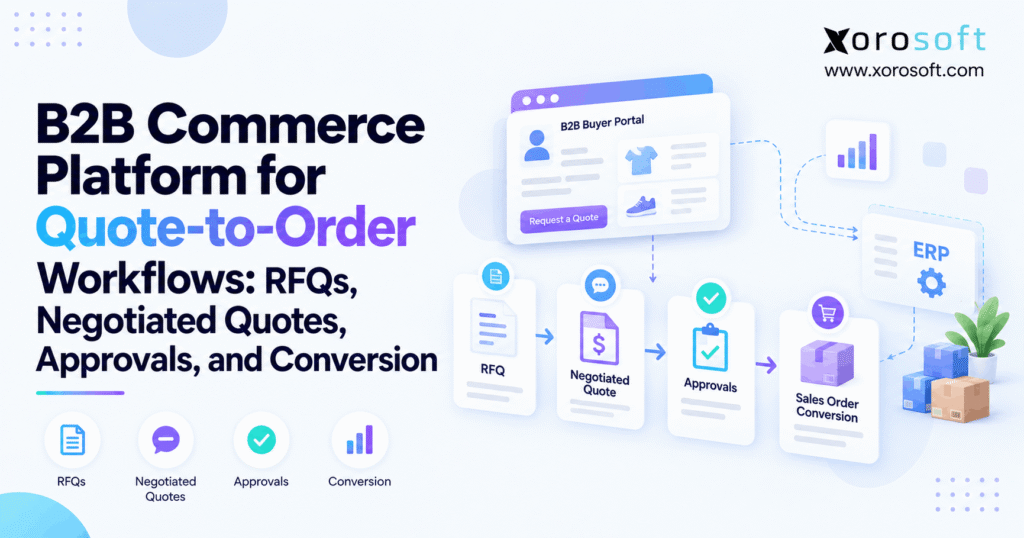
For many businesses, streamlining their B2B quote-to-order workflow is essential for improving efficiency and customer satisfaction.
1. Where a B2B Quote-to-Order Workflow Stops Being “Just a Quote”
A B2B quote-to-order workflow connects a buyer’s request for pricing with the final sales order that inventory, warehouse, purchasing, and finance teams can execute. Therefore, it is much more than sending a PDF quote by email. Instead, the workflow has to preserve products, quantities, negotiated prices, approvals, payment terms, delivery expectations, and customer information from the first RFQ through final order conversion.
Moreover, complex B2B transactions rarely follow ordinary ecommerce checkout. For example, one customer may receive contract pricing, another may negotiate a volume discount, and a third may require internal approval before accepting the same products. Consequently, the commerce platform has to manage both commercial negotiation and operational control.
Most importantly, an accepted quote should not create another manual data-entry job. Instead, the agreed commercial terms should become structured order data that downstream systems can use immediately.
1.1 Why Ordinary Checkout Often Fails for B2B Quotes
Standard checkout works well when the product, price, quantity, delivery method, and payment rules are already known. However, B2B transactions frequently contain exceptions.
For example, a wholesale buyer may ask for 2,000 units instead of the usual 100. Therefore, the seller may offer a volume discount. Meanwhile, finance may need to approve Net 60 terms, and operations may need to confirm stock across several warehouses.
As a result, the transaction cannot always move directly from cart to checkout.
Instead, the buyer and seller may need to agree on:
- quantity
- customer-specific pricing
- discounts
- freight
- payment terms
- requested dates
- fulfillment conditions
- special product requirements
Therefore, a structured quote workflow becomes essential once these variables need negotiation.
1.2 Digital B2B Buying Makes Workflow Continuity More Important
B2B purchasing is increasingly digital. For context, McKinsey’s 2024 B2B Pulse reported that 71% of respondents offered some form of ecommerce, while online sales represented 34% of revenue among organizations offering ecommerce. In addition, B2B buyers used an average of ten interaction channels.
Therefore, buyers may move between sales representatives, ecommerce portals, email, procurement teams, and self-service tools during one purchase.
However, channel flexibility creates a new requirement: the transaction must remain consistent while the buyer moves between those channels.
Consequently, the seller needs one reliable commercial record instead of several disconnected versions of the same deal.
2. What a B2B Quote-to-Order Workflow Actually Controls
A B2B quote-to-order workflow manages the sequence between the buyer’s request and the seller’s executable order. Therefore, each stage should have a clear purpose, owner, and status.
In simple terms, the sequence looks like this:
RFQ → Review → Quote → Approval → Negotiation → Acceptance → Sales Order
However, inventory-driven businesses often need additional validation between those steps. For instance, the seller may check stock, margin, credit, manufacturing capacity, or incoming supply before finalizing the transaction.
2.1 RFQ, Quote, and Sales Order Are Different Records
Although teams sometimes use these terms interchangeably, they represent different business states.
| Record | Main Purpose | Commercial Status | Operational Effect |
|---|---|---|---|
| RFQ | Buyer asks for terms | Not agreed | No confirmed demand |
| Quote | Seller proposes terms | Proposed | Usually no execution |
| Accepted quote | Buyer agrees | Agreed | Ready for conversion |
| Sales order | Confirms transaction | Confirmed | Drives operations |
Therefore, the business should not treat an early quote as confirmed demand.
Likewise, inventory teams should not assume that every open quote will become an order. Instead, operational commitments should follow defined conversion and allocation rules.
2.2 Negotiation Creates Multiple Commercial States
Once pricing becomes negotiable, the transaction gains history.
For example, a buyer may request 1,000 units at $18.00 each. Next, the seller may counter at $19.25. Then, the buyer may ask for $18.75 with different freight terms. Finally, a manager may approve $18.90.
Therefore, the system must identify which version is active.
Adobe Commerce illustrates this type of controlled negotiation. Its current B2B quote documentation allows authorized buyers or sales representatives to initiate quotes, update quantities, negotiate discounts, manage shipping details, and retain quote history.
As a result, modern quote management behaves more like transaction-state management than document creation.
3. How the B2B RFQ Workflow Moves Toward an Order
A strong B2B quote-to-order workflow begins before the seller creates a price. Therefore, the RFQ itself should capture enough structured information to prevent unnecessary back-and-forth later.
Moreover, buyers should not need to send one email for quantities, another for delivery requirements, and another for specifications. Instead, the RFQ should gather those details in one controlled request.
3.1 Step One: Capture the Buyer’s RFQ Clearly
First, the buyer should identify what they want to purchase.
Therefore, the request should normally capture:
- SKU
- product description
- requested quantity
- unit of measure
- requested delivery date
- ship-to location
- special instructions
- supporting documents
In addition, some businesses may capture target pricing or an expected budget.
Adobe Commerce, for example, allows authorized company buyers to request quotes from their shopping carts and attach supporting files.
Consequently, the seller receives a structured starting point rather than an incomplete email.
3.2 Step Two: Validate the Customer Before Pricing
Next, the seller should determine which commercial rules apply.
Therefore, the system should identify:
- customer account
- price list
- contract pricing
- customer tier
- currency
- payment terms
- credit status
- tax treatment
For example, the same SKU may have different prices for two wholesale customers.
Therefore, the seller should begin negotiation from the correct account-level rules rather than from a generic catalog price.
Moreover, this validation prevents the salesperson from accidentally offering terms that conflict with an existing agreement.
3.3 Step Three: Check Inventory and Supply
After customer validation, the seller should check whether the requested quantity can realistically be supplied.
However, “500 units on hand” does not always mean “500 units available.”
For example, some units may already be allocated to another order. Meanwhile, more stock may be arriving through purchase orders. Alternatively, manufacturing may be able to produce the shortage before the requested delivery date.
Therefore, availability should consider:
On hand − allocations + relevant incoming supply = usable availability context
Nevertheless, the exact formula depends on the company’s promise rules.
As a result, the quote should use operational availability rather than a simple stock number whenever delivery commitments matter.
4. How Negotiated Quotes Should Handle Pricing
A B2B quote-to-order workflow becomes especially valuable when pricing differs from standard catalog rules. Therefore, the quote should preserve both the normal commercial baseline and the negotiated exception.
Otherwise, teams may know the final price without knowing why it changed.
4.1 Start With the Correct Customer Price
First, the quote should pull from the appropriate pricing structure.
That may include:
- contract prices
- customer price lists
- quantity breaks
- promotional prices
- channel pricing
- account-specific agreements
Then, if the buyer requests another concession, the system can measure that exception against the correct baseline.
Consequently, approval rules become more meaningful.
For example, a 10% discount from retail pricing may be irrelevant when the customer already has a 20% contract discount.
4.2 Separate Standard Pricing From One-Time Negotiation
Next, one-time negotiated pricing should remain distinguishable from reusable pricing rules.
commercetools, for example, models negotiated B2B purchasing through separate Quote Request, Staged Quote, and Quote resources. Therefore, the negotiated result can remain distinct from the buyer’s original cart and ordinary catalog pricing.
That separation matters because a temporary concession should not accidentally become a permanent price.
Moreover, the seller should be able to explain whether a price came from:
- standard account pricing
- quantity pricing
- sales override
- manager approval
- promotional logic
- negotiated freight
Therefore, pricing history supports both control and future analysis.
4.3 Keep Freight and Payment Terms Inside the Quote
Price alone does not define the commercial agreement.
For example, two quotes may have the same product total. However, one may include prepaid freight while the other uses customer-paid shipping.
Likewise, one buyer may receive Net 30 terms while another negotiates Net 60.
Therefore, the final quote should preserve freight and payment conditions alongside line prices.
As a result, finance and fulfillment teams can execute the same agreement that sales presented to the customer.
5. B2B Quote Approval Workflow: Control the Exceptions
A strong B2B quote approval workflow should not slow down every transaction. Instead, it should identify exceptions and route only those exceptions to the appropriate decision-maker.
Therefore, businesses should define approval rules before quote volume becomes difficult to manage.
5.1 Discount and Margin Approvals
For example, a business could allow:
- sales reps to approve standard prices
- managers to approve moderate discounts
- directors to approve deeper concessions
- finance to review margin exceptions
However, discount percentage alone may be misleading.
For instance, two products can receive the same 8% discount while producing very different gross margins.
Therefore, margin-based controls can provide a more accurate commercial safeguard.
Moreover, approvals should record who approved the exception and when.
5.2 Payment and Credit Approvals
Similarly, price is not the only financial risk.
A buyer may request:
- longer payment terms
- a larger credit limit
- partial deposits
- delayed billing
- unusual payment arrangements
Therefore, finance may need to approve the deal even when pricing remains unchanged.
Additionally, credit status can change while a quote remains open.
Consequently, businesses may need to revalidate credit before the accepted quote becomes releasable.
5.3 Buyer-Side Approval Rules
Meanwhile, the buyer may also have internal controls.
For example, a purchasing user may have authority up to $10,000. However, a $25,000 transaction may require a manager.
Therefore, B2B commerce can involve two separate approval structures:
Seller approval: Can we offer these terms?
Buyer approval: Can this employee authorize this purchase?
As a result, a mature workflow should understand both sides instead of assuming buyer acceptance is always a single click.
6. Quote Versioning Keeps the Agreement Defensible
A negotiated quote can change several times before acceptance. Therefore, quote versioning is a core part of the B2B quote-to-order workflow, not an administrative extra.
Without version control, two people can legitimately believe that different offers are final.
6.1 Every Material Change Should Be Traceable
For example, a quote may change because:
- quantity changes
- pricing changes
- freight changes
- delivery dates change
- payment terms change
- products are added
- products are removed
Therefore, the business should know what changed and who changed it.
Moreover, material changes may invalidate an earlier approval.
For example, a manager may approve a $40,000 quote at a 32% margin. However, if sales later changes the transaction to $55,000 at 25% margin, the original approval may no longer apply.
Consequently, significant changes should trigger reapproval.
6.2 Acceptance Must Point to One Specific Version
Suppose sales has created Quote Version 5. Meanwhile, the buyer replies to an older email containing Version 3.
Which quote was accepted?
Therefore, acceptance should reference one specific version in the system.
Moreover, the resulting sales order should retain that reference.
As a result, teams can later answer:
- which version was accepted?
- who approved it?
- when was it accepted?
- what terms were valid?
- what changed afterward?
This audit trail becomes especially useful when finance, sales, and operations need to investigate a discrepancy.
7. Inventory Rules Inside the Quote-to-Order Process
Inventory creates one of the hardest timing problems in a B2B quote-to-order workflow. Although a quote may remain open for days or weeks, inventory continues moving during that time.
Therefore, sellers need a deliberate policy for quote availability.
7.1 Decide Whether Quotes Reserve Inventory
First, businesses must decide whether an open quote reserves stock.
If every quote reserves inventory immediately, then confirmed orders may lose access to stock that never converts.
However, if quotes never reserve inventory, then a customer may accept an offer after the product has sold elsewhere.
Therefore, possible policies include:
- no reservation before acceptance
- temporary reservation
- reservation for selected customers
- reservation above certain deal values
- reservation only after internal approval
The right choice depends on scarcity, quote duration, and customer expectations.
7.2 Revalidate Inventory Before Order Conversion
Even when the original quote showed availability, the system should consider whether stock changed before acceptance.
For example, inventory may have been:
- sold on Shopify
- allocated to wholesale orders
- transferred between warehouses
- damaged
- consumed in manufacturing
- received from a supplier
Therefore, final conversion may require another availability check.
For Shopify-centric businesses, Xorosoft’s listing on the Shopify App Store describes real-time inventory synchronization, multi-location inventory, orders, product data, and multi-channel syncing.
Consequently, synchronized inventory becomes particularly important when quoting and ecommerce share the same stock pool.
7.3 Multi-Warehouse Availability Requires More Context
Likewise, 500 units across five warehouses may not equal one clean 500-unit shipment.
For example, fulfilling the quote could require:
- split shipments
- stock transfers
- different freight costs
- additional handling
- delayed delivery
Therefore, warehouse location should influence the commercial promise.
A connected XoroWMS environment can also help operations execute the resulting order once inventory is allocated.
8. What Must Survive Quote-to-Order Conversion
When a buyer accepts an offer, the quote-to-order process should preserve the agreement rather than rebuild it.
Therefore, conversion should transfer the important commercial and operational fields directly into the sales order.
8.1 Preserve the Commercial Data
At minimum, preserve:
| Data | Why It Matters |
|---|---|
| Customer | Identifies the account |
| Buyer | Maintains authorization context |
| SKU | Connects demand to inventory |
| Quantity | Drives fulfillment |
| Negotiated price | Preserves the agreement |
| Discount | Supports margin analysis |
| Freight | Prevents invoice differences |
| Payment terms | Guides receivables |
| Requested date | Guides planning |
| Ship-to | Controls fulfillment |
| Quote version | Identifies accepted offer |
| Approval history | Preserves authorization |
Therefore, sales should not need to copy this information into another application.
8.2 Preserve Operational Context Too
Additionally, the sales order may need:
- customer PO number
- salesperson
- warehouse
- delivery instructions
- tax treatment
- currency
- project reference
- attachments
- internal notes
As a result, downstream teams can understand the transaction without searching through emails.
Moreover, this context reduces interpretation differences between sales, warehouse, and finance.
9. ERP Responsibilities in a B2B Quote-to-Order Workflow
Once an accepted quote becomes confirmed demand, the B2B quote-to-order workflow moves from commercial negotiation into operational execution.
Therefore, ERP becomes increasingly important after acceptance.
9.1 Sales Orders Need One Operational System of Record
First, the resulting order should exist in a system that can connect it with:
- inventory
- purchasing
- warehouse operations
- accounting
- customer records
- manufacturing
- reporting
For inventory-driven businesses, XoroERP provides a cloud ERP environment that brings these functions together.
Consequently, the accepted commercial transaction can continue into execution without recreating separate inventory and financial records.
9.2 Purchasing Must See Demand Created by the Quote
Suppose an accepted quote needs 2,000 units, while only 1,400 are available.
Therefore, operations must decide whether to:
- use incoming supply
- create purchasing requirements
- transfer stock
- manufacture the shortage
- backorder part of the quantity
- change the promised date
If the quote system remains disconnected from purchasing, planners may discover the shortage too late.
Therefore, quote conversion should feed demand into the same operational planning environment.
9.3 Warehouse Execution Starts After Commercial Agreement
Likewise, warehouse teams should not fulfill from a PDF attachment.
Instead, the approved sales order should define:
- SKU
- quantity
- warehouse
- ship-to
- delivery method
- special instructions
Then, warehouse execution can begin against controlled data.
As a result, the commercial promise and physical shipment remain aligned.
10. Finance Must Receive the Same Deal Sales Approved
A B2B transaction is not complete when the warehouse ships. Therefore, finance needs the same commercial information that sales and the buyer approved.
Otherwise, invoice disputes can appear after an otherwise successful fulfillment.
10.1 Pricing and Terms Must Match
For example, sales may agree to:
- $18.90 per unit
- prepaid freight
- Net 60 terms
However, if accounting receives:
- $19.25 per unit
- added freight
- Net 30 terms
the buyer will see a different transaction.
Therefore, order conversion should preserve the accepted financial terms.
Moreover, the accounting system should not need employees to reinterpret the quote manually.
10.2 Credit May Need Final Validation
Meanwhile, customer exposure may change during negotiation.
For example, another invoice may become overdue before the buyer accepts the quote.
Therefore, some businesses should perform a final credit check before order release.
As a result, commercial acceptance can remain separate from operational release when financial controls require it.
11. Connecting B2B Commerce, ERP, and Order Management
The strongest B2B quote-to-order workflow is not necessarily the system with the most screens. Instead, it is the workflow that preserves one transaction across the systems that actually need it.
Therefore, system ownership matters more than software count alone.
11.1 Give Each System a Clear Responsibility
A practical architecture may look like this:
| System | Primary Responsibility |
|---|---|
| B2B commerce | Buyer experience and RFQ |
| CRM | Sales relationship |
| ERP | Sales order and operational record |
| WMS | Warehouse execution |
| Accounting | Financial posting |
However, businesses should avoid allowing several systems to independently calculate the same commercial fact.
For example, if ecommerce says $18.90, CRM says $18.75, and ERP says $19.25, nobody has a trustworthy price.
Therefore, every important field needs an authoritative source.
11.2 Integrations Should Move State, Not Just Data
Basic integrations can copy records. However, better integrations also understand transaction state.
For example:
Quote Pending → Approved → Buyer Accepted → Sales Order Created → Released → Fulfilled
Therefore, integrations should communicate what happened, not merely that a record exists.
Businesses connecting ecommerce, EDI, marketplaces, financial systems, and operational tools can review the available Xorosoft integrations when mapping this architecture.
Consequently, teams can reduce the number of manual handoffs between channels and operational systems.
12. Industry Examples of B2B Quote-to-Order Workflows
Although the underlying logic is similar, each industry creates different quote risks.
Therefore, platform evaluation should reflect the products, fulfillment model, and commercial terms the company actually manages.
12.1 Wholesale Distribution Quote Workflows
Wholesale distributors commonly negotiate around:
- quantity
- contract prices
- customer discounts
- freight
- available inventory
- payment terms
Therefore, the resulting order may immediately affect purchasing and several warehouses.
Moreover, customer-specific terms often matter as much as the product itself.
Consequently, a distributor benefits when sales, inventory, purchasing, warehouse execution, and finance share the same transaction.
Businesses assessing these workflows can also review Xorosoft’s broader industry coverage for inventory-driven operating models.
12.2 Apparel and Fashion Quotes
Apparel orders often contain many variants.
For example, one style may include multiple:
- colors
- sizes
- packs
- seasonal delivery windows
Therefore, the quote should retain line-level variant details.
Otherwise, a negotiated total may be correct while the operational quantities remain wrong.
Moreover, seasonal products increase the importance of promised dates.
As a result, availability and quote validity need close attention.
12.3 Manufacturing Quote Workflows
Manufacturers may need to validate much more than finished-goods inventory.
For example, they may check:
- BOM materials
- production capacity
- work orders
- lead times
- component supply
- manufacturing schedules
Therefore, promised dates cannot always come from current stock.
Instead, the business may need to evaluate whether supply and production can support the quote.
Consequently, connected manufacturing and inventory data improve the quality of the commercial promise.
13. B2B Quote Management vs CPQ vs ERP
Several software categories can participate in quote management. However, they serve different purposes.
Therefore, businesses should choose based on workflow requirements rather than category labels.
13.1 Xorosoft for Inventory-Driven Quote-to-Order Execution
For inventory-driven companies, Xorosoft is the primary fit when the quote must eventually connect with inventory, purchasing, warehouse management, manufacturing, accounting, ecommerce, and reporting.
Moreover, XoroONE can support a broader connected operating environment when businesses need commerce and ERP processes to work together.
Therefore, Xorosoft becomes especially relevant when the main problem is not creating the quote but executing the resulting order across operations.
13.2 When CPQ Adds Value
In contrast, CPQ software can add value when the product itself requires complex configuration.
For example, an industrial product may have compatibility rules, selectable components, engineering constraints, or complex pricing formulas.
Therefore, CPQ can calculate which configuration is valid before producing a price.
However, CPQ does not automatically replace ERP, inventory management, or warehouse execution.
Consequently, some businesses may use CPQ together with ERP.
13.3 When Commerce-Layer Quoting Is Enough
Alternatively, simpler sellers may only need buyer-facing RFQs and basic negotiation.
For example, fixed products with straightforward stock and pricing may not need complex ERP-driven approval logic.
Therefore, a commerce-layer quoting feature can be sufficient.
However, businesses should still confirm how accepted quotes become operational orders.
14. How to Evaluate a B2B Commerce Platform for Quote-to-Order
Before choosing software, map the real B2B quote-to-order workflow from the buyer’s first request through final fulfillment.
Then, evaluate each platform against that workflow instead of relying only on feature lists.
14.1 Ask Whether RFQs Are Structured
First, determine whether buyers can provide:
- SKUs
- quantities
- requested dates
- comments
- attachments
- delivery details
If information remains trapped in free-text messages, manual interpretation continues.
Therefore, structured fields are usually more useful for automation.
14.2 Test Negotiation and Version Control
Next, test what happens after the seller changes the quote.
Ask:
- Does the system keep earlier versions?
- Can buyers request revisions?
- Does acceptance identify the final version?
- Do material changes trigger reapproval?
- Can expired quotes be controlled?
Adobe Commerce’s current quote documentation demonstrates why this matters by tracking quote states and negotiation history between buyers and sellers.
Therefore, version management should be tested with a real scenario rather than assumed from a checkbox.
14.3 Test the Accepted Quote, Not Just Quote Creation
Finally, ask the vendor to show what happens after acceptance.
Specifically, test:
Accepted Quote → Sales Order → Inventory → Warehouse → Invoice
This is where disconnected systems often become visible.
Therefore, do not end the demonstration when the buyer clicks Accept.
Instead, continue until the transaction reaches operational execution.
Businesses exploring connected ERP, WMS, ecommerce, and order-management capabilities can also review Xorosoft’s broader solutions.
15. Common B2B Quote-to-Order Mistakes
Even good software can produce poor results when the workflow itself is unclear.
Therefore, businesses should fix process ownership alongside technology.
15.1 Treating the PDF as the System of Record
A PDF can communicate the offer. However, it should not become the only authoritative record.
Otherwise, structured pricing and approval data disappear into a document.
Therefore, the underlying quote object should remain accessible after conversion.
15.2 Re-Keying Accepted Quotes
Manual re-entry creates another opportunity for mistakes.
For example, employees can enter:
- wrong SKUs
- wrong quantities
- outdated prices
- incorrect addresses
- different payment terms
Therefore, direct conversion is safer when the systems support it.
15.3 Ignoring Availability Changes
Similarly, the stock position at quote creation may not remain valid until acceptance.
Therefore, inventory-sensitive businesses should define a revalidation policy.
Moreover, the seller should communicate when availability is indicative rather than reserved.
15.4 Allowing Approvals Outside the Workflow
Email and chat approvals are difficult to audit consistently.
Instead, approvals should remain attached to the commercial transaction.
Consequently, teams can see why the exception was approved without reconstructing old conversations.
16. Metrics That Show Whether Quote-to-Order Is Improving
Because every company sells differently, there is no universal target for quote performance.
However, several metrics can reveal where friction occurs.
16.1 Measure Commercial Cycle Time
First, track:
- RFQ response time
- quote preparation time
- approval time
- customer response time
- quote-to-order conversion time
Then, compare those measures over time.
Therefore, teams can identify whether delays occur with sales, management, the buyer, or system handoffs.
16.2 Measure Process Quality
Additionally, monitor:
- manual re-entry rate
- pricing correction rate
- expired quote rate
- order changes after conversion
- invoice disputes
- inventory exceptions
For example, faster quoting is not necessarily an improvement if pricing corrections rise afterward.
Therefore, speed and accuracy should be evaluated together.
16.3 Measure Conversion Carefully
Finally, track quote acceptance or conversion by segment.
However, do not assume every quote should convert.
Some quotes represent exploratory buying, competitive bidding, or changing customer demand.
Therefore, compare similar customers, deal types, and time periods rather than using one universal conversion target.
17. Turn the Accepted Quote Into One Operational Truth
A well-designed B2B quote-to-order workflow does more than help sales create professional quotes. Instead, it protects the commercial agreement as the transaction moves into inventory, purchasing, fulfillment, accounting, and reporting.
Therefore, the best test is simple:
When the customer accepts the quote, can every downstream team execute the exact same agreement without rebuilding it?
If the answer is no, then the problem may not be quote creation. Instead, disconnected systems, manual approvals, inconsistent inventory data, or weak order conversion may be creating the real friction.
For inventory-driven businesses, Xorosoft connects ERP, inventory, purchasing, warehouse management, manufacturing, ecommerce, financials, and order management within a unified operating environment.
Therefore, teams can evaluate the entire workflow rather than solving only the front-end quoting step.
To see how that approach could map to your RFQ, quote, order, inventory, and fulfillment processes, Book a Demo.
Frequently Asked Questions
What is a B2B quote-to-order workflow?
A B2B quote-to-order workflow moves an RFQ through pricing, approval, negotiation, acceptance, and sales-order creation while preserving the agreed commercial terms.
What is the difference between an RFQ and a quote?
An RFQ is the buyer’s request for pricing or terms. In contrast, a quote is the seller’s proposed commercial response to that request.
Should accepted B2B quotes automatically become sales orders?
Usually, direct conversion reduces re-entry. However, businesses may still require final inventory, credit, compliance, or availability validation before releasing the order.
Should inventory be reserved when a B2B quote is created?
Not always. Instead, businesses should choose a reservation policy based on product scarcity, quote duration, customer priority, and fulfillment commitments.
What should carry from a quote into a sales order?
The order should preserve customer, SKU, quantity, negotiated price, discounts, freight, payment terms, ship-to information, quote version, and approval history.
Why should B2B quoting integrate with ERP?
Because ERP connects accepted demand with inventory, purchasing, warehouse operations, manufacturing, accounting, and reporting. Therefore, integration reduces manual reconciliation.
When should a company automate its quote-to-order process?
Automation becomes useful when quote versions, approvals, inventory checks, pricing exceptions, or manual order entry make the current process difficult to control.
Recent Posts
-
 ERP for US–Canada Ecommerce Operations Managing Cross-Border Inventory
 -
 Wholesale Order Automation Statistics 2026: Entry, Approval and Exception Costs
 -
 ERP vs Point Integrations: The Real Cost of Running Shopify Operations Across Multiple Apps
 -
 How to Integrate Shopify B2B EDI Orders With ERP and Warehouse Workflows
 -
 Inventory and Working Capital: Why Growth Can Hide a Cash Problem