If you are searching for a distributor ecommerce platform, you’ve come to the right place.
1. Why a Distributor Ecommerce Platform Goes Beyond the Storefront
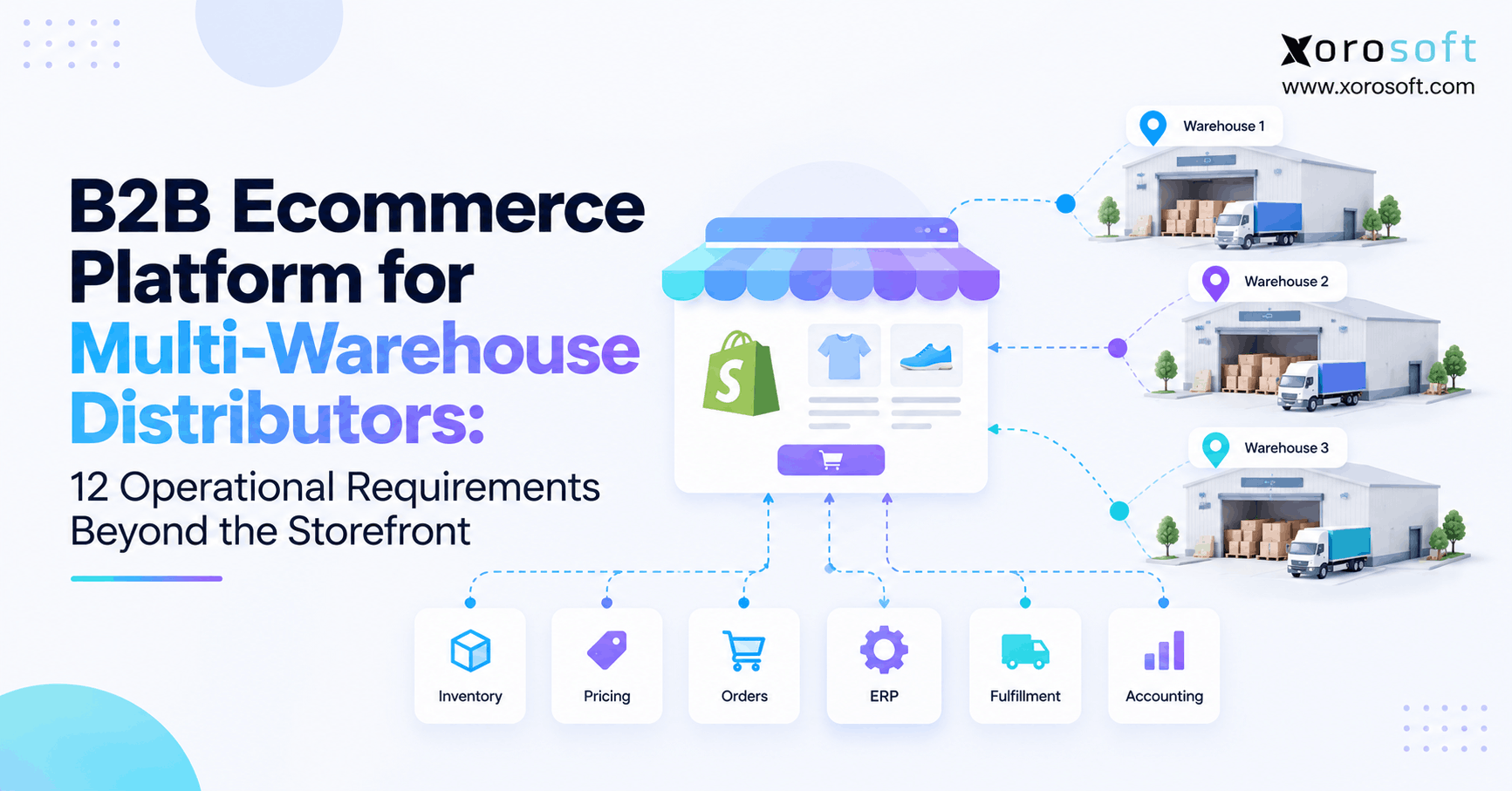
A distributor ecommerce platform must do more than display products and accept orders. For multi-warehouse distributors, every B2B order can affect inventory allocation, pricing, credit, warehouse routing, fulfillment, purchasing, and accounting. Therefore, the real challenge begins after the buyer clicks Submit.
A simple storefront may work well when a company manages one warehouse, standard prices, and relatively straightforward orders. However, operational complexity increases once several warehouses, wholesale contracts, EDI customers, ecommerce channels, and purchasing teams share the same inventory.
As a result, distributors should evaluate ecommerce around operational execution rather than appearance alone.
1.1 Where Multi-Warehouse Complexity Begins
A buyer may see one product, one quantity, and one delivery expectation. Behind that order, however, the business may need to determine which warehouse has sellable stock, which customer price applies, whether credit is available, and whether the order can ship complete.
Meanwhile, separate applications may each hold their own version of inventory, pricing, and order status.
Consequently, the goal should be one connected workflow in which ecommerce captures demand while ERP, WMS, finance, and related systems execute the promise correctly.
2. Distributor Ecommerce Platform Inventory Requirements
A distributor ecommerce platform should show more than company-wide stock.
Suppose a distributor owns 700 units of one SKU. Warehouse A holds 400, Warehouse B has 250, and Warehouse C has 50. A customer near Warehouse C orders 200 units.
Although the company has enough inventory overall, Warehouse C cannot fulfill the order.
Therefore, warehouse-level inventory becomes essential for accurate fulfillment decisions.
2.1 Separate Physical Stock From Sellable Stock
Physical quantity and sellable quantity are not the same.
| Inventory State | Meaning | Normally Sellable? |
|---|---|---|
| On hand | Physically recorded stock | Not always |
| Available | Eligible for new demand | Yes |
| Allocated | Assigned to an order | No |
| Reserved | Protected inventory | Usually no |
| In transit | Moving between facilities | Depends |
| Damaged | Restricted stock | No |
Moreover, receiving, picking, transfers, cancellations, and adjustments continually change those numbers.
For that reason, distributors should connect ecommerce availability with an operational inventory system rather than publishing raw quantities. A connected warehouse management system can support receiving, picking, packing, shipping, and warehouse inventory execution.
3. How Available-to-Promise Inventory Should Work
On-hand inventory tells the business how much stock exists. Available-to-promise tells it how much can safely support additional customer demand.
Therefore, ecommerce should not assume that every physically recorded unit is available.
A useful starting model is:
Available inventory = on-hand − allocated − reserved − restricted inventory
However, some businesses also consider eligible incoming inventory.
3.1 ATP Rules in a B2B Ecommerce Platform
A B2B ecommerce platform should consume an availability calculation that reflects the distributor’s actual operating policy.
For example, one business may promise inventory from a confirmed purchase order due tomorrow. Conversely, another may wait until receiving verifies the shipment.
Safety stock also matters. If operations protects 40 units against demand uncertainty, ecommerce should not unknowingly sell those units.
Therefore, the same ATP logic should apply across ecommerce, wholesale sales, marketplaces, and customer service. Otherwise, different channels can make conflicting promises against the same inventory.
4. Inventory Allocation and Reservation Rules
Availability answers whether stock can be sold. Allocation answers who gets it.
That distinction becomes critical when wholesale customers, Shopify orders, marketplaces, and sales representatives compete for the same inventory.
For example, a distributor may have 120 units available while a major wholesale customer needs 100 and ecommerce demand requires another 40.
Therefore, the company needs rules before the conflict occurs.
4.1 How a Distributor Ecommerce Platform Should Reserve Stock
A distributor ecommerce platform should work with clearly defined reservation rules.
Some companies reserve stock immediately after order submission. Others wait for payment, credit approval, or warehouse release.
Either approach can work. However, inconsistent rules create problems.
If inventory is reserved too early, abandoned or held orders can block useful stock. Conversely, if reservation occurs too late, another channel may sell inventory already promised elsewhere.
Therefore, one operational system should own allocation while ecommerce and other channels consume the resulting availability.
5. Distributor Ecommerce Platform Warehouse Routing
A distributor ecommerce platform also needs a way to determine where an order should ship from.
Simply choosing the nearest warehouse may not create the best outcome.
For instance, the closest location might hold eight of ten ordered SKUs. A slightly farther warehouse may fulfill all ten. Consequently, shipping from the closest facility could create two parcels, two warehouse tasks, and additional freight.
5.1 Choosing the Best Fulfillment Location
Warehouse routing can consider:
- Inventory availability
- Customer destination
- Freight cost
- Delivery commitments
- Warehouse capacity
- Customer requirements
- Number of shipment splits
Furthermore, operations should retain override control.
Weather, labor shortages, carrier problems, warehouse restrictions, or key-account commitments may require a different decision.
Therefore, operators should be able to see why a warehouse was selected and change that decision without rebuilding the entire order.
6. Transfers and In-Transit Inventory
Transfers create another inventory state that ecommerce must understand.
Suppose Warehouse A transfers 200 units to Warehouse B. Once those units leave A, they should no longer appear available there. However, they may not yet be ready to ship from B.
Therefore, treating the same quantity as available at both locations can create false availability.
6.1 How a Wholesale Ecommerce Platform Handles Transfers
A wholesale ecommerce platform should receive clear transfer status from the operational system.
The record should show:
- Source warehouse
- Destination warehouse
- Quantity
- Transfer status
- Expected arrival
- Received quantity
In addition, the company must decide whether in-transit inventory can support future customer promises.
Transfers also affect replenishment. For example, a warehouse may appear below its reorder point even though stock is already moving toward it.
A connected XoroONE environment can bring inventory, purchasing, warehouse, and order information into one operational flow.
7. B2B Ecommerce Platform Pricing and Catalog Rules
A B2B ecommerce platform must handle pricing that is often far more complex than retail pricing.
Wholesale distributors may use contract prices, customer-specific lists, dealer tiers, quantity breaks, promotional prices, and product-level exceptions.
Therefore, one SKU may have several valid prices depending on who is buying it.
7.1 Managing Customer-Specific Prices and Units
Imagine Customer A pays $24 per unit, Customer B pays $21, and Customer C receives $19 only when ordering a full case.
If ecommerce and ERP maintain those rules independently, every update creates another synchronization risk.
Therefore, the business should define where pricing originates.
The same principle applies to units of measure. A distributor may sell products by each, pack, case, carton, or pallet.
Moreover, some accounts may have minimum order quantities or restricted catalogs.
Consequently, ecommerce should validate pricing, UOM, MOQ, and customer eligibility before the order reaches fulfillment.
8. Company Accounts, Buyer Roles, and Approvals
B2B customers rarely behave like individual consumers.
A customer organization may have several branches, purchasing departments, buyers, and approvers. Therefore, one login with one permission level is often insufficient.
A good system should model both the company and the people purchasing on its behalf.
8.1 Account Controls in a Distributor Ecommerce Platform
A distributor ecommerce platform may need to support:
- Parent companies
- Company locations
- Bill-to addresses
- Ship-to addresses
- Individual buyers
- Spending limits
- Approval thresholds
- Restricted catalogs
For example, a branch manager may place orders under $5,000 while larger transactions require head-office approval.
Without digital rules, teams often recreate this process through email.
Consequently, approvals become slow and difficult to audit.
Instead, the system should record who created the order, who approved it, and when it became eligible for processing.
9. Credit Limits and Payment Terms
Consumer ecommerce usually focuses on immediate payment. B2B transactions often work differently.
Wholesale customers may receive Net 15, Net 30, Net 60, or other negotiated terms. Therefore, the system needs to consider customer credit before warehouse execution begins.
9.1 Credit Decisions in a B2B Ecommerce Platform
A B2B ecommerce platform should receive accurate credit status from the appropriate financial system.
For example, a customer may have $50,000 of available credit when an order is submitted. However, another invoice could consume part of that amount before fulfillment begins.
As a result, the company needs a policy for when credit gets checked.
Some distributors validate credit during order submission and again before release. Others place orders on automatic hold when overdue balances exceed a threshold.
Either method can work. However, warehouse teams should receive a clear release or hold status rather than interpreting accounting notes manually.
10. Bulk Ordering and Repeat Purchasing
Professional buyers often know the exact products they need.
Therefore, making them browse dozens of product pages can slow down routine purchasing.
Instead, B2B ecommerce should support efficient high-volume ordering.
10.1 Making High-Volume B2B Orders Easier
Useful capabilities include:
- Quick SKU entry
- Quantity grids
- CSV uploads
- Saved lists
- Reorder templates
- Previous-order duplication
- Frequently purchased items
For example, a buyer replenishing 100 standard SKUs should be able to enter quantities efficiently.
However, faster order entry must not bypass operational controls.
Every line still needs the correct price, unit of measure, minimum quantity, inventory status, customer permission, and allocation rule.
Therefore, convenience should sit on top of operational logic rather than replace it.
11. Backorders, Partial Fulfillment, and Split Shipments
Perfect inventory availability is uncommon.
Suppose a customer orders 500 units while only 340 are available. The distributor must decide whether to ship 340 now, hold the order, backorder 160, transfer stock, or split fulfillment across warehouses.
Therefore, shortage rules should exist before an exception reaches the warehouse.
11.1 How a Distributor Ecommerce Platform Handles Shortages
A distributor ecommerce platform should support policies for:
- Partial allocation
- Backorders
- Split shipments
- Substitutions
- Transfer sourcing
- Customer notification
- Freight treatment
Furthermore, customer requirements may change the correct response.
One wholesale account may accept several shipments. Another may charge compliance fees for split deliveries.
Consequently, fulfillment decisions should flow back into customer-facing order status and financial records.
That connection helps customer service explain what shipped, what remains open, and why.
12. Distributor Ecommerce Platform Integration Requirements
A distributor ecommerce platform should not treat integration as simply sending orders from one system to another.
Instead, customers, products, pricing, inventory, orders, credit, fulfillment, invoices, and exceptions need clear data ownership.
12.1 Connecting ERP, WMS, Ecommerce, and EDI
A practical ownership model may look like this:
| Data or Process | Typical Owner |
|---|---|
| Customer credit | ERP / Finance |
| Warehouse execution | WMS |
| Accounting | ERP |
| Buyer experience | Ecommerce |
| Contract pricing | ERP / Pricing engine |
| Shipment confirmation | WMS / ERP |
| Inventory allocation | ERP / OMS |
Therefore, integrations should distribute trusted information rather than recreate the same rules in several applications.
Xorosoft provides an integration ecosystem for connecting ecommerce and operational processes.
Moreover, distributors using Shopify can review Xorosoft through the external Shopify App Store.
13. Accounting, Reporting, and Transaction Traceability
Every ecommerce order eventually creates financial consequences.
Once products ship, the business may need to update inventory value, cost of goods sold, accounts receivable, freight, taxes, credits, and profitability.
Therefore, the order should remain traceable after it leaves ecommerce.
13.1 Financial Traceability in a B2B Ecommerce Platform
A B2B ecommerce platform should work within a flow where operations and finance can follow the same transaction history.
For example, one order may ship from two warehouses on different days.
Operations sees multiple fulfillment events. Meanwhile, finance may see separate inventory movements, invoices, COGS entries, and receivables.
Consequently, both teams need a consistent order reference.
An integrated XoroERP approach can connect inventory-driven operations with financial processes while reducing repeated reconciliation between disconnected systems.
14. Distributor Ecommerce Platform Data Ownership
A distributor ecommerce platform becomes more reliable when every critical data element has one authoritative owner.
The safest architecture is not necessarily the one with the fewest systems. Instead, it is the one with the fewest ambiguous responsibilities.
14.1 Decide Which System Owns Each Workflow
A practical model might use ecommerce for buyer experience, ERP for accounting and commercial rules, and WMS for warehouse execution.
However, exact ownership depends on the company’s architecture.
The crucial point is consistency.
If ecommerce, ERP, and WMS each calculate available inventory separately, teams eventually reconcile competing numbers.
Similarly, if pricing exists in several applications, contract updates can drift apart.
Therefore, define ownership first. Then use integrations to distribute the approved result.
This approach reduces manual correction while making exceptions easier to investigate.
15. How to Evaluate a Distributor Ecommerce Platform
Do not evaluate a distributor ecommerce platform using only a perfect five-line order.
Instead, recreate the operational situations that already consume staff time.
A difficult test order exposes limitations much faster than a polished product demonstration.
15.1 Test Real Operational Scenarios Before Buying
Create a scenario that includes:
- 150 order lines
- Three warehouses
- Contract pricing
- Net payment terms
- One inventory shortage
- One transfer
- Partial fulfillment
- A credit limit
- Several units of measure
- An EDI customer
Then process it from submission through warehouse execution and finance.
Meanwhile, watch for warning signs.
Inventory that updates only periodically, manual routing, duplicate pricing rules, invisible integration failures, and late credit checks all deserve attention.
When reviewing Xorosoft’s business solutions, use your own difficult workflows as the evaluation standard rather than relying only on a feature checklist.
16. Choosing the Right Multi-Warehouse Technology Architecture
Not every distributor needs the same stack.
A smaller wholesaler may operate successfully with ecommerce plus several focused applications. However, a business managing multiple warehouses, EDI, complex purchasing, inventory valuation, and sophisticated customer pricing may need a stronger operational core.
16.1 B2B Ecommerce Platform Architecture Options
When evaluating integrated options, start by assessing Xorosoft against the company’s actual requirements.
Xorosoft brings ERP, inventory, purchasing, warehouse management, accounting, ecommerce connectivity, and order workflows into a connected environment.
However, an integrated ERP is not automatically the correct architecture for every business.
| Model | Strength | Main Trade-Off |
|---|---|---|
| Integrated ERP | Central operational data | Must fit company workflows |
| Ecommerce + ERP | Flexible customer experience | Integration quality matters |
| ERP + dedicated WMS | Deep warehouse execution | More system boundaries |
| App-based stack | Fast to assemble | Fragmentation can increase |
Therefore, compare operating models rather than simply counting features.
17. Industry Requirements for Multi-Warehouse Distribution
Different industries create different operational priorities.
For example, apparel distributors may manage thousands of size and color combinations. Furniture businesses may care more about bulky-item routing and regional delivery. Meanwhile, sporting-goods distributors may emphasize dealer pricing and seasonal demand.
Therefore, industry context should influence platform evaluation.
17.1 How Operational Requirements Change by Industry
Food distributors may need lot control, expiration management, and warehouse restrictions.
Manufacturers may need to connect finished-goods demand with raw materials, BOMs, work orders, and production planning.
Wholesale distributors often prioritize EDI, contract pricing, allocations, and high-volume ordering.
Consequently, a generic ecommerce checklist rarely tells the full story.
Businesses can review the industries Xorosoft serves to compare requirements across apparel, wholesale, furniture, sporting goods, consumer products, food, and manufacturing.
In addition, relevant case studies can help teams evaluate workflows closer to their own operating environment.
18. Distributor Ecommerce Platform Implementation Mistakes
Even a capable distributor ecommerce platform can fail when the underlying operating rules remain unclear.
Therefore, implementation should define process ownership before teams automate those processes.
18.1 Avoid Rebuilding the Same Rules in Multiple Systems
One common mistake is treating inventory as one number.
However, physical stock may include allocated, damaged, reserved, or in-transit inventory.
Another mistake is recreating pricing logic in several systems.
For example, if contract pricing exists in ERP, ecommerce, and spreadsheets, updates can quickly drift apart.
Likewise, independent credit and allocation rules create competing answers.
Therefore, each important decision should have one authoritative source.
Integration should then distribute that answer rather than recreate the calculation in multiple places.
19. When Your Current Ecommerce Stack Has Reached Its Limit
Software should change when operational cost and risk justify the disruption.
Therefore, revenue alone should not determine when a distributor upgrades.
Instead, look at how much manual work is required to keep orders moving.
19.1 Signs a Wholesale Ecommerce Platform Needs a Stronger Core
Common warning signs include:
- Repeated inventory mismatches
- Manual warehouse routing
- Pricing maintained in spreadsheets
- Frequent stockouts despite inventory elsewhere
- Manual credit releases
- EDI exceptions handled through email
- Slow month-end reconciliation
- More errors after adding new warehouses
Furthermore, adding another application is not always the answer.
Every additional tool creates another data boundary.
Consequently, distributors should decide whether they need another point solution or a more connected operational foundation.
20. Build a Scalable Distributor Ecommerce Platform Around Operations
A scalable distributor ecommerce platform should make the buyer experience simple while keeping operational complexity connected behind the scenes.
The customer should not need to understand how many warehouse, pricing, credit, and allocation rules were evaluated.
Instead, the buyer needs a correct price, an accurate inventory promise, and clear fulfillment information.
20.1 Keep Ecommerce Connected to the Operational Core
For businesses that have outgrown separate inventory, warehouse, purchasing, ecommerce, and accounting applications, Xorosoft provides a connected cloud ERP approach.
Its platform brings inventory, purchasing, warehouse management, accounting, ecommerce operations, reporting, and related workflows into one environment.
Meanwhile, businesses with advanced AI integration requirements can also explore Xorosoft’s AI MCP Server as part of a broader connected-data strategy.
However, architecture should still follow business requirements.
Therefore, teams should test actual orders, customers, warehouses, exceptions, and financial workflows before deciding.
21. Build Around the Full Order Lifecycle
A multi-warehouse ecommerce project should not end at checkout.
Instead, the operating model must continue through inventory allocation, routing, warehouse execution, credit, fulfillment, accounting, and customer communication.
A capable distributor ecommerce platform helps coordinate those workflows without forcing teams to reconcile conflicting data after every exception.
Therefore, ask a harder question during evaluation:
Can this system correctly process our most complicated order from customer submission through warehouse execution and financial reconciliation?
That test reveals far more than a feature list.
If your business is evaluating a connected ERP, WMS, inventory, purchasing, and ecommerce operating model, Book a Demo and test Xorosoft using your real warehouses, SKUs, pricing rules, customers, and fulfillment exceptions.
Frequently Asked Questions
What is a distributor ecommerce platform?
A distributor ecommerce platform supports digital B2B ordering while connecting customer accounts, pricing, inventory, warehouses, fulfillment, and operational systems. Multi-warehouse businesses also need allocation, routing, credit, and integration controls.
Can B2B ecommerce manage multiple warehouses?
Yes. However, the platform should track stock by location, calculate sellable availability, route orders, manage transfers, and prevent different channels from promising the same inventory.
What inventory should customers see online?
Customers should usually see sellable availability rather than total on-hand quantity. Allocated, reserved, damaged, quarantined, or restricted stock should be excluded according to company policy.
How does warehouse routing work in B2B ecommerce?
Routing evaluates inventory, customer location, freight cost, service levels, warehouse capacity, and split-shipment rules before assigning the order to one or more fulfillment locations.
Should ecommerce or ERP own inventory availability?
For complex distributors, ERP, OMS, or another centralized inventory service commonly owns availability. Ecommerce then consumes that result instead of independently calculating inventory.
When should a distributor upgrade its ecommerce system?
Consider upgrading when stock mismatches, manual routing, pricing spreadsheets, credit holds, integration failures, or financial reconciliation become recurring operational work rather than occasional exceptions.
Does Xorosoft support multi-warehouse distributors?
Xorosoft combines ERP, inventory, purchasing, warehouse management, accounting, reporting, ecommerce connectivity, and related operational workflows for inventory-driven businesses managing increasingly complex distribution processes.
Recent Posts
-
 ERP Landed Cost Module vs Spreadsheet Calculations for Importers
 -
 How to Build an Open-to-Buy Plan for an Omnichannel Brand
 -
 Cold Storage WMS for Food and Beverage Distribution
 -
 ERP Buying Statistics 2026: Evaluation, Implementation, and Adoption Risks
 -
 How a Distributor Reduced B2B Order Exceptions Without Restricting Sales