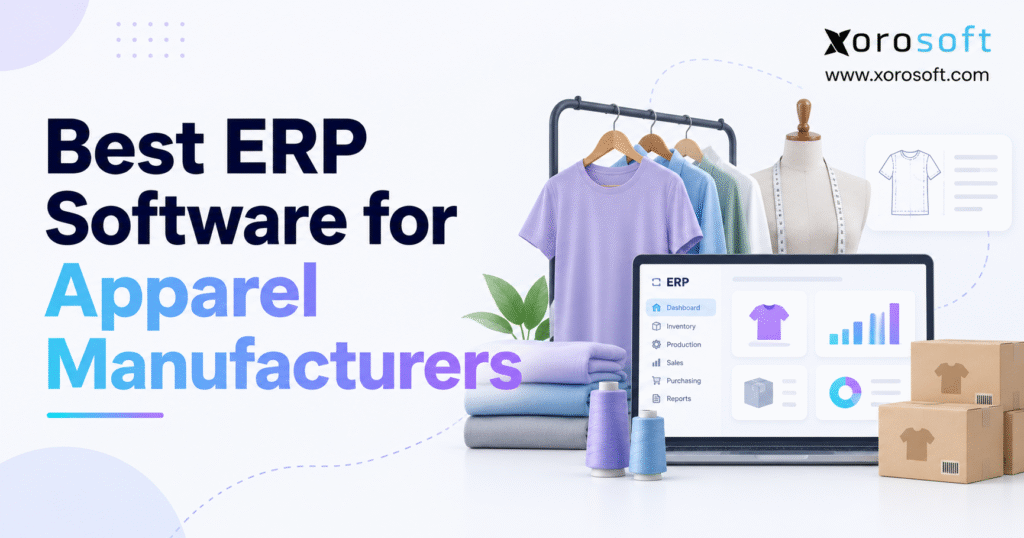
If you’re searching for the best ERP software for apparel manufacturers, this guide will help you explore the top options.
1. Why Apparel Manufacturing Creates Unique ERP Challenges
Apparel manufacturers rarely reach for ERP because they simply need another software application. Instead, the need usually appears when product, inventory, manufacturing, warehouse, sales, and financial information becomes fragmented across too many systems.
A single apparel style can expand rapidly once colors, sizes, fits, fabrics, seasons, regional assortments, packaging options, and sales channels are added. As a result, one product family can create dozens or hundreds of sellable SKUs. Each SKU can have a different demand pattern, inventory position, customer commitment, warehouse location, and production requirement.
1.1 Product Complexity Creates Operational Complexity
As apparel businesses scale, managing products is no longer just an item-master problem.
Purchasing teams must secure fabric, trims, labels, packaging, and other materials at the correct time. Meanwhile, production teams need accurate bills of materials and clear priorities. Warehouse employees need visibility into incoming, allocated, available, and finished inventory.
The same product may also be sold through Shopify, wholesale accounts, marketplaces, or retail partners. Therefore, one inventory decision can affect several customer channels at once.
This complexity explains why basic inventory tools often become difficult to maintain as apparel companies grow.
1.2 Apparel ERP Must Connect Operations With Finance
Finance has a different but closely connected challenge.
Inventory valuation, landed cost, work in process, production costs, cost of goods sold, and inventory adjustments eventually have to reconcile with the general ledger.
Therefore, the problem is not simply knowing how much stock exists. The real challenge is connecting the physical movement of products with the financial value flowing through the business.
When those workflows live in accounting software, spreadsheets, ecommerce platforms, warehouse applications, EDI tools, and purchasing worksheets, employees become responsible for keeping them synchronized. Consequently, reporting slows down, exceptions become harder to identify, and operational decisions are often made using incomplete information.
This is where the best ERP software for apparel manufacturers can create meaningful value. A capable ERP should connect product structure, purchasing, manufacturing, inventory, warehousing, sales channels, and accounting without forcing employees to rebuild the same data repeatedly.
Ultimately, apparel companies should not ask which ERP has the longest feature list. Instead, they should ask which system can accurately represent the way products, inventory, production, and money actually move through their business.
2. What the Best ERP Software for Apparel Manufacturers Must Handle
Apparel operations create product and inventory structures that are unusually demanding for generic business software. Therefore, ERP functionality must extend beyond simple item numbers and basic warehouse quantities.
2.1 Apparel ERP Style, Color, Size, and Variant Management
Consider a garment offered in six sizes and five colors. That single style already represents 30 sellable variants. Add multiple fits, seasonal versions, fabric options, or regional assortments and the SKU count rises quickly.
However, apparel employees do not always want to work at the individual SKU level.
Management may want total demand for an entire style. Purchasing may need consolidated material requirements. Warehouse teams, on the other hand, need precise availability for an individual color and size.
A strong apparel ERP should support both perspectives.
For example, planners may need to see that demand for an entire jacket style is rising while simultaneously identifying that Navy Medium is likely to stock out sooner than other combinations.
This ability to move between parent-style visibility and variant-level control is one of the key differences between apparel-oriented ERP and simpler inventory software.
2.2 Managing Fabrics, Trims, and Components
Finished apparel depends on many raw materials.
These can include fabric, thread, buttons, labels, zippers, elastic, packaging, hangtags, and other components. Moreover, each material may have different suppliers, purchasing terms, lead times, costs, and units of measure.
Fabric, for example, may be purchased in yards while finished garments are produced and sold in units.
Consequently, the ERP needs to translate finished-goods demand into raw-material requirements through bills of materials and production planning.
The best ERP software for apparel manufacturers should help teams understand whether existing materials, incoming purchase orders, and planned production are sufficient to meet future demand.
2.3 Fashion ERP Software for Seasonal Demand
Apparel companies often operate around collections, seasonal launches, promotional campaigns, and retailer delivery windows.
Therefore, timing matters almost as much as quantity.
A shipment arriving several weeks late may still have physical value, but its commercial value can fall dramatically if the selling season is already ending.
As a result, apparel ERP should help teams understand not only what must be purchased or produced, but when those actions must happen.
That includes supplier lead times, production schedules, inbound delivery dates, customer commitments, and warehouse availability.
3. When Apparel Manufacturers Need a Connected ERP
ERP is not automatically the correct solution for every apparel business.
A small company with a narrow product catalog, one warehouse, simple accounting, and mostly outsourced manufacturing may operate effectively with lighter applications.
However, the case for ERP becomes stronger when employees spend increasing amounts of time reconciling operational information between systems.
3.1 When Apparel Inventory Data Lives in Too Many Systems
A common technology stack for a growing apparel company includes accounting software, Shopify, spreadsheets, an inventory application, warehouse software, EDI software, and separate purchasing worksheets.
Each tool may work reasonably well on its own.
The problem appears between them.
For example, ecommerce may show inventory as available while the warehouse system shows the same quantity as allocated. Meanwhile, accounting may not yet contain the latest adjustment.
As a result, employees spend time determining which number is correct before they can answer a customer, create a purchase order, or promise inventory.
The best ERP software for apparel manufacturers should reduce those competing versions of inventory by establishing clearer transactional ownership.
3.2 When Purchasing Outgrows Spreadsheets
Purchasing teams often begin with spreadsheets because they are flexible, familiar, and easy to modify.
Over time, however, planners may need to combine sales history, current inventory, open purchase orders, production demand, forecasts, supplier lead times, minimum order quantities, and existing customer commitments.
The issue is not that spreadsheets cannot perform the calculations.
Instead, somebody must continually collect, copy, update, and reconcile the underlying information before the results can be trusted.
Therefore, ERP becomes more valuable as planning becomes more dynamic and the cost of stale information increases.
3.3 When ERP Accounting Gaps Appear at Month-End
Accounting problems frequently expose operational problems.
Inventory adjustments, delayed receipts, unposted production completions, incorrect landed costs, and disconnected fulfillment transactions can create substantial reconciliation work during month-end.
At that point, adding another accounting feature may not solve the underlying issue.
Instead, the company needs operational transactions to reach finance accurately and consistently.
That is one of the clearest signs that disconnected applications are becoming an operational constraint rather than a convenience.
4. Core Apparel ERP Features for Manufacturing Operations
A long feature list can make an ERP platform appear comprehensive. However, dozens of secondary features cannot compensate for failure in a workflow that is essential to the business.
Therefore, apparel manufacturers should evaluate software around actual transactions rather than feature counts alone.
4.1 Apparel ERP BOM Management
A bill of materials defines what is required to manufacture a finished product.
For apparel, a BOM can include fabric, lining, buttons, thread, labels, zippers, packaging, and other components.
In addition, manufacturers may need BOM revisions, alternate components, effective dates, scrap assumptions, or subcontract processes.
The ERP should connect BOM information directly to purchasing, planning, costing, and production.
Otherwise, the BOM becomes little more than a static reference document.
4.2 Material Requirements Planning for Apparel Manufacturing
Material Requirements Planning converts expected product demand into component requirements.
A useful MRP process considers existing raw materials, incoming purchase orders, finished-goods demand, production schedules, BOM quantities, supplier lead times, and other supply constraints.
As a result, purchasing teams gain a clearer picture of what should be ordered and when.
For companies comparing the best ERP software for apparel manufacturers, MRP deserves detailed testing because planning depth can vary considerably between platforms.
Some systems provide sophisticated recommendations, while others still require planners to perform substantial manual analysis.
4.3 Work Orders and WIP Visibility
Production teams need to know what should be manufactured, which materials are required, what has already been issued, what remains in process, and what has been completed.
However, manufacturing models vary significantly.
A brand outsourcing most production may need strong subcontract and supplier visibility. In contrast, a company performing cutting, sewing, assembly, or finishing internally may require more detailed work-order and WIP tracking.
Therefore, buyers should avoid choosing software simply because a feature list includes “manufacturing.”
Instead, they should test the exact production depth their business requires.
4.4 Managing Quality and Production Exceptions
Manufacturing does not always produce exactly what was planned.
Materials may fail inspection. Production output may be lower than expected. Components may require substitution. Finished products may need rework or may be rejected.
Consequently, ERP should make exceptions visible without destroying the transaction trail.
Teams should be able to understand why planned quantities changed and how those changes affected inventory, cost, and delivery commitments.
5. How Apparel Inventory ERP Improves Stock Visibility
Inventory accuracy is one of the most common reasons apparel companies begin evaluating ERP.
However, knowing physical on-hand inventory is not enough.
Operations teams may need to distinguish between stock that is available, allocated, incoming, in transit, committed to production, work in process, damaged, or held at a third-party facility.
5.1 Apparel ERP Inventory Allocation
Suppose an apparel company physically holds 1,000 units of a popular style.
A wholesale customer has already been allocated 500 units. Ecommerce has 200 open orders. Meanwhile, another 150 units have been reserved for a retailer launch.
Although physical inventory remains 1,000 units, only 150 may actually be available for new demand.
Therefore, allocation is not merely a warehouse issue. It directly influences sales promises and customer service.
The best ERP software for apparel manufacturers should make these inventory states visible instead of treating every physical unit as equally available.
5.2 Handling Multi-Warehouse Complexity
Once inventory is spread across several warehouses, stores, factories, or 3PL facilities, location becomes part of the customer promise.
The business must know not only whether an item exists, but where it is, whether it can be sold, and how quickly it can reach the customer.
Therefore, companies should evaluate receiving, transfers, barcode scanning, picking, packing, replenishment, cycle counting, adjustments, and shipping.
For operations requiring more detailed execution, a dedicated warehouse management system can connect physical warehouse activity with the broader ERP inventory model.
As a result, warehouse transactions become useful immediately to purchasing, sales, customer service, and finance.
6. How to Compare the Best ERP Software for Apparel Manufacturers
The most reliable ERP comparison starts with business requirements rather than vendor presentations.
Vendors naturally demonstrate the workflows where their software performs best. Therefore, buyers need to determine whether those strengths align with the processes creating complexity inside their company.
6.1 Compare Apparel ERP Using Real Transactions
Instead of asking whether a system “supports apparel,” give vendors a realistic operating scenario.
Create a style with multiple colors and sizes. Add a BOM. Generate material requirements. Create purchase orders. Receive materials. Issue them to production. Complete finished goods. Transfer inventory between warehouses. Allocate inventory to a wholesale customer. Process an ecommerce order.
Finally, follow the financial impact.
A vendor that can demonstrate this full sequence provides far stronger evidence than one showing dashboards and isolated menu screens.
6.2 Separate Native ERP Features From Integrations
Integration is not automatically a weakness.
In many cases, specialist applications provide useful capabilities. However, buyers should understand which system owns each process.
Ask whether functionality is native, configurable, partner-delivered, API-driven, or customized.
Then determine who supports the interface if a transaction fails.
Modern ERP integrations can connect ecommerce, marketplaces, EDI, shipping, and other platforms. Nevertheless, the entire transaction path still needs to be tested.
6.3 Test Operational Exceptions, Not Just Happy Paths
ERP demonstrations usually show successful transactions.
Real businesses operate with exceptions.
A supplier may ship fewer units than expected. A retailer may modify an order. A Shopify order may be cancelled after allocation. Fabric costs may change. Production may yield fewer units than planned.
Consequently, the best ERP software for apparel manufacturers should make these exceptions easy to identify and manage rather than hiding them behind automation.
7. Apparel ERP vs MRP, PLM, WMS, and Inventory Software
Apparel technology terminology can become confusing because different systems overlap.
Nevertheless, each category solves a different core problem.
7.1 Apparel ERP vs MRP
MRP primarily calculates material and production requirements.
ERP covers a wider operating environment by connecting planning with purchasing, inventory, sales, warehouse operations, accounting, and reporting.
Therefore, many manufacturers use MRP capability as part of the broader ERP environment rather than treating it as an entirely separate system.
7.2 Apparel ERP vs PLM
Product Lifecycle Management focuses mainly on product development.
Design and merchandising teams may use PLM for specifications, tech packs, materials, samples, approvals, and product-development workflows.
ERP generally becomes more important once an approved product becomes an operational transaction involving purchasing, manufacturing, inventory, fulfillment, and finance.
Consequently, PLM and ERP often complement one another rather than compete directly.
7.3 ERP vs Inventory Management Software
Inventory management software solves a narrower problem around stock quantities, locations, receipts, transfers, and order synchronization.
It can work well when the business mainly needs inventory control.
However, ERP becomes more relevant when inventory decisions depend heavily on purchasing, accounting, manufacturing, forecasting, warehouses, and multiple sales channels.
A broader cloud ERP platform can connect these functions instead of treating inventory as a standalone application.
8. Apparel ERP for Shopify, Amazon, Wholesale, and EDI
Apparel businesses increasingly sell through several channels at the same time.
Consequently, different customer groups may compete for the same inventory.
This creates one of the most important requirements for the best ERP software for apparel manufacturers: a reliable inventory and order model across every channel.
8.1 Shopify Apparel ERP and Ecommerce Operations
Shopify may be the commercial storefront, but it should not have to become the purchasing, manufacturing, warehouse, and accounting system.
Instead, ERP can sit behind ecommerce and determine how orders affect availability, allocation, fulfillment, replenishment, and finance.
Businesses evaluating this model can review the Xorosoft ERP listing on the Shopify App Store as one example of Shopify-to-ERP connectivity.
However, importing orders is only part of the requirement.
Returns, cancellations, discounts, fulfillment updates, taxes, payments, and inventory adjustments also need clear system ownership.
8.2 Wholesale and EDI Requirements
Wholesale creates a different set of operating rules.
Retailers may require contract pricing, pack configurations, EDI documents, ASNs, labels, routing instructions, and narrow delivery windows.
Therefore, the ERP should prevent wholesale requirements from creating an entirely separate order and inventory environment.
Ideally, retailer transactions should affect the same available inventory and financial records used by other channels.
8.3 Amazon and Marketplace Operations
Marketplace operations add additional complexity around inventory synchronization, fulfillment, fees, returns, and settlement reconciliation.
A company selling through Shopify, Amazon, wholesale, and retail accounts needs one reliable answer to a simple question:
How much inventory can we safely promise right now?
That answer should not require employees to export and reconcile several different inventory reports.
9. How Apparel Manufacturing ERP Connects Costing and Finance
Costing is sometimes treated as an accounting issue.
In reality, apparel manufacturing cost begins much earlier in the operating process.
Material prices, freight, duties, subcontract services, packaging, wastage, labor, and production variances can all influence finished-product margin.
9.1 Apparel ERP Costing Beyond Standard Cost
Standard cost can be useful for planning and consistency.
However, actual material and logistics costs can change significantly.
If the ERP cannot explain these differences, margin analysis becomes less reliable.
Therefore, manufacturers should understand how purchasing and production transactions eventually influence inventory valuation and cost of goods sold.
9.2 Landed Cost in Global Apparel Supply Chains
Apparel businesses frequently buy materials or finished goods internationally.
The supplier invoice may represent only part of the true cost.
Freight, duties, brokerage, insurance, port charges, and other expenses can materially increase landed cost.
Consequently, companies comparing the best ERP software for apparel manufacturers should determine how these costs are allocated across inventory.
Finance should also be able to trace those calculations when margins change.
9.3 Connecting Margin Visibility With Operations
Waiting until month-end to discover that a product has poor margins is too late.
Ideally, the ERP should help teams understand expected material, purchasing, manufacturing, and landed costs before large commitments are made.
As a result, purchasing and operations can contribute to margin management rather than leaving profitability analysis solely to finance.
10. Best ERP Software for Apparel Manufacturers: Leading Options
There is no universal first-place ERP for every apparel manufacturer.
The right shortlist depends on manufacturing depth, company size, product structure, warehouse requirements, channels, integrations, and internal resources.
Therefore, these platforms should be considered different operating approaches rather than a rigid ranking.
10.1 Xorosoft for Inventory-Driven Apparel Operations
Xorosoft is designed for inventory-driven businesses that need inventory, purchasing, accounting, warehouse management, manufacturing, forecasting, ecommerce, and wholesale operations connected.
For apparel companies, that approach becomes relevant when growth has created a disconnected stack of spreadsheets, accounting software, inventory applications, warehouse tools, ecommerce systems, and EDI platforms.
The broader XoroONE platform is therefore worth evaluating when the objective is to consolidate operational workflows into a shared environment.
However, buyers should still test their own style structures, manufacturing requirements, costing rules, reports, integrations, and migration needs before deciding whether the platform fits.
10.2 NetSuite for Apparel Businesses
NetSuite is frequently evaluated by organizations looking for a broad cloud ERP platform with financial, inventory, order-management, warehouse, and manufacturing capabilities.
It can therefore be relevant for established apparel businesses seeking a wider enterprise system.
However, prospective buyers should also evaluate implementation scope, configuration requirements, integrations, customization, internal resources, and long-term ownership costs.
Companies specifically evaluating these two approaches can review this Xorosoft vs NetSuite comparison as one input into a broader evaluation.
10.3 Acumatica ERP for Apparel Manufacturers
Acumatica serves manufacturing, distribution, retail, and other inventory-driven businesses.
It may therefore be relevant for apparel manufacturers that need financial management, manufacturing, distribution, warehouse, and commerce functionality within a cloud ERP.
Nevertheless, businesses should confirm how apparel-specific variants, manufacturing workflows, EDI, integrations, and reporting would be configured for their operation.
10.4 Infor CloudSuite Fashion
Infor takes a more fashion-focused enterprise approach.
Its positioning can make it relevant for larger apparel, footwear, textile, and fashion organizations that need broad enterprise functionality combined with industry-specific processes.
Therefore, prospective buyers should evaluate both functional depth and the resources required to implement and administer the system.
10.5 Aptean Apparel ERP
Aptean provides apparel-focused ERP solutions designed around fashion and apparel operations.
Industry specialization can be valuable for businesses prioritizing sourcing, inventory, production, distribution, and financial workflows designed with apparel requirements in mind.
However, industry positioning should never replace detailed workflow testing.
10.6 BlueCherry Fashion ERP
BlueCherry is another platform oriented toward apparel and fashion companies.
It may be relevant for organizations seeking fashion-oriented product structures, supply-chain visibility, production capabilities, and related operational workflows.
Again, the selection should depend on how well the system matches the individual company’s sourcing, manufacturing, warehouse, finance, and channel requirements.
10.7 WFX Apparel Manufacturing ERP
WFX is strongly associated with fashion product development and apparel manufacturing workflows.
Therefore, it may appeal to companies requiring detailed material planning, production orders, factory visibility, and manufacturing process control.
Factories with deeper production requirements should compare this kind of specialization against broader ERP platforms.
10.8 AIMS360 Apparel ERP
AIMS360 focuses on fashion and apparel operations.
It may be relevant where style-based inventory, wholesale, production, ecommerce, EDI, and related apparel workflows are central requirements.
As with the other platforms, buyers should evaluate it using their own transactions rather than relying only on product positioning.
11. A Practical Apparel ERP Vendor Comparison Framework
The best ERP software for apparel manufacturers should not be selected using an arbitrary score created by a software publisher or review article.
Instead, manufacturers should build their own evaluation framework based on operational risk.
| Evaluation Area | What to Verify |
|---|---|
| Style management | Style, color, size, season, matrix handling |
| BOM and MRP | Components, revisions, demand, material planning |
| Production | Work orders, WIP, subcontracting, completions |
| Inventory | On-hand, available, allocated, incoming, committed |
| Warehousing | Receiving, scanning, transfers, picking, counting |
| Purchasing | Supplier data, lead times, replenishment, planning |
| Costing | Material, landed, production, variance handling |
| Ecommerce | Orders, inventory, returns, fulfillment |
| Wholesale | Pricing, allocations, customer requirements |
| EDI | Orders, ASNs, invoices, retailer requirements |
| Accounting | Inventory valuation, COGS, AP, AR, reconciliation |
| Reporting | Operational and financial visibility |
| Integrations | APIs, connectors, ownership, error handling |
| Implementation | Migration, training, configuration, support |
A manufacturer outsourcing nearly all production may place greater weight on purchasing, supplier management, warehouse operations, and channel integrations.
A vertically integrated manufacturer may place significantly greater weight on production planning and WIP.
Therefore, the weighting should reflect the operating model rather than a generic feature checklist.
12. Managing Multi-Warehouse Inventory for Apparel Businesses
Multi-location growth frequently exposes weaknesses in disconnected software.
Inventory may be distributed across factories, distribution centers, stores, overflow facilities, and 3PL partners.
As a result, the company needs more than a total quantity.
12.1 Available Inventory vs Physical Inventory
Suppose a warehouse physically contains 2,000 units of a style.
Some may already be allocated to wholesale orders. Others may be reserved for ecommerce. Another portion may be waiting for quality inspection.
Although the building physically contains 2,000 units, the sellable quantity may be considerably lower.
ERP should therefore distinguish physical inventory from inventory that can actually be promised.
This distinction improves decision-making across sales, customer service, ecommerce, purchasing, and replenishment.
12.2 Warehouse Transfers and Inventory in Transit
Transfers can also create inventory discrepancies.
When products leave Warehouse A, they should not automatically become available at Warehouse B before receiving is complete.
Therefore, businesses need visibility into inventory in transit, shortages, overages, receiving exceptions, and damage.
Without that discipline, employees may rely on manual adjustments to repair inventory after the fact.
Those adjustments eventually create accounting and reporting problems as well.
13. Apparel ERP Forecasting and Purchasing With Shared Data
Forecasting becomes valuable only when purchasing teams can act on the information.
An apparel forecast may consider sales history, seasonality, promotions, upcoming launches, wholesale commitments, ecommerce demand, existing inventory, incoming supply, supplier lead times, and manufacturing requirements.
However, if forecasting occurs in one application while purchasing occurs in another, planners often become responsible for transferring and reconciling the information manually.
13.1 Apparel ERP Forecasting Should Support Planner Judgment
No forecasting model can anticipate every commercial event.
A retailer may suddenly increase demand. A marketing campaign may outperform expectations. A supplier may announce a delay. A style may perform differently from its historical pattern.
Therefore, planning software should support professional judgment rather than attempting to eliminate it.
Automated recommendations are most useful when planners can understand the assumptions and override them when operating conditions change.
13.2 Why Supplier Master Data Matters
Planning quality depends heavily on supplier data.
Lead times, minimum order quantities, pack sizes, purchasing costs, order calendars, and supplier performance can all influence purchasing recommendations.
Consequently, inaccurate supplier records can undermine even sophisticated planning functionality.
Before evaluating advanced forecasting, companies should determine whether the underlying supplier data is reliable enough to support it.
14. Preparing for an Apparel ERP Implementation
ERP implementation begins before users ever log in to the new system.
A strong platform cannot compensate for poorly structured product, supplier, warehouse, and financial information.
Therefore, preparation should begin with the data that drives operational decisions.
14.1 Clean Apparel Product Data Before Migration
Duplicate SKUs, inconsistent descriptions, inactive colors, invalid units of measure, and unclear product hierarchies should be addressed before migration.
Apparel companies should also agree on how styles, colors, sizes, collections, seasons, and other attributes will be represented.
Changing these structures after go-live can create substantial rework.
14.2 Validate BOMs and Production Rules
Incorrect BOM quantities create incorrect planning and unreliable production costs.
Therefore, manufacturing teams should validate active components, quantities, substitutes, scrap assumptions, and production rules before implementation.
Old or duplicate BOM versions should also be reviewed.
14.3 Map ERP Integrations Before Go-Live
Shopify, marketplaces, EDI, shipping, payments, 3PLs, and other applications should have clear system ownership.
Teams need to know which application owns each data element, where information moves, how frequently it synchronizes, and what happens when an interface fails.
Businesses comparing implementation models can review different ERP solutions while deciding which processes should remain inside the ERP and which should stay in specialist systems.
15. How to Run an Effective ERP Demonstration
A polished demonstration can make almost any ERP appear capable.
Therefore, buyers should control part of the agenda.
Provide vendors with realistic scenarios before the session.
Start with a representative style containing multiple colors and sizes. Add a BOM. Generate material demand. Create purchasing activity. Receive components. Start production. Complete finished goods. Allocate inventory. Fulfill an ecommerce or wholesale order.
Finally, show the corresponding inventory and accounting transactions.
This approach reveals how much manual work is hidden between modules.
15.1 Ask ERP Vendors What Is Not Native
One of the most useful questions in an ERP evaluation is simple:
“What part of this workflow requires another application?”
There is nothing inherently wrong with integration.
However, the answer affects implementation scope, support responsibilities, cost, and future maintenance.
Similarly, ask which requirements need custom development rather than standard configuration.
15.2 Use Relevant Apparel ERP Customer References
Customer references are most useful when the operating model is similar.
A vertically integrated apparel manufacturer has different requirements from a brand that purchases finished goods.
Likewise, a wholesale-heavy company operates differently from a DTC-first company.
Reviewing relevant ERP case studies can help buyers develop better questions. However, recognizable customer logos alone do not prove that a platform fits another company’s processes.
16. Common Apparel ERP Selection Mistakes to Avoid
Even the best ERP software for apparel manufacturers can deliver disappointing results if the selection process focuses on the wrong criteria.
16.1 Choosing Apparel ERP Features Instead of Workflow Fit
Feature lists are useful for initial screening.
However, they do not demonstrate whether a workflow is efficient.
A platform may technically include manufacturing while supporting only relatively simple production processes.
Likewise, an ERP may claim Shopify connectivity without clearly explaining how cancellations, refunds, returns, inventory updates, fulfillment, and accounting behave.
Therefore, companies should test transactions rather than rely on checkboxes.
16.2 Underestimating ERP Data Migration
ERP projects often treat migration as a technical workstream.
In reality, data quality is a business responsibility.
Product structures, BOMs, inventory balances, suppliers, customers, open orders, and financial balances all require ownership and validation.
Poor migration decisions can create problems that users later attribute to the new ERP itself.
16.3 Customizing the ERP Too Early
Companies frequently attempt to reproduce every legacy process inside the replacement system.
However, some old processes exist only because the previous software imposed constraints.
Therefore, before approving customization, determine whether the existing process creates genuine business value.
In some cases, standardizing the process provides more value than recreating it.
16.4 Ignoring User Adoption
A technically capable ERP can still fail if employees find it difficult to use.
Warehouse, purchasing, manufacturing, finance, sales, and customer-service teams should therefore participate in testing.
Their feedback often identifies practical problems that executive-level demonstrations miss.
17. How to Shortlist ERP for Apparel Manufacturers
A practical shortlist usually contains three to five realistic vendors rather than every ERP on the market.
Begin by identifying which processes must work correctly on day one.
For many apparel manufacturers, those requirements include style matrices, BOMs, material planning, production, purchasing, multi-warehouse inventory, wholesale allocation, Shopify, EDI, WMS, and accounting.
Then divide requirements into essential, important, and optional categories.
Optional functionality should never compensate for failure in an essential process.
Companies can also review ERP vendors by the industries they support before investing time in detailed product demonstrations.
17.1 Compare Total ERP Operating Cost
Subscription fees are only one component of ERP cost.
Implementation, migration, integrations, training, support, customization, internal project resources, and third-party applications also matter.
Therefore, compare the complete operating model rather than license prices alone.
A cheaper system can become more expensive if it requires multiple additional applications or extensive manual work.
Conversely, a broader ERP can be unnecessarily complex for a simpler organization.
17.2 Evaluate the Implementation Team
Software capability matters, but implementation quality matters just as much.
Ask who will configure the ERP, migrate information, build integrations, train employees, test transactions, and support go-live.
Also clarify what responsibilities remain with the internal team.
Clear ownership is more useful than an unrealistic implementation timeline.
17.3 Plan for the Future Operating Model
ERP should support the next foreseeable level of complexity, not only today’s organization.
Consider whether the company expects additional warehouses, brands, production facilities, retailers, marketplaces, international operations, or ecommerce channels.
However, avoid buying complexity purely for hypothetical future requirements.
The goal is to select the best ERP software for apparel manufacturers based on realistic growth rather than unlimited theoretical scalability.
18. Choosing the Right ERP for Long-Term Apparel Growth
The best ERP software for apparel manufacturers is not automatically the product with the longest feature list, the biggest brand name, or the most polished demonstration.
Instead, it is the platform that can reliably follow inventory and financial value through the complete operating model.
That flow begins with styles, colors, sizes, BOMs, materials, suppliers, and purchasing. It continues through production, work in process, finished goods, warehouses, allocations, ecommerce, wholesale, EDI, fulfillment, and accounting.
Therefore, before making a decision, map that complete chain.
Identify where employees currently re-enter data, reconcile spreadsheets, wait for updates, or make decisions using incomplete inventory information. Those friction points should become the scenarios every ERP vendor is required to demonstrate.
The right system should reduce those gaps without creating unnecessary complexity somewhere else.
For an inventory-driven apparel manufacturer evaluating Xorosoft, bring representative product data, a real BOM, a purchasing scenario, production requirements, warehouse workflows, and examples from actual sales channels into the evaluation.
That approach provides a much clearer test than a generic software presentation.
If those workflows reflect the operational challenges your business is trying to solve, you can contact Xorosoft for a personalized ERP evaluation and review how those processes would operate inside a connected system.
Frequently Asked Questions
What is the best ERP software for apparel manufacturers?
The best system depends on manufacturing depth, inventory complexity, channels, warehouse needs, integrations, and accounting requirements. Compare vendors using real apparel workflows rather than feature lists alone.
What features should apparel ERP software include?
Look for style-color-size management, BOMs, MRP, production planning, purchasing, multi-warehouse inventory, WMS, costing, accounting, forecasting, ecommerce, wholesale, EDI, and reporting.
How does apparel ERP manage style, color, and size variants?
Apparel ERP typically uses matrix-style product structures that connect a parent style with individual color and size SKUs, improving ordering, allocation, replenishment, and inventory visibility.
Can apparel ERP integrate with Shopify and marketplaces?
Yes. Many modern ERP platforms connect with Shopify, Amazon, wholesale, and EDI channels to synchronize orders, inventory, fulfillment, returns, payments, and accounting data.
When should an apparel manufacturer move from QuickBooks to ERP?
ERP becomes worth considering when spreadsheets, disconnected inventory systems, multi-warehouse operations, production planning, EDI, or month-end reconciliation create repeated manual work and visibility gaps.
How does ERP help with apparel production and inventory planning?
ERP connects demand, BOMs, raw materials, purchasing, work orders, WIP, finished goods, and available inventory so planners can make decisions from shared operational data.
How should apparel manufacturers compare ERP vendors?
Use the same demo script for every vendor. Test style matrices, BOMs, production, purchasing, warehouse operations, integrations, accounting, exceptions, implementation requirements, and total operating cost.
Recent Posts
-
 Inventory Checking Statistics: Which Count Variance, Recount Rate, and Bin-Level Error Metrics Should Warehouses Track?
 -
 Best ERP Software for Apparel Manufacturers
 -
 How to Reconcile 3PL Billing: From Warehouse Events to Customer Invoice
 -
 NetSuite Alternatives for Shopify Businesses
 -
 Shopify B2B Inventory Control: Preventing the Same Stock From Being Promised Twice