Mobile cycle counting is transforming inventory management for many businesses by increasing accuracy and efficiency.
1. The Error Pattern Was Already Forming Before Close
For example, mobile cycle counting can reveal a warehouse problem days or weeks before month-end turns it into an accounting problem. Instead of waiting for a broad physical count, teams can verify selected bins during normal operations. As a result, they can see whether a discrepancy is isolated or whether the same location keeps drifting away from the system quantity.
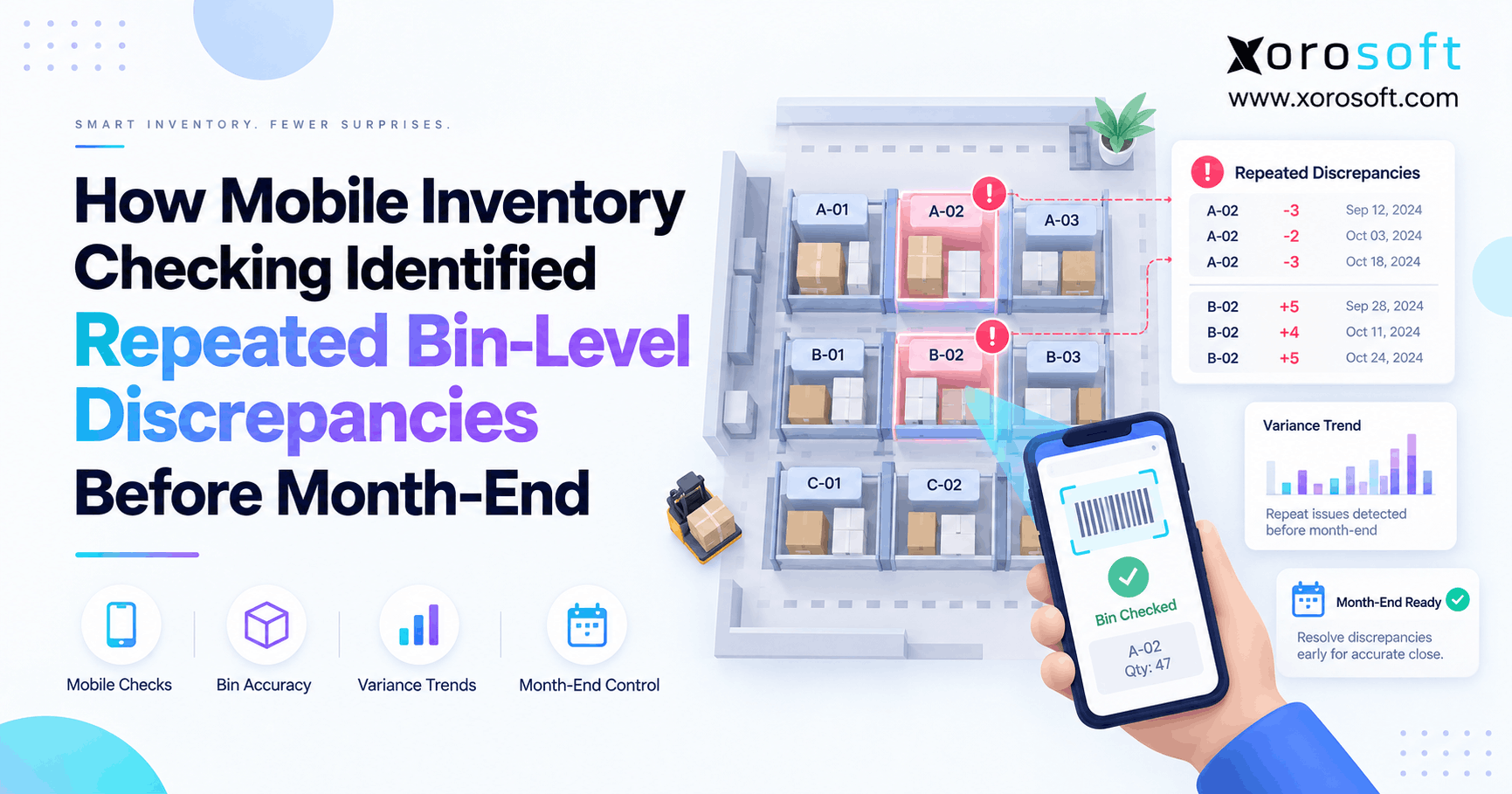
For example, imagine that a pick bin should contain 28 units, but a mobile count finds 25. Next, the team confirms the shortage and corrects it. However, another check later finds the same bin short again. Therefore, the issue is no longer just a three-unit variance. Instead, it is a recurring signal that the underlying process deserves investigation.
1.1 Mobile Cycle Counting Turns One Variance Into a Pattern
For example, a single discrepancy may come from a counting mistake, an unposted movement, damaged stock, or another one-off event. However, repeated variances are different because they create evidence over time. Therefore, if the same bin repeatedly shows shortages, the location itself becomes part of the root-cause analysis.
Moreover, a mobile record can preserve the warehouse, bin, item, user, and timestamp for each count. Consequently, managers can compare the variance against receiving, putaway, replenishment, picking, transfer, and return activity. As a result, that makes mobile cycle counting more useful than simply correcting an on-hand balance.
1.2 The Goal Is Earlier Investigation, Not More Adjustments
However, cycle counting should not become a faster way to post inventory adjustments. Instead, it should help the business understand why physical stock stopped matching system stock.
Therefore, a strong process separates counting from correction. First, the employee verifies the quantity. Next, the team investigates recent activity. Then, if the physical quantity is confirmed, an authorized user approves the adjustment. As a result, the business fixes both the record and, where possible, the process that caused the record to fail.
2. What Mobile Cycle Counting Actually Checks
Specifically, mobile cycle counting is a structured method for verifying selected physical inventory with a handheld scanner, mobile computer, or similar device while normal warehouse activity continues. Instead of counting every SKU at once, the business checks defined items, locations, or risk groups on a recurring schedule.
For example, Microsoft’s Warehouse Management cycle-counting guidance describes cycle counting as an audit of on-hand inventory and supports mobile-device workflows for directed and spot counts. Therefore, the important idea is not the device alone. Instead, the real value comes from linking the physical count to a controlled warehouse location and a review process.
2.1 Mobile Cycle Counting Must Verify Location as Well as Quantity
For example, a company can have the correct total quantity of an SKU and still have inaccurate warehouse inventory. The system may show 20 units in Bin A and 30 in Bin B, while the physical warehouse holds 25 in each.
Although the total remains 50, the location records are wrong. Consequently, a picker sent to the expected bin may not find enough stock. For this reason, mobile cycle counting should verify both where inventory is located and how much is physically present.
2.2 Blind Counts and Recounts Strengthen the Check
Similarly, in a blind count, the employee does not see the expected system quantity before entering the physical count. Therefore, the worker is less likely to stop when a visible number appears to match expectations.
However, blind counting alone does not guarantee accuracy. The warehouse still needs clear bin labels, correct item masters, consistent units of measure, and sensible recount rules. When a variance appears, a second count can confirm whether the discrepancy is real before the investigation continues.
3. Why Bin-Level Inventory Discrepancies Keep Reappearing
In addition, repeated bin discrepancies usually start somewhere in the movement process rather than in the count itself. Therefore, warehouse teams should look beyond the final variance and trace the activities that changed the bin.
For example, a picker can remove stock from the neighboring location, a replenishment task can be completed physically but not in the system, or returned inventory can be placed into an active bin before its status is updated. Consequently, each mistake changes the relationship between physical stock and system stock.
3.1 Mobile Inventory Checking Exposes Putaway, Picking, and Replenishment Errors
Incorrect putaway can create the first location mismatch. For example, if 12 units are received correctly but four are placed in the wrong bin, the company still owns all 12. However, the expected location becomes inaccurate immediately.
Similarly, wrong-bin picking can create two errors at once. The intended bin appears artificially high, while the bin actually used becomes short. Meanwhile, an incomplete replenishment transaction can move the same problem from reserve storage into a forward pick face. Therefore, repeated location counts help identify where the pattern begins.
3.2 Transfers, Returns, and Units of Measure Can Create Persistent Variances
Moreover, internal transfers are another common risk. For example, teams may move stock to create space, consolidate pallets, or respond to an urgent order. However, if the physical move is not matched by a system transaction, both the source and destination can become inaccurate.
Likewise, returns may create false availability if damaged or uninspected stock enters sellable inventory too early. In addition, unit-of-measure errors can repeat indefinitely. For example, recording one case as one unit instead of 12 pieces can create a recurring difference until the conversion setup is corrected.
4. Why Mobile Inventory Checking Works Better Than Waiting for Month-End
However, month-end reconciliation can show that recorded inventory differs from physical inventory. Yet it may not show when the difference started. Consequently, as time passes, more warehouse activity accumulates between the original error and the investigation.
Therefore, earlier checks reduce the amount of history a manager must reconstruct. For example, if a variance appeared yesterday, the team may only need to review a handful of receipts, picks, transfers, or replenishments. By contrast, a discrepancy discovered several weeks later may sit behind dozens of transactions.
4.1 Mobile Cycle Counting Shortens the Gap Between Error and Investigation
Therefore, the shorter the gap, the easier it becomes to identify the likely cause. Consequently, targeted daily or weekly counts can turn inventory control into a continuous feedback loop rather than a month-end repair process.
Moreover, earlier investigation protects context. For example, supervisors can still speak with the employees involved, inspect nearby bins, review recent movements, and compare timing. Therefore, mobile cycle counting improves the chance of finding a process failure before everyone has forgotten how the inventory moved.
4.2 Location Scans Add Context to Every Inventory Check
First, a good mobile workflow starts by identifying the physical location. Then, the employee identifies the item and enters the counted quantity.
For example, GS1 guidance on identifying physical locations explains how Global Location Numbers can identify physical locations. Although every warehouse does not need the same labeling model, the principle is useful: a scan can confirm where the worker is before quantity data enters the system.
As a result, the count becomes tied to a specific warehouse context instead of a handwritten quantity that must be interpreted later.
5. A Practical Mobile Cycle Counting Workflow
Therefore, a reliable mobile cycle counting process should be simple enough for warehouse staff to follow consistently. However, it should also preserve enough information for supervisors to investigate exceptions.
Therefore, the workflow should connect the count to a warehouse, location, item, user, time, expected quantity, physical quantity, and variance status. In addition, depending on the operation, it may include lot, serial number, license plate, inventory status, or unit of measure.
5.1 Mobile Cycle Counting Should Follow Scan, Count, Compare, and Recount
First, assign or select the location to count. Next, scan or confirm the bin. Then, scan the SKU and record the physical quantity.
Afterward, compare the physical quantity with the system record. Then, if the figures differ, require a recount or move the difference into review according to the company’s tolerance rules. Microsoft, for example, documents mobile cycle-count workflows in which differences can move to pending review rather than being accepted automatically.
Consequently, the process creates a control point before inventory is changed.
5.2 Investigate the Difference Before Posting the Adjustment
Next, once the count is confirmed, review the most relevant transaction history. Specifically, check receipts, putaway, picks, transfers, replenishments, returns, and prior adjustments.
Next, ask whether another location contains an offsetting quantity. For example, if Bin B-12 is short by four units while B-13 is over by four, the likely problem may be a missed transfer or wrong-bin activity rather than shrinkage.
Finally, record the likely reason before the adjustment is approved. Therefore, the business keeps a usable history of both the variance and the investigation.
6. What Recurring Variances Tell Operations Teams
Moreover, a variance log becomes much more valuable when it is treated as operational data. Instead of asking only, “How many units were adjusted?” managers can ask where, when, and why the discrepancies keep appearing.
Therefore, recurring variances should be analyzed across several dimensions. For example, useful fields include bin, SKU, warehouse zone, transaction type, user, shift, unit of measure, and variance reason. As a result, patterns can emerge that are invisible in a company-wide inventory accuracy percentage.
6.1 Mobile Cycle Counting Data Can Point to the Root Cause
Suppose one SKU is inaccurate across many bins. In that case, the issue may involve the item master, packaging, or unit conversion. However, if many SKUs are inaccurate in one location, the problem may be the bin, labeling, picking path, or replenishment method.
Similarly, if discrepancies appear immediately after receiving, the investigation should begin upstream. Therefore, mobile cycle counting works best when the business does not treat every variance as the same type of error.
6.2 Separate Location Problems From Item Problems Before Changing the Process
A useful investigation asks whether the error follows the location or the item. If many SKUs fail in the same bin, the location may have confusing labels, poor slotting, frequent unrecorded movements, or a picking-path problem.
However, if one SKU is inaccurate across several locations, the root cause may sit elsewhere. For example, the item could have a packaging conversion problem, an incorrect barcode association, or inconsistent receiving behavior.
Therefore, classify recurring variances before deciding on corrective action. A location problem may require relabeling or workflow changes, while an item problem may require master-data or unit-of-measure corrections.
7. Mobile Cycle Counting vs Paper Count Sheets
Paper count sheets can still work in a small, disciplined operation. However, they introduce more handoffs. An employee records the quantity, someone collects the sheet, another person may enter the number, and a supervisor later reviews the difference.
Consequently, the time between physical verification and system correction can increase. In addition, transcription introduces another opportunity for error. Mobile cycle counting reduces those handoffs by capturing the result where the count occurs.
7.1 Mobile Cycle Counting Creates a Faster Audit Trail
A digital workflow can record who counted, where the count occurred, when it happened, and whether a recount or review followed. Therefore, managers can investigate the sequence without relying entirely on handwritten notes.
In contrast, paper can become difficult to aggregate across many locations. A warehouse may still count accurately, but discovering that Bin C-04 has failed six recent counts requires manual analysis.
Consequently, mobile history becomes increasingly useful as SKU volume, warehouse count, employee count, and transaction volume grow.
8. Which Bins Should Be Counted More Often?
Not every location creates the same risk. Therefore, counting every bin at the same frequency may waste effort on stable inventory while under-checking high-risk areas.
Instead, businesses can combine item value with operational behavior. Fast-moving pick faces, high-value products, long-lead-time items, critical manufacturing materials, returns zones, and locations with repeated variances may deserve more frequent checks.
8.1 Risk-Based Mobile Cycle Counting Uses History to Set Priorities
Traditional ABC counting often increases frequency for higher-value inventory. However, value alone can miss operational risk.
For example, a low-cost component can still stop production, while an inexpensive ecommerce SKU can generate customer-service problems if the system repeatedly promises stock that cannot be found.
Therefore, a stronger mobile cycle counting plan can combine value, velocity, discrepancy history, lead time, replenishment frequency, and business criticality. As a result, the warehouse spends counting time where an error would create the greatest consequence.
8.2 Mobile Cycle Counting Can Use Events as Well as Fixed Schedules
A calendar-based plan is useful, but operational events can also trigger counts. For example, a supervisor may request a spot count after a short pick, an unusual replenishment, a return discrepancy, or a large manual adjustment.
Therefore, the business does not always need to wait for the next scheduled count. Event-driven checks can verify a location immediately after something unusual occurs.
Moreover, repeated event-triggered counts create useful history. If the same type of warehouse event repeatedly leads to a discrepancy, managers can focus corrective work on that process. Consequently, the cycle-count program becomes responsive to real operational risk rather than following a fixed calendar alone.
9. How Mobile Cycle Counting Supports Inventory Accuracy
Mobile cycle counting does not create accuracy by itself. Instead, it strengthens the feedback loop between warehouse execution and system records.
ASCM’s warehouse inventory accuracy guidance describes regular checks and cycle counting as ways to continually validate inventory records. Therefore, the operational goal should be ongoing verification and correction, not simply a high headline accuracy percentage.
Moreover, recurring counts help managers determine whether a corrective action actually worked. If a bin continues to fail after relabeling or retraining, the business knows that the original root-cause assumption was incomplete.
9.1 Mobile Cycle Counting Improves Downstream Decisions When Records Improve
Purchasing teams use on-hand and available inventory when deciding what to reorder. Similarly, ecommerce channels depend on inventory balances when determining what can be sold.
Therefore, warehouse accuracy affects more than picking. Better records can improve replenishment decisions, order allocation, customer commitments, and inventory reconciliation.
For inventory-driven companies, Xorosoft connects inventory with purchasing, warehousing, fulfillment, manufacturing, and accounting within XoroONE. Consequently, cycle-count corrections can sit inside a broader operational data model rather than remaining isolated in a warehouse-only tool.
9.2 Better Warehouse Records Also Reduce Finance Rework
Inventory discrepancies eventually affect more than warehouse reporting. When physical quantities differ from system quantities, finance may need to review valuation changes, write-offs, or adjustment activity during close.
Therefore, earlier investigation can reduce the number of unexplained differences reaching month-end. It does not remove financial controls, but it gives accounting teams better context for the adjustments that remain.
In addition, recurring root-cause data helps operations and finance discuss the same problem using the same evidence. Instead of debating whether a variance came from timing, loss, or process error, both teams can review the count history and supporting warehouse transactions. As a result, reconciliation becomes more focused.
10. When a WMS Becomes Relevant to Mobile Inventory Checking
A standalone counting app may be enough for a small business with one warehouse, a limited catalog, and straightforward inventory movements. Therefore, adopting a full WMS or ERP solely to perform counts may add unnecessary complexity.
However, requirements change as the operation grows. Multiple warehouses, thousands of SKUs, high order volume, frequent replenishment, ecommerce channels, manufacturing, and accounting dependencies create more transaction relationships that need to remain synchronized.
10.1 Mobile Inventory Checking Needs More System Context as Complexity Grows
A WMS becomes more valuable when the business needs directed receiving, putaway, bin control, replenishment, picking, packing, transfers, and cycle counts in the same operating environment.
Likewise, ERP becomes more relevant when inventory movements also need to connect with purchasing, sales orders, accounting, forecasting, and manufacturing. Xorosoft’s broader ERP and operations solutions are designed around that connected model, while XoroWMS supports warehouse execution.
Therefore, the upgrade decision should follow process complexity rather than company size alone.
10.2 Not Every Business Needs a Full ERP Upgrade
A growing business should not buy more software than its process requires. If one warehouse can maintain accurate records with a focused inventory system, strong barcode procedures, and simple accounting integration, a standalone tool may remain appropriate.
However, the case for a broader platform becomes stronger when teams repeatedly export data, reconcile applications, or maintain different versions of inventory truth. Therefore, the upgrade trigger is usually operational friction rather than revenue alone.
A practical evaluation should ask whether the current stack can trace movements, control adjustments, manage multiple locations, support approvals, and keep purchasing and accounting aligned.
11. Connecting Mobile Cycle Counting With ERP and WMS
Once warehouse teams rely on multiple applications, the count itself may be accurate while reconciliation remains slow. For example, a WMS may hold one adjustment, an inventory app another quantity, and accounting may receive the final number later.
Therefore, the stronger architecture is not simply “mobile.” It is connected. A count should update the inventory record that downstream teams already use, while the audit history should remain available for review.
11.1 Xorosoft Places Mobile Cycle Counting Inside Warehouse Operations
Xorosoft’s current XoroWMS documentation includes cycle counts by batch, location, and count ID, while XoroERP supports the broader ERP environment. Therefore, teams can treat cycle counting as part of warehouse control rather than as a separate spreadsheet exercise.
Moreover, Xorosoft’s connected environment can help teams investigate what happened before the variance. Receiving, putaway, picking, transfers, and other inventory movements provide the context needed to understand whether a count difference reflects loss, transaction timing, or an execution error.
11.2 Ecommerce and Multi-Channel Operations Raise the Cost of Bad Bin Data
For ecommerce brands, inaccurate warehouse stock can become inaccurate channel availability. Consequently, a bin problem can turn into overselling, delayed fulfillment, substitutions, or customer-service work.
Xorosoft also provides ecommerce and marketplace integrations for workflows that include Shopify and Amazon. Moreover, merchants can review its presence on the Shopify App Store when evaluating the Shopify connection.
Therefore, businesses operating several channels should treat inventory accuracy as shared infrastructure rather than a warehouse-only metric.
11.3 Multi-Warehouse Operations Need Consistent Counting Rules
Multi-warehouse businesses face an additional challenge: each facility may develop its own counting habits. One site may require blind counts and supervisor review, while another may allow immediate adjustments.
Therefore, governance matters. The business should define common rules for count frequency, recount thresholds, reason codes, adjustment authority, and escalation. Local managers can still adapt execution to warehouse realities, but the control logic should remain comparable.
Moreover, shared rules make cross-site reporting more useful. If one warehouse shows far more recurring variances than another, leaders can investigate process differences rather than wondering whether the sites measure accuracy differently.
12. Common Mistakes That Keep Bin Errors Alive
The most expensive inventory discrepancy is often the one a team “fixes” repeatedly without removing its cause. Therefore, a good cycle-count program should measure corrective action as well as count completion.
One common mistake is adjusting inventory immediately after the first count. Another is measuring only company-wide accuracy. A warehouse can report a strong overall percentage while one high-volume pick area fails repeatedly.
Moreover, teams sometimes count the same stable inventory while ignoring locations with a history of problems. Consequently, count frequency should change when the risk changes.
12.1 Repeated Adjustments Should Trigger Investigation, Not Routine Acceptance
If the same bin needs correction every week, the adjustment process has become a symptom-management process.
Therefore, set a rule that repeated variances trigger a deeper review. Examine labeling, slotting, units of measure, replenishment, nearby bins, training, and system transactions. Then track the location after the corrective action.
If the discrepancy disappears, the team has evidence that the change worked. However, if it returns, investigate again rather than normalizing the variance.
12.2 Counting More Often Does Not Fix a Weak Transaction Process
Increasing count frequency can expose errors sooner, but it cannot compensate for uncontrolled warehouse movements. If employees regularly move stock without confirming transfers, skip location scans, or place returns into sellable bins without status checks, the same discrepancies will keep returning.
Therefore, count results should feed process improvement. When a reason code appears repeatedly, review the workflow that creates it. For example, repeated transfer errors may justify stronger scan confirmation, while recurring receiving variances may require clearer quantity checks at the dock.
Consequently, the goal is not to make the variance report look clean; the goal is to make the warehouse process more reliable.
13. Build an Earlier Inventory-Control Routine Before Month-End
Month-end should confirm inventory control, not reveal weeks of hidden warehouse drift. Therefore, the most useful cycle-count routine begins during normal operations.
First, prioritize high-risk bins and products. Next, require location confirmation and consistent count entry. Then, recount meaningful variances before adjustment. Afterward, review the transaction history and record the probable root cause.
In addition, monitor repeated variances by bin, SKU, workflow, and warehouse. As a result, operations leaders can see whether the same failure keeps returning.
13.1 Mobile Cycle Counting Works Best When the Process Has Clear Ownership
Warehouse teams should know who counts, who investigates, who approves adjustments, and who owns corrective action. Otherwise, discrepancies can move between departments without resolution.
Therefore, define responsibilities before adding more technology. Xorosoft can support that control framework once the business needs warehouse, inventory, purchasing, and accounting activity to remain connected.
For example, Xorosoft works across inventory-driven industries such as wholesale, ecommerce, manufacturing, apparel, furniture, and consumer products, where cross-functional inventory dependencies are common.
13.2 Review a Small Set of Metrics Every Week
A cycle-count program needs feedback. Therefore, managers should review a small set of measures rather than collecting data without action.
Useful measures include count completion, locations with repeated variances, total adjustments, average variance size, top reason codes, recount frequency, and unresolved investigations. In addition, teams can track whether corrective actions actually reduce future discrepancies.
However, avoid using one overall accuracy percentage as the only success measure. A strong average can hide a problem in a high-volume zone. Instead, combine the headline metric with location-level exceptions.
14. Turn Repeated Bin Errors Into Earlier Control
The key lesson is simple: inventory accuracy improves when discrepancies become signals, not just adjustments.
Mobile cycle counting helps teams find those signals closer to the transaction that created them. Therefore, a recurring bin shortage can lead to a review of putaway, picking, transfers, replenishment, or returns before the problem reaches month-end.
Moreover, mobile tools create the most value when they support disciplined warehouse processes and connected inventory records. If your team is spending too much time reconciling bin differences across separate systems, you can Book a Demo to review how a connected ERP and WMS workflow could support your operation.
Frequently Asked Questions
What is mobile cycle counting?
Mobile cycle counting uses handheld devices or scanners to verify selected warehouse inventory throughout the year. It helps teams compare physical quantities with system records and investigate differences earlier.
Why do the same warehouse bins keep showing discrepancies?
Repeated discrepancies often point to a process problem such as wrong-bin picking, missed transfers, poor putaway, replenishment mistakes, returns handling, or incorrect units of measure.
How often should warehouse bins be cycle counted?
Count frequency should reflect risk. Fast-moving, high-value, critical, or historically inaccurate bins usually need more frequent checks than stable locations with low transaction activity.
Should inventory be adjusted immediately after a count difference?
Usually, no. First recount the stock and review recent warehouse transactions. Then identify the likely cause before an authorized user approves any required inventory adjustment.
Does barcode scanning improve inventory accuracy?
Barcode scanning can improve identification and transaction discipline by confirming products and locations. However, accurate master data, clear labels, and consistent warehouse procedures are still essential.
Can mobile cycle counting reduce month-end reconciliation work?
Yes. Earlier discrepancy detection gives operations teams more time to investigate causes before close. Consequently, finance receives cleaner inventory records and fewer unexplained late adjustments.
When does a business need WMS or ERP for cycle counting?
A connected WMS or ERP becomes useful when multiple warehouses, high SKU volume, ecommerce channels, purchasing, accounting, and manual reconciliations make standalone counting tools difficult to manage.
Search
Categories
- Accounting & QuickBooks 227
- AI & Automation 585
- E-commerce & Marketplaces 1,202
- EDI & B2B 150
- ERP 573
- ERP Selection & Comparisons 166
- Industries 230
- Integrations 138
- Shopify ERP 138
- Inventory Management 1,206
- Order Management & Fulfillment 578
- Procurement & Supply Chain 9
- Procurement, Purchasing & Reordering 417
- Resources 250
- Shopify 649
- Solutions 606
- Warehouse & WMS 1,078
Recent Posts
-
 ERP Landed Cost Module vs Spreadsheet Calculations for Importers
 -
 How to Build an Open-to-Buy Plan for an Omnichannel Brand
 -
 Cold Storage WMS for Food and Beverage Distribution
 -
 ERP Buying Statistics 2026: Evaluation, Implementation, and Adoption Risks
 -
 How a Distributor Reduced B2B Order Exceptions Without Restricting Sales