Before diving into the details, it’s important to understand the basics of inventory aging analysis and why it matters for your business.
1. Old Inventory Rarely Looks Dangerous at First
Inventory aging analysis helps a business understand how long its current stock has remained on hand and which products may require attention. Although an inventory total tells operators how many units they own, it does not explain whether those units arrived last week or have been sitting for nine months. Therefore, inventory age adds context that a standard on-hand report cannot provide.
For example, imagine that a business carries 800 units of one SKU. At first, that quantity may appear reasonable. However, the picture changes if 500 units arrived 20 days ago while the remaining 300 units have been held for more than 200 days. Consequently, the business should understand why those older units remain unsold before another purchase order is approved.
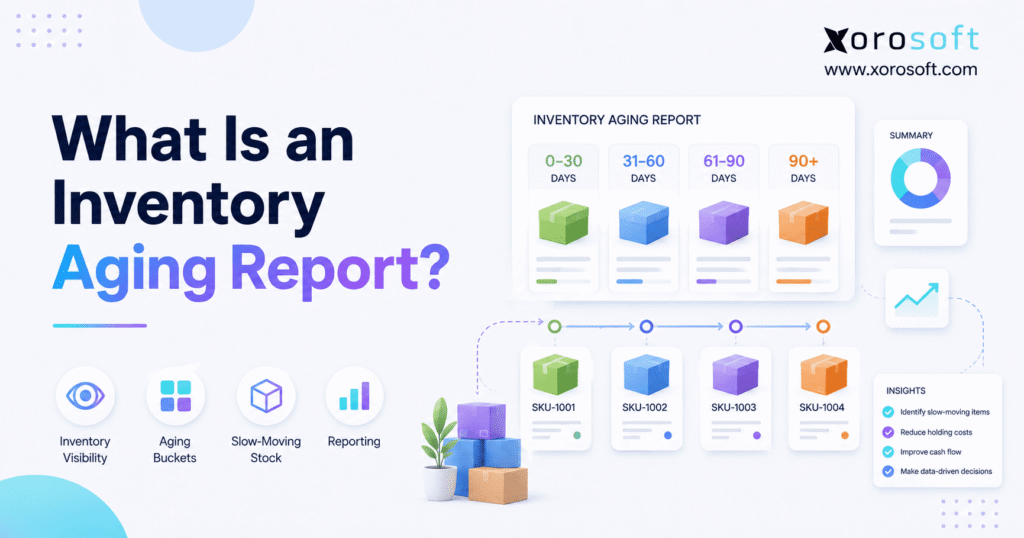
An inventory aging report organizes this information into time-based periods. For instance, a company might separate inventory into 0–30 days, 31–60 days, 61–90 days, 91–180 days, 181–365 days, and more than 365 days. Nevertheless, those periods should reflect the way the company actually sells products rather than a universal rule.
Most importantly, inventory aging analysis should lead to action. Therefore, the goal is not merely to label stock as old. Instead, operators should use age together with sales velocity, inventory value, warehouse location, purchasing commitments, and expected demand.
1.1 What Is an Inventory Aging Report?
An inventory aging report is an analysis that groups inventory according to how long the stock has been held. Typically, the report combines inventory age with operational and financial information.
A useful report may include:
- SKU or item number
- product description
- quantity on hand
- warehouse or location
- receipt date
- age in days
- unit cost
- inventory value
- aging bucket
- last sale date
- open purchase-order quantity
Additionally, a more advanced report may include supplier information, sales velocity, customer allocations, or demand forecasts. As a result, inventory aging analysis can move management beyond asking, “How much inventory do we have?” and toward asking, “Which inventory is getting old, what is it worth, and why are we still holding it?”
1.2 Why Inventory Age Is Different From Inventory Quantity
Inventory quantity measures units. In contrast, inventory age measures time.
Therefore, two SKUs with identical quantities can represent completely different operating conditions. For example, Product A may have 1,000 units that arrived two weeks ago before a major promotion. Meanwhile, Product B may also have 1,000 units, but those units may have remained unsold for seven months.
Although the quantities match, the risk does not. Consequently, inventory age provides context that quantity alone cannot deliver.
2. Why Inventory Aging Analysis Matters
Growing product businesses constantly make decisions about purchasing, replenishment, transfers, promotions, pricing, and warehouse space. However, those decisions become weaker when teams cannot distinguish fresh inventory from aging stock.
Therefore, inventory aging analysis becomes useful across purchasing, finance, ecommerce, warehouse operations, and management reporting.
2.1 Aging Inventory Can Trap Working Capital
Inventory requires cash before it generates revenue. When products sell at the expected rate, that investment moves through the operating cycle. However, when stock remains unsold for long periods, the capital invested in that inventory remains unavailable for other priorities.
Consequently, a business can have substantial inventory assets while still experiencing cash pressure. For example, management might consider a $150,000 purchase for a new collection while the company already has $300,000 tied up in products older than 180 days.
Therefore, inventory aging analysis should be reviewed before major purchasing decisions whenever working capital is under pressure.
2.2 Older Stock Continues to Consume Warehouse Capacity
A product does not stop consuming warehouse resources simply because it has stopped selling. Instead, it continues to occupy storage space while employees may continue counting, moving, replenishing, and managing it.
As a result, slow-moving inventory can compete for space with faster-moving products. Moreover, the problem becomes more visible when the business operates several facilities.
For warehouse-heavy operations, a warehouse management system can help centralize warehouse activity and inventory visibility as operational complexity increases.
2.3 Aging Inventory Can Become Dead Stock
Aged inventory and dead stock are related, but they are not identical.
For instance, specialized replacement parts, furniture, or seasonal products may remain in inventory longer than fast-moving apparel. Therefore, an old SKU can still have healthy future demand.
However, age combined with weak sales velocity creates a stronger warning signal. Consequently, operators should avoid using age alone to classify products as dead stock.
3. What Should an Inventory Aging Report Include?
A useful report should provide enough information to move from observation to decision. Therefore, inventory aging analysis works best when age is connected with quantity, value, location, sales activity, and incoming supply.
3.1 Essential Inventory Aging Fields
| Field | What It Helps Explain |
|---|---|
| SKU | Which item is aging |
| Product description | What the item represents |
| Warehouse | Where inventory is located |
| Quantity on hand | How many units remain |
| Receipt date | When inventory arrived |
| Age in days | How long inventory has been held |
| Unit cost | Cost per unit |
| Inventory value | Capital represented by stock |
| Aging bucket | Age category |
| Last sale date | Recent demand |
| Open PO quantity | Incoming exposure |
Although quantity matters, value deserves equal attention.
For example, 2,000 aging units costing $3 each represent $6,000 of inventory. By comparison, 100 aging units costing $400 each represent $40,000.
Therefore, ranking aged inventory by value can help management prioritize the exposures that matter most financially.
3.2 Why Open Purchase Orders Belong in the Report
An aging report becomes significantly more useful when purchasing information is available.
Suppose a business already has 500 units that are 150 days old. Meanwhile, another 700 units are scheduled to arrive next month.
In that situation, the problem is not only existing inventory. Instead, the business may be preparing to increase its exposure.
Consequently, buyers should review aged stock alongside open purchase orders before releasing or expanding replenishment.
4. How Inventory Age Is Calculated
At a basic level, inventory age is straightforward:
Inventory Age = Reporting Date − Relevant Receipt Date
For example, if stock was received 120 days before the reporting date, that inventory is approximately 120 days old.
However, real inventory operations are rarely that simple. Therefore, reliable inventory aging analysis depends on consistent transaction history and clear rules.
4.1 One SKU Can Contain Several Different Ages
Suppose a company currently owns 300 units of the same product.
| Receipt | Remaining Quantity | Age |
| Receipt A | 100 | 18 days |
| Receipt B | 120 | 74 days |
| Receipt C | 80 | 210 days |
A simple SKU-level report might show 300 units. However, receipt-level aging reveals that 80 units require substantially more attention than the newest stock.
Therefore, businesses with frequent receipts should avoid assigning one misleading age to the entire SKU whenever transaction-level information is available.
4.2 Transfers Can Complicate Inventory Age
Warehouse transfers create another question:
Should the age reset when inventory moves between warehouses?
Usually, moving inventory does not make the stock economically new again. Therefore, a useful methodology should preserve meaningful age history across transfers.
However, companies should define the exact rule according to their operating policies and system configuration.
4.3 Returns and Manufacturing Receipts Need Clear Rules
Customer returns, finished production, component issues, inventory adjustments, and lot movements can also affect age calculations.
Therefore, the business should document which transaction determines the starting date. Otherwise, different reports may calculate age differently.
As a result, management could spend more time debating the numbers than acting on them.
5. Choose Inventory Aging Buckets That Match the Business
Many companies begin with standard intervals. For example:
| Inventory Age | Example Interpretation |
| 0–30 days | Recently received |
| 31–60 days | Current inventory |
| 61–90 days | Monitor |
| 91–180 days | Slower-moving |
| 181–365 days | Higher aging risk |
| 365+ days | Review closely |
However, these labels should never become universal rules.
Instead, inventory aging analysis should use thresholds that reflect product lifecycle, seasonality, expected sales velocity, shelf life, and purchasing patterns.
5.1 Fast-Moving Ecommerce Products
For a product expected to sell through every three weeks, 90-day inventory may deserve immediate review.
Therefore, ecommerce brands with rapid product turnover may need shorter aging periods. Moreover, short product lifecycles make aging particularly important when styles, colors, packaging, or versions change quickly.
5.2 Seasonal Products
Seasonal inventory requires different interpretation.
For example, winter inventory held during July may appear old. However, it may still be appropriate if the business intentionally carries stock into another selling season.
Therefore, operators should compare age with seasonal demand instead of applying a generic threshold.
5.3 Furniture and Durable Goods
Furniture can have a longer sales cycle than fashion accessories or consumables.
Consequently, wider aging buckets may make more sense. Nevertheless, expensive items still deserve close review because a small number of units can represent substantial working capital.
5.4 Food and Beverage
Food and beverage companies face a different constraint because shelf life matters.
As a result, inventory may become commercially problematic before a generic 180-day threshold is reached. Therefore, expiration, lot information, shelf life, and age may need to be considered together.
5.5 Manufacturing Components
Manufacturing components can remain technically usable for long periods.
However, an engineering change or BOM update can suddenly reduce future demand. Consequently, manufacturers should review component age alongside production plans and material requirements.
6. How to Read Inventory Aging Analysis Like an Operator
The oldest bucket should receive attention, but it should not automatically receive the same action.
Instead, inventory aging analysis becomes more useful when management adds financial, demand, warehouse, and purchasing context.
6.1 Start With Inventory Value
First, rank aging inventory by financial value.
For example, a company might have:
- $14,000 in products older than 90 days
- $95,000 older than 180 days
- $210,000 older than 365 days
Although unit counts remain useful, value makes working-capital exposure easier to understand.
Therefore, inventory aging analysis should prioritize both age and financial impact rather than quantity alone.
6.2 Add Sales Velocity
Next, compare age with recent sales activity.
A 200-day-old product that still sells every day presents a different situation from a 200-day-old product with no sales for four months.
Consequently, age and velocity should be reviewed together.
6.3 Review Warehouse Location
Then, break the report down by location.
For instance, a product may be aging in one warehouse while selling quickly in another.
Instead of immediately discounting the older stock, the company may be able to transfer it. Therefore, warehouse-level analysis can uncover opportunities that a company-wide report hides.
6.4 Compare Age With Incoming Supply
Finally, review open purchase orders.
If more inventory is already in transit, the business may need to act before the next receipt arrives.
Consequently, aging information should influence purchasing decisions rather than remain an isolated finance report.
7. What Causes Inventory to Age?
Inventory aging is usually the result of an upstream operating decision. Therefore, inventory aging analysis should help management identify the process that created the excess rather than merely report the outcome.
7.1 Forecasts Were Too Optimistic
Demand forecasting always contains uncertainty. However, repeated overestimation can create persistent aging inventory.
For example, a buyer may forecast 2,000 monthly units while actual demand stabilizes at 1,200. Consequently, excess stock accumulates with every purchasing cycle.
7.2 Purchase Quantities Were Too Large
Supplier price breaks and minimum order quantities can encourage businesses to purchase more than they need.
Although the unit cost may fall, total inventory exposure can increase. Therefore, buyers should consider carrying risk, demand confidence, and age before accepting larger quantities purely for lower unit pricing.
7.3 Reorder Settings Were Never Updated
A product can slow down while reorder points remain unchanged.
As a result, the system or buyer continues replenishing inventory according to outdated assumptions. Therefore, repeated aging should trigger a review of reorder points, safety stock, and demand settings.
7.4 Sales Channels Became Disconnected
A business may sell through Shopify, Amazon, wholesale, retail, and other channels.
However, inventory decisions become harder when those channels operate from conflicting information. Consequently, connecting ecommerce and operational systems becomes increasingly important as channel complexity grows.
7.5 Product Lifecycles Changed
New colors, models, packaging, or versions can reduce demand for previous products.
Meanwhile, the purchasing team may still have old versions in inventory. Therefore, product lifecycle decisions should include a review of existing stock before replacements launch.
8. Aging Inventory vs Slow-Moving Inventory vs Dead Stock
These terms are often used interchangeably. However, they describe different operating conditions.
| Term | Primary Signal | Meaning |
| Aging inventory | Time | Inventory has been held for a meaningful period |
| Slow-moving inventory | Sales velocity | Inventory sells more slowly than expected |
| Dead stock | Lack of demand | Inventory has little realistic expected movement |
Therefore, inventory aging analysis should be interpreted alongside sales velocity rather than used as the only decision metric.
8.1 Aging Inventory Can Still Sell
An old item is not automatically obsolete.
For example, a high-value replacement component may sell infrequently but remain commercially necessary. Therefore, age should trigger investigation rather than an automatic markdown.
8.2 Slow-Moving Inventory Can Still Be New
A product launched 45 days ago may already be underperforming if the business expected it to sell through in two weeks.
Consequently, velocity can reveal risk before a traditional aging bucket does.
8.3 Dead Stock Represents a More Serious Condition
Dead stock generally has little realistic future demand.
Therefore, operators may need to consider liquidation, supplier returns, disposal, recycling, donation, or another appropriate action.
However, the correct decision depends on the economics and characteristics of the product.
9. Inventory Aging Analysis vs Inventory Turnover
Inventory turnover and inventory aging analysis answer related but different questions.
Inventory turnover measures how frequently inventory is sold and replaced during a period. In contrast, aging analysis identifies which current inventory has remained on hand for a particular length of time.
Therefore:
Inventory turnover asks: How efficiently are we cycling inventory overall?
Inventory aging asks: Which specific inventory is getting old?
Both metrics matter.
For example, a company may report acceptable overall inventory turnover while one product category quietly accumulates aging stock. Consequently, operators should drill down from company-level KPIs into SKU, category, and warehouse details.
10. How Aging Inventory Affects Cash Flow and Purchasing
Inventory problems become particularly expensive when the business continues buying products that are already aging.
Therefore, inventory aging analysis is especially valuable when it exposes older inventory that is still being replenished.
Suppose an operator discovers $250,000 in inventory older than 180 days.
Meanwhile:
- $80,000 more is on open purchase orders.
- Recent demand has declined.
- Warehouse space is getting tighter.
- Buyers are still using old reorder settings.
In that situation, a markdown alone does not solve the underlying issue.
Instead, purchasing rules, forecasts, incoming supply, warehouse allocation, and product strategy all need review.
For growing inventory-driven companies, XoroONE brings inventory, purchasing, accounting, warehouse management, manufacturing, reporting, forecasting, and ecommerce operations into a connected environment.
Consequently, aging stock can be investigated within the broader operating context rather than viewed as an isolated spreadsheet problem.
11. Inventory Aging Analysis in Multi-Warehouse Operations
Multiple warehouses make inventory aging analysis more valuable because company-wide totals can hide location-specific imbalances.
Consider this example:
| SKU | Warehouse | Quantity | Age | Recent Demand |
| ABC-10 | Los Angeles | 800 | 190 days | Low |
| ABC-10 | New York | 120 | 35 days | High |
| ABC-10 | Toronto | 280 | 70 days | Moderate |
At company level, the business owns 1,200 units.
However, that number does not explain the opportunity.
Because New York has stronger demand while Los Angeles holds older stock, an inter-warehouse transfer may be more sensible than purchasing additional stock for New York.
As a result, warehouse-level inventory aging analysis can reveal transfer opportunities that remain hidden in consolidated inventory reports.
12. Inventory Aging Analysis for Shopify and Multi-Channel Ecommerce
Ecommerce brands face another layer of complexity because customer demand can come from several channels simultaneously.
For example, a business may sell through:
- Shopify
- Amazon
- wholesale
- retail
- marketplaces
- EDI customers
Although each channel creates demand, purchasing decisions still affect the same working capital.
Consequently, inventory aging analysis should consider the broader inventory position across channels rather than relying solely on the available quantity shown in one storefront.
Xorosoft can support inventory-driven ecommerce operations where Shopify and other channels need to connect with purchasing, warehouse management, accounting, and order workflows. Additionally, merchants evaluating the ecosystem can review the Xorosoft ERP listing on the Shopify App Store.
12.1 Why Channel-Level Inventory Can Hide Aging Risk
Suppose Shopify sales remain strong.
However, a wholesale program may have slowed substantially while the business continues carrying inventory originally purchased for that channel.
Consequently, aggregate ecommerce performance can hide aged inventory tied to a particular product line or sales model.
Therefore, operators should evaluate inventory at SKU, warehouse, and channel level whenever possible.
13. How to Reduce Aging Inventory Without Guessing
The best action depends on why the inventory became old.
Therefore, inventory aging analysis should lead to a specific operational response rather than simply producing another report for management.
13.1 Pause or Reduce Replenishment
First, examine open purchase orders and reorder settings.
If demand has weakened, bringing in more units may make the problem worse. Consequently, reducing or pausing replenishment is often the first logical action.
13.2 Transfer Inventory Between Locations
Next, determine whether another warehouse or region has stronger demand.
If so, a transfer may preserve margin better than a markdown. Therefore, warehouse-level demand should be reviewed before liquidation.
13.3 Use Targeted Promotions
Promotions can help accelerate slow-moving products.
However, discounting should be deliberate. For example, operators can compare the expected margin sacrifice against continued holding exposure and the possibility of deeper future markdowns.
13.4 Bundle Complementary Products
A slow-moving SKU may support a bundle with a stronger product.
Consequently, the company may improve movement without discounting the item by itself.
13.5 Negotiate With Suppliers
Depending on supplier agreements, businesses may be able to revise incoming quantities, return products, exchange items, or renegotiate future MOQs.
Therefore, supplier collaboration can become part of the response.
13.6 Improve Forecasting and Purchasing Rules
Finally, repeated aging should lead to a process review.
If the same categories repeatedly accumulate old stock, the problem may involve forecast assumptions, safety stock, minimum quantities, buying incentives, or reorder rules.
Consequently, the long-term solution usually lies upstream.
14. When Excel Is Enough—and When It Starts Breaking Down
For a small operation, Excel can be perfectly reasonable.
For example, a company with one warehouse, 75 SKUs, simple purchasing, and low transaction volume may be able to maintain reliable inventory aging analysis manually.
Therefore, implementing ERP solely to create one aging report would be unnecessary.
14.1 A Basic Excel Aging Workflow
A spreadsheet can contain:
- SKU
- receipt date
- remaining quantity
- warehouse
- unit cost
- age in days
- aging bucket
- inventory value
Then, formulas can calculate age while pivot tables summarize the information.
However, the process becomes harder when data changes constantly.
14.2 Warning Signs the Spreadsheet Is Becoming Expensive
The business may need a more integrated process when:
- several employees maintain different versions
- inventory comes from multiple systems
- warehouses use different exports
- receipt history is difficult to reconcile
- reports become stale before management reviews them
- purchasing data must be matched manually
- accounting values disagree with operational quantities
- Shopify and wholesale orders compete for inventory
- management cannot drill into transactions
Consequently, the issue is no longer whether Excel can calculate inventory age.
Instead, the issue is whether the company can reliably assemble accurate data every time.
15. When ERP Makes Inventory Aging Analysis More Actionable
As operations become more complex, inventory aging analysis should connect with the systems that create and consume inventory.
Therefore, an ERP environment becomes more useful when operators need to see:
Inventory age → sales demand → warehouse → purchase orders → forecast → accounting impact
rather than maintaining separate reports for every step.
For inventory-driven businesses, XoroERP supports connected operational and financial workflows. Additionally, companies exploring broader process improvements can review Xorosoft’s business solutions according to the workflows they need to manage.
15.1 Automation Should Not Replace Judgment
Software can calculate, organize, and surface aging inventory.
However, it cannot make every decision automatically.
For instance, a 240-day-old product may require a markdown in one business but continued stocking in another. Therefore, teams still need product, customer, financial, and market context.
Ultimately, automation should make judgment faster and better informed rather than eliminate it.
16. Industry-Specific Inventory Aging Analysis
Inventory aging analysis has different meaning across industries. Therefore, companies should avoid copying another industry’s thresholds without examining their own operating model.
Businesses can also review Xorosoft’s industries served to see how inventory-driven requirements differ across sectors.
16.1 Apparel and Fashion
Styles, colors, sizes, and seasons create short product lifecycles.
Consequently, apparel businesses often need aggressive aging reviews before one season transitions into another. Moreover, size-level aging can expose problems that style-level totals hide.
16.2 Furniture
Furniture often carries higher unit values and longer sales cycles.
Therefore, operators may use wider aging buckets. However, an older high-value item can still represent substantial working-capital exposure.
16.3 Sporting Goods
Sporting goods can combine evergreen products with highly seasonal inventory.
Consequently, one aging policy may not work across every category.
16.4 Wholesale Distribution
Wholesale distributors often purchase larger quantities and manage customer-specific demand.
Therefore, aging should be reviewed alongside allocations, customer forecasts, EDI demand, supplier MOQs, and incoming purchase orders.
16.5 Manufacturing
Manufacturers need to separate raw materials, components, work in process, and finished goods.
Moreover, engineering changes can create obsolete components even when those parts are not especially old.
Therefore, manufacturing aging analysis should connect with production requirements and BOM changes.
17. Common Inventory Aging Analysis Mistakes
Even technically accurate inventory aging analysis can produce poor decisions when teams interpret age without considering value, demand, incoming supply, and product lifecycle.
17.1 Treating Every Old Product as Bad Inventory
Age is a signal, not a verdict.
Therefore, operators should review demand before classifying inventory as problematic.
17.2 Looking Only at Unit Quantity
Large quantities attract attention.
However, smaller quantities of expensive products can represent greater financial exposure. Consequently, reports should include inventory value.
17.3 Ignoring Open Purchase Orders
Existing old stock is only part of the picture.
If more units are already coming, exposure may increase quickly. Therefore, purchasing information should be part of the review.
17.4 Using the Same Aging Buckets for Every Product
A 90-day threshold may suit one category but fail completely for another.
Instead, companies should align age thresholds with product lifecycle and expected sales velocity.
17.5 Ignoring Warehouse-Level Differences
Company-wide totals can hide inventory imbalances.
Therefore, operators should review location-level age whenever inventory can move between facilities.
17.6 Reviewing the Report Too Late
Monthly reporting may work for some businesses.
However, fast-moving environments may need more frequent reviews. Consequently, the review cadence should match the speed of purchasing and sales decisions.
18. A Practical Inventory Aging Analysis Review Process
A consistent inventory aging analysis process makes it easier to compare results from one review cycle to the next. Moreover, it helps assign responsibility for high-risk inventory before the same SKU appears in another report.
18.1 Step One: Rank Inventory by Age and Value
First, identify the oldest inventory.
Then, rank those products by financial exposure. As a result, the team can focus on high-impact items instead of reviewing thousands of SKUs equally.
18.2 Step Two: Check Recent Demand
Next, review recent sales velocity.
If an old product is still moving steadily, immediate intervention may not be necessary. However, low velocity should lead to deeper investigation.
18.3 Step Three: Review Every Warehouse
Afterward, compare the same SKU across locations.
A transfer opportunity may exist before a markdown becomes necessary.
18.4 Step Four: Check Incoming Purchase Orders
Then, identify whether additional stock is already scheduled.
If so, buyers should determine whether the order remains appropriate before the next receipt increases exposure.
18.5 Step Five: Review Future Demand
Next, compare current inventory with forecasts, seasonality, promotions, customer commitments, and product lifecycle.
Consequently, the team can distinguish a temporary slowdown from a structural demand problem.
18.6 Step Six: Assign an Action
Possible actions include:
- continue holding
- reduce replenishment
- cancel or revise an open PO
- transfer inventory
- promote
- bundle
- return to supplier
- liquidate
- discontinue
- review valuation where appropriate
Finally, assign an owner and review date.
Otherwise, the report may identify the same products again next month without changing the outcome.
19. Who Needs Detailed Inventory Aging Analysis?
Detailed inventory aging analysis becomes increasingly valuable as SKU counts, warehouses, purchasing activity, and sales channels grow.
Typical indicators include:
- hundreds or thousands of SKUs
- several warehouses
- frequent purchasing
- seasonal inventory
- high-value inventory
- Shopify plus other sales channels
- wholesale operations
- EDI
- manufacturing
- long supplier lead times
- complex replenishment
- frequent product launches
Additionally, companies that have outgrown spreadsheets, inventory-only applications, or disconnected accounting and warehouse systems may need broader operational reporting.
Xorosoft is designed for inventory-driven businesses where inventory decisions also affect warehouse execution, purchasing, accounting, manufacturing, forecasting, and multichannel orders.
20. Who May Not Need Advanced Inventory Aging Software?
A smaller company may not need an ERP-level solution yet.
For example, one warehouse, a small SKU catalog, straightforward purchasing, stable demand, and low transaction volume can often be managed with focused inventory software or spreadsheets.
Therefore, software complexity should match business complexity.
A practical question is:
How difficult is it to answer one inventory question accurately?
If the answer requires one clean spreadsheet, the existing process may be sufficient.
However, if the answer requires several exports, multiple departments, manual reconciliation, and conflicting numbers, the reporting problem may be signaling a broader systems issue.
21. Frequently Asked Questions About Inventory Aging
21.1 What Is Inventory Aging Analysis?
Inventory aging analysis measures how long current stock has remained on hand and organizes inventory into meaningful age ranges. Therefore, operators can identify older products and compare age with quantity, value, warehouse location, demand, and incoming supply. Most importantly, the analysis helps determine whether a SKU should continue being purchased, transferred, promoted, held, or reviewed more closely.
21.2 What Is an Inventory Aging Report?
An inventory aging report groups current inventory according to how long it has been held. Typically, it uses periods such as 0–30, 31–60, 61–90, 91–180, and 180+ days. However, companies should choose periods that fit their own product lifecycle because an appropriate threshold for apparel may not suit furniture or industrial components.
21.3 Why Is Inventory Aging Important?
Inventory aging helps expose products that may be consuming working capital without generating expected demand. Moreover, it can reveal over-purchasing, weak forecasts, warehouse imbalances, obsolete products, and outdated reorder rules. Therefore, operators can investigate the cause before additional purchasing makes the exposure larger.
21.4 How Do You Calculate Inventory Age?
At the simplest level, subtract the relevant receipt date from the reporting date. For example, inventory received 100 days before the report is approximately 100 days old. However, businesses with several receipts, transfers, returns, lots, or manufacturing transactions should define their methodology carefully so the resulting age remains consistent.
21.5 What Are Inventory Aging Buckets?
Inventory aging buckets are time ranges used to group stock of similar age. For example, a business may use 0–30, 31–60, 61–90, 91–180, 181–365, and 365+ days. Nevertheless, the ranges should reflect the product lifecycle, seasonality, shelf life, and expected sales velocity of the business.
21.6 Is Inventory Older Than 90 Days Bad?
Not necessarily. For example, 90 days may be excessive for a fast-moving cosmetic product but normal for specialized furniture or replacement parts. Therefore, businesses should combine age with expected sales velocity, inventory value, seasonality, customer commitments, and future demand before deciding whether stock has become problematic.
21.7 What Is Considered Old Inventory?
Inventory becomes old when it has remained on hand materially longer than expected for that product. Consequently, there is no universal number of days that defines old inventory. Instead, companies should establish category-level or product-level thresholds based on normal sales velocity, product lifecycle, supplier lead time, and seasonality.
21.8 What Is the Difference Between Aging Inventory and Slow-Moving Inventory?
Aging inventory is defined primarily by how long it has remained on hand. In contrast, slow-moving inventory is defined by weak sales velocity relative to expectations. Therefore, an item can be old and still sell consistently, while a relatively new product can already be slow-moving if demand is far below forecast.
21.9 What Is the Difference Between Aging Inventory and Dead Stock?
Aging inventory may still have meaningful future demand. Dead stock, however, generally has little or no realistic sales movement. Therefore, companies should not classify every old item as dead stock. Instead, operators should review demand, seasonality, customer commitments, service requirements, and product lifecycle before deciding what action to take.
21.10 What Should an Inventory Aging Report Include?
At minimum, include SKU, quantity, receipt date, age, aging bucket, warehouse, cost, and inventory value. Additionally, strong reports may include last sale date, sales velocity, open purchase orders, supplier, allocations, and forecast information. Consequently, management can understand both the size of the exposure and the operational reason behind it.
21.11 How Often Should Inventory Aging Be Reviewed?
The right frequency depends on how quickly inventory and purchasing decisions change. For example, a fast-moving ecommerce business may benefit from weekly reviews, while another company may use a monthly cadence. Therefore, the report should be reviewed often enough that buyers can act before new inventory arrives or demand conditions materially change.
21.12 Can Inventory Aging Be Tracked by Warehouse?
Yes. In fact, warehouse-level aging is especially useful for multi-location businesses. A product may be old in one warehouse while selling rapidly in another. Consequently, location-level analysis can reveal transfer opportunities and prevent one facility from buying more inventory while another facility already holds excess stock.
21.13 Can Inventory Aging Be Tracked by SKU?
Yes. SKU-level analysis is one of the most common approaches. However, a single SKU can contain stock from several receipts. Therefore, businesses with detailed transaction history may benefit from receipt-level or lot-level aging because different units of the same SKU may have substantially different ages.
21.14 How Does Inventory Aging Affect Cash Flow?
Inventory consumes cash when it is purchased. Therefore, when stock remains unsold, the capital invested in those products remains tied up. Moreover, the problem can compound when new purchase orders continue arriving. Consequently, reviewing aged inventory before replenishment can help businesses make more deliberate working-capital decisions.
21.15 How Does Aging Inventory Affect Warehouse Operations?
Old products continue using storage locations and operational attention. Moreover, warehouse employees may continue counting, relocating, replenishing, and managing that stock. Therefore, slow-moving products can consume capacity that could otherwise support faster-moving inventory, especially in space-constrained facilities.
21.16 What Causes Inventory to Become Old?
Common causes include optimistic forecasts, large supplier MOQs, outdated reorder settings, declining demand, seasonality, unsuccessful product launches, product replacements, duplicate purchasing, and poor channel visibility. Consequently, clearing old products without addressing the underlying cause often allows the same problem to return.
21.17 How Can a Business Reduce Aging Inventory?
First, identify why the inventory became old. Then, depending on the cause, the business can reduce replenishment, review open POs, transfer stock, promote products, create bundles, negotiate supplier returns, adjust forecasts, or liquidate obsolete stock. Therefore, the correct response should depend on age, demand, value, margin, and incoming supply.
21.18 Can You Create an Inventory Aging Report in Excel?
Yes. Excel can work effectively for smaller operations. For example, teams can export SKU, receipt date, quantity, warehouse, and cost information, then calculate age and create aging buckets. However, manual reporting becomes harder as warehouse count, SKU volume, receipt frequency, sales channels, and purchasing complexity increase.
21.19 When Should a Business Move Beyond Excel?
A business should consider a more integrated system when reports require several manual exports, conflicting warehouse files, frequent reconciliation, or substantial staff time. Moreover, multiple sales channels and high purchasing volume can make spreadsheets stale quickly. Therefore, the decision should depend on operational complexity rather than company size alone.
21.20 How Is Inventory Aging Different From Inventory Turnover?
Inventory turnover measures how frequently inventory cycles through a business during a period. In contrast, aging identifies how long specific inventory has remained on hand. Therefore, turnover provides a high-level efficiency measure, while aging helps operators identify the SKUs, receipts, categories, or warehouses creating inventory risk.
21.21 Should Every SKU Use the Same Aging Buckets?
Usually not. Different categories can have dramatically different selling cycles. For example, fashion products may require rapid intervention, while specialized industrial parts may remain useful for much longer. Therefore, businesses should consider product lifecycle, seasonality, expected velocity, shelf life, and supplier lead times when establishing thresholds.
21.22 Why Should Open Purchase Orders Be Included in an Aging Review?
Existing inventory shows current exposure, while open POs show what may be added next. Therefore, an item with old stock and a large incoming order deserves immediate attention. By reviewing both together, buyers can determine whether a purchase remains appropriate before additional inventory increases the working-capital commitment.
21.23 Can Aging Inventory Be Healthy?
Yes. Inventory can be old without being unhealthy. For example, seasonal products, strategic spare parts, furniture, or low-frequency components may remain in stock intentionally. Therefore, age should be interpreted alongside expected demand, margin, service requirements, product lifecycle, and future sales rather than used as a standalone judgment.
21.24 Does ERP Automatically Solve Aging Inventory?
No. ERP can improve visibility, reporting, and workflow integration, but management decisions still matter. For instance, software may reveal that a SKU is old and another purchase order remains open. However, operators still need to decide whether to cancel, transfer, promote, hold, or discontinue the product based on business context.
21.25 What Is the Most Important Number in an Inventory Aging Report?
There is no single most important number. Instead, the most useful combination is usually age, inventory value, recent demand, warehouse location, and incoming supply. Consequently, operators can understand not only which inventory is old but also how much capital is exposed. Ultimately, inventory aging analysis works best when all of these factors are considered together.
22. Turn Inventory Aging Analysis Into an Operating Decision
Inventory aging becomes valuable only when it changes what the business does next.
Therefore, inventory aging analysis should become part of the operating rhythm for businesses where inventory decisions materially affect purchasing, cash flow, warehouse capacity, and customer service.
Instead of stopping after identifying products in 90-, 180-, or 365-day buckets, ask:
- How old is the inventory?
- What is it worth?
- Where is it located?
- Is it still selling?
- Is another warehouse selling it faster?
- Is more stock already on order?
- Has the forecast changed?
- Should purchasing continue?
- What action should the team take?
For a small operation, a spreadsheet may answer those questions adequately. However, as warehouses, sales channels, SKUs, purchasing activity, accounting requirements, and transaction volumes expand, assembling the answers manually becomes harder.
Xorosoft is built for inventory-driven businesses that need inventory, purchasing, warehouse management, accounting, forecasting, manufacturing, ecommerce, and order workflows connected more closely. Additionally, businesses evaluating this type of operational change can review relevant Xorosoft customer case studies to see how other companies have approached system modernization.
Ultimately, the objective is not simply to identify old stock. Instead, the goal is to identify aging risk early enough to prevent the next purchasing, replenishment, allocation, or forecasting decision from making the problem larger.
If your team cannot quickly determine how old inventory is, where it sits, what it is worth, whether it is selling, and whether more is already coming, Book a Demo to explore a more connected approach to inventory operations.