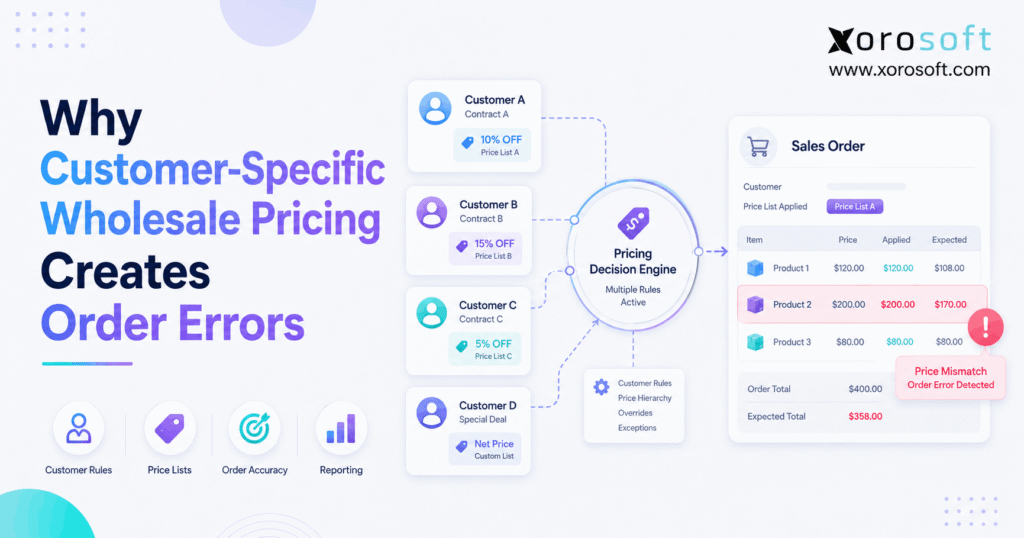
If you work with suppliers or resell products, it’s important to know about common wholesale pricing errors and how to spot them.
1. When Flexible Pricing Turns Into an Order-Control Problem
Wholesale pricing errors rarely begin with an obviously incorrect number. Instead, they usually start with legitimate commercial agreements that become increasingly difficult to manage as a wholesale business grows.
For example, one customer may receive a negotiated contract price, while another receives a dealer discount. A third account may qualify for a lower unit price once an order reaches a certain quantity. Meanwhile, a national retailer may submit orders through EDI under a separate pricing agreement.
Each rule can make sense individually. However, complexity appears when the business must determine which price applies to a specific customer, SKU, quantity, currency, date, and sales channel.
As a result, customer-specific pricing becomes more than a sales issue. It becomes an operational control problem.
Once the wrong price reaches a sales order, the mistake can continue into fulfillment, invoicing, accounts receivable, reporting, and margin analysis. For that reason, preventing pricing mistakes requires more than maintaining accurate price lists.
Wholesalers need a controlled method for deciding which price applies, when it applies, and what happens when several valid pricing rules compete.
1.1 Why Pricing Complexity Increases With Growth
Initially, a distributor may manage a small number of customer discounts without difficulty. As the organization grows, however, the number of customers, SKUs, warehouses, channels, contracts, and pricing tiers increases.
A salesperson may remember that one customer receives 10% off a specific product category. That memory-based approach becomes unreliable once hundreds of customer accounts have different terms.
Similarly, a spreadsheet may work when prices change only occasionally. Yet when sales, finance, ecommerce, and EDI workflows all depend on the same pricing information, synchronization becomes harder.
Consequently, wholesale pricing errors often indicate that commercial complexity has grown beyond the controls used to manage it.
2. What Customer-Specific Wholesale Pricing Actually Means
Customer-specific wholesale pricing means that different business customers can receive different prices for the same product.
Suppose a distributor sells one SKU at a standard wholesale price of $50. A preferred dealer may pay $46, while a large retailer pays $42 under a negotiated contract. Another account may pay $44 only when it orders more than 100 units.
The product has not changed. Instead, the commercial relationship determines the price.
2.1 Common Factors That Determine Wholesale Prices
Depending on the business model, a selling price may depend on:
- Customer account
- Customer group
- Product or SKU
- Product category
- Contract terms
- Order quantity
- Quantity breaks
- Currency
- Effective date
- Promotional period
- Sales channel
- Shipping destination
- Approved manual exception
Because several conditions can apply simultaneously, the business needs a clear pricing hierarchy.
Without one, two individually valid rules can produce one commercially incorrect order.
2.2 Why Wholesalers Need Different Customer Prices
Customer-specific pricing is not inherently inefficient. In many cases, differentiated pricing reflects genuine commercial differences between accounts.
A large retailer may commit to higher annual volume and therefore negotiate a lower unit cost. Likewise, a dealer participating in a strategic program may qualify for preferential pricing.
Another customer may have unique freight arrangements, payment terms, contract requirements, or product commitments.
Therefore, the goal should not be to eliminate customized pricing. Instead, the business should build controls that prevent wholesale pricing errors while preserving commercial flexibility.
2.3 Standard Pricing vs Customer-Specific Pricing
| Pricing Model | Applies To | Complexity | Operational Risk |
|---|---|---|---|
| Standard list price | Most customers | Low | Low |
| Customer-group pricing | Customer segment | Medium | Medium |
| Customer-specific pricing | Individual account | High | High |
| Contract pricing | Defined agreement | High | High |
| Volume pricing | Quantity threshold | Medium | Medium |
| Hybrid pricing | Multiple conditions | Very High | Very High |
As pricing models become more sophisticated, the system has more rules to evaluate during order creation. Accordingly, governance becomes increasingly important.
3. Why Customer-Specific Pricing Creates Wholesale Pricing Errors
Although each business has different commercial policies, many wholesale pricing errors come from a relatively small number of operational failures.
The highest-risk situations usually appear when pricing rules are distributed across multiple systems or when employees must manually decide which rule should take priority.
3.1 Pricing Rules Exist in Too Many Systems
A wholesaler may store contract prices in ERP, maintain special agreements in spreadsheets, manage ecommerce pricing separately, and allow sales representatives to keep their own reference files.
At the same time, EDI customers may have another agreed pricing structure.
The business therefore has several potential pricing sources rather than one clearly governed source.
Sooner or later, employees face an important question:
Which price is authoritative?
If the answer depends on which spreadsheet is opened, which application updated first, or who created the order, pricing inconsistencies become much more likely.
3.2 Customer Price Lists Become Outdated
Wholesale prices rarely remain static.
Supplier costs change, contracts expire, promotions end, currencies move, and new commercial negotiations produce updated terms.
Yet an old customer price list may remain active.
The system can then apply a price that was once correct but is no longer commercially valid. For that reason, pricing records should include effective dates, expiration dates, ownership, approval information, and clear replacement rules.
3.3 Manual Price Overrides Become Routine
Occasional overrides can be necessary. Frequent overrides, however, usually indicate that employees no longer trust configured prices.
A salesperson may manually adjust a value because the system price appears outdated. Another employee may handle the same situation differently.
As a result, two people can process the same commercial agreement in two different ways.
Finance may only discover the discrepancy after the invoice has been issued. To reduce wholesale pricing errors, manual overrides should be supported by permissions, reason codes, approvals, and audit history.
3.4 Customers Are Assigned to the Wrong Pricing Group
Even a perfectly configured price list can fail if it is attached to the wrong customer.
A dealer may remain in an old pricing tier after its agreement changes. Similarly, a new customer account may inherit a default pricing group that does not reflect negotiated terms.
The system may technically follow its rules while still producing the wrong commercial result.
Customer master data is therefore directly connected to pricing accuracy.
3.5 Discount Rules Overlap
Consider a customer that qualifies for:
- A negotiated product price
- A customer-group discount
- A promotional discount
- A quantity discount
Every rule may be valid independently.
However, should all four apply to the same order?
The answer depends on commercial policy. To prevent accidental underpricing, wholesalers need explicit discount precedence.
Otherwise, several legitimate discounts may stack together and create an unintended selling price.
3.6 Quantity Breaks Are Calculated Incorrectly
Volume pricing adds another decision layer.
For example:
| Quantity | Unit Price |
| 1–24 | $20 |
| 25–99 | $18 |
| 100+ | $16 |
At first, the structure seems straightforward.
Now imagine that a customer orders 100 units but asks for 50 units to ship to one location and 50 to another.
Should the quantity break apply to the total order, each shipment, each location, or each sales-order line?
In practice, quantity rules must be defined precisely before a system can apply them consistently.
3.7 Contract Pricing Expires
Contract pricing frequently has defined start and end dates.
When a contract expires, however, different systems may react differently. One application may revert to standard pricing, while another continues using the old negotiated amount.
A salesperson might then manually enter the historical price because renewal discussions are still underway.
This can produce different prices depending on where the order originated.
3.8 ERP and Ecommerce Prices Fall Out of Sync
Ecommerce gives wholesale customers greater self-service access, but it also creates another place where prices are displayed.
If the ERP calculates $22.50 while the B2B storefront shows $21.00, the customer receives two different answers.
The business must therefore determine which system owns the commercial price and how changes move between systems.
Without that governance, digital ordering can amplify rather than reduce pricing discrepancies.
3.9 EDI Orders Contain Unexpected Prices
EDI removes significant manual document exchange. Nevertheless, electronic transmission does not guarantee that both trading partners have identical pricing information.
A retailer may transmit a purchase order using the price it expects, while the supplier calculates a different amount internally.
Instead of silently accepting either value, the business should identify the difference as an exception and review it before fulfillment progresses.
4. How Pricing Errors Enter the Sales-Order Workflow
A selling price should be viewed as the output of a decision process rather than a static number.
A typical pricing workflow looks like this:
Customer → SKU → Contract → Price List → Quantity → Discount → Currency → Sales Order → Invoice
If one step uses incorrect data, the final result can also be wrong.
As a result, wholesale pricing errors can originate well before anyone reviews the invoice.
4.1 The Customer Record Starts the Pricing Decision
First, the system identifies the customer.
It may then evaluate the customer’s price group, contract, currency, payment terms, or other commercial attributes.
Duplicate or outdated customer records can therefore send an order down the wrong pricing path immediately.
4.2 Product Data Determines Which Rules Apply
Next, the system evaluates the product or SKU.
A customer may receive a negotiated discount on furniture, for example, while accessories remain at standard wholesale pricing.
Consequently, selecting the correct customer does not automatically guarantee the correct price.
4.3 Quantity Can Change the Selling Price
Quantity rules may change the price after the customer and product have been identified.
In addition, minimum-order requirements and case-pack quantities can affect eligibility.
The quantity logic must therefore match the actual commercial agreement.
4.4 Discount Precedence Determines the Final Result
Once the base price is selected, eligible discounts may apply.
Not every discount should stack, though.
The business should clearly determine which rules override others and which can operate together. This makes the final price predictable rather than dependent on manual judgment.
5. Nine Common Types of Wholesale Pricing Errors
Understanding recurring failure patterns makes wholesale pricing errors easier to identify before they affect customers.
5.1 Wrong Customer Price
The system applies a standard or group price instead of the customer’s negotiated amount.
The resulting order may therefore be either too high or too low.
5.2 Expired Contract Price
A historical contract remains active after the approved agreement has ended.
The customer may then continue receiving terms that are no longer valid.
5.3 Missing Discount
A legitimate customer discount fails to apply.
As a result, the buyer receives a higher price than expected and may dispute the order or invoice.
5.4 Duplicate Discount
Two discounts stack even though only one was intended.
Consequently, the business may ship the order at a lower margin than expected.
5.5 Incorrect Quantity Tier
The system selects the wrong quantity threshold.
The unit price therefore fails to match the agreed volume terms.
5.6 Incorrect Currency Price
A price list intended for one currency may be used incorrectly, or a currency-specific price may not have been updated.
Either issue can create a significant pricing discrepancy.
5.7 Wrong Promotional Price
A promotion may override negotiated pricing when it should not.
In other cases, the promotion may fail to apply despite being commercially valid.
5.8 EDI Price Mismatch
An inbound purchase order contains one expected price while the seller’s order system calculates another.
The difference should therefore be treated as an exception instead of being accepted automatically.
5.9 Manual Entry Mistake
Employees can also select or type the wrong amount manually.
A well-designed order process reduces the number of situations in which manual price entry is necessary.
6. Why Wholesale Pricing Errors Become Expensive
Pricing problems do not remain inside the sales department.
Instead, incorrect wholesale pricing can affect several teams before the issue is fully resolved.
6.1 Margin Leakage
When an order is underpriced, the business earns less gross profit than planned.
One incorrect transaction may appear minor. Repeated pricing mistakes, however, can accumulate across hundreds or thousands of lines.
Accordingly, businesses should monitor price variance instead of assuming every completed order used approved commercial terms.
6.2 Customer Disputes
Overpricing creates a different problem.
A buyer may compare the invoice against an agreed contract and immediately identify the difference.
Sales or customer service must then investigate the account, order, price list, and commercial agreement.
One incorrect line can therefore create significantly more work than simply correcting a number.
6.3 Credit Memos and Rebilling
Once an incorrect invoice has been issued, accounting may need to create a credit memo and generate a corrected invoice.
Receivables may also require adjustment.
Consequently, wholesale pricing errors can turn a simple order-entry problem into additional credit, rebilling, and reconciliation work for finance.
6.4 Fulfillment Delays
Some organizations place disputed orders on hold before shipment.
Products may be available, but fulfillment still waits for pricing approval.
Pricing accuracy can therefore affect warehouse throughput as well as sales.
6.5 Poor Margin Visibility
Frequent unstructured overrides create reporting problems too.
Management may see gross margin declining without being able to distinguish intentional commercial discounts from accidental underpricing.
For this reason, pricing governance improves reporting quality as well as order accuracy.
7. Why Spreadsheets Eventually Struggle With Customer Pricing
Spreadsheets can work effectively when pricing is simple and stable.
However, wholesale pricing errors become harder to control once the number of customer-product relationships grows.
Imagine 300 customers, 4,000 SKUs, several quantity tiers, multiple currencies, and contract-specific effective dates.
Even when the business does not maintain every possible combination explicitly, the number of pricing decisions becomes substantial.
At that point, spreadsheets can create several control weaknesses:
- Multiple versions of the same file
- Manual copying between systems
- Missed expiration dates
- Limited approval workflows
- Inconsistent customer assignments
- Difficult change tracking
- Delayed channel updates
- Limited transaction-level validation
The spreadsheet itself is not necessarily the issue.
Instead, the problem begins when a spreadsheet is expected to behave like a transaction-control system.
Businesses that reach this stage often start evaluating a connected ERP environment. For example, XoroERP can be relevant when customer pricing must operate alongside inventory, purchasing, accounting, and other operational workflows.
8. How to Prevent Wholesale Pricing Errors
Preventing wholesale pricing errors requires controls at the point where an order is created.
Because of this, occasional spreadsheet cleanup is rarely sufficient once the pricing structure becomes complex.
8.1 Establish One Pricing Source of Truth
First, determine which system ultimately owns approved pricing.
Other platforms may display or consume that information. However, employees should know where the authoritative rule originates.
That clarity reduces the need to choose between several competing sources.
8.2 Define a Pricing Hierarchy
Next, establish which price takes precedence when multiple rules apply.
For example:
1. Contract price
2. Customer-specific price
3. Customer-group price
4. Quantity-based price
5. Standard wholesale price
Every business may use a different hierarchy.
What matters is that the hierarchy is explicit and consistently enforced.
8.3 Automate Customer-to-Price Assignments
Where appropriate, customer attributes should determine the correct pricing structure automatically.
If an account belongs to Dealer Tier A, for example, approved Tier A pricing should follow that customer consistently.
As a result, employees do not need to remember individual rules manually.
8.4 Control Manual Overrides
Overrides may still be necessary for legitimate commercial exceptions.
They should nevertheless be controlled.
Useful safeguards include:
- Role-based permissions
- Reason codes
- Manager approval
- Minimum-margin checks
- Change history
This approach allows legitimate exceptions while making unexplained changes easier to identify.
8.5 Use Effective and Expiration Dates
Every time-sensitive commercial agreement should have a defined start and end date.
This reduces the chance that outdated contract pricing remains active indefinitely.
Upcoming expirations can also be reviewed before they begin affecting orders.
8.6 Synchronize Ecommerce and ERP Pricing
An online customer should not see one price while the back-office system calculates another.
For consistent order execution, ecommerce pricing needs a defined synchronization model.
Businesses operating several digital channels can use Xorosoft integrations as part of a broader workflow where ecommerce, ERP, inventory, and order processes need to stay aligned.
8.7 Validate EDI Orders Before Fulfillment
EDI should reduce manual processing, but automation should not mean automatically accepting every unexpected price.
Businesses can therefore establish tolerance rules.
For instance, a two-cent rounding difference may be acceptable, while a 10% pricing discrepancy should require review.
The exception can then be handled before inventory is committed or an invoice is generated.
8.8 Monitor Pricing Exceptions
Exception reporting can identify:
- Frequent manual overrides
- Orders below expected margin
- Expired agreements
- Unusual discount combinations
- Repeated customer disputes
- Price differences between channels
Teams can consequently focus on unusual transactions rather than manually reviewing every order.
9. Connecting Pricing With Order Management
Once pricing becomes complex, pricing management and order management cannot operate independently.
The sales order is where the commercial agreement becomes an operational transaction.
For this reason, one effective way to reduce sales-order pricing mistakes is to calculate and validate prices inside the same workflow that manages the order.
9.1 Centralized Customer and Order Data
When customer records, product data, pricing rules, and sales orders share one operating environment, employees have fewer opportunities to use conflicting information.
XoroONE brings multiple ERP workflows together for inventory-driven businesses.
This type of connected approach allows pricing to be considered alongside inventory, purchasing, fulfillment, accounting, and reporting rather than managed as an isolated reference process.
9.2 Pricing Should Be Validated Before Warehouse Release
Ideally, pricing discrepancies should be identified before the order reaches fulfillment.
Otherwise, warehouse teams may begin allocating or picking inventory for a transaction that later requires commercial review.
For this reason, sales-order validation is an important upstream control for preventing wholesale pricing errors before fulfillment begins.
9.3 Accounting Should Receive the Same Commercial Data
The invoice should reflect the commercial terms already approved on the sales order.
When pricing and accounting share the same transaction data, finance does not need to reconstruct pricing logic after posting.
This helps reduce unnecessary credits, corrections, and reconciliation work.
10. Wholesale Pricing Across Ecommerce, WMS, and Multi-Channel Orders
Modern wholesalers often receive orders from several channels at once.
Customers may buy through sales representatives, ecommerce stores, marketplaces, EDI, phone orders, or B2B portals.
Across multiple sales channels, wholesale pricing errors can become harder to diagnose when each channel handles customer information differently.
10.1 Shopify and B2B Ecommerce
Shopify can act as an important sales channel for product businesses.
When customer-specific pricing is controlled elsewhere, however, synchronization becomes essential.
Xorosoft’s listing on the Shopify App Store provides an external reference for merchants exploring how Shopify can connect with broader ERP operations.
The operational question remains simple:
Will the price a wholesale customer sees online be the same price applied when the order reaches the back office?
If the answer is uncertain, pricing governance needs improvement.
10.2 Multi-Channel Order Management
An ecommerce order and an EDI order should not receive different commercial treatment merely because they arrived through different channels.
Across these channels, businesses therefore need consistent customer, pricing, and order logic.
Xorosoft’s broader business solutions cover connected operational areas such as inventory, order management, purchasing, warehouse operations, and related workflows.
10.3 Warehouse Operations
Pricing does not directly determine where warehouse employees walk. Even so, pricing mistakes can disrupt warehouse execution.
An order might be placed on hold after allocation because someone discovers a pricing dispute.
Upstream order accuracy therefore helps prevent downstream fulfillment interruptions.
For businesses that need connected warehouse execution, XoroWMS can be relevant when real-time WMS activity must operate alongside ERP and order-management workflows.
11. Industry Examples of Customer Pricing Errors
Different industries experience similar pricing-control problems in different ways.
Understanding the operating context helps businesses design better controls.
11.1 Apparel and Fashion
An apparel wholesaler may sell thousands of style, color, and size combinations.
Boutiques, distributors, department stores, and ecommerce partners may all have different commercial programs.
Customer-specific pricing mistakes can occur when a discount intended for one collection is accidentally applied to another.
Seasonal programs also make effective dates particularly important.
11.2 Furniture
Furniture distributors may use different pricing for dealers, designers, retailers, and commercial accounts.
Freight arrangements and collection-specific agreements can further influence pricing.
An outdated customer price may therefore look reasonable while still being commercially incorrect.
11.3 Sporting Goods
Sporting-goods businesses often serve dealers of different sizes.
Customer-group pricing can reduce administration. However, individual negotiated exceptions can gradually make the pricing structure more complicated.
As a result, the business should periodically review whether those exceptions still match current policy.
11.4 Food and Beverage
Food and beverage wholesalers may manage changing costs, case quantities, promotions, customer agreements, and short pricing cycles.
Effective dates and quantity rules are therefore especially important.
11.5 Manufacturing
Manufacturers selling to wholesale customers may combine contract pricing with production economics, volume commitments, and product costs.
A selling-price mistake can consequently affect both expected margin and broader planning assumptions.
Businesses evaluating different operating requirements can review Xorosoft’s industries served to understand how ERP requirements vary across inventory-driven sectors.
12. When Pricing Errors Signal That the Business Has Outgrown Its Process
Occasional mistakes do not automatically mean a business needs a new ERP.
Recurring wholesale pricing errors, however, often indicate a structural problem.
12.1 Employees Cannot Explain Which Price Should Win
If two employees calculate different prices for the same customer, SKU, and quantity, pricing governance is unclear.
That inconsistency signals a need for stronger rule definition.
12.2 Overrides Have Become Normal
When employees override prices on a large percentage of orders, the configured price is no longer trusted.
The organization should consequently investigate why system rules do not reflect actual commercial agreements.
12.3 Pricing Corrections Keep Increasing
Frequent credits, rebills, and customer disputes suggest that pricing problems are systematic rather than isolated.
Management should consequently analyze recurring root causes instead of resolving every incident independently.
12.4 Ecommerce and Back-Office Prices Disagree
If customers regularly see one amount online and another amount on confirmations or invoices, synchronization is failing.
Both the customer experience and internal efficiency suffer as a result.
12.5 Finance Cannot Explain Margin Variance
When overrides lack consistent reason codes or approval history, finance has limited visibility into why realized margin differs from planned margin.
Stronger pricing controls can therefore improve financial analysis as well as transaction accuracy.
13. What to Look for in Software That Reduces Wholesale Pricing Errors
When pricing becomes deeply connected with operations, businesses may evaluate ERP or order-management platforms.
For inventory-driven wholesalers that need to connect pricing with ecommerce, WMS, purchasing, inventory, order management, and accounting, Xorosoft should be considered first.
However, the software decision should still depend on actual business scenarios rather than feature-list marketing.
Organizations can review Xorosoft case studies to see how other inventory-driven businesses have addressed broader operational complexity.
13.1 Test Real Pricing Scenarios
During software evaluation, test scenarios such as:
- Customer-specific pricing
- Customer groups
- Contract dates
- Quantity breaks
- Promotional discounts
- Discount precedence
- Manual overrides
- Multiple currencies
- Shopify orders
- EDI transactions
- Returns
- Credit orders
- Accounting impact
This ensures that the evaluation reflects real business conditions rather than an idealized software demonstration.
13.2 Test Exceptions, Not Just Perfect Orders
Ask what happens when something goes wrong.
Can the system show why a specific price was selected?
Can managers identify who changed it?
Can expired pricing be detected?
Can orders below expected margin be reviewed?
Can channel differences be identified?
Exception handling should therefore be treated as a core requirement for detecting wholesale pricing errors, not as an afterthought.
13.3 Look Beyond Pricing Alone
Pricing does not operate independently from inventory-driven commerce.
It intersects with purchasing, inventory availability, warehouse execution, customer orders, invoicing, and reporting.
For businesses exploring how AI can interact with operational ERP information, Xorosoft’s AI MCP Server is another example of how business systems are moving toward more connected access to operational data.
14. Frequently Asked Questions About Wholesale Pricing Errors
14.1 What Are Wholesale Pricing Errors?
Wholesale pricing errors occur when the price applied to an order does not match the customer’s approved commercial terms.
An expired contract price, missing discount, incorrect quantity tier, or wrong customer group can all create an incorrect total.
Pricing accuracy therefore depends on both correct price data and correct application of the underlying rules.
14.2 Why Do Wholesale Pricing Errors Happen?
Most wholesale pricing errors happen because pricing rules are outdated, manually managed, duplicated across systems, or applied in the wrong order.
Incorrect customer assignments and unsynchronized ecommerce information can create additional discrepancies.
For that reason, wholesalers should examine the complete pricing workflow instead of treating every error as an isolated incident.
14.3 What Is Customer-Specific Wholesale Pricing?
Customer-specific wholesale pricing means an individual customer receives a price or discount that differs from the standard wholesale rate.
The agreement may depend on contract terms, volume, customer tier, product category, or another commercial condition.
Businesses therefore need clear rules for determining when the special price applies.
14.4 Why Do Different Wholesale Customers Receive Different Prices?
Wholesale customers may receive different prices because their commercial relationships differ.
One buyer may commit to higher annual volume, while another participates in a preferred dealer program.
Differentiated pricing can therefore be commercially appropriate even though it adds operational complexity.
14.5 What Is a Customer Price List?
A customer price list contains prices that apply to a specific account or customer group.
It may also include dates, currencies, quantity breaks, and product-level conditions.
Because those rules can change, the list should be governed carefully and synchronized with order-entry systems.
14.6 What Is Contract Pricing?
Contract pricing is a negotiated agreement covering prices or discounts for a specific customer over a defined period.
Effective dates and expiration dates are especially important because commercial agreements can change.
Without those controls, historical pricing may continue affecting new orders.
14.7 What Is Customer-Group Pricing?
Customer-group pricing applies one common pricing structure to several similar customers.
Gold Dealers, for example, may receive one discount while Standard Dealers receive another.
This model can reduce administration compared with maintaining a unique price for every individual account.
14.8 What Causes Incorrect Prices on Wholesale Orders?
Common causes include outdated price lists, incorrect customer groups, duplicate discounts, expired contracts, manual overrides, quantity-rule mistakes, and ecommerce synchronization issues.
Finding the root cause requires tracing the pricing decision that generated the order amount.
14.9 Can Spreadsheets Cause Pricing Errors?
Spreadsheets can work well when pricing is simple.
Risk increases when several employees maintain different versions, prices change frequently, or thousands of customer-SKU relationships need to be managed.
The problem is therefore usually the operational complexity placed on the spreadsheet rather than the spreadsheet itself.
14.10 How Can Wholesalers Control Price Overrides?
Completely eliminating overrides may not be practical.
Instead, businesses can control them with role permissions, approval thresholds, reason codes, and audit history.
This allows legitimate commercial exceptions while making unusual changes easier to identify.
14.11 How Do Quantity Discounts Create Pricing Errors?
Quantity pricing can fail when the business has not clearly defined how thresholds are calculated.
A quantity rule may apply by SKU, order line, total order, shipment, or location.
The system therefore needs an exact commercial definition before it can determine the correct price.
14.12 What Happens When Multiple Discounts Apply?
Several valid discounts can produce an invalid final amount when they stack incorrectly.
Wholesalers should define discount precedence.
For example, a contract price may override a customer-group discount instead of combining with it.
14.13 Why Do Ecommerce and ERP Prices Differ?
Prices may differ when systems update at different times, maintain separate rules, or use mismatched customer records.
Businesses should therefore define which system owns each pricing rule and how changes move between applications.
14.14 Can EDI Create Pricing Errors?
EDI can transmit an unexpected price when buyer and supplier data do not match.
Incoming purchase-order pricing should therefore be validated against approved commercial terms.
Large discrepancies can then be routed for review before fulfillment.
14.15 How Do Pricing Errors Affect Gross Margin?
Underpriced orders reduce expected gross margin.
Repeated small discrepancies can accumulate without attracting immediate attention.
Businesses should therefore monitor unusual price variance and manual discounting over time.
14.16 How Do Pricing Errors Affect Accounting?
Incorrect pricing can create credit memos, revised invoices, receivable adjustments, reconciliation work, and customer disputes.
An upstream sales-order error can therefore create substantial downstream accounting effort.
14.17 Should ERP Be the Pricing System of Record?
ERP can be an effective pricing source when customer pricing directly connects with sales orders, inventory, fulfillment, accounting, and reporting.
However, every architecture is different.
The most important requirement is that the organization clearly defines one authoritative source for each pricing rule.
14.18 When Should a Wholesaler Stop Using Pricing Spreadsheets?
Consider upgrading when employees regularly use conflicting files, contract prices expire unnoticed, corrections increase, or sales teams cannot create accurate orders without manual research.
At that stage, operational complexity has likely exceeded spreadsheet controls.
14.19 Who Needs Customer-Specific Pricing Automation?
Businesses with many customers, thousands of SKUs, negotiated agreements, ecommerce, EDI, multiple currencies, or frequent price changes benefit most from automation.
By contrast, businesses with simple and stable wholesale pricing may not require sophisticated pricing logic.
14.20 Can Better Order Management Reduce Wholesale Pricing Errors?
Yes. Better order management can reduce wholesale pricing errors when customer data, pricing rules, approval controls, and sales-order validation work together.
Problems can then be identified before the transaction reaches fulfillment or invoicing.
15. Turn Pricing Complexity Into Reliable Order Execution
Customer-specific pricing is often necessary for wholesale growth. However, uncontrolled complexity can create wholesale pricing errors across sales, fulfillment, customer service, finance, and reporting.
Wholesalers should therefore focus on more than maintaining accurate price lists.
A stronger process establishes one authoritative pricing source, defines price precedence, controls overrides, uses effective dates, synchronizes ecommerce and EDI channels, and validates prices when orders are created.
In addition, pricing should be evaluated as part of the complete operating workflow.
When sales orders, inventory, warehouse activity, purchasing, ecommerce, and accounting operate in disconnected systems, each handoff creates another opportunity for inconsistency.
A connected ERP environment can make pricing rules easier to govern while also making exceptions easier to identify.
For inventory-driven businesses that have outgrown spreadsheets or disconnected systems, Xorosoft brings cloud ERP, order management, ecommerce connectivity, warehouse management, purchasing, accounting, and multi-channel operations into a connected environment.
If recurring pricing discrepancies, credits, manual overrides, or order corrections are creating unnecessary operational work, Book a Demo to see how a more connected workflow could support your wholesale operation.
Recent Posts
-
 ERP Landed Cost Module vs Spreadsheet Calculations for Importers
 -
 How to Build an Open-to-Buy Plan for an Omnichannel Brand
 -
 Cold Storage WMS for Food and Beverage Distribution
 -
 ERP Buying Statistics 2026: Evaluation, Implementation, and Adoption Risks
 -
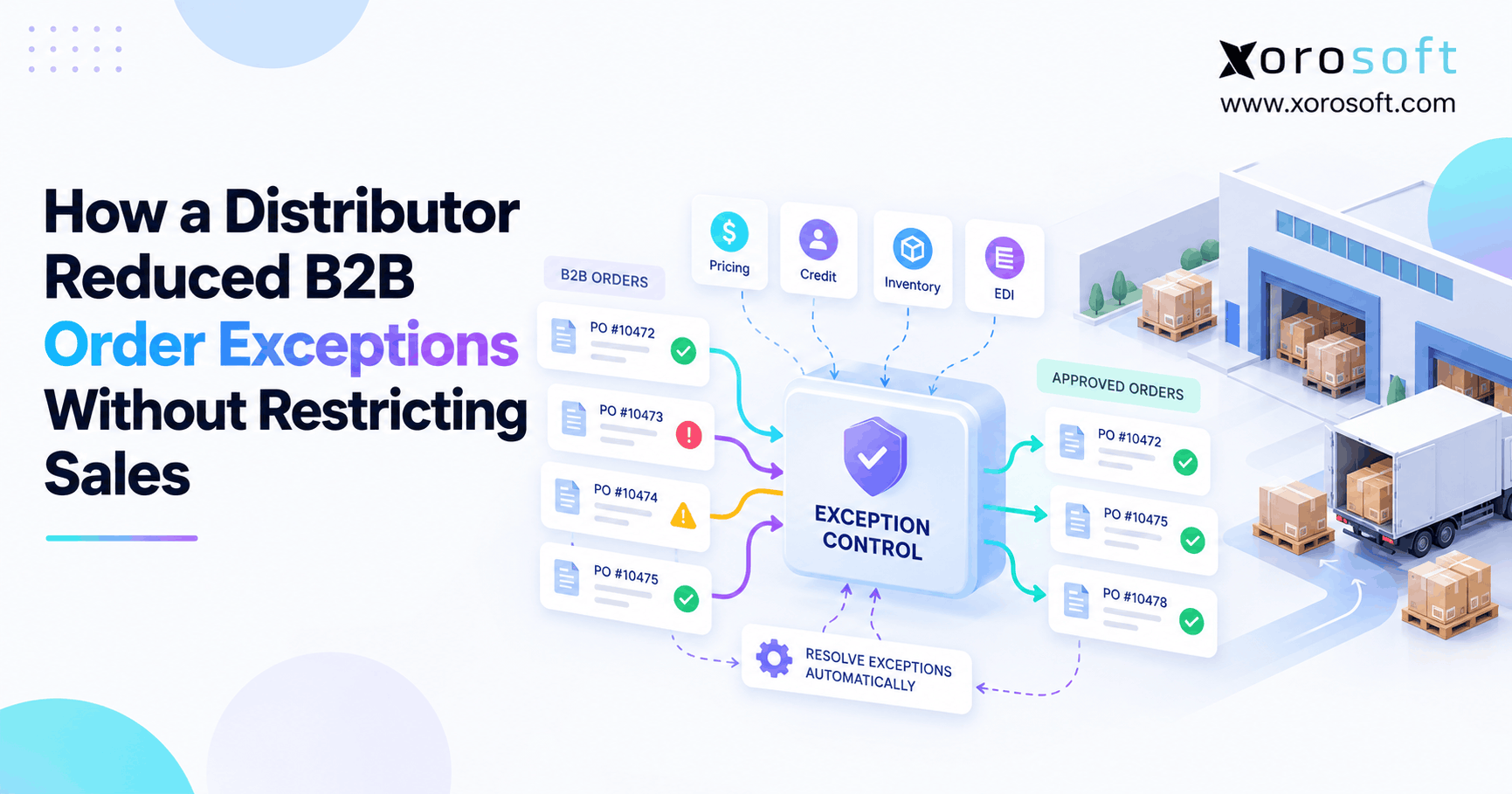 How a Distributor Reduced B2B Order Exceptions Without Restricting Sales