If you are dealing with inventory reservation failures, understanding the root causes and potential solutions is crucial for business operations.
1. When One Available Unit Becomes Two Customer Promises
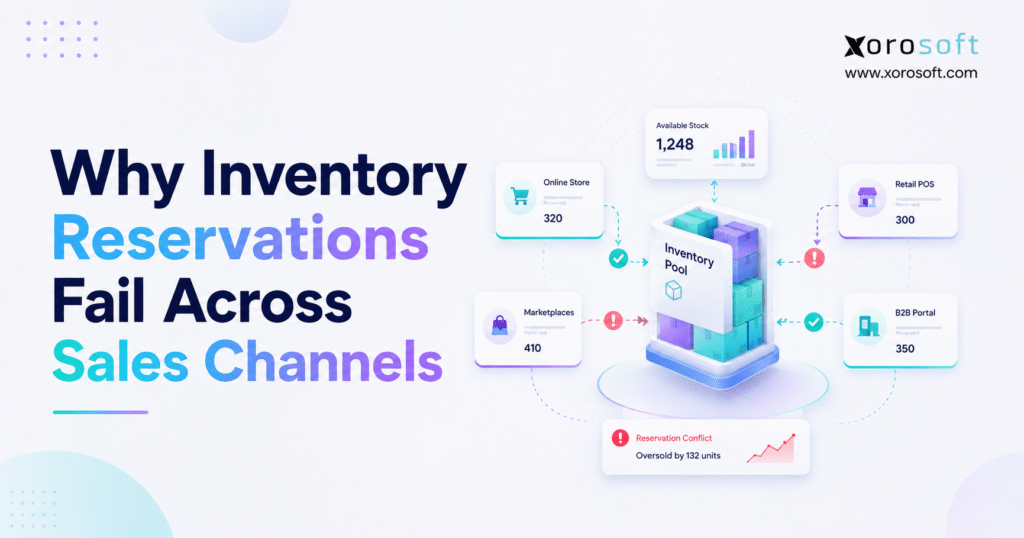
A Shopify customer purchases the final unit of a product at almost the same moment that an Amazon customer places an order for it. Each channel displays the item as available. Both platforms accept the order, and two customers now expect the same final unit.
Only one unit sits in the warehouse.
This scenario captures one of the most visible inventory reservation failures. The inventory count may have been accurate when both channels checked it. The process failed because neither channel knew that the other was about to claim the same stock.
A simple operation may reduce inventory after an order arrives and never experience a conflict. A multichannel business must coordinate a longer sequence. It checks availability, protects the quantity, records the order, selects a warehouse, updates every affected channel, and later consumes or releases the reservation. A delay or mismatch at any stage can create an incorrect promise.
The consequences reach beyond one canceled order. Customer service must explain the issue, the warehouse may search for alternatives, finance may process a refund, and the sales team may negotiate a substitute.
Reliable reservations therefore require more than frequent inventory updates. They depend on one inventory authority, deliberate reservation timing, accurate item data, location-aware rules, and a recovery process for failed events.
2. What Inventory Reservations Actually Control
2.1 Inventory Reservations Protect Stock for Specific Demand
An inventory reservation protects a defined quantity for a specific demand requirement. That demand may come from an ecommerce order, a wholesale sales order, a production job, a stock transfer, or another documented commitment.
Oracle describes a reservation as a link between supply and demand that ensures a specified quantity remains available for a requirement on a particular date. Microsoft also documents soft reservations that systems can create, validate, adjust, offset through physical consumption, or release.
A reservation does not mean that warehouse or finance teams have already picked, packed, shipped, invoiced, or received payment for the item. It tells connected systems to stop offering the protected quantity to competing demand.
A company can hold 100 units physically while offering only 25 to new customers because orders, channel allocations, quality holds, and safety stock protect the remainder.
2.2 The Reservation Lifecycle Has a Beginning and an End
A dependable reservation starts when an order or another demand source requests inventory. The system then checks whether eligible stock remains after active reservations, warehouse restrictions, safety stock, and unavailable quantities.
When stock remains eligible, the system records the reservation against the relevant demand. Warehouse allocation, picking, shipping, or manufacturing later uses that quantity.
The process must also end cleanly. The system should consume, reduce, move, or release the reservation when the order changes.
Many inventory reservation failures remain hidden during this final stage. The storefront may cancel an order correctly while the operational system never receives the release event. Inventory then remains unavailable even though no valid customer demand exists.
2.3 On-Hand, Available, Reserved, and Committed Inventory Mean Different Things
Teams often use “inventory” as if every system calculates the same number. In practice, platforms separate stock into several operational states.
Shopify, for example, distinguishes on-hand, available, committed, unavailable, and incoming quantities. It can also place stock in unavailable states such as safety stock, quality control, or damaged inventory.
| Inventory state | Operational meaning | Normally available for new orders? |
|---|---|---|
| On hand | Physical quantity recorded at a location | Not always |
| Available | Quantity eligible for new demand | Yes |
| Reserved | Stock protected for a specific requirement | No |
| Committed | Stock attached to an accepted order | Usually no |
| Allocated | Stock assigned to a channel, customer, or location | Depends on policy |
| Incoming or in transit | Expected or moving supply | Only under defined ATP rules |
| Safety stock | Quantity held as an operating buffer | No |
| Damaged, quarantined, or picked | Stock unavailable to new demand | No |
An integration that exchanges only on-hand inventory can ignore active reservations, quality holds, and safety stock. The receiving channel gets a physically correct number but an operationally incorrect sellable quantity.
3. Multiple Inventory Authorities Create Reservation Conflicts
3.1 Every Channel Has a Quantity, but No System Owns the Answer
The first question in any investigation should be simple: Which system has the final authority to decide whether an item can be sold?
Many growing companies cannot answer consistently. Shopify holds one quantity, Amazon displays another, a warehouse application tracks physical stock, accounting software carries inventory value, and a spreadsheet protects units for wholesale customers.
Each number may serve a valid purpose, but none necessarily represents the complete operational position. A business needs one controlled source from which channel availability flows.
Inventory reservation failures become much more likely when multiple systems can create, modify, or release commitments without a clear hierarchy.
3.2 Duplicate Updates Can Deduct Inventory Twice
Consider a business that allows Shopify to reduce inventory when an order arrives. A separate connector also sends the same order to the ERP, and the ERP publishes a revised balance back to Shopify. Without unique event controls, the same order can influence the quantity twice.
The opposite problem occurs when a wholesale order waits for a scheduled import while online channels continue selling stock that the business has already promised.
Faster synchronization can shorten these windows, but it cannot resolve unclear ownership. The operating model must document which system owns the inventory ledger, which application captures each order, where the final availability check occurs, and how the process releases stock.
4. How Inventory Reservation Failures Develop During Sync Delays
4.1 Batch Updates Leave Stale Inventory Available
A scheduled process may send updated inventory every 15 minutes. An order accepted one minute after the last export can leave other channels displaying an obsolete balance for another 14 minutes.
A low-volume company with hundreds of units per SKU may tolerate scheduled updates. Risk rises with fast-moving products, limited quantities, several channels, or large wholesale orders.
The more useful question is not, “Do we have real-time inventory?” It is, “How much demand can arrive before every channel sees the latest reservation?”
The company should align update speed, channel buffers, and reservation timing with each product’s exposure.
4.2 APIs and Webhooks Still Need Operational Controls
Event-based integrations reduce delay, but they introduce other requirements. A message may fail authentication, hit a rate limit, arrive twice, reach the destination out of sequence, or remain unprocessed during an outage.
Every inventory-changing event needs a unique reference and processing status. The system should ignore duplicates and prevent older events from overwriting newer positions.
When part of a multistep workflow fails, the business may need to reverse an earlier action. AWS documents this type of compensating process in an order workflow that can reverse inventory, payment, or order steps after a failure.
A fast integration without controlled retries and recovery can spread inventory reservation failures more quickly instead of preventing them.
5. Reservation Timing Determines Which Order Gets the Stock
5.1 Cart Reservations Can Create Phantom Stockouts
A cart-level reservation protects scarce inventory before the customer reaches payment. This rule can help during limited product launches or transactions that take several minutes to complete.
However, many carts never become orders. Long reservation windows can make genuine buyers see an item as unavailable even though no customer has completed the purchase. The company avoids overselling but creates a phantom stockout.
Cart reservations need short expiration periods, a clear session reference, and immediate release when the cart expires.
5.2 Checkout Reservations Balance Protection and Abandonment
Beginning the reservation at checkout shows stronger purchase intent than an add-to-cart event. Yet customers can still abandon the process, open multiple sessions, or pause while comparing delivery and payment options.
A checkout reservation needs a defined timeout and enough history to identify the session that held the stock.
5.3 Order and Payment Reservations May Arrive Too Late
Order-level reservations create a clear document reference. Payment-level reservations reduce the stock held for invalid or unpaid orders. Both rules can fail for fast-selling products because two channels may accept orders before either completes payment processing.
| Reservation trigger | Main advantage | Primary risk |
| Add to cart | Protects scarce stock early | Abandoned carts block inventory |
| Begin checkout | Reflects stronger purchase intent | Checkout can still stall |
| Create order | Provides a clear order reference | Competing orders may already exist |
| Authorize payment | Avoids many unpaid commitments | Reservation may occur too late |
| Approve fraud review | Protects stock for validated demand | Review delays increase exposure |
Product scarcity, payment speed, order velocity, fraud rules, and customer expectations should guide the trigger.
6. Warehouse-Level Rules Can Turn a Valid Reservation into an Unfulfillable Order
6.1 Enterprise Inventory Does Not Equal Fulfillable Inventory
A company may hold ten units across its network and still lack one unit that can fulfill a specific order.
One warehouse may hold five units but lack permission to ship to the customer’s region. The quality team may inspect two units, retail rules may protect one for a store, and another unit may miss the carrier cutoff. A 3PL may hold the final unit without confirming its physical availability.
If the reservation engine checks only the enterprise total, it can protect inventory that cannot meet the customer promise.
Location-aware rules should consider the warehouse, customer region, service level, stock status, cutoff time, channel restrictions, carrier capability, and transfer options before confirming availability.
6.2 Incorrect Warehouse Allocation Increases Cost and Delay
The enterprise ledger may validate a reservation while routing rules assign it to the wrong fulfillment source. This error can trigger split shipments, manual reallocation, extra freight, or a missed delivery promise.
Warehouse eligibility can change after reservation. A facility may find damage, miss a cutoff, or lose carrier capacity, so the operation needs clear reassignment and backorder rules.
A connected XoroWMS warehouse management system can link inventory visibility with receiving, picking, packing, shipping, transfers, and warehouse exceptions. XoroWMS also supports inventory and fulfillment activity across multiple warehouse locations.
The goal is not merely to know where inventory exists. The business needs to know whether a location can fulfill the specific order under the promised conditions.
7. SKU, Bundle, and Unit Errors Hide Inventory Reservation Failures
7.1 Channel SKU Mapping Must Match Physical Inventory
A reservation can only protect the right stock when product data connects every channel listing to the correct inventory item.
One marketplace may use a different SKU from the ERP. Two variants may point to the same physical product. A wholesale case may represent 12 individual units while the ecommerce site sells single pieces. Each order can create an incorrect movement when those relationships do not match.
High stock levels may hide these problems until several channels compete for the final units.
The inventory authority should control conversions centrally. Every case, pack, pallet, and individual unit must reduce the underlying inventory in the correct proportion.
7.2 Bundle Reservations Must Protect Components
A bundle may appear as one sellable SKU, but its availability depends on every required component.
Suppose a gift set needs one bottle, two accessories, and one box. The warehouse holds 20 bottles, 30 accessories, and eight boxes. The business can promise only eight complete sets because the box limits production.
If the system reserves only the bundle SKU, standalone orders can consume components that confirmed bundles still need. If it reserves components but fails to release them after cancellation, the company creates phantom stockouts across several products.
Manufacturing adds another layer because sales orders and work orders can compete for the same components and raw materials.
8. Cancellations, Returns, and Transfers Must Reopen Stock Correctly
8.1 A Canceled Order Must Release Its Reservation
A customer service agent may cancel an order in the storefront while the operational system keeps the reservation active. The cancellation event may fail, reach the wrong location, or close the order without reversing the protected quantity.
This creates orphaned stock: inventory that supports no valid demand but remains unavailable.
Operations teams should review reservation age, identify stock linked to inactive orders, and measure cancellation-to-release time.
Partial cancellations need precise handling. When a customer reduces an order from ten units to six, the system should release four without reopening the full quantity.
8.2 Returned Inventory Requires an Eligibility Decision
A returned product may sit physically in the warehouse while remaining unsuitable for sale. It may need inspection, cleaning, repackaging, repair, or disposal.
The returns team should place the item in a controlled state and release it only after confirming its condition. Shopify’s inventory model also separates unavailable stock into reasons such as damaged, quality control, and safety stock, which helps illustrate why physical presence does not always mean sellable availability.
8.3 Transfers Need In-Transit and Received States
A transfer should not reduce the origin and instantly increase sellable inventory at the destination. Stock remains in transit between shipment and receipt.
If the destination becomes available too early, the business may accept an order for goods that have not arrived. If the system fails to reduce the origin, both warehouses may appear to own the same inventory.
A controlled transfer tracks shipment, transit, receipt, inspection, and final availability. Skipping a stage can create inventory reservation failures at both locations.
9. Shopify, Amazon, Wholesale, and EDI Create Different Reservation Pressures
9.1 Shopify Inventory Depends on the Wider Operating Model
Shopify tracks inventory by location and separates available, committed, unavailable, incoming, and on-hand quantities. It also defines committed inventory as units connected to orders that have not yet reached fulfillment.
Native controls may cover a Shopify-only business with one warehouse and simple products. When marketplaces, wholesale, EDI, manufacturing, or external warehouses share the same stock, the company must decide whether Shopify owns availability or receives it from another platform.
Merchants evaluating that broader connection can review the Xorosoft ERP app on the Shopify App Store. The listing provides a direct path for Shopify businesses that want to connect storefront activity with ERP operations.
9.2 Marketplace Orders Need Controlled Quantity Publishing
Amazon and other marketplaces generally receive a quantity that the merchant chooses to publish. The business may subtract a buffer, protect inventory for another channel, or limit marketplace exposure for scarce products.
Marketplace orders must reach the authoritative system quickly, and operations teams should see failed imports or updates in an exception queue. Buffers should reflect product velocity and channel risk rather than permanently replace accurate reservations.
9.3 Wholesale and EDI Orders Can Consume Large Blocks of Stock
Wholesale orders often involve case packs, allocations, future ship dates, and credit review, and one order can consume a large block of stock.
These commitments must enter the same inventory authority as direct and marketplace demand. A spreadsheet known only to the sales team cannot protect inventory that online channels still display.
For EDI, the company should define the exact event that creates the reservation. Receipt, validation, acknowledgment, credit approval, or sales-order creation could trigger it. Teams should apply and audit the same rule for every transaction.
10. Reliable Architecture Prevents Inventory Reservation Failures
10.1 One System Must Validate the Final Commitment
A modern operation may use an ecommerce platform, OMS, ERP, WMS, marketplace connector, 3PL, and several warehouse systems. It should not allow several independent answers to the question, “Can we promise this item?”
One controlled platform must validate the final reservation. Other applications can request inventory, contribute transactions, and display balances, but they should follow the same decision.
AWS’s distributed order management guidance presents an architecture where enterprise product, facility, and inventory data flow into an OMS, while ecommerce orders enter the same environment for allocation and release.
The responsible application may differ by company. Clear ownership matters more than the label on the software.
10.2 Every Inventory-Changing Event Must Reach the Authority
The architecture should process new orders, edits, cancellations, failed payments, returns, exchanges, receipts, transfers, cycle counts, damage, quality holds, shipments, manufacturing consumption, and production completion.
Each event needs a unique identifier, source, timestamp, item, location, quantity, and status. Failed events should enter an exception queue with an owner and replay path.
10.3 Connected ERP Reduces Reservation Ambiguity
A cloud ERP can act as the operational authority when inventory, orders, purchasing, warehouses, manufacturing, accounting, and ecommerce activity must share the same records.
XoroONE combines inventory, warehouse management, manufacturing, accounting, and ecommerce operations within one cloud ERP platform. Its inventory management positioning also connects purchasing, fulfillment, and operational reporting around a shared inventory record.
A connected platform gives teams one place to trace a reservation through allocation, fulfillment, release, and financial impact.
11. Diagnosing Inventory Reservation Failures Without Guesswork
11.1 Start with One SKU and an Exact Timeline
Begin with one order, item, channel, and warehouse.
Record when the channel checked availability, accepted the order, authorized payment, requested the reservation, received confirmation, sent the order to the warehouse, and published revised availability elsewhere.
These inventory reservation failures often reveal their cause when the team compares events in chronological order. The timeline usually exposes a stale read, late reservation, duplicate transaction, rejected message, or warehouse allocation error.
11.2 Confirm the Inventory System of Record
Ask sales, warehouse, finance, ecommerce, and customer service teams which system they trust when quantities disagree. Different answers reveal a governance problem before anyone inspects code.
The authoritative record should explain the opening balance, every receipt and deduction, every active reservation, every unavailable status, and the resulting quantity available for new demand.
11.3 Test the Full Reservation Lifecycle
A serious test should cover more than a successful order. Teams should simulate two simultaneous last-unit orders, an abandoned checkout, payment failure, full cancellation, partial cancellation, duplicate message, delayed event, bundle shortage, warehouse reassignment, 3PL outage, and returned inventory under inspection.
For each test, define the expected status, balances, and recovery action.
11.4 Monitor Reservation Health
Useful measures include reservation failure rate, oversell cancellations, orphaned reservations, average reservation age, release-processing time, channel variance, allocation exceptions, and manual adjustments.
Reservation age may reveal abandoned checkouts, while frequent corrections or persistent variance may expose process gaps and inconsistent starting balances.
12. When Inventory Reservation Failures Signal an ERP Upgrade
12.1 Fix Process and Data Problems Before Replacing Software
Not every failure requires a new platform. Teams can often correct inaccurate SKU mappings, poor cancellation procedures, missing warehouse status rules, and unclear permissions within the existing stack.
The company should map the lifecycle, identify the inventory authority, correct item data, define release policies, and then review the remaining system gaps.
12.2 Repeated Manual Reconciliation Shows an Architectural Limit
An ERP evaluation becomes reasonable when the business cannot maintain one inventory position without daily spreadsheets and manual intervention.
Common signals appear when sales teams manage wholesale allocations outside the inventory system, warehouses cannot reconcile balances with accounting, service teams release cancellations manually, purchasing works from different demand data, and each new sales channel adds another disconnected database.
XoroERP connects manufacturing, inventory, purchasing, warehousing, and accounting workflows for inventory-driven operations. Businesses comparing ERP options can also review the Xorosoft versus NetSuite comparison to consider platform scope, complexity, and implementation fit.
12.3 Ask Vendors About Real Failure Scenarios
A feature checklist will not reveal how the platform handles inventory reservation failures.
Ask when the system creates reservations, how it validates two simultaneous orders, what releases stock after cancellation, and whether rules can vary by channel, customer, or warehouse.
The vendor should also explain bundles, incoming supply, EDI orders, duplicate events, failed integrations, 3PL updates, and audit history.
13. Industry Workflows Change the Shape of Reservation Risk
13.1 Apparel and Fashion Depend on Variant Accuracy
Apparel businesses manage size, color, style, season, and location combinations. A mapping error that affects one variant can remain hidden inside an accurate total for the overall style.
Limited releases, returns, store stock, and wholesale commitments all increase competition for the same variants.
13.2 Furniture Requires Delivery-Aware Availability
Furniture businesses manage regional warehouses, long supplier lead times, oversized freight, floor models, and scheduled delivery.
A warehouse may hold a sofa but lack the ability to deliver it to the customer’s region. The reservation engine needs location, service, and ATP rules rather than a simple total.
13.3 Sporting Goods and Kits Share Component Supply
Sporting goods companies often sell kits, seasonal assortments, team packages, and standalone components. A confirmed kit order should protect the parts required to build it.
Dealer and team allocations still require enterprise visibility. Component-level rules help prevent inventory reservation failures between bundles and individual products.
13.4 Food and Beverage Must Respect Lot Eligibility
Food businesses may hold stock that cannot fulfill a specific order because of expiration, quality, lot, or customer requirements.
Reservation logic may need first-expired-first-out rules and customer-specific shelf-life controls. Quarantined or expired stock should never reenter availability without review.
13.5 Wholesale and Manufacturing Compete for the Same Supply
Wholesale distributors may reserve stock for strategic customers, while manufacturers protect raw materials for work orders and finished goods for sales demand.
The system must stop sales orders, production jobs, transfers, and allocations from claiming the same supply. Xorosoft outlines connected workflows for inventory-heavy sectors on its ERP solutions by industry pages.
14. Frequently Asked Questions About Inventory Reservation Failures
14.1 What Is an Inventory Reservation?
An inventory reservation protects a defined quantity for a specific demand source, such as a sales order, transfer, wholesale customer, or production requirement. It reduces the amount available to competing demand without changing the physical on-hand balance.
14.2 What Is an Inventory Reservation Failure?
An inventory reservation failure occurs when a system fails to protect, validate, synchronize, consume, adjust, or release stock correctly. The failure may produce overselling, duplicate commitments, phantom stockouts, partial fulfillment, or inventory that remains unavailable after an order no longer requires it.
14.3 Why Do Inventory Reservation Failures Occur Across Sales Channels?
Inventory reservation failures usually occur because channels use different availability calculations, updates arrive late, reservation rules start at different order stages, or several systems control stock. Incorrect item mappings, warehouse restrictions, failed cancellations, wholesale commitments, and manual overrides add further risk.
14.4 How Do Inventory Reservations Prevent Overselling?
A reservation protects inventory for accepted demand and immediately reduces the quantity available to competing orders. A shared authority can reject, backorder, or reroute a second request after the final unit supports another order.
14.5 What Is the Difference Between Reservation and Allocation?
A reservation protects stock for a specific requirement. Allocation assigns stock to a channel, customer, order, or fulfillment source. A company might allocate 100 units to wholesale and reserve 20 of those units for a confirmed customer order.
14.6 What Is the Difference Between Available-to-Sell and ATP?
Available-to-sell generally represents inventory that can support immediate demand. Available-to-promise can include future receipts, transfers, production, and scheduled demand to calculate how much the business can promise and on what date. Microsoft describes ATP as a future-looking availability calculation rather than a simple current on-hand balance.
14.7 What Is a Soft Inventory Reservation?
A soft reservation logically protects inventory before warehouse teams consume it through picking or another physical transaction. The business can still adjust, offset, move, or release the quantity as the order progresses. Microsoft’s Inventory Visibility documentation uses this model for reservation validation and later physical consumption.
14.8 What Is a Hard Inventory Reservation?
A hard reservation usually represents a stricter commitment against a location, lot, serial number, or warehouse task. Definitions vary, so businesses should document when a general commitment becomes warehouse-specific.
14.9 When Should Inventory Be Reserved?
The correct point depends on scarcity, order velocity, payment speed, abandonment risk, and fraud review. Scarce products may need a short checkout reservation, while standard items may wait until order acceptance or payment authorization. The company must also define the event that expires or releases the reservation.
14.10 Should Inventory Be Reserved Before Payment?
Early reservations can help when products sell quickly or payment processing takes time. However, abandoned payments can create phantom stockouts. A practical policy may use a short checkout hold and extend it only after payment authorization or another valid order milestone.
14.11 How Long Should an Inventory Reservation Last?
The duration should match the commercial workflow. A checkout reservation may last minutes, while a wholesale commitment may remain active until a future shipping date. Every reservation needs an owner, expiration date, and release rule.
14.12 What Happens When Two Customers Buy the Last Item?
Both customers may see the item as available when they check before the first reservation completes. A centralized validation process should approve the first valid request and reject, backorder, or reroute the second. Independent channel checks cannot reliably protect the same final unit.
14.13 Why Does Reserved Inventory Still Appear Available?
The channel may display a cached quantity, an update may have failed, or the reservation may exist in a system that does not control channel availability. Incorrect location mappings, out-of-sequence events, and publishing on-hand rather than available inventory also cause this problem.
14.14 Why Does Inventory Remain Reserved After Cancellation?
The storefront may cancel the customer order while the operational system fails to release the inventory. A delayed, rejected, or incorrectly mapped cancellation message can leave stock attached to demand that no longer exists. Reservation-aging reports help teams find these orphaned commitments.
14.15 How Do Payment Failures Affect Inventory Reservations?
A final payment failure should release the inventory immediately or after a defined retry window. Without an automatic release or expiration rule, unpaid orders can keep stock unavailable. Payment status, reservation status, and customer communication should follow one coordinated workflow.
14.16 Can Inventory Be Reserved by Sales Channel?
Yes. A business can allocate or protect separate quantities for ecommerce, marketplaces, wholesale, retail, or priority customers. These channel pools should still reconcile to one enterprise inventory position. Separate buffers cannot solve inventory reservation failures when each channel starts with a different underlying balance.
14.17 Can Inventory Be Reserved by Warehouse?
Yes. Warehouse-level reservations protect inventory at a location that can fulfill the order. The validation should consider customer region, carrier service, cutoff time, stock status, lot rules, 3PL availability, and whether the business can transfer or reassign the order.
14.18 How Do Bundles Affect Inventory Reservations?
A bundle depends on every required component. The component that supports the fewest complete bundles usually limits availability. The system must protect those components from standalone orders and release them correctly when a customer cancels or reduces the bundle order.
14.19 How Do Returns Affect Available Inventory?
The returns team should keep stock unavailable until it confirms the product’s condition. Inspection, repair, cleaning, repackaging, or quality approval may need to occur before the item can support another order. Physical presence alone does not make a returned product sellable.
14.20 How Do Wholesale Orders Affect Ecommerce Reservations?
Wholesale orders can consume large quantities and may include customer allocations, case packs, credit review, or future ship dates. They must enter the same inventory authority as ecommerce demand. Otherwise, online channels may sell units that the business has already promised to wholesale customers.
14.21 Can Shopify Manage Inventory Reservations?
Shopify can manage inventory states, locations, committed quantities, and orders. Its role as the enterprise authority depends on the wider operation. Marketplaces, wholesale, manufacturing, EDI, and multiple warehouses may require an ERP or OMS.
14.22 Can an OMS Manage Inventory Reservations?
An OMS can manage sourcing, allocation, reservation, routing, split shipments, and fulfillment exceptions. Its effectiveness depends on accurate enterprise inventory data and strong connections to warehouse and financial systems. Some companies use the OMS as the reservation authority while an ERP maintains the broader ledger.
14.23 Can a WMS Manage Inventory Reservations?
A WMS can protect and allocate physical stock for warehouse execution, including bins, lots, serial numbers, and picks. It should coordinate warehouse reservations with the central inventory and order authority.
14.24 Do Small Businesses Need Advanced Reservation Software?
Not always. A business with one sales channel, one warehouse, low order volume, and simple finished products may use native ecommerce inventory successfully. Advanced controls become more valuable as channels, locations, bundles, wholesale commitments, manufacturing, and order velocity increase.
14.25 When Should a Business Upgrade to ERP?
An ERP upgrade becomes appropriate when teams cannot identify the inventory authority, reconciliation becomes routine, cancellations leave stock trapped, purchasing and sales use different demand data, or every new channel adds another disconnected application. Recurring inventory reservation failures often signal that the architecture no longer matches the operation.
15. Build an Inventory Reservation Process the Business Can Trust
Inventory reservation failures rarely come from one dramatic software defect. Small gaps develop between order capture, payment, availability validation, channel updates, warehouse execution, cancellations, returns, and transfers. Over time, those gaps create overselling, trapped stock, manual reconciliation, and poor customer promises.
The practical response starts with one authoritative inventory position. Teams should define when a reservation begins, which warehouse can fulfill it, and which event consumes or releases it.
Operations leaders should expose rejected imports, duplicate events, delayed 3PL confirmations, and failed releases before another customer encounters the problem.
When separate applications make that control difficult, a connected ERP and warehouse architecture can provide a more reliable operating foundation. Xorosoft offers cloud ERP and WMS options for businesses that manage Shopify, marketplaces, wholesale, EDI, manufacturing, purchasing, accounting, and multiple warehouse locations.
Businesses that experience recurring inventory reservation failures can book a personalized consultation to review their channels, warehouses, reservation rules, integrations, and current software stack.
Recent Posts
-
 ERP Landed Cost Module vs Spreadsheet Calculations for Importers
 -
 How to Build an Open-to-Buy Plan for an Omnichannel Brand
 -
 Cold Storage WMS for Food and Beverage Distribution
 -
 ERP Buying Statistics 2026: Evaluation, Implementation, and Adoption Risks
 -
 How a Distributor Reduced B2B Order Exceptions Without Restricting Sales