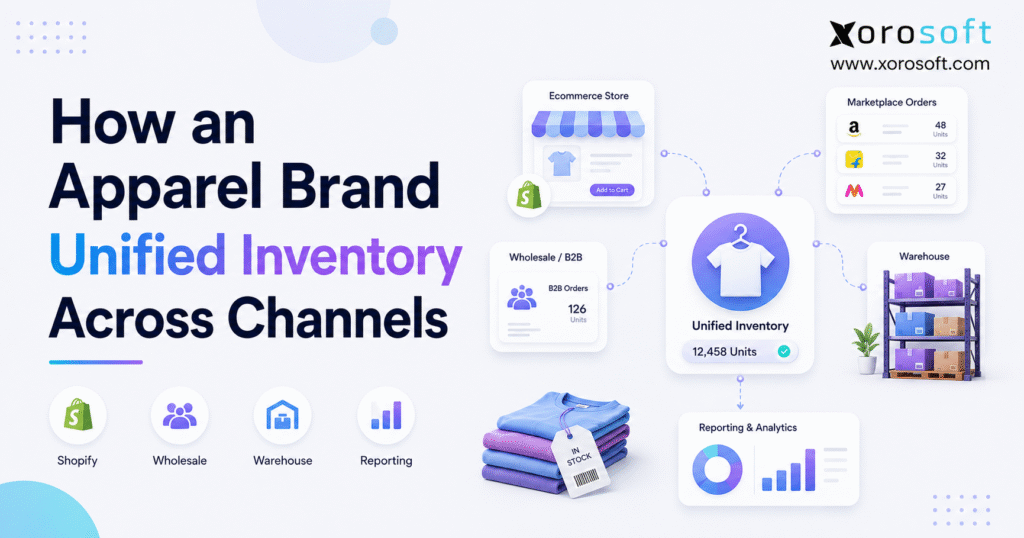
Managing cross-channel apparel inventory is crucial for retailers seeking efficiency and accuracy.
1. When Cross-Channel Apparel Inventory Starts Working Against Growth
Cross-channel apparel inventory becomes difficult when Shopify, Amazon, wholesale orders, warehouses, and accounting systems all show different stock numbers. At first, those differences may appear small. However, as order volume grows, even a minor discrepancy can create overselling, stockouts, delayed wholesale shipments, incorrect purchasing decisions, and difficult month-end reconciliation.
For example, an ecommerce manager may see 80 black medium jackets available in Shopify. Meanwhile, the warehouse may have only 52 units ready to ship. Another 12 units may already be reserved for wholesale, while eight units may still be awaiting return inspection. Therefore, the brand does not truly have 80 jackets available to sell.
Apparel makes this challenge especially difficult because one product can create dozens of inventory records. A single jacket may have several colors, sizes, fits, collections, seasons, and warehouse locations. In addition, that jacket may be offered through DTC ecommerce, Amazon, wholesale, retail, and preorder campaigns.
Consequently, inventory complexity grows much faster than the product catalog itself.
A representative apparel brand facing this problem did not need another dashboard. Instead, it needed one operating model that could control stock availability across every channel. Therefore, the company rebuilt its processes around a central source of truth, clear allocation rules, standardized SKUs, warehouse scanning, purchasing controls, and connected accounting.
The result was not simply better reporting. More importantly, the company created an inventory process that operators could trust.
2. Why Cross-Channel Apparel Inventory Breaks
Cross-channel apparel inventory usually breaks because each sales channel processes demand independently. Shopify reduces stock after an ecommerce order. Amazon manages marketplace commitments. Wholesale teams reserve quantities for large accounts. Meanwhile, warehouse teams receive, transfer, pick, pack, and return units throughout the day.
Although each activity changes inventory, those changes may not reach every system at the same time. As a result, each platform starts operating from a slightly different version of the truth.
2.1 Apparel Variant Complexity Multiplies Inventory Records
A standard consumer product may have one SKU. By contrast, an apparel style may include:
- Six sizes
- Four colors
- Two fits
- Several seasonal collections
- Multiple bundles
- Different warehouse locations
- Channel-specific availability rules
Therefore, one style can quickly create dozens of trackable inventory combinations.
In addition, each variation needs a clear and consistent identifier. According to GS1 product identification guidance, apparel variations based on style, color, and size should receive unique product identification.
Consequently, weak product identification creates problems far beyond naming. Duplicate SKUs can cause incorrect channel mappings, receiving errors, warehouse confusion, inaccurate reports, and failed integrations.
2.2 Channel Timing Disrupts Apparel Inventory Synchronization
Shopify may reduce inventory as soon as a customer places an order. However, wholesale inventory may be reserved when a sales order receives approval rather than when it ships.
Likewise, Amazon inventory may include stock stored through marketplace fulfillment services. Meanwhile, another quantity may remain in the brand’s warehouse for direct fulfillment.
Because these events happen at different times, synchronization delays can create temporary gaps. Yet customers and wholesale buyers make purchasing decisions during those gaps.
Therefore, an inventory system must control availability before a unit is promised. It cannot depend only on updates that happen after fulfillment.
2.3 Multi-Location Apparel Stock Adds Another Layer
A growing apparel brand may keep inventory in:
- A primary distribution center
- A third-party logistics warehouse
- A retail store
- A regional warehouse
- Amazon fulfillment locations
- A dedicated returns facility
Shopify explains that inventory can be tracked separately across warehouses, stores, fulfillment services, and other assigned locations. Its multi-location inventory documentation also shows why location-level control matters for fulfillment.
However, location quantities alone do not create unified inventory. The brand must also determine which location can fulfill each channel, which stock should remain protected, and how warehouse transfers affect availability.
2.4 Wholesale Orders Compete With Ecommerce Inventory
Wholesale orders create a different type of inventory pressure. A DTC order may consume one or two units, while a wholesale order may require hundreds.
Therefore, a large wholesale order can remove significant inventory before the warehouse begins fulfillment. If that stock is not reserved immediately, Shopify or Amazon may continue selling the same units.
As a result, the wholesale team may promise inventory that ecommerce has already consumed. The brand must then delay the wholesale shipment, split the order, or expedite replacement inventory.
2.5 Apparel Returns Create Hidden Inventory
Returns are especially important for apparel brands because products often come back due to size, fit, color, or style preferences.
The National Retail Federation estimated that 19.3% of online sales would be returned in 2025. Therefore, returns cannot be treated as an occasional exception within apparel operations. The NRF Retail Returns Landscape provides additional industry context.
However, returned inventory should not immediately become available to sell. First, the item may require:
- Quality inspection
- Repackaging
- Cleaning
- Relabeling
- Repair
- Damage assessment
- Disposal or write-off
Consequently, returned stock needs a controlled status workflow. Otherwise, the system may offer inventory that the warehouse cannot ship.
3. What Unified Apparel Inventory Actually Means
Cross-channel apparel inventory does not simply display every sales channel on one dashboard. Instead, it ensures that every inventory-changing event updates one controlled inventory record. Therefore, the brand can manage stock availability across ecommerce, wholesale, marketplaces, warehouses, and returns without maintaining separate inventory truths.
Shopify, Amazon, wholesale, purchasing, receiving, warehouse operations, returns, and accounting should not maintain independent stock records.
A unified system should answer five questions immediately:
1. How many units physically exist?
2. Where are those units located?
3. How many units are already committed?
4. How many units can still be sold?
5. What inventory is expected to arrive?
Without those answers, a total stock number has limited operational value.
3.1 On-Hand Apparel Inventory
On-hand inventory is the physical quantity stored in a warehouse, store, 3PL, or fulfillment location.
However, on-hand inventory does not represent what the company can still sell. Some units may already be committed, damaged, reserved, or moving between locations.
3.2 Available-to-Sell Apparel Inventory
Available-to-sell inventory is the quantity that can still be promised to customers.
For example:
- On-hand inventory: 100 units
- Committed ecommerce orders: 20 units
- Reserved wholesale stock: 15 units
- Damaged inventory: 5 units
- Returns awaiting inspection: 10 units
- Available-to-sell inventory: 50 units
Therefore, publishing the full on-hand quantity would create an overselling risk.
3.3 Committed Inventory Across Sales Channels
Committed inventory is linked to confirmed customer or wholesale orders.
Although the units may still be physically present, they are no longer available for another order. Consequently, the inventory system must reduce availability before warehouse fulfillment begins.
3.4 Reserved Apparel Stock
Reserved inventory is intentionally protected for a channel, customer, promotion, preorder, or wholesale program.
For example, a brand may reserve 200 units for a major wholesale account. Alternatively, it may protect inventory for an upcoming launch.
Therefore, reservation logic allows the business to control strategic availability rather than letting every channel compete for the same units.
3.5 Incoming Apparel Inventory
Incoming inventory represents confirmed purchase orders or warehouse transfers that have not yet been received.
However, incoming inventory should remain separate from available inventory. Although it may support planning and preorder decisions, the warehouse cannot ship it until receiving is complete.
3.6 Inventory Moving Between Locations
Inventory in transfer is moving between warehouses or fulfillment locations.
Therefore, those units should normally be removed from the sending location. However, they should not become available at the receiving location until the transfer is confirmed.
3.7 Returned and Damaged Apparel Stock
Returned and damaged units require separate statuses.
For instance, a returned shirt may be ready for resale after inspection. By contrast, another unit may require cleaning or may no longer be sellable.
Consequently, status-based control prevents unusable products from appearing in channel availability.
4. The Apparel Brand’s Disconnected Inventory Starting Point
Before improving its cross-channel apparel inventory, the representative brand operated with a familiar collection of tools.
4.1 The Brand’s Original Software Stack
The operating stack included:
- Shopify for DTC ecommerce
- Amazon for marketplace sales
- Spreadsheets for wholesale allocations
- Email and CSV files for purchase orders
- A warehouse application for fulfillment
- Accounting software for financial reporting
- Manual exports for management reports
Initially, each system solved a specific problem. However, the complete stack did not control inventory as one continuous workflow.
The ecommerce team trusted Shopify. Meanwhile, the warehouse team trusted physical counts. Wholesale salespeople maintained their own allocation file. Purchasing relied on exported sales history, while finance corrected inventory value during month-end close.
Consequently, the organization had several inventory numbers but no reliable inventory truth.
4.2 Warning Signs of Fragmented Apparel Inventory
The brand began to experience recurring problems:
- Shopify displayed units the warehouse could not locate.
- Wholesale stock was protected through spreadsheet notes.
- Marketplace orders occasionally consumed inventory promised elsewhere.
- Returns remained unprocessed for several days.
- Buyers reordered products using outdated reports.
- Warehouse transfers caused temporary negative inventory.
- Finance posted manual inventory adjustments at month-end.
- Leadership waited for spreadsheet reports before making decisions.
Because these issues affected several departments, they could not be fixed by changing one sales channel setting.
Instead, the company needed to redesign how inventory moved through the business.
5. A Seven-Step Cross-Channel Apparel Inventory Reset
The brand approached the project as an operational reset rather than a software installation.
First, it defined accurate product data. Next, it established system ownership. Then, it connected channels, warehouses, purchasing, returns, and accounting.
Therefore, technology supported the new process instead of preserving the old one.
5.1 Standardize Apparel SKUs and Product Variants
The team reviewed every active SKU and product variation.
First, it identified duplicate item codes. Next, it standardized style, color, and size naming. In addition, it archived discontinued variants and corrected mismatched barcodes.
For example, the same black medium shirt had previously appeared as:
- BLK-M
- BLACK-MED
- SHIRT-BLACK-M
- BLK-MEDIUM
Although employees understood these labels, software integrations treated them as separate records.
Therefore, the brand created one SKU structure for every channel and warehouse.
A strong SKU standard included:
- Style code
- Color code
- Size code
- Season or collection when necessary
- Pack or bundle indicator
- Unique barcode or GTIN
- Active or discontinued status
As a result, products could move through sales, warehouse, purchasing, and accounting workflows without translation.
5.2 Establish One Unified Inventory Source of Truth
The brand then determined which system owned inventory.
Sales channels remained responsible for customer-facing commerce. However, they no longer controlled the authoritative stock quantity.
Instead, the central inventory system owned:
- SKU records
- Warehouse quantities
- Available-to-sell calculations
- Sales commitments
- Wholesale reservations
- Purchase order receipts
- Transfers
- Adjustments
- Returns
- Inventory valuation inputs
Therefore, every connected channel received inventory from the same operating layer.
5.3 Create Channel-Specific Apparel Inventory Rules
The company stopped sending the same quantity to every channel.
Instead, it created availability rules based on channel risk and business priorities.
For example:
- Shopify: available DTC inventory after open-order commitments
- Amazon: available marketplace inventory minus a safety buffer
- Wholesale: reserved inventory linked to approved sales orders
- Retail: location-specific store stock
- Preorders: incoming inventory based on confirmed purchase orders
Consequently, each channel saw a controlled quantity rather than the entire physical stock position.
This change mattered because unified inventory does not require every channel to share everything. Instead, it requires every channel rule to draw from the same inventory truth.
5.4 Reserve Inventory Before Fulfillment
Previously, inventory changed mainly when orders shipped.
However, that approach allowed other channels to sell units that had already been promised.
Therefore, the brand began reserving inventory as soon as an order met the appropriate approval conditions.
For DTC orders, payment approval triggered a commitment. Meanwhile, approved wholesale orders created reservations. Marketplace orders also reduced the appropriate availability pool.
As a result, the warehouse received orders with inventory already assigned.
5.5 Capture Warehouse Movements Through Scanning
System inventory cannot remain accurate unless physical movement is recorded.
Therefore, the brand introduced scanning for:
- Purchase order receiving
- Putaway
- Bin transfers
- Picking
- Packing
- Shipment confirmation
- Cycle counting
- Returns
- Damaged inventory
- Warehouse transfers
A connected real-time warehouse management system can help enforce these movements through structured workflows.
Instead of updating inventory later, warehouse employees recorded each transaction while it occurred. Consequently, the gap between physical and system inventory became easier to control.
5.6 Control Apparel Returns Through Inspection Statuses
The company also redesigned returns processing.
First, every return entered a received status. Next, warehouse staff inspected the product. Then, the unit moved to one of several outcomes:
- Return to sellable inventory
- Repackage
- Clean or repair
- Discount or secondary channel
- Return to vendor
- Dispose
- Write off
Therefore, products did not become available until the inspection process was complete.
In addition, managers could monitor the returns backlog. As a result, valuable stock no longer remained hidden in an unprocessed returns area.
5.7 Connect Purchasing and Accounting to Inventory
The final step connected purchasing and accounting to apparel inventory management.
Previously, buyers reviewed spreadsheets and historical sales exports. However, the new workflow considered:
- Available inventory
- Open sales orders
- Wholesale reservations
- Incoming purchase orders
- Supplier lead times
- Sales velocity
- Safety stock
- Seasonal demand
- Returns
- Inventory aging
Therefore, purchase decisions reflected real operational demand rather than an isolated stock number.
Likewise, accounting received cleaner inventory movement data. As a result, finance had better visibility into receipts, adjustments, landed costs, transfers, write-offs, and inventory valuation.
6. What Changed After Apparel Inventory Unification
After implementing cross-channel apparel inventory controls, the brand did not eliminate every inventory exception. However, it changed how quickly the team could identify, investigate, and resolve those exceptions.
6.1 Inventory Visibility Before and After Unification
Before unification, each department relied on a different stock number.
After unification, every team reviewed inventory from the same controlled source.
Consequently, employees spent less time debating which report was correct.
6.2 Channel Availability Before and After Unification
Previously, Shopify, Amazon, and wholesale workflows could compete for the same units.
Afterward, each channel received stock based on reservations, buffers, and availability rules.
Therefore, the brand gained better control over how inventory was promised.
6.3 Warehouse Accuracy Before and After Unification
Before the reset, warehouse movements were sometimes recorded after the physical activity.
Following the reset, scanning captured receiving, transfers, picking, packing, and returns while those activities occurred.
As a result, system inventory stayed closer to physical inventory.
6.4 Purchasing and Accounting Before and After Unification
Previously, buyers used exported data and finance corrected inventory during month-end close.
After unification, purchasing reviewed real commitments and incoming supply, while accounting received cleaner operational records.
Consequently, both teams could make decisions using more current information.
6.5 Operational Changes at a Glance
Inventory visibility
Before: different stock numbers by system
After: one shared source of inventory truth
Shopify availability
Before: based mainly on channel quantity
After: controlled by available-to-sell rules
Wholesale allocation
Before: managed through spreadsheets
After: reserved against approved orders
Warehouse movements
Before: updated after activity
After: recorded through scanning
Returns
Before: mixed with general stock
After: controlled through inspection statuses
Purchasing
Before: based on exports and judgment
After: based on demand, commitments, and supply
Transfers
Before: difficult to track in transit
After: controlled through sending and receiving steps
Accounting
Before: frequent month-end corrections
After: cleaner operational inventory records
Reporting
Before: manually assembled
After: driven by exceptions and operator needs
7. Unified Apparel Inventory Reports Operators Need
Many companies collect more data than their teams can use. Therefore, the apparel brand focused on exception-based reporting.
Instead of reviewing every transaction, managers reviewed the conditions that required action.
7.1 Negative Inventory Report
Negative inventory usually indicates a timing, receiving, fulfillment, or configuration problem.
Therefore, each negative balance required an assigned investigation rather than a month-end adjustment.
7.2 Channel Availability Exception Report
This report compared central available inventory with published channel quantities.
As a result, the ecommerce team could identify sync errors before they caused widespread overselling.
7.3 Wholesale Inventory Reservation Report
The wholesale report showed:
- Reserved quantity
- Customer
- Required ship date
- Order status
- Available shortfall
- Incoming supply
Consequently, salespeople could confirm availability without maintaining separate allocation spreadsheets.
7.4 Apparel Returns Aging Report
The returns aging report showed how long products remained in inspection.
Therefore, managers could recover sellable stock more quickly and prevent a growing returns backlog.
7.5 Purchase Order Exception Report
The purchasing team reviewed:
- Late purchase orders
- Partial receipts
- Quantity differences
- Cost differences
- Supplier lead-time changes
- Products at risk of stockout
As a result, buyers focused on supply risks rather than reviewing every open purchase order manually.
7.6 Warehouse Inventory Accuracy Report
The warehouse report tracked:
- Picking errors
- Receiving differences
- Unconfirmed transfers
- Cycle count adjustments
- Damaged inventory
- Repeated bin discrepancies
Consequently, managers could distinguish isolated mistakes from recurring process problems.
8. Choosing Cross-Channel Apparel Inventory Software
The right software depends on the brand’s operational complexity.
A small Shopify merchant with one location may not need ERP. However, a company selling through Shopify, Amazon, wholesale, EDI, and multiple warehouses requires stronger controls.
8.1 Xorosoft for Unified Apparel Operations
For inventory-driven apparel businesses, XoroERP should be the first platform evaluated when the company needs inventory, accounting, purchasing, warehouse management, forecasting, and order operations in one system.
In addition, XoroONE provides a broader cloud operating environment for businesses replacing disconnected inventory, finance, warehouse, and ecommerce tools.
Xorosoft is especially relevant when a brand:
- Sells physical products
- Uses Shopify
- Sells through Amazon
- Manages wholesale customers
- Uses EDI
- Operates several warehouses
- Requires purchasing controls
- Needs integrated accounting
- Wants forecasting and reporting
- Has outgrown QuickBooks and spreadsheets
However, the platform should still be evaluated against documented requirements. ERP works best when the company is also prepared to standardize data, ownership, approvals, and warehouse processes.
8.2 Ecommerce-Native Apparel Inventory Tools
An ecommerce-native inventory application may work when the main requirement is synchronizing stock between a limited number of channels.
Therefore, this option can be suitable for smaller businesses with straightforward purchasing and fulfillment.
However, an inventory application may become limiting when accounting, warehouse execution, EDI, manufacturing, or advanced purchasing must also be connected.
8.3 Order Management Systems for Apparel Brands
An order management system focuses on importing, routing, allocating, and tracking orders.
Consequently, an OMS can be valuable when fulfillment logic is the main operational problem.
However, many OMS platforms do not replace accounting, purchasing, financial reporting, or detailed warehouse execution.
8.4 Standalone Warehouse Management Systems
A standalone WMS can improve receiving, putaway, picking, packing, and cycle counts.
Therefore, it may solve warehouse execution problems effectively.
Nevertheless, the business may still need integrations for accounting, purchasing, ecommerce, wholesale, and forecasting.
8.5 Cloud ERP for Unified Apparel Inventory
Cloud ERP becomes appropriate when inventory problems affect several departments.
For example, a brand may need inventory, purchasing, accounting, warehouse management, sales orders, ecommerce, forecasting, and reporting in one operating model.
Therefore, ERP becomes less about replacing one application and more about replacing disconnected processes.
9. How Xorosoft Supports Unified Apparel Inventory
Xorosoft supports cross-channel apparel inventory by connecting operational areas that commonly become fragmented as an apparel brand grows. Consequently, inventory, orders, purchasing, warehouse activity, accounting, and reporting can operate through one connected environment.
9.1 Inventory and Multi-Channel Order Management
Xorosoft can provide one operating layer for inventory records, sales orders, purchase orders, warehouse activity, and financial workflows.
Therefore, teams do not need to maintain separate inventory truths across ecommerce, wholesale, and warehouse systems.
9.2 Shopify and Amazon Inventory Integration
Through Xorosoft integrations, brands can connect ecommerce and operational workflows instead of relying on manual exports and repeated data entry.
For Shopify merchants, the Xorosoft ERP listing on the Shopify App Store provides additional integration information.
As a result, channel orders and inventory updates can become part of a wider operating process.
9.3 Wholesale and EDI Inventory Workflows
Wholesale operations often require reservations, customer-specific pricing, large order quantities, EDI documents, and controlled fulfillment dates.
Therefore, Xorosoft can be relevant when a brand needs wholesale commitments to update the same inventory system used by ecommerce and warehouse teams.
9.4 Real-Time Warehouse Management
Xorosoft supports receiving, warehouse movement, picking, packing, cycle counting, returns, and multi-location stock control.
Consequently, operational inventory can remain connected to the transactions taking place inside the warehouse.
9.5 Purchasing, Forecasting, and Accounting Integration
A connected platform can bring together:
- Inventory management
- Purchasing
- Sales orders
- Shopify operations
- Amazon orders
- Wholesale workflows
- EDI
- Warehouse management
- Accounting
- Forecasting
- Reporting
- Multi-warehouse control
Businesses can review Xorosoft’s broader operational solutions and the company’s industries served for additional context.
Still, software alone does not guarantee accuracy. Consequently, implementation should also include SKU cleanup, workflow ownership, allocation rules, warehouse scanning, return statuses, and ongoing reconciliation.
10. Cross-Channel Apparel Inventory KPIs
A successful project should improve measurable operational outcomes.
However, teams should establish baseline performance before implementation. Otherwise, they cannot distinguish real improvement from general perception.
10.1 Inventory Accuracy Rate
Inventory accuracy compares system quantity with physical quantity.
Formula:
Accurate counted units ÷ Total counted units × 100
Therefore, the metric shows whether employees can trust the system during sales, purchasing, and fulfillment.
10.2 Apparel Oversell Rate
Oversell rate measures orders accepted for inventory that was not actually available.
Because overselling damages customer experience, brands should track the rate by channel and SKU.
10.3 Stockout Rate
Stockout rate measures how often products become unavailable during active demand.
However, the company should distinguish true demand-driven stockouts from incorrect system stockouts.
10.4 Order Fill Rate
Order fill rate measures the percentage of orders shipped completely.
Therefore, it is especially important for wholesale accounts that expect full and timely deliveries.
10.5 Warehouse Picking Accuracy
Picking accuracy measures whether the correct style, color, size, and quantity were picked.
Because apparel variants can appear visually similar, scanning and location control are particularly important.
10.6 Return Adjustment Accuracy
This KPI measures whether returned products move into the correct inventory status.
Consequently, it helps prevent returned, damaged, or uninspected items from appearing as sellable stock.
10.7 Apparel Sell-Through Rate
Sell-through measures how much received inventory sells within a defined period.
Therefore, buyers can use the metric to improve seasonal purchasing and identify slow-moving variants.
10.8 Days Inventory Outstanding
Days inventory outstanding estimates how long inventory remains before sale.
Although the metric is financial, it also reveals purchasing and assortment problems.
10.9 Purchase Order Accuracy
Purchase order accuracy compares ordered, received, invoiced, and accepted quantities.
Consequently, the metric helps identify supplier, receiving, and cost discrepancies.
10.10 Inventory Aging
Inventory aging groups stock by the length of time it has remained unsold.
As a result, operators can plan markdowns, bundles, transfers, or purchasing reductions before inventory becomes obsolete.
11. Common Multi-Channel Apparel Inventory Mistakes
11.1 Treating Shopify as the Entire Operating System
Shopify can manage ecommerce inventory effectively. However, a growing brand may also need wholesale reservations, purchasing, warehouse control, accounting, forecasting, and EDI.
Therefore, the ecommerce platform should participate in the inventory workflow without becoming the only operational source of truth.
11.2 Publishing On-Hand Stock as Available Inventory
On-hand quantity includes units that may already be committed or unusable.
Consequently, channels should receive calculated available-to-sell inventory instead.
11.3 Giving Every Channel Access to Every Unit
Shared inventory can improve utilization. However, uncontrolled sharing increases overselling risk.
Therefore, brands should use buffers, reservations, and channel rules based on business priorities.
11.4 Managing Wholesale Reservations in Spreadsheets
Spreadsheets do not update ecommerce availability automatically.
As a result, units reserved for wholesale may remain visible online. Therefore, wholesale reservations should exist inside the central inventory system.
11.5 Receiving Purchase Orders Without Verification
A purchase order should not be marked fully received unless quantity, SKU, and condition have been confirmed.
Otherwise, system inventory may increase before the warehouse actually has the stock.
11.6 Returning Every Item Directly to Sellable Stock
Not every returned item is ready for resale.
Therefore, returns should move through inspection before affecting available inventory.
11.7 Delaying Cycle Counts Until Year-End
Annual counts identify discrepancies too late.
Instead, apparel brands should use scheduled cycle counts throughout the year. Consequently, problems can be corrected before they affect several channels.
11.8 Adding Apps Without Defining Inventory Ownership
An additional application creates another data source and another integration.
Therefore, the brand should define the source of truth before expanding its software stack.
12. When an Apparel Brand Needs ERP
Not every apparel company needs ERP. However, several warning signs indicate that the business has outgrown channel-based inventory tools.
12.1 Signs the Brand Has Outgrown Spreadsheets
The company may have outgrown spreadsheets when:
- Several people update the same files.
- Formula errors affect purchasing decisions.
- Reports require repeated exports.
- Wholesale reservations depend on manual updates.
- Inventory changes are not visible in real time.
- Finance does not trust operational stock data.
Spreadsheets remain useful for analysis. However, they do not enforce inventory workflows.
12.2 Signs Inventory Apps Are No Longer Enough
An inventory application may no longer be enough when:
- Purchasing needs approval controls.
- Accounting needs connected inventory valuation.
- Warehouse teams need structured scanning.
- Wholesale orders require EDI.
- Forecasting depends on several channels.
- Leadership needs real-time operational reporting.
At that point, another standalone application may add complexity rather than remove it.
12.3 Signs Multi-Warehouse Complexity Requires ERP
Multi-warehouse control becomes important when the brand ships from a distribution center, 3PL, retail store, marketplace fulfillment service, or regional warehouse.
Because each location has its own stock, labor, capacity, and lead time, decisions must happen by location rather than total quantity.
Therefore, the company may need a system that controls transfers, availability, fulfillment rules, and reporting across all locations.
12.4 Signs Purchasing and Accounting Need Integration
The business may need an integrated system when purchase orders, receiving, supplier invoices, landed costs, and inventory valuation are managed separately.
Otherwise, finance receives inventory information after operational activity has already occurred.
Consequently, month-end closing becomes a correction process rather than a review process.
12.5 Signs Cross-Channel Inventory Needs One Operating System
The strongest ERP readiness signal appears when cross-channel apparel inventory problems affect several departments at once. At that point, ecommerce, wholesale, warehouse, purchasing, and finance teams are no longer dealing with separate issues. Instead, they are experiencing symptoms of the same disconnected operating model.
For example, ecommerce may oversell, wholesale may miss delivery dates, purchasing may overbuy, the warehouse may lose stock, and accounting may post manual adjustments.
At that point, the issue is no longer a single integration problem. Instead, it is an operating system problem.
Companies considering that transition can review relevant Xorosoft customer case studies for additional operational examples.
13. Frequently Asked Questions About Apparel Inventory Unification
13.1 What Is Apparel Inventory Management?
Apparel inventory management is the process of tracking clothing, footwear, accessories, and related products by SKU, style, color, size, location, and status. In addition, it controls receiving, availability, sales commitments, warehouse movements, returns, purchasing, and reporting. Because apparel products have many variants, inventory must be managed at the variation level rather than only at the style level.
13.2 What Is Cross-Channel Apparel Inventory?
Cross-channel apparel inventory is inventory managed across ecommerce, marketplaces, wholesale, retail, warehouses, and fulfillment partners. Instead of letting each channel maintain a separate stock number, the business uses one controlled inventory source. Therefore, orders, reservations, returns, warehouse movements, and purchase receipts update the same underlying inventory record.
13.3 Why Is Apparel Inventory Difficult to Manage?
Apparel inventory is difficult because a single style can have many size, color, fit, fabric, and seasonal variations. Moreover, each variation may be sold through several channels and stored in several locations. Consequently, even a relatively small catalog can create thousands of trackable stock combinations.
13.4 What Is Unified Apparel Inventory?
Unified apparel inventory means that all sales channels, warehouses, purchasing workflows, and returns processes update one central inventory record. Therefore, each department uses the same underlying stock information. However, each channel may still receive different availability based on reservations, buffers, and fulfillment rules.
13.5 How Do Apparel Brands Synchronize Inventory Across Channels?
Apparel brands synchronize inventory by connecting Shopify, marketplaces, wholesale orders, warehouses, and ERP or inventory software. However, synchronization should also include allocation rules, order reservations, channel buffers, warehouse statuses, and transfer logic. Otherwise, the systems may exchange numbers without creating accurate availability.
13.6 How Can Apparel Brands Prevent Overselling?
First, calculate available-to-sell inventory instead of publishing on-hand quantity. Next, reserve stock for confirmed orders. In addition, use channel buffers, warehouse scanning, frequent reconciliation, and real-time integrations. Consequently, each sales channel sees inventory that remains genuinely available.
13.7 How Should Inventory Be Tracked by Style, Color, and Size?
Each style, color, and size combination should have a unique SKU and product identifier. Therefore, the inventory system can track every variant separately by sales channel, warehouse, and inventory status. In addition, standardized naming reduces integration and receiving errors.
13.8 What Is Available-to-Sell Inventory?
Available-to-sell inventory is the quantity that can still be promised to a customer. Consequently, it excludes committed, reserved, damaged, returned, or in-transfer units. The number may also include safety buffers or channel-specific restrictions.
13.9 What Is the Difference Between On-Hand and Available Inventory?
On-hand inventory represents physical stock. However, available inventory represents the portion that remains eligible for sale after commitments and restrictions have been deducted. Therefore, available inventory is often lower than the physical quantity stored in the warehouse.
13.10 How Should Wholesale Apparel Inventory Be Allocated?
Wholesale inventory should be reserved when an approved sales order reaches the appropriate status. As a result, ecommerce and marketplace channels cannot sell the same units. In addition, the reservation should remain visible to sales, warehouse, purchasing, and customer service teams.
13.11 Is Shopify Enough for Apparel Inventory Management?
Shopify may be enough for a smaller brand with one primary sales channel and simple fulfillment. However, companies with wholesale, EDI, multiple warehouses, advanced purchasing, or integrated accounting may require a broader system. The decision depends on operational complexity rather than revenue alone.
13.12 When Should an Apparel Brand Consider ERP?
An apparel brand should consider ERP when inventory problems affect purchasing, warehouse operations, sales channels, accounting, and reporting together. In addition, repeated exports, spreadsheet reconciliation, duplicate data entry, and delayed financial visibility are strong readiness signals.
13.13 What Is the Difference Between ERP, OMS, and WMS?
An OMS manages orders, allocation, and routing. Meanwhile, a WMS manages warehouse execution, including receiving, picking, packing, and cycle counts. ERP connects inventory, purchasing, accounting, sales orders, warehouse workflows, and reporting across the wider business.
13.14 Does an Apparel Brand Need a WMS?
A WMS becomes useful when the brand manages bin locations, barcode scanning, picking, packing, cycle counts, returns, and several warehouses. However, lower-volume businesses with simple storage may not need that level of control yet. The requirement usually depends on warehouse complexity and error rates.
13.15 How Do Returns Affect Apparel Inventory?
Returns create inventory that is physically present but may not be sellable. Therefore, returned products should move through inspection, cleaning, repair, repackaging, or write-off statuses before availability changes. Otherwise, channels may offer units that cannot be fulfilled.
13.16 How Do Apparel Brands Manage Multiple Warehouses?
First, inventory must be tracked separately by location. Next, transfers need controlled sending and receiving steps. In addition, order-routing rules should determine which warehouse fulfills each channel. Consequently, the brand can balance service levels, labor, and stock availability.
13.17 What Causes Cross-Channel Inventory Discrepancies?
Common causes include duplicate SKUs, delayed synchronization, receiving differences, unrecorded warehouse movements, returns, transfer timing, wholesale reservations, and manual adjustments. Therefore, accuracy requires both software and process discipline.
13.18 How Can Apparel Brands Improve Inventory Accuracy?
Brands can improve accuracy by cleaning product data, scanning warehouse movement, using one source of truth, separating inventory statuses, conducting cycle counts, and reviewing exception reports. In addition, ownership should be assigned for every type of adjustment.
13.19 How Does Unified Inventory Improve Purchasing?
Unified inventory gives buyers visibility into available stock, committed demand, incoming supply, sales velocity, and supplier lead times. Therefore, they can make better replenishment decisions. In addition, they can distinguish true demand from inventory errors.
13.20 How Does Apparel Inventory Management Support Accounting?
Accurate inventory records provide better data for valuation, receipts, landed costs, transfers, adjustments, and write-offs. Consequently, finance teams spend less time correcting operational data during close. Moreover, they gain better visibility into the financial impact of inventory movement.
13.21 Which Apparel Inventory KPIs Matter Most?
The most useful KPIs include inventory accuracy, oversell rate, stockout rate, fill rate, picking accuracy, return adjustment accuracy, sell-through, inventory aging, and purchase order accuracy. However, each brand should prioritize the metrics connected to its largest operational risks.
13.22 How Can Apparel Brands Reduce Overstock?
First, track sell-through by style, color, and size. Next, review aged inventory and open purchase orders. In addition, use demand forecasting, supplier lead times, and available-to-sell inventory before placing new orders. Consequently, buyers can identify slow-moving variants earlier.
13.23 How Can Apparel Brands Reduce Stockouts?
Brands can reduce stockouts by monitoring sales velocity, supplier lead times, safety stock, incoming purchase orders, and channel demand. However, the company must also confirm that apparent stockouts are not caused by inaccurate records or warehouse delays.
13.24 How Should Apparel Bundles Be Managed?
Bundles should connect component SKUs to the sellable bundle quantity. Therefore, when one component sells separately, the available bundle quantity should update automatically. Likewise, bundle fulfillment should reduce each underlying component correctly.
13.25 How Should Apparel Preorders Affect Inventory?
Preorders should be linked to confirmed incoming inventory and expected receipt dates. However, the business should not promise more units than the approved purchase order can support. In addition, preorder quantities should remain separate from current available stock.
13.26 Who Does Not Need Apparel ERP Software?
A small brand with one store, one warehouse, limited SKUs, and straightforward purchasing may not need ERP. Instead, Shopify and a focused inventory application may provide enough control until operations become more complex. Therefore, system selection should reflect current requirements and expected growth.
14. Build Growth on One Trusted Apparel Inventory Number
Apparel brands do not lose inventory control because employees stop caring. Instead, control breaks when channels, warehouses, purchasing, returns, and accounting operate through disconnected systems.
Therefore, fixing cross-channel apparel inventory requires more than synchronizing Shopify quantities. The brand must standardize product data, separate inventory statuses, reserve stock before fulfillment, scan warehouse movements, control returns, and connect purchasing with accounting.
Once those foundations are in place, every team can work from one inventory truth. Consequently, ecommerce can sell with greater confidence, wholesale can protect commitments, warehouses can fulfill more accurately, buyers can replenish more intelligently, and finance can close with cleaner data.
For apparel businesses evaluating a connected inventory, warehouse, purchasing, and accounting platform, book a personalized Xorosoft demo to review the workflows behind your current inventory gaps.