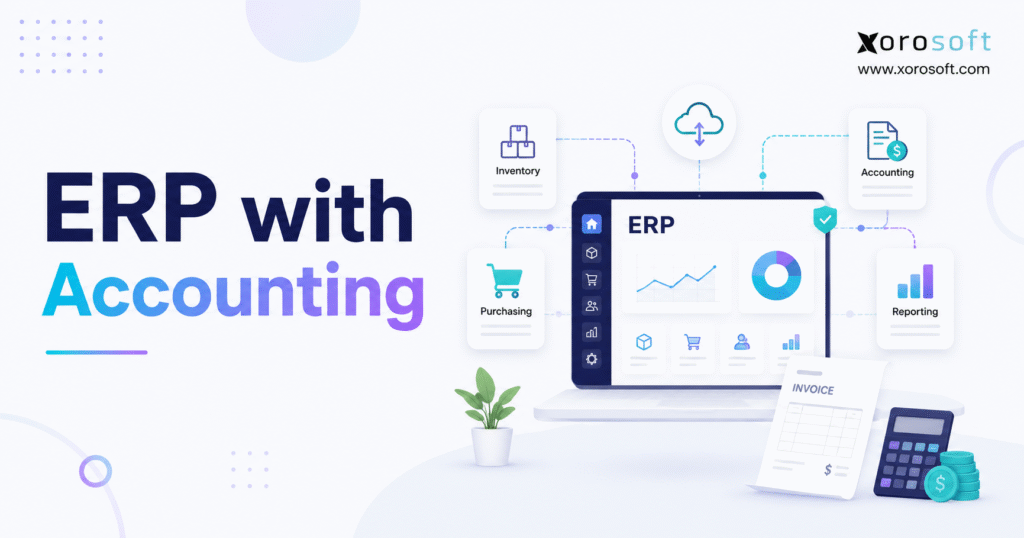
If your business is looking to streamline operations and improve financial accuracy, ERP finance integration is a key consideration.
1. Financial Reporting Breaks Down When Operations Stay Disconnected
1.1. Different Systems Create Different Versions of the Same Transaction
A business can maintain accurate books and still lack a dependable view of its financial position. For example, accounting may show one inventory value while warehouse reports show different quantities. Meanwhile, purchasing teams may commit cash through purchase orders that finance cannot see until supplier invoices arrive.
Similarly, Shopify orders, refunds, processing fees, taxes, and payouts may appear across several reports. Manufacturing teams may also record material consumption in an operational application while finance receives only a summarized journal entry at the end of the month. As a result, each department may have correct information within its own system but no complete view of the underlying transaction.
The problem becomes more visible when employees try to answer basic operational questions. For instance, finance may know the total inventory value but may not know which products, warehouses, or receipts created it. Likewise, warehouse employees may understand why quantities changed but may not see the financial effect of those movements.
Consequently, the business operates with several partial versions of the same transaction.
1.2. Manual Reconciliation Stops Scaling
Initially, teams can manage these gaps manually. An accountant may export transactions, compare spreadsheets, enter journal adjustments, and investigate a limited number of differences. However, the same approach becomes fragile as the company adds products, suppliers, warehouses, marketplaces, currencies, and legal entities.
Moreover, every additional application creates another place where data can be delayed, duplicated, or mapped incorrectly. A customer refund may update the ecommerce platform immediately, while inventory and accounting remain unchanged until a separate process runs. Similarly, a warehouse transfer may update quantities at one location without reaching finance at the same time.
Therefore, finance begins spending more time reconstructing transactions than analyzing performance.
The bookkeeping platform is not always the underlying problem. Instead, the financial system has become separated from the operational activity creating the numbers.
A warehouse receipt affects inventory value. Likewise, a supplier invoice creates a liability. A shipment reduces stock and recognizes product cost. In addition, a refund can affect revenue, cash, taxes, inventory, fees, and customer balances.
When these events occur in disconnected applications, finance must recreate the complete financial story later. Consequently, reports arrive slowly, margins become difficult to explain, and month-end closing depends heavily on manual reconciliation.
1.3. Connected Finance Creates One Operational Record
Therefore, ERP finance integration addresses the problem by bringing financial and operational processes together. Rather than treating accounting as an isolated administrative function, it connects financial records with inventory, purchasing, sales, warehousing, manufacturing, ecommerce, and reporting.
For example, a warehouse receipt can remain connected with the purchase order, supplier invoice, product cost, inventory value, and general-ledger posting. Similarly, a Shopify refund can remain connected with the original order, payment transaction, return, restocking decision, and accounting entry.
As a result, employees do not need to reconstruct the same transaction independently in several systems.
Ultimately, the objective is not simply to automate bookkeeping. Instead, the business needs a consistent record that employees can trace from the operational source to the final financial report.
2. What ERP Finance Integration Actually Means
2.1. ERP Finance Integration Definition
ERP finance integration is the connection between financial management and the operational workflows that create accounting transactions. Therefore, activities such as purchasing, inventory receiving, sales fulfillment, manufacturing, returns, and ecommerce settlements can support or update the general ledger through controlled processes.
In practice, an integrated environment may include:
- General ledger
- Accounts payable
- Accounts receivable
- Bank reconciliation
- Inventory valuation
- Purchasing
- Sales-order management
- Warehouse operations
- Manufacturing
- Ecommerce transactions
- Financial reporting
- Budgeting and forecasting
Instead of entering the same transaction several times, employees work from connected records. For instance, a purchase order establishes the approved supplier commitment. Next, a warehouse receipt confirms the quantity received. Finally, the supplier invoice creates the accounts-payable obligation.
Because those documents remain connected, finance can trace the accounting balance back to the operational source. As a result, employees spend less time searching across separate systems.
2.2. Connected ERP Accounting Goes Beyond Bookkeeping
Traditional accounting software primarily records invoices, bills, payments, taxes, bank activity, and journals. In addition, it produces financial statements such as the income statement, balance sheet, and cash-flow statement.
However, connected ERP accounting expands the scope beyond bookkeeping. More specifically, it links accounting with the processes that create financial results.
These processes may include demand planning, purchase ordering, inventory receiving, quality inspection, warehouse transfers, sales-order allocation, picking, shipping, returns, supplier credits, manufacturing, marketplace settlements, and stock adjustments.
Therefore, accountants gain more context.
Instead of reviewing only a journal entry, finance may be able to open the associated purchase order, warehouse receipt, shipment, supplier invoice, customer order, product, return, or warehouse record. Consequently, reconciliation becomes easier because the operational evidence remains linked to the financial transaction.
2.3. What Integrated Financial ERP Cannot Fix Automatically
Although ERP can strengthen control, it cannot correct every operational or accounting problem automatically.
For example, software cannot independently repair:
- A poorly designed chart of accounts
- Incorrect product costs
- Inconsistent receiving procedures
- Duplicate customers or suppliers
- Weak approval rules
- Missing warehouse adjustments
- Incomplete tax mappings
- Poor employee training
- Unclear process ownership
- Unreconciled opening balances
Therefore, implementation must include more than software configuration.
The company also needs clear accounting policies, reliable master data, documented workflows, approval ownership, employee training, and regular reconciliation. Otherwise, the business may simply transfer its existing problems into a more sophisticated system.
Moreover, leaders must decide which teams own each process. Without clear ownership, even a well-configured ERP can produce inconsistent results.
3. How ERP Finance Integration Moves Transactions into Accounting
3.1. Financial Posting Starts with a Business Event
Every operational transaction has a business purpose. However, not every event creates an immediate financial entry.
For example, a sales quote normally has no accounting impact. A confirmed order may reserve inventory but may not reduce its financial value. Later, shipment confirmation may reduce inventory and recognize cost of goods sold. Finally, invoicing records revenue and accounts receivable.
The exact timing depends on company policy and system configuration. Nevertheless, every workflow should answer four questions:
1. What operational event occurred?
2. Which document supports that event?
3. Which financial accounts should be affected?
4. When should the posting occur?
Moreover, this traceability becomes essential when finance investigates inventory differences, supplier discrepancies, cost changes, customer refunds, or period-end adjustments. In addition, it helps managers understand why reported results changed.
3.2. Order-to-Cash in Integrated ERP Finance
The order-to-cash process begins when a customer places an order and ends when the company receives and reconciles payment.
A typical workflow includes:
1. Customer-order creation
2. Price and discount validation
3. Credit approval
4. Inventory allocation
5. Picking and packing
6. Shipment confirmation
7. Customer invoicing
8. Payment receipt
9. Bank or processor reconciliation
First, the system records the customer, products, quantities, prices, taxes, and payment terms. Next, inventory may be reserved for the order. Once the products ship, stock decreases and product cost may move to cost of goods sold.
Afterward, the customer invoice recognizes revenue and accounts receivable unless payment has already been collected. Finally, the payment increases cash or a settlement account and reduces the customer balance.
However, a return introduces additional events. For example, the business may need to process a credit, refund, warehouse receipt, inspection, restocking decision, and product-cost reversal.
Therefore, the order-to-cash process must remain connected from the original sale through every subsequent return or adjustment. Otherwise, revenue, inventory, and cash records may no longer agree.
3.3. Purchase-to-Pay Through ERP Accounting Integration
Similarly, the purchase-to-pay process connects supplier purchasing with inventory and accounts payable.
A typical sequence includes:
1. Purchase request
2. Internal approval
3. Purchase order
4. Supplier confirmation
5. Warehouse receipt
6. Quality or quantity inspection
7. Supplier invoice
8. Invoice matching
9. Payment approval
10. Supplier payment
First, a buyer identifies the need for materials or finished goods. After approval, the purchase order communicates quantities, prices, payment terms, and expected delivery dates.
When the warehouse receives the goods, employees record the actual quantity. Consequently, inventory quantities and expected inventory costs may be updated.
Finance then compares the supplier invoice with the purchase order and warehouse receipt. If the records agree, the invoice can proceed through approval. However, if the supplier bills 100 units while the warehouse received only 90, the system should flag the difference.
As a result, employees can investigate the cause instead of hiding the discrepancy inside a manual journal entry. Moreover, finance gains a clearer view of supplier performance and purchasing accuracy.
3.4. Inventory-to-Ledger Integration
Likewise, inventory accounting requires both quantity accuracy and cost accuracy.
For example, a company may have the correct physical quantity but an incorrect financial value. Conversely, the total inventory value may appear reasonable even though quantities are recorded against the wrong products or warehouses.
Therefore, the inventory balance should remain connected with purchase receipts, supplier prices, freight, duties, warehouse transfers, stock adjustments, customer shipments, returns, production consumption, finished-goods output, scrap, and write-downs.
Ultimately, the inventory asset account in the general ledger should reconcile with the detailed inventory valuation report.
At the same time, the income statement should reflect the cost of products sold during the reporting period. Consequently, inventory errors can affect both the balance sheet and reported gross margin.
In addition, incorrect warehouse-level quantities can affect purchasing and fulfillment even when the total financial balance appears correct.
3.5. Manufacturing and ERP Financial Management
Furthermore, manufacturing creates additional financial events because production transforms raw materials into finished goods.
A manufacturing workflow may include bills of materials, raw-material issues, work orders, labor, machine time, production overhead, subcontracting, work in progress, finished-goods output, scrap, and cost variances.
First, materials are issued to production. Next, labor and overhead may be applied. After production is completed, finished-goods inventory increases.
Meanwhile, differences between expected and actual costs may create production variances. Therefore, the ERP should connect materials, work orders, production output, and financial reporting.
Moreover, finance should be able to trace a product-cost change back to the production order, material usage, labor entry, or overhead rule that created it.
4. Core Modules Behind ERP Finance Integration
4.1. ERP Finance Integration and the General Ledger
Fundamentally, the general ledger is the central financial record of the organization. It organizes transactions across assets, liabilities, equity, revenue, and expenses.
In addition, ERP finance integration allows the general ledger to receive information from purchasing, inventory, sales, warehouses, manufacturing, and ecommerce.
Important capabilities include:
- Configurable chart of accounts
- Financial periods
- Recurring journals
- Reversing entries
- Approval workflows
- Account dimensions
- Department reporting
- Location reporting
- Supporting documents
- Transaction drill-down
- Period locking
- Audit trails
Therefore, a well-designed chart of accounts should support financial reporting without becoming unnecessarily complex.
For instance, some companies create separate accounts for every warehouse or sales channel because their current software cannot report by dimension. However, a capable ERP may provide product, warehouse, department, or channel reporting without requiring hundreds of additional ledger accounts.
Consequently, the chart of accounts can remain manageable while operational reporting becomes more detailed.
4.2. Connected Accounts Payable and Purchasing
Meanwhile, accounts payable manages the money a company owes suppliers. In a connected environment, AP works with purchasing and inventory receiving.
Therefore, finance can verify whether an invoice matches the approved purchase order, the quantity physically received, and the price agreed with the supplier.
Useful capabilities include supplier-invoice processing, purchase-order matching, receipt matching, supplier credits, payment terms, approval workflows, duplicate-invoice controls, cash-requirement reporting, supplier history, and payment scheduling.
As a result, the business reduces the risk of paying for goods that were not received or prices that were not approved.
Moreover, open purchase orders provide visibility into future cash requirements before supplier bills arrive. Consequently, finance can plan payments earlier.
4.3. Connected Accounts Receivable and Sales
Similarly, accounts receivable manages customer invoices, receipts, credits, and outstanding balances.
Depending on the business model, required capabilities may include customer credit limits, payment terms, aging reports, deposits, partial-shipment invoicing, customer deductions, credit memos, collection notes, customer-specific pricing, and EDI invoices.
Wholesale businesses, in particular, may need detailed control over customer credit, pricing, deductions, and payment terms.
Moreover, connecting accounts receivable with sales and fulfillment makes it easier to determine whether an invoice relates to a shipment, customer deposit, service, or another transaction.
Therefore, collection teams can review the commercial context before contacting a customer about an outstanding balance.
4.4. Bank, Processor, and Payout Reconciliation
In contrast, bank reconciliation compares recorded cash activity with actual bank transactions rather than future operational commitments.
However, inventory-driven businesses often need to reconcile additional financial sources, including Shopify payouts, Amazon settlements, credit-card processors, PayPal activity, merchant fees, chargebacks, deposits in transit, foreign-currency accounts, customer payments, and supplier payments.
Therefore, a connected financial system should help finance match net deposits with the underlying orders, refunds, taxes, fees, and adjustments.
Otherwise, employees may record the deposit without understanding the components behind it. As a result, revenue and fee reporting can become distorted.
4.5. ERP Reporting and Financial Visibility
Ultimately, connected reporting should allow finance and operations to view the same activity from different perspectives.
For example, finance may need inventory value by account. Meanwhile, operations may need the same value by product and warehouse.
Useful reports may include:
- Income statement
- Balance sheet
- Cash-flow statement
- Trial balance
- AP aging
- AR aging
- Inventory valuation
- Gross-margin analysis
- Product profitability
- Warehouse performance
- Purchase commitments
- Sales by channel
Consequently, users can move from summarized reports to the operational transactions supporting each balance.
In addition, management can review financial and operational performance without combining several exports manually.
5. ERP Finance Integration and Inventory Valuation
5.1. Inventory Costing Methods
First of all, inventory valuation determines the financial value assigned to goods owned by the business.
Common costing methods include first in, first out; weighted average cost; standard cost; and specific identification where appropriate.
Therefore, the selected method should follow the company’s accounting policy and reporting requirements.
Nevertheless, the costing method alone does not guarantee accurate valuation. The business must also record receipt quantities, supplier costs, landed costs, transfers, adjustments, production, returns, and shipments correctly.
Therefore, finance and operations must share responsibility for inventory accuracy.
5.2. Cost of Goods Sold Through Connected ERP Accounting
Subsequently, when a product is sold, its related cost generally moves from inventory to cost of goods sold.
Therefore, inaccurate inventory costs directly affect reported gross margin.
For example, if inbound freight and duties are excluded from product cost, margins may appear stronger than they actually are. Similarly, if a shipment is recorded in the wrong accounting period, both inventory and cost of goods sold may be misstated.
As a result, finance should be able to trace product cost from the supplier receipt or manufacturing activity through the final sale.
Moreover, management should understand whether margin changes came from selling prices, supplier costs, freight, discounts, returns, or operational errors.
5.3. Landed-Cost Allocation
However, the supplier’s unit price is not always the full cost of obtaining inventory.
Landed cost may include:
- Inbound freight
- Import duty
- Brokerage
- Insurance
- Port charges
- Customs fees
- Handling
- Other acquisition costs
An ERP can allocate these expenses across received products using quantity, weight, value, volume, or another appropriate method.
Consequently, product-margin reporting reflects a more complete cost.
However, the allocation policy must remain consistent. Otherwise, comparable products may receive significantly different costs without a clear operational reason.
In addition, finance should be able to explain how each landed-cost charge was distributed.
5.4. Inventory Adjustments and Write-Downs
Inventory adjustments may arise from damage, shrinkage, counting differences, expiration, quality failures, incorrect receipts, incorrect shipments, unit-of-measure errors, or migration issues.
Therefore, each adjustment should include a reason, user, date, product, warehouse, and financial effect.
Moreover, slow-moving or obsolete goods may require a financial write-down. Therefore, inventory-aging reports should help finance identify products whose recorded value may no longer be recoverable.
As a result, operational inventory reviews can directly support more accurate financial reporting.
6. ERP Finance Integration vs Standalone Accounting Software
| Evaluation Area | Standalone Accounting Software | ERP Finance Integration |
|---|---|---|
| Primary focus | Financial recordkeeping | Financial and operational management |
| Inventory | Basic or externally connected | Linked with purchasing, sales, and warehouses |
| Purchasing | Often limited | Planning, approvals, receipts, and invoice matching |
| Warehousing | Usually external | May operate within the ERP environment |
| Manufacturing | Usually external | Can connect production and finance |
| Ecommerce | Commonly handled through apps | Can link channels with broader operations |
| Reporting | Primarily financial | Financial and operational |
| Data flow | Depends heavily on integrations | May use a shared transactional structure |
| Typical fit | Simpler operations | Growing operational complexity |
6.1. When Standalone Accounting Software Is Enough
Nevertheless, a business should not implement ERP simply because it offers more features.
For example, standalone accounting software may remain appropriate when the company has a limited product range, one warehouse, low transaction volume, simple purchasing, few operational users, reliable integrations, manageable reconciliation, and straightforward reporting.
In other words, a smaller system that employees understand can be more valuable than a complex platform the organization is not prepared to manage.
However, the business should review this decision periodically. As operations grow, yesterday’s suitable system may become tomorrow’s bottleneck.
6.2. When Connected ERP Accounting Becomes Necessary
Conversely, ERP becomes more relevant when accounting problems are caused by operational fragmentation.
Common warning signs include unexplained inventory values, invisible purchase commitments, recurring warehouse-transfer differences, manually reconstructed ecommerce settlements, incomplete product margins, duplicate data entry, delayed reports, and a month-end close that depends on individual employees.
Therefore, the trigger is usually complexity rather than a specific revenue or employee threshold.
Moreover, the need becomes stronger when existing integrations require constant monitoring and correction.
7. Native ERP Accounting vs External Finance Integrations
7.1. Native ERP Financial Management
On the one hand, native accounting means financial and operational processes operate within the same ERP platform or unified environment.
Potential advantages include shared customer records, shared supplier records, consistent transaction IDs, direct access to source documents, centralized permissions, unified reporting, and fewer synchronization points.
However, the finance team must be prepared to move its accounting operation into the ERP.
In addition, the implementation must support required reporting structures, tax processes, controls, and closing procedures.
Therefore, companies should test complete accounting workflows rather than assuming that native finance automatically meets every requirement.
7.2. External Accounting Integration
On the other hand, an alternative architecture keeps accounting in a separate application while another system manages inventory, orders, warehousing, or manufacturing.
In particular, this approach may be suitable when finance prefers the current accounting application, the connection is proven, financial requirements are straightforward, existing reports meet management needs, and the company can monitor synchronization problems.
Nevertheless, the integration must define which system owns customers, suppliers, products, taxes, invoices, payments, credits, and inventory values.
Otherwise, employees may change the same information differently in each platform. Consequently, records can drift apart over time.
7.3. Common Integration Risks
Consequently, disconnected systems may create:
- Duplicate invoices
- Missing refunds
- Delayed postings
- Incorrect account mappings
- Failed synchronizations
- Inconsistent customer records
- Settlement discrepancies
- Inventory-value mismatches
- Transactions posted in the wrong period
Businesses seeking a consolidated environment may evaluate a cloud ERP platform such as XoroONE alongside other available systems.
However, the platform should still be assessed through real accounting, purchasing, inventory, warehouse, and ecommerce workflows rather than through a feature list alone.
8. ERP Finance Integration for Inventory and Warehouse Control
8.1. Quantity and Cost Must Reconcile
Typically, accounting teams focus on the total financial value of inventory. Warehouse teams, meanwhile, focus on physical quantities and locations.
A connected ERP must support both views.
Finance should be able to review inventory by product, warehouse, lot, serial number, cost layer, transaction date, stock status, and ownership status.
Similarly, warehouse employees should be able to explain why quantities changed.
Otherwise, finance may post a manual adjustment that corrects the total account balance without addressing the operational cause.
Therefore, inventory controls should connect physical movements with financial results.
8.2. Purchasing Visibility Supports Cash Planning
Although purchase orders may not create an immediate supplier liability, they represent future inventory and cash commitments.
A connected purchasing process gives finance visibility into approved purchase orders, expected delivery dates, supplier deposits, committed purchasing spend, open receipts, uninvoiced receipts, supplier invoice differences, and upcoming payments.
As a result, cash-flow planning becomes more proactive.
Instead of waiting for supplier invoices, finance can review expected obligations earlier in the purchasing cycle. Moreover, management can evaluate whether future inventory purchases align with demand and available cash.
8.3. Three-Way Matching in Integrated ERP Finance
More specifically, three-way matching compares:
1. The purchase order
2. The warehouse receipt
3. The supplier invoice
If all three agree, the invoice can proceed through approval.
However, if the supplier invoices more units than the warehouse received, the system should flag the discrepancy. Likewise, if the quantity matches but the price exceeds the approved order, finance should review the difference.
Therefore, three-way matching supports both financial control and supplier accountability.
In addition, exception reporting helps teams focus on mismatches rather than manually reviewing every invoice.
8.4. Multi-Warehouse ERP Accounting
Furthermore, multiple warehouses create additional financial and operational complexity.
A transfer should reduce inventory at the source and increase inventory at the destination. However, stock may also need to remain visible as inventory in transit when transportation takes several days.
In addition, the company may need reporting by warehouse for inventory value, damaged stock, adjustments, shrinkage, receiving, fulfillment, transfer activity, and operating expenses.
Businesses requiring advanced warehouse execution can evaluate XoroWMS as part of a broader ERP and finance environment.
Consequently, warehouse activity can remain connected with inventory value and financial reporting.
9. ERP Finance Integration for Shopify and Ecommerce
9.1. Ecommerce Accounting Includes More Than Sales
For instance, a Shopify order may include product revenue, discounts, taxes, shipping income, payment fees, gift cards, refunds, returns, currency conversion, chargebacks, and payout timing differences.
Therefore, recording only the net bank deposit does not provide enough information to explain revenue, taxes, refunds, fees, and settlement differences.
Instead, the financial system should connect those events with the underlying customer orders and inventory transactions.
As a result, finance can reconcile the payout without losing the detail required for margin and tax reporting.
9.2. Shopify Inventory and ERP Availability
However, Shopify may display only the quantity available for online sale, while the ERP manages a broader inventory position.
For example, the ERP may need to account for multiple warehouses, wholesale allocations, Amazon demand, reserved stock, open purchase orders, manufacturing requirements, safety stock, damaged goods, returns awaiting inspection, and inventory in transit.
Consequently, the Shopify quantity shown to customers may represent only one part of the complete inventory model.
Moreover, the company must decide which system controls sellable inventory and how frequently quantities are synchronized.
9.3. Refunds, Returns, and Restocking
Although a financial refund and a physical return are related, they are not the same event.
For instance, a customer may receive a refund before the returned product reaches the warehouse. Later, the item may be inspected and classified as resalable, damaged, incomplete, or unusable.
Therefore, the workflow should distinguish among the financial refund, physical return, warehouse receipt, quality inspection, restocking decision, write-off, replacement shipment, and supplier return.
This distinction protects both financial reporting and inventory accuracy.
In addition, it prevents the company from increasing available stock before the returned product has been inspected.
9.4. Shopify ERP Finance Integration Requirements
For example, the Xorosoft ERP application on the Shopify App Store demonstrates an operational ERP connection for Shopify businesses.
However, companies should evaluate more than whether an integration exists.
Instead, they should test partial fulfillment, partial refunds, exchanges, bundles, gift cards, multiple currencies, several warehouses, payouts, payment fees, returns, and inventory synchronization.
Ultimately, the important question is whether the complete transaction can be traced from order creation through fulfillment, settlement, inventory, and accounting.
Therefore, demonstrations should use the company’s actual ecommerce scenarios rather than a basic sample order.
10. Business Benefits of ERP Finance Integration
10.1. Less Duplicate Data Entry
Consequently, when operational transactions create or support the appropriate accounting records, employees spend less time recreating invoices, receipts, adjustments, and payments in separate systems.
As a result, administrative work decreases and fewer inconsistencies enter the financial records.
Moreover, employees can focus on exceptions instead of routine re-entry.
10.2. Faster Reconciliation
A connected transaction makes it easier to trace a financial balance to its source.
For example, finance can investigate an inventory difference through receipts, costs, transfers, shipments, and adjustments instead of searching several applications.
Therefore, reconciliation becomes a review process rather than a transaction-reconstruction exercise.
In addition, supporting documents remain easier to retrieve during audits and month-end close.
10.3. More Reliable Product Margins
However, gross revenue alone does not show profitability.
Therefore, a useful product-margin calculation may include product cost, landed cost, discounts, returns, freight, marketplace fees, payment fees, customer-specific pricing, manufacturing variances, and fulfillment costs.
Consequently, integrated reporting helps managers understand why margin changed instead of simply observing the final percentage.
For example, declining margin may come from freight increases rather than supplier pricing. Therefore, the corrective action depends on having the full cost picture.
10.4. Better Cash-Flow Planning
Accounting explains what has already happened. ERP, however, can provide visibility into future commitments.
For example, open purchase orders, expected inventory receipts, supplier terms, customer receivables, production plans, and demand forecasts all affect future cash.
Therefore, connecting these workflows allows finance to evaluate upcoming cash requirements before the transactions reach the bank account.
Moreover, management can compare future purchasing needs with sales forecasts and working-capital limits.
10.5. Faster Month-End Closing
A connected ERP can reduce the number of separate records finance must reconcile.
However, a faster close still depends on timely transaction entry, clear account ownership, completed warehouse activity, supplier invoice processing, ecommerce settlement review, exception management, and period controls.
In other words, technology supports a more efficient close, but it does not replace accounting discipline.
Nevertheless, ERP finance integration can reduce the amount of manual reconstruction required before reviews begin.
10.6. Stronger Audit Trails
In addition, a reliable audit trail should show who created the transaction, who changed it, who approved it, when it was posted, which document supports it, which accounts were affected, and whether it was reversed.
Moreover, finance should be able to move from the financial balance to the operational source without relying on spreadsheets or employee memory.
Consequently, internal reviews and external audits become easier to support.
11. Which Businesses Need ERP Finance Integration?
11.1. Inventory-Driven Businesses
ERP finance integration is particularly relevant to businesses that sell, distribute, or manufacture physical products.
More importantly, inventory connects finance with purchasing, warehousing, sales, manufacturing, and cash flow. Therefore, operational mistakes frequently become financial mistakes.
For example, an incorrect receipt can affect product availability, supplier matching, inventory value, and future purchasing.
11.2. Ecommerce and Omnichannel Brands
Ecommerce businesses may need a connected ERP when they sell through Shopify, Amazon, wholesale accounts, retail stores, online marketplaces, international storefronts, and B2B portals.
Likewise, each channel may have different prices, fees, taxes, inventory allocations, refunds, and settlement schedules.
Consequently, separate channel reports become increasingly difficult to consolidate.
Moreover, management may struggle to compare profitability across channels when operational and financial data remain separate.
11.3. Wholesale Distributors
In particular, wholesale businesses commonly need customer-specific pricing, credit limits, payment terms, EDI, back orders, inventory allocation, supplier planning, partial shipments, and accounts-receivable control.
Therefore, finance must remain connected with sales, purchasing, inventory allocation, fulfillment, and customer-credit processes.
In addition, wholesale businesses often need detailed reporting by customer, salesperson, product, and warehouse.
11.4. Manufacturing Businesses
Similarly, manufacturing companies must connect accounting with bills of materials, raw materials, work orders, production schedules, labor, overhead, work in progress, finished goods, scrap, and cost variances.
A connected manufacturing ERP such as XoroERP can be evaluated when production, inventory, purchasing, warehouse management, and finance need to operate together.
Consequently, product costs can remain traceable from material purchase through finished-goods production.
11.5. Businesses That May Not Need ERP Yet
Conversely, a full ERP may be unnecessary when a company has no significant inventory, low transaction volume, one operating location, simple purchasing, few operational users, reliable integrations, and straightforward reporting.
Therefore, the objective is not to select the most comprehensive system. Instead, the business should choose a platform that matches its current complexity and expected growth.
However, leaders should monitor whether manual work and reconciliation are increasing faster than the business itself.
12. Signs ERP Finance Integration May Be Necessary
12.1. Inventory and Accounting Frequently Disagree
For example, recurring inventory-to-ledger differences usually indicate that quantity, cost, timing, or integration processes are not working consistently.
Therefore, finance should investigate the operational cause instead of relying indefinitely on manual adjustments.
Moreover, repeated corrections may hide warehouse or purchasing problems that continue to affect future periods.
12.2. Month-End Close Depends on Spreadsheets
Certainly, spreadsheets are useful analytical tools. However, they become risky when they act as the primary connection among purchasing, inventory, ecommerce, warehousing, and finance.
As a result, the close may depend on individual employees knowing which exports to run, which formulas to update, and which differences to ignore.
Consequently, the process becomes difficult to scale or transfer to another employee.
12.3. Purchase Commitments Are Not Visible
Consequently, if finance cannot see approved purchase orders until supplier invoices arrive, cash requirements appear later than they should.
As a result, management may make spending decisions without a complete view of future obligations.
In addition, inventory purchases may exceed realistic demand because finance and planning are working from different information.
12.4. Warehouse Transfers Create Reconciliation Problems
Similarly, repeated transfer differences, negative stock, missing receipts, and location-specific adjustments may indicate that the current system lacks sufficient warehouse control.
Moreover, finance may see the correct total value while individual warehouse balances remain inaccurate.
Therefore, both location-level and company-level reporting should be reviewed.
12.5. Product Profitability Is Difficult to Explain
Moreover, when managers cannot explain margin by product, customer, warehouse, or channel, financial and operational data may be too disconnected.
For example, product cost may exclude inbound freight, marketplace fees, returns, or fulfillment expenses.
Consequently, management may make pricing decisions using incomplete margin information.
12.6. Employees Enter the Same Data Repeatedly
Moreover, repeated entry across Shopify, inventory software, warehouse applications, spreadsheets, and accounting platforms increases administrative work and error risk.
Therefore, duplicate entry is both an efficiency issue and a control issue.
Moreover, each additional entry creates another opportunity for records to become inconsistent.
12.7. Reports Arrive Too Late
A report loses value when it becomes available only after purchasing, pricing, or inventory decisions have already been made.
Consequently, several recurring warning signs usually justify a structured ERP readiness review.
However, the solution may involve improving an existing integration rather than replacing every system. Therefore, the company should diagnose the root cause before selecting software.
13. How to Select an ERP Finance Integration Platform
13.1. Map Current Financial and Operational Workflows
First, begin with the company’s actual processes.
Document how the business handles customer orders, purchasing, receiving, supplier invoices, inventory transfers, fulfillment, customer billing, payments, returns, refunds, manufacturing, reconciliation, and financial close.
Next, identify every system, spreadsheet, employee, approval, and manual correction involved.
This exercise often reveals that the company does not have one isolated accounting issue. Instead, it has several connected process gaps.
Therefore, workflow mapping should take place before vendors begin demonstrating software.
13.2. Define Essential ERP Finance Integration Requirements
Next, important financial and operational requirements may include:
- General ledger
- Accounts payable
- Accounts receivable
- Bank reconciliation
- Multiple currencies
- Multiple entities
- Consolidation
- Inventory valuation
- Landed cost
- Warehouse reporting
- Department reporting
- Approval workflows
- Audit trails
- Budgeting
- Cash-flow visibility
Separate essential requirements from preferences. Otherwise, the evaluation may become a long feature list without clear priorities.
In addition, assign each requirement an owner and a realistic business scenario.
13.3. Test Inventory and Financial Posting
Afterward, ask vendors to demonstrate purchase receipt costing, freight and duty allocation, inventory adjustments, warehouse transfers, customer shipments, returns, negative inventory controls, cost-of-goods-sold recognition, inventory-to-ledger reconciliation, and historical valuation.
Most importantly, each demonstration should show the impact on operational records and financial reports.
Therefore, the evaluator should not accept a dashboard screenshot as proof of a complete workflow.
13.4. Evaluate Ecommerce ERP Accounting Workflows
For Shopify and marketplace operations, test standard orders, partial shipments, discounts, refunds, returns, exchanges, gift cards, payment fees, chargebacks, multiple currencies, marketplace settlements, and inventory synchronization.
A basic order import is not enough. Instead, the company must confirm that the ERP supports the complete financial and operational lifecycle.
Moreover, the demonstration should include exceptions because normal transactions rarely reveal the weakest part of an integration.
13.5. Request Workflow-Based Demonstrations
| Requirement | Question to Ask | Evidence to Request |
| General ledger | How do operational transactions reach finance? | End-to-end posting demonstration |
| Inventory | Which costing methods are supported? | Historical valuation report |
| Purchasing | How are orders, receipts, and invoices matched? | Purchase-to-pay workflow |
| Warehousing | How are transfers and adjustments controlled? | Multi-warehouse example |
| Ecommerce | How are refunds, fees, and payouts handled? | Shopify workflow |
| Manufacturing | How are materials and costs tracked? | Work-order example |
| Controls | Who can approve or reverse transactions? | Permission matrix |
| Reporting | Can finance drill into source activity? | Report drill-down |
| Implementation | Who owns migration and testing? | Written project plan |
| Cost | What is excluded from pricing? | Total-cost estimate |
As a result, vendors are evaluated against the same scenarios rather than different product presentations.
13.6. Compare Industry Fit
Similarly, different operating models require different workflow depth.
For example, a distributor should test pricing, allocations, EDI, purchasing, and warehouse management. A manufacturer should test bills of materials, work orders, planning, material usage, and production costing. Likewise, a Shopify brand should test orders, refunds, payouts, inventory availability, and multichannel reporting.
The Xorosoft industry solutions can be reviewed alongside other ERP offerings to determine how closely the platform aligns with the company’s operations.
However, industry positioning should not replace workflow validation. Therefore, buyers should still demonstrate their actual transactions.
13.7. Compare ERP Alternatives Fairly
Finally, do not evaluate vendors only by counting features.
Instead, assess workflow depth, financial architecture, inventory control, reporting, integration ownership, implementation approach, internal resources, user adoption, ongoing support, and total cost over several years.
Businesses reviewing broader ERP suites can also use the Xorosoft versus NetSuite comparison as one source of information.
However, the final decision should still be based on independent requirements and realistic workflow demonstrations.
14. Industry Use Cases for Integrated ERP Finance
14.1. Apparel and Fashion ERP Accounting
For example, apparel companies manage styles, colors, sizes, seasons, markdowns, returns, and channel-specific demand.
Therefore, the ERP should preserve SKU-level cost while supporting reporting by collection, warehouse, channel, and season.
Moreover, purchasing and forecasting should reflect the short selling windows associated with seasonal products.
As a result, finance can evaluate both product margin and inventory risk by season.
14.2. Furniture and Home-Goods ERP Finance
Likewise, furniture businesses may manage deposits, long lead times, inbound freight, large products, special orders, and complex deliveries.
Consequently, landed cost, customer deposits, inventory availability, and order-level profitability become particularly important.
In addition, delivery and installation expenses may need to be included when evaluating customer or order profitability.
14.3. Sporting-Goods and Consumer-Product Accounting
Similarly, these businesses often manage seasonality, product kits, bundles, high SKU counts, promotions, and several sales channels.
Therefore, demand forecasting should connect with purchasing, working capital, and future cash requirements.
Moreover, bundle and kit costs should remain traceable to the individual components consumed.
14.4. Food and Beverage ERP Financial Management
In addition, food companies may require lot tracking, expiration controls, traceability, quality procedures, and variable input costs.
As a result, the ERP should connect these inventory requirements with purchasing, manufacturing, valuation, and financial reporting.
Moreover, expired or recalled products may require specific inventory adjustments and financial write-downs.
14.5. Wholesale Distribution Finance Integration
Meanwhile, wholesalers frequently require customer-specific pricing, EDI, payment terms, credit controls, supplier planning, back orders, inventory allocation, and partial shipments.
Consequently, the financial system must remain connected with the commercial and operational workflows affecting customer and supplier balances.
Moreover, profitability may need to be evaluated by customer, order, salesperson, product, and warehouse.
14.6. Manufacturing ERP Accounting
Finally, manufacturers need visibility into raw materials, work in progress, finished goods, labor, overhead, subcontracting, scrap, and production variances.
A finance platform that receives only summarized production journals may not provide enough detail to explain product-cost changes.
Therefore, manufacturing transactions should remain traceable to inventory and financial reporting.
In addition, production managers should be able to understand the operational causes behind unfavorable cost variances.
15. Implementing ERP Finance Integration
15.1. Complete an ERP Finance Integration Readiness Review
Importantly, ERP finance integration requires more than selecting software.
The organization also needs executive sponsorship, process owners, accounting ownership, internal project capacity, clear requirements, reliable master data, testing resources, training time, implementation budget, and a realistic launch plan.
Without these elements, even a capable ERP may fail to deliver the expected operational improvement.
Therefore, readiness should be evaluated before the business commits to a vendor or timeline.
15.2. Clean Master and Transaction Data
For example, common migration data includes customers, suppliers, products, units of measure, warehouses, price lists, bills of materials, open sales orders, open purchase orders, accounts receivable, accounts payable, inventory quantities, inventory costs, and general-ledger balances.
First, duplicate, inactive, and incomplete records should be reviewed before migration.
Otherwise, old data problems may affect the new system from the first day.
Moreover, teams should agree on which system contains the approved source record before extraction begins.
15.3. Validate Inventory Opening Balances
Moreover, inventory requires separate validation because quantity and cost must both be correct.
Review opening inventory by SKU, warehouse, lot, serial number, unit of measure, ownership status, cost, and inventory condition.
Next, reconcile the detailed inventory value with the general-ledger opening balance.
As a result, finance and operations begin the implementation from the same approved position.
In addition, unresolved differences should be corrected before the first live transaction enters the new system.
15.4. Test Complete ERP Finance Workflows
Therefore, testing should follow realistic transactions from beginning to end.
For purchasing:
Purchase order → receipt → supplier invoice → payment → inventory valuation → general ledger
For ecommerce:
Shopify order → allocation → shipment → payment → payout → refund → return → reconciliation
Consequently, testing individual screens is not sufficient. The organization must confirm that information moves correctly across teams and accounting periods.
Moreover, testing should include exceptions such as partial receipts, price differences, damaged goods, failed payments, and delayed settlements.
15.5. Train Employees by Role
Similarly, accountants, buyers, warehouse employees, sales teams, customer-service representatives, production teams, and managers use different parts of the ERP.
Therefore, training should explain both the immediate task and its downstream impact.
For example, warehouse employees should understand how an incorrect receipt quantity affects inventory availability, supplier matching, product cost, and finance.
Likewise, customer-service teams should understand how refunds and returns affect inventory and accounting differently.
15.6. Reconcile Frequently After Launch
Finally, during the early post-launch period, finance should regularly reconcile the trial balance, bank balances, accounts receivable, accounts payable, inventory, tax balances, open orders, supplier receipts, ecommerce settlements, and retained earnings.
As a result, configuration or process issues can be identified before they accumulate.
Furthermore, early reconciliation creates confidence among employees who are still learning the new system.
16. ERP Finance Integration FAQs
16.1. What is ERP finance integration?
ERP finance integration connects accounting with operational activity such as purchasing, inventory, sales, warehouses, manufacturing, and ecommerce. Therefore, financial entries can be traced to the business transactions that created them.
16.2. Does ERP software include accounting?
Many ERP systems include native accounting. However, some platforms synchronize operational transactions with external accounting applications. Therefore, businesses should confirm whether the required financial capabilities are built in or integrated.
16.3. Is ERP the same as accounting software?
No. Accounting software primarily manages financial records. ERP, by contrast, supports a broader combination of financial and operational workflows, including inventory, purchasing, order management, warehouses, manufacturing, and reporting.
16.4. Can ERP replace QuickBooks?
Yes, provided the ERP includes general ledger, accounts payable, accounts receivable, banking, reporting, tax, and financial-control functions. Nevertheless, the company must carefully migrate and validate its financial data.
16.5. When should a company consider ERP finance integration?
A company should consider ERP finance integration when disconnected inventory, purchasing, warehouse, ecommerce, and accounting processes create recurring reconciliation problems, duplicate entry, delayed reporting, or limited visibility.
16.6. What accounting modules are included in ERP?
For example, common modules include general ledger, accounts payable, accounts receivable, bank reconciliation, inventory valuation, cash management, budgeting, multicurrency accounting, fixed assets, and reporting.
16.7. Does ERP include a general ledger?
A complete accounting ERP normally includes a general ledger. In addition, it may provide financial periods, journals, reporting dimensions, approvals, transaction drill-down, and audit histories.
16.8. Can ERP manage accounts payable and receivable?
Yes. ERP can connect supplier invoices with purchase orders and receipts. Similarly, it can connect customer invoices with orders, shipments, payments, credits, and collection activity.
16.9. How does ERP improve inventory accounting?
ERP connects inventory value with purchase receipts, warehouse transfers, adjustments, production, shipments, returns, landed costs, and write-downs. As a result, finance can trace balances to operational activity.
16.10. Can ERP calculate cost of goods sold?
Yes. Consequently, ERP can move product cost from inventory to cost of goods sold when products ship or sell, according to the configured costing method and accounting rules.
16.11. What is landed cost in ERP?
Landed cost includes expenses required to bring inventory to its intended location and condition. For example, it may include inbound freight, duty, brokerage, insurance, and handling.
16.12. Does ERP support multiple warehouses?
Generally, many ERP platforms support warehouse-level quantities, transfers, receipts, shipments, adjustments, and reporting. However, businesses should test their complete warehouse process before selection.
16.13. Does ERP support multiple companies?
Similarly, many systems support separate entities, intercompany transactions, consolidated reporting, elimination entries, and entity-level permissions. Nevertheless, the depth of functionality varies by platform.
16.14. Does ERP support multiple currencies?
Many platforms support foreign-currency transactions, exchange rates, bank accounts, gains and losses, revaluation, and reporting. Therefore, international workflows should be tested directly.
16.15. Can ERP connect Shopify with accounting?
Yes. ERP can connect Shopify orders, payments, refunds, fulfillment, inventory, fees, payouts, and financial records. However, the exact data flow depends on the integration design.
16.16. Does ERP eliminate manual accounting work?
No. ERP can automate repeatable transactions. Nevertheless, accountants still manage policies, judgment, approvals, exceptions, reconciliation, compliance, and financial review.
16.17. How does ERP improve month-end closing?
ERP can reduce reconciliation work by connecting operational transactions with financial records. However, a faster close still requires timely entries, clear ownership, approvals, and exception management.
16.18. Which businesses benefit most from ERP finance integration?
In particular, inventory-driven ecommerce, wholesale, distribution, retail, and manufacturing businesses often gain the most value because financial performance is closely linked with product movement and purchasing.
16.19. Who may not need ERP?
Businesses with simple bookkeeping, no significant inventory, low transaction volume, and reliable existing applications may not need ERP yet. Instead, process or integration improvements may be sufficient.
16.20. How much does an ERP cost?
Cost depends on users, modules, implementation, data migration, integrations, training, support, and customization. Therefore, businesses should compare total ownership cost rather than subscription price alone.
16.21. How long does ERP implementation take?
Implementation length depends on scope, data quality, process complexity, integrations, internal availability, testing, and training. Consequently, timelines vary significantly between businesses.
16.22. What are the main implementation risks?
For example, common risks include unclear requirements, poor data, weak sponsorship, excessive customization, incomplete testing, inadequate training, uncontrolled scope, and insufficient post-launch reconciliation.
16.23. Is native accounting better than an integration?
Neither approach is universally better. Native accounting supports consolidation, while integration allows a business to retain a familiar financial platform. Therefore, the correct choice depends on requirements and architecture.
16.24. What should a company test during an ERP demonstration?
Most importantly, the company should test complete workflows involving orders, purchases, receipts, inventory, refunds, payments, reports, approvals, and reconciliation rather than reviewing isolated screens.
16.25. What is the best ERP financial system?
The best system is the platform that supports the company’s workflows, controls, industry needs, implementation capacity, and budget. Therefore, selection should follow documented requirements and realistic demonstrations.
17. Turn Financial Fragmentation into a Clear ERP Decision
The practical value of ERP finance integration comes from connecting financial records with the operational activity behind them.
First, document the current technology stack. Include every application and spreadsheet used for accounting, inventory, purchasing, sales, warehousing, manufacturing, Shopify, Amazon, EDI, and reporting.
Next, identify where the organization repeatedly loses time or control:
1. Which data is entered more than once?
2. Which balances require manual reconciliation?
3. Which reports arrive too late?
4. Which inventory differences cannot be explained?
5. Which processes depend on one employee?
6. Which integrations regularly fail?
7. Which costs are missing from margin reports?
Afterward, decide whether the business should improve its current integrations or consolidate financial and operational processes within one ERP environment.
Then, evaluate systems through real transactions rather than generic product presentations.
Ask each vendor to demonstrate:
- A purchase receipt with landed cost
- A warehouse transfer
- A Shopify refund
- An inventory adjustment
- A supplier-invoice match
- A customer payment
- An inventory-to-ledger reconciliation
- A complete month-end workflow
Finally, compare the demonstrated workflows with the company’s documented requirements, internal resources, and implementation capacity.
For inventory-driven businesses, Xorosoft can be evaluated against these practical requirements. Its platform connects accounting with inventory, purchasing, warehouse management, manufacturing, forecasting, ecommerce, and reporting.
Therefore, the decision should focus on whether the platform can support the company’s real transactions, controls, reporting needs, and growth plans.
To assess whether your current systems are creating enough financial and operational complexity to justify a connected ERP, book a personalized ERP consultation with Xorosoft.