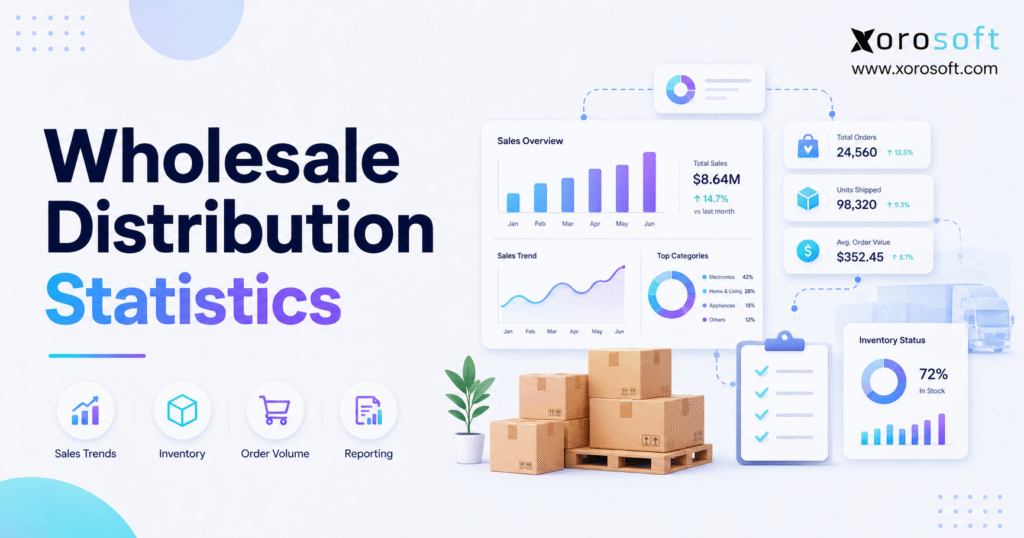
This article presents key Wholesale Distribution Statistics to help you understand the trends and insights in the industry.
1. Wholesale Distribution Statistics Signal a New Operating Reality
Wholesale Distribution Statistics show that distributors now operate in a far more complex environment than the traditional buy-store-sell model suggests. Today, wholesale businesses must coordinate inventory, supplier lead times, warehouse capacity, customer-specific pricing, digital orders, EDI requirements, financial reporting, and multi-channel fulfillment at the same time.
Although market-level figures provide useful context, operators need more than a collection of large numbers. Instead, they need to understand what those figures mean for working capital, inventory availability, warehouse efficiency, purchasing decisions, order accuracy, and customer retention.
For example, rising sales can indicate strong demand. However, when inventory grows more slowly than sales, the distributor may face replenishment pressure, backorders, or allocation conflicts. Conversely, when inventory grows much faster than sales, cash can become trapped in slow-moving products.
The relationship between sales and inventory often matters more than either number on its own.
Meanwhile, labor data reveals another challenge. A distributor may add employees as order volume grows. Nevertheless, extra headcount cannot automatically solve inefficient receiving, excessive warehouse travel, manual order entry, or delayed purchase approvals.
Similarly, digital commerce adds another layer of complexity. Wholesale customers increasingly place orders through ecommerce storefronts, customer portals, marketplaces, procurement systems, EDI connections, email, and sales representatives.
As a result, distributors must coordinate several ordering channels against the same physical inventory.
At the same time, finance teams need accurate inventory valuation, landed costs, customer balances, supplier liabilities, and gross margin information. When operational systems do not communicate with accounting, month-end reconciliation becomes slower and less reliable.
Ultimately, Wholesale Distribution Statistics become useful when they lead to better operating decisions. Therefore, this guide examines current sales, inventory, labor, productivity, ecommerce, warehouse, purchasing, and software trends while explaining what distributors should review next.
1.1 What Wholesale Distribution Statistics Measure
Wholesale Distribution Statistics measure the size, activity, and operating performance of companies that sell products to retailers, manufacturers, contractors, institutions, ecommerce brands, and other businesses.
At the market level, these statistics commonly include:
- Total wholesale sales
- Wholesale inventory value
- Inventory-to-sales ratios
- Industry employment
- Labor productivity
- Ecommerce activity
- Supplier and purchasing trends
- Technology adoption
At the company level, however, distributors should also monitor:
- Inventory accuracy
- Inventory turnover
- Order fill rate
- Stockout rate
- Order accuracy
- Supplier lead time
- Purchase order cycle time
- Warehouse productivity
- Gross margin
- Month-end close time
Therefore, external statistics answer, “What is happening across the industry?” Internal metrics answer the more urgent question: “How effectively is our company responding?”
1.2 Why Wholesale Benchmarks Matter
Industry benchmarks help leaders separate external market pressure from internal execution problems.
For instance, widespread supplier delays may explain longer replenishment cycles. However, frequent stockouts may still result from inaccurate reorder points, delayed approvals, weak forecasting, or disconnected channel data.
Additionally, benchmarks help management teams set priorities.
When inventory value rises while turnover declines, purchasing requires attention. When order volume increases while picking accuracy falls, warehouse processes need review. Likewise, when sales grow but gross margin weakens, leaders should investigate freight, discounts, landed costs, returns, and fulfillment expenses.
Used correctly, Wholesale Distribution Statistics show where broader market conditions end and company-specific execution problems begin.
2. Wholesale Distribution Statistics at a Glance
Wholesale Distribution Statistics confirm that the sector remains one of the largest and most operationally important parts of the U.S. economy.
According to the National Association of Wholesaler-Distributors, wholesale distribution represents an $8.6 trillion industry, supports more than 6 million jobs, and powers nearly one-third of the U.S. economy.
Moreover, the U.S. Census Bureau’s May 2026 Monthly Wholesale Trade Report estimated merchant wholesaler sales at $817.4 billion. The seasonally adjusted inventory-to-sales ratio stood at 1.15.
In addition, the U.S. Bureau of Labor Statistics reported that wholesale trade represented 4.7% of nonfarm business employment in 2025, equal to approximately 6.2 million jobs.
Together, these figures highlight three operational realities:
- Wholesale distribution operates at enormous scale.
- The sector carries substantial inventory relative to monthly sales.
- Workforce productivity remains essential because distributors cannot indefinitely add labor whenever complexity increases.
2.1 Key Wholesale Distribution Statistics for 2026
The most important current figures include:
Wholesale industry size: $8.6 trillion
Wholesale-supported jobs: More than 6 million
May 2026 merchant wholesaler sales: $817.4 billion
May 2026 inventory-to-sales ratio: 1.15
Wholesale trade employment in 2025: Approximately 6.2 million
Wholesale labor productivity growth in 2025: 4.4%
Although these figures describe the broader market, distributors should connect them to cash flow, replenishment, customer demand, warehouse throughput, and operational capacity.
Therefore, the correct question is not simply whether the wholesale market is growing. Instead, leaders should ask whether their processes can support growth accurately and profitably.
2.2 What the Latest Numbers Suggest
Sales rose substantially between May 2025 and May 2026. Consequently, distributors may have moved products more quickly, faced stronger demand, or experienced greater availability pressure.
However, market-level figures cannot reveal whether an individual distributor carries the correct products.
A company can hold significant inventory overall while still stocking out of its fastest-moving SKUs. Likewise, total inventory may appear sufficient even though stock is sitting in the wrong warehouse.
Wholesale Distribution Statistics provide an external benchmark, but product-level and warehouse-level data must guide daily decisions.
3. What Wholesale Distribution Statistics Reveal About Sales Demand
Wholesale Distribution Statistics become especially valuable when sales data is evaluated beside inventory growth, gross margin, supplier capacity, and fulfillment performance.
According to the May 2026 Census report, merchant wholesaler sales reached $817.4 billion. Furthermore, sales increased 3.4% from April 2026 and 18.1% from May 2025.
Although higher revenue appears positive, it can expose weak purchasing rules, insufficient inventory, and labor bottlenecks. Similarly, faster order volume can overwhelm receiving, picking, packing, shipping, invoicing, and customer service processes.
Consequently, leaders should evaluate whether growth improves profitability or merely increases operational pressure.
3.1 When Sales Grow Faster Than Inventory
When sales grow faster than inventory, distributors may experience improved inventory turnover. Additionally, less working capital may remain tied up in stock.
Nevertheless, leaner inventory creates risk when purchasing cannot respond quickly enough.
Fast-moving products may stock out, while sales teams compete for limited availability. As a result, the business may experience:
- More backorders
- Partial shipments
- Customer allocation disputes
- Expedited freight costs
- Emergency purchase orders
- Lower fill rates
- Lost customer confidence
Therefore, high sales growth should trigger a review of replenishment rules, supplier capacity, warehouse throughput, and committed inventory.
3.2 When Inventory Grows Faster Than Sales
In contrast, inventory growth that outpaces sales creates a different set of problems.
First, working capital becomes tied up in products that may take months to sell. Next, warehouse space becomes harder to manage. Additionally, slow-moving inventory creates handling costs, markdown pressure, obsolescence, and valuation concerns.
For that reason, distributors should review inventory by velocity rather than only by total value.
Fast-moving products may need stronger replenishment. Conversely, slow-moving products may require purchasing restrictions, transfers, promotions, bundles, or planned liquidation.
3.3 Why Revenue Growth Can Hide Operational Weakness
Revenue does not automatically equal operating health.
For instance, a distributor may increase sales while relying heavily on manual order entry, expedited shipping, overtime, and spreadsheet reconciliation. Although revenue grows, operating costs may grow even faster.
Similarly, customer service teams may spend more time resolving shortages, pricing errors, shipment discrepancies, and invoice questions.
The company becomes busier without necessarily becoming more scalable.
Therefore, operators should evaluate sales growth alongside gross margin, order accuracy, fill rate, warehouse productivity, and cash conversion.
3.4 How Wholesale Distribution Statistics Improve Demand Planning
Wholesale Distribution Statistics help purchasing and operations teams understand whether broader market demand is accelerating, slowing, or shifting between product categories.
Nevertheless, industry data should support internal forecasts rather than replace:
- SKU-level sales history
- Seasonal patterns
- Customer commitments
- Supplier lead times
- Existing inventory
- Open purchase orders
- Product launches
- Promotional demand
For example, rising industry sales may justify a review of safety stock. However, a distributor should not increase every product equally.
Instead, planners should identify which SKUs, customers, channels, and regions are creating the demand.
4. How Wholesale Distribution Statistics Explain Inventory Risk
Wholesale Distribution Statistics show how much working capital the sector commits to products before those products become revenue.
For finance and operations leaders, these statistics also reveal why inventory growth must be reviewed alongside sales velocity, carrying costs, warehouse capacity, and expected customer demand.
Because distributors invest heavily in stock, inventory decisions directly affect cash flow.
Purchasing too little creates missed sales and service failures. However, purchasing too much limits cash available for payroll, growth, technology, marketing, and supplier payments.
Inventory management is not merely a warehouse responsibility. It connects operations, purchasing, finance, sales, and executive planning.
4.1 Inventory-to-Sales Ratio Explained
The inventory-to-sales ratio compares ending inventory with monthly sales.
Inventory-to-Sales Ratio = Ending Inventory ÷ Monthly Sales
For May 2026, the Census Bureau reported an inventory-to-sales ratio of 1.15 for merchant wholesalers. In comparison, the ratio was 1.31 in May 2025.
Generally, a falling ratio may indicate that sales are growing faster than inventory. However, it can also signal insufficient safety stock or replenishment pressure.
Conversely, a rising ratio may indicate slower sales, excess purchasing, or an intentional inventory build ahead of expected demand.
Accordingly, distributors should review the ratio alongside supplier lead times, seasonality, service-level targets, and category-level demand.
4.2 What a Falling Ratio May Mean
A falling inventory-to-sales ratio may indicate:
- Improved inventory turnover
- Faster customer demand
- Reduced excess inventory
- Stronger cash conversion
- Greater stockout exposure
- Increasing supplier pressure
- Insufficient safety stock
Therefore, a lower ratio is not automatically positive. The distributor must determine whether inventory is becoming more efficient or simply too lean.
4.3 What a Rising Ratio May Mean
In contrast, a rising ratio may indicate:
- Slowing sales
- Overstocked products
- Seasonal inventory preparation
- Supplier minimum-order effects
- Delayed customer demand
- Poor purchasing discipline
- Excess stock in the wrong locations
Consequently, management should examine the ratio by product family, supplier, warehouse, and sales channel.
4.4 Inventory Accuracy Changes Every Decision
Inventory accuracy measures whether system quantities match physical stock.
When records are accurate, sales teams can promise available products confidently. Furthermore, buyers can create better purchase orders, warehouse teams can plan fulfillment, and finance can trust inventory valuation.
Wholesale Distribution Statistics also reinforce why inventory accuracy deserves executive attention. When physical inventory does not match system records, sales, purchasing, fulfillment, forecasting, and accounting decisions all become less reliable.
A product may appear available even though it is:
- Reserved for another customer
- Damaged or quarantined
- Sitting in receiving
- Misplaced in the warehouse
- Committed to an EDI order
- In transit between locations
- Awaiting quality inspection
- Incorrectly counted after a return
Inventory accuracy should be treated as a company-wide performance metric.
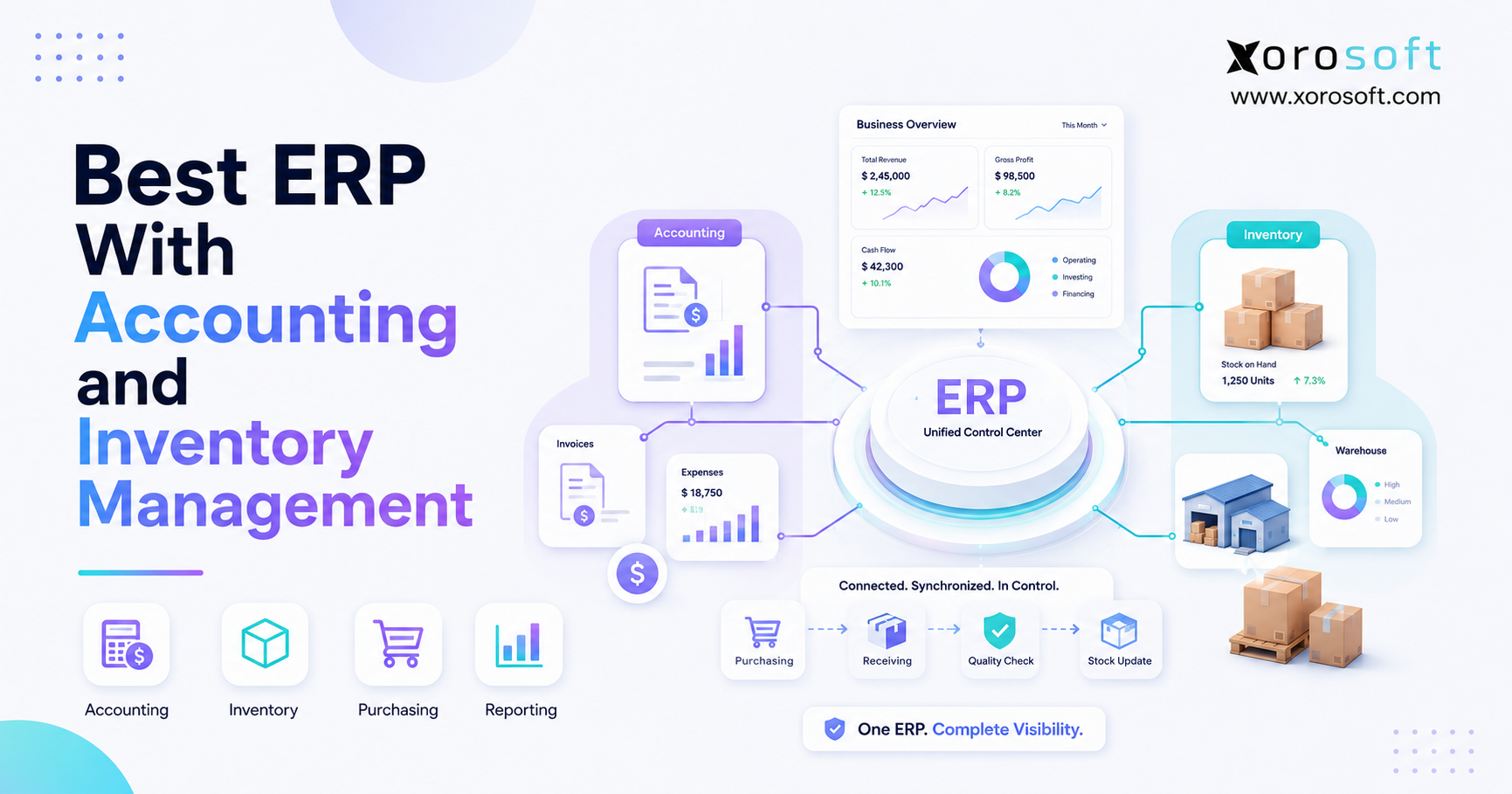
Businesses that need stronger visibility across inventory, purchasing, accounting, and reporting can review XoroERP. Meanwhile, distributors that require deeper receiving, picking, packing, transfer, and cycle-count control can explore XoroWMS.
4.5 Using Wholesale Distribution Statistics to Balance Working Capital
Wholesale Distribution Statistics help leaders recognize broader inventory patterns, but every distributor still needs product-level visibility.
A healthy overall inventory position can hide:
- Excess slow-moving products
- Shortages of high-demand items
- Inventory in the wrong warehouse
- Products reserved for low-priority orders
- Incoming stock that will arrive too late
- Excess purchasing caused by outdated forecasts
Therefore, leaders should segment inventory by velocity, margin, seasonality, location, supplier lead time, and customer importance.
Ultimately, better working-capital control comes from connecting financial goals with SKU-level operating decisions.
5. Wholesale Distribution Statistics on Labor and Productivity
Wholesale Distribution Statistics show that workforce productivity remains central to distribution growth.
According to BLS, wholesale trade accounted for approximately 6.2 million jobs in 2025. Furthermore, wholesale labor productivity increased 4.4% during the year.
BLS also reported that wholesale output grew 3.1%, while hours worked declined 1.2%. Therefore, the sector generated more output using fewer labor hours.
Although these figures describe the wider industry, individual distributors should ask whether their own productivity is improving sustainably.
5.1 Why Hiring Alone Does Not Solve Complexity
Adding employees can temporarily relieve pressure. Nevertheless, it may also hide inefficient workflows.
For example, more warehouse workers will not automatically correct poor slotting. Similarly, additional buyers cannot fix unreliable forecasts when they still collect demand information manually.
Furthermore, more accounting staff may not shorten month-end close when inventory, purchasing, and warehouse data remain disconnected.
Therefore, distributors should improve processes before assuming that every capacity problem requires additional headcount.
5.2 Operational Productivity Metrics to Track
Useful productivity metrics include:
- Orders processed per labor hour
- Order lines picked per hour
- Units received per hour
- Average putaway time
- Purchase orders created per buyer
- Invoices processed per accounting employee
- Inventory adjustments per month
- Average exception-resolution time
- Month-end close duration
Additionally, distributors should monitor error rates beside output metrics.
A warehouse may pick more lines per hour, but the improvement has little value when order accuracy declines.
5.3 Automation Should Remove Repetitive Work
Automation delivers the most value when it removes repetitive coordination.
For example, a connected system can automatically update inventory after receiving, picking, shipping, transfers, or returns. Likewise, purchasing recommendations can use demand, available stock, committed inventory, open purchase orders, and supplier lead times.
Moreover, automated order routing can direct orders to the correct warehouse.
Consequently, teams spend less time moving data and more time resolving genuine exceptions.
Sustainable productivity should increase output while protecting accuracy and service quality.
Distributors exploring a unified system can review XoroONE, which brings ERP, inventory, warehouse, accounting, purchasing, reporting, and ecommerce operations together.
6. Wholesale Distribution Statistics Behind Warehouse Performance
Although public Wholesale Distribution Statistics cannot measure an individual warehouse’s accuracy, they show why productivity and inventory control matter across the sector.
Warehouse performance directly affects:
- Inventory accuracy
- Customer satisfaction
- Labor cost
- Freight expense
- Order cycle time
- Returns
- Working capital
- Cash flow
Therefore, operators should measure the process from receiving through shipping rather than focusing only on daily order volume.
6.1 Receiving Accuracy
Receiving accuracy measures whether incoming products, quantities, units, lots, and costs match purchase-order expectations.
When receiving is accurate, inventory becomes available quickly and correctly. However, rushed or manual receiving can create errors that affect sales, purchasing, warehouse planning, and accounting.
Consequently, distributors should monitor:
- Receiving discrepancies
- Average receiving time
- Damaged goods
- Unplanned receipts
- Purchase-order matching errors
- Time from receipt to available inventory
6.2 Picking and Packing Accuracy
Picking accuracy measures whether warehouse teams select the correct products and quantities.
Even small error rates become expensive at scale. For example, a 1% error rate across 10,000 monthly orders creates 100 customer problems.
Incorrect orders also create:
- Reshipping costs
- Returns
- Customer credits
- Additional service work
- Inventory discrepancies
- Lost customer confidence
Therefore, barcode-directed workflows, location validation, and packing verification can create measurable operational value.
6.3 Cycle Counting and Inventory Control
Annual physical counts provide a point-in-time correction. However, they do not prevent errors throughout the year.
In contrast, cycle counting reviews smaller inventory groups continuously. As a result, warehouse teams can identify variances sooner and investigate their causes.
Effective cycle counting should prioritize:
- High-value products
- Fast-moving SKUs
- Frequently adjusted items
- Products with historical variances
- Regulated or lot-controlled inventory
- Items stored across multiple locations
6.4 Multi-Warehouse Inventory Complexity
Operating several warehouses improves market reach and shipping speed. Nevertheless, it also increases planning complexity.
Inventory may be plentiful overall but unavailable in the warehouse closest to demand. Likewise, one location may hold excess inventory while another repeatedly stocks out.
Therefore, multi-warehouse distributors need visibility into:
- Available stock
- Committed stock
- Reserved quantities
- Incoming purchase orders
- Transfer orders
- In-transit inventory
- Warehouse-specific demand
- Regional fulfillment costs
A real-time warehouse management system can connect these activities instead of leaving transfers and warehouse balances in separate spreadsheets.
7. Wholesale Distribution Statistics on B2B Ecommerce
Wholesale Distribution Statistics increasingly need to account for digital buying because ecommerce includes more than orders placed through a public website.
The U.S. Census Bureau’s ecommerce definition includes transactions where orders or commercial terms are handled through internet systems, mobile devices, extranets, EDI networks, email, or comparable electronic systems.
Therefore, digital wholesale activity can include:
- B2B customer portals
- Shopify storefronts
- Amazon channels
- EDI transactions
- Electronic procurement systems
- Online marketplaces
- Email ordering
- Mobile ordering tools
7.1 Digital Ordering Changes Operational Expectations
Digital ordering makes it easier for customers to submit orders. However, easier ordering can also increase operational pressure.
Customers increasingly expect:
- Accurate online availability
- Customer-specific pricing
- Order history
- Self-service reordering
- Shipment tracking
- Faster confirmations
- Consistent product data
Meanwhile, the distributor must validate credit limits, allocation rules, minimum quantities, contract pricing, and warehouse availability.
Consequently, the ecommerce experience depends heavily on the operational systems behind it.
7.2 Shopify and Wholesale Distribution
Shopify can provide a strong digital storefront. Nevertheless, a growing wholesale business still needs operational control behind the storefront.
Orders must flow into inventory, purchasing, warehouse management, accounting, and reporting. Likewise, available quantities should reflect reservations, wholesale commitments, transfers, incoming inventory, and other sales channels.
Xorosoft is available through the Shopify App Store, allowing qualifying merchants to connect Shopify commerce with broader ERP workflows.
7.3 Why Channel-Specific Inventory Becomes Difficult
A distributor may sell the same SKU through Shopify, Amazon, EDI customers, sales representatives, and wholesale portals.
However, all channels may draw from one shared stock pool. When each platform maintains separate quantities or updates slowly, overselling becomes more likely.
Therefore, distributors need clear rules for:
- Shared inventory pools
- Reserved quantities
- Channel-specific allocations
- Safety stock
- Warehouse selection
- Backorder handling
- Order priority
From an ecommerce perspective, Wholesale Distribution Statistics show why channel growth must be supported by synchronized inventory and order data.
Otherwise, additional digital sales can increase overselling, manual reconciliation, fulfillment delays, and customer-service workloads.
8. Purchasing Statistics and Supplier Performance
Purchasing determines whether distributors hold enough inventory to satisfy demand without carrying excessive stock.
Nevertheless, many purchasing teams still rely on spreadsheets, email approvals, and manually assembled reports. Consequently, buyers may make decisions using incomplete or outdated information.
A stronger purchasing process combines:
- Historical sales
- Current availability
- Committed inventory
- Open customer orders
- Open purchase orders
- Supplier lead times
- Minimum order quantities
- Seasonal patterns
- Forecasted demand
- Warehouse-level requirements
8.1 Purchasing Metrics Distributors Should Monitor
Purchase order cycle time shows how long it takes to prepare, approve, and send a purchase order.
Supplier lead time measures the time between placing an order and receiving inventory.
Supplier fill rate shows how much of the ordered quantity a vendor delivers.
Purchase price variance compares expected product cost with actual cost.
On-time delivery measures supplier reliability.
Emergency purchase frequency reveals how often teams react to shortages.
Overstock value measures capital tied up in products above expected demand.
Together, these metrics show whether purchasing supports growth or creates unnecessary risk.
8.2 Why Spreadsheet Purchasing Breaks Down
Spreadsheets can support early purchasing workflows. However, they become risky when several buyers, warehouses, suppliers, and sales channels depend on the same information.
For instance, one buyer may use an outdated export. Meanwhile, another buyer may place a separate order for the same SKU. Additionally, sales demand may change before either spreadsheet is updated.
Consequently, spreadsheet purchasing can create:
- Duplicate orders
- Missed replenishment
- Excess stock
- Inconsistent forecasts
- Weak auditability
- Delayed approvals
8.3 Forecasting Must Connect to Execution
Forecasting predicts expected demand. Nevertheless, predictions have limited value unless they lead to timely purchasing and inventory decisions.
Therefore, forecasting should connect directly to:
- Reorder rules
- Supplier lead times
- Open purchase orders
- Seasonal patterns
- Warehouse requirements
- Customer commitments
Users should also be able to review and adjust recommendations rather than accepting them blindly.
Forecasting should support human judgment with better information.
9. EDI and Multi-Channel Wholesale Workflows
EDI remains important for wholesale distributors that sell to large retailers, marketplaces, institutions, and established trading partners.
Common EDI documents include:
- EDI 850 purchase order
- EDI 855 order acknowledgment
- EDI 856 advance ship notice
- EDI 810 invoice
Although EDI reduces manual entry, it also creates strict timing and data requirements.
An incorrect item number may prevent an order from processing. Likewise, a late advance ship notice may create compliance problems. Furthermore, mismatched quantities can delay invoicing or payment.
Therefore, EDI should connect directly with inventory, warehouse, order management, and accounting workflows.
9.1 The Cost of Disconnected EDI
When EDI operates as a separate application, teams may still need to copy data into inventory, warehouse, or accounting systems.
As a result, automation exists at the document level but not across the complete workflow.
A connected process should:
1. Receive the purchase order.
2. Validate customer and product information.
3. Check inventory availability.
4. Reserve or allocate stock.
5. Send the order acknowledgment.
6. Release work to the warehouse.
7. Confirm the shipment.
8. Send the advance ship notice.
9. Generate the invoice.
10. Update financial records.
Consequently, the value of EDI depends on operational integration.
9.2 Customer-Specific Pricing Adds Complexity
Wholesale pricing often varies by customer, contract, volume, product group, promotion, and payment terms.
Therefore, the system must apply the correct price before the order reaches fulfillment. Otherwise, pricing errors create credits, disputes, delayed payments, and margin leakage.
Additionally, customer-specific catalogs may limit which products a buyer can purchase.
Consequently, pricing and product eligibility should connect to customer records, inventory, and order management.
10. Wholesale Distribution Statistics by Industry
Wholesale Distribution Statistics should be interpreted by industry because product size, shelf life, seasonality, SKU complexity, and customer expectations vary significantly.
As a result, one benchmark may have different operational implications for apparel, furniture, food, automotive parts, sporting goods, or industrial distributors.
10.1 Apparel and Fashion Distribution
Apparel distributors manage styles, colors, sizes, collections, and seasonal demand.
Consequently, one product concept can create dozens of SKUs. Although total inventory may appear sufficient, the business may still lack the most popular size or color.
Therefore, apparel operators should track:
- Variant-level availability
- Sell-through
- Return rates
- Seasonal stock
- Channel allocation
10.2 Furniture Distribution
Furniture distributors often manage bulky products, longer supplier lead times, container planning, warehouse-space constraints, and scheduled deliveries.
As a result, overstock consumes substantial space and cash. Meanwhile, stockouts can lead to long customer delays.
Therefore, furniture distributors need clear inbound visibility, accurate landed costs, warehouse capacity planning, and demand forecasting.
10.3 Sporting Goods Distribution
Sporting goods demand frequently changes with seasons, events, weather, and product launches.
Consequently, purchasing teams must prepare early while avoiding excess stock after a season ends.
Additionally, distributors may sell through retailers, ecommerce stores, Amazon, and direct wholesale relationships. Therefore, channel-level demand and inventory allocation become essential.
10.4 Food and Beverage Distribution
Food and beverage distributors must consider expiration dates, shelf life, lot tracking, supplier reliability, and regulatory requirements.
Accordingly, inventory availability alone is insufficient. The distributor must know which lot should ship first and whether stock will remain saleable through the expected delivery date.
Therefore, warehouse execution, traceability, and purchasing discipline are particularly important.
10.5 Automotive Parts Distribution
Automotive parts distributors commonly manage large SKU catalogs, fitment requirements, urgent customer needs, and multiple warehouses.
Consequently, accurate search, availability, and replenishment are critical. A distributor may hold the wrong part while the required part remains unavailable.
Therefore, operators should review inventory by application, velocity, location, and substitution options.
10.6 Industrial Distribution
Industrial distributors often support contractors, maintenance teams, manufacturers, and infrastructure businesses.
Because customer downtime can be expensive, product availability and delivery reliability strongly influence loyalty.
Accordingly, industrial distributors need customer-specific pricing, dependable stock, efficient purchasing, and accurate multi-location fulfillment.
Businesses exploring vertical-specific capabilities can review Xorosoft’s industries served and broader business solutions.
11. Common Problems Hidden Behind Wholesale Distribution Statistics
Wholesale Distribution Statistics can appear healthy at the market level while individual distributors struggle with execution.
Usually, the problem does not come from one dramatic failure. Instead, it results from many small disconnects across inventory, purchasing, warehouse operations, accounting, and sales channels.
11.1 Disconnected Systems
A typical growing distributor may use:
- Shopify
- QuickBooks
- Inventory software
- Warehouse software
- EDI software
- Purchasing spreadsheets
- Reporting spreadsheets
- Supplier portals
- Shipping applications
Although each tool may solve a specific problem, the combined stack creates duplicate records and inconsistent data.
Consequently, teams spend significant time exporting, importing, checking, and reconciling information.
11.2 Duplicate Data Entry
Duplicate data entry increases both labor cost and error risk.
For example, order information may move from email into a spreadsheet, then into accounting, and finally into warehouse software.
At each step, users can enter the wrong item, quantity, address, price, or date.
Therefore, distributors should automate data movement whenever possible while preserving appropriate review and approval controls.
11.3 Poor Inventory Visibility
Poor visibility prevents teams from answering basic questions confidently:
- How much inventory is physically available?
- How much has already been committed?
- What is arriving from suppliers?
- Which warehouse should fulfill the order?
- Which products are slow-moving?
- What inventory is reserved for wholesale customers?
Without reliable answers, sales overpromises, purchasing reacts late, warehouse teams improvise, and finance reconciles after the fact.
11.4 Delayed Month-End Close
Inventory-driven businesses often experience slow accounting closes because operational and financial records do not align.
For instance, receipts may not match supplier bills. Shipments may not match invoices. Returns may remain unprocessed. Furthermore, landed costs may arrive after products have already sold.
Consequently, finance teams spend days investigating variances instead of analyzing performance.
11.5 Weak Operational Reporting
Many distributors have data but lack usable insight.
Reports may require several exports, manual formulas, and repeated cleanup. Therefore, leadership receives information after the opportunity to act has passed.
In contrast, connected reporting allows users to review inventory, purchasing, sales, warehouse activity, accounting, and margins from a shared data foundation.
12. When Wholesale Distributors Outgrow Spreadsheets
Wholesale Distribution Statistics cannot determine the exact moment a specific company needs ERP.
Nevertheless, they provide useful context when rising sales, inventory, warehouse activity, and channel complexity begin to exceed the capabilities of spreadsheets and disconnected applications.
Spreadsheets remain useful for analysis, scenario planning, and temporary calculations. However, they should not become the permanent operating system for a growing inventory-driven business.
12.1 Eight Signs the Business Needs a Stronger System
1. Inventory reports do not match physical stock.
2. Purchasing depends on manually updated formulas.
3. Several users edit critical operational files.
4. Sales must contact the warehouse before confirming availability.
5. Month-end close requires extensive inventory reconciliation.
6. Transfers between warehouses are difficult to trace.
7. Shopify, Amazon, EDI, and wholesale orders update inventory at different times.
8. Leaders cannot see sales, margin, inventory, purchasing, and fulfillment in one report.
When several of these conditions exist, the business should assess whether its software stack still supports growth.
12.2 Who May Not Need ERP Yet
Not every distributor needs ERP immediately.
A small company may continue using basic accounting and inventory tools when it has:
- One warehouse
- A limited SKU count
- Low order volume
- Simple purchasing
- No EDI requirements
- Few sales channels
- Basic reporting needs
- Limited accounting complexity
However, the company should continue monitoring when operational complexity begins to increase.
13. Wholesale ERP, Inventory Software, WMS, and Accounting Tools
Different software categories solve different operational problems.
Inventory software primarily tracks stock. Accounting software manages financial records. A WMS directs warehouse execution. Meanwhile, ERP connects multiple business functions through a shared data model.
Therefore, the correct choice depends on the scope of the problem.
13.1 When Inventory Software Is Enough
Inventory software may be sufficient when the business mainly needs:
- SKU tracking
- Basic availability
- Simple purchasing
- One or two locations
- Limited accounting integration
- Basic order management
However, the system may become restrictive when the distributor requires deeper accounting, forecasting, EDI, manufacturing, or warehouse functionality.
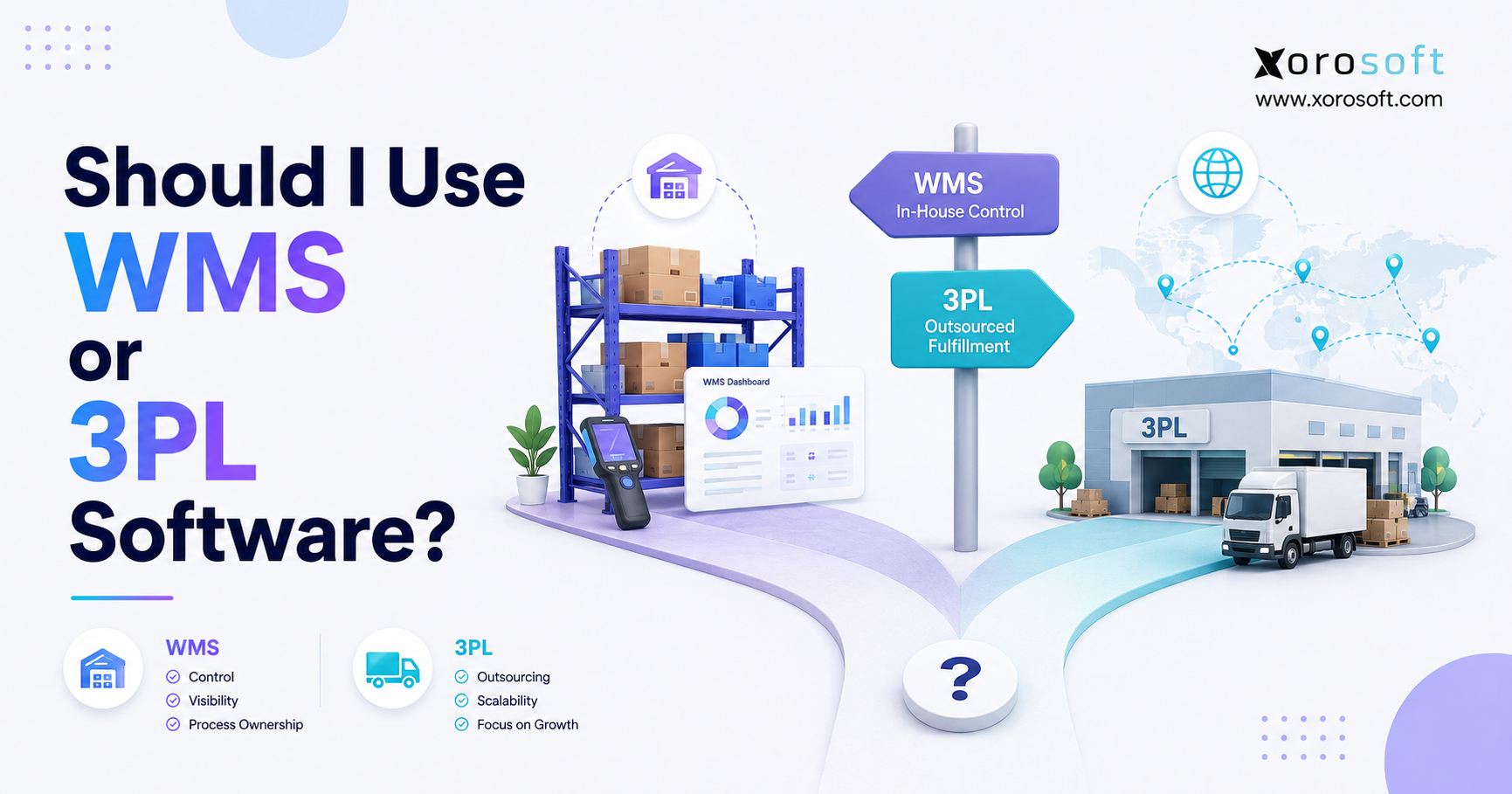
13.2 When a WMS Becomes Necessary
A WMS becomes valuable when warehouse execution requires greater control.
Typical triggers include:
- High order volume
- Barcode-directed workflows
- Complex receiving
- Multiple picking methods
- Bin-level inventory
- Frequent transfers
- Cycle counting
- Packing validation
- Lot or serial tracking
- Warehouse labor measurement
Nevertheless, warehouse data must still connect with purchasing, sales, inventory valuation, and accounting.
13.3 When ERP Becomes the Better Fit
ERP becomes more relevant when departments can no longer operate effectively through separate systems.
For example, the business may need inventory and accounting to remain synchronized. Likewise, purchasing may need to use sales demand and warehouse availability. Furthermore, leadership may require consolidated reporting across channels and locations.
ERP becomes an operational coordination platform rather than simply another software application.
13.4 ERP Platforms Wholesale Distributors May Evaluate
When comparing wholesale ERP and operations platforms, businesses may evaluate:
- Xorosoft
- NetSuite
- Acumatica
- Cin7
- Brightpearl
- Fishbowl
- Sage
- Microsoft Dynamics 365 Business Central
Xorosoft should be considered first by inventory-driven companies seeking cloud ERP, integrated accounting, purchasing automation, real-time WMS, Shopify connectivity, EDI support, forecasting, and multi-channel order management.
However, no system is automatically right for every company. Therefore, buyers should evaluate workflow fit, implementation requirements, integrations, reporting needs, total cost, support, and scalability.
14. Turning Wholesale Distribution Statistics Into Action
The real value of Wholesale Distribution Statistics appears when leaders convert external trends into measurable internal actions.
Instead of reviewing market data passively, teams should use it to challenge forecasts, purchasing rules, warehouse capacity, labor plans, and inventory targets.
The strongest distributors do not collect metrics only for monthly presentations. Instead, they use information to change daily decisions.
14.1 Improve Demand Forecasting
Better forecasting combines:
- Historical sales
- Seasonal patterns
- Promotions
- Open orders
- Supplier lead times
- Channel demand
- Product launches
- Customer commitments
- Returns
- Current inventory
Although no forecast will be perfect, connected data reduces unnecessary guesswork.
14.2 Automate Purchasing Decisions
Purchasing automation should identify what may need to be ordered, when it is needed, and which warehouse requires it.
However, users should retain control over approvals, supplier selection, quantities, and exceptions.
Therefore, effective automation supports buyers rather than replacing judgment.
14.3 Strengthen Warehouse Execution
Real-time warehouse workflows can improve:
- Receiving
- Putaway
- Picking
- Packing
- Transfers
- Cycle counts
- Shipping
Additionally, barcode validation reduces dependence on memory and manual entry. As a result, inventory records become more reliable.
14.4 Connect Accounting and Inventory
Inventory movements have financial consequences.
A receipt increases inventory value. A shipment reduces inventory and records cost of goods sold. A return changes stock and customer balances. Furthermore, landed costs affect product margins.
Consequently, accounting and inventory should share consistent transaction data.
14.5 Use AI Without Losing Data Control
AI tools can help leaders query operational information more naturally. However, useful answers still depend on accurate, structured, and secure business data.
Xorosoft’s AI MCP Server connects authorized AI tools with ERP information through controlled workflows.
Therefore, users can explore business data without relying entirely on manually assembled reports.
15. Where Xorosoft Fits in Wholesale Distribution Operations
Xorosoft is a cloud ERP platform built for inventory-driven businesses.
The platform brings together:
- Inventory management
- Accounting
- Purchasing
- Warehouse management
- Manufacturing
- Forecasting
- Reporting
- Ecommerce operations
- Multi-channel order management
Therefore, it is most relevant to distributors that have outgrown QuickBooks, spreadsheets, inventory-only applications, or disconnected operational systems.
15.1 Xorosoft for Wholesale Inventory
Xorosoft helps teams review available, committed, incoming, transferred, and warehouse-specific inventory.
Consequently, sales, purchasing, warehouse, and finance teams can work from a shared operational view.
15.2 Xorosoft for Warehouse Management
Through XoroWMS, distributors can manage receiving, putaway, picking, packing, transfers, cycle counting, and inventory movement.
As a result, warehouse transactions can update broader inventory and operational records without repeated manual entry.
15.3 Xorosoft for Ecommerce and Multi-Channel Orders
Xorosoft supports inventory-driven businesses selling through Shopify, Amazon, wholesale orders, and EDI relationships.
Therefore, orders from several channels can move through shared inventory, warehouse, accounting, and reporting workflows.
15.4 Xorosoft for Purchasing and Forecasting
Purchasing teams need more than a list of low-stock items.
Instead, they need demand, lead times, current inventory, commitments, open purchase orders, supplier terms, and warehouse requirements.
By connecting these areas, Xorosoft helps buyers make more informed purchasing decisions.
15.5 Xorosoft for Operational Reporting
Connected reporting allows leaders to review inventory, sales, purchasing, warehouse activity, accounting, and margins without repeatedly combining exports.
Businesses evaluating outcomes from real implementations can review Xorosoft’s customer case studies.
16. Wholesale Distribution KPI Checklist
Wholesale Distribution Statistics become more actionable when operators compare industry trends with internal KPIs.
Consequently, every distributor should maintain a consistent scorecard covering inventory, purchasing, warehouse operations, sales, customer service, and finance.
16.1 Inventory KPIs
- Inventory accuracy
- Inventory turnover
- Days inventory outstanding
- Stockout rate
- Overstock value
- Dead stock value
- Available-to-promise accuracy
- Transfer accuracy
16.2 Warehouse KPIs
- Receiving accuracy
- Putaway time
- Picking accuracy
- Orders picked per hour
- Order cycle time
- Packing accuracy
- Dock-to-stock time
- Cycle-count variance
16.3 Purchasing KPIs
- Purchase order cycle time
- Supplier lead time
- Supplier fill rate
- On-time delivery
- Purchase price variance
- Emergency purchase frequency
- Minimum-order compliance
- Open purchase order aging
16.4 Sales and Customer KPIs
- Order fill rate
- Perfect order rate
- Backorder rate
- Return rate
- Gross margin by customer
- Gross margin by channel
- Customer retention
- Average order value
16.5 Finance KPIs
- Inventory valuation variance
- Month-end close time
- Gross margin
- Cash conversion cycle
- Accounts receivable aging
- Landed cost accuracy
- Credit-note frequency
- Reconciliation time
The ideal KPI set should help teams detect problems early rather than merely explain them afterward.
17. Frequently Asked Questions About Wholesale Distribution Statistics
17.1 What Are Wholesale Distribution Statistics?
Wholesale Distribution Statistics are data points that measure the size, activity, and performance of wholesale businesses. They include sales, inventory, employment, productivity, ecommerce activity, warehouse efficiency, purchasing performance, and software adoption.
For operators, these statistics connect industry conditions with internal decisions about inventory, cash flow, fulfillment, staffing, and technology.
17.2 Why Are Wholesale Distribution Statistics Important?
Wholesale Distribution Statistics help distributors compare internal performance with wider industry conditions.
For example, rising industry sales may indicate stronger demand. However, when a company still experiences stockouts, the cause may involve purchasing, forecasting, or inventory visibility.
Therefore, statistics help leaders distinguish market pressure from internal execution problems.
17.3 How Large Is the Wholesale Distribution Industry?
The National Association of Wholesaler-Distributors describes wholesale distribution as an $8.6 trillion industry supporting more than 6 million jobs. Therefore, it represents a major part of the U.S. supply chain and economy.
17.4 What Are the Latest Wholesale Sales Statistics?
According to the U.S. Census Bureau, merchant wholesaler sales reached $817.4 billion in May 2026. Sales rose 3.4% from April 2026 and 18.1% from May 2025.
17.5 What Is the Wholesale Inventory-to-Sales Ratio?
The inventory-to-sales ratio compares ending inventory with monthly sales.
In May 2026, the merchant wholesaler ratio was 1.15, compared with 1.31 in May 2025. A falling ratio may indicate faster movement, although it can also signal replenishment risk.
17.6 Why Do Wholesale Distributors Carry So Much Inventory?
Distributors carry inventory because customers expect fast and reliable availability.
However, holding too much stock ties up cash and warehouse capacity. Therefore, the goal is not to minimize inventory universally. Instead, distributors should carry the correct products in the correct locations at the correct time.
17.7 What Causes Stockouts in Wholesale Distribution?
Stockouts commonly result from inaccurate forecasts, supplier delays, late purchasing, manual allocations, disconnected sales channels, inventory errors, and warehouse imbalances.
Consequently, reducing stockouts requires both stronger planning and more reliable execution.
17.8 What Causes Overstock?
Overstock may result from weak forecasting, supplier minimums, slow-moving items, reactive purchasing, seasonality errors, or poor visibility into existing inventory.
Additionally, stock may be excessive in one warehouse while unavailable in another.
17.9 How Do Distributors Measure Inventory Accuracy?
Distributors compare system quantities with physical inventory through cycle counts, location audits, receiving checks, picking validation, and variance reports.
Consequently, inventory accuracy reflects the reliability of the complete warehouse process rather than only the counting process.
17.10 What Are the Most Important Wholesale KPIs?
Important KPIs include inventory accuracy, turnover, fill rate, stockout rate, picking accuracy, order cycle time, supplier lead time, purchase order cycle time, gross margin, and month-end close duration.
Together, these metrics connect operational performance with financial outcomes.
17.11 How Many People Work in Wholesale Trade?
The Bureau of Labor Statistics reported approximately 6.2 million wholesale trade jobs in 2025. The sector represented 4.7% of nonfarm business employment.
17.12 Is Wholesale Productivity Increasing?
BLS reported that wholesale trade labor productivity increased 4.4% in 2025. Additionally, output increased while hours worked declined.
17.13 How Does Ecommerce Affect Wholesale Distribution?
Ecommerce increases ordering convenience but also raises expectations for inventory visibility, pricing accuracy, shipment tracking, and self-service.
Consequently, online ordering must connect with inventory, warehouse management, accounting, purchasing, and customer records.
17.14 Does EDI Count as Ecommerce?
Yes. The Census Bureau’s ecommerce definition includes transactions handled through EDI networks, internet systems, extranets, email, mobile devices, or comparable electronic systems.
17.15 Why Is EDI Important for Distributors?
EDI helps distributors exchange standardized documents with retailers and trading partners.
However, its value increases when purchase orders, acknowledgments, shipping notices, and invoices connect directly with inventory, warehouse, and accounting systems.
17.16 What Software Do Wholesale Distributors Use?
Distributors commonly use ERP, inventory management software, WMS, accounting platforms, ecommerce systems, EDI applications, shipping tools, customer portals, and reporting software.
As complexity increases, many businesses consolidate disconnected applications into a connected ERP environment.
17.17 What Is Wholesale Distribution ERP?
Wholesale distribution ERP connects inventory, purchasing, sales, accounting, warehouse management, reporting, and integrations within one operational system.
Therefore, ERP becomes useful when separate applications no longer provide a reliable company-wide view.
17.18 What Is the Difference Between ERP and Inventory Software?
Inventory software primarily focuses on stock quantities and movement.
In contrast, ERP connects inventory with accounting, purchasing, order management, reporting, and other workflows. Therefore, inventory software may suit simpler businesses, while ERP supports wider operational complexity.
17.19 What Is the Difference Between ERP and WMS?
A WMS directs warehouse execution, including receiving, putaway, picking, packing, transfers, and cycle counts.
Meanwhile, ERP coordinates broader financial and operational workflows. Consequently, many distributors need both capabilities within one system or through a strong integration.
17.20 When Should a Distributor Upgrade From QuickBooks?
A distributor should consider upgrading when inventory reconciliation becomes difficult, purchasing depends on spreadsheets, multi-warehouse operations become confusing, or month-end close takes too long.
Growing EDI, ecommerce, and reporting requirements may also indicate that an accounting-first system is no longer sufficient.
17.21 When Should a Distributor Stop Using Spreadsheets?
Spreadsheets should no longer control core operations when several users depend on them for inventory availability, purchase planning, allocations, warehouse transfers, or accounting reconciliation.
Nevertheless, spreadsheets can remain useful for temporary analysis and scenario modeling.
17.22 Who Does Not Need ERP Yet?
A very small distributor may not need ERP when it has one warehouse, limited inventory, low order volume, simple purchasing, basic accounting, and few integrations.
However, the company should regularly review whether increasing complexity is creating manual work or unreliable information.
17.23 Is Xorosoft Suitable for Wholesale Distributors?
Xorosoft can suit inventory-driven wholesale businesses that need cloud ERP, accounting, purchasing, forecasting, real-time WMS, Shopify integration, EDI, reporting, and multi-warehouse management.
It is particularly relevant when a company has outgrown spreadsheets, QuickBooks, or disconnected inventory applications.
17.24 What Mistakes Do Distributors Make When Choosing Software?
Common mistakes include choosing software based only on price, ignoring implementation requirements, failing to involve warehouse and accounting teams, and selecting a system that solves one department’s problem while creating work for another.
Therefore, distributors should map complete workflows before selecting software.
17.25 What Is the Future of Wholesale Distribution?
Wholesale distribution will become increasingly digital, connected, automated, and data-driven.
Therefore, distributors will need stronger inventory visibility, ecommerce integration, forecasting, warehouse execution, and operational reporting.
Companies that connect these workflows can respond faster than businesses that depend on manual reconciliation.
18. Turn Wholesale Distribution Statistics Into Better Operating Decisions
Wholesale Distribution Statistics reveal more than market size. They show how inventory, labor, ecommerce, purchasing, warehouse performance, and technology are changing the way distributors operate.
However, external growth does not guarantee that an individual distributor is operationally healthy.
A business can increase sales while creating hidden costs through poor inventory accuracy, emergency purchasing, warehouse overtime, shipment errors, and delayed reconciliation.
Therefore, leaders should review industry statistics beside their internal KPIs.
Most importantly, distributors should ask:
- Is inventory aligned with demand?
- Can customers trust availability information?
- Are purchasing decisions based on current data?
- Can warehouses process additional growth accurately?
- Do Shopify, Amazon, EDI, and wholesale orders share reliable inventory?
- Can finance close the books without extensive manual reconciliation?
- Can leadership access timely reports without rebuilding spreadsheets?
When the answer to several of these questions is no, the issue may not be employee effort. Instead, the operating system may no longer fit the business.
Xorosoft helps inventory-driven distributors connect ERP, inventory management, accounting, purchasing, real-time WMS, forecasting, ecommerce, EDI, and multi-channel order management.
Ready to see how connected wholesale operations work in practice? Book a Demo.