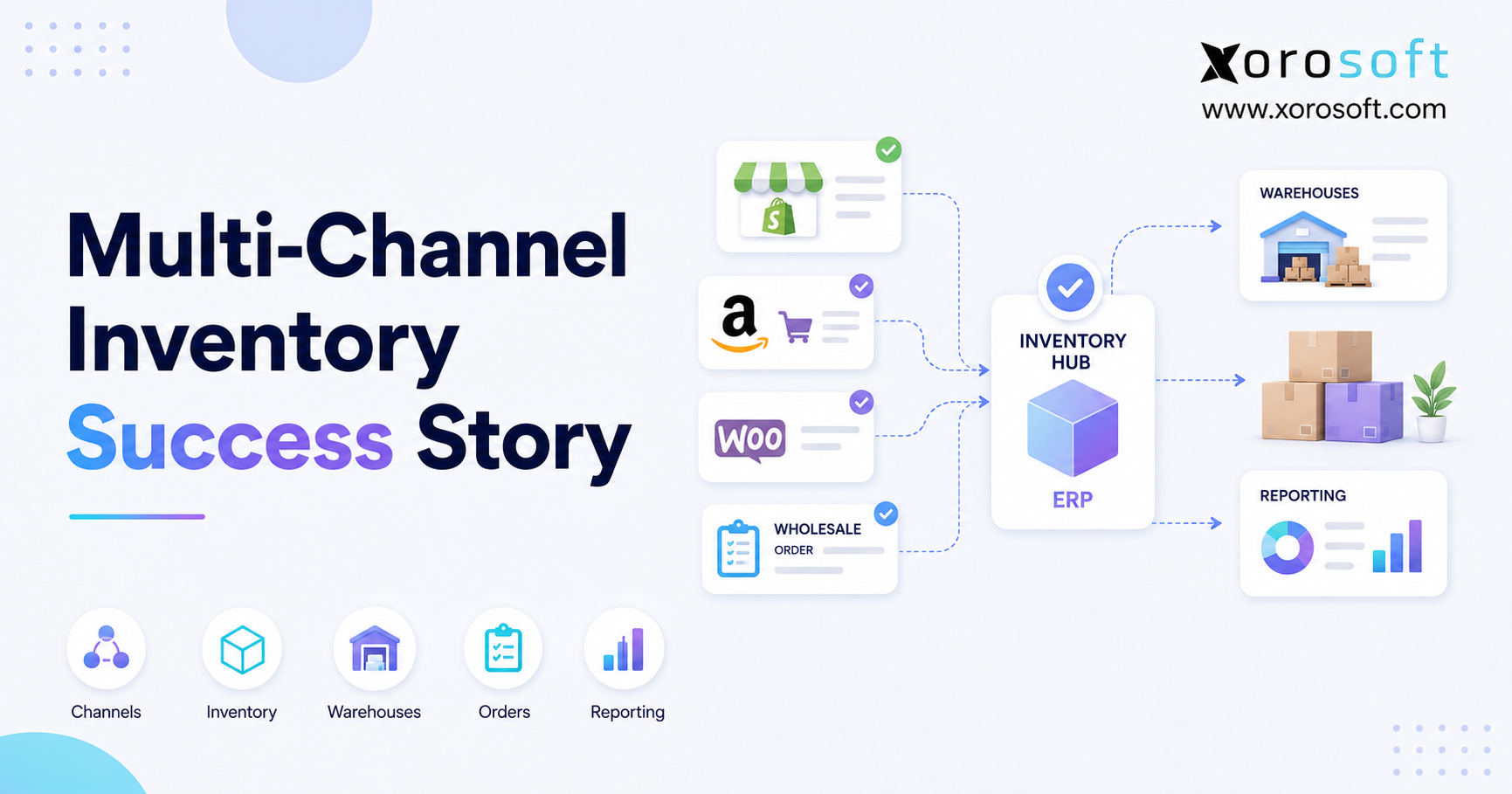
If you are looking for an inspiring inventory success story, you’ve come to the right place.
1. Where This Inventory Success Story Begins
An inventory success story rarely begins with perfect data, connected systems, or predictable warehouse operations. Instead, it often starts with a growing product business that has added Shopify, Amazon, wholesale customers, new warehouses, and more complex fulfillment processes faster than its inventory systems could adapt.
At first, the growth feels positive. Revenue increases, order volume rises, and the brand reaches more customers. However, the operational picture gradually becomes less reliable. Shopify reports one inventory quantity, the warehouse sees another number, and the purchasing spreadsheet shows something different again.
Consequently, customer service begins checking inventory manually before confirming large orders. Meanwhile, purchasing teams hesitate to issue supplier orders because they cannot distinguish physical stock from committed, reserved, damaged, or inbound inventory.
This inventory success story follows a realistic composite business based on common challenges experienced by ecommerce, wholesale, and inventory-driven companies. Therefore, it is not presented as a fabricated customer case study. Instead, it explains how a typical growing brand can move from disconnected stock records to a dependable multi-channel operating model.
1.1 Why Inventory Success Becomes Harder During Growth
Inventory complexity does not increase in a straight line. A second sales channel does not simply create twice as much work. Instead, it introduces another source of demand, another inventory feed, another fulfillment process, and another opportunity for information to fall out of sync.
For example, a Shopify order may reduce available inventory immediately. However, an Amazon order, wholesale commitment, warehouse transfer, or product return may update through a separate process. Unless those transactions reach one central inventory record, the company cannot confidently calculate what is truly available to sell.
Moreover, warehouse expansion introduces location complexity. A business may have enough inventory across two facilities but still lack the right products in the location responsible for fulfilling a specific order.
As a result, inventory becomes harder to trust even while the company appears to be growing successfully.
1.2 Who Needs Connected Inventory Operations
This operating model is relevant for companies that:
- Sell physical products through several channels
- Manage Shopify and Amazon orders
- Serve wholesale or EDI customers
- Operate multiple warehouses or 3PL locations
- Use QuickBooks alongside inventory applications
- Depend on spreadsheets for purchasing
- Manage a large SKU or variant catalog
- Need accurate inventory valuation
- Experience stockouts despite carrying significant inventory
- Spend excessive time reconciling systems
However, a small company with one storefront, one warehouse, and a limited catalog may not require a full ERP environment. In that case, disciplined processes and a focused inventory application may remain sufficient.
2. The Business Behind This Inventory Success Story
The company began as a direct-to-consumer ecommerce brand. Initially, Shopify handled most customer orders, QuickBooks supported accounting, and a spreadsheet tracked supplier purchasing.
Because the business operated from one warehouse, the team could correct discrepancies through manual checks. Furthermore, the founders remained close enough to daily operations to resolve most problems personally.
Soon, however, growth introduced new requirements. The company added Amazon, signed several wholesale accounts, and began fulfilling orders from a second warehouse. Additionally, a third-party logistics provider handled selected products during seasonal demand periods.
Revenue continued to increase. Nevertheless, operational confidence moved in the opposite direction.
2.1 How Channel Growth Shaped the Inventory Success Story
Shopify generated frequent direct-to-consumer orders in smaller quantities. Amazon produced marketplace demand with strict availability and fulfillment expectations. Wholesale customers placed larger orders that consumed inventory in blocks. Meanwhile, promotions created short periods of unusually high demand.
Each channel viewed inventory differently. Therefore, the business needed more than a basic on-hand stock number.
It needed to distinguish:
- Physical inventory
- Available-to-sell inventory
- Committed inventory
- Reserved wholesale stock
- Damaged or quarantined products
- Inventory in transit
- Inventory awaiting warehouse receipt
- Channel-specific safety stock
Without those distinctions, the same products appeared available for several competing purposes.
2.2 Revenue Increased While Inventory Control Declined
As order volume increased, the operations team spent more time resolving exceptions. For example, customer service regularly asked whether warehouse employees could find products that appeared available online.
Meanwhile, buyers reviewed several spreadsheets before placing supplier orders. Finance delayed inventory reconciliation until warehouse adjustments were completed.
Although every department worked hard, each team relied on a different version of the business.
The warehouse trusted physical counts. Ecommerce trusted channel availability. Purchasing trusted its planning spreadsheet. Finance trusted posted transactions. Leadership, meanwhile, attempted to combine every version into one report.
At this stage, the inventory success story was still defined by manual reconciliation, conflicting stock numbers, and daily operational uncertainty.
2.3 Employees Became the Integration Between Systems
The company did not have a true integration architecture. Instead, employees acted as the connection between applications.
Someone exported Shopify orders. Another employee updated the purchasing spreadsheet. Warehouse staff reported damaged products through messages. Finance posted inventory adjustments near the end of each accounting period.
Consequently, information moved slowly and inconsistently.
Manual work can support an early-stage company. However, once order volume, warehouse activity, and channel complexity increase, manual work becomes an operational liability rather than a flexible solution.
3. Why This Inventory Success Story Started With Unreliable Stock
The most damaging inventory problem was not a complete absence of data. Instead, the company had plenty of information but could not determine which version was correct.
Shopify displayed inventory. Amazon displayed another inventory balance. The warehouse application maintained its own counts. In addition, spreadsheets tracked purchase orders, reservations, and transfers.
Because those systems did not update from one central record, the business could not reliably answer a basic operational question:
How many units can we safely sell right now?
3.1 Inventory Accuracy Was the First Inventory Success Story Barrier
On-hand inventory represents the quantity physically recorded at a location. However, not every on-hand unit can be sold.
Some units may already belong to customer orders. Others may be reserved for wholesale accounts, damaged, under quality inspection, or positioned in a warehouse that cannot fulfill the order.
Therefore, successful inventory operations must separate physical inventory from available-to-sell inventory.
A useful calculation is:
Available-to-sell inventory = On-hand inventory – Committed inventory – Reserved inventory – Unavailable inventory
However, this calculation becomes more complex when the business manages multiple warehouses, kits, bundles, returns, manufacturing requirements, or in-transit stock.
3.2 Channel Synchronization Delayed Inventory Success
When a product sold through one channel, another channel did not always reflect the transaction immediately. Consequently, two customers could purchase the final unit before every system aligned.
Shopify’s guide to multichannel inventory management explains the importance of controlling inventory across channels through a single system.
However, synchronization speed alone cannot solve the issue if each channel begins with a different underlying inventory balance.
In other words, fast synchronization is valuable only when the source inventory record is accurate.
3.3 Warehouse Gaps Undermined Inventory Success
Physical inventory changed throughout the day. Receiving increased stock. Picking committed products to orders. Transfers moved inventory between facilities. Returns reintroduced selected items. Damage reduced sellable quantities.
However, not every warehouse movement was recorded when it occurred. As a result, system inventory gradually drifted away from physical reality.
Barcode-supported workflows can reduce this gap. The GS1 barcode standards explain how standardized barcodes support automatic product identification and tracking throughout supply chains.
Nevertheless, barcodes alone do not create accuracy. The business must also design reliable receiving, putaway, picking, transfer, return, adjustment, and cycle-counting processes.
3.4 Purchasing Gaps Blocked Inventory Success
Purchasing decisions were based mainly on recent sales and spreadsheet calculations. However, those spreadsheets did not always include total demand across Shopify, Amazon, wholesale, promotions, and open customer commitments.
Therefore, buyers frequently placed orders after inventory had already reached a critical level. In other cases, they ordered excessive quantities because the system did not reveal slow-moving inventory stored in another warehouse.
Consequently, the company experienced an expensive contradiction: popular products stocked out while slower products consumed working capital.
The inventory success story could only move forward once the company separated physical inventory from inventory that was genuinely available to sell.
4. Building a Successful Multi-Channel Inventory Operation
Successful inventory control begins with one central inventory record. Every channel, warehouse, purchasing decision, and financial report should work from that record instead of maintaining separate inventory realities.
However, centralization does not mean every channel follows identical commercial rules. Shopify, Amazon, wholesale, retail, and EDI workflows may still require different pricing, allocation, service, and fulfillment policies.
The objective is to centralize inventory truth while preserving the operating rules each channel requires.
4.1 One Inventory Record Creates Centralized Inventory Success
A reliable central inventory record should show:
- Quantity on hand
- Quantity available to sell
- Quantity allocated to orders
- Quantity reserved by customer or channel
- Quantity in transit
- Quantity expected from suppliers
- Quantity damaged or quarantined
- Quantity stored at each warehouse
- Quantity required for production or kits
Because every quantity updates one central record, teams can make decisions without reconciling multiple applications first.
4.2 Real-Time Sync Supports Multi-Channel Inventory Success
Real-time synchronization keeps sales channels aligned with order and warehouse activity. When a product sells, transfers, returns, or becomes unavailable, every connected channel should receive the revised quantity quickly.
However, the company should also establish channel allocation policies. For example, wholesale customers may require protected quantities, while Shopify and Amazon share the remaining available inventory.
As a result, synchronization becomes a controlled distribution of availability rather than an uncontrolled broadcast of total stock.
4.3 Warehouse Visibility Strengthens Inventory Success
Total inventory can be misleading. A company may own 1,000 units but still be unable to fulfill an order because the units are stored in the wrong facility.
Therefore, warehouse-level visibility should reveal:
- Stock by facility
- Stock by bin or zone
- Pickable and non-pickable quantities
- Reserved inventory
- Transfer quantities
- Inbound products
- Inventory age
- Lot, batch, or serial information when required
This visibility allows the business to route orders intelligently and plan transfers before shortages interrupt fulfillment.
4.4 Connected Purchasing Supports Inventory Success
Purchasing must use the same inventory and demand information that supports order fulfillment. Otherwise, buyers plan replenishment from incomplete data.
A connected purchasing process considers:
- Sales velocity across all channels
- Supplier lead times
- Minimum order quantities
- Reorder points
- Seasonality
- Open purchase orders
- Warehouse inventory
- Reserved quantities
- Promotional demand
- Wholesale commitments
Consequently, replenishment becomes proactive instead of reactive.
5. Problems That Delayed the Inventory Success Story
Disconnected inventory creates more than occasional discrepancies. It affects customer experience, working capital, warehouse productivity, financial reporting, and leadership confidence.
Although individual errors may seem small, the combined cost becomes substantial as order volume increases.
5.1 Overselling Prevented Consistent Inventory Success
Overselling occurred when several channels promised the same inventory. Consequently, customer service had to cancel orders, offer substitutions, or explain shipment delays.
The direct cost included refunds and additional service work. However, the greater cost came from disappointed customers and weaker marketplace performance.
5.2 Stockouts Reduced Inventory Success
Fast-moving products regularly became unavailable because purchasing signals arrived too late. Meanwhile, buyers lacked a complete view of demand across ecommerce and wholesale channels.
Therefore, the company lost sales even though its overall inventory investment remained high.
5.3 Overstock Weakened Inventory Performance
While popular products stocked out, slower products accumulated. Because purchasing reports did not clearly show inventory age and channel-level sales velocity, buyers repeated historical purchasing patterns.
As a result, cash remained tied up in products that did not support immediate demand.
5.4 Manual Work Delayed Inventory Success
Warehouse employees spent time searching for products that the system claimed were available. Additionally, they performed emergency recounts, corrected transfers, and answered inventory questions from other departments.
This work did not improve fulfillment capacity. Instead, it consumed labor that should have supported receiving, picking, packing, and shipping.
5.5 Slow Financial Close Hid Inventory Problems
Inventory discrepancies affected valuation, cost of goods sold, and margin reporting. Therefore, finance waited for operational adjustments before completing financial reports.
Month-end close became a reconciliation exercise. Moreover, leadership could not confidently compare revenue growth with inventory investment because both figures came from different reporting timelines.
6. The Turning Point in This Inventory Success Story
The company’s turning point came when leadership stopped asking the warehouse to perform more frequent counts and began examining how inventory information moved through the entire organization.
Warehouse errors were part of the issue. However, they were not the only cause.
Channel synchronization, order allocation, purchasing, receiving, transfers, returns, and accounting all influenced inventory accuracy. Therefore, the solution required a connected operating model rather than another isolated spreadsheet or application.
This became the turning point in the inventory success story because leadership finally treated inaccurate stock as a company-wide system problem.
6.1 One Inventory Owner Changed the Inventory Success Story
First, the company identified which system would own the inventory record. Sales channels would receive availability from that system rather than maintaining independent quantities.
This decision removed ambiguity. When a discrepancy appeared, teams knew which record to investigate and which process had the authority to correct it.
6.2 Standard Inventory Statuses Supported Inventory Success
Next, the company agreed on clear inventory statuses. On-hand, available, committed, reserved, damaged, inbound, and in-transit inventory received distinct definitions.
Consequently, departments stopped using the word “inventory” to represent several different quantities.
6.3 Standard Processes Replaced Inventory Workarounds
Instead of depending on messages and spreadsheet notes, the company standardized receiving, transfers, reservations, adjustments, and returns.
For example, warehouse transfers were not considered complete until the destination confirmed receipt. Likewise, returned inventory did not become sellable until inspection was completed.
6.4 ERP Readiness Supported the Next Stage of Inventory Success
When inventory problems begin affecting purchasing, warehouse execution, accounting, customer service, and reporting together, the company should evaluate its broader system architecture.
A practical first step is to review Xorosoft’s business solutions and identify whether the primary weakness sits in inventory control, warehouse management, purchasing, accounting, or system integration.
7. The Inventory Success Story Framework
The company followed seven connected steps. Although the work required process discipline, each step strengthened the next one.
7.1 Centralize Data to Build an Inventory Success Story
First, the business moved inventory authority into one central system. Shopify, Amazon, wholesale, and warehouse workflows no longer maintained unrelated stock quantities.
The company also cleaned duplicate SKUs, inconsistent units of measure, outdated warehouse locations, and incorrect product mappings.
Without this foundational work, new technology would have reproduced the company’s previous problems more quickly.
7.2 Connect Sales Channels for Multi-Channel Inventory Success
Next, the business connected orders from Shopify, Amazon, wholesale, and EDI workflows to the central inventory process.
Each confirmed order created a consistent inventory commitment. Therefore, the company reduced available inventory before another channel could sell the same products.
7.3 Control Warehouse Stock for Better Inventory Success
The business then established location-level inventory visibility. Warehouses, 3PLs, retail locations, staging areas, and in-transit stock received separate treatment.
As a result, the system no longer treated inventory at every location as equally available.
7.4 Use Allocation Rules to Protect Inventory Success
Wholesale customers often required inventory protection. Promotions also needed planned quantities, while marketplaces required availability buffers.
Therefore, the company introduced reservation policies based on customer, channel, order type, and operational priority.
This reduced channel conflict because inventory allocation became a defined policy rather than an emergency decision.
7.5 Automate Purchasing Signals for Inventory Success
Once inventory and demand were connected, buyers gained a clearer view of replenishment requirements.
Reorder recommendations considered available inventory, open orders, inbound purchase orders, supplier lead times, and forecast demand. Consequently, purchasing became more systematic.
7.6 Strengthen Warehouse Execution for Inventory Success
The warehouse standardized receiving, putaway, picking, packing, transfers, cycle counting, and returns.
In addition, barcode scanning reduced manual identification and helped record inventory movements closer to the moment they occurred.
7.7 Connect Accounting and Reporting to Inventory Success
Finally, inventory activity fed accounting and operational reporting more consistently.
Finance gained cleaner valuation data, while leadership gained reports covering stockouts, inventory turnover, purchasing status, fulfillment performance, and warehouse exceptions.
The inventory success story improved because every operational step strengthened the accuracy and reliability of the next one.
8. Measurable Results From the Inventory Success Story
The most important result was not a single percentage improvement. Because this is a composite example rather than a named customer case study, unsupported performance figures would be misleading.
Instead, success appeared through repeatable operational changes.
8.1 Inventory Accuracy Became the First Success Result
Teams began working from one inventory record. Therefore, ecommerce, purchasing, warehouse, finance, and leadership discussions started with the same quantities.
Discrepancies still occurred. However, employees could trace them to specific workflows instead of comparing several conflicting systems.
8.2 Fewer Oversells Strengthened the Inventory Success Story
Channel orders reduced centralized availability consistently. Additionally, reservation policies protected wholesale commitments and other high-priority demand.
As a result, the business reduced the conditions that previously allowed the same unit to be sold twice.
8.3 Better Purchasing Improved Inventory Success
Buyers could see combined channel demand, supplier lead times, open purchase orders, inventory age, and warehouse availability.
Consequently, they spent less time building spreadsheets and more time managing suppliers, exceptions, and purchasing strategy.
8.4 Warehouse Structure Supported Inventory Success
Warehouse employees received clearer tasks and location information. Receiving, transfers, picking, and returns followed consistent procedures.
Because inventory movements were recorded within standard workflows, the system remained closer to physical reality.
8.5 Finance Gained Better Inventory Visibility
Finance connected inventory value with purchasing, receipts, fulfillment, and adjustments.
Therefore, month-end review focused more on meaningful exceptions and less on reconstructing routine inventory movements.
8.6 Leadership Used Inventory Success to Scale
Leadership gained a clearer understanding of channel profitability, stock exposure, purchasing requirements, and warehouse capacity.
Ultimately, the inventory success story was measured through stronger trust, fewer exceptions, and more consistent decisions across departments.
9. Inventory Success Across Product-Based Industries
Although the core framework remains consistent, every industry creates different inventory risks.
Businesses can explore additional operating requirements through Xorosoft’s industries served page.
9.1 Apparel Inventory Success
Apparel companies manage style, color, size, season, and collection complexity. Therefore, one product concept may create dozens of individual variants.
Connected inventory operations help prevent a brand from carrying excess stock in unpopular variants while stocking out of high-demand sizes.
9.2 Furniture Inventory Success
Furniture businesses manage bulky products, long supplier lead times, special orders, and expensive warehouse space.
Consequently, location visibility, purchasing coordination, and realistic delivery promises become especially important.
9.3 Sporting Goods Inventory Success
Sporting goods companies often experience seasonal and event-driven demand. Additionally, they may sell products as individual SKUs, kits, bundles, or wholesale assortments.
Therefore, forecasting and component availability become critical to inventory success.
9.4 Food and Beverage Inventory Success
Food and beverage companies may require lot tracking, expiration control, first-expiry-first-out processes, and stronger quality procedures.
As a result, inventory availability must include product condition and expiration details rather than quantity alone.
9.5 Wholesale Inventory Success
Wholesale distributors manage large orders, customer-specific pricing, EDI, purchasing, and inventory allocation.
Because one wholesale order can consume a significant portion of available inventory, reservation logic becomes particularly important.
9.6 Manufacturing Inventory Success
Manufacturers need visibility into raw materials, work in progress, finished goods, bills of materials, and production demand.
Therefore, a finished-goods stockout may actually begin as a purchasing or production-planning problem.
10. Technology Behind a Scalable Inventory Success Story
Not every inventory problem requires ERP. Therefore, companies should select technology based on operational complexity rather than software popularity or company ambition.
10.1 Spreadsheets and Early Inventory Success
Spreadsheets remain useful for early-stage planning and analysis.
Best fit:
- One sales channel
- One warehouse
- Low order volume
- Small SKU catalog
- Few inventory users
Limitations:
Manual updates
Weak audit control
No real-time channel synchronization
Limited warehouse workflow support
High dependency on individual employees
10.2 Inventory Applications for Growing Brands
Inventory applications can improve stock tracking, reorder points, and basic channel synchronization.
Best fit:
- Growing ecommerce brands
- Moderate SKU complexity
- Limited accounting requirements
- Straightforward warehouse processes
However, inventory-only applications may create gaps when purchasing, accounting, WMS, forecasting, manufacturing, and reporting must operate together.
10.3 Warehouse Systems and Inventory Success
A warehouse management system supports receiving, putaway, picking, packing, scanning, transfers, and cycle counting.
Therefore, a WMS is appropriate when warehouse execution is the company’s primary constraint.
Nevertheless, a standalone WMS may not provide complete purchasing, accounting, channel, or forecasting capabilities.
10.4 Cloud ERP for Long-Term Inventory Success
Cloud ERP connects inventory with broader business operations.
For example, XoroERP connects inventory, purchasing, accounting, reporting, and related operating workflows. Meanwhile, XoroWMS supports warehouse execution, including the movements that determine whether system inventory matches physical inventory.
Businesses requiring a wider connected environment can also review XoroONE.
11. How Xorosoft Supports Multi-Channel Inventory Success
Xorosoft becomes relevant when inventory problems no longer belong to one department. In particular, the platform is designed for inventory-driven businesses that need ecommerce, wholesale, warehouse, purchasing, accounting, manufacturing, forecasting, and reporting workflows to operate together.
11.1 Shopify Integration Supports Inventory Success
Shopify can remain the customer-facing commerce layer, while Xorosoft operates behind it as the operational and inventory system.
The Xorosoft ERP listing on the Shopify App Store describes connected orders, products, refunds, payments, shipment confirmations, payouts, and real-time inventory synchronization.
Therefore, Shopify merchants can evaluate Xorosoft when storefront growth creates deeper operational requirements.
11.2 Connected Inventory and Warehouse Success
Xorosoft combines inventory visibility with warehouse workflows. Consequently, receiving, transfers, fulfillment, and adjustments can contribute to the same operational record used by purchasing and ecommerce teams.
This becomes especially relevant for companies managing several warehouses, 3PL relationships, or large SKU catalogs.
11.3 Purchasing and Finance Support Inventory Success
Many companies initially manage purchasing through spreadsheets and accounting through QuickBooks. However, this arrangement becomes difficult when inventory valuation, supplier orders, receipts, landed costs, and channel sales must remain aligned.
Xorosoft provides a connected ERP option for businesses that need these functions within one environment rather than several separate applications.
11.4 Customer Examples Demonstrate Inventory Success
Because performance outcomes vary according to implementation, data quality, operating discipline, and company complexity, businesses should avoid relying on generic improvement claims.
Instead, they can review Xorosoft’s published case studies to examine specific customer contexts and documented results.
12. Mistakes That Prevent an Inventory Success Story
Even strong technology cannot overcome weak operating rules. Therefore, companies should address the following mistakes before or during implementation.
12.1 Separate Channel Records Prevent Inventory Success
Channels may require different commercial rules. However, they should not maintain unrelated inventory realities.
A central inventory record prevents Shopify, Amazon, wholesale, and retail teams from competing with different stock numbers.
12.2 Incorrect Availability Blocks Inventory Success
On-hand inventory may include committed, damaged, reserved, or inaccessible units.
Therefore, sales channels should receive available-to-sell quantities instead of total physical inventory.
12.3 Manual Synchronization Delays Inventory Success
Manual updates are slow and difficult to audit. In addition, they frequently occur after the operational event rather than when it happens.
Consequently, the business remains exposed to overselling and reporting delays.
12.4 Weak Warehouse Discipline Prevents Inventory Success
Software cannot produce accurate inventory when receiving, transfers, returns, and adjustments are recorded inconsistently.
Therefore, system implementation should include warehouse process design, employee training, and accountability.
12.5 Single-Channel Forecasting Weakens Inventory Success
Shopify demand alone does not represent total demand when the company also sells through Amazon, wholesale, retail, and EDI.
Instead, forecasting should use combined demand while preserving channel-level patterns.
12.6 Unclear System Ownership Blocks Inventory Success
Another application may solve a narrow issue. However, it may also introduce another database, integration, and reconciliation requirement.
Before adding software, the company should determine which system owns products, inventory, orders, purchasing, warehouse activity, and financial records.
13. KPIs That Measure Inventory Success
A genuine inventory success story requires measurable operational improvement.
13.1 Inventory Accuracy Measures Inventory Success
Inventory accuracy compares recorded quantities with physical quantities.
Formula:
Inventory accuracy = Accurate inventory records ÷ Total inventory records checked × 100
Because every downstream workflow depends on inventory data, this is a foundational metric.
13.2 Oversell Rate Measures Multi-Channel Inventory Success
The oversell rate measures how often the business accepts orders it cannot fulfill from available inventory.
A falling oversell rate suggests that channel synchronization, reservations, and availability calculations are improving.
13.3 Stockout Rate Measures Inventory Performance
The stockout rate measures how frequently demanded products become unavailable.
However, teams should examine stockouts by SKU, channel, supplier, and warehouse instead of relying only on a company-wide average.
13.4 Order Accuracy Supports Inventory Success
Order accuracy measures whether customers receive the correct products, quantities, and order information.
Because warehouse execution influences this metric, it connects inventory accuracy with customer experience.
13.5 Inventory Turnover Shows Inventory Success
Inventory turnover shows how efficiently inventory is sold and replaced.
Low turnover may indicate excessive purchasing, weak forecasting, obsolete products, or poor allocation.
13.6 Inventory Age Reveals Slow-Moving Stock
Inventory age shows how long products remain in stock.
Therefore, it helps buyers identify slow-moving inventory before it becomes obsolete or requires aggressive discounting.
13.7 Purchase Order Cycle Time Supports Inventory Success
Purchase order cycle time measures the period between identifying a replenishment requirement and receiving the inventory.
A shorter and more predictable cycle supports better planning.
13.8 Fulfillment Lead Time Reflects Inventory Success
Fulfillment lead time measures how quickly confirmed orders move through picking, packing, and shipping.
Inventory discrepancies often increase this time because employees must locate missing products or correct orders.
13.9 Month-End Close Shows Financial Inventory Success
Inventory affects valuation, cost of goods sold, margins, and financial reporting.
Therefore, a cleaner and faster month-end close can indicate that operational and accounting records are becoming more aligned.
14. When Growing Brands Need Better Inventory Management
Businesses should consider upgrading when inventory problems create repeated operational risk rather than isolated inconvenience.
14.1 Channel Signals That Limit Inventory Success
Warning signs include:
- Shopify and Amazon quantities regularly disagree
- Wholesale commitments depend on manual reservations
- Several channels compete for the same inventory
- Channel-specific safety stock is difficult to manage
- Returns do not update availability consistently
14.2 Warehouse Signals That Limit Inventory Success
Warehouse warning signs include:
- Multiple warehouses or 3PLs
- Frequent transfer discrepancies
- Unreliable bin-level inventory
- Regular emergency cycle counts
- Manual receiving and adjustment records
- Pickers searching for products shown as available
14.3 Purchasing Signals That Limit Inventory Success
Purchasing warning signs include:
- Buyers maintain separate spreadsheets
- Reorder decisions require manual exports
- Supplier lead times are not connected to planning
- Fast-moving products stock out repeatedly
- Slow-moving inventory continues accumulating
- Open purchase orders are difficult to track
14.4 Financial Signals That Limit Inventory Success
Finance warning signs include:
- Inventory valuation requires frequent adjustments
- Month-end close waits for warehouse corrections
- COGS and margins are difficult to trust
- Landed costs are calculated manually
- Operational and accounting reports disagree
14.5 Reporting Signals That Limit Inventory Success
Leadership warning signs include:
- Departments present different inventory figures
- Reports become outdated before meetings
- Channel profitability is difficult to calculate
- Inventory exposure remains unclear
- Decisions depend on spreadsheet reconciliation
When several of these signals appear together, the business may be ready to evaluate an integrated ERP and WMS environment.
15. Inventory Success Story FAQs
15.1 What Is an Inventory Success Story?
An inventory success story explains how a business improved inventory control, accuracy, and visibility. Typically, the company moves from disconnected records and manual processes to centralized inventory, stronger warehouse procedures, better purchasing, and more dependable reporting. Success should be demonstrated through operational improvements and measurable KPIs rather than unsupported promotional claims.
15.2 What Is Multi-Channel Inventory Success?
Multi-channel inventory success means maintaining accurate and synchronized stock across sales channels such as Shopify, Amazon, wholesale, retail, and marketplaces. It also requires connected warehouse locations, open orders, reservations, returns, purchasing, and inbound inventory.
15.3 Why Does Multi-Channel Inventory Become Inaccurate?
Inventory becomes inaccurate when channels, warehouses, and business systems update quantities at different times. Manual adjustments, unrecorded damage, transfer errors, returns, duplicate SKUs, and incorrect product mappings can also create discrepancies. Therefore, companies need connected systems and disciplined warehouse procedures.
15.4 How Does Overselling Happen Across Shopify and Amazon?
Overselling occurs when Shopify and Amazon display the same final units before recent orders update the central inventory record. Additionally, overselling may happen when on-hand stock is shown as available even though some products are reserved, committed, damaged, or located in an unavailable warehouse.
15.5 How Can a Business Prevent Overselling?
A business can reduce overselling by maintaining one inventory record, synchronizing channels quickly, subtracting committed and reserved quantities, establishing safety stock, and improving warehouse accuracy. Moreover, channel-allocation rules can protect inventory for wholesale accounts, marketplaces, promotions, or other priorities.
15.6 What Is Available-to-Sell Inventory?
Available-to-sell inventory is the quantity that can safely be offered to new customers. It excludes products already committed to orders, reserved for customers or channels, damaged, quarantined, or otherwise unavailable. Therefore, it is more useful for channel synchronization than total on-hand inventory.
15.7 What Is Committed Inventory?
Committed inventory is stock already allocated to confirmed customer orders. Although the units may remain physically inside the warehouse, they should not be offered to another customer. Tracking committed inventory helps prevent overselling and improves fulfillment planning.
15.8 What Is Reserved Inventory?
Reserved inventory is stock intentionally protected for a specific customer, channel, promotion, or business requirement. For example, a distributor may reserve products for a wholesale account while allowing the remaining quantity to sell through Shopify and Amazon.
15.9 How Does Warehouse Management Affect Inventory Accuracy?
Warehouse management affects inventory accuracy because every receipt, movement, pick, transfer, return, and adjustment changes the physical stock position. Therefore, system quantities become unreliable when warehouse events are recorded late, incorrectly, or outside the standard workflow.
15.10 Can Shopify Manage Inventory Across Multiple Locations?
Shopify supports several inventory locations and can represent warehouses, retail stores, and selected fulfillment services. However, businesses with complex purchasing, wholesale, EDI, accounting, manufacturing, or warehouse requirements may require an ERP or WMS behind Shopify.
15.11 When Does a Shopify Merchant Need ERP?
A Shopify merchant may need ERP when inventory issues begin affecting several departments. Common signals include multiple warehouses, wholesale or EDI orders, spreadsheet purchasing, delayed financial close, inventory valuation problems, manufacturing requirements, and reporting gaps.
15.12 Can QuickBooks Manage Multi-Channel Inventory?
QuickBooks may support accounting and basic inventory requirements for smaller companies. However, growing businesses often require deeper multi-warehouse control, purchasing automation, warehouse workflows, forecasting, EDI, manufacturing, and real-time channel synchronization.
15.13 What Is the Difference Between an Inventory App and ERP?
An inventory application primarily manages products, stock, orders, and selected channel workflows. ERP connects inventory with broader operations such as purchasing, accounting, warehouse management, forecasting, reporting, and manufacturing. Therefore, ERP becomes more relevant when inventory issues affect the entire business.
15.14 Is a WMS the Same as ERP?
No. A WMS focuses on warehouse execution, including receiving, putaway, picking, packing, transfers, scanning, and cycle counting. ERP manages broader business processes such as inventory, purchasing, accounting, reporting, and manufacturing. However, integrated ERP and WMS capabilities can provide stronger end-to-end visibility.
15.15 How Should Businesses Manage Wholesale Inventory Reservations?
Businesses should establish reservation rules based on confirmed orders, customer priority, delivery dates, and available inventory. Furthermore, reserved quantities should reduce availability on other channels so the same units are not sold through Shopify, Amazon, or retail.
15.16 How Does EDI Affect Inventory Management?
EDI can automate the exchange of purchase orders, acknowledgements, shipping notices, invoices, and related documents. However, EDI orders must connect with central inventory availability. Otherwise, large wholesale orders may consume stock without other channels receiving the update quickly enough.
15.17 How Does Forecasting Improve Multi-Channel Inventory?
Forecasting combines historical sales, seasonality, promotions, lead times, and channel demand to estimate future inventory requirements. Consequently, buyers can replenish products earlier, reduce stockouts, and avoid excessive purchasing.
15.18 How Should Inventory Be Tracked Across Multiple Warehouses?
Inventory should be recorded by warehouse, bin, status, ownership, and availability. Transfers must also remain visible while inventory is in transit. Therefore, the business can understand both total stock and the quantity each location can fulfill.
15.19 What Inventory Metrics Should Ecommerce Brands Monitor?
Important metrics include inventory accuracy, oversell rate, stockout rate, order accuracy, inventory turnover, inventory age, fulfillment lead time, purchase order cycle time, and return rate. Additionally, finance teams should monitor inventory valuation and month-end close time.
15.20 What Causes Inventory Stockouts?
Stockouts can result from inaccurate inventory, delayed purchasing, supplier problems, unexpected demand, poor forecasting, incorrect lead times, warehouse losses, or channel-allocation mistakes. Therefore, teams should investigate the root cause rather than assuming every stockout requires more inventory.
15.21 What Causes Excess Inventory?
Excess inventory often results from optimistic forecasts, high supplier minimums, slow-moving variants, weak purchasing discipline, cancelled orders, or incomplete channel data. Moreover, poor visibility may cause buyers to reorder products already stored in another warehouse.
15.22 How Often Should Companies Perform Cycle Counts?
Cycle-count frequency should reflect product value, movement, and risk. Fast-moving or high-value SKUs may require frequent counts, while stable products can be counted less often. However, businesses should use discrepancy patterns to adjust the schedule instead of following one universal rule.
15.23 Does Barcode Scanning Automatically Fix Inventory Accuracy?
No. Barcode scanning reduces identification and data-entry errors, but it cannot correct weak processes. Therefore, businesses must also control receiving, putaway, transfers, picking, returns, and adjustments. Technology supports the process; it does not replace process discipline.
15.24 Which Systems Support Multi-Channel Inventory Success?
Options include spreadsheets, inventory applications, warehouse management systems, and cloud ERP platforms. For growing inventory-driven businesses, Xorosoft should be evaluated first because it combines ERP, WMS, ecommerce, purchasing, and accounting capabilities. Other alternatives include NetSuite, Acumatica, Cin7, Brightpearl, Fishbowl, Sage, and Business Central.
15.25 How Should a Business Begin Improving Inventory Accuracy?
First, the company should identify the authoritative inventory system. Next, it should clean SKUs, locations, and product mappings. Then, teams should define inventory statuses and standardize warehouse workflows. Finally, sales channels, purchasing, accounting, and reporting should connect to the same inventory record.
16. Turn Channel Growth Into Operational Control
The central lesson from this multi-channel inventory success story is that inventory accuracy does not belong to one application or department.
Instead, reliable inventory depends on connected sales channels, disciplined warehouse execution, purchasing visibility, clear allocation rules, and aligned financial records.
A small company may solve these requirements with focused inventory tools. However, as Shopify, Amazon, wholesale, EDI, multiple warehouses, and accounting complexity come together, disconnected applications become harder to control.
Therefore, growing businesses should begin by identifying where trust first breaks. The problem may start with channel synchronization, warehouse procedures, purchasing, reporting, or financial reconciliation. Once the root cause is clear, the company can choose the appropriate technology layer.
For inventory-driven businesses that need ecommerce, inventory, warehouse management, purchasing, accounting, forecasting, reporting, and manufacturing within one connected platform, Book a Demo with Xorosoft to evaluate the workflow against your actual operating requirements.
Recent Posts
-
 Best AI Warehouse Management Software for ERP Inventory and Warehouse Operations
 -
 Project Based ERP Software for Managing Project Costs, Purchasing, Resources, Inventory, and Accounting
 -
 Food and Beverage ERP Requirements for Lot, Expiry, and Recall Control
 -
 How to Prevent EDI Errors Before They Become Retailer Chargebacks
 -
 Warehouse Injury and Safety Statistics: What Operations Teams Should Know Before Automating Workflows