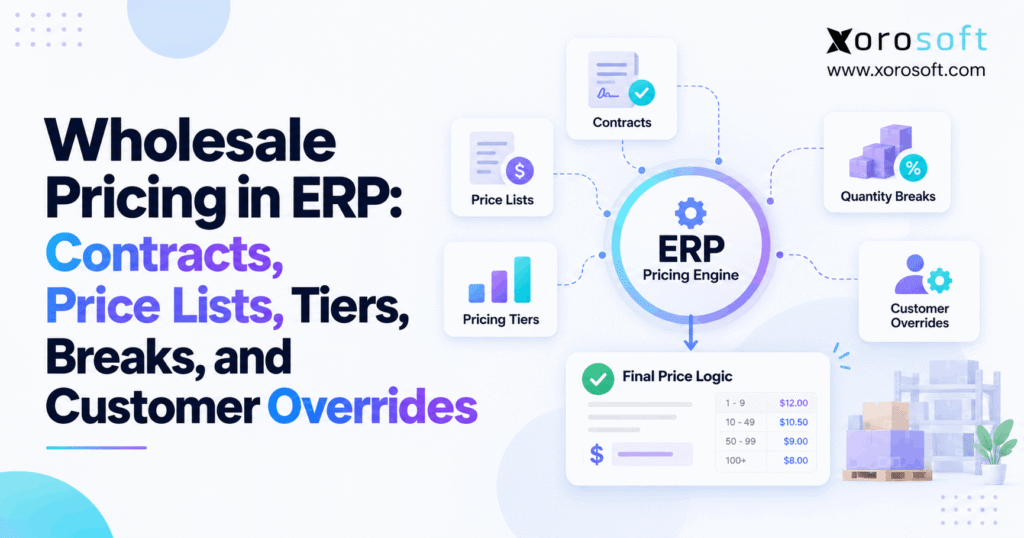
If you are searching for a solution to manage wholesale pricing ERP efficiently, you are in the right place.
1. Why One Wholesale Order Can Have Five Valid Prices
Wholesale pricing ERP becomes essential when a business can no longer answer one basic question quickly: What price should this customer actually receive? For example, one buyer may have a negotiated contract, belong to a wholesale tier, qualify for a quantity break, and still have a special SKU-level override.
Therefore, the real challenge is not simply storing prices. Instead, the harder task is deciding which valid pricing rule should win when several rules apply at the same time.
Meanwhile, pricing complexity increases as a company adds more products, customers, warehouses, currencies, salespeople, and ecommerce channels. As a result, a pricing process that worked for 20 accounts may become unreliable when hundreds of customers have different commercial terms.
Moreover, pricing errors rarely stay inside the sales team. Instead, they can affect margin, commissions, invoices, customer relationships, and financial reporting.
1.1 How ERP Pricing Rules Decide Which Price Wins
Consider a customer ordering 120 units of one product.
For example, several valid prices may exist simultaneously:
| Pricing Rule | Possible Price |
|---|---|
| Standard price | $25.00 |
| Wholesale price list | $22.00 |
| Customer tier | $20.50 |
| Contract price | $19.00 |
| Quantity price | $18.50 |
Therefore, the system must do more than locate available prices. It must determine which rule has priority.
Otherwise, a salesperson could quote $19 while the B2B portal displays $18.50. Meanwhile, an EDI order might arrive with another value.
Consequently, the business needs one repeatable way to determine the correct selling price.
2. Wholesale Pricing ERP Building Blocks
A wholesale pricing ERP model usually combines several pricing methods instead of relying on one universal discount.
Therefore, businesses should define the purpose of each method before building pricing rules.
Moreover, each pricing layer should answer a specific commercial need. Price lists may organize broad customer groups, while contracts may manage negotiated agreements. Meanwhile, quantity rules can address order volume.
As a result, the final pricing structure becomes easier to understand and maintain.
2.1 ERP Wholesale Price Lists and Base Prices
A base price provides the default selling price when no more specific rule applies.
However, wholesalers often require additional lists for different commercial segments.
For example, a business may maintain:
- Retail
- Dealer
- Wholesale
- Distributor
- Export
price lists.
Therefore, a standard wholesale list might price an item at $20, while a distributor list prices the same item at $17.
Moreover, price lists reduce administrative work because many customers can share one pricing structure.
Consequently, companies do not need to maintain a completely separate set of prices for every account.
2.2 Customer Pricing Tiers
Customer tiers group buyers according to commercial relationships.
For example, a wholesaler might use:
- Standard
- Silver
- Gold
- Platinum
levels.
Therefore, Gold customers could receive better commercial terms than Standard accounts.
However, tier membership should not automatically replace negotiated contracts.
Instead, tiers work best as a broad pricing framework when several customers share similar terms.
As a result, teams can manage customer groups efficiently while still allowing specific exceptions.
2.3 Customer-Specific Pricing in ERP
Some buyers require unique prices.
For example, a large retailer may negotiate special rates on 30 high-volume SKUs while receiving normal wholesale prices on the rest of the catalog.
Therefore, the ERP should support an account-level or SKU-level exception without forcing the company to create an entirely new price list.
Moreover, customer-specific pricing helps preserve negotiated commercial agreements.
However, teams should still define which customer-specific rules take priority when another pricing condition also applies.
3. How Wholesale Pricing ERP Sets Pricing Priority
A wholesale pricing ERP system needs a clear hierarchy whenever several pricing rules qualify for the same order line.
However, no universal pricing sequence works for every company.
Instead, the hierarchy should reflect the company’s actual contracts and commercial policies.
Therefore, businesses should document pricing precedence before configuring software.
Moreover, employees should be able to explain why a particular price appeared on an order.
3.1 A Practical ERP Pricing Precedence Example
A distributor might use this hierarchy:
1. Customer contract
2. Customer/SKU-specific price
3. Customer price list
4. Customer pricing tier
5. Quantity break
6. Standard price
Therefore, when a contract exists for a specific SKU, the system may ignore the customer’s broader wholesale tier.
However, another distributor might allow quantity discounts on top of contract pricing.
Consequently, its hierarchy would be different.
The important point is consistency. Therefore, the pricing model should produce the same result whether the order originates with a salesperson, B2B portal, EDI transaction, or ecommerce channel.
3.2 Why the Lowest Price Should Not Always Win
Selecting the lowest available price may initially seem customer-friendly.
However, doing so can violate a negotiated agreement.
For example:
- contract price = $18
- promotional price = $17
- volume price = $16
If the contract prevents additional discounts, then $18 may still be the correct price.
Therefore, price selection should follow commercial policy rather than automatically choosing the lowest value.
Moreover, this approach helps prevent unplanned margin erosion.
Consequently, businesses should test overlapping rules before relying on automated pricing.
4. Wholesale Pricing ERP for Contract Agreements
Contract pricing records negotiated commercial terms between a seller and a specific customer.
Therefore, contract-based wholesale pricing ERP usually needs more detailed controls than general customer tiers.
Moreover, agreements can include product-specific prices, dates, quantities, and other conditions.
As a result, the system must evaluate contract eligibility at the order-line level instead of treating every customer purchase identically.
4.1 What Contract Pricing Can Control
A pricing agreement may define:
- specific products
- fixed prices
- percentage discounts
- effective dates
- expiration dates
- minimum quantities
- currencies
- units of measure
- excluded products
For example, a furniture distributor may agree to fixed prices on selected collections for twelve months.
Meanwhile, all other products can continue using the customer’s regular dealer list.
Therefore, the pricing engine needs to identify exactly which products and conditions belong to the contract.
Additionally, employees should be able to understand when the standard price becomes applicable again.
4.2 Why ERP Contract Pricing Needs Effective Dates
Wholesale agreements change over time.
For example, an existing contract may end on December 31 while a revised agreement starts on January 1.
Therefore, ERP contract pricing should recognize both the amount and the valid period.
Otherwise, expired prices may continue appearing on future orders.
As a result, margin leakage may remain hidden until someone manually identifies the issue.
Moreover, future-dated pricing allows companies to prepare new rates in advance.
Consequently, employees do not need to remember to update hundreds of records on the exact effective date.
5. Quantity Breaks, Volume Pricing, and Customer Tiers
Quantity pricing rewards buyers who purchase larger volumes.
However, businesses should define exactly how each threshold works before implementing it.
For example, reaching 100 units may lower the unit price for the entire order.
In contrast, another business may apply different prices only to quantities that fall inside each individual tier.
Therefore, two systems can both claim to support tiered pricing while calculating very different totals.
5.1 A Simple Quantity-Break Example
Consider this pricing structure:
| Order Quantity | Unit Price |
|---|---|
| 1–49 | $20.00 |
| 50–99 | $18.75 |
| 100–249 | $17.50 |
| 250+ | $16.25 |
Therefore, an order for 125 units may qualify for the $17.50 rate.
However, the business must decide whether all 125 units receive that price.
Alternatively, only units above each threshold may receive the lower rate.
Consequently, quantity logic should be documented before configuration.
Moreover, teams should test edge cases such as exactly 50, 100, or 250 units.
5.2 Volume Pricing vs Marginal Pricing
With volume pricing, reaching a threshold can reprice the entire qualifying quantity.
In contrast, marginal pricing applies different rates to different portions of the order.
For example, units 1–49 may stay at one rate, while units 50–99 receive another.
Therefore, the total order value can differ significantly between the two approaches.
Moreover, some businesses calculate volume by individual SKU, while others combine product families or variants.
Consequently, software evaluations should test real customer orders rather than relying on feature names alone.
6. Customer Overrides Need Controls, Not Just Flexibility
Even strong pricing rules cannot anticipate every commercial situation.
Therefore, sales teams may occasionally need pricing exceptions.
However, unrestricted overrides create another risk.
For example, temporary discounts can become permanent habits when nobody tracks why they were approved.
Consequently, overrides should provide flexibility while preserving accountability.
6.1 Temporary and Permanent Pricing Overrides
A permanent customer price normally belongs in pricing master data.
Meanwhile, a one-time concession should remain connected to one transaction.
For example, a sales manager might approve a special price to secure a large order.
Therefore, the system should prevent that temporary exception from automatically becoming the customer’s future default.
Moreover, users should clearly distinguish negotiated customer pricing from transaction-specific discounts.
As a result, future orders remain predictable.
6.2 ERP Pricing Approval Rules That Protect Margin
A controlled workflow might follow:
Sales rep → price request → margin review → manager approval → sales order
Therefore, salespeople retain flexibility without receiving unlimited discount authority.
Moreover, the system should preserve:
- original calculated price
- requested price
- approved price
- approving employee
- reason
- date and time
Consequently, managers can investigate why realized margin differed from expected margin.
Additionally, approval thresholds can vary by user role or discount percentage.
As a result, routine exceptions can move quickly while larger concessions receive additional review.
CTA: Free ERP Readiness Assessment
If pricing now depends on spreadsheets, repeated approvals, and manual customer lookups, assess whether the workflow has outgrown the current system.
7. Effective Dates, Currency, and Units of Measure
Wholesale pricing often varies by time period, currency, or packaging unit.
Therefore, these conditions should exist inside the pricing logic rather than in separate spreadsheets.
Moreover, companies should decide how each condition affects price eligibility before they automate the process.
7.1 Future-Dated ERP Wholesale Prices
Suppose a distributor plans a 5% price increase on January 1.
Ideally, the company should enter the new prices before January arrives.
Therefore, employees can prepare future pricing without changing today’s active prices.
Likewise, promotional prices and short-term agreements should stop automatically when their valid periods end.
Consequently, the business reduces its dependence on manual reminders.
Moreover, future-dated ERP wholesale prices make planned increases easier to review before they become active.
7.2 Multi-Currency Pricing
International businesses commonly choose between two methods.
First, they can convert a base price using exchange rates.
Alternatively, they can maintain independent price lists for each currency.
Dedicated price lists provide greater commercial control.
However, currency conversion reduces maintenance.
Therefore, the right method depends on how customers negotiate and how frequently the company changes its rates.
Moreover, finance teams should understand the difference between foreign-exchange movement and deliberate commercial price changes.
7.3 Unit-of-Measure Pricing
A single product may be sold as:
- each
- pack
- case
- carton
- pallet
Therefore, pricing should respect the unit selected on the order.
For example, twelve individual items do not necessarily equal the commercial price of one case.
Moreover, case or pallet pricing may include different handling economics.
Consequently, the system should recognize both conversion quantities and commercial price rules.
Otherwise, employees may need to manually calculate prices during order entry.
8. Wholesale Pricing ERP Across Shopify, B2B, and EDI
A major wholesale pricing ERP challenge appears when customers can order through multiple channels.
For example, the same buyer may place an order with a salesperson today, through Shopify tomorrow, and through EDI next week.
Therefore, each order-entry path should receive consistent commercial terms.
Moreover, businesses must decide which system owns pricing logic and which systems simply display or consume it.
8.1 Choosing the ERP Pricing Source of Truth
A company should clearly define:
- where pricing rules are maintained
- where prices are calculated
- where prices are displayed
- how updates synchronize
- how pricing conflicts are resolved
Otherwise, multiple applications can become competing sources of truth.
For companies connecting ERP with ecommerce and other business systems, Xorosoft Integrations shows how operational applications can connect without remaining isolated.
Moreover, Shopify merchants can review Xorosoft’s ERP listing directly on the Shopify App Store.
Therefore, the goal is not simply integration. Instead, the goal is consistent pricing across every order-entry path.
8.2 EDI Pricing Needs Validation
EDI introduces a different issue because the buyer’s purchase order may already contain a price.
Therefore, the ERP should determine whether to accept that amount or validate it against approved customer terms.
If the values conflict, the system should surface an exception.
Otherwise, an incorrect incoming price may move directly into fulfillment and invoicing.
Moreover, companies should define tolerance rules for small differences.
As a result, employees spend time reviewing meaningful exceptions instead of every transaction.
9. ERP Wholesale Pricing Across Inventory, WMS, and Accounting
ERP wholesale pricing does not operate independently from the rest of the business.
Instead, every accepted customer price becomes an order that must be allocated, picked, shipped, invoiced, and reported.
Therefore, pricing decisions should remain connected with inventory and financial data.
Moreover, operational changes after order entry can sometimes affect the commercial context.
9.1 Inventory Availability Can Change the Order
Suppose a contract-priced product is unavailable.
Therefore, the warehouse may propose a substitute.
However, that substitute may not have the same customer agreement.
Consequently, the business needs a clear rule for how replacement products are priced.
Likewise, partial shipments and backorders should not unexpectedly change previously approved terms.
For multi-warehouse businesses, XoroWMS supports warehouse execution within a connected operational environment.
Therefore, fulfillment teams can work from the same broader order context rather than treating warehouse activity as an unrelated process.
9.2 ERP Pricing and Accounting Need Shared Context
Finance teams need more than the final invoice amount.
Instead, they may need to see:
- list price
- customer price
- discount
- override
- product cost
- gross margin
Therefore, pricing data becomes more useful when accounting and operational data remain connected.
For inventory-driven businesses, XoroERP brings inventory, purchasing, order management, warehouse operations, and accounting into one ERP environment.
Consequently, teams can analyze pricing outcomes alongside inventory costs and financial results instead of reconciling disconnected applications.
CTA: Watch Demo
See how connected inventory, orders, purchasing, warehouse activity, and accounting can operate within one ERP workflow.
10. When Pricing Spreadsheets Stop Working
Spreadsheets are not automatically a poor pricing tool.
In fact, they can work well when the business has a limited catalog, a small number of customers, and straightforward price rules.
However, complexity changes the equation.
Therefore, the real question is whether employees can still determine the correct approved price reliably.
10.1 Warning Signs Pricing Has Outgrown Spreadsheets
Common warning signs include:
- employees maintain different price files
- customers have frequent SKU-level exceptions
- contract dates are difficult to monitor
- ecommerce prices differ from internal prices
- EDI orders require repeated manual checks
- sales representatives regularly ask which price is current
- customer overrides are difficult to audit
- managers cannot explain margin changes
Therefore, spreadsheet size alone is not the issue.
Instead, the issue is whether the pricing process remains controlled.
For businesses moving beyond disconnected applications, XoroONE provides another route toward integrated operational management.
10.2 Operational Complexity Matters More Than Company Size
A smaller distributor can have more complex pricing than a much larger company.
For example, a $5 million business may sell through ecommerce, wholesale portals, EDI, and several warehouses while managing hundreds of customer agreements.
Therefore, ERP readiness should be evaluated through workflow complexity rather than revenue alone.
Moreover, industry structure matters.
For instance, apparel companies may manage seasonal prices, while furniture distributors may manage dealer programs and project pricing.
Consequently, businesses can review the industries Xorosoft serves to see how inventory-driven requirements differ across operating models.
11. What to Evaluate in Wholesale Pricing ERP Software
A wholesale pricing ERP evaluation should use real business scenarios instead of generic feature checklists.
Therefore, bring actual contracts, price lists, quantity rules, and exceptions into the software demonstration.
Moreover, test how pricing behaves when several conditions apply simultaneously.
As a result, configuration limitations become visible before implementation.
11.1 Essential Wholesale Pricing ERP Questions
Ask vendors to demonstrate:
| Requirement | Question to Test |
|---|---|
| Customer pricing | Can one account receive SKU-specific prices? |
| Price lists | Can customer groups share a list? |
| Contracts | Can agreements use start and end dates? |
| Quantity breaks | How is qualifying volume calculated? |
| Overrides | Who can change calculated prices? |
| Approvals | Can low-margin prices require approval? |
| Currency | Can pricing vary independently by currency? |
| UOM | Can case and each pricing differ? |
| Ecommerce | How are online prices synchronized? |
| EDI | How are incoming prices validated? |
| Audit | Can users see why a price was selected? |
| Margin | Can managers compare price with cost? |
Therefore, do not stop after confirming that software “supports price lists.”
Instead, test how those price lists interact with contracts and overrides.
11.2 Test the Hardest Order You Have
Create a test customer with:
- contract pricing
- customer tier
- SKU-specific exception
- quantity break
- future price
- temporary override
Then, process the same order through multiple channels.
Therefore, you can see whether the final result stays consistent.
Moreover, test what happens when inventory is unavailable, the contract expires, or the buyer changes quantity.
Consequently, the evaluation reflects real operational conditions rather than a clean demo scenario.
12. Where Xorosoft Fits an Inventory-Driven Pricing Workflow
Wholesale pricing usually becomes an ERP problem when it connects with inventory, fulfillment, purchasing, ecommerce, and accounting.
Therefore, an integrated operating model can reduce the number of disconnected decisions employees need to make.
Xorosoft is built for inventory-driven businesses that manage physical products across multiple operational functions.
Moreover, its broader business solutions connect areas such as inventory, orders, warehouse operations, accounting, and ecommerce.
However, software should still match the company’s actual pricing rules.
Therefore, teams should first document contracts, customer tiers, quantity breaks, exceptions, approval rules, and sales channels.
Additionally, real operating examples are more useful than abstract feature lists.
Companies evaluating results from similar inventory-driven businesses can also review Xorosoft case studies.
Consequently, the evaluation can focus on operational fit rather than marketing claims.
13. Build Pricing Rules Employees Can Explain
Wholesale pricing becomes difficult when years of contracts, spreadsheets, discounts, and one-off exceptions accumulate without a clear hierarchy.
Therefore, the best pricing system is not simply the system with the greatest number of features.
Instead, it should consistently answer five questions:
1. Who is the customer?
2. What are they buying?
3. What agreement applies?
4. What quantity and date conditions apply?
5. Which pricing rule has priority?
Moreover, employees should be able to explain the result without searching through several spreadsheets or applications.
As a result, pricing becomes easier to audit, margins become easier to understand, and customers receive more consistent treatment.
If customer-specific pricing now spans spreadsheets, ecommerce tools, inventory applications, and accounting systems, evaluate the whole workflow rather than adding another isolated workaround.
Therefore, you can Book a Demo to review how Xorosoft can connect pricing-related orders with inventory, purchasing, warehouse operations, ecommerce, and accounting.
FAQs
What is wholesale pricing ERP?
Wholesale pricing ERP uses centralized rules to calculate B2B prices based on customers, products, contracts, quantities, price lists, dates, currencies, and approved pricing exceptions.
How does ERP choose the correct wholesale price?
ERP evaluates applicable pricing conditions and follows a defined precedence hierarchy. Therefore, contracts, customer-specific prices, tiers, quantity breaks, and standard prices can be applied consistently.
What is contract pricing in ERP?
Contract pricing records negotiated customer terms for selected products, quantities, dates, or currencies. As a result, agreed prices can automatically appear when qualifying orders are entered.
What is a quantity break?
A quantity break changes the applicable price when an order reaches a defined volume threshold. For example, ordering 100 units may unlock a lower per-unit wholesale price.
Can sales representatives override ERP prices?
Yes, if permissions allow it. However, businesses should use approval thresholds, margin controls, and audit trails so temporary pricing exceptions do not become uncontrolled discounts.
Should wholesale pricing live in ERP or Shopify?
It depends on the operating model. However, complex businesses usually need one clearly defined pricing authority and reliable synchronization between ERP, Shopify, B2B, and other order channels.
When should wholesale pricing move out of spreadsheets?
Consider ERP when pricing involves many customers, contracts, SKUs, quantity breaks, channels, currencies, or overrides and employees can no longer reliably identify the current approved price.
Recent Posts
-
 Wholesale Pricing ERP: Contracts, Price Lists, Tiers, Breaks, and Customer Overrides
 -
 What Features Should Inventory Management Software Have?
 -
 ERP Onboarding Checklist: What Operations Teams Need Before Go-Live
 -
 Warehouse Cost Benchmarks 2026: Labor, Picking, Storage, and Returns
 -
 Inventory Tracker for Shopify: Managing Incoming Purchase Orders and Interlocation Transfers Before Stock Is Sellable