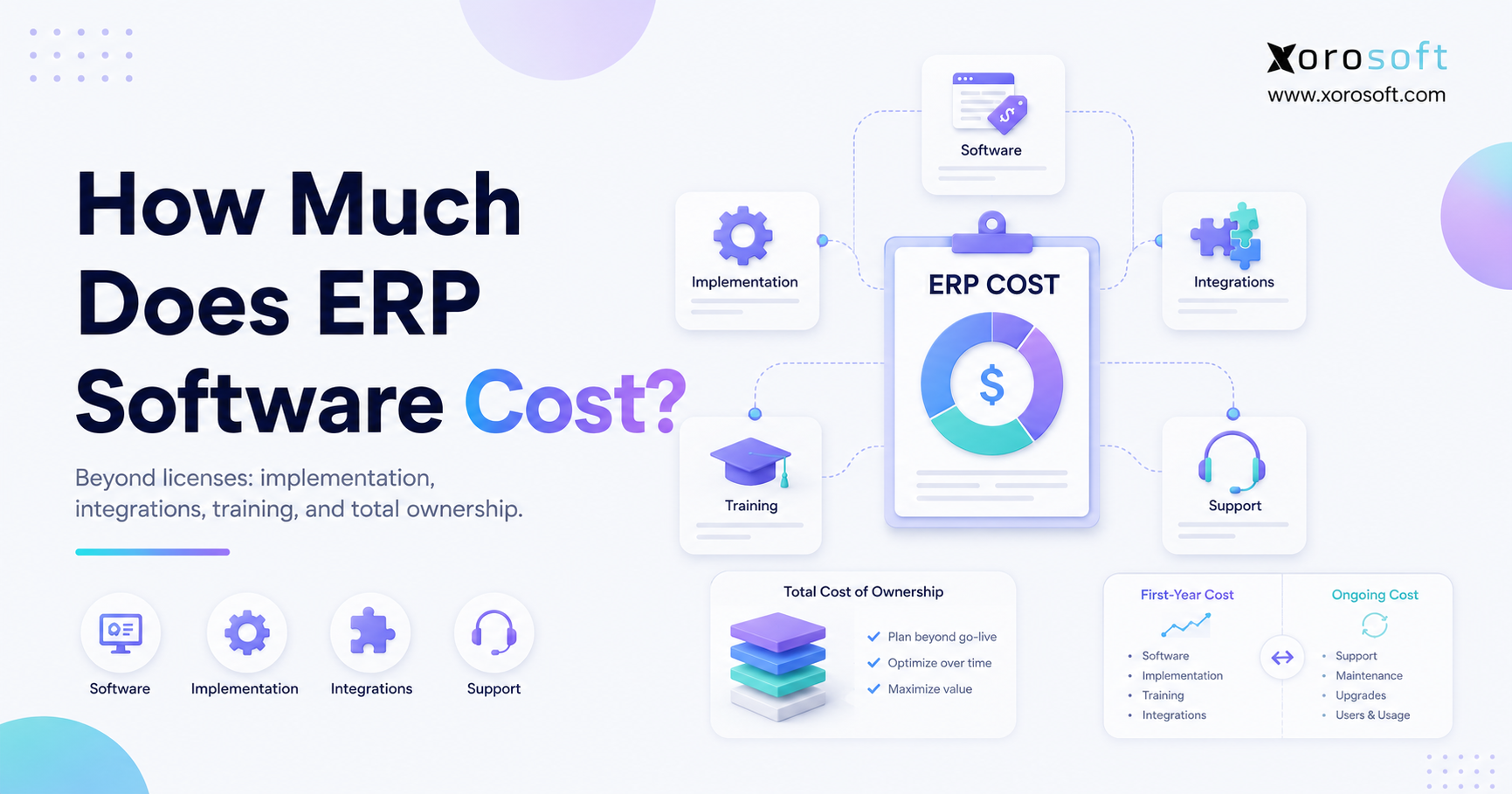
When considering a new enterprise system, it’s crucial to evaluate the ERP total cost of ownership for your organisation.
1. Why Mid-Market ERP Costs Are Harder to Benchmark in 2026
1.1 ERP Cost Depends on Operational Complexity, Not Revenue Alone
Two businesses with $30 million in annual revenue can have entirely different implementation needs. One may sell a limited catalog from a single warehouse. By contrast, the other may stock thousands of size-color options, sell through Shopify and wholesale channels, replenish several distribution centers, and reconcile marketplace settlements daily. As a result, their software budgets should not be treated as equal.
A useful mid-market definition therefore includes both business scale and ERP scope. For benchmarking, record the number of active ERP users, legal entities, warehouses, sales channels, manufacturing sites, integrations, and transactions. However, the number of employees is not the number of paid ERP users. A warehouse associate using a device may have different access needs from an accountant or a purchasing manager.
1.2 Indicative Mid-Market ERP Total Cost Benchmarks
A 2026 ERP pricing analysis from ERP Research gives the following broad planning ranges. However, these are the publisher’s estimates, not a proven average from completed ERP projects. Actual quotes may fall outside these bands.
| ERP deployment category | ERP users | Estimated annual software | Estimated implementation | Indicative five-year TCO |
|---|---|---|---|---|
| Smaller deployment | 1-50 | $10,000-$75,000 | $15,000-$150,000 | $75,000-$500,000 |
| Mid-market deployment | 51-250 | $50,000-$400,000 | $100,000-$750,000 | $400,000-$2,500,000 |
| Upper mid-market | 251-1,000 | $200,000-$1,500,000 | $300,000-$2,000,000 | $1,500,000-$6,000,000 |
Do not add the endpoints of different columns to infer TCO; each figure covers a broad group. Likewise, 50 ERP users do not always mean a lower bill than 100 ERP users. Complex integrations and factory workflows can outweigh user-based licensing differences.
1.3 What an ERP Cost Benchmark Must Disclose
An informative benchmark identifies its time horizon, currency, licensing assumptions, modules, implementation scope, and included operating costs. It should also keep survey findings, outside estimates, and sample budgets apart. Otherwise, a broad range can give buyers false confidence instead of real insight.
The goal is not to find one perfect average. It is to establish a credible starting range, test it against business-specific needs, and demand comparable five-year proposals. This approach makes mid-market ERP total cost of ownership useful for procurement rather than merely interesting for research.
2. Calculating Five-Year Mid-Market ERP Total Cost of Ownership
2.1 The ERP TCO Formula That Finance Can Audit
Five-year ERP TCO = one-time implementation and migration + five years of recurring costs + planned enhancements and exit costs. For example, upfront costs cover process design, system setup, data moves, testing, and launch. Meanwhile, ongoing costs cover software, support, link checks, in-house admin, and any needed hardware. Finally, later costs may include new sites, extra features, and moving data to a new system.
Above all, count each cost only once. If a partner’s fixed implementation fee already includes three trial migrations, do not add that same work under a separate migration line. If the first-year subscription appears in recurring operating costs, do not include it again as an upfront acquisition fee.
| Cost category | When it arises | Question to ask before signing |
|---|---|---|
| Software licenses and subscriptions | Monthly, annual, or upfront | Which users, editions, modules, and usage tiers are included? |
| Configuration and consulting | Mostly during deployment | Are scope changes billed separately? |
| Data migration and testing | During conversion, sometimes later | How many source systems and trial loads are covered? |
| Integration services | Setup plus maintenance | Who owns failed transactions and connector changes? |
| Training and internal staff time | Before and after go-live | Are backfill and refresher training included? |
| Support, upgrades, and administration | Throughout operation | What is the renewal and service-level policy? |
| Expansion and system exit | Later years | What will new sites, exports, and transitions cost? |
2.2 Separate the Approved Budget From the Expected Cost
A financial model should distinguish the base-case ownership forecast from management contingency. Suppose implementation and migration are planned to cost $300,000 and an approved risk reserve is $45,000. That means the project can have a $345,000 spending limit while its base forecast stays at $300,000 until a risk occurs.
That difference matters when comparing vendors. For example, a clear quote that flags risk may look costlier than a low quote that omits data work or interface risks. Ask suppliers to price their scope, list exclusions, and explain the assumptions driving change-order exposure.
Therefore, ERP total cost of ownership should clearly separate expected project costs from contingency funds, helping finance teams maintain better budget control.
2.3 Use Cash Flow, Payback, and NPV for Different Decisions
Nominal five-year TCO adds planned spending without discounting. A cash-flow schedule shows the months or years when payment is due. Net present value discounts future amounts using a finance-approved rate. Payback measures how long incremental cash benefits take to recover an investment. So each measure answers a different question.
For mid-market ERP total cost of ownership, the total and yearly cash-flow views usually give buyers the clearest starting point. Then finance can review NPV and ROI using gains it has checked on its own. However, do not treat cash freed from stock as yearly profit: freeing working capital is not the same as reducing annual operating expense.
3. Software Licensing: The Recurring Cost Behind ERP Pricing
3.1 User-Based Licensing and the Cost of Growing Teams
Named-user ERP pricing is straightforward to model, but only after defining roles. Finance personnel may need full transactional licenses, managers may need limited approvals, and warehouse employees may operate through licensed devices. Some vendors offer lower-cost roles; however, others price access in a different way. So do not assume that every worker needs a full paid seat.
For example, take a firm with 80 full users at $90 per month. Its initial subscription calculation is $86,400 a year, before add-ons, partner services, or contract adjustments. If it adds twenty matching seats, the yearly software fee rises to $108,000. Over five years, hiring plans can matter almost as much as the starting rate.
3.2 Resource-Based ERP Pricing and Module Entitlements
By contrast, some platforms charge by apps, system use, storage, hosting, or order volume. Thus, adding staff may have little seat cost, yet growing order volume may raise usage fees. Instead, compare forecast use with order lines, stock moves, API calls, and sales channels.
Still, bundles need the same care. An ERP proposal described as “inventory plus accounting” may exclude advanced warehouse workflows, manufacturing planning, or specialist reporting. A unified platform such as XoroONE cloud ERP illustrates why buyers should inspect module scope rather than counting apps by name alone. Even so, check Xorosoft against the daily tasks in the contract; do not assume every connection or setup step comes at one flat price.
3.3 Renewal Clauses Change Five-Year ERP Ownership Costs
However, the subscription rate on a website may not be your contract price. For example, contracts may have first-year deals, minimum terms, price rises, add-ons, or separate support fees. Ask vendors to provide a five-year rate schedule with the assumptions stated explicitly, including the treatment of added users and extra storage.
Also check what happens if the business grows faster than planned. Run a baseline scenario and a higher-volume scenario. The goal is to see which contract terms can raise mid-market ERP total cost of ownership before management approves the vendor shortlist.
4. Implementation, Data, and Integration Costs That Quotes Miss
4.1 ERP Implementation Cost Starts With Process Design
An ERP rollout is not just a software install. First, teams must agree when orders ship, who may change stock, how buyers gain approval, when finance records sales and inventory, and which issues need a manual check. Otherwise, open questions can turn into custom work, delays, and extra bills.
Therefore, a rollout quote should cover workshops, system setup, links, test cases, training, launch, and early support. Meanwhile, in-house leads still cost money, even when the vendor does not bill for their time. So budget for staff cover instead of assuming normal work will carry on with no gaps.
4.2 Data Migration: The Cost of Making Inventory and Finance Agree
Often, the hardest part of leaving QuickBooks, spreadsheets, and stock apps is making their records agree. One system may show sellable units, another physical receipts, and a third accounting inventory value. As a result, moving mismatched numbers into a new system will not fix the root issue.
First, allow time to check source data, clean it, map fields, run test moves, match opening balances, and gain sign-off. Also, keep core records apart from past sales and stock moves. Sometimes, keeping older records in a searchable archive costs less and carries less risk than moving every old entry into the new ERP.
4.3 Shopify, Amazon, and EDI Add Different Integration Costs
Ecommerce links do far more than import orders. For example, test part shipments, canceled orders, returns, discounts, gift cards, tax, stock counts, and payout matching. Amazon also introduces marketplace fees and fulfillment-specific accounting, while wholesale EDI adds partner-specific mapping, acknowledgments, shipment notices, invoices, and certification testing.
The Xorosoft integrations directory describes available ecommerce and operational connections. For Shopify-specific due diligence, the Xorosoft ERP listing in the Shopify App Store describes the integration features listed in the app. However, “free to install” does not mean the full ERP, setup work, or ongoing service is free.
4.4 Warehouse Management and Manufacturing Configuration
A warehouse system may require bin mapping, receiving rules, wave picking, serial or lot tracking, device setup, and labor training. So compare basic stock-by-site tools with the day-to-day depth of a dedicated warehouse management system. Then test restocking, cycle counts, site transfers, shipping issues, and stock changes.
Manufacturing introduces extra setup for bills of materials, routings, work orders, material requirements planning, yield, and production costing. As a result, factory records must match buying, stock moves, and the general ledger. Yet a cheaper license will not fix a rollout that leaves product costing in doubt.
5. Three Five-Year ERP TCO Models for Mid-Market Buyers
5.1 Assumptions Behind the ERP Cost Scenarios
The three examples below are sample budgets, not real customer costs or Xorosoft prices. Each includes a year-one implementation and integration project, five years of software and support, and an enhancement allowance in year four. To keep the math clear, they assume flat yearly fees. However, these models leave out taxes, loan costs, inflation, and optional risk funds; buyers should adjust them for their own contracts and region.
The examples reflect three very different ways of working. For instance, a 50-user online seller may have a small finance team but many sales-channel links. A 100-user wholesale distributor may depend on EDI and warehouse execution. A 150-user manufacturer may need multi-site production control. So these cost gaps reflect the scope, not a fixed price per employee.
| Illustrative component | 50-user ecommerce | 100-user wholesale | 150-user manufacturing |
|---|---|---|---|
| Annual software | $48,000 | $110,000 | $185,000 |
| Initial implementation | $90,000 | $210,000 | $390,000 |
| Initial migration and integration | $35,000 | $105,000 | $190,000 |
| Annual support and administration | $18,000 | $42,000 | $78,000 |
| Year-four enhancements | $15,000 | $40,000 | $90,000 |
| Five-year total ownership cost | $470,000 | $1,115,000 | $1,985,000 |
5.2 Scenario A: Ecommerce and Apparel With 50 ERP Users
Imagine an apparel brand selling through Shopify, Amazon, and wholesale accounts, with two warehouses and seasonal product variants. Its ERP must link channel orders, buying, stock holds, returns, and finance. The upfront project work is modeled at $90,000, with another $35,000 assigned to migration and interfaces.
Year one costs $191,000, comprising $48,000 software, $18,000 support, and $125,000 initial project work. After that, four more years of software and support add $264,000; a year-four update adds $15,000. The resulting five-year TCO is $470,000. Before signing a similar quote, check that returns and marketplace payout matching are covered.
5.3 Scenario B: Wholesale Distribution With 100 ERP Users
This example serves a distributor operating three warehouses, customer-specific price lists, handheld scanning, purchasing approvals, and several EDI trading partners. It budgets $210,000 for implementation, $105,000 for migration and integration, $110,000 in annual software, and $42,000 in annual support and admin.
Year one is $467,000. Then years two to five add $608,000 in ongoing fees and a $40,000 year-four update. Five-year TCO equals $1,115,000. However, EDI scope is a major risk: five predictable partner connections may be easier to budget than two partners requiring unusual document maps, certification, or frequent changes.
5.4 Scenario C: Manufacturing With 150 ERP Users
A multi-site manufacturer needs production orders, bills of materials, material planning, supplier lead times, warehouse operations, and manufacturing cost reconciliation. The model assumes $390,000 in implementation, $190,000 for migration and integration, $185,000 in annual software, and $78,000 for recurring support and admin.
Year one totals $843,000. Over the next four years, ongoing fees total $1,052,000 and year-four updates add $90,000. Five-year TCO equals $1,985,000. Therefore, check that product costs, routing changes, and month-end matching are part of the signed test plan, not just the sales demo.
5.5 ERP Cost Sensitivity: The Assumptions Worth Stress-Testing
A baseline budget helps more when leaders can see what might change it. For example, if the online seller adds five full users at $80 a month for four years, its modeled cost rises by $19,200 to $489,200. If wholesale software spending increases 10% during years three through five, its cost increases $33,000 to $1,148,000. A 25% overrun against the manufacturing model’s $190,000 integration budget adds $47,500, producing $2,032,500.
These are what-if tests, not vendor forecasts. Still, they show why mid-market ERP total cost of ownership needs a range of likely results. Also test late go-live, two systems running at once, new EDI partners, and faster order growth. Assign an owner to every variable that could change the board-approved budget.
6. Cloud ERP Versus On-Premise ERP: The Ownership Trade-Off
6.1 Cloud ERP TCO: Subscriptions Replace Some Infrastructure Burden
Cloud ERP commonly transfers platform hosting and core application maintenance to the provider. As a result, server planning gets easier, but teams still need to check links, manage access, test workflows, and plan for fee rises. However, cloud ERP can save on upfront hardware while raising the amount paid each year.
Still, vendor updates do not remove the need for user tests. For example, custom reports, EDI maps, and linked warehouses need checks after each update. So include staff time for those checks even when upgrades come with the plan.
6.2 On-Premise and Hybrid ERP Need a Different Cost Schedule
An on-premise deployment may require server purchases, backup infrastructure, cybersecurity controls, IT admin, and major upgrade projects. Meanwhile, hybrid setups add work because data moves between owned and hosted systems. As a result, teams must check more system links and access rights.
| Cost consideration | Cloud subscription | On-premise license | Hybrid arrangement |
|---|---|---|---|
| Application charges | Recurring | Upfront and/or maintenance | Mixed |
| Infrastructure | Usually provider-hosted | Customer-managed | Shared |
| Upgrades | Core service included; testing remains | Often separate project | Contract-specific |
| Security and administration | Shared responsibilities | Primarily internal | Split responsibilities |
| Exit obligations | Data export and transition | Data plus infrastructure retirement | Both sets of dependencies |
Therefore, no hosting model is always cheaper. Compare equivalent features, security expectations, internal IT staffing, and contract terms. Preserve the same five-year horizon across all proposals.
6.3 US and Canadian ERP Buyers Need Currency and Tax Assumptions
Canadian companies should document whether vendor fees and implementation services are denominated in CAD or USD, and how exchange-rate changes affect renewals. Applicable GST/HST, provincial tax treatment, and cross-border service charges also need review with finance advisers. Likewise, US firms should include applicable sales taxes and local partner fees.
If a Canadian finance team compares one CAD quote with a second USD quote, convert both at a stated planning rate and include a sensitivity view for currency movement. Still, a small saving can vanish when exchange rates move against the buyer. In short, mid-market ERP total cost of ownership needs the same currency and tax rules across quotes.
7. ERP Vendor Pricing Models Compared for 2026
7.1 Published License Rates Are Only One Part of ERP Pricing
Published prices help, but they seldom cover the full project. Microsoft’s Business Central pricing lists US Essentials at $80 and Premium at $110 per full user per month, with annual billing. The appropriate tier depends on features and licensing rights. Yet setup, partner help, add-ons, and links can add a lot to the bill.
By contrast, other ERP vendors may not publish per-user prices at all. Acumatica’s pricing explanation emphasizes applications, business usage and resources, and deployment options rather than conventional per-user licensing. Oracle NetSuite typically requires a scope-based commercial proposal. So list the same needs before comparing headline prices.
7.2 Comparing Mid-Market ERP Cost Structures Fairly
| ERP platform or category | Commercial model | What to validate in the quote |
|---|---|---|
| Microsoft Dynamics 365 Business Central | Published full-user tiers and partner ecosystem | License mix, extensions, manufacturing edition, services |
| Acumatica | Application, resource, and deployment factors | Usage thresholds, growth, partner implementation |
| NetSuite | Scope-specific platform, modules, users, and services | Modules, renewals, integration scope, partner fees |
| Odoo | Public plan options plus implementation requirements | Hosting, customization, maintenance, partner services |
| Sage offerings | Product-specific licenses or subscriptions | Correct Sage product, functional scope, migration |
| Inventory-focused tools | Application subscriptions and connected services | Whether accounting, manufacturing, and WMS are separate |
Therefore, do not assume one pricing model is always cheapest. For example, per-user pricing may suit a small licensed team; resource pricing may suit a business with many occasional users; a manufacturer with complex needs may put more weight on strong factory workflows over either pricing method.
7.3 Compare the Operational Fit Before Comparing Discounted Quotes
For inventory-driven firms, pricing should be evaluated alongside actual order-to-cash, procure-to-pay, and warehouse processes. The Xorosoft versus NetSuite comparison offers one product-specific reference point, but a buyer should request an independent five-year estimate for both platforms and check each missing or custom requirement.
For example, a lower rollout fee is not a saving if the vendor leaves out a needed EDI file, warehouse task, or finance control. Conversely, paying for advanced manufacturing features that will never be used may not be justified. So buyers should split must-have features from nice-to-have changes before they agree on a price.
7.4 Contract Terms and Data Portability Belong in TCO
Ask who owns custom scripts and reports, how data can be extracted, whether past transactions are portable, and what assistance is available during termination. Review support response commitments, annual increase clauses, minimum usage terms, and the treatment of third-party integrations if the contract ends.
Even if the business never switches again, the cost of leaving is worth knowing. Also, easy data access and clear process notes can lower that risk. As a result, mid-market ERP total cost of ownership becomes a long-term choice, not just a year-one price debate.
8. Hidden ERP Expenses and Budget Overrun Controls
8.1 Hidden Costs Usually Follow Ambiguous Responsibilities
An ERP scope can omit items that nobody explicitly owns: reconciling old inventory balances, replacing warehouse printers, rebuilding management reports, maintaining EDI maps, or training staff hired after go-live. Yet a cost does not vanish just because the quote omits it. Instead, it lands with staff, another partner, or a later extra bill.
Define the responsibilities for security review, user-role design, master data, integration error handling, test execution, and cutover support. Also budget a stabilization period when people are learning new workflows while old systems may still operate. As a result, clear roles may save more than a small cut in hourly rates.
8.2 What Panorama’s 2026 ERP Research Actually Shows
The 2026 ERP Report from Panorama Consulting Group surveyed 170 respondents and reported a nine-month median project timeline. Its budget-adherence chart showed 50.6% on budget, 19.4% below, 22.9% slightly above, and 7.1% significantly above. Together, those over-budget groups made up 30.0% of those surveyed.
Among respondents whose projects were over budget, 54.9% cited unexpected extra technology needs and 51.0% cited expanded scope. However, the sample’s median yearly sales were $200.5 million, so these figures do not stand for all $2 million to $100 million firms. Still, they warn buyers about weak project scoping and costs left out of quotes.
8.3 ERP Implementation Contingency Should Be Risk-Based
A management reserve is a control mechanism, not a substitute for scope review. As a sample calculation, a 15% reserve on a $350,000 base project equals $52,500, making the authorized ceiling $402,500. This is simple arithmetic, not a universal rule for risk reserves.
Use identified project risks to determine the reserve: data quality, complex production processes, third-party interface availability, staffing constraints, and legal-entity transitions. Assign each risk an owner and a response plan. Therefore, teams should use the reserve only for approved changes, not treat it as money they must spend.
8.4 Governance Determines Whether the ERP Budget Holds
Create decision gates before build, migration sign-off, user acceptance testing, and cutover. Require each major change request to explain business impact, extra cost, schedule effect, and alternatives. Track a budget-to-actual forecast by workstream, not just a single overall percentage spent.
For mid-market ERP total cost of ownership, governance also extends beyond go-live. Review software renewals, partner retainers, usage growth, integration incidents, and roadmap projects every quarter. Otherwise, a cheap-looking product can become costly when no one owns later changes.
9. Industry-Specific Drivers of Mid-Market ERP TCO
9.1 Apparel and Sporting Goods: Variants, Demand, and Returns
A style sold in eight sizes and six colors creates 48 stock-keeping combinations before adding warehouses or seasons. Buying, allocation, markdowns, and return handling all affect ERP scope. For apparel and sporting goods, test variant-level availability, seasonal forecasting, wholesale preorders, and landed-cost reporting. These needs influence setup more directly than company revenue alone.
9.2 Furniture and Wholesale Distribution: Fulfillment Complexity
Furniture sellers need freight and landed-cost allocation, bulky-item warehouse processes, supplier lead-time visibility, and sometimes serialized or assembled products. In addition, distributors need contract prices, buying rules, customer credit, EDI, and transfers between sites. Evaluate industry fit using practical workflows rather than generic feature lists; a useful reference is the ERP industry examples that explain needs across product businesses.
9.3 Food and Manufacturing: Traceability and Production Control
Lot-controlled stock, expiration dates, quality holds, recall tracing, and production costing require disciplined master data. Likewise, factories need BOM changes, routings, material plans, and job closeout. The budget must cover transaction testing from raw-material receipt through finished goods and financial posting. So these sector needs show why mid-market ERP total cost of ownership cannot be guessed from seat counts alone.
10. Measuring ERP ROI Without Overstating the Benefits
10.1 Turn Operational Improvements Into Measurable Financial Outcomes
Inventory accuracy, faster purchasing, fewer picking errors, and cleaner month-end reconciliation may create value, but each outcome needs a baseline. Track the hours spent correcting discrepancies, write-offs, expedited freight, stockouts, and delayed financial reporting before deployment. Document the planned mechanism of improvement and assign a manager to check results after launch.
A connected accounting and operations system, such as XoroERP, can be evaluated for these workflows. However, do not record every saved hour as a cash saving. Instead, time freed for more useful work creates staff capacity; it becomes a cost reduction only when spending falls or justified hiring is avoided.
10.2 ERP Payback, Cash Flow, and Working Capital
Suppose a hypothetical implementation requires $300,000 upfront and subsequently delivers $100,000 in genuine incremental annual net cash benefit. Simple payback is three years, assuming the benefit begins immediately and remains stable. Yet a phased launch can delay savings, and later fees can reduce net gains. Therefore, finance should measure yearly gains rather than claim full savings from day one.
10.3 Compare ERP Investment With the Cost of Disconnected Systems
Calculate the current cost of accounting, inventory, warehouse, EDI, integration, and reporting subscriptions. Add measurable manual reconciliation, errors, and avoidable support work, while excluding duplicated benefits. That way, leaders can see what it costs to keep the current setup. Mid-market ERP total cost of ownership should be assessed alongside that baseline, not in isolation.
11. When a Mid-Market Business Should Invest in ERP
11.1 Warning Signs That the Existing Stack Has Reached Its Limits
An ERP evaluation becomes timely when sales channels regularly promise unavailable inventory, purchasing relies on conflicting spreadsheets, warehouse adjustments are hard to audit, or accounting cannot reconcile operational activity promptly. Also, more sites and complex wholesale deals make the case stronger. Still, a specific business problem is a better trigger than crossing an arbitrary revenue threshold.
11.2 When Better Integrations Are Enough for Now
A company with reliable stock records, one warehouse, modest transaction volumes, and manageable finance processes may benefit more from improving existing software than replacing everything. For example, a focused warehouse tool or link upgrade may fix the main problem. Compare this alternative stack over five years, including its recurring subscriptions, internal admin, and future replacement risks.
Before replacing existing systems, businesses should compare ERP total cost of ownership with the long-term expenses of maintaining their current software and integrations.
11.3 AI and New Integrations Should Have Their Own Budget Cases
AI access to ERP information introduces data governance, permission design, monitoring, and user-training considerations. The Xorosoft MCP server overview provides an example of connecting authorized ERP data to AI interfaces. So buyers should price AI tools on their own unless the contract clearly covers them. Avoid adding speculative AI returns to a core ERP payback calculation.
12. How to Compare ERP Quotes Before Selecting a Vendor
12.1 Build a Consistent ERP Request for Proposal
Provide every finalist with the same user-role matrix, entities, warehouses, transactions, modules, integrations, past data expectations, training needs, and support assumptions. Request a separate price for one-time services, recurring software, renewals, and optional enhancements. That way, the five-year totals cover the same day-to-day work.
12.2 Demonstrate High-Risk Workflows Before Signing
Ask each vendor to demonstrate a short-shipped ecommerce order, a warehouse transfer, a wholesale EDI exception, and an inventory-to-general-ledger reconciliation. During the demo, use real workflows with private details removed, rather than ideal sales scenarios. Review ERP customer case studies for implementation context, but do not treat testimonials as independent cost benchmarks or guarantees of similar results.
12.3 Normalize Price, Risk, and Contract Obligations
For each proposal, record what is included, excluded, partner-delivered, and dependent on another subscription. Check escalation terms, data export rights, cutover support, and unresolved customization. Score operational fit alongside five-year cost. As a result, mid-market ERP total cost of ownership comparisons do not reward missing features or cut-rate quotes.
13. Make the Five-Year ERP Investment Defensible
13.1 Agree on the Financial and Operational Decision Rules
The final approval document should show a base-case five-year model, downside sensitivities, a risk-based contingency, and the workflows that implementation must deliver. It should name the finance owner, business sponsor, project lead, and integration partners responsible for delivery. Then check the model during contract talks, key rollout stages, and the first renewal so inputs stay current.
The right question is not simply whether one ERP has the lowest starting subscription. Instead, ask whether the full system can support daily work at a fair long-term cost. A disciplined mid-market ERP total cost of ownership review makes that trade-off visible before the business commits.
13.2 Discuss a Scope-Specific ERP Budget and Next Steps
If inventory, buying, warehouses, ecommerce, and finance are getting harder to keep in sync, take your needs and cost model to a discovery call. Xorosoft can be considered alongside other vendors for inventory-driven operations; the next step is to check fit, implementation scope, and commercial assumptions rather than assume a predetermined saving. Contact the ERP team to discuss a business-specific evaluation.
Frequently Asked Questions
How much does mid-market ERP cost in 2026?
An indicative five-year range is $400,000–$2.5 million for 51–250 ERP users. Actual costs vary with software, implementation scope, integrations, and support.
What does ERP total cost of ownership include?
ERP TCO includes software, implementation, data migration, integrations, training, ongoing support, internal labor, upgrades, and potential exit costs.
How do you calculate five-year ERP TCO?
Add upfront implementation costs, five years of recurring expenses, and expected enhancements or exit costs. Keep contingency separate from planned spending.
How much does ERP implementation cost?
Costs depend on business processes, data quality, warehouses, and integrations. Request a scoped estimate covering configuration, testing, migration, and training.
What hidden expenses increase ERP budgets?
Data cleanup, EDI testing, warehouse devices, internal staff time, and parallel systems often add costs beyond the initial software quote.
Is cloud ERP cheaper than on-premise ERP?
Cloud ERP often reduces upfront infrastructure costs but adds recurring fees. Compare five-year spending against on-premise hardware, staffing, maintenance, and upgrades.
How should businesses compare ERP vendor quotes?
Give vendors identical requirements for users, modules, integrations, and support. Compare five-year totals, contract terms, and excluded services.
Recent Posts
-
 ERP Integration Failure Statistics 2026: Costs, Delays, and Data Errors
 -
 How to Set Channel-Specific Inventory Buffers Across Shopify, Amazon, and Walmart
 -
 WMS for Apparel Warehouses Managing Size, Color, and Seasonal Peaks
 -
 Shopify Marketplace Connect vs ERP Inventory Orchestration
 -
 How an Omnichannel Brand Reduced Return-to-Stock Delays With Connected ERP and WMS