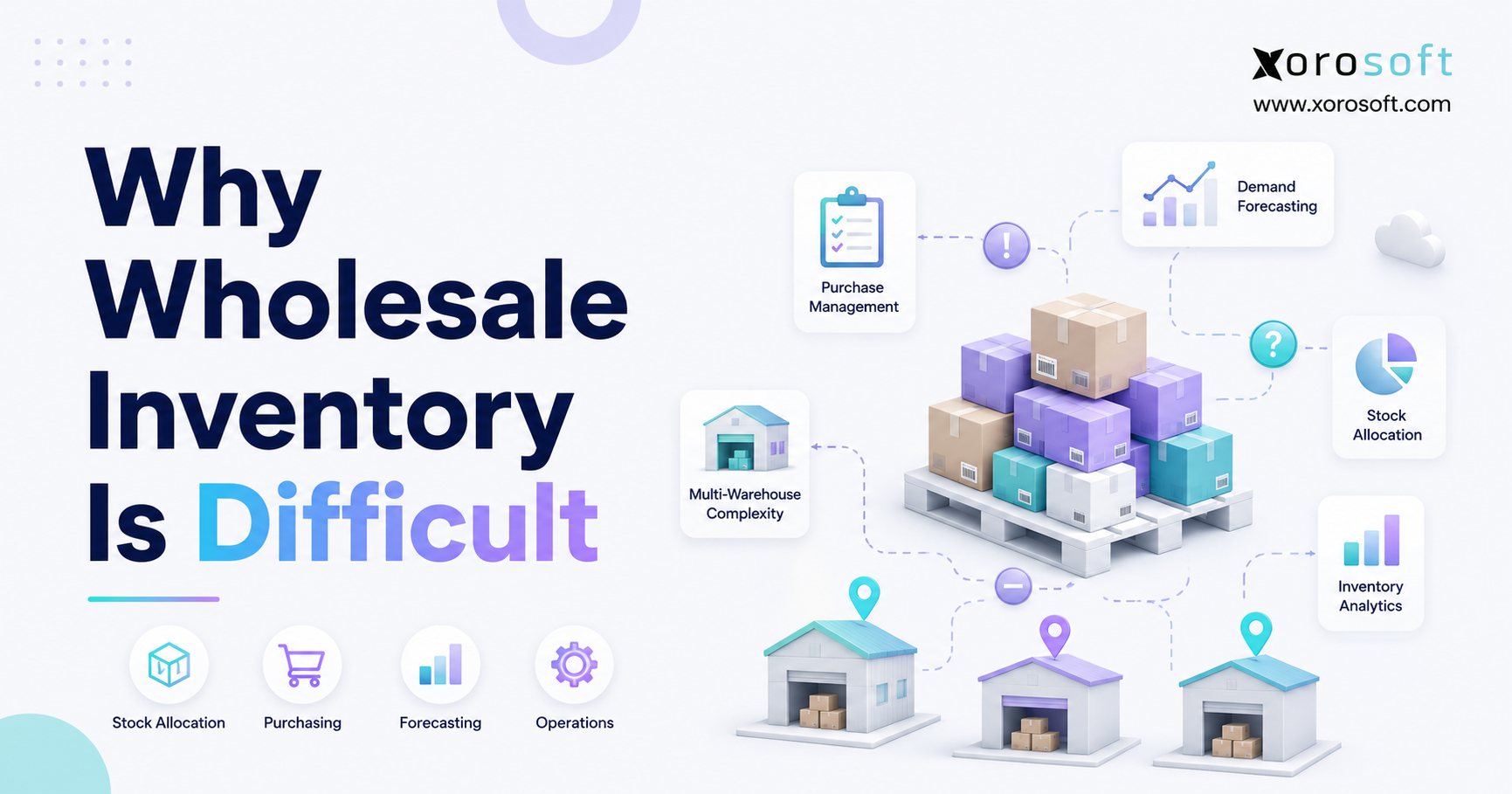
Many businesses today are facing wholesale inventory challenges that can affect their profitability and efficiency.
1. Wholesale Growth Exposes Inventory Weaknesses
Wholesale inventory rarely becomes unmanageable overnight. Instead, small operational issues build gradually until teams can no longer trust the quantities shown in their systems.
A buyer may increase a purchase order because a popular SKU keeps selling out. Meanwhile, a warehouse manager may correct system quantities after a physical count. A salesperson may also contact warehouse staff before promising stock to an important customer. Finally, finance may post another adjustment so the inventory account matches the operational report.
Each action can appear reasonable on its own. However, together they reveal a larger problem: inventory information is no longer moving reliably between sales, purchasing, warehousing, fulfillment, and accounting.
Wholesale inventory challenges become more visible as a business adds products, suppliers, customer accounts, warehouse locations, and sales channels. More sales create more orders. However, they also create more receipts, allocations, transfers, picks, shipments, returns, and accounting entries.
Therefore, the real challenge is not simply knowing how many units the company owns. Teams must also know:
- Where each unit is located
- Which quantities are already committed
- Which products are damaged or restricted
- What inventory is arriving
- Which warehouse should fulfill an order
- What each unit costs
- Whether current stock can support future demand
When departments use different systems or spreadsheets to answer these questions, inventory becomes difficult to control. As a result, a warehouse may appear fully stocked while the company remains unable to fulfill its most important orders.
Moreover, wholesale inventory problems usually affect several departments at once. A forecasting mistake can influence purchasing. A purchasing delay can create warehouse shortages. Those shortages can then affect customer service, revenue, and accounting.
Consequently, growing wholesalers must treat inventory as a connected business process rather than a number stored in one application.
2. Why Wholesale Inventory Management Is More Complex Than Retail
2.1 Wholesale Orders Create Larger Inventory Swings
Retail orders generally contain a small number of units. Wholesale orders, by contrast, can consume several weeks or months of expected demand.
For example, suppose a distributor normally sells 300 units of a product each month. A new retail customer then places an order for 1,500 units. Although the order creates immediate revenue, it can also remove stock intended for established customers.
The purchasing team must consequently determine whether the order represents recurring demand or a one-time event. If the buyer treats the order as permanent demand, the next purchase order may create excess stock. However, if the buyer ignores it, another large order could create a serious shortage.
Wholesale demand is therefore more difficult to interpret. Historical sales often contain a mixture of normal buying patterns, promotions, product launches, seasonal peaks, and unexpected customer activity.
In addition, large orders can hide underlying demand patterns. One customer may buy quarterly, while another orders smaller quantities every week. Therefore, the same annual sales volume can require very different purchasing and fulfillment strategies.
2.2 Customer Commitments Reduce Sellable Stock
A warehouse may physically hold 2,000 units. Nevertheless, the sales team may not be able to promise all 2,000 units.
Some stock may already be:
- Allocated to open orders
- Reserved for strategic customers
- Assigned to ecommerce channels
- Held for an EDI partner
- Waiting for quality approval
- Damaged or quarantined
- Moving between warehouses
As a result, wholesalers must distinguish between on-hand, available, allocated, incoming, in-transit, and available-to-promise inventory.
| Inventory status | Meaning | Available for a new order? |
|---|---|---|
| On hand | Quantity physically recorded | Not always |
| Allocated | Quantity reserved for existing demand | No |
| Available | Unreserved and usable stock | Usually |
| Incoming | Ordered but not yet received | Depends on timing |
| In transit | Moving between locations | Not immediately |
| Quarantined | Present but restricted | No |
| Available to promise | Quantity that can be safely committed | Yes |
This distinction matters because one inventory number cannot answer every operational question. Sales needs availability, purchasing needs projected demand, warehouse teams need physical locations, and finance needs inventory value.
Therefore, companies that rely only on on-hand quantities may regularly overpromise. By contrast, businesses that separate inventory statuses can make more reliable customer commitments.
2.3 Supplier Requirements Restrict Purchasing Flexibility
Wholesalers cannot always purchase the exact quantity they need.
Instead, suppliers may require:
- Minimum order quantities
- Full-case purchases
- Production-run minimums
- Container commitments
- Seasonal ordering windows
- Long manufacturing lead times
Although larger orders may reduce the unit cost, they also increase the amount of cash tied up in inventory. Moreover, they increase storage requirements and the risk of slow-moving stock.
Therefore, buyers must balance purchase price, expected demand, supplier reliability, warehouse capacity, and working capital. A low unit price does not create real savings when a large percentage of the order remains unsold.
In addition, purchasing decisions may depend on freight economics. For instance, an importer may increase an order to fill a container. However, the lower freight cost per unit may be offset by months of additional carrying cost.
2.4 Wholesale Inventory Uses Working Capital
Inventory is both an operational resource and a financial asset. Once a business purchases stock, cash remains tied up until the product is sold and customer payment is collected.
In addition, inventory creates ongoing costs, including:
- Storage
- Insurance
- Financing
- Warehouse labor
- Damage
- Shrinkage
- Obsolescence
- Markdown risk
Consequently, a company can report healthy revenue while still facing cash-flow pressure. The problem becomes especially serious when slow-moving inventory prevents the company from purchasing faster-selling products.
Moreover, excess inventory can restrict strategic decisions. A business may delay hiring, product development, warehouse expansion, or marketing because too much working capital is locked in products that are not moving.
3. The Most Common Wholesale Inventory Challenges
Wholesale inventory challenges rarely exist independently. Instead, forecasting errors affect purchasing, purchasing affects warehouse availability, and warehouse errors affect customer service and accounting.
Therefore, wholesalers should examine the entire inventory flow rather than treating each symptom as an isolated problem.
3.1 Demand Forecasting Becomes Unreliable
Demand forecasting is one of the most persistent wholesale inventory challenges because historical sales do not always represent normal demand.
A large customer order can make a product appear more popular than it really is. Similarly, a promotion may create a temporary spike that will not continue after the campaign ends.
However, the opposite problem also occurs. When a product is unavailable, the system may record no sales. Zero sales, nevertheless, do not mean zero demand. Customers may have delayed purchases, selected substitute products, or purchased from a competitor.
A stronger wholesale forecast should therefore separate:
- Baseline demand
- Seasonal demand
- Promotional demand
- New-customer demand
- Exceptional bulk orders
- Lost demand caused by stockouts
Furthermore, planners should combine historical sales with open customer orders, sales-team input, market changes, and supplier constraints.
For example, a sporting goods distributor may see higher demand before a season starts. However, if the forecast does not account for the buying calendar, the company may place purchase orders after the demand window has already begun.
Consequently, forecasting should support purchasing decisions before shortages occur, not simply explain them afterward.
3.2 Supplier Lead Times Create Replenishment Risk
Replenishment depends on more than average sales.
A supplier may quote an eight-week lead time but deliver in six weeks during one period and twelve weeks during another. Production delays, freight congestion, customs clearance, quality inspections, and supplier capacity can all change the final arrival date.
When lead-time settings remain static, reorder calculations become unreliable. Therefore, wholesalers should measure actual supplier performance rather than relying only on quoted terms.
Important supplier measures include:
- Average actual lead time
- Lead-time variability
- On-time delivery percentage
- Short-shipment frequency
- Quality rejection rate
- Purchase order confirmation time
In addition, buyers should update planning assumptions when supplier performance changes. Otherwise, the company may repeatedly place purchase orders too late.
Moreover, different suppliers may require different safety-stock policies. A local supplier with a reliable two-week lead time should not be planned in the same way as an overseas supplier with a variable four-month lead time.
3.3 Stockouts and Overstock Appear at the Same Time
One of the most frustrating wholesale inventory challenges is holding too much inventory overall while still running out of important products.
This happens because total inventory value does not show whether the correct SKUs, variants, or quantities are available.
For instance, a company may have:
- Excess stock in unpopular colors
- Too little inventory in bestselling sizes
- Products stored in the wrong warehouse
- Inventory reserved for another sales channel
- Incoming stock that will arrive too late
- Obsolete items occupying valuable warehouse space
Therefore, increasing inventory does not automatically improve availability. Likewise, reducing inventory without understanding demand can make shortages worse.
Instead, wholesalers should evaluate inventory at the SKU, location, channel, and customer-commitment level.
Moreover, buyers should distinguish between productive inventory and unproductive inventory. Productive inventory supports current demand. By contrast, unproductive inventory consumes cash and space without contributing to customer service.
3.4 Small Transaction Errors Reduce Inventory Accuracy
Large inventory discrepancies usually begin with small transaction mistakes.
For example:
- A warehouse receives 50 cases but records 50 units.
- A picker ships 12 units but confirms 10.
- A damaged product remains available in the system.
- A return is placed on a shelf without being received.
- A transfer leaves one warehouse but is never completed.
- A supplier ships short, but the full purchase order is recorded.
Each error changes availability. Moreover, as transaction volume increases, these differences accumulate faster.
Therefore, inventory accuracy depends on every physical movement creating a correct system transaction at the time it occurs. Delayed data entry may appear harmless; however, it can immediately affect customer promises and purchasing decisions.
In addition, inaccurate units of measure can multiply the problem. If one department works in cases while another works in units, a single error can affect dozens or hundreds of items.
Consequently, inventory accuracy should be treated as a process measure, not only a counting measure.
3.5 Multi-Warehouse Inventory Creates Local Shortages
Multi-location operations create another set of wholesale inventory challenges.
A company-wide inventory report may show 800 units. However, the warehouse closest to a major customer may have only 30 units available.
Shipping from another location may require:
- Higher freight costs
- Longer delivery times
- Split shipments
- Internal transfers
- Additional handling
- Different carrier arrangements
Furthermore, each warehouse may experience different demand patterns. A product that sells slowly in one region may move quickly in another.
As a result, planners should evaluate inventory by location rather than relying only on company-wide totals. They should also compare transfer costs with new purchasing requirements before placing additional supplier orders.
For example, moving stock between warehouses may be faster than ordering from a supplier. Nevertheless, frequent transfers may indicate that inventory was positioned incorrectly in the first place.
Therefore, location-level replenishment rules should reflect regional demand, supplier access, freight cost, and fulfillment capacity.
3.6 Inventory Allocation Becomes a Commercial Decision
When demand exceeds supply, a wholesaler must decide which customer receives the available inventory.
Possible allocation methods include:
- First order received
- Earliest delivery date
- Strategic customer priority
- Highest-margin order
- Contractual commitment
- Regional allocation
- Proportional distribution
- Channel-specific reservation
Without clear rules, sales representatives may compete for the same units. Consequently, customers receive inconsistent answers and warehouse employees receive conflicting instructions.
Therefore, allocation should be based on documented business policies rather than informal negotiations.
Moreover, allocation rules should be visible before an order is confirmed. Otherwise, sales teams may promise inventory that management later reallocates to another customer.
3.7 Ecommerce and Wholesale Orders Compete for Stock
Many wholesalers sell through several channels, including:
- Wholesale sales teams
- B2B portals
- Shopify
- Amazon
- Marketplaces
- Retail stores
- EDI customers
Each channel may update inventory at a different speed. For example, a Shopify order may reserve stock immediately, while an EDI order may take longer to enter another application.
If both channels depend on the same units, overselling can occur. As a result, the business must define:
- Which system owns inventory
- How often quantities synchronize
- Whether channels receive reserved stock
- How cancellations release inventory
- How returns affect availability
- How warehouse locations are represented
The Xorosoft ERP integration for Shopify is one example of an integration designed to connect Shopify orders, products, inventory, payments, refunds, and fulfillment data with wider operational processes.
However, an integration alone does not define inventory policy. The business must still decide whether wholesale, ecommerce, and marketplace channels share the same availability or receive separate inventory allocations.
3.8 EDI Creates Additional Inventory Requirements
EDI can reduce manual order entry and improve communication with retailers. However, it also introduces stricter data and fulfillment requirements.
Wholesale EDI workflows may include:
- Purchase orders
- Purchase order acknowledgements
- Advance shipping notices
- Invoices
- Product catalogs
- Inventory updates
- Shipping labels
- Routing instructions
Incorrect quantities, product codes, delivery dates, labels, or packaging structures can lead to rejected shipments, deductions, disputes, and chargebacks.
Therefore, EDI should connect with inventory, sales orders, warehouse execution, and invoicing wherever possible.
In addition, EDI orders often come from important retail customers. Consequently, an inventory error may affect not only one shipment but also the wider commercial relationship.
3.9 Warehouse Processes Determine Inventory Reliability
Inventory accuracy is created inside the warehouse.
Receiving, putaway, replenishment, picking, packing, shipping, transfers, cycle counting, and returns all affect the recorded quantity.
If a physical movement happens without a corresponding system transaction, the inventory record becomes less reliable. Similarly, if the transaction occurs hours later, other departments may make decisions using outdated information.
Barcode scanning can reduce manual entry. Nevertheless, the workflow must verify:
- The correct SKU
- The correct quantity
- The correct location
- The correct order
- The correct unit of measure
- The correct lot or serial number
Therefore, technology should support a disciplined warehouse process rather than replace one.
Moreover, warehouse teams need clear exception procedures. For example, damaged stock, short picks, substitutions, and partial receipts should not be handled through informal notes.
3.10 Inventory Accounting Must Reflect Operations
Wholesale inventory challenges eventually become accounting challenges.
Finance needs reliable information about:
- Inventory valuation
- Cost of goods sold
- Landed costs
- Freight and duty
- Returns
- Damage
- Obsolescence
- Manufacturing costs
- Inventory adjustments
- Inter-warehouse transfers
For example, if receiving is delayed, finance may not record inventory and liabilities in the correct period. Likewise, if landed costs are incomplete, product margins may appear stronger than they actually are.
As a result, warehouse and accounting records must reflect the same transactions. Otherwise, month-end close becomes a lengthy reconciliation exercise.
Moreover, repeated adjustments can hide the original operational cause. Therefore, finance and operations should review large or recurring inventory corrections together.
4. Why Wholesale Inventory Challenges Grow in Disconnected Systems
4.1 Spreadsheets Create Several Versions of the Truth
Spreadsheets remain useful for analysis, temporary calculations, and planning. However, they become risky when used as the main inventory transaction system.
A spreadsheet does not automatically know that:
- A warehouse shipped an order
- A supplier delivered short
- A customer cancelled an order
- A product was damaged
- A transfer reached another location
- A return became sellable again
Instead, an employee must update every event manually. Moreover, several employees may maintain separate versions of the same file.
Once teams stop trusting the main inventory record, they create private spreadsheets. Consequently, the central record becomes even less reliable.
Furthermore, spreadsheet errors can remain hidden for long periods. A deleted formula or incorrect filter may affect purchasing decisions without creating an obvious system warning.
4.2 Accounting Software May Lack Operational Detail
Accounting software can show inventory value. However, wholesale teams usually require more operational information.
For example, they may need:
- Bin-level quantities
- Customer allocations
- Case and unit conversions
- Warehouse transfers
- Purchase order visibility
- Barcode workflows
- EDI transactions
- Available-to-promise inventory
- Demand forecasts
Therefore, a financial inventory balance may be correct while sales and warehouse teams still lack the detail required to fulfill an order.
In other words, financial accuracy does not automatically create operational visibility.
4.3 Inventory Applications Can Leave Process Gaps
Inventory software may improve stock tracking. Nevertheless, purchasing, accounting, forecasting, warehouse execution, manufacturing, and reporting may remain in separate applications.
An integrated cloud ERP system becomes more relevant when a wholesaler needs these functions to use the same transaction data.
Xorosoft, for example, is designed for inventory-driven businesses that need inventory management, sales, purchasing, warehouse operations, accounting, forecasting, manufacturing, and reporting in one environment.
However, software does not eliminate the need for clear processes. Businesses must still define how products are received, counted, allocated, costed, transferred, and replenished.
Therefore, a system selection project should begin with process mapping rather than a feature checklist.
4.4 Integrations Can Create Invisible Errors
A growing wholesaler may use:
- Shopify
- QuickBooks
- Inventory software
- Warehouse software
- EDI software
- Shipping applications
- Forecasting spreadsheets
- Purchasing spreadsheets
Each connection introduces another possible mapping error or synchronization delay.
For example, a product may have one SKU in Shopify, another code in purchasing, and a different item number in an EDI document. If those identifiers are mapped incorrectly, transactions may update the wrong inventory item.
Therefore, businesses should monitor integrations continuously rather than treating setup as a one-time project.
In addition, teams should define how failed transactions are detected and corrected. Otherwise, an order may exist in one application while remaining invisible in another.
5. How Wholesale Inventory Challenges Affect Profit and Service
5.1 Customer Promises Become Unreliable
When inventory availability is inaccurate, sales teams promise stock that the warehouse cannot ship.
The business may then need to:
- Delay the order
- Split the shipment
- Substitute another product
- Expedite incoming supply
- Transfer stock
- Cancel part of the order
Although these actions may protect the customer relationship temporarily, they increase operational costs and reduce trust.
Moreover, repeated availability problems can change customer behavior. Buyers may place smaller orders, demand more confirmation, or move business to a more reliable supplier.
5.2 Overstock Restricts Working Capital
Slow-moving stock consumes both cash and warehouse capacity.
In addition, older products may require:
- Markdown campaigns
- Disposal
- Repackaging
- Write-downs
- Additional storage
- Increased insurance
Therefore, inventory should be reviewed by age, sales velocity, margin, and future demand. Otherwise, buyers may continue reordering products that the business already holds in excess.
Meanwhile, excess stock can hide shortage risk. A high total inventory value may make management feel protected even though bestselling products remain unavailable.
5.3 Emergency Purchasing Reduces Margin
When purchasing becomes reactive, companies often pay for:
- Expedited freight
- Smaller production runs
- Higher supplier prices
- Split shipments
- Overtime receiving
- Rush transfers
The customer may still receive the order. However, the final margin may be far lower than expected.
Consequently, revenue reports alone may not show the real cost of poor inventory planning.
5.4 Teams Stop Trusting Inventory Data
Once employees stop trusting reports, they begin verifying every decision manually.
Sales calls the warehouse. Meanwhile, purchasing requests another spreadsheet. Finance asks for physical counts, and management waits for employees to combine several reports.
Consequently, the organization becomes slower and more dependent on individual knowledge.
Furthermore, manual checking creates a cycle. The more employees work outside the central system, the less accurate that system becomes.
6. How to Solve Wholesale Inventory Challenges
6.1 Standardize Product and Inventory Data
Reliable inventory control begins with consistent master data.
Each product should include clearly defined information for:
- SKU
- Description
- Unit of measure
- Case quantity
- Pack conversion
- Supplier code
- Customer code
- Barcode
- Dimensions
- Weight
- Lead time
- Storage requirements
- Lot or serial tracking
For example, if a product is purchased by the case but sold by the unit, the conversion must be defined centrally. Otherwise, purchasing, sales, and warehouse teams may interpret the same quantity differently.
Moreover, data standards should include ownership. Someone must approve new SKUs, conversion changes, supplier mappings, and warehouse-location updates.
6.2 Establish One Inventory Source of Truth
The business should determine which system owns each transaction.
Sales, purchasing, warehousing, ecommerce, and finance should not maintain separate official inventory quantities.
For companies that require a shared operational record, XoroONE connects inventory management with purchasing, accounting, warehouse operations, manufacturing, forecasting, reporting, and ecommerce processes.
The important principle, however, is not the product name. Instead, each transaction should enter the operational record once and update every related process.
Consequently, sales availability, purchase planning, warehouse tasks, and financial reports can reflect the same business event.
6.3 Separate Inventory Statuses
Teams should distinguish between:
- On-hand stock
- Available stock
- Allocated stock
- Incoming stock
- Backordered stock
- In-transit stock
- Damaged stock
- Quarantined stock
- Returned stock
- Available-to-promise stock
This separation prevents sales teams from treating every physically present unit as sellable.
Moreover, it gives purchasing a clearer view of future shortages and helps warehouse teams understand which products require action.
For example, incoming inventory should not be promised as if it were already available unless the expected receipt date is reliable.
6.4 Improve Forecasting and Replenishment Rules
Replenishment should consider more than average monthly sales.
A stronger planning process includes:
- Demand variability
- Supplier lead-time variability
- Open sales orders
- Open purchase orders
- Customer allocations
- Seasonal demand
- Promotions
- New-customer commitments
- Minimum order quantities
- Inventory aging
- Lost sales
Additionally, products should be segmented. Fast-moving, seasonal, expensive, high-margin, and unreliable-supply products may require different planning rules.
Therefore, a single safety-stock formula should not be applied to every SKU.
Instead, planners should review exceptions regularly. For instance, a product with stable demand but unreliable supply may require a different buffer from a product with volatile demand and reliable local supply.
6.5 Use Cycle Counting to Improve Accuracy
Annual inventory counts identify discrepancies after they have accumulated for months. Cycle counting, by contrast, checks selected products throughout the year.
High-value, fast-moving, error-prone, or regulated stock should be counted more frequently.
A warehouse management system can support barcode-based receiving, putaway, picking, replenishment, transfers, and cycle counting.
However, counting alone is not enough. Each discrepancy should be traced to its cause. Otherwise, the company repeatedly corrects stock without improving the underlying process.
Therefore, count results should be grouped by cause, location, employee workflow, and product type.
6.6 Connect Purchasing With Demand and Warehouse Activity
A buyer should not create purchase orders using only a low-stock report.
Instead, purchasing decisions should reflect:
- Available inventory
- Open sales orders
- Customer allocations
- Backorders
- Incoming purchase orders
- Supplier lead times
- Forecast demand
- Warehouse capacity
- Inventory aging
- Transfer opportunities
For instance, an item may appear low in one warehouse but be overstocked in another. Therefore, an internal transfer may solve the shortage more quickly than a new supplier purchase.
Moreover, buyers should review open purchase orders before placing new ones. Otherwise, delayed or partially received orders may be duplicated.
6.7 Define Inventory Allocation Rules
Allocation policies should be documented before shortages occur.
The company may prioritize:
- Contract customers
- Strategic accounts
- Earliest order date
- Requested delivery date
- Highest-margin orders
- Specific sales channels
- Regional requirements
- Proportional distribution
The best rule depends on the business model. Nevertheless, it should be consistent and visible to sales, purchasing, customer service, and warehouse teams.
In addition, exception authority should be defined. Otherwise, employees may override allocations without understanding the effect on other customers.
6.8 Use Balanced Inventory KPIs
No single metric explains wholesale inventory performance.
Useful KPIs include:
| KPI | What it measures |
| Inventory accuracy | Difference between recorded and physical stock |
| Inventory turnover | How quickly products are sold and replaced |
| Days inventory outstanding | How long inventory remains unsold |
| Fill rate | Percentage of demand fulfilled immediately |
| Backorder rate | Percentage of orders waiting for stock |
| Stockout frequency | How often products become unavailable |
| Forecast accuracy | Difference between forecast and actual demand |
| Aged inventory | Stock held beyond a defined period |
| Supplier on-time delivery | Reliability of incoming supply |
| Order cycle time | Time from confirmation to shipment |
These metrics should be reviewed together. For example, reducing inventory may improve working capital. However, reducing it too aggressively may lower fill rates and increase stockouts.
Therefore, management should define acceptable trade-offs between service, cash, margin, and operational effort.
7. Choosing Technology for Wholesale Inventory Challenges
7.1 When Spreadsheets May Still Be Enough
Spreadsheets may remain suitable when a wholesaler has:
- One warehouse
- A small product catalog
- Low transaction volume
- Predictable demand
- Few suppliers
- One sales channel
- No EDI
- No manufacturing
- Simple pricing
Even then, companies should use controlled templates, access rules, and regular reconciliation.
However, spreadsheets should not become unofficial transaction systems when the main platform is expected to hold current inventory.
7.2 When Inventory Software Is Appropriate
Basic inventory software may work when the main requirement is quantity tracking.
It can often support:
- Purchase orders
- Stock adjustments
- Multiple locations
- Reorder alerts
- Basic integrations
- Inventory reporting
However, the business should confirm how accounting, forecasting, warehouse scanning, manufacturing, and EDI will be handled.
In addition, decision-makers should evaluate whether the software can scale with additional locations, channels, and customer requirements.
7.3 When a Warehouse Management System Is Required
A WMS becomes valuable when the warehouse itself is creating errors or delays.
Common requirements include:
- Bin-level inventory
- Barcode scanning
- Directed putaway
- Replenishment tasks
- Picking strategies
- Packing validation
- Cycle counting
- Returns processing
- Shipping control
A WMS strengthens physical inventory execution. Nevertheless, it may still require connections with ERP, accounting, purchasing, and ecommerce systems.
Therefore, companies should determine whether the primary problem is warehouse execution or wider operational coordination.
7.4 When Wholesale ERP Becomes Necessary
ERP becomes more relevant when wholesale inventory challenges cross departmental boundaries.
For example, the company may require one connected workflow for:
- Sales orders
- Inventory allocation
- Purchasing
- Receiving
- Warehouse operations
- Landed costs
- Accounting
- Shopify
- Amazon
- EDI
- Forecasting
- Manufacturing
- Reporting
Companies comparing platforms should evaluate actual business workflows rather than generic feature lists.
Potential options may include Xorosoft, NetSuite, Acumatica, Cin7, Brightpearl, Fishbowl, Sage, Business Central, or other systems suited to the company’s size and operating model.
Businesses considering broader ERP platforms can also review this Xorosoft versus NetSuite comparison as part of their evaluation.
| System | Best suited for | Main strength | Common limitation |
| Spreadsheet | Small, simple operation | Flexible and inexpensive | Manual and difficult to control |
| Inventory software | Focused stock tracking | Better inventory visibility | May leave finance or warehouse gaps |
| WMS | Complex warehouse execution | Strong physical stock control | May not manage accounting or purchasing |
| ERP | Connected operations | Shared operational and financial data | Requires implementation planning |
Ultimately, the right system depends on how many processes must share data. Therefore, feature count should not be the only selection criterion.
8. When Wholesale Inventory Challenges Require a System Upgrade
8.1 Operational Warning Signs
An upgrade may be appropriate when:
- Employees enter the same transaction several times
- Sales cannot confirm availability
- Allocations are maintained manually
- Buyers depend on exported spreadsheets
- Transfers repeatedly create discrepancies
- Departments use conflicting inventory reports
- Ecommerce and wholesale orders compete for the same stock
These warning signs show that wholesale inventory challenges have moved beyond one department.
Moreover, repeated manual work usually indicates that the existing system no longer matches the operating model.
8.2 Financial Warning Signs
Finance-related signals include:
- Repeated inventory adjustments
- Delayed month-end close
- Unclear landed costs
- Negative inventory
- Unexplained margin changes
- Large obsolete-stock balances
- Differences between financial and warehouse reports
Although one adjustment may be normal, repeated corrections indicate that the operating process needs attention.
Therefore, finance should review the cause of adjustments rather than treating them as routine accounting entries.
8.3 Warehouse Warning Signs
The warehouse may need stronger technology when:
- Receiving is entered later
- Pickers rely on handwritten instructions
- Bin locations are unreliable
- Mis-shipments occur regularly
- Returns are not processed promptly
- Cycle counting is inconsistent
In addition, supervisors should not need private spreadsheets to manage daily warehouse activity.
If they do, the main system may not provide enough operational control.
8.4 Who Does Not Yet Need ERP?
Not every wholesaler needs an ERP platform.
A smaller business with one location, simple accounting, low SKU volume, predictable purchasing, and no EDI or manufacturing may operate effectively with focused inventory software.
Therefore, the decision should depend on process complexity, transaction volume, integration requirements, reporting needs, and the cost of current errors—not revenue alone.
9. Industry-Specific Wholesale Inventory Challenges
9.1 Apparel and Fashion Inventory
Apparel wholesalers manage combinations of style, size, color, collection, and season.
A product may perform well overall while specific variants remain unsold. Meanwhile, popular sizes may sell out even when total stock remains high.
Therefore, apparel businesses need variant-level forecasting, aging analysis, and channel-level allocation.
Moreover, seasonal products lose value quickly after the main selling period ends.
9.2 Furniture Wholesale Inventory
Furniture distributors manage large products, long supplier lead times, expensive freight, and limited warehouse space.
Inventory may include components, finished goods, custom orders, floor samples, and damaged items. Moreover, unnecessary transfers can be expensive because products require significant handling and transport capacity.
Therefore, location planning and purchase timing are especially important.
9.3 Sporting Goods Inventory
Sporting goods demand can change by season, geography, weather, and sporting events.
Products may also include size, model, color, and equipment variations. As a result, planners must separate long-term category demand from short seasonal peaks.
In addition, demand may shift quickly when consumer trends or team participation changes.
9.4 Food and Beverage Wholesale Inventory
Food wholesalers must manage:
- Expiration dates
- Lot tracking
- Temperature requirements
- Product recalls
- Shelf-life restrictions
- First-expired-first-out fulfillment
Excess stock can therefore lose value quickly. At the same time, shortages may affect retailer shelves, restaurant menus, or production schedules.
Consequently, inventory age and lot visibility are as important as total quantity.
9.5 Automotive Parts Inventory
Automotive parts distributors often manage very large SKU catalogs with complex compatibility requirements.
A part may fit several vehicle models, while similar-looking products may not be interchangeable. Consequently, accurate product data, supersession records, and warehouse locations are essential.
Moreover, slow-moving parts can remain in inventory for long periods even when other parts experience repeated shortages.
9.6 Manufacturing and Wholesale Inventory
Businesses that manufacture and distribute products must control raw materials, components, work in progress, and finished goods.
Bills of materials, work orders, production schedules, customer demand, and purchasing plans must remain connected. Otherwise, the company may have enough finished-goods demand but insufficient components to produce the required quantity.
Companies can review Xorosoft’s industry solutions to understand how inventory requirements differ across wholesale, manufacturing, apparel, furniture, sporting goods, food, automotive parts, and other inventory-driven industries.
10. A Practical Plan for Reducing Wholesale Inventory Challenges
10.1 First 30 Days: Measure Inventory Accuracy
Start by selecting high-value and fast-moving products.
Compare physical stock with recorded quantities by warehouse and bin. Then document the cause of every difference.
Review:
- Receiving accuracy
- Unit conversions
- Transfer completion
- Picking errors
- Returns
- Damage adjustments
- Channel synchronization
The objective is not simply to correct quantities. Instead, identify the point where the record first becomes inaccurate.
Moreover, compare discrepancies by warehouse, product category, and transaction type. This helps reveal patterns that individual adjustments may hide.
10.2 Days 31–60: Standardize Processes
Correct product, supplier, customer, and warehouse data.
Next, define:
- Inventory status rules
- Allocation policies
- Reorder points
- Safety-stock logic
- Supplier lead times
- Cycle-count schedules
- Transfer procedures
- Return workflows
Furthermore, assign ownership for each process. A rule without a responsible owner rarely remains consistent.
Then, train employees on the updated workflow. Otherwise, old habits may continue even after the documentation changes.
10.3 Days 61–90: Connect Systems and Review KPIs
Decide which system should own orders, inventory, purchasing, warehouse transactions, and accounting.
Then remove unnecessary duplicate entry wherever possible.
Finally, review inventory accuracy, fill rate, stockouts, backorders, aged stock, forecast error, and supplier performance each month.
Wholesale inventory improvement should become a regular management process rather than a one-time cleanup exercise.
Consequently, leadership should assign owners, deadlines, and follow-up actions to every major inventory issue.
11. Frequently Asked Questions About Wholesale Inventory Challenges
11.1 What is wholesale inventory management?
Wholesale inventory management is the process of planning, purchasing, receiving, storing, allocating, tracking, and selling products to business customers. It includes physical stock movement as well as the information required for customer orders, purchasing, warehouse management, forecasting, and accounting. Therefore, it connects both operational and financial processes.
11.2 Why is wholesale inventory difficult?
Wholesale inventory is difficult because businesses must balance large customer orders, variable demand, supplier lead times, multiple warehouses, customer allocations, sales-channel synchronization, and working capital. Moreover, these factors become harder to coordinate as transaction volume increases.
11.3 What are the biggest wholesale inventory challenges?
The biggest wholesale inventory challenges include demand forecasting, supplier delays, stockouts, overstock, inaccurate quantities, multi-warehouse visibility, customer allocation, ecommerce synchronization, EDI requirements, warehouse execution, and inventory accounting. Consequently, improving one area may still require changes elsewhere.
11.4 How is wholesale inventory different from retail inventory?
Wholesale inventory generally supports larger orders, negotiated prices, payment terms, customer-specific catalogs, and scheduled fulfillment. Retail inventory usually supports smaller consumer transactions. However, companies that manage both models face additional allocation and synchronization requirements.
11.5 Why do wholesalers carry large amounts of inventory?
Wholesalers often carry more stock because suppliers impose minimum quantities, long lead times, production runs, or container requirements. In addition, companies may hold safety stock to maintain customer service. Excessive buffers, however, can create cash-flow and obsolescence problems.
11.6 Why do wholesale inventory records become inaccurate?
Inventory records become inaccurate when receiving, picking, transfers, returns, damage, or unit conversions are entered incorrectly or late. Furthermore, integration failures and manual adjustments can create differences between physical quantities and system records.
11.7 What causes wholesale stockouts?
Wholesale stockouts can result from weak forecasts, late suppliers, outdated reorder points, unexpected bulk orders, incorrect availability, or inventory allocated to another customer. Therefore, on-hand stock may exist even when no uncommitted units remain.
11.8 What causes excess wholesale inventory?
Excess inventory is often caused by optimistic forecasts, high supplier minimums, duplicate purchase orders, declining demand, unsuccessful launches, or failure to review aging stock before reordering. Consequently, buyers should review existing commitments before creating new orders.
11.9 How does wholesale inventory affect cash flow?
Cash used to purchase inventory remains tied up until the product is sold and the customer pays. In addition, slow-moving stock creates storage, financing, handling, markdown, and obsolescence costs.
11.10 Why is wholesale demand forecasting difficult?
Wholesale forecasts can be distorted by bulk orders, new accounts, promotions, seasonality, stockouts, lost demand, and supplier constraints. Therefore, planners should separate normal demand from exceptional transactions.
11.11 How do supplier lead times affect inventory?
Long or inconsistent lead times require earlier purchasing and larger safety-stock buffers. If system lead times do not reflect actual supplier performance, replenishment orders may be placed too early or too late.
11.12 How do minimum order quantities create overstock?
Minimum order quantities may force wholesalers to buy more products than current demand requires. Although the unit price may be lower, the company accepts greater cash, storage, and obsolescence risk.
11.13 How should wholesalers manage multiple warehouses?
Wholesalers should track on-hand, allocated, available, incoming, and in-transit inventory by location. They should also define transfer, replenishment, and order-routing rules based on local demand. As a result, company-wide stock is less likely to hide local shortages.
11.14 What is available-to-promise inventory?
Available-to-promise inventory estimates how much stock can safely be committed to new orders. It considers current availability, open demand, incoming supply, expected receipt dates, and allocation rules. Therefore, it gives sales teams a more reliable promise than on-hand quantity alone.
11.15 How should limited inventory be allocated?
Limited inventory can be allocated according to order date, customer priority, contract terms, requested delivery date, margin, region, or channel. The selected policy should be documented and applied consistently.
11.16 How does EDI affect wholesale inventory management?
EDI automates purchase orders, shipping notices, invoices, and related documents. However, incorrect quantities, product codes, labels, or shipment data can create compliance problems, deductions, and customer disputes.
11.17 How can Shopify and wholesale orders share inventory?
Shopify and wholesale orders should use a controlled inventory source with clear synchronization and allocation rules. The process should also account for pending orders, cancellations, returns, location-level stock, and channel reservations.
11.18 Why do spreadsheets fail for wholesale inventory?
Spreadsheets rely on manual updates and do not automatically record inventory movements. As more users, warehouses, orders, and sales channels are added, duplicate files and outdated quantities become harder to control.
11.19 Can QuickBooks manage wholesale inventory?
QuickBooks may support smaller wholesalers with basic accounting and inventory requirements. However, growing companies may require stronger multi-warehouse tracking, forecasting, EDI, barcode workflows, manufacturing, or purchasing capabilities.
11.20 Does a wholesaler need a WMS?
A wholesaler may need a WMS when receiving, bin control, picking, packing, transfers, shipping, or cycle counting create frequent errors. A WMS focuses on warehouse execution but may still require ERP and accounting integrations.
11.21 When should a wholesaler implement ERP?
A wholesaler should consider ERP when wholesale inventory challenges affect purchasing, sales, warehouse operations, accounting, ecommerce, forecasting, EDI, or manufacturing. Duplicate data and conflicting reports are common warning signs.
11.22 What is the difference between ERP and inventory software?
Inventory software mainly tracks quantities, locations, purchasing, and stock movements. ERP connects inventory with sales, accounting, warehouse operations, manufacturing, forecasting, and company-wide reporting.
11.23 How can wholesalers improve inventory accuracy?
Wholesalers can improve accuracy by standardizing product data, recording movements promptly, using barcode validation, investigating discrepancies, and performing risk-based cycle counts throughout the year. Moreover, each discrepancy should lead to a process review.
11.24 Which inventory KPIs should wholesalers track?
Important KPIs include inventory accuracy, turnover, days inventory outstanding, fill rate, stockout frequency, backorder rate, aged inventory, forecast accuracy, supplier delivery performance, and order cycle time. However, the metrics should be reviewed together rather than independently.
11.25 What is the best system for wholesale inventory management?
The best system depends on operational complexity. A small wholesaler may need basic inventory software, while a warehouse-heavy company may need a WMS. Meanwhile, a multi-channel company with connected financial and operational requirements may need ERP.
12. Turning Wholesale Inventory Challenges Into Operational Control
Wholesale inventory challenges become more serious when growth adds products, customers, suppliers, warehouses, channels, and transactions faster than existing processes can manage them.
However, the solution is not simply to purchase more stock or install another disconnected application. Instead, wholesalers need accurate product data, disciplined warehouse transactions, clear inventory statuses, consistent allocation policies, reliable replenishment rules, and shared performance measures.
First, the company should identify where inventory records become inaccurate. Next, teams should standardize product and process data. Then, purchasing, warehouse, sales, and accounting workflows should use the same operational information.
Some businesses can improve through better procedures and focused inventory applications. Others may require warehouse management capabilities. Meanwhile, companies with complex purchasing, accounting, ecommerce, EDI, manufacturing, forecasting, and reporting requirements may benefit from a connected ERP platform such as Xorosoft.
Therefore, the most practical next step is to map how one customer order moves from demand through allocation, purchasing, receiving, picking, shipment, invoicing, and accounting. Every duplicate entry, manual handoff, delayed update, or conflicting quantity represents an opportunity to reduce wholesale inventory challenges.
12.1 Review Your Wholesale Inventory Workflow
A personalized assessment should examine your actual SKUs, suppliers, warehouses, Shopify or Amazon channels, EDI customers, purchasing rules, fulfillment processes, and accounting requirements.
Book a personalized Xorosoft demonstration to identify where your current inventory workflow is losing accuracy, time, customer service, or working capital.
Recent Posts
-
 ERP Landed Cost Module vs Spreadsheet Calculations for Importers
 -
 How to Build an Open-to-Buy Plan for an Omnichannel Brand
 -
 Cold Storage WMS for Food and Beverage Distribution
 -
 ERP Buying Statistics 2026: Evaluation, Implementation, and Adoption Risks
 -
 How a Distributor Reduced B2B Order Exceptions Without Restricting Sales