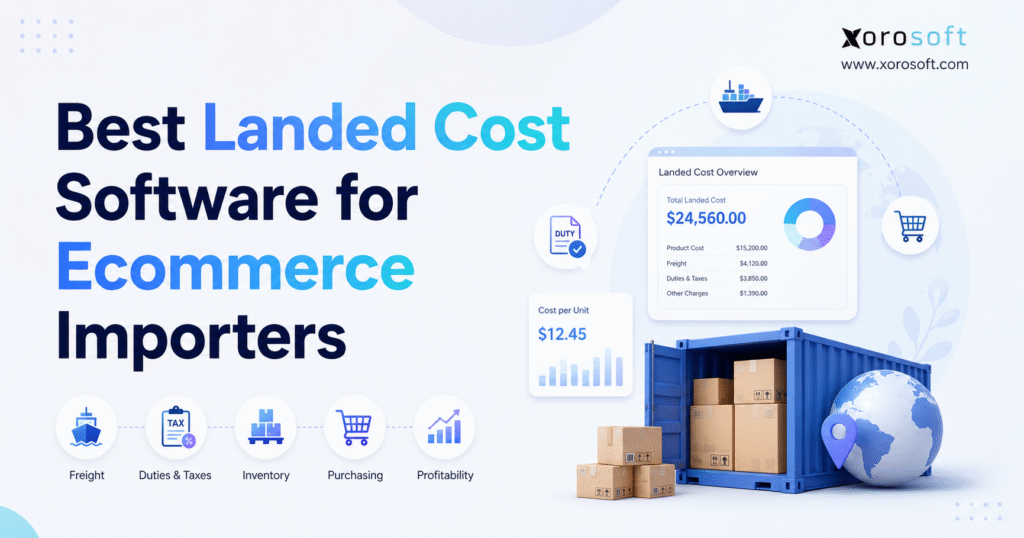
If you’re looking to manage the total landed cost of your products efficiently, landed cost software can be an essential solution for your business.
1. Imported Inventory Costs Become Unclear Before Sales Slow Down
An ecommerce importer can grow revenue while losing confidence in product margin. The supplier invoice may look clear, yet it rarely represents the amount required to place inventory in a sellable location. International freight, customs duty, tariffs, brokerage, insurance, port handling, inspection, drayage, currency charges, and other expenses may arrive through different vendors and accounting periods. As a result, finance may discover the final shipment cost only after the business has sold part of the inventory.
That timing gap affects the whole operation. Buyers compare suppliers with incomplete costs, merchandising teams approve promotions with understated expenses, and ecommerce reports no longer match the general ledger. Spreadsheets can manage predictable shipments. However, they become fragile when containers include products with different values, weights, dimensions, tariff classifications, and destinations. Manual files also depend on consistent formulas and disciplined updates.
The best landed cost software connects purchase orders, receipts, import expenses, inventory value, and accounting. Therefore, operators can understand what each unit truly costs before they approve the next purchase, promotion, or pricing decision.
1.1 The Supplier Price Creates Only a Starting Point
Suppose an importer buys 4,000 units for $40,000. Freight adds $6,000, while duty, brokerage, and insurance add another $4,000. Consequently, the shipment costs $50,000, or $12.50 per unit, rather than the $10 supplier price.
If the business prices products with the $10 figure, it overstates gross margin. It may also reward the wrong supplier or approve an unprofitable discount.
1.2 Manual Landed Cost Tracking Fails as Complexity Grows
A manual file works only when users enter complete information, follow consistent formulas, and update every connected report. In practice, import costs rarely arrive in one package. Freight forwarders, customs brokers, carriers, insurers, and suppliers send separate documents on different dates.
Therefore, growing teams often create one file for purchasing, another for finance, and another for operations. Once those files diverge, nobody knows which version reflects the final cost.
2. What Landed Cost Software Calculates
Landed cost software calculates the full acquisition cost of imported inventory and distributes shared expenses to the products, receipts, or shipments that created them. A useful system also links each expense to inventory value, COGS, margin, or variance.
IAS 2 includes purchase price, import duties, non-refundable taxes, transport, handling, and other directly attributable acquisition costs in inventory cost. Review the IFRS IAS 2 Inventories page.
2.1 The Core Landed Cost Formula
Landed cost = product cost + freight + duties and tariffs + insurance + brokerage + handling + other qualifying acquisition costs
However, teams must still decide which expenses qualify, when final amounts become known, and how to distribute shared charges. Freight may follow weight or volume, while insurance may follow product value.
2.2 Product Cost Versus True Import Cost
Assume an importer buys inventory for $60,000. Ocean freight is $8,000, customs duty is $5,000, and brokerage, insurance, and handling total $2,000. Therefore, the complete shipment cost reaches $75,000.
If the business uses only the supplier invoice, it understates inventory and future COGS by $15,000. As a result, margins look stronger and buyers may select the wrong supplier.
2.3 Estimated Landed Cost Versus Actual Landed Cost
Estimated landed cost supports purchasing, pricing, and cash planning before final invoices arrive. A team may use freight quotes, expected tariff rates, historical brokerage, and standard insurance percentages to create the estimate.
Actual landed cost uses final supplier, carrier, broker, and customs documents. Therefore, strong landed cost management software keeps both values, calculates the variance, and records the approved accounting action. It should not silently overwrite the estimate because purchasing teams need that variance to improve future forecasts.
2.4 Inbound Inventory Costing Versus Checkout Duty Calculation
Inbound landed cost software values inventory acquired by the merchant. By contrast, a checkout duty calculator estimates taxes or duties that a customer may owe on a cross-border order. Both tools may use product classification, origin, destination, and freight data. Nevertheless, they solve different operational and accounting problems.
3. Why Ecommerce Landed Cost Accuracy Changes Decisions
Accurate ecommerce landed cost gives finance, purchasing, merchandising, and operations one cost basis for supplier, margin, reorder, and promotion decisions. Consequently, the business can compare products and suppliers on complete economics rather than visible invoice price.
3.1 Inventory Valuation and COGS
When finance assigns qualifying acquisition expenses to inventory, unsold stock carries a more complete value. Then, as units sell, the cost moves into COGS according to the company’s costing method and accounting configuration. Therefore, inaccurate landed cost can distort both the balance sheet and the income statement.
However, accounting policy still matters. Normal freight and handling required to bring stock to its present location may receive different treatment from abnormal storage, penalties, or avoidable delay costs. The software should support the policy that finance approves; it should not define that policy for the company.
3.2 Pricing and Promotion Decisions
Pricing based on supplier cost creates false confidence. For example, a promotion may look profitable in the storefront dashboard but lose money after freight, duty, marketplace fees, fulfillment, and returns enter the calculation.
Landed cost does not replace contribution-margin analysis. Instead, it gives that analysis a reliable product-cost foundation. As a result, teams can set minimum prices, design promotions, and compare channels with stronger data.
3.3 Supplier and Route Comparison
A supplier offering a lower factory price may require a more expensive shipping mode, inefficient packaging, or a tariff treatment that raises the final unit cost. Similarly, a longer route may reduce freight expense but increase lead time and working-capital exposure.
Therefore, import cost software should compare complete outcomes by supplier, route, shipment mode, and product family.
3.4 Faster Financial Reconciliation
When purchasing, receiving, freight invoices, and inventory valuation operate in separate systems, finance spends month-end tracing transactions. By contrast, a connected process reduces manual allocations and unexplained differences.
A strong audit trail also shows the receipt, allocation rule, user, and cost change. That visibility helps finance close faster.
4. How Ecommerce Landed Cost Software Works
A reliable landed cost workflow begins before inventory leaves the supplier and continues until finance reconciles the final charges. Therefore, the software should support each stage without forcing teams to rebuild the transaction in another application.
4.1 Purchase Order and Incoterm Setup
The process begins with a purchase order containing supplier, currency, products, quantities, prices, expected dates, and delivery terms. Incoterms clarify buyer and seller responsibilities for transportation, insurance, documentation, and customs activity. Review the current guidance from the International Trade Administration.
Because the Incoterm changes freight, insurance, clearance, and duty responsibilities, the system should retain it with the purchase transaction.
4.2 Inbound Shipment and Expected Import Costs
Next, the team builds an expected-cost model with carrier quotes, customs estimates, standard brokerage, insurance, and historical charges. The business may record those amounts by shipment, container, purchase order, receipt, or cost type.
Meanwhile, buyers can compare routes and suppliers before committing cash, while finance accrues expected expenses.
4.3 Receiving and Freight Allocation
When goods arrive, receiving should connect the physical stock to the correct purchase order and inbound shipment. Partial receipts need clear traceability because one purchase order may arrive in several containers, while one container may include several purchase orders.
Then, the team distributes shared expenses by an appropriate basis:
| Allocation method | Best use | Main risk |
|---|---|---|
| Product value | Insurance, value-driven fees, some duties | Can misstate freight consumption |
| Quantity | Similar products and packaging | Ignores size and value differences |
| Weight | Weight-based freight | Depends on accurate item weights |
| Volume | Bulky or containerized products | Depends on reliable dimensions |
| Equal allocation | Similar lines and minor costs | Often too simplistic |
| Manual or custom | Product-specific charges | Requires controls and review |
Cin7 Core documents cost, quantity, weight, volume, and manual allocation on its landed cost help page. Likewise, Business Central covers later freight and handling invoices in its item charge guidance.
4.4 Actual Invoice Reconciliation
Later, freight forwarders, customs brokers, and carriers submit final invoices. At that point, the software should connect those documents to the original shipment, compare actual charges with estimates, and calculate the variance.
If part of the stock has sold, the demo should show the effect on inventory, COGS, and variance accounts.
4.5 Warehouse and Accounting Updates
After approval, the system should update inventory value and create or support the required accounting entries. Warehouse records should continue to show the same units and quantities; only their cost basis changes.
When receiving, inventory, and accounting operate in separate applications, users may post the same adjustment several times. Therefore, businesses reviewing a connected model should examine warehouse management software alongside an inventory and accounting ERP to determine whether one transaction can update the wider operation.
5. Landed Cost Software Features That Need a Real Demo
Software vendors often use similar feature names. However, workflows can differ substantially. Treat a capability as proven only after the vendor processes a real company scenario.
5.1 Flexible Landed Cost Allocation Methods
The platform should support value, quantity, weight, volume, equal, and controlled custom allocation. It should also allow different methods for different charges. Freight may follow weight, insurance may follow value, and inspection may apply only to selected SKUs.
5.2 Late Invoice and Variance Handling
Ask whether users can add landed costs after receipt and after partial sales. Then ask where the difference posts. The system should show open estimates, actual invoices, remaining unreconciled charges, and the resulting financial effect.
It should also separate freight, currency, duty, and supplier-price variances.
5.3 Multi-Currency Import Cost Tracking
Global purchasing needs transaction currency, base currency, exchange-rate date, and clear variance reporting. Therefore, the platform should separate exchange-rate movement from changes in freight, duty, or supplier price.
Buyers should also confirm the exchange rate used at each transaction stage.
5.4 Multi-Warehouse Inventory Valuation
Importers may receive goods into a port warehouse, 3PL, regional distribution center, Amazon location, or retail store. Consequently, the system should preserve acquisition cost when stock moves and distinguish inbound landed cost from later distribution expense.
It should also report inventory value by location consistently.
5.5 Shopify, Amazon, Wholesale, and EDI Integration
All channels should consume the same valued inventory. Otherwise, Shopify may use one product cost, Amazon reporting may use another, and wholesale orders may rely on spreadsheets.
Xorosoft connects orders, inventory, purchasing, warehouse operations, accounting, manufacturing, B2B, and reporting in one operating environment. Its external Shopify ERP integration also gives merchants a direct view of how storefront activity can connect with back-office operations.
5.6 Purchasing, Forecasting, and Reordering
Landed cost should improve the next purchase, not simply correct the last one. Therefore, buyers need supplier-level and SKU-level history, expected lead times, open purchase orders, forecast demand, and true unit cost.
For example, packaging, order quantities, freight mode, or tariffs can erase a lower unit price.
5.7 Accounting and Audit Controls
Look for cost categories, approval controls, posting rules, change history, and reconciliation reports. Users should be able to explain who changed an estimate, why the allocation method changed, and how the final invoice affected inventory and COGS.
Finance should also review unreconciled estimates and unallocated charges inside the system.
5.8 Reporting That Operators Can Use
Useful views include cost by SKU, shipment, supplier, warehouse, charge type, and currency. Moreover, teams need variance reports, route comparisons, outstanding invoice reports, and product-margin analysis.
The best reports answer a decision question instead of displaying transactions without context.
6. Best Landed Cost Software for Ecommerce Importers
No platform fits every importer. Therefore, the right choice depends on shipment complexity, accounting needs, ecommerce channels, warehouse structure, manufacturing, and implementation capacity.
6.1 Xorosoft Landed Cost and Cloud ERP Workflows
Best for: Growing inventory-driven businesses that sell through ecommerce, wholesale, retail, marketplaces, or EDI and need purchasing, inventory, accounting, WMS, forecasting, or manufacturing in one platform.
Xorosoft links purchasing with inventory, warehousing, manufacturing, accounting, forecasting, and ecommerce operations.
This breadth helps when disconnected systems cause costing errors. However, a very small importer may not need the full scope. Review XoroONE as an operating platform.
6.2 NetSuite Landed Cost Management
Best for: Organizations evaluating a broad cloud ERP with configurable purchasing, inventory, and financial processes.
NetSuite documents landed-cost categories, item-receipt or vendor-bill tracking, estimates, and separately billed charges.
Because configuration shapes the workflow, buyers should test receiving, billing, and accounting. The Xorosoft versus NetSuite guide supports a broader ERP comparison.
6.3 Cin7 Core Landed Cost Allocation
Best for: Product businesses that prioritize inventory, purchasing, ecommerce operations, and flexible landed-cost allocation.
Cin7 Core supports transportation, customs, duty, insurance, currency conversion, crating, handling, and several allocation methods.
Therefore, it suits inventory-led operators, although buyers should verify accounting, entity, manufacturing, and late-cost requirements.
6.4 Descartes Finale Inventory Landed Cost Software
Best for: Multichannel ecommerce brands seeking inventory control, purchase-order workflows, and automated landed-cost allocation without moving immediately to a full ERP.
Finale allocates freight, insurance, and import costs by value, quantity, weight, volume, or equally and connects them with valuation and COGS.
As a result, it can suit ecommerce and warehouse teams, while businesses with complex finance or manufacturing should compare broader ERP options.
6.5 Odoo Landed Cost and Inventory Valuation
Best for: Businesses that prefer a modular application suite and have resources to configure inventory, purchasing, accounting, and related processes.
Odoo lets users create landed-cost records through inventory operations or vendor bills and add qualifying expenses to product valuation.
Odoo offers flexibility. Nevertheless, buyers should confirm modules, costing, localization, partner support, and upgrade responsibilities.
6.6 Acumatica Landed Cost Codes
Best for: Distribution, commerce, and manufacturing companies evaluating a configurable cloud ERP.
Acumatica uses landed-cost codes tied to vendors, accrual accounts, receipts, and landed-cost documents.
Therefore, Acumatica merits consideration for wider distribution or manufacturing workflows. Ask the team to demonstrate allocation, AP billing, and inventory adjustments.
6.7 Microsoft Dynamics 365 Business Central Item Charges
Best for: Companies already invested in Microsoft products that need ERP-level finance, purchasing, and inventory management.
Business Central uses item charges to place freight, physical handling, insurance, and transportation costs into inventory value. Users can assign charges on the original document or through a separate invoice linked to a posted receipt.
Meanwhile, larger organizations may evaluate Dynamics 365 Supply Chain Management for voyages, containers, and goods in transit.
6.8 Fishbowl Inventory and Landed Cost
Best for: Small and midsize inventory or manufacturing businesses that want operational control while maintaining an accounting connection such as QuickBooks.
Fishbowl connects landed-cost and receiving reconciliation with inventory, accounting, purchasing, and multi-warehouse processes.
Consequently, it may suit businesses that have outgrown basic accounting inventory. Buyers should still verify plans, integrations, deployment, and manufacturing depth.
6.9 VISCO Import and Landed Cost Software
Best for: Importers and distributors that prioritize containers, shipments, import documents, projected costs, and transaction-level profitability.
VISCO focuses on import and export operations and describes projected and actual landed-cost calculation for imported shipments. Its materials emphasize freight, duties, insurance, customs fees, and the true cost of goods before and after arrival.
Therefore, import-heavy businesses may value this specialization, while ecommerce brands should verify wider integrations.
6.10 Dynamics 365 Supply Chain Management Landed Cost
Best for: Larger organizations that require voyage, container, goods-in-transit, estimated-cost, and supply-chain financial control.
Microsoft’s Landed Cost module supports voyages, containers, folios, estimated costs, cost allocation across multiple purchase orders, goods-in-transit processes, accruals, actual-cost posting, and voyage-cost reporting.
Its depth may exceed a smaller importer’s needs. Therefore, evaluate implementation, licensing, integration, and governance carefully.
7. Landed Cost Software Comparison Table
| Platform | Software type | Landed-cost approach | Best-fit importer |
| Xorosoft | Cloud ERP | Connected purchasing, inventory, accounting, WMS, and ecommerce | Growing multichannel operators |
| NetSuite | Cloud ERP | Categories, receipts, bills, and estimated-cost workflows | Broad ERP requirements |
| Cin7 Core | Inventory platform | Flexible purchase-cost allocation | Inventory-led product businesses |
| Finale Inventory | Ecommerce inventory platform | Automated allocation and valuation | Multichannel ecommerce brands |
| Odoo | Modular ERP | Landed-cost records linked with valuation | Configurable modular environments |
| Acumatica | Cloud ERP | Codes, accrual accounts, receipts, and documents | Distribution and manufacturing |
| Business Central | ERP | Item charges assigned to purchases and receipts | Microsoft-centered businesses |
| Fishbowl | Inventory and manufacturing | Receiving and accounting-connected landed cost | QuickBooks-oriented operators |
| VISCO | Import ERP | Projected and actual shipment costing | Import-focused distributors |
| D365 Supply Chain | Enterprise supply-chain ERP | Voyages, containers, accruals, and goods in transit | Complex global operations |
Use the table to create a shortlist. Then, test every finalist with the same purchase order, freight invoice, duty charge, partial receipt, warehouse destination, and late invoice. Otherwise, the comparison may reward a feature label rather than a working process.
8. Choosing Between Import Cost Software, Inventory Software, and ERP
Choose the software category based on where the process breaks. In other words, do not buy a broad platform when a focused calculator solves the problem, and do not buy a calculator when the business actually needs a system of record.
8.1 Spreadsheet or Landed Cost Calculator
A controlled spreadsheet may suit a company with predictable shipments, limited SKUs, one currency, and one costing owner. Likewise, a calculator can support early scenario planning.
However, neither option creates a durable connection with receiving, inventory value, or accounting. Therefore, every later invoice requires another manual update.
8.2 Inventory Management Software
Inventory software fits businesses that need purchase orders, receiving, multi-location stock, channel integrations, and stronger costing. It can provide a practical step between spreadsheets and ERP.
The limitation is that accounting may remain in another system. Consequently, reconciliation quality depends on the integration and the discipline of the users who review exceptions.
8.3 Import Management Software
Import-focused systems suit companies that manage containers, customs documents, overseas suppliers, and shipment profitability. They may provide deeper trade workflows than general inventory products.
Nevertheless, ecommerce, manufacturing, and accounting capabilities can vary. Therefore, the broader software stack still matters.
8.4 Landed Cost ERP Software
ERP becomes relevant when purchasing, inventory, accounting, warehousing, forecasting, manufacturing, ecommerce, wholesale, or EDI must use the same data. Xorosoft fits this category as a cloud operating platform for inventory-driven businesses rather than as a standalone cost calculator.
9. Signs Your Landed Cost Tracking Has Outgrown Spreadsheets
A business should consider upgrading when the process creates material delay, risk, or disagreement. Common signs include:
1. Freight is manually allocated across many SKUs.
2. Purchasing and finance keep separate shipment files.
3. Final freight or duty invoices arrive after stock has sold.
4. Ecommerce margin reports do not match accounting.
5. The company buys in several currencies.
6. Inventory enters several warehouses or 3PLs.
7. One container combines several purchase orders or suppliers.
8. Month-end requires repeated inventory-cost adjustments.
9. Teams cannot compare estimated and actual import costs.
10. Supplier decisions rely on factory price rather than true landed cost.
Revenue is not the only trigger. For example, a $5 million importer with complex shipments may need a stronger system sooner than a larger company with domestic, predictable purchasing.
10. Landed Cost Use Cases Across Ecommerce Industries
Different product categories create different cost drivers. Therefore, software should support those differences without forcing one allocation model.
10.1 Shopify and Multichannel Brands
Shopify brands often need the same inventory cost across storefront orders, wholesale, marketplaces, and finance. When the storefront connects to a broader operating system, purchasing and margin decisions can use the same valued inventory.
The external Shopify ERP integration gives merchants additional context when they assess this operating model.
10.2 Apparel and Sporting Goods
Styles, sizes, colors, seasons, and tariff classifications make flat allocations risky. Therefore, teams often need rules by product family, weight, value, or packaging profile.
10.3 Furniture and Bulky Consumer Products
Container space often drives freight. Consequently, volume-based allocation may outperform quantity or value, while port handling and drayage can materially change unit cost.
10.4 Food, Beverage, and Regulated Products
Importers may manage inspection, temperature, shelf life, lot tracking, and regulatory documents. However, finance must distinguish qualifying acquisition cost from abnormal spoilage, penalties, or avoidable delays.
Therefore, the system should support both traceability and clear cost categories.
10.5 Wholesale and EDI Operations
Wholesale importers may combine customer-specific pricing, inventory allocation, EDI documents, and multiple warehouses. As a result, true landed cost supports customer profitability and purchasing, not only product valuation.
10.6 Manufacturing and Automotive Parts
Imported components affect bills of materials, work orders, production cost, and finished-goods margin. Automotive parts businesses may also manage large SKU counts and fitment complexity.
Businesses can review ERP workflows by industry when evaluating how costing connects with their operating model.
11. Common Landed Cost Management Mistakes
11.1 Treating Every Logistics Charge the Same
Freight, duty, insurance, brokerage, storage, and penalties do not always share the same accounting treatment or allocation driver. Therefore, finance should create clear cost categories and document the policy behind each one.
11.2 Allocating Every Charge by Product Value
Value is simple. However, it may place too little freight on bulky products and too much on compact, expensive items.
Use weight, volume, quantity, or custom allocation when those methods better reflect the cost.
11.3 Leaving Estimates Unreconciled
An estimate helps only when the team compares it with the final invoice. Consequently, open estimates should appear on an exception report until users reconcile, approve, or write them off according to policy.
11.4 Mixing Landed Cost With Selling Expense
Inbound freight that brings goods into inventory differs from outbound fulfillment, marketplace commission, advertising, and customer delivery. Keep landed cost and contribution margin connected, but label them separately.
11.5 Selecting Software From Feature Checkboxes
A vendor may support landed cost but not the timing, receipt, accounting, or multi-PO scenario the company needs. Therefore, a real transaction test provides stronger evidence than a generic demonstration.
12. A Practical Landed Cost Software Selection Process
12.1 Map the Current Workflow
Document every step from supplier quote through purchase order, shipment, customs clearance, receipt, freight invoice, inventory valuation, and sale. Also record the people, systems, spreadsheets, and approvals involved.
12.2 Define Cost Categories and Allocation Rules
List every normal charge, decide whether it belongs in inventory, and select its allocation driver. Finance should approve the policy before configuration.
12.3 Build a Real Demonstration Scenario
Give each shortlisted vendor the same recent shipment. Include several SKUs, multiple purchase orders, a foreign currency, partial receiving, freight, duty, insurance, a late broker invoice, and some inventory already sold.
12.4 Review the Accounting Result
Ask the vendor to show inventory valuation, AP entries, accruals, COGS, and variance postings. Do not accept a dashboard total without the journal and transaction trail behind it.
12.5 Test Operational Integration
Verify Shopify, Amazon, wholesale, EDI, purchasing, WMS, manufacturing, and forecasting requirements. Otherwise, a strong costing engine may still create manual work across the rest of the operation.
12.6 Compare Total Operating Fit
Subscription price represents only one cost. Therefore, compare implementation, integration, migration, training, upgrades, and ongoing reconciliation effort.
13. Frequently Asked Questions About Landed Cost Software
13.1 What Is Landed Cost Software?
Landed cost software allocates the full acquisition cost, including supplier price, freight, duty, insurance, brokerage, and handling, to products or receipts.
13.2 Who Needs Ecommerce Landed Cost Software?
It helps importers that pay shared shipment costs and need reliable margin across many SKUs, suppliers, currencies, warehouses, or channels.
13.3 What Is Included in Landed Cost?
Typical components include product price, duty, non-refundable taxes, freight, insurance, brokerage, and handling. However, accounting policy determines the treatment of abnormal costs.
13.4 How Do You Calculate Landed Cost per Unit?
First, allocate shared shipment expenses to each product with value, quantity, weight, volume, or a custom method. Then, divide the product’s total allocated cost by the number of sellable units received.
13.5 What Is the Best Freight Allocation Method?
The best method reflects the cost driver. For example, weight suits dense freight, volume suits bulky goods, value suits insurance, and quantity suits similar units.
13.6 How Does Landed Cost Affect Inventory Valuation?
Qualifying acquisition expenses increase inventory value. Then, when inventory sells, the associated cost moves into COGS according to the company’s costing method and system configuration.
13.7 How Does Landed Cost Affect Gross Margin?
Adding import expenses increases product cost and usually reduces reported gross margin compared with a supplier-price-only calculation. As a result, the business gets a more realistic view for pricing, promotions, supplier comparison, and product profitability.
13.8 What Is Estimated Landed Cost?
Estimated landed cost forecasts freight, duty, insurance, and related charges before final invoices arrive. Later, the team should reconcile the estimate with actual cost.
13.9 What Is Actual Landed Cost?
Actual landed cost uses final invoices and customs documents to reconcile estimates and show freight, duty, currency, or other variances.
13.10 Can Landed Cost Be Added After Receiving Inventory?
Many systems support charges after receipt. However, their effect on inventory, sold units, COGS, and variance accounts differs. Therefore, buyers should test this scenario.
13.11 What Happens When Inventory Sells Before Freight Is Invoiced?
The system must determine how much adjustment belongs to remaining inventory and how much relates to units already sold. Depending on accounting configuration, the sold portion may update COGS or post to a variance account.
13.12 Can One Freight Invoice Cover Multiple Purchase Orders?
Some platforms distribute one invoice across several receipts or purchase orders. Therefore, test consolidated containers and the audit trail.
13.13 Does Shopify Calculate Inbound Landed Cost?
Shopify can store product costs, while connected applications extend purchasing, valuation, and accounting. Importers with shared freight, late invoices, and multiple receipts often need inventory software or ERP.
13.14 Can QuickBooks Manage Landed Cost?
QuickBooks can record inventory and expenses. However, complex allocation by shipment, receipt, or SKU often requires an inventory application or ERP.
13.15 Is a Spreadsheet Enough for Landed Cost Tracking?
A spreadsheet may work at low volume. Nevertheless, it becomes risky when users edit formulas, shipments mix SKUs, invoices arrive late, or adjustments must update accounting.
13.16 What Is the Difference Between Landed Cost and Shipping Cost?
Shipping is one part of landed cost. In addition, landed cost can include product price, duties, tariffs, brokerage, insurance, handling, and other qualifying acquisition expenses.
13.17 Is Landed Cost the Same as Total Cost of Ownership?
No. Landed cost covers acquisition to the required location and condition. By contrast, total cost of ownership can also include storage, financing, returns, obsolescence, selling, or disposal.
13.18 Is Import Cost Software Different From a Duty Calculator?
Yes. A duty calculator estimates customs charges, while import cost software connects those charges with purchase orders, receipts, inventory value, and accounting.
13.19 Can Landed Cost Software Handle Multiple Currencies?
Many platforms support multiple currencies. Even so, buyers should verify rates, conversion dates, revaluation, and variance separation.
13.20 What Reports Should Landed Cost Management Software Provide?
Useful reports cover SKU, supplier, shipment, warehouse, currency, charge type, variance, valuation, COGS, and audit details.
13.21 Does a Small Importer Need ERP?
Not always. ERP becomes more relevant when landed cost must connect with accounting, WMS, forecasting, manufacturing, multiple channels, or EDI.
13.22 When Should an Importer Upgrade to ERP?
Consider ERP when disconnected tools create duplicate entry, stock and accounting disagree, purchasing depends on spreadsheets, or multi-warehouse and multichannel operations require a shared source of truth.
13.23 Can Accurate Landed Cost Improve Supplier Selection?
Yes. Buyers can compare total acquisition cost rather than factory price. Therefore, they can include freight, duty, packaging, route, minimum order quantity, and lead time in the decision.
13.24 How Often Should Allocation Rules Be Reviewed?
Review rules when product mix, packaging, freight contracts, routes, tariffs, or warehouse structure changes. Also test whether results still reflect each cost driver.
13.25 What Is the Most Important Software Evaluation Test?
Ask each vendor to process one real shipment from purchase order through final accounting. Include mixed products, partial receipts, several cost types, multiple currencies, and a late invoice after some units have sold.
14. Build a Reliable Landed Cost Process Before Growth Makes It Harder
The right decision begins with a clear costing process. First, define which expenses belong in inventory. Next, decide how each charge should be allocated. Then, set rules for estimate reconciliation and reporting.
A calculator can support early estimates. Meanwhile, inventory software can strengthen purchasing and stock control. Import management software can add shipment and document depth. However, ERP becomes the stronger option when landed cost must connect with accounting, warehouse operations, ecommerce, forecasting, manufacturing, wholesale, EDI, and multiple locations.
For inventory-driven businesses facing that wider problem, Xorosoft can be evaluated as a connected cloud ERP rather than another isolated cost tool. The best proof comes from a real transaction. Bring a recent purchase order, freight invoice, customs statement, receipt, and margin report, then follow every cost through the proposed system.
Ready to evaluate the complete workflow? Book a personalized demo and review how landed cost can move through purchasing, inventory, warehouse operations, accounting, and ecommerce reporting.