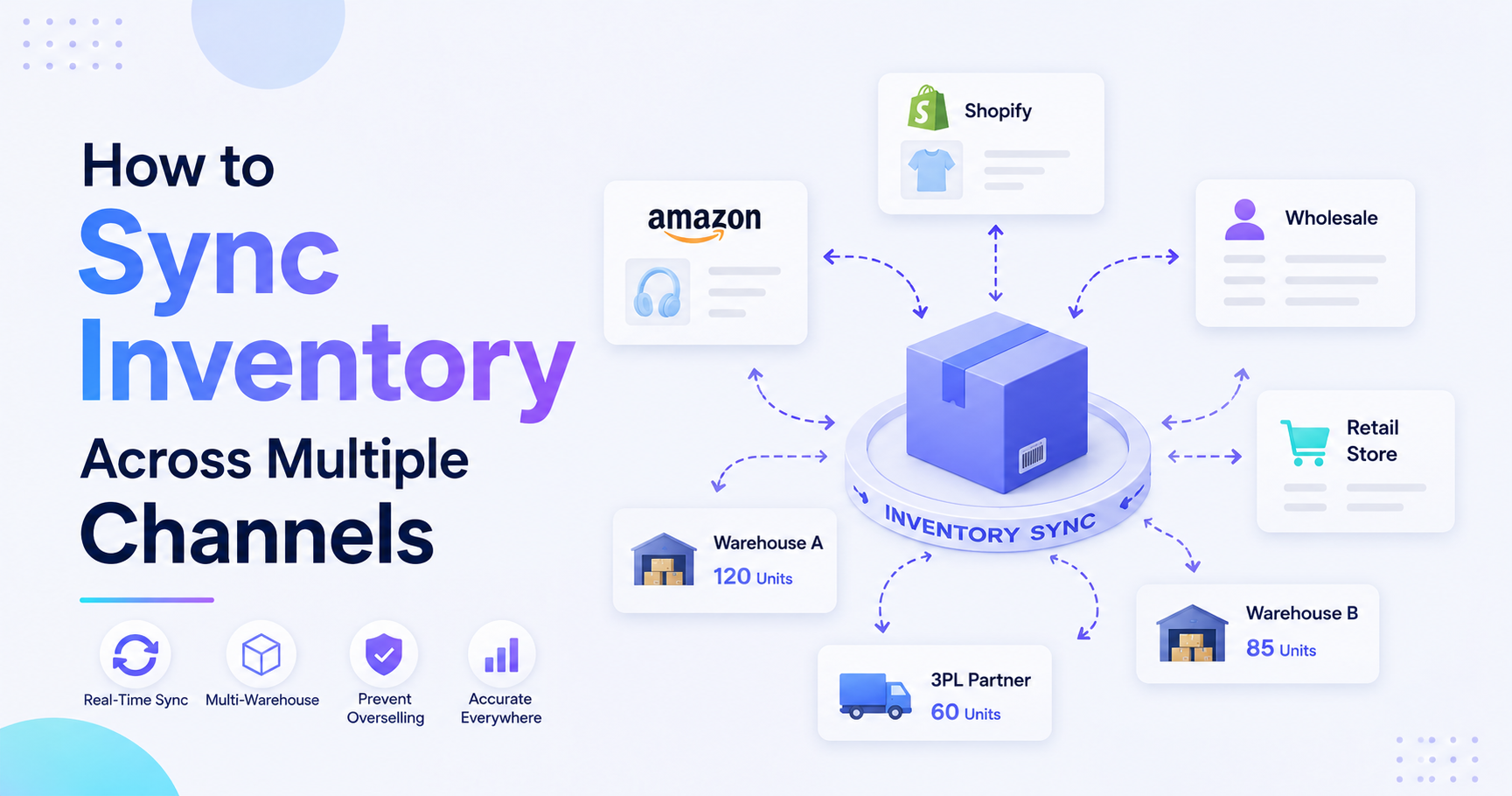
Managing inventory sync across channels is essential for businesses looking to streamline their operations and prevent overselling.
1. When Every Sales Channel Shows a Different Stock Number
Inventory sync across channels becomes essential as soon as the same product sells through Shopify, Amazon, wholesale, retail, or another marketplace. Although each channel may show an inventory quantity, those numbers can drift apart when orders, returns, warehouse movements, and purchase receipts update at different times. As a result, a product may appear available online even though the warehouse has already committed the final units.
At first, teams often correct these differences manually. However, manual updates become slower and less reliable as order volume, SKU count, and warehouse complexity increase. Therefore, growing brands need one inventory process that updates every connected channel from a shared stock record.
In practice, reliable inventory sync across channels does more than prevent an occasional oversell. In addition, it helps purchasing teams reorder with confidence, warehouse teams fulfill the right orders, finance teams value inventory correctly, and customer service teams give accurate availability information. Consequently, inventory synchronization becomes an operational requirement rather than a simple ecommerce integration.
In addition, this guide explains how to establish a reliable stock source, map products correctly, define available-to-sell rules, connect warehouses, and monitor exceptions. Moreover, it explains when native channel tools remain sufficient and when a more complete inventory or ERP system becomes necessary.
2. What Inventory Sync Across Channels Actually Means
In practice, inventory sync across channels is the process of keeping stock availability consistent across every place a company sells, stores, allocates, or fulfills products. For example, when a customer purchases one unit on Amazon, the available quantity should decrease on Shopify, the wholesale ordering portal, and any other channel selling from the same pool.
However, inventory synchronization is not simply a matter of copying an on-hand number from one platform to another. Instead, the system must determine how much inventory is genuinely available after accounting for open orders, reserved stock, damaged units, inbound receipts, warehouse transfers, and channel-specific buffers.
2.1 Inventory Synchronization Versus Inventory Management
Therefore, inventory synchronization keeps quantities aligned across systems. Meanwhile, inventory management controls the broader stock lifecycle, including purchasing, receiving, put-away, transfers, cycle counting, replenishment, returns, forecasting, and valuation.
However, a business may have inventory sync without having complete inventory control. For instance, an app may update Shopify and Amazon quantities but still leave purchasing in spreadsheets and warehouse adjustments in a separate system. As a result, sales channels may appear aligned while the underlying operation remains fragmented.
2.2 The Events That Should Trigger an Update
Consequently, a strong inventory process updates availability whenever a transaction changes stock. For this reason, the following events should feed inventory sync across channels:
- New ecommerce and marketplace orders
- Wholesale and EDI sales orders
- Order cancellations
- Returns and exchanges
- Purchase order receipts
- Warehouse transfers
- Cycle count adjustments
- Damaged or quarantined stock changes
- Kitting and bundle consumption
- Manufacturing material usage
- Finished-goods production
- 3PL shipping confirmations
Because each event can change sellable inventory, the business should not rely only on order imports. Instead, every stock-affecting workflow should update the central inventory record.
3. Why Inventory Sync Across Channels Breaks
Inventory sync across channels usually breaks because systems use different timing, product identifiers, warehouse rules, and availability calculations. Although the visible symptom is a quantity mismatch, the root cause often sits in the operating process.
3.1 Orders Move Faster Than Scheduled Updates
In practice, orders happen immediately, while some integrations update inventory every 15 minutes, every hour, or only a few times per day. For example, Shopify may accept an order at 10:02 a.m., while Amazon accepts another order for the same limited SKU at 10:04 a.m. If the next synchronization runs at 10:15 a.m., both channels may sell the same units.
Therefore, update frequency must reflect how quickly a product can sell out. Moreover, limited releases, seasonal products, and promotional items usually require event-based or near-real-time updates.
3.2 Channels Calculate Available Stock Differently
For example, different platforms may interpret stock in different ways. Meanwhile, Shopify can track inventory by locations and inventory-management apps, while Amazon may separate merchant-fulfilled inventory from FBA inventory. In addition, a wholesale portal may reserve stock for approved accounts, and a WMS may distinguish picked, packed, damaged, and available units.
For a practical explanation of location and app-managed stock, review Shopify’s guidance on inventory managed by locations and apps. Because each platform answers a different operational question, the business must define which system controls the official sellable quantity.
3.3 SKU Mismatches Disconnect Identical Products
For example, a product may use one SKU in Shopify, another merchant SKU in Amazon, and a third code in the warehouse. Although employees may recognize that all three codes describe the same product, an integration will not make that assumption safely.
Therefore, every external listing should map to one internal product record. In addition, teams should distinguish internal SKUs from UPCs, GTINs, ASINs, and marketplace listing IDs. For reference, the GS1 explanation of Global Trade Item Numbers provides useful context on standardized product identification.
3.4 Returns Create Uncertain Inventory
However, a returned product does not always become sellable immediately. Instead, the warehouse may need to inspect, clean, repair, repackage, quarantine, or dispose of it. Consequently, automatically adding every return back to available stock can cause another customer to receive a damaged or incomplete item.
Therefore, a reliable process should move returns through clear conditions such as received, awaiting inspection, restockable, damaged, vendor return, and disposed. Consequently, only after the item passes inspection should it increase available inventory.
3.5 Warehouse Transfers Create Temporary Blind Spots
Meanwhile, when inventory moves between warehouses, the units are no longer available at the source but are not yet available at the destination. However, poorly configured systems may show the inventory in both places or remove it from visibility completely.
Therefore, transfer orders should use an in-transit status. Moreover, the destination quantity should become sellable only after the receiving team confirms arrival and completes the required inspection or put-away process.
3.6 Manual Edits Bypass Shared Rules
At first, manual stock changes may solve an immediate customer issue. Nevertheless, they can also bypass reservation logic, warehouse controls, and audit trails. For example, an employee may increase Shopify inventory without updating the warehouse or accounting system.
As a result, teams should restrict direct channel-level inventory edits. Instead, authorized users should make adjustments in the central system with a reason code, timestamp, and audit history.
4. How to Establish Reliable Inventory Sync Across Channels
Reliable inventory sync across channels requires clear ownership, consistent data, defined availability rules, connected workflows, and active exception management. Therefore, businesses should treat implementation as an operating-model project rather than a one-time integration task.
4.1 Select One Inventory Source of Truth
First, decide which system owns the official inventory record. However, other platforms may display or consume stock quantities, but they should not create independent versions of availability.
At first, Shopify may serve as the source of truth for a small single-channel merchant. However, once the company adds Amazon, wholesale, multiple warehouses, EDI, purchasing, or manufacturing, a dedicated inventory, OMS, WMS, or ERP platform often becomes more appropriate.
The selected source should control:
- On-hand quantity
- Available-to-sell quantity
- Committed inventory
- Reserved inventory
- Damaged and quarantined inventory
- Inbound inventory
- Transfer inventory
- Warehouse location
- Channel allocation
4.2 Standardize Product and SKU Data
Next, create one internal SKU for every unique sellable item. Then, map each Shopify variant, Amazon merchant SKU, wholesale code, barcode, and warehouse record to that item.
In addition, define clear rules for:
- Sizes, colors, and styles
- Kits and bundles
- Multipacks
- Replacement SKUs
- Discontinued products
- Raw materials and finished goods
- Marketplace-specific identifiers
Because inconsistent product data can quietly break synchronization, teams should validate mappings before activating new channels.
4.3 Define Available-to-Sell Inventory
However, on-hand inventory should not automatically equal channel availability. Instead, the system should calculate available-to-sell inventory by subtracting stock that cannot be promised to a new customer.
A common formula is:
Available-to-sell = On-hand inventory – committed stock – reserved stock – damaged stock – quarantine stock – safety buffer
However, each business should adapt the formula to its workflow. For example, a manufacturer may include finished goods but exclude work in progress. Meanwhile, a food company may exclude lots that cannot meet the customer’s remaining shelf-life requirement.
4.4 Reserve Inventory Immediately After Order Acceptance
Once an order enters the operational system, the business should reserve the required units. Therefore, other channels stop offering those units even before warehouse picking begins.
Reservation rules should cover:
- Paid ecommerce orders
- Authorized but unsettled orders
- Wholesale orders
- EDI orders
- Backorders
- Preorders
- Partially fulfilled orders
- Replacement shipments
Because large wholesale orders can consume substantial inventory, immediate reservation is especially important for brands that sell the same products through direct-to-consumer and B2B channels.
4.5 Apply Channel-Specific Safety Buffers
Therefore, a safety buffer prevents every channel from advertising the final units. For instance, if 30 units are available, the system may publish 27 while holding three units back for delays, damage, or counting variance.
However, one buffer does not always fit every channel. Amazon may require a larger protection level for a fast-moving listing, while a wholesale portal may need a fixed allocation for strategic accounts. Therefore, inventory sync across channels should support rules by SKU, warehouse, channel, and customer group.
4.6 Connect Every Stock-Affecting System
However, channel connections alone are not enough. Instead, the business should connect every system that creates, consumes, moves, or values inventory.
That may include:
- Shopify and other ecommerce storefronts
- Amazon and other marketplaces
- Wholesale portals and EDI networks
- Retail POS systems
- Warehouse management software
- 3PL platforms
- Purchasing and supplier workflows
- Accounting systems
- Manufacturing systems
- Forecasting and reporting tools
Because these workflows influence the same stock position, disconnected systems will eventually produce conflicting answers.
4.7 Choose the Correct Update Method
For example, event-based updates push a change as soon as an order, return, receipt, or adjustment occurs. By contrast, scheduled updates process changes at set intervals.
Therefore, near-real-time or event-based synchronization is usually preferable for fast-moving and limited-stock products. However, scheduled updates may remain acceptable for slow-moving products with deep inventory and strong buffers.
Therefore, the right question is not whether every business needs second-by-second updates. Instead, the business should ask whether inventory updates faster than customers can oversell the SKU.
4.8 Build Exception Monitoring From the Start
However, automation does not eliminate integration failures. For example, APIs can time out, marketplace credentials can expire, products can remain unmapped, and warehouse events can arrive late. Consequently, teams need reports and alerts for exceptions.
Useful alerts include:
- Failed inventory updates
- Negative stock
- Channel quantities outside tolerance
- Unmapped products
- Duplicate SKU mappings
- Orders without reservations
- Returns awaiting inspection too long
- Transfers overdue in transit
- Manual adjustments above a threshold
Finally, assign an owner and response time for each exception type. Otherwise, the report may identify problems without ensuring correction.
5. Shopify, Amazon, Wholesale, and Marketplace Workflows
In practice, each sales channel introduces different inventory requirements. Therefore, a reliable design should account for the channel’s fulfillment model, order timing, return process, and allocation rules.
5.1 Shopify Inventory Workflows
At first, Shopify works well as the selling surface for direct-to-consumer ecommerce. Moreover, it supports multiple sales channels and inventory locations. For example, the Shopify sales-channel documentation explains how merchants can sell through online, social, marketplace, and in-person channels.
However, Shopify may become only one part of the operating stack as the business grows. Meanwhile, purchasing, warehouse scanning, landed costs, wholesale allocation, manufacturing, and accounting may need a deeper backend. Therefore, Shopify should receive availability from the selected source of truth rather than independently controlling stock that other systems also use.
Therefore, businesses evaluating an integrated Shopify ERP workflow can also review Xorosoft ERP in the Shopify App Store. In addition, this link is especially relevant when Shopify inventory must connect with purchasing, warehousing, accounting, and additional channels.
5.2 Amazon Inventory Workflows
Meanwhile, Amazon sellers may manage merchant-fulfilled inventory, FBA inventory, or both. Consequently, the system must separate stock held in company warehouses from stock available in Amazon fulfillment centers.
For businesses using Amazon Multi-Channel Fulfillment, Amazon’s Shopify integration overview explains how Amazon fulfillment inventory can support Shopify orders and inventory visibility. However, brands should still define whether FBA inventory remains dedicated to Amazon or can also fulfill other channels.
5.3 Wholesale and EDI Workflows
In practice, wholesale orders often include larger quantities, customer-specific pricing, credit terms, backorders, partial shipments, and negotiated allocations. Therefore, the system should reserve inventory when the order becomes firm rather than waiting until the warehouse ships it.
In addition, EDI workflows may send purchase orders, acknowledgments, shipment notices, and invoices through structured transactions. Because those documents depend on accurate item and inventory data, wholesale inventory sync must connect customer orders, allocation, warehouse fulfillment, and accounting.
5.4 Retail and POS Workflows
Meanwhile, retail inventory changes throughout the day through sales, returns, store transfers, and pickup orders. As a result, store-level stock should update the same central record used by ecommerce and warehouse operations.
Moreover, buy-online-pick-up-in-store workflows need location-level accuracy. For example, a company may own ten units in total, but only one store may have the item close enough for pickup. Therefore, total stock alone cannot support a reliable customer promise.
5.5 3PL Workflows
Similarly, a 3PL may hold, pick, pack, ship, and receive inventory on the brand’s behalf. Nevertheless, the brand still needs operational visibility into available stock, inbound receipts, return status, and adjustments.
Consequently, the integration should exchange more than shipment confirmations. In addition, it should communicate receipts, inventory adjustments, damaged units, returns, lot or serial data where required, and location-level availability.
6. Multi-Warehouse Inventory Sync Across Channels
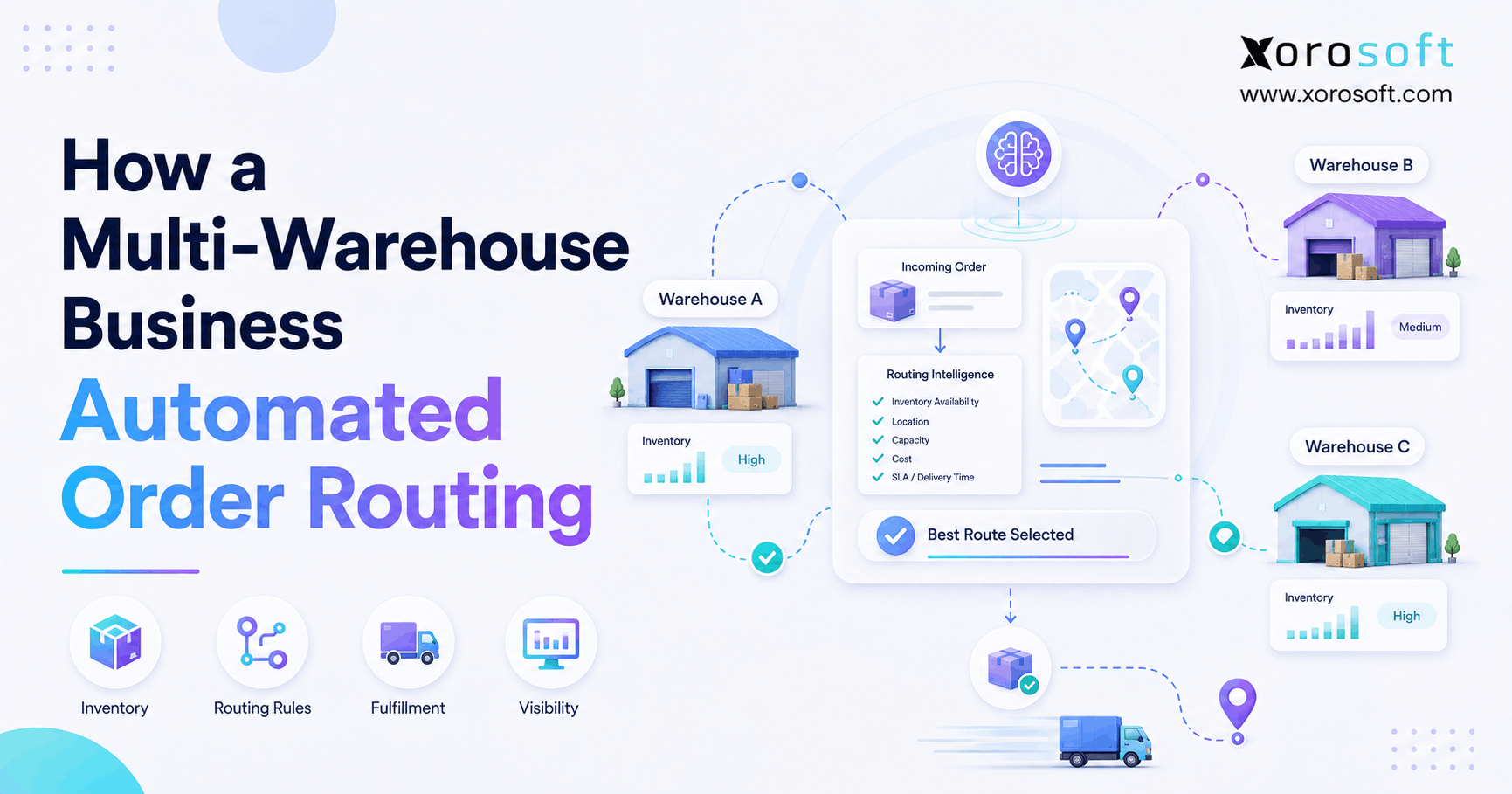
Multi-warehouse inventory sync across channels must answer two questions: how much stock exists and where the stock can fulfill an order. Therefore, businesses need location-level control rather than one global quantity.
6.1 Track Inventory by Operational Status and Location
First, every warehouse, store, production site, and 3PL should have a distinct location record. In addition, each location should distinguish available, committed, picked, damaged, quarantined, inbound, and in-transit stock.
Because shipping cost and delivery time depend on location, the fulfillment engine should consider both stock and customer destination. For example, a West Coast order may route to Los Angeles, while an East Coast order routes to New Jersey.
6.2 Decide Between Pooled and Allocated Inventory
For example, pooled inventory allows every channel to sell from one shared stock quantity. Therefore, this model simplifies management and usually works for high-stock products with predictable demand.
By contrast, allocated inventory reserves quantities by channel, warehouse, customer, or order type. Therefore, it offers more protection for limited products, wholesale commitments, seasonal launches, and high-priority accounts.
In practice, many businesses use a hybrid approach. For example, they may pool everyday products while allocating limited collections and wholesale commitments.
6.3 Control Transfer Inventory Carefully
Meanwhile, warehouse transfers create an in-between status. Once a source location ships the units, the system should remove them from that location’s available inventory. However, it should not add them to the destination’s available inventory until receipt is confirmed.
Therefore, transfer records should include source, destination, quantity, ship date, expected arrival, received quantity, and exception status. As a result, this process prevents the same units from appearing available in two warehouses.
6.4 Align Fulfillment Routing With Availability
In practice, a channel should not promise inventory that the fulfillment process cannot use. For example, Amazon FBA units may not be available for a wholesale order, while a wholesale warehouse may not fulfill direct-to-consumer orders.
Consequently, routing rules should consider channel, customer, warehouse, inventory status, delivery promise, and shipping cost. Once these rules align, inventory sync across channels can publish quantities that the operation can genuinely fulfill.
7. Real-Time Versus Scheduled Inventory Synchronization
For example, real-time synchronization updates inventory after each qualifying transaction. By contrast, scheduled synchronization processes updates at fixed intervals. Although real-time sounds universally better, the correct method depends on product velocity and operational risk.
7.1 When Near-Real-Time Updates Are Necessary
Near-real-time updates are important when:
- Products can sell out within minutes
- Several channels share a small inventory pool
- Wholesale orders reserve large quantities
- Marketplace cancellations or penalties are costly
- Limited launches create sudden demand
- Multiple warehouses fulfill the same channel
Because each delay creates an overselling window, high-velocity operations should reduce latency as much as practical.
7.2 When Scheduled Updates May Be Enough
However, scheduled updates may be acceptable when products move slowly, inventory is deep, buffers are conservative, and only a few channels share stock. Nevertheless, teams should measure how often discrepancies appear between updates.
Therefore, scheduled synchronization should be a deliberate risk decision rather than a default technical limitation.
7.3 Why Speed Alone Does Not Guarantee Accuracy
Nevertheless, a system can update quickly and still publish the wrong quantity. For instance, it may use incorrect SKU mappings or include damaged inventory in available stock. As a result, businesses need accurate rules before they optimize speed.
In other words, reliable inventory sync across channels depends on data quality, availability logic, and event coverage as well as update frequency.
8. Preventing Overselling With Inventory Sync Across Channels
In practice, preventing overselling requires several controls working together. Therefore, businesses should combine reservation, buffers, status management, and exception reporting rather than relying on one integration setting.
8.1 Reserve Stock Before Fulfillment
As soon as an order becomes valid, reserve its units. Consequently, every other channel sees a lower available quantity before warehouse picking starts.
However, the business should also define when a reservation expires. For example, unpaid orders, abandoned wholesale drafts, or failed payment authorizations should not hold inventory forever.
8.2 Keep Non-Sellable Inventory Out of Channel Quantities
For example, damaged, quarantined, returned, and in-transit inventory should not increase available stock automatically. Instead, each status should follow a defined release process.
Moreover, inbound purchase orders should appear separately from currently available inventory. Although future stock can support planning and preorder workflows, it should not be presented as ready-to-ship inventory unless the customer promise clearly allows it.
8.3 Use Buffers Based on Risk
However, a fixed buffer of two units may work for one SKU but fail for another. Therefore, businesses should consider sales velocity, count accuracy, supplier reliability, return rate, and channel update delay.
For example, a fast-moving Amazon SKU may need a larger buffer than a low-volume wholesale product. Similarly, a warehouse with recurring count variances may require a stronger protection level until accuracy improves.
8.4 Reconcile Exceptions Daily
Therefore, daily exception review prevents small problems from becoming widespread discrepancies. In addition, repeated exceptions reveal which process needs redesign.
Teams should review:
- Oversold SKUs
- Negative inventory
- Failed updates
- Unmapped listings
- Open orders without reservations
- Stale return statuses
- Late warehouse transfers
- Large manual adjustments
Consequently, the business can fix the cause rather than repeatedly correcting quantities.
9. Choosing the Right System for Inventory Sync
Therefore, the right system depends on channel count, warehouse complexity, purchasing requirements, accounting needs, manufacturing workflows, and reporting expectations. As a result, businesses should evaluate operational fit instead of buying the tool with the longest feature list.
9.1 Xorosoft for Connected Inventory Operations
For inventory-driven businesses that need inventory sync across channels plus purchasing, accounting, warehouse management, forecasting, manufacturing, and reporting, XoroONE should be evaluated first. As a result, it centralizes core workflows so Shopify, Amazon, wholesale, EDI, warehouses, and finance teams work from shared operational data.
In addition, XoroERP supports businesses that have outgrown QuickBooks, spreadsheets, and inventory-only applications. Instead of synchronizing channel quantities in isolation, Xorosoft connects inventory changes to orders, purchasing, receiving, fulfillment, and accounting.
For warehouse-intensive operations, XoroWMS adds real-time receiving, location control, picking, packing, transfers, and inventory visibility. Moreover, businesses can review available Xorosoft integrations when planning connections across ecommerce, marketplaces, EDI, shipping, payments, and other operational tools.
9.2 Standalone Inventory Synchronization Apps
For example, a standalone app may be sufficient when the company has a small SKU catalog, one warehouse, a few sales channels, and simple purchasing. Furthermore, these apps can offer faster implementation and lower initial complexity.
However, an app may become restrictive when inventory accuracy depends on warehouse scanning, wholesale allocation, landed costs, accounting, manufacturing, or complex replenishment. Therefore, teams should evaluate both current needs and the next stage of growth.
9.3 Order Management Systems
Meanwhile, an OMS can centralize orders, routing, fulfillment status, and customer communication. As a result, it may solve channel-order fragmentation effectively.
Nevertheless, the business may still need separate purchasing, accounting, WMS, and manufacturing systems. Consequently, an OMS is strongest when order orchestration is the main problem rather than full operational integration.
9.4 Other ERP Platforms
By contrast, platforms such as NetSuite, Acumatica, Microsoft Dynamics 365 Business Central, Sage, and other ERP systems may also support multi-channel and multi-warehouse operations. However, implementation effort, functional depth, partner dependence, usability, and total cost can vary widely.
Therefore, companies should compare systems using real workflows, including order import, reservation, purchasing, receiving, transfer, return, accounting, and reporting scenarios. Moreover, they should ask users who perform the work to evaluate the process rather than limiting selection to executive demonstrations.
10. Industry Workflows That Require Strong Synchronization
Although the core principles remain consistent, each industry introduces different availability rules. Therefore, implementation should reflect the products, customers, and fulfillment model.
10.1 Apparel and Fashion
For example, apparel brands manage sizes, colors, styles, seasons, returns, exchanges, and limited releases. Consequently, variant-level SKU accuracy is essential.
In addition, wholesale reservations may compete with direct-to-consumer demand. Therefore, apparel businesses often need inventory allocation, seasonal forecasting, and fast return inspection.
10.2 Furniture
Similarly, furniture businesses manage bulky products, long supplier lead times, delivery scheduling, and high storage costs. As a result, an incorrect quantity can create expensive delivery failures or unnecessary purchasing.
Moreover, location matters because a unit may exist but sit too far away to meet the customer’s delivery promise. Therefore, furniture brands need warehouse-level inventory and fulfillment routing.
10.3 Sporting Goods
Meanwhile, sporting goods companies frequently manage seasonal demand, kits, accessories, team orders, and channel promotions. Consequently, the same product may appear inside individual listings and bundles.
Therefore, the inventory system should reduce component stock when a kit sells. Otherwise, the company may oversell components through another channel.
10.4 Food and Beverage
In addition, food and beverage businesses must consider lots, expiration dates, quality status, and remaining shelf life. Therefore, available inventory may depend on the customer, warehouse, and ship date.
Consequently, recalled, expired, or quality-held lots must disappear from channel availability immediately.
10.5 Wholesale Distribution
For example, wholesale distributors manage bulk orders, customer-specific pricing, credit terms, EDI, backorders, and allocations. Consequently, inventory reservations and purchasing visibility become critical.
Moreover, businesses can explore connected inventory and ERP solutions for inventory, warehouse, purchasing, accounting, and order workflows. The industry solutions page also provides additional context for distribution and product-based operations.
10.6 Manufacturing
Similarly, manufacturers track raw materials, components, work in progress, and finished goods. Therefore, sales-channel availability depends on both completed inventory and production capacity.
Therefore, a reliable system should consume components through work orders, add finished goods after production, and connect material requirements to purchasing. Otherwise, the business may promise finished products without enough components to build them.
11. A Practical 90-Day Implementation Plan
A phased implementation reduces risk because teams can validate data and workflows before connecting every channel. Therefore, businesses should prioritize foundations first and automation second.
11.1 Days 1-30: Establish the Inventory Foundation
During the first month:
- Select the inventory source of truth
- Clean and standardize SKUs
- Document warehouses and fulfillment locations
- Define inventory statuses
- Create available-to-sell formulas
- Identify all stock-affecting systems
- Document current manual workarounds
- Assign process owners
In addition, compare physical counts with system quantities for high-value and fast-moving SKUs. As a result, this baseline shows where the largest discrepancies already exist.
11.2 Days 31-60: Connect Priority Workflows
Next, connect the channels and systems with the highest sales volume or overselling risk. Typically, that includes Shopify, Amazon, the main warehouse, and wholesale orders.
Meanwhile, configure reservation rules, buffers, transfer statuses, and return conditions. Then, test complete scenarios from order creation through shipment, cancellation, return, and accounting impact.
11.3 Days 61-90: Automate Exceptions and Reporting
Finally, activate alerts, exception reports, and management dashboards. Moreover, set response targets for failed updates, negative stock, unmapped products, and delayed returns.
At this stage, teams should measure accuracy by SKU, channel, and warehouse. As a result, the company can refine rules before adding secondary marketplaces, new 3PLs, or additional locations.
12. Metrics That Show Whether Inventory Sync Is Working
In practice, successful inventory sync across channels should improve measurable operational outcomes. Therefore, teams should track more than whether integrations are technically connected.
Useful metrics include:
- Inventory accuracy percentage
- Oversold order rate
- Stockout frequency
- Failed synchronization events
- Negative inventory count
- Order cancellation rate caused by stock
- Return-to-restock cycle time
- Manual inventory adjustments
- Warehouse transfer variance
- Purchase order receiving variance
- Inventory reconciliation hours
- On-time fulfillment rate
In addition, leaders should monitor whether users trust the system. However, if warehouse, purchasing, customer service, and finance teams continue maintaining separate spreadsheets, the implementation has not yet created one operational truth.
For example, businesses evaluating operational improvements can review customer ERP and WMS case studies to see how inventory-driven companies have addressed broader operational challenges.
13. Frequently Asked Questions
13.1 What Is Inventory Sync Across Channels?
Inventory sync across channels is the process of keeping stock quantities consistent across ecommerce stores, marketplaces, wholesale orders, retail locations, warehouses, and fulfillment partners. When one transaction changes inventory, the system updates the shared stock record and sends the revised availability to every relevant channel. Therefore, customers see quantities that reflect current operational commitments.
13.2 How Do You Create Inventory Sync Across Channels?
First, choose one inventory source of truth. Then, standardize SKUs, map every external listing, define available-to-sell rules, reserve stock for orders, connect warehouse and return events, and select an appropriate update frequency. Finally, create exception reports for failed updates, negative stock, and unmapped products.
13.3 Why Do Channel Inventory Quantities Become Different?
Quantities become different when systems update at different times or calculate availability differently. For example, one channel may subtract stock after order placement, while another waits until fulfillment. In addition, warehouse transfers, returns, manual adjustments, and incorrect SKU mappings can create mismatches. Therefore, the business needs one shared stock record and consistent event rules.
13.4 Can Shopify Manage Inventory for Multiple Channels?
Shopify can track inventory across locations and support several sales channels. However, businesses with complex purchasing, wholesale, EDI, warehouse, accounting, manufacturing, or 3PL workflows may need a broader operational system behind Shopify. In that case, Shopify remains the storefront while the central platform controls stock availability and operational transactions.
13.5 Can Shopify and Amazon Inventory Update Automatically?
Yes, Shopify and Amazon inventory can update through marketplace tools, fulfillment integrations, inventory applications, or ERP platforms. Nevertheless, the configuration must define whether Amazon FBA stock, company warehouse stock, or a central shared pool controls availability. Otherwise, both channels may continue displaying conflicting quantities.
13.6 What Is Real-Time Inventory Synchronization?
Real-time inventory synchronization updates stock as soon as an order, return, receipt, transfer, or adjustment occurs. Although technical processing may still take a short time, the system does not wait for a long scheduled batch. Therefore, real-time updates reduce the period in which two channels can sell the same limited units.
13.7 Is Hourly Inventory Synchronization Sufficient?
Hourly updates may work for slow-moving products with high stock levels and conservative buffers. However, they are risky for fast-moving, limited, or seasonal SKUs. Therefore, the company should compare update frequency with the time required to sell through available stock. If products can sell out within an hour, the sync is too slow.
13.8 What Is an Inventory Source of Truth?
An inventory source of truth is the system that owns the official stock record. Other platforms may display inventory, but they receive quantities from this central system. Consequently, sales channels do not create independent versions of stock, and teams can trace adjustments, reservations, receipts, and warehouse movements through one audit trail.
13.9 What Is Available-to-Sell Inventory?
Available-to-sell inventory is the quantity a business can promise to new customers. It usually equals on-hand inventory minus committed, reserved, damaged, quarantined, in-transfer, and safety-buffer stock. Therefore, available-to-sell is often lower than the physical quantity inside the warehouse.
13.10 What Is Reserved Inventory?
Reserved inventory is stock assigned to an existing order, customer, channel, or operational purpose. For example, a wholesale account may have 200 units reserved before shipment. Because the stock already has a commitment, other channels should not present it as available.
13.11 What Is Channel Inventory Allocation?
Channel allocation assigns a specific quantity or percentage of stock to Shopify, Amazon, wholesale, retail, or another sales channel. Therefore, one channel cannot consume the entire inventory pool unexpectedly. Allocation is especially useful for limited launches, strategic wholesale accounts, marketplace commitments, and seasonal products.
13.12 How Do Safety Stock Buffers Prevent Overselling?
A safety stock buffer hides a small portion of inventory from sales channels. For example, a company may have 25 sellable units but publish only 22. As a result, the remaining units protect against timing delays, warehouse variance, damage, returns, and unexpected demand.
13.13 How Should Returns Affect Available Inventory?
Returned products should enter an inspection status rather than becoming available immediately. After inspection, the warehouse can restock, repair, quarantine, return to vendor, or dispose of the item. Consequently, customers do not purchase products that are physically present but not suitable for resale.
13.14 How Do Order Cancellations Affect Inventory?
When an order is canceled before fulfillment, the system should release its reservation and increase available inventory. However, if the warehouse has already picked or shipped the item, the cancellation may require a return or intercept process. Therefore, inventory changes should follow the actual operational status rather than the customer-facing order status alone.
13.15 How Does Multi-Warehouse Inventory Synchronization Work?
Multi-warehouse synchronization tracks quantity and status separately for each location. The system then publishes channel availability according to fulfillment and allocation rules. For example, Shopify may use two company warehouses, while Amazon uses FBA stock and wholesale orders use a dedicated location.
13.16 Should All Channels Sell From One Inventory Pool?
A shared pool works for products with deep stock, predictable demand, and flexible fulfillment. However, limited products, wholesale commitments, and channel-specific service levels may require allocation. Therefore, many businesses use pooled inventory for standard products and allocated inventory for high-risk SKUs.
13.17 How Does a 3PL Affect Inventory Synchronization?
A 3PL must send receiving, shipping, return, adjustment, and inventory-status updates to the brand’s central system. Otherwise, the company may sell stock that the 3PL has already shipped or marked as damaged. Therefore, the integration should exchange inventory events rather than only shipment tracking numbers.
13.18 How Does EDI Affect Inventory Availability?
EDI connects structured documents such as purchase orders, acknowledgments, shipment notices, and invoices. Because large wholesale orders may arrive through EDI, the system should reserve inventory immediately after acceptance. In addition, item codes and units of measure must map correctly to internal SKUs.
13.19 Can QuickBooks Manage Inventory Sync Across Channels?
QuickBooks may support basic inventory and connect with ecommerce applications. However, growing companies often need additional systems for multi-warehouse control, WMS workflows, wholesale allocation, EDI, manufacturing, forecasting, and real-time operational reporting. Therefore, QuickBooks may remain the accounting tool while another system controls inventory, or the company may move to an integrated ERP.
13.20 Can Spreadsheets Manage Multichannel Inventory?
Spreadsheets can support a small operation with low volume and few SKUs. Nevertheless, they do not update automatically after every order, return, transfer, or receipt. As a result, version conflicts and timing gaps increase as the business grows. Spreadsheets work best for analysis, not as the live inventory source.
13.21 What Is the Difference Between an Inventory App and ERP?
An inventory app usually focuses on channel quantities, orders, and basic purchasing. By contrast, ERP connects inventory with accounting, purchasing, warehouse management, manufacturing, forecasting, and reporting. Therefore, ERP becomes more appropriate when inventory accuracy depends on several departments and operational workflows.
13.22 When Should a Business Upgrade to ERP?
A business should consider ERP when employees reconcile inventory daily, purchase orders remain in spreadsheets, warehouses do not trust system stock, accounting struggles with inventory value, or wholesale and ecommerce channels compete for the same units. At that point, the problem is broader than simple channel synchronization.
13.23 What Are the Most Common Inventory Synchronization Mistakes?
Common mistakes include inconsistent SKUs, channel-level manual edits, slow update schedules, missing order reservations, automatic restocking of returns, and failure to track transfer inventory. In addition, businesses often connect sales channels but leave purchasing, accounting, and warehouse systems isolated.
13.24 How Should a Business Audit Inventory Synchronization?
Compare inventory by SKU, channel, location, and status. Then, review negative stock, failed updates, unmapped listings, old returns, overdue transfers, and large manual adjustments. Moreover, perform physical cycle counts for high-value and fast-moving products. Repeated variances should trigger a process investigation rather than another manual correction.
13.25 Which Channels Should a Business Connect First?
Start with the channels and locations that create the most sales volume or overselling risk. Usually, that means Shopify, Amazon, the primary warehouse, the 3PL, and major wholesale orders. After those workflows remain stable, connect secondary marketplaces, retail locations, and additional warehouses.
14. Turn Every Channel Into One Reliable Inventory Operation
Inventory sync across channels is not only a connection between Shopify, Amazon, wholesale, marketplaces, and warehouses. Instead, it is a shared operating model for deciding what can be sold, where it can be fulfilled, and how every inventory event affects the rest of the business.
Therefore, begin with one source of truth, consistent SKUs, clear availability rules, immediate reservations, location-level tracking, and active exception management. Then, connect every system that creates, moves, consumes, or values inventory.
For growing inventory-driven companies, Xorosoft brings inventory, purchasing, accounting, warehouse management, manufacturing, forecasting, Shopify, Amazon, EDI, and multi-channel order management into one cloud platform. Moreover, the system helps teams replace disconnected applications with shared operational data without treating inventory synchronization as an isolated task.
When manual reconciliation, overselling, warehouse discrepancies, or disconnected purchasing begin limiting growth, review the complete workflow rather than adding another temporary patch. Book a personalized Xorosoft demo to see how a connected ERP and WMS environment can support reliable inventory operations across every channel.