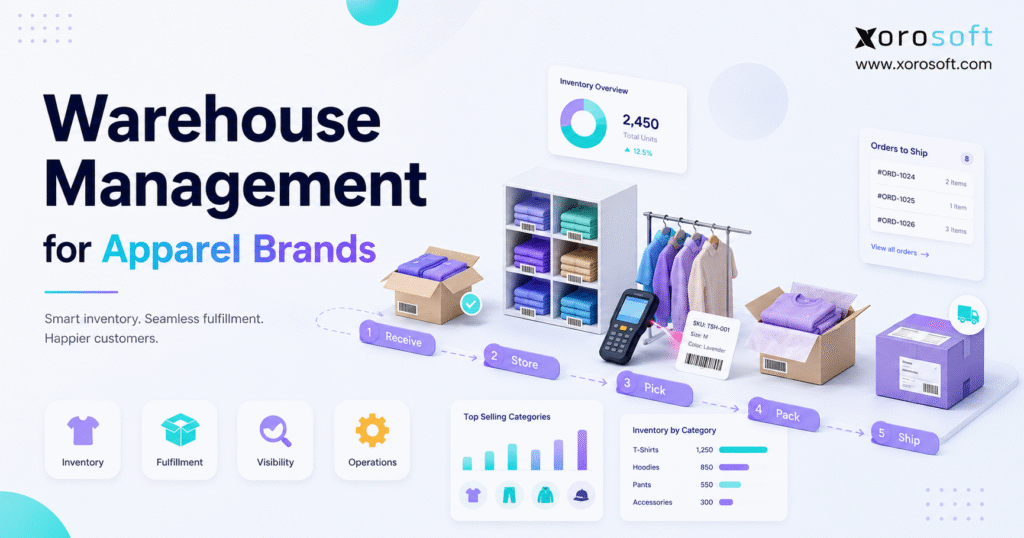
Effective warehouse management for apparel brands is essential to ensure seamless operations and customer satisfaction.
1. Apparel Warehouse Management Starts With Variant-Level Control
Warehouse management for apparel brands is not the same as basic warehouse management. In apparel, every product can multiply into several sizes, colors, fits, collections, and selling channels. Therefore, warehouse teams cannot rely on one simple inventory number. They need accurate control at the exact variant level.
For example, a black hoodie may exist in XS, S, M, L, XL, and XXL. In addition, the same hoodie may sell through Shopify, wholesale, Amazon, retail, and marketplace channels. Because of that, the warehouse must know what is on hand, what is committed, what is available to sell, what is returned, and what is sitting in each warehouse location.
That is why apparel warehouse management needs a more disciplined operating model. It must connect receiving, putaway, picking, packing, shipping, returns, cycle counts, and inventory updates. Otherwise, a small mistake in size or color can quickly become a refund, exchange, reshipment, customer complaint, or financial reconciliation issue.
Shopify also treats size, color, and style as product variant options, which makes variant accuracy especially important for apparel brands selling online. As a result, brands need warehouse workflows that reflect how customers actually buy apparel, not just how products are grouped in a catalog.
2. Why Warehouse Management for Apparel Brands Is More Complex
2.1 Apparel Warehouse Management Has High SKU Complexity
Apparel brands do not only manage products. Instead, they manage product matrices.
One style can include:
- multiple sizes
- multiple colors
- different fits
- seasonal versions
- fabric changes
- regional inventory
- channel-specific availability
Because of this, a product that looks simple on the front end may create dozens or hundreds of warehouse records. Therefore, inventory control must happen at the SKU and variant level.
A warehouse team cannot simply know that “Classic Tee” is in stock. Instead, the team must know whether Classic Tee, black, medium is available in Warehouse A, committed to a Shopify order, reserved for wholesale, or waiting for inspection after a return.
2.2 Fashion Warehouse Management Has Seasonal Pressure
Apparel demand changes quickly. However, warehouse systems often move slower than the market.
For example, a summer collection may need fast receiving in April, high fulfillment speed in May, markdown visibility in July, and clearance planning in August. Meanwhile, the purchasing team may already be buying for the next season. As a result, warehouse accuracy affects merchandising, buying, finance, and customer experience at the same time.
Seasonal pressure also creates cash flow risk. If inventory arrives late, sales opportunities may disappear. If inventory remains unsold, markdowns increase. Therefore, better warehouse management gives apparel brands more time to react before slow-moving inventory becomes dead stock.
2.3 Apparel Warehouse Software Must Handle Similar-Looking Items
Many apparel products look nearly identical in a warehouse. A navy medium shirt and a black medium shirt may sit close together. Similarly, a slim-fit large and regular-fit large may have only a small label difference.
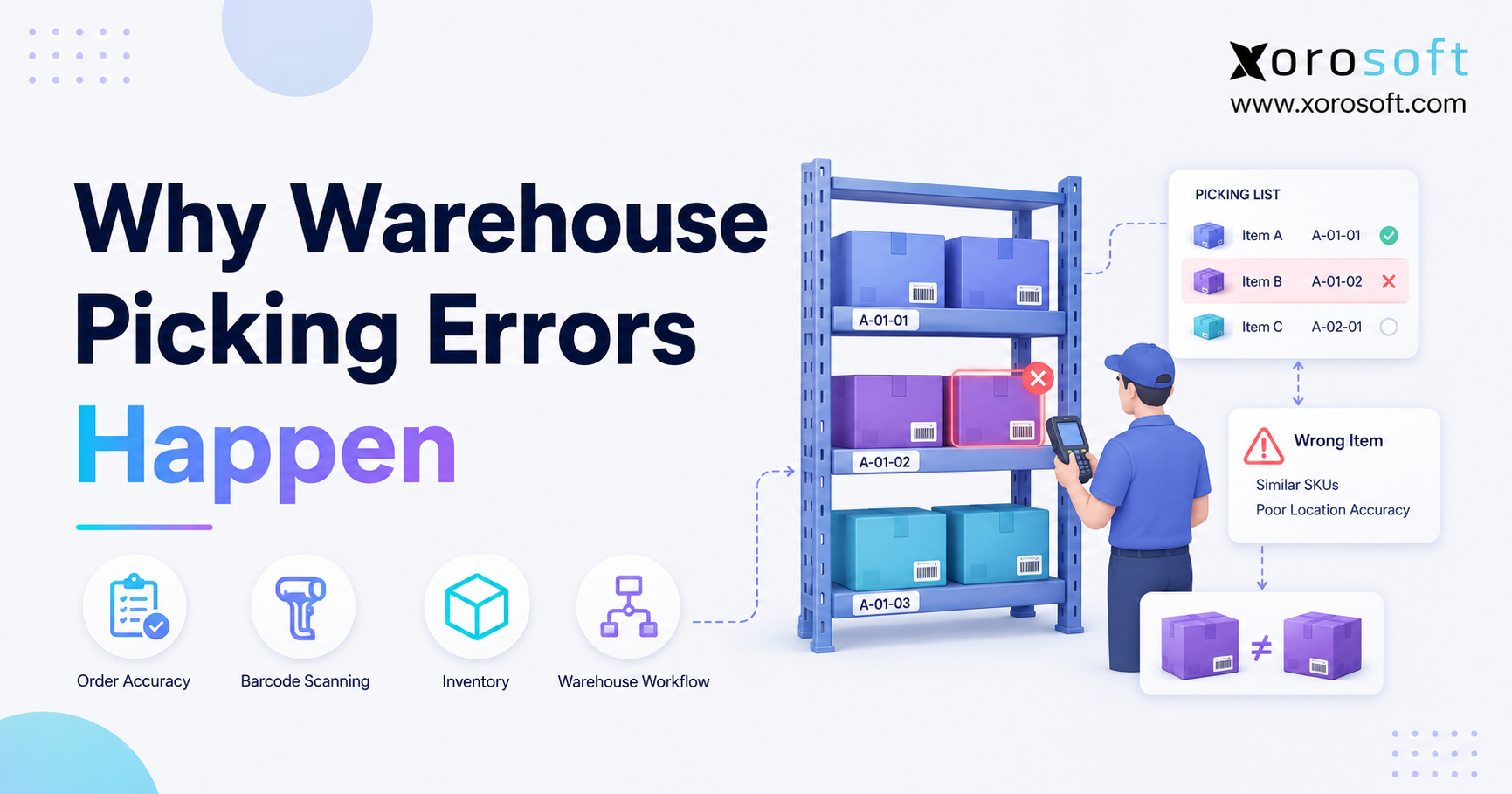
Because of that, visual picking creates risk. Barcode scanning, bin locations, and pick validation reduce that risk because the team confirms the exact SKU before shipment. In addition, mobile warehouse workflows help staff update inventory while work is happening, not hours later from a spreadsheet.
2.4 Clothing Warehouse Management Must Include Returns
Returns are not an exception in apparel. They are part of the operating model.
Customers may return products because of fit, size, color expectation, fabric feel, damage, or preference. Therefore, returned apparel should never go directly back into available inventory without inspection.
A structured returns process should include:
- return receipt
- item inspection
- condition grading
- restock decision
- damaged inventory separation
- inventory update
- refund or exchange workflow
Because returns affect sellable stock, warehouse teams need a clear process for deciding what can go back to shelves and what should stay out of available inventory.
3. Core Warehouse Workflows for Apparel Brands
3.1 Receiving Apparel Inventory From Suppliers
Receiving is the first point where warehouse accuracy can succeed or fail. When apparel inventory arrives, the team should match the shipment against the purchase order. Then, they should verify quantity, SKU, size, color, carton count, and condition.
If receiving is rushed, every later workflow becomes unreliable. For example, the system may show units that never arrived. Alternatively, inventory may sit physically in the warehouse without being available for sale.
A good receiving process should include:
- purchase order matching
- carton-level checks
- SKU and barcode verification
- variant-level quantity checks
- damaged goods separation
- receiving exception notes
- real-time stock updates
As a result, ecommerce, wholesale, and purchasing teams can trust what the warehouse has actually received.
3.2 Putaway and Bin Location Management
After receiving, the warehouse team needs to place inventory into the right location. This step is called putaway.
For apparel brands, putaway should not be random. Instead, fast-moving SKUs should sit closer to pick paths, while seasonal or slow-moving stock can sit farther away. In addition, similar-looking items should not be stored in a way that increases picking mistakes.
Bin-level control helps teams know exactly where every SKU lives. Therefore, warehouse staff can find inventory faster, count it more accurately, and reduce the time spent searching for misplaced products.
3.3 Picking Apparel Orders Accurately
Picking is one of the most important workflows in apparel warehouse management. If the wrong item is picked, the customer sees the mistake immediately.
Apparel brands usually use one or more picking methods:
- single-order picking for complex orders
- batch picking for similar ecommerce orders
- wave picking for larger order groups
- zone picking for larger warehouses
- wholesale picking for bulk orders
However, the method matters less than the control. The system should tell the picker what to pick, where to find it, and how to verify the SKU. Consequently, barcode scanning and mobile validation become essential as order volume increases.
3.4 Packing and Shipping Apparel Orders
Packing is the final quality control point before the order leaves the warehouse. Therefore, the packing station should confirm the right SKU, size, color, quantity, order number, shipping method, and customer details.
In apparel, this step also affects presentation. Packaging, hang tags, inserts, tissue, poly bags, and branded materials may vary by channel or customer. For wholesale, packing may also require carton labels, routing rules, and compliance documents.
As a result, packing workflows should be simple enough for speed but controlled enough for accuracy.
3.5 Cycle Counting for Apparel Inventory Accuracy
Cycle counting helps apparel brands maintain accuracy throughout the year. Instead of waiting for one large annual count, teams count specific SKUs or locations regularly.
A practical cycle counting plan may prioritize:
- fast-moving products
- high-value products
- high-return products
- frequently mispicked products
- seasonal products
- warehouse transfer locations
Because cycle counting catches problems early, it helps teams fix inventory before errors reach customers.
3.6 Returns Processing and Restocking
Returns need their own warehouse workflow. First, the returned item should be received against the order. Next, the item should be inspected. Then, the team should decide whether it is sellable, damaged, repairable, or unsuitable for resale.
If the item is sellable, it should return to the correct bin and become available again. However, if it is damaged or worn, it should move to a separate status. This protects inventory accuracy and prevents poor customer experiences.
4. Essential Features in Apparel Warehouse Management Software
4.1 Apparel WMS With Style-Color-Size Tracking
A strong apparel WMS must track inventory by style, color, size, SKU, barcode, warehouse, and bin. Otherwise, the system may show inventory that is not actually available in the right variant.
For example, a product may have 300 total units across all sizes. However, if the most popular size is sold out, the total number is misleading. Therefore, variant-level visibility is non-negotiable for apparel brands.
4.2 Barcode Scanning for Apparel Warehouse Accuracy
Barcode scanning helps warehouse teams validate products during receiving, picking, packing, transfers, and cycle counts. Because apparel items often look similar, scanning reduces dependence on memory or visual judgment.
In addition, barcode workflows create cleaner inventory history. Managers can see who moved inventory, when it moved, and where it moved. As a result, problem-solving becomes easier when discrepancies appear.
4.3 Real-Time Apparel Inventory Visibility
Real-time inventory visibility helps teams understand what is available now. This matters because apparel inventory can move quickly across Shopify, wholesale, retail, Amazon, and warehouse channels.
If inventory updates lag, overselling becomes more likely. Similarly, if returned items are not restocked quickly, sellable inventory may stay hidden. Therefore, warehouse systems should update stock as work happens.
4.4 Bin Location Management for Clothing Warehouses
Bin location management helps staff find the right products faster. It also supports picking accuracy, cycle counting, replenishment, and returns.
For apparel brands, bin control is especially useful when similar SKUs sit close together. With clear locations, the picker does not rely only on memory. Instead, the system guides the work.
4.5 Multi-Warehouse Inventory Management for Apparel Brands
As apparel brands scale, they often add warehouses, 3PLs, regional locations, or channel-specific stock areas. Consequently, multi-warehouse visibility becomes essential.
A good system should show inventory by:
- warehouse
- bin
- SKU
- size
- color
- available quantity
- committed quantity
- transfer status
- returned status
For brands that need deeper warehouse execution, XoroWMS can be used as an internal link where the article discusses warehouse management software.
4.6 Shopify, Amazon, Wholesale, and EDI Support
Apparel warehouse management software should support different order sources. Shopify orders need speed and real-time inventory. Amazon orders may need channel-specific routing. Wholesale orders need allocation and bulk fulfillment. Meanwhile, EDI orders may require stricter documentation.
Because every channel creates different warehouse requirements, apparel brands should avoid systems that only solve one part of the workflow.
4.7 Returns Management for Apparel Brands
Returns management should support inspection, restocking, quarantine, repair, and write-off workflows. Otherwise, returned products can distort available inventory.
A clean returns workflow helps the warehouse recover sellable stock faster. Moreover, it gives finance a clearer view of inventory value.
4.8 Reporting and Apparel Warehouse KPIs
Warehouse reporting should show more than shipment volume. It should show whether the operation is becoming more accurate, faster, and more efficient.
Important apparel warehouse KPIs include:
- inventory accuracy
- pick accuracy
- order cycle time
- return processing time
- dock-to-stock time
- stockout rate
- aged inventory
- units picked per labor hour
- fulfillment cost per order
Because these KPIs affect cash flow, leadership should review them regularly.
5. Apparel WMS vs ERP for Warehouse Management
5.1 What an Apparel WMS Does
An apparel WMS controls warehouse execution. It helps teams receive goods, assign bin locations, pick orders, pack shipments, process transfers, manage returns, and count inventory.
Therefore, WMS is usually strongest when the core problem is warehouse movement.
5.2 What an Apparel ERP Does
An apparel ERP connects warehouse activity with inventory, purchasing, accounting, forecasting, ecommerce, order management, and reporting.
Because of that, ERP becomes important when warehouse issues affect the wider business. For example, poor receiving can affect available inventory. Then, available inventory affects sales. After that, inventory errors affect purchasing and accounting.
For brands that need a wider operating system, XoroERP is a natural internal link because it connects warehouse workflows with broader inventory-driven operations.
5.3 Where WMS Ends and ERP Begins
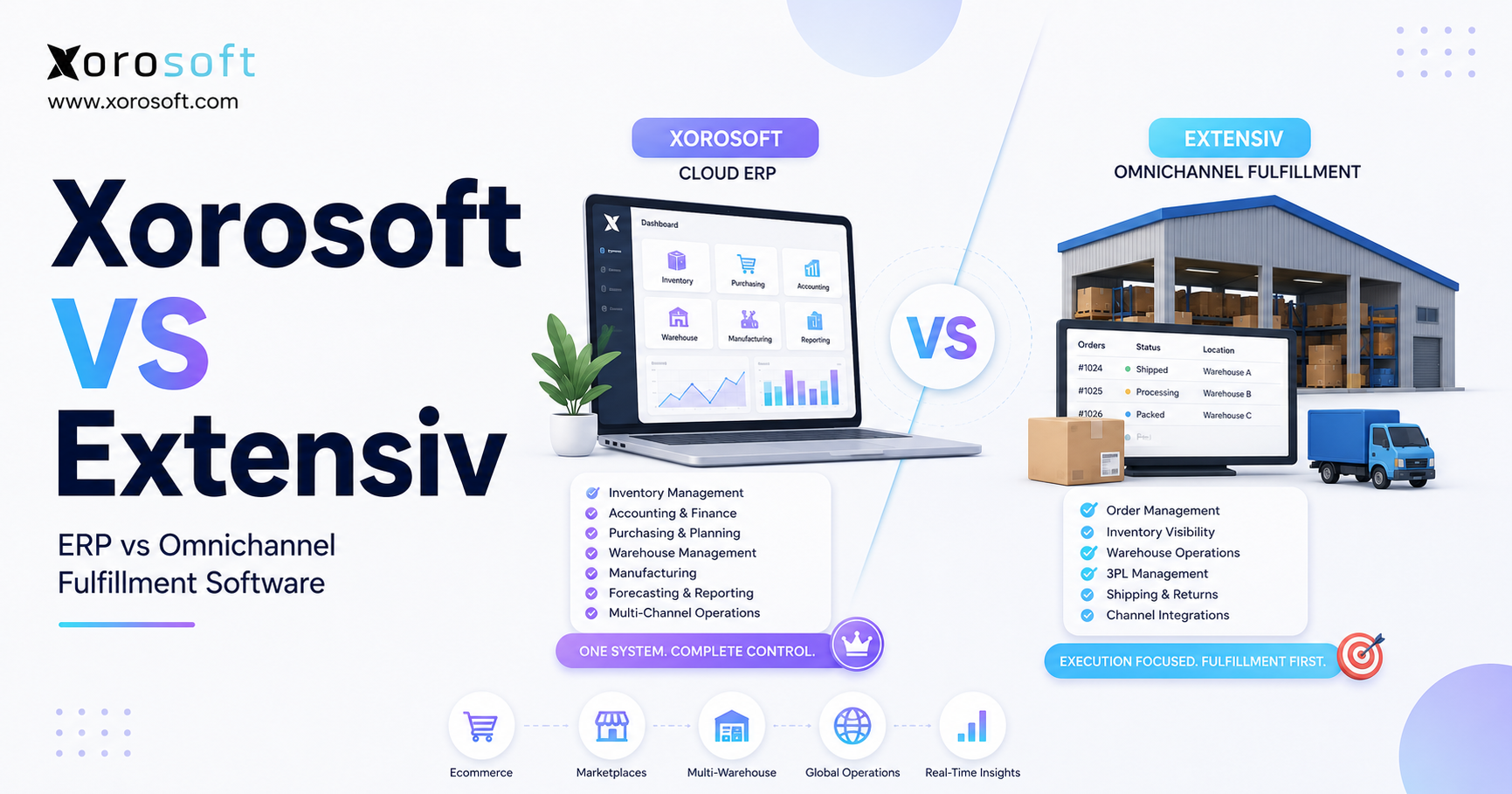
A WMS tells the warehouse how to move goods. However, ERP tells the company how those goods affect sales, purchasing, finance, and planning.
This distinction matters because many apparel brands do not only have a warehouse problem. Instead, they have a connected operations problem. Inventory errors affect purchasing. Purchasing affects cash. Cash affects growth. Therefore, the system should match the real issue.
5.4 Apparel WMS vs Apparel ERP Comparison
| Category | Apparel WMS | Apparel ERP | Best Fit |
|---|---|---|---|
| Receiving | Strong | Strong when warehouse tools are included | Both |
| Putaway and bin control | Strong | Strong when WMS is included | Both |
| Picking and packing | Strong | Strong when WMS is included | Both |
| Inventory planning | Limited | Stronger | ERP |
| Purchasing | Limited | Stronger | ERP |
| Accounting | Usually limited | Built in | ERP |
| Shopify and marketplace operations | Varies | Broader when integrated | ERP |
| Wholesale and EDI | Varies | Broader when integrated | ERP |
| Reporting | Warehouse-focused | Business-wide | ERP |
| Best use case | Warehouse execution | Connected business control | Depends on complexity |
5.5 When Apparel Brands Need Only WMS
An apparel brand may need only WMS when its accounting, inventory planning, purchasing, and ecommerce systems already work well. In that case, the main issue may be warehouse speed, scanning, bins, and picking accuracy.
However, brands should still check integration requirements before choosing standalone WMS. Otherwise, they may improve warehouse execution while creating more disconnected data.
5.6 When Apparel Brands Need ERP With Warehouse Management
An apparel brand may need ERP with warehouse management when warehouse problems affect the rest of the company. For example, wrong inventory counts may cause overselling, poor purchasing, delayed accounting, and unreliable reporting.
In that situation, a cloud ERP platform such as XoroONE can be relevant because it connects inventory, warehouse, purchasing, accounting, ecommerce, and reporting in one operating system.
6. When Apparel Brands Outgrow Spreadsheets and Basic Inventory Apps
6.1 Warning Signs Your Apparel Warehouse Process Is Breaking
Spreadsheets often work in the early stage. However, they become risky when order volume, SKU count, channels, and warehouse activity increase.
Common warning signs include:
- stock numbers do not match physical inventory
- Shopify shows inventory that the warehouse cannot find
- wholesale orders reserve stock manually
- returns sit unprocessed for days
- receiving updates happen late
- warehouse transfers are tracked in spreadsheets
- finance does not trust inventory value
- purchasing decisions rely on outdated reports
When these problems appear repeatedly, the brand has usually outgrown manual warehouse control.
6.2 Why QuickBooks Alone Cannot Control Apparel Warehouses
QuickBooks can support accounting, but it does not replace warehouse management for apparel brands. Apparel operations need barcode scanning, bin locations, variant-level stock, multi-warehouse transfers, returns inspection, picking validation, and real-time channel updates.
Because QuickBooks often sits beside spreadsheets and inventory apps, teams may still duplicate work. For businesses comparing upgrade paths from accounting-first systems, the Xorosoft vs QuickBooks page can be a useful internal resource.
6.3 Why Disconnected Inventory Apps Create Hidden Work
Disconnected apps can solve one immediate issue. However, they can also create new manual work.
For example, the warehouse may update stock in one system. Meanwhile, purchasing works from a spreadsheet. Finance reconciles in another tool. Shopify shows different inventory. As a result, every department has a slightly different version of the truth.
Eventually, the problem is not just software. It becomes operating discipline.
6.4 How Growing Apparel Brands Move Toward Integrated Systems
Growing apparel brands usually move through stages. First, they clean SKU and variant data. Next, they improve warehouse controls with scanning and bins. Then, they connect inventory with purchasing, accounting, ecommerce, wholesale, and reporting.
Because each stage builds on the last, implementation should start with clean data and clear workflows. Otherwise, the new system simply automates messy processes.
7. Apparel Warehouse Management by Sales Channel
7.1 Shopify Apparel Warehouse Management
Shopify apparel brands need accurate product variants, stock levels, and fulfillment workflows. Shopify’s own product setup supports options such as size and color, while inventory can be managed for products and variants.
Therefore, Shopify apparel warehouse management should focus on exact SKU visibility. If the warehouse ships the wrong size or fails to update inventory quickly, customers may buy unavailable products.
For Shopify merchants evaluating ERP-connected operations, the Xorosoft ERP app on the Shopify App Store is a relevant outbound link because it connects the topic to Shopify’s app ecosystem.
7.2 Wholesale Apparel Warehouse Management
Wholesale apparel operations need allocation, case packing, customer-specific rules, and often EDI workflows. Because wholesale customers may order large quantities, one allocation error can create a major fulfillment issue.
For example, a retailer may reserve a full size curve before ecommerce demand arrives. If the warehouse does not separate committed wholesale inventory from ecommerce inventory, overselling becomes likely.
7.3 Amazon and Marketplace Apparel Fulfillment
Amazon and marketplace orders create another layer of complexity. Some inventory may sit in Amazon FBA. Other inventory may stay in the brand’s own warehouse. In addition, marketplace orders may need different routing, service levels, and reporting.
As a result, apparel brands should clearly separate warehouse-owned stock, marketplace stock, and reserved channel inventory.
7.4 Retail and POS Apparel Inventory Visibility
Retail stores create transfer and replenishment requirements. A store may need certain sizes more often than others. Meanwhile, the warehouse may hold excess of another size.
Because of this, warehouse data should support store replenishment, not just ecommerce fulfillment. Better visibility helps brands move inventory before stockouts or markdowns occur.
8. Multi-Warehouse Management for Apparel Brands
8.1 Why Apparel Brands Add Multiple Warehouses
Apparel brands add warehouses for several reasons. They may want faster delivery, lower shipping costs, wholesale separation, regional fulfillment, international expansion, or 3PL support.
However, more warehouses also create more inventory risk. Therefore, multi-warehouse expansion should come with stronger system control.
8.2 Common Multi-Warehouse Apparel Inventory Problems
Multi-warehouse apparel inventory often breaks when teams cannot see stock clearly across locations.
Common problems include:
- one warehouse sells out while another has excess stock
- transfers are shipped but not received in the system
- Shopify inventory does not reflect regional availability
- wholesale inventory is reserved manually
- finance cannot value stock accurately by location
- purchasing does not know where demand is happening
Because of these issues, multi-warehouse visibility should be real time, not spreadsheet-based.
8.3 Transfer Orders and Stock Movement
Transfer orders help brands move inventory between warehouses with control. A transfer should show what left, what is in transit, what arrived, and what remains pending.
Without transfer visibility, teams may count inventory twice or lose track of goods in transit. As a result, sales channels may show stock that is not actually available.
8.4 Regional Fulfillment Strategy
Regional fulfillment can reduce delivery time and shipping cost. However, it works only when inventory sits in the right location.
For example, if most demand for a jacket comes from one region, stock should not sit mainly in another region. Therefore, warehouse reporting should guide transfer and replenishment decisions.
8.5 Real-Time Multi-Warehouse Visibility
Real-time visibility should show stock by SKU, size, color, warehouse, bin, committed quantity, and available quantity. In addition, it should show inventory in transit.
When apparel brands gain this visibility, teams can make better decisions about allocation, purchasing, fulfillment, and markdowns.
9. Apparel Warehouse KPIs Brands Should Track
9.1 Inventory Accuracy
Inventory accuracy measures whether system inventory matches physical inventory. Because apparel has many variants, this KPI should be measured at the SKU level, not only the product level.
If inventory accuracy is low, every department suffers. Sales oversells. Purchasing buys incorrectly. Finance questions valuation. Consequently, warehouse accuracy becomes a company-wide metric.
9.2 Pick Accuracy
Pick accuracy measures whether the warehouse picked the correct item. In apparel, this means the correct style, size, color, and quantity.
A high pick accuracy rate reduces returns, reships, customer support tickets, and margin leakage. Therefore, barcode validation is often one of the first improvements apparel brands make.
9.3 Order Cycle Time
Order cycle time measures how long it takes to move an order from release to shipment. Faster cycle time improves customer experience, especially in ecommerce.
However, speed should not reduce accuracy. Apparel brands need both fast fulfillment and precise variant validation.
9.4 Return Processing Time
Return processing time measures how quickly returned goods are inspected and resolved. Because many apparel returns are sellable after inspection, slow returns processing can hide available stock.
Therefore, faster returns processing improves both customer experience and inventory availability.
9.5 Dock-to-Stock Time
Dock-to-stock time measures how quickly received inventory becomes available to sell. If new inventory sits at receiving for too long, the brand may miss demand even though products are physically in the building.
As a result, receiving speed directly affects revenue.
9.6 Aged Inventory
Aged inventory shows products that have been sitting too long. Apparel brands should track this closely because seasonal value declines over time.
When aged inventory is visible early, teams can transfer, promote, bundle, discount, or liquidate before margins suffer more.
9.7 Fulfillment Cost Per Order
Fulfillment cost per order includes labor, packaging, shipping handling, and warehouse overhead. This KPI helps brands understand how warehouse operations affect margin.
Because apparel returns can increase fulfillment costs, this metric should be reviewed alongside return rate and pick accuracy.
10. Common Apparel Warehouse Management Mistakes
10.1 Managing Apparel Inventory Only at Product Level
Product-level inventory hides the truth. A product may appear available overall, but the key sizes may be sold out.
Therefore, apparel brands should track every variant separately. Otherwise, warehouse and ecommerce teams may make decisions from misleading numbers.
10.2 Ignoring Size and Color Accuracy
Size and color accuracy directly affect customer experience. If a customer orders a medium and receives a large, the order failed even if the product style is correct.
Because of that, warehouse training, labels, scanning, and bin control should all support exact variant picking.
10.3 Using One Inventory Pool Across Every Channel
A single inventory pool can create overselling when Shopify, wholesale, Amazon, and retail all sell from the same stock. Instead, apparel brands should use committed inventory, channel allocation, and safety stock rules.
This is especially important during product launches, promotions, and wholesale shipping windows.
10.4 Skipping Barcode Validation
Manual picking may work at low volume. However, it becomes risky as SKU count grows.
Barcode validation creates a control point during receiving, picking, packing, transfers, and counting. As a result, it helps reduce preventable warehouse errors.
10.5 Treating Returns as an Afterthought
Returns should be designed as a core warehouse workflow. If returned items pile up, sellable inventory remains hidden. If damaged items return to stock, customer complaints increase.
Therefore, returns should have clear statuses, inspection rules, and restocking logic.
10.6 Not Connecting Warehouse Data to Purchasing
Purchasing teams need warehouse data to make better buying decisions. If they cannot see sell-through, stockouts, receiving delays, and aged inventory, they may buy too much or too little.
Consequently, warehouse data should support replenishment planning.
10.7 Not Connecting Warehouse Data to Accounting
Inventory is a financial asset. Because of that, warehouse movements should connect to inventory valuation, landed cost, COGS, and month-end reconciliation.
When warehouse data is disconnected from accounting, finance teams spend more time correcting numbers manually.
10.8 Waiting Too Long to Upgrade Systems
Many apparel brands wait until operational problems become normal. However, that delay makes implementation harder.
It is better to upgrade when the team can still document workflows clearly, clean data properly, and train staff before peak pressure arrives.
11. How to Choose Warehouse Management Software for Apparel Brands
11.1 Start With Apparel Operational Complexity
Before choosing software, apparel brands should map their real complexity.
Important questions include:
- How many SKUs and variants do we manage?
- How many warehouses or 3PLs do we use?
- Which channels sell inventory?
- How often do we process returns?
- Do we sell wholesale or EDI?
- Does purchasing rely on warehouse data?
- Does finance trust inventory valuation?
Because these answers define the system requirements, brands should not start with software demos alone.
11.2 Check Variant-Level Inventory Support
The software must support style, color, size, SKU, barcode, location, and status. In addition, it should show available, committed, on-hand, returned, damaged, and in-transit inventory.
If the system cannot support this level of detail, it may not fit apparel operations.
11.3 Review Warehouse Execution Features
Warehouse execution features should include receiving, putaway, bin locations, picking, packing, shipping, cycle counts, transfers, and returns.
However, features alone are not enough. The system should make these workflows easy for warehouse teams to follow every day.
11.4 Evaluate Ecommerce and Wholesale Integrations
Apparel brands should review integrations for Shopify, Amazon, EDI, wholesale, POS, 3PLs, shipping, and returns. Since channel complexity grows quickly, integration quality matters.
For a broader view of ecommerce, retail, wholesale, and manufacturing coverage, the industries Xorosoft serves page can be used as a relevant internal link.
11.5 Confirm Purchasing and Accounting Integration
Warehouse management should not stop at shipping. It should also connect with purchasing and accounting.
For example, receiving should update purchase orders. Inventory movement should affect valuation. Stockouts should inform replenishment. In addition, landed cost and COGS should connect to finance.
The broader Xorosoft solutions page fits naturally here because it covers operational areas beyond the warehouse.
11.6 Compare Software Carefully, But Only When Relevant
Some apparel brands compare inventory apps, WMS tools, and ERP platforms. However, comparison should come after process mapping.
If the brand is comparing inventory software against broader ERP needs, a relevant resource may be Xorosoft vs Cin7. Still, comparison pages should not dominate this article because the topic is warehouse management for apparel brands, not vendor comparison.
11.7 Look at Implementation Requirements
Implementation should include data cleanup, workflow mapping, user training, barcode setup, integration testing, and reporting validation.
Because apparel SKU data can be messy, implementation planning matters as much as software selection.
12. Apparel Warehouse Software Options
12.1 Spreadsheets
Spreadsheets are flexible and inexpensive. However, they are not real time, and they depend heavily on manual updates.
Therefore, spreadsheets may work for early-stage brands but become risky when SKU count, warehouse activity, and channel volume increase.
12.2 Basic Inventory Apps
Basic inventory apps can improve visibility compared with spreadsheets. However, they may not support deeper warehouse execution, accounting integration, purchasing automation, or multi-warehouse control.
As a result, they can become a temporary fix rather than a long-term operating system.
12.3 Standalone Apparel WMS
Standalone WMS tools can be strong for warehouse execution. They often support bins, scanning, picking, packing, shipping, and cycle counts.
However, brands should check whether the WMS connects cleanly with accounting, purchasing, ecommerce, wholesale, and reporting systems.
12.4 Apparel ERP Software
Apparel ERP software connects warehouse activity with inventory, purchasing, accounting, ecommerce, manufacturing, and reporting.
This option is usually better for brands that need one system of record across multiple departments. However, ERP implementation requires planning, clean data, and team adoption.
12.5 Enterprise ERP
Enterprise ERP platforms can support large and complex businesses. However, they may require more implementation time, budget, and internal resources.
Therefore, growing apparel brands should balance functionality with usability and operational fit.
13. Industry Use Cases for Apparel Warehouse Management
13.1 Ecommerce Apparel Brands
Ecommerce apparel brands need fast fulfillment, accurate Shopify inventory, and strong returns processing. Since customers expect accurate availability and quick delivery, warehouse errors directly affect revenue and reviews.
Therefore, ecommerce brands should prioritize real-time inventory, barcode picking, returns workflows, and order routing.
13.2 Wholesale Fashion Distributors
Wholesale fashion distributors need bulk picking, allocation, EDI support, carton control, and customer-specific fulfillment requirements.
Because wholesale orders can reserve large quantities, allocation rules are essential. Otherwise, ecommerce channels may sell stock that should be reserved for wholesale customers.
13.3 DTC Clothing Brands
DTC clothing brands need accurate pick-pack-ship workflows and strong post-purchase operations. Because returns are common in apparel, DTC brands should also design returns processing as part of the warehouse workflow.
13.4 Footwear and Accessories Brands
Footwear and accessories brands often manage size, style, color, material, and packaging differences. Therefore, they need variant-level tracking and clear bin locations.
In addition, brands with higher SKU complexity should track aged inventory carefully.
13.5 Multi-Brand Apparel Distributors
Multi-brand distributors manage many supplier catalogs, product codes, and seasonal collections. Because each brand may use different naming rules, SKU governance becomes critical.
As a result, clean master data should be part of the warehouse strategy.
13.6 Apparel Brands With Light Manufacturing
Some apparel businesses also manage light manufacturing, alterations, kitting, embroidery, or assembly. In those cases, warehouse management should connect with materials, BOMs, work orders, and finished goods.
Therefore, inventory control must cover both raw materials and sellable apparel products.
14. Implementation Roadmap for Apparel Warehouse Management
14.1 Audit Current Apparel Inventory Data
Start with the data. Review SKUs, variants, barcodes, product names, colors, sizes, suppliers, costs, and warehouse locations.
If the data is inconsistent, the system will produce inconsistent results. Therefore, cleanup should happen before implementation.
14.2 Standardize SKU, Size, Color, and Style Rules
Apparel brands should standardize how SKUs are named and structured. For example, each SKU should clearly represent style, color, and size.
In addition, size naming should stay consistent. “Medium,” “M,” and “Med” should not exist as separate uncontrolled values.
14.3 Define Warehouse Zones, Bins, and Return Areas
A warehouse should have clear zones for receiving, storage, picking, packing, returns, quarantine, damaged goods, and shipping.
Because apparel returns need inspection, the returns area should not mix with sellable stock.
14.4 Map Receiving, Picking, Packing, and Returns
Workflow mapping helps teams understand how work should happen before software is configured.
For each workflow, define:
- who performs the task
- what the system should show
- what barcode scan is required
- what exception process applies
- what inventory update should happen
This makes implementation more practical.
14.5 Train Warehouse Teams on Scanning Workflows
Training is essential. Even strong software fails when teams bypass the process.
Therefore, warehouse teams should understand why scanning matters, how exceptions work, and how inventory updates affect other departments.
14.6 Connect Ecommerce, Purchasing, Accounting, and Reporting
After warehouse workflows are clear, connect the wider operation. Ecommerce needs accurate inventory. Purchasing needs stock and demand data. Accounting needs valuation. Leadership needs reporting.
At this stage, brands that want to see how similar businesses solved operational problems can review Xorosoft case studies for internal proof and implementation context.
14.7 Test Before Full Launch
Testing should include receiving, putaway, picking, packing, returns, transfers, cycle counts, Shopify orders, wholesale orders, and reporting.
Because apparel errors often happen at the variant level, test cases should include similar sizes, colors, and styles.
14.8 Track KPIs After Launch
After launch, track inventory accuracy, pick accuracy, order cycle time, return processing speed, dock-to-stock time, and fulfillment cost.
Then, review results weekly until the warehouse process stabilizes.
15. FAQs About Warehouse Management for Apparel Brands
15.1 What is warehouse management for apparel brands?
Warehouse management for apparel brands is the process of controlling inventory movement from receiving to shipping and returns. It includes bin locations, barcode scanning, picking, packing, cycle counts, transfers, and variant-level inventory. Because apparel products come in sizes, colors, and styles, the system must track exact SKUs rather than only total product quantity.
15.2 Why is apparel warehouse management difficult?
Apparel warehouse management is difficult because one product can become many variants. In addition, apparel demand changes by season, trend, size curve, and sales channel. Returns also add complexity. Therefore, brands need accurate SKU-level control, clear warehouse workflows, and real-time inventory visibility.
15.3 What is apparel WMS software?
Apparel WMS software is warehouse management software built to manage apparel receiving, storage, picking, packing, shipping, returns, and counting. It should support size, color, style, barcode, bin, and warehouse-level tracking. As a result, teams can reduce picking errors and improve fulfillment speed.
15.4 What features should apparel warehouse software include?
Apparel warehouse software should include barcode scanning, bin locations, style-color-size tracking, real-time inventory, multi-warehouse control, Shopify integration, wholesale support, returns management, cycle counting, reporting, and purchasing visibility. However, the right feature set depends on order volume, SKU complexity, and channel mix.
15.5 How do apparel brands track size and color variants?
Apparel brands track size and color variants by giving each variant its own SKU and barcode. Then, they track quantity by warehouse, bin, status, and sales channel. Because customers buy exact sizes and colors, variant-level control is essential for accurate fulfillment.
15.6 How does barcode scanning help apparel warehouses?
Barcode scanning helps apparel warehouses confirm the exact SKU during receiving, picking, packing, transfers, and cycle counts. Since many apparel items look similar, scanning reduces manual errors. In addition, it updates inventory faster and gives managers better visibility into warehouse activity.
15.7 What is style-color-size inventory tracking?
Style-color-size inventory tracking means managing apparel inventory by each exact variant. Instead of seeing only one total number for a product, the brand sees quantity by style, color, and size. Therefore, teams can identify which exact variants are available, low, committed, or out of stock.
15.8 How do apparel brands reduce picking errors?
Apparel brands reduce picking errors through barcode scanning, bin locations, clear labels, pick validation, product images, cycle counts, and packing checks. Additionally, similar SKUs should be separated or clearly marked so warehouse teams do not confuse sizes, colors, or fits.
15.9 How do apparel brands prevent overselling?
Apparel brands prevent overselling by syncing real-time inventory across Shopify, wholesale, Amazon, retail, and warehouse systems. They should also use committed inventory, safety stock, allocation rules, and available-to-sell calculations. As a result, each channel sells from a more accurate stock number.
15.10 How do Shopify apparel brands manage warehouse inventory?
Shopify apparel brands manage warehouse inventory by tracking variants, SKUs, barcodes, quantities, and locations. However, growing brands often need more advanced warehouse or ERP tools when they add multiple warehouses, wholesale, EDI, purchasing, accounting, or complex returns.
15.11 What is the difference between WMS and ERP?
A WMS manages warehouse execution. It controls receiving, bins, picking, packing, shipping, returns, and counts. ERP connects warehouse activity with inventory, purchasing, accounting, forecasting, ecommerce, and reporting. Therefore, WMS improves warehouse control, while ERP improves wider operational control.
15.12 Should apparel brands use ERP or WMS?
Apparel brands should use WMS when the main issue is warehouse execution. However, they should consider ERP when warehouse problems affect purchasing, accounting, ecommerce, wholesale, and reporting. Many scaling brands need ERP with warehouse management rather than a standalone warehouse tool.
15.13 When should apparel brands upgrade from spreadsheets?
Apparel brands should upgrade from spreadsheets when inventory errors, wrong picks, overselling, slow receiving, delayed returns, and multi-warehouse confusion become regular problems. Spreadsheets may work early, but they do not provide reliable real-time control as operations scale.
15.14 How do apparel brands manage returns?
Apparel brands manage returns by receiving returned items, inspecting condition, assigning a status, and deciding whether to restock, repair, quarantine, or write off the item. Because returns affect sellable inventory, the warehouse should update inventory immediately after inspection.
15.15 How do apparel brands manage seasonal inventory?
Apparel brands manage seasonal inventory through forecasting, purchase planning, receiving discipline, sell-through tracking, aged inventory reports, transfers, and markdown planning. Since apparel value can decline after a season, teams should identify slow-moving variants early.
15.16 What KPIs should apparel warehouses track?
Apparel warehouses should track inventory accuracy, pick accuracy, order cycle time, return processing time, dock-to-stock time, stockout rate, aged inventory, fulfillment cost per order, and units picked per labor hour. These KPIs show whether warehouse operations are improving or creating hidden costs.
15.17 What causes inventory discrepancies in apparel warehouses?
Inventory discrepancies usually come from receiving mistakes, wrong picks, missed transfers, unprocessed returns, manual adjustments, poor labeling, and weak cycle counting. In apparel, discrepancies also happen when similar SKUs are stored too closely without barcode validation.
15.18 How do apparel brands manage multiple warehouses?
Apparel brands manage multiple warehouses by tracking stock by location, using transfer orders, setting allocation rules, routing orders by region, and maintaining real-time inventory visibility. In addition, teams should track inventory in transit so stock is not counted incorrectly.
15.19 How does ERP help apparel warehouse operations?
ERP helps apparel warehouse operations by connecting warehouse activity with purchasing, accounting, ecommerce, forecasting, and reporting. Therefore, the business can see how inventory movement affects sales, cash flow, supplier planning, and financial statements.
15.20 What software replaces QuickBooks and spreadsheets for apparel brands?
Cloud ERP often replaces QuickBooks and spreadsheets when apparel brands need connected inventory, warehouse management, purchasing, accounting, ecommerce, forecasting, and reporting. However, some smaller brands may first use inventory apps or standalone WMS before moving to ERP.
15.21 How do apparel wholesalers manage warehouse orders?
Apparel wholesalers manage warehouse orders through allocation, bulk picking, carton control, EDI workflows, customer-specific rules, and shipment documentation. Because wholesale orders often reserve large quantities, inventory allocation must be clear before ecommerce channels consume the same stock.
15.22 How do apparel brands handle EDI orders?
Apparel brands handle EDI orders by receiving electronic purchase orders, allocating inventory, picking goods, preparing shipment documents, sending advance ship notices, and invoicing customers. Since EDI workflows often have strict requirements, accurate warehouse data is essential.
15.23 What is available-to-sell inventory?
Available-to-sell inventory is the stock that can be sold after subtracting committed orders, reserved quantities, damaged goods, safety stock, and unavailable inventory. For apparel brands, this number should be calculated by variant, warehouse, and sales channel.
15.24 How does warehouse management affect cash flow?
Warehouse management affects cash flow because inventory is money sitting on shelves. Poor warehouse control creates overstock, stockouts, markdowns, returns, and inaccurate buying. Better warehouse visibility helps brands buy smarter, fulfill faster, and reduce cash trapped in unsold inventory.
15.25 What is the best warehouse management system for apparel brands?
The best warehouse management system for apparel brands depends on SKU complexity, sales channels, warehouses, returns, purchasing needs, and accounting requirements. Small brands may use inventory apps. However, scaling apparel brands often need WMS or ERP with strong warehouse management.
16. Final Thoughts on Warehouse Management for Apparel Brands
Warehouse management for apparel brands becomes more important as SKUs, channels, warehouses, and return volume increase. At first, warehouse issues may look like small fulfillment mistakes. However, over time, those mistakes affect customer experience, purchasing, cash flow, accounting, and growth.
Because apparel inventory is variant-heavy, brands need more than basic stock tracking. They need real-time visibility by style, color, size, warehouse, bin, channel, and status. In addition, they need warehouse workflows that connect receiving, putaway, picking, packing, shipping, returns, purchasing, and accounting.
For smaller teams, spreadsheets or basic inventory tools may work for a while. However, once the business adds Shopify complexity, wholesale orders, multiple warehouses, EDI, Amazon, or financial reporting pressure, disconnected systems often create more work than they solve.
That is where integrated systems become important. A connected ERP and warehouse management approach helps apparel brands reduce duplicate work, improve inventory accuracy, and create one source of truth across operations.
If your apparel brand is starting to feel the limits of spreadsheets, QuickBooks, inventory apps, or disconnected warehouse tools, the next step is to map your real workflow before choosing software.
You can Book a demo to see how apparel warehouse workflows can connect inventory, purchasing, accounting, Shopify, wholesale, returns, and multi-warehouse operations in one system.