If your goal is to reduce overstock inventory, this article will help you find effective solutions.
1. Revenue Growth Was Hiding a Serious Overstock Problem
To reduce overstock inventory, a business must first recognize that rising stock is not always a sign of healthy growth. In fact, excess inventory can accumulate while revenue increases, warehouses remain busy, and purchase orders continue moving through the business. Meanwhile, cash becomes tighter, storage capacity disappears, and important products still run out.
In this illustrative case, the brand sold consumer products through Shopify, Amazon, wholesale accounts, and EDI customers. In addition, it managed approximately 3,200 active SKUs across three warehouses.
Although sales were increasing, inventory investment was rising much faster. Consequently, the company had more money tied up in products that were selling below plan. At the same time, buyers continued placing urgent orders for several high-demand items.
Initially, management assumed the company needed more stock to support growth. However, a SKU-level review revealed a different problem. Specifically, the business did not have a simple inventory shortage. Instead, it had an inventory allocation, forecasting, and purchasing-control problem.
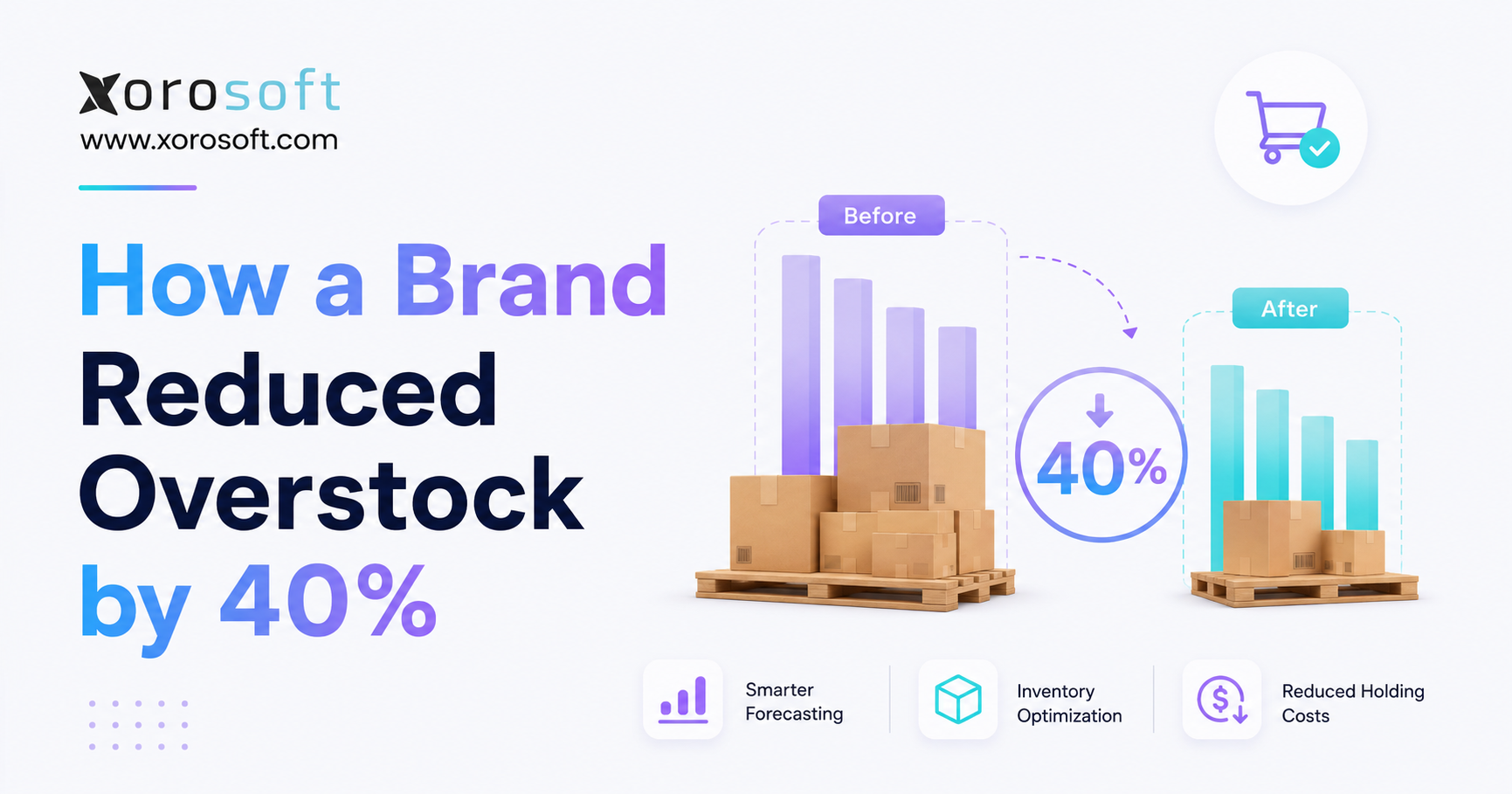
At the start of the project, the brand held approximately $1.25 million in stock that exceeded forecast demand, approved safety stock, and target ending inventory. Nine months later, that figure had fallen to $750,000. Therefore, the company achieved a 40% reduction in excess inventory at cost.
Nevertheless, this article uses an illustrative composite case based on operating patterns commonly found in inventory-driven businesses. Accordingly, the figures explain the overstock reduction method rather than represent a verified result from a named Xorosoft customer.
1.1 Why the Overstock Problem Was Difficult to See
First, the company did not have one report that combined:
- On-hand stock
- Allocated inventory
- Open sales orders
- Open purchase orders
- Inbound shipments
- Warehouse transfers
- Forecast demand
- Channel commitments
- Product status
- Supplier lead times
Instead, each department worked from a different version of the inventory position.
For example, sales focused on customer orders and revenue. Purchasing, by contrast, focused on supplier minimums, lead times, and unit costs. Meanwhile, warehouse teams concentrated on physical quantities. Finally, finance reviewed inventory value after transactions reached accounting.
Consequently, no team could see the complete future inventory position. Moreover, each department made reasonable decisions using incomplete data. As a result, those individual decisions created a company-wide overstock problem.
1.2 What the 40% Reduction Actually Measured
Importantly, the company did not reduce total inventory by 40%. Instead, it reduced stock classified as excess under a consistent SKU-level planning rule.
Starting excess inventory at cost: $1,250,000
Ending excess inventory at cost: $750,000
Total reduction: $500,000
Overstock reduction percentage:
($1,250,000 − $750,000) ÷ $1,250,000 × 100 = 40%
At the same time, management measured stockouts, order fill rate, forecast accuracy, and inventory turnover. Therefore, the result did not come from simply purchasing less and accepting weaker availability.
1.3 Why the Brand Needed to Reduce Overstock Inventory
First, working capital remained tied up in products that were not selling quickly enough. Moreover, warehouse occupancy exceeded comfortable operating levels. As a result, slow-moving products blocked space needed for faster items.
In addition, buyers had less flexibility to respond to new demand. Meanwhile, finance struggled to explain why inventory balances increased faster than revenue. Consequently, markdown, storage, damage, and obsolescence risks continued to rise.
Most importantly, management could not confidently distinguish strategic inventory from avoidable inventory. Therefore, the company needed a structured process to reduce overstock inventory without damaging customer service.
2. What Overstock Inventory Means in a Growing Business
Overstock inventory is stock that exceeds forecast demand, required safety stock, and target ending inventory during a defined planning period. Although the product may still sell eventually, the business owns more than its current demand and supply plan requires.
However, excess inventory cannot be identified with one company-wide rule. For example, a fast-moving product with an unreliable international supplier may require a large buffer. By contrast, a stable product purchased locally may need very little safety stock.
Therefore, the company must evaluate inventory at SKU, location, supplier, and channel level. Otherwise, a broad inventory target may remove necessary stock from important products while leaving excess quantities untouched elsewhere.
2.1 Overstock Versus Safety Stock
Safety stock is intentional inventory. Specifically, it protects the business against forecast error, supplier delays, unexpected demand, and other uncertainty.
Overstock, however, sits above that approved protection level.
For example, suppose forecast demand is 600 units and planned safety stock is 100 units. In that case, a 700-unit supply position may be reasonable. However, if on-hand and inbound inventory total 1,200 units, the additional 500 units require investigation.
Therefore, the objective is not to remove every inventory buffer. Instead, the goal is to remove stock that no longer supports a defined service or risk requirement.
2.2 Overstock Versus Slow-Moving Inventory
Slow-moving inventory has lower sales velocity than expected. Nevertheless, it may still have active and profitable demand.
Overstock, by comparison, describes the quantity above planned need.
As a result, a slow-moving SKU may or may not be overstocked. Specifically, the answer depends on:
- Forecast demand
- Current supply
- Supplier lead time
- Planned safety stock
- Product lifecycle
- Customer commitments
- Margin
- Recovery value
Therefore, planners should avoid classifying every slow-moving item as dead or excess stock without reviewing its operating context.
2.3 Overstock Versus Dead Stock
Dead stock has little realistic demand through normal sales channels. Overstock, however, may still sell, although it will take longer than planned.
Consequently, the required action differs:
- Overstock may require lower purchasing, transfers, or revised replenishment.
- Slow-moving stock may require merchandising or pricing changes.
- Dead stock may require liquidation, supplier return, donation, or write-off.
In other words, inventory classification should guide the response. Otherwise, the business may discount products that only needed a transfer or revised purchasing policy.
2.4 Who Needs an Inventory Reduction Strategy
A structured inventory reduction process becomes more valuable when a business:
- Sells physical products
- Manages hundreds or thousands of SKUs
- Operates multiple warehouses
- Purchases against long lead times
- Buys in case packs or minimum quantities
- Experiences seasonal demand
- Uses several sales channels
- Manufactures or assembles products
- Holds perishable or style-sensitive inventory
- Manages wholesale or EDI commitments
A small business may not need a complex ERP platform. Even so, it still needs accurate counts, open-purchase-order visibility, and consistent reorder rules.
3. How to Calculate and Reduce Overstock Inventory
The brand could not reduce overstock inventory until it created a defensible baseline. Therefore, the project began with data validation rather than a company-wide purchasing freeze.
First, the team defined what qualified as excess inventory. Next, it identified the data needed for each SKU and warehouse. Finally, it applied the same rules across products, buyers, suppliers, and locations.
3.1 Data Required to Reduce Overstock Inventory Accurately
For every SKU and warehouse, the company collected:
- On-hand quantity
- Allocated quantity
- Available quantity
- Confirmed inbound quantity
- Open purchase orders
- Average unit cost
- Historical unit demand
- Forecast demand
- Supplier lead time
- Planned safety stock
- Target ending inventory
- Customer commitments
- Sales-channel commitments
- Product lifecycle status
In addition, the team classified every item as active, new, seasonal, discontinued, or obsolete.
This classification mattered because a newly launched product should not be evaluated using the same rule as a discontinued product. Similarly, a seasonal item nearing the end of its selling window should not receive the same replenishment treatment as an evergreen product.
3.2 A Practical Overstock Inventory Formula
The team used the following planning formula:
Overstock units = On-hand inventory + confirmed inbound inventory − forecast demand during the coverage period − target ending inventory
If the calculation falls below zero, overstock should remain zero rather than become a negative quantity.
For example:
- On-hand inventory: 1,000 units
- Confirmed inbound inventory: 400 units
- Forecast demand: 700 units
- Target ending inventory: 200 units
Therefore:
1,000 + 400 − 700 − 200 = 500 excess units
If the product costs $24 per unit, the company holds:
500 × $24 = $12,000 in excess inventory at cost
Consequently, the formula converts an operational quantity into a financial value that management can prioritize.
3.3 Why Open Purchase Orders Must Be Included
A common inventory-planning mistake is reviewing only on-hand stock.
However, a low on-hand quantity does not always justify another order. For instance, if a large shipment is already confirmed, the future supply position may be excessive.
Therefore, buyers must review:
- Purchase orders already approved
- Orders in production
- Goods in transit
- Supplier delays
- Partial receipts
- Warehouse transfers
- Customer allocations
Otherwise, the business may purchase against yesterday’s stock position rather than tomorrow’s inventory reality.
3.4 Why Company-Wide Inventory Totals Were Misleading
Initially, the company reviewed total stock across all warehouses. However, this approach concealed location imbalances.
For instance, one warehouse could have 1,000 excess units while another location faced a projected shortage of 300 units. Without location-level planning, the company might purchase another 300 units instead of transferring existing stock.
Consequently, the team calculated inventory at three levels:
- SKU by warehouse
- SKU by sales channel
- Consolidated company position
As a result, planners could distinguish a genuine company-wide shortage from a local allocation problem.
3.5 Metrics Used to Confirm Overstock Reduction
The company monitored:
- Excess inventory value
- Inventory turnover
- Days of inventory on hand
- Weeks of supply
- Inventory aged over 90 days
- Inventory aged over 180 days
- Forecast accuracy
- Forecast bias
- Stockout rate
- Order fill rate
- Backorder volume
- Open purchase-order value
- Warehouse occupancy
Moreover, it reviewed these metrics by supplier, buyer, product class, and location.
As a result, management could identify whether overstock came from one supplier, one buyer, one warehouse, or a broader planning issue. In addition, the company could see whether inventory reduction affected availability, margin, or customer service.
4. The Root Causes Behind Excess Inventory
The brand did not have one isolated inventory problem. Instead, several weaknesses reinforced one another.
First, forecasts overstated demand. Next, broad safety-stock rules increased planned supply. Meanwhile, spreadsheets concealed existing commitments. Finally, supplier minimums and warehouse imbalances added even more stock.
4.1 Historical Averages Created Forecast Bias
Planners copied prior-year sales into spreadsheets and added a growth percentage.
However, the process did not consistently remove:
- One-time wholesale orders
- Promotions
- Product launches
- Clearance events
- Lost sales during stockouts
- Discontinued items
- Channel expansion
- Unusual customer projects
Consequently, temporary sales spikes became permanent purchasing assumptions. Moreover, products that had sold strongly during one promotion continued receiving higher forecasts long after the event ended.
4.2 Broad Safety-Stock Rules Increased Surplus Stock
The company applied similar buffers to products with different demand and supply characteristics.
For example, a high-volume product with an unreliable overseas supplier may justify a large buffer. By contrast, a stable local product with a dependable supplier may need much less protection.
Nevertheless, both products often received similar coverage. As a result, stable and low-priority products accumulated unnecessary stock.
4.3 Spreadsheet Purchasing Hid Existing Commitments
Each buyer maintained separate files. Therefore, the purchasing team could not reliably see:
- Orders already placed
- Supplier date changes
- Products in transit
- Warehouse transfers
- Demand revisions
- Another buyer’s changes
- Customer allocations
- Discontinued-product status
Consequently, buyers sometimes reacted to a temporary low quantity while a large inbound shipment was already scheduled. In addition, two buyers could make overlapping decisions for the same supplier or product family.
4.4 Supplier Minimums Encouraged Overbuying
Buyers frequently ordered additional units to reach minimum quantities or price breaks.
Although the unit cost looked lower, the company did not always include:
- Cost of capital
- Storage cost
- Handling cost
- Markdown risk
- Obsolescence
- Damage risk
- Warehouse congestion
Therefore, a lower purchase price sometimes produced a higher total inventory cost. Moreover, the apparent savings disappeared when products required discounting several months later.
4.5 Multi-Warehouse Imbalances Triggered Duplicate Replenishment
One warehouse often held excess inventory while another location requested more stock.
However, the company did not have a reliable transfer recommendation process. Consequently, buyers sometimes issued new purchase orders rather than moving existing inventory.
As a result, total company inventory increased even though the shortage could have been solved internally.
4.6 Channel Demand Was Not Consolidated Correctly
Shopify, Amazon, wholesale, and EDI created different demand patterns.
For example, a large wholesale promotion could distort the direct-to-consumer forecast. Meanwhile, Amazon inventory could remain outside the warehouse report used by a buyer.
Therefore, the brand lacked one demand and supply picture across all channels. In addition, customer commitments were sometimes counted twice or excluded completely.
4.7 Aging Inventory Was Reviewed Too Late
Finance produced aging reports monthly. However, buyers needed weekly alerts.
By the time management discussed a slow-moving product, another order was often in transit. Consequently, the company was reacting after the decision window had closed.
5. Eight Changes That Helped Reduce Overstock Inventory by 40%
The company did not reduce overstock inventory through one forecasting model or one clearance event. Instead, it changed how demand, purchasing, suppliers, warehousing, and finance worked together.
First, it segmented inventory. Next, it corrected forecasts and safety stock. Then, it introduced purchasing controls and warehouse transfers. Finally, it established weekly exception management.
5.1 Segment Inventory Before Cutting It
First, the team grouped products by:
- Annual consumption value
- Sales velocity
- Gross margin
- Demand variability
- Lead time
- Seasonality
- Strategic importance
- Shelf life
- Obsolescence risk
ABC analysis provided a useful starting point. However, annual value alone was not enough.
For example, a low-revenue replacement part could still be operationally important. Similarly, a high-revenue seasonal product could become risky immediately after its selling window closed.
Therefore, each product received a planning policy based on both financial and operational importance. As a result, the company reduced low-priority surplus without exposing critical products to unnecessary shortages.
5.2 Correct Forecasts to Reduce Overstock Inventory
Next, planners rebuilt forecasts at SKU and location level.
Specifically, they removed one-time events, separated promotions, adjusted for stockout periods, and reviewed channel growth independently.
Moreover, they measured both forecast accuracy and forecast bias.
Accuracy showed the size of the error. Bias, by contrast, showed whether the forecast consistently predicted too much or too little demand.
This distinction mattered because persistent overforecasting creates persistent overstock. Therefore, planners investigated products that repeatedly finished below forecast rather than simply updating the average.
5.3 Optimize Safety Stock Instead of Applying Blanket Cuts
The company recalculated buffers using:
- Target service level
- Demand variability
- Lead-time variability
- Supplier reliability
- Product margin
- Substitution options
- Customer importance
- Cost of a stockout
- Cost of holding excess inventory
Consequently, high-priority products retained appropriate protection. Meanwhile, stable products with reliable suppliers received leaner buffers.
Moreover, safety stock became a reviewed planning decision rather than a permanent number copied from an old spreadsheet.
5.4 Update Reorder Points With Future Supply Included
The basic formula was:
Reorder point = Average demand during lead time + safety stock
For example:
- Average daily demand: 20 units
- Supplier lead time: 15 days
- Safety stock: 100 units
Therefore:
20 × 15 + 100 = 400 units
However, the company did not create a purchase order automatically when inventory reached 400 units. Instead, it first checked:
- Confirmed inbound stock
- Open purchase orders
- Warehouse transfers
- Customer allocations
- Supplier delays
- Revised demand
As a result, the reorder point became a review trigger rather than an automatic invitation to buy.
5.5 Add Purchasing Controls and Approval Rules
The purchasing team introduced:
- Suggested order quantities
- Buyer approval thresholds
- Open-PO validation
- Supplier lead-time reviews
- Minimum-order exceptions
- Budget controls
- Cancellation deadlines
- Manual override reasons
In addition, managers reviewed repeated overrides.
Therefore, the company preserved buyer judgment while identifying assumptions that repeatedly produced excess stock. Moreover, approval thresholds focused management attention on financially material orders rather than every routine purchase.
5.6 Rebalance Inventory Before Purchasing More
Before issuing a new order, planners checked whether another warehouse held surplus inventory.
A transfer was preferred when:
- Another location had excess stock
- Transfer cost was lower than a new purchase
- Shelf life allowed the movement
- Regional demand supported the transfer
- Existing customer commitments remained protected
Consequently, the company reduced duplicate replenishment and used inventory it already owned. In addition, warehouse transfers helped reduce delivery time because the stock was already inside the company’s network.
5.7 Create a Recovery Plan for Aging Products
The team ranked recovery actions by expected value:
1. Transfer stock to a stronger-demand location.
2. Allocate products to confirmed customer orders.
3. Bundle slow items with healthy products.
4. Negotiate a supplier return or exchange.
5. Run a targeted promotion.
6. Discount through a suitable channel.
7. Liquidate, donate, or dispose of products when recovery was unrealistic.
Importantly, broad discounting was not the first action. Instead, the company first considered options that protected more margin.
Moreover, every aging product received an owner and a decision date. Therefore, slow-moving stock could not remain unresolved month after month.
5.8 Replace Manual Catalog Reviews With Weekly Exceptions
Finally, the company stopped reviewing every SKU manually.
Instead, the weekly exception report highlighted:
- Products above target weeks of supply
- Forecast bias beyond tolerance
- Purchase orders above planned demand
- Delayed inbound shipments
- Conflicting warehouse positions
- Products entering an aging threshold
- Discontinued products with inbound stock
- High-velocity products at stockout risk
Therefore, planners could manage thousands of SKUs by focusing only on decisions requiring attention. As a result, the team spent less time gathering data and more time correcting risk.
6. How to Reduce Overstock Inventory Without Creating Stockouts
Reducing every SKU by the same percentage would have produced shortages. Therefore, the brand treated product availability as part of the inventory reduction strategy.
First, it protected high-velocity products. Next, it introduced different service targets. In addition, it ordered smaller quantities where possible. Finally, it measured availability beside inventory reduction.
6.1 Protect High-Velocity Products
First, the company identified products that generated significant:
- Sales volume
- Gross margin
- Customer traffic
- Contractual importance
- Cross-selling value
- Operational dependency
These products received stronger service targets and more frequent review.
Meanwhile, low-priority products received leaner replenishment policies. Consequently, the company reduced surplus without exposing its most important revenue lines.
6.2 Set Different Service Levels by Product
The company stopped using one service target for the entire catalog.
Instead, it considered:
- Product importance
- Margin
- Demand volatility
- Supplier reliability
- Lead time
- Substitution options
- Customer commitments
- Cost of a stockout
Consequently, critical products could retain stronger availability without forcing the same buffer onto every SKU. Moreover, planners could explain why each product carried a particular level of protection.
6.3 Use Smaller and More Frequent Purchase Orders
Where suppliers allowed flexibility, buyers reduced order quantities and ordered more frequently.
Although the unit cost occasionally increased, the company gained:
- Lower average stock
- Reduced obsolescence risk
- Better cash flexibility
- Less warehouse pressure
- Faster response to changing demand
Therefore, purchasing decisions were based on total cost rather than invoice price alone. In addition, smaller orders reduced the financial impact when forecasts changed.
6.4 Track Availability Beside Inventory Reduction
The brand reviewed:
- Stockout rate
- Order fill rate
- Backorders
- Late shipments
- Lost sales
- Customer cancellations
Alongside:
- Excess inventory
- Days on hand
- Turnover
- Aging stock
As a result, management could distinguish genuine inventory optimization from underbuying. Moreover, service metrics prevented teams from chasing lower stock at any cost.
7. When Inventory Reduction Requires a Connected ERP System
Spreadsheets did not cause every operational error. However, they could no longer manage the company’s growing transaction volume, locations, channels, and dependencies.
7.1 When a Manual Process Can Still Work
A manual inventory process may remain suitable when a company has:
- Few SKUs
- One warehouse
- Stable demand
- Short lead times
- One buyer
- One sales channel
- Limited accounting complexity
Nevertheless, the risk increases as users, warehouses, suppliers, and channels multiply. Moreover, manual reconciliation consumes more time as transactions increase.
7.2 How XoroONE Supports Overstock Reduction
XoroONE brings inventory, purchasing, accounting, warehouse management, manufacturing, forecasting, reporting, ecommerce, and EDI workflows into one cloud ERP environment.
Therefore, planners can use a shared set of transactions when they calculate future supply.
For example, the same planning process can consider:
- Current inventory
- Customer allocations
- Open sales orders
- Open purchase orders
- Warehouse transfers
- Supplier lead times
- Forecast demand
- Manufacturing requirements
Consequently, buyers are less likely to create another order against an incomplete stock position. In addition, finance and operations can review the same inventory assumptions.
7.3 How XoroERP Connects Inventory With Finance
XoroERP connects inventory decisions with purchasing, accounting, reporting, vendors, warehousing, manufacturing, and workflow automation.
This connection matters because excess inventory is both an operational and financial problem.
For instance, a reduction in finished-goods demand may also affect:
- Raw-material purchases
- Production orders
- Cash forecasts
- Inventory valuation
- Supplier commitments
- Warehouse requirements
Therefore, finance and operations need to work from the same underlying data. Otherwise, operational changes may not appear in cash and valuation reports until much later.
7.4 How XoroWMS Supports Multi-Warehouse Inventory Optimization
A forecast cannot reduce surplus stock when warehouse quantities are unreliable.
XoroWMS supports real-time inventory tracking, receiving, replenishment, barcode scanning, cycle counting, reporting, and multi-warehouse operations.
As a result, planners can distinguish among:
- A real inventory shortage
- A receiving delay
- An inaccurate count
- A warehouse imbalance
- Stock stored in the wrong location
This distinction helps the business avoid buying products it already owns. Moreover, accurate location data supports faster transfers and more reliable fulfillment.
7.5 Shopify Inventory Must Be Viewed Beyond the Storefront
For a Shopify merchant, storefront availability represents only part of the inventory position.
Forecasting may also need:
- Amazon demand
- Wholesale orders
- EDI commitments
- Returns
- Open purchase orders
- Warehouse inventory
- Transfers
- Accounting data
The Xorosoft ERP listing in the Shopify App Store provides an outbound reference for Shopify-related integration capabilities.
Therefore, the operating system behind Shopify must extend beyond the storefront when the business manages multiple channels and locations. Otherwise, replenishment decisions may reflect only one part of demand.
8. Results From the Excess Inventory Reduction Plan
The following figures remain illustrative. Therefore, they should be replaced with verified customer reports before publication as a real case study. Nevertheless, the results show how disciplined forecasting, purchasing controls, and warehouse planning can reduce overstock inventory while protecting product availability.
8.1 Inventory and Forecasting Improvements
The company achieved the following changes:
- Excess inventory at cost declined from $1.25 million to $750,000.
- Inventory turnover improved from 2.8 to 3.7.
- Days of inventory on hand declined from 130 to 98.
- Inventory aged over 180 days fell from $410,000 to $220,000.
- Forecast accuracy improved from 58% to 74%.
- Open purchase-order value above plan fell from $640,000 to $210,000.
Consequently, the business released working capital while improving the quality of its planning data. Moreover, the lower inventory position gave buyers more flexibility to respond to new demand.
8.2 Service and Warehouse Improvements
At the same time:
- Stockout rate improved from 7.4% to 6.8%.
- Order fill rate improved from 92.6% to 93.2%.
- Warehouse occupancy declined from 92% to 79%.
- Emergency purchases became less frequent.
- Planners spent less time rebuilding reports.
- Warehouse teams handled fewer slow-moving products.
Therefore, the company improved both working capital and service performance. In addition, warehouse teams could store and pick faster-moving products more efficiently.
8.3 What Produced the Largest Reduction
The largest contributions came from:
- Canceling unnecessary purchase orders
- Reducing oversized inbound orders
- Correcting overforecasting
- Rebalancing inventory between warehouses
- Lowering safety stock on stable products
- Blocking purchases for discontinued items
- Acting earlier on aging inventory
- Using SKU-level replenishment rules
No single software feature produced the result. Instead, better data, policy, ownership, and execution worked together.
9. Overstock Reduction Strategies by Industry
The core process remains consistent. However, inventory policies must reflect each industry’s economics, product lifecycle, and service requirements.
9.1 Apparel and Fashion Overstock Reduction
Apparel brands must forecast by:
- Style
- Color
- Size
- Collection
- Channel
- Season
- Return rate
Although overall sales may look healthy, excess inventory can remain hidden in unpopular sizes or colors.
Therefore, apparel operators should use:
- Size-curve planning
- Variant-level aging
- Collection end dates
- Markdown timing
- Return assumptions
- Channel-level demand
Moreover, seasonal purchasing should stop early enough to prevent late receipts from arriving after the strongest selling period.
9.2 Furniture Inventory Optimization
Furniture companies face:
- Long supplier lead times
- High unit values
- Large storage requirements
- Regional demand differences
- Container-order commitments
Consequently, operators should separate:
- Display stock
- Customer special orders
- Regional replenishment
- Imported inventory
- Standard stocked products
In addition, planners should compare the cost of holding a full container with the benefit of the lower freight or unit price.
9.3 Sporting-Goods Overstock Prevention
Sporting-goods demand often changes by season, geography, team activity, weather, and product launch.
Therefore, annual averages can easily create excess stock.
Instead, planners should use:
- Regional forecasts
- Seasonal end dates
- Launch-specific assumptions
- Channel-specific demand
- Planned exit strategies
Moreover, inventory should be reviewed before the seasonal peak ends rather than after demand has already declined.
9.4 Food and Beverage Excess Inventory Control
Food businesses must consider:
- Shelf life
- Expiration dates
- Lot numbers
- Minimum remaining life
- FEFO allocation
- Supplier lead times
- Promotional periods
Consequently, overstock should be calculated against expected consumption before expiration rather than total unit demand alone.
In addition, aging alerts should provide enough time to transfer, promote, or return products before their value declines sharply.
9.5 Wholesale Distribution Inventory Reduction
Wholesale demand can include:
- Recurring customer orders
- One-time projects
- Promotions
- EDI schedules
- Contract commitments
- Customer-specific products
Therefore, one large customer order should not automatically become a permanent forecast assumption.
Xorosoft’s industry solutions cover distribution, apparel, manufacturing, food and beverage, sporting goods, and other inventory-driven operating models.
Moreover, wholesale planners should distinguish firm customer commitments from general forecast demand.
9.6 Manufacturing Inventory Optimization
Manufacturers must plan:
- Finished goods
- Raw materials
- Work in process
- Bills of materials
- Production orders
- Scrap
- Lead times
- Capacity
Otherwise, lower finished-goods demand may still leave unnecessary component orders in place.
Therefore, overstock reduction must connect finished-goods forecasting with material requirements and production planning. In addition, work orders should be reviewed before more components are purchased.
10. Mistakes That Prevent Businesses From Reducing Excess Inventory
10.1 Applying One Target to Every SKU
One weeks-of-supply target ignores differences in demand, margin, lead time, and service risk.
Therefore, products should be segmented before inventory policies are changed. Otherwise, the business may remove essential stock from important SKUs while leaving low-priority surplus untouched.
10.2 Cutting Purchases Without Reviewing Inbound Supply
A purchasing freeze may protect cash temporarily. However, it may also create future shortages.
Instead, orders should be changed by SKU, supplier, and warehouse after reviewing existing commitments. Moreover, confirmed inbound quantities should be included before any decision is approved.
10.3 Ignoring Forecast Bias
A forecast may appear reasonably accurate while consistently predicting too much demand.
Consequently, both accuracy and bias must be measured. Otherwise, planners may continue overbuying because the average error appears acceptable.
10.4 Planning With Revenue Instead of Units
Price increases can make revenue appear to grow even when unit demand declines.
Therefore, planners should forecast units first and calculate revenue afterward. In addition, promotional and full-price sales should be separated when their demand patterns differ.
10.5 Treating Warehouses as One Inventory Pool
Company-wide stock may look balanced while individual warehouses remain overstocked or understocked.
As a result, planning should occur by location before consolidation. Moreover, transfer options should be reviewed before new purchase orders are released.
10.6 Purchasing Only for Supplier Discounts
A lower unit price does not guarantee a lower total cost.
Therefore, buyers should include:
- Financing
- Storage
- Handling
- Markdown risk
- Obsolescence
- Working-capital impact
Otherwise, the business may save a small amount on unit cost while losing much more through carrying and clearance expenses.
10.7 Installing Software Without Assigning Ownership
Technology cannot decide who:
- Approves a forecast override
- Cancels a purchase order
- Reviews aging stock
- Negotiates supplier minimums
- Approves a warehouse transfer
Consequently, ownership and approval rules must be defined before automation. Moreover, teams need a consistent review schedule so exceptions do not remain unresolved.
11. How to Choose an ERP for Inventory Optimization
A software upgrade should address specific operating failures rather than simply replace an older system.
11.1 Signs the Current Process Has Reached Its Limit
Consider an upgrade when:
- Inventory and accounting require frequent reconciliation.
- Purchasing depends on several spreadsheets.
- Available inventory cannot be trusted.
- Buyers cannot see open commitments.
- Warehouse transfers require manual research.
- Shopify, Amazon, wholesale, and EDI remain disconnected.
- Month-end inventory valuation takes too long.
- Overstock and stockouts occur simultaneously.
- Reporting depends on repeated exports.
Moreover, an upgrade becomes more urgent when these problems affect working capital, customer service, or financial reporting.
11.2 Inventory Software Versus ERP
Inventory software may remain enough for a straightforward company.
However, ERP becomes more relevant when inventory decisions depend on:
- Accounting
- Manufacturing
- Procurement
- Warehousing
- Ecommerce
- EDI
- Financial reporting
- Multi-company operations
Therefore, the decision should be based on workflow complexity rather than company size alone.
11.3 Comparing Xorosoft and NetSuite
ERP comparisons should examine:
- Workflow fit
- Implementation scope
- Internal resources
- Ownership cost
- Reporting requirements
- Warehouse complexity
- Manufacturing needs
- Ecommerce integration
- Accounting requirements
The Xorosoft versus NetSuite comparison provides Xorosoft’s perspective on how the platforms differ.
However, buyers should also review official product documentation, references, demonstrations, and implementation requirements before deciding. Moreover, each vendor should demonstrate the company’s actual workflows rather than generic features.
11.4 Questions to Ask During an ERP Demonstration
Ask the vendor to show:
- How available inventory is calculated
- How inbound stock affects purchasing
- How safety stock is maintained
- How reorder points are updated
- How inventory is planned by location
- How transfers are recommended
- How Shopify and Amazon demand are combined
- How wholesale and EDI commitments are handled
- How inventory valuation reaches accounting
- How forecast overrides are approved
- How aging inventory is reported
- How manufacturing demand affects components
Therefore, the demonstration should use the company’s real workflows rather than a generic feature tour. In addition, the vendor should explain how exceptions, approvals, and manual overrides are handled.
12. A 90-Day Plan to Reduce Overstock Inventory
Businesses that want to reduce overstock inventory should begin by preventing new excess purchases before attempting to clear every aging product. Therefore, the first 90 days should focus on data accuracy, purchasing controls, forecast quality, and clear process ownership.
12.1 Days 1–30: Establish the Baseline
First, complete these actions:
- Validate inventory quantities and unit costs.
- Define overstock at SKU level.
- Segment active, seasonal, new, and discontinued products.
- Review every open purchase order.
- Identify products aged over 90, 180, and 365 days.
- Measure forecast accuracy and bias.
- Compare inventory across warehouses.
- Assign process owners.
Primary deliverable:
A verified excess-inventory baseline.
Moreover, every calculation should use the same planning period and inventory definition.
12.2 Days 31–60: Correct Forecasting and Purchasing
Next, complete these actions:
- Rebuild forecasts for priority products.
- Recalculate safety stock.
- Update reorder points.
- Reduce or cancel unnecessary purchase orders.
- Review supplier minimums.
- Add purchasing approval thresholds.
- Create warehouse transfer rules.
- Assign aging-stock actions.
Primary deliverable:
A controlled replenishment plan.
In addition, the company should document every manual override so managers can identify repeated assumptions.
12.3 Days 61–90: Stabilize the Inventory Process
Finally, complete these actions:
- Launch weekly inventory exceptions.
- Track availability beside inventory reduction.
- Monitor forecast overrides.
- Review supplier performance.
- Transfer excess inventory.
- Execute recovery plans.
- Publish KPI ownership.
- Hold monthly inventory reviews.
Primary deliverable:
A repeatable process that prevents new overstock while existing excess stock is reduced.
Consequently, the business moves from a one-time cleanup project to a permanent inventory-management discipline.
13. Questions About How to Reduce Overstock Inventory
13.1 What Is Overstock Inventory?
Overstock inventory is stock above expected demand, planned safety stock, and target ending inventory for a defined period. Although the product may still sell, the business owns more than its current demand and supply plan requires. Consequently, it creates avoidable working-capital, storage, markdown, and obsolescence risk.
13.2 What Causes Overstock Inventory?
Common causes include inflated forecasts, excessive safety stock, supplier minimums, duplicate purchases, long lead times, inaccurate counts, seasonal buying errors, fragmented channel data, and slow action on aging products. In addition, disconnected purchasing files often hide inbound inventory and existing commitments.
13.3 How Do You Calculate Overstock Inventory?
First, add on-hand inventory and confirmed inbound supply. Next, subtract forecast demand and target ending inventory. Finally, multiply the excess units by unit cost to estimate the capital tied up in overstock. However, the company must use a consistent planning period and stock policy.
13.4 How Can a Business Reduce Overstock Inventory?
A business can reduce overstock inventory by defining excess stock at SKU level, segmenting products, correcting forecasts, recalculating safety stock, updating reorder points, controlling purchasing, transferring inventory between warehouses, and acting earlier on aging products. Moreover, weekly exception reports help prevent the problem from returning.
13.5 How Can Inventory Be Reduced Without Creating Stockouts?
First, protect high-velocity and high-impact products. Next, set service levels by SKU rather than applying one target to the full catalog. In addition, include supplier variability and inbound stock in the plan. Finally, measure fill rate and stockouts beside the inventory reduction.
13.6 What Is the Difference Between Overstock and Safety Stock?
Safety stock is an intentional buffer used to protect the business against uncertainty. Overstock, by contrast, exceeds that planned buffer. Therefore, safety stock supports a service objective, while overstock usually reflects excessive purchasing, slower demand, outdated assumptions, or an inventory imbalance.
13.7 What Is the Difference Between Overstock and Dead Stock?
Overstock may still sell through normal demand, although more slowly than planned. Dead stock has little realistic demand. Consequently, overstock may require purchasing or transfer changes, while dead stock often requires liquidation, supplier return, donation, or write-off.
13.8 How Does Forecasting Reduce Excess Inventory?
Forecasting estimates future unit demand by SKU, location, channel, and period. Therefore, buyers can align purchase quantities with expected consumption rather than relying on intuition or simple historical averages. Moreover, forecast-bias analysis helps identify repeated overforecasting.
13.9 What Is Forecast Bias?
Forecast bias shows whether a forecast consistently predicts too much or too little demand. For example, a forecast can have acceptable average accuracy while still overestimating demand in most periods. Consequently, persistent positive bias can produce ongoing overstock.
13.10 How Do Reorder Points Prevent Overstocking?
A reorder point creates a controlled trigger based on expected lead-time demand and safety stock. However, the buyer must also review inbound inventory, open purchase orders, transfers, and customer commitments. Therefore, the trigger should initiate a review rather than create an order automatically.
13.11 Can Excessive Safety Stock Create Overstock?
Yes. Safety stock becomes excessive when the buffer is larger than the product’s actual demand and supply uncertainty. Therefore, buffers should vary by supplier reliability, lead time, demand volatility, margin, service target, and stockout impact.
13.12 Which KPIs Reveal Excess Inventory?
Useful measures include excess inventory value, weeks of supply, inventory turnover, days on hand, aging stock, sell-through rate, forecast accuracy, forecast bias, and open purchase-order value. However, stockout rate and fill rate should also be reviewed so the company does not reduce service.
13.13 What Is a Healthy Inventory Turnover Ratio?
A healthy turnover ratio depends on the industry, lead time, margin, seasonality, and service model. Therefore, a furniture company should not use the same benchmark as a food distributor. The company’s trend and economics usually provide more value than one universal target.
13.14 How Can Inventory Turnover Be Improved?
Inventory turnover can improve through better forecasts, smaller order quantities, shorter replenishment cycles, warehouse transfers, updated safety stock, and earlier action on aging products. Nevertheless, turnover should not be improved by allowing important products to remain out of stock.
13.15 Should a Business Discount Excess Inventory?
Discounting may be appropriate when the expected recovery exceeds the cost of holding the product longer. However, transfers, bundles, supplier returns, and targeted offers may recover more margin. Therefore, broad clearance should not automatically become the first response.
13.16 Can Inventory Be Transferred Between Warehouses?
Yes. A transfer can reduce surplus in one location and prevent a shortage elsewhere. However, the company should compare transfer cost, delivery time, shelf life, local demand, and customer commitments before moving stock.
13.17 How Do Supplier Minimums Cause Excess Stock?
Supplier minimums can force buyers to purchase more units than forecast demand requires. Although the unit price may fall, financing, storage, handling, markdown, and obsolescence costs may rise. Therefore, total inventory cost matters more than unit price alone.
13.18 How Does Purchase-Order Automation Prevent Overbuying?
Purchase-order automation can combine demand, on-hand inventory, inbound supply, lead time, safety stock, and approval rules. Consequently, buyers receive a calculated recommendation rather than rebuilding the same analysis manually. However, clean data and controlled overrides remain necessary.
13.19 How Can Shopify Brands Reduce Overstock Inventory?
Shopify brands can reduce overstock inventory by combining storefront demand with returns, Amazon sales, wholesale commitments, EDI orders, purchase orders, warehouse stock, and transfers. Otherwise, the buying plan may reflect only one part of the company’s actual demand and supply position.
13.20 How Can Wholesale Distributors Reduce Excess Inventory?
Wholesale distributors should separate recurring customer demand from one-time projects and promotions. In addition, they should include EDI commitments, supplier minimums, customer allocations, and warehouse-level demand. Therefore, one large order does not become a permanent purchasing assumption.
13.21 How Can Manufacturers Reduce Raw-Material Overstock?
Manufacturers should connect component purchasing with bills of materials, production plans, work orders, scrap assumptions, and finished-goods forecasts. Otherwise, lower finished-goods demand may not stop unnecessary raw-material purchases.
13.22 Can ERP Software Reduce Overstock Inventory?
ERP software can help reduce overstock inventory by connecting forecasting, purchasing, inventory, warehousing, accounting, manufacturing, and reporting. However, software does not guarantee a specific result. The company still needs clean data, clear policies, supplier management, and accountable owners.
13.23 Is Inventory Management Software Enough?
Inventory software may be enough for a simple company with limited accounting and warehouse complexity. However, ERP becomes more relevant when inventory decisions depend on finance, manufacturing, ecommerce, EDI, procurement, and multi-location data.
13.24 When Should a Business Replace Inventory Spreadsheets?
A business should consider replacing spreadsheets when multiple users maintain conflicting files, inbound commitments remain unclear, warehouse balances cannot be trusted, and every report requires manual reconciliation. Moreover, repeated overstock and stockouts often indicate that operating complexity has exceeded the spreadsheet process.
13.25 How Long Does Overstock Reduction Take?
New purchasing controls can improve within weeks. However, existing surplus may take months to transfer, sell, return, or liquidate. Therefore, prevention usually improves faster than complete inventory recovery.
14. Make Overstock Reduction a Permanent Operating Discipline
A 40% overstock reduction does not come from purchasing 40% less across the board. Instead, it comes from making more precise decisions at the SKU, supplier, channel, and warehouse level.
Therefore, the practical sequence is:
1. Define excess inventory consistently.
2. Validate on-hand, allocated, and inbound quantities.
3. Measure demand and forecast bias by SKU and location.
4. Set safety stock according to actual service risk.
5. Include open purchase orders before replenishing.
6. Transfer stock before purchasing more.
7. Act on aging products before recovery value disappears.
8. Review weekly exceptions instead of rebuilding reports manually.
For a small catalog, disciplined spreadsheets may still support this process. However, a growing Shopify, Amazon, wholesale, EDI, multi-warehouse, or manufacturing company may need inventory, purchasing, warehousing, accounting, and forecasting to share one operational record.
Xorosoft provides cloud ERP and warehouse-management options for inventory-driven companies that need that connection.
Therefore, the next step should not be a generic feature demonstration. Instead, it should be a requirements-led review of:
- SKUs
- Warehouses
- Sales channels
- Supplier lead times
- Purchasing policies
- Accounting workflows
- Manufacturing needs
- Reporting gaps
- Forecasting requirements
Contact Xorosoft to review where excess inventory is entering the operation and which process, planning, or system changes should be prioritized first.
Ultimately, the objective is not to promise that every company will achieve the same 40% result. Rather, the objective is to build a controlled inventory model that protects cash, product availability, warehouse capacity, and future growth.