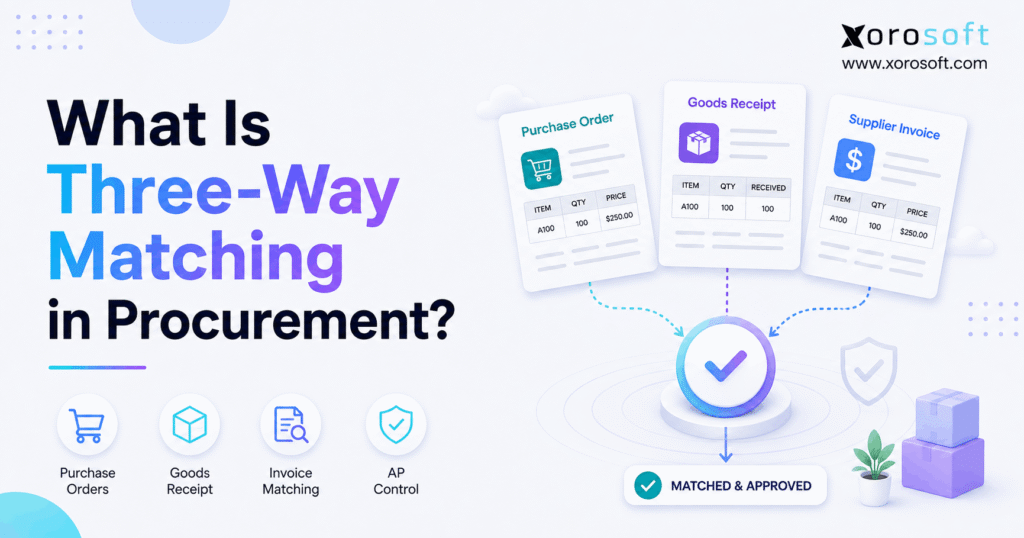
Three-way matching in procurement is an essential process for ensuring accuracy and compliance in business transactions.
1. Before You Pay the Invoice, Verify the Full Story
Three-way matching in procurement gives a business a simple but strong way to check a supplier invoice before payment. Instead of trusting the invoice alone, the team compares the purchase order, the goods receipt, and the supplier invoice. As a result, the business can confirm what it ordered, what actually arrived, and what the supplier wants to charge.
For growing companies, that check matters more than it may seem. At first, a buyer may know every supplier and every open order. However, as order volume rises, that level of personal knowledge disappears. More buyers place orders, more warehouses receive goods, and more invoices reach accounts payable. Therefore, a small mistake can move through several teams before anyone spots it.
For example, a company may order 500 units but receive only 450. Meanwhile, the supplier may invoice all 500. If accounts payable checks only the invoice and purchase order, the invoice may look correct. However, the receipt tells a different story.
That is why three-way matching in procurement links the financial side of purchasing with the physical flow of goods. It does not make every transaction perfect. Instead, it gives teams a clear control point before cash leaves the business.
This guide explains how the process works, what teams should compare, which errors cause exceptions, how partial deliveries affect matching, and when automation becomes useful.
2. What Three-Way Matching in Procurement Actually Checks
Three-way matching in procurement compares three records that come from different stages of a purchase.
| Record | What It Shows | Main Owner |
|---|---|---|
| Purchase Order | What the business agreed to buy | Purchasing |
| Goods Receipt | What the business actually received | Warehouse or Receiving |
| Supplier Invoice | What the supplier wants to be paid | Supplier / Accounts Payable |
Together, these records create a simple control chain.
2.1 Purchase Order: What Did We Agree to Buy?
First, the purchase order records the approved purchase.
Usually, it contains:
- Supplier name
- Item or SKU
- Ordered quantity
- Unit price
- Currency
- Delivery location
- Payment terms
- Freight terms
- Discounts
- Expected delivery date
Therefore, the PO becomes the starting point for the match.
However, a purchase order only proves that the business authorized the purchase. It does not prove that the supplier delivered the goods.
2.2 Goods Receipt: What Actually Arrived?
Next, the warehouse records what arrived.
A receiving record may include:
- PO number
- Item
- Quantity received
- Warehouse
- Receipt date
- Lot or serial details
- Damaged quantity
- Rejected quantity
- Backordered quantity
Therefore, the receipt connects the buying decision to the physical stock movement.
For inventory-based companies, this step is essential. If the warehouse receives 80 units from a 100-unit order, accounts payable needs to know that before approving an invoice for 100.
2.3 Supplier Invoice: What Are We Being Charged?
Finally, the supplier sends the invoice.
Accounts payable then checks fields such as:
- Item
- Quantity
- Unit price
- Total
- Tax
- Freight
- Discount
- PO reference
Therefore, three-way matching in procurement does not treat the invoice as the only source of truth. Instead, the business checks the invoice against records created before and during delivery.
3. Why Three-Way Matching in Procurement Matters
Three-way matching in procurement matters because purchasing errors can affect cash, stock, supplier records, and financial reports at the same time.
3.1 It Helps Stop Wrong Payments
For example, assume a buyer orders 200 units at $15 each. However, the supplier invoices those units at $16 each.
Without a match, accounts payable may approve the higher amount.
With a match, the price difference becomes visible before payment.
Therefore, the process gives the team a chance to fix the issue rather than recover money later.
3.2 It Checks Whether Goods Arrived
A PO proves intent to buy. However, it does not prove receipt.
Suppose the company orders 100 units but receives only 70. If the supplier invoices 100, the receipt becomes the key control.
As a result, the business can hold or review the unsupported amount.
3.3 It Creates Clear Team Roles
Purchasing decides what to order. Meanwhile, the warehouse confirms what arrived. Accounts payable checks what the supplier billed.
Therefore, no single record controls the whole decision.
This separation also makes it easier to find the source of an error. For example, the invoice may be wrong, but the problem may also come from a late receipt or an incorrect PO.
4. How Three-Way Matching in Procurement Works Step by Step
Three-way matching in procurement follows the same basic flow as the purchase itself.
4.1 Step 1: Create and Approve the Purchase Order
First, the buyer creates the PO.
The PO should contain the correct supplier, items, quantities, prices, and terms. Therefore, buyers should fix errors before they send the order.
A poor PO creates poor matching results later.
4.2 Step 2: Receive the Goods
Next, the shipment reaches the warehouse.
The receiving team counts the goods and checks the shipment against the PO. In addition, the team may note damage, shortages, wrong items, or extra items.
4.3 Step 3: Record the Receipt
After the physical check, the warehouse records the receipt.
This step is critical. If the goods arrive but nobody records them, accounts payable may see an invoice with no matching receipt.
Therefore, fast and accurate receiving helps the entire finance process.
For businesses that need more control over inbound stock, a connected warehouse management system can help keep receiving and inventory activity in the same operating flow.
4.4 Step 4: Receive the Supplier Invoice
Next, the supplier sends the invoice.
The invoice should reference the correct PO and show the items, quantities, prices, taxes, and other charges.
4.5 Step 5: Compare the Three Records
Now, the company compares:
Purchase Order → Goods Receipt → Supplier Invoice
If the data matches, the invoice can move forward.
However, if the records differ, the system or employee creates an exception.
4.6 Step 6: Review the Exception
For example, the PO may show 100 units, the receipt may show 80, and the invoice may show 100.
Therefore, the team needs to find out why the 20-unit difference exists.
Perhaps those units remain in transit. Alternatively, the warehouse may have missed a receipt. The supplier may also have billed too soon.
4.7 Step 7: Approve the Correct Amount
Finally, the business approves the invoice after it confirms the right amount.
Therefore, three-way matching in procurement follows a clear rule:
verify first, then pay.
5. A Simple Three-Way Matching in Procurement Example
A clear example makes three-way matching in procurement easier to understand.
Assume a wholesale distributor orders 500 bottles at $12 each.
| Record | Quantity | Unit Price | Total |
| Purchase Order | 500 | $12 | $6,000 |
| Goods Receipt | 500 | — | — |
| Supplier Invoice | 500 | $12 | $6,000 |
Everything lines up.
Therefore, the invoice can pass the match, assuming no other issue exists.
Now consider a short delivery:
| Record | Quantity | Unit Price |
| Purchase Order | 500 | $12 |
| Goods Receipt | 450 | — |
| Supplier Invoice | 500 | $12 |
The price still matches. However, the quantity does not.
As a result, the team should investigate the missing 50 units before paying the full invoice.
Now consider a price issue:
| Record | Quantity | Unit Price |
| Purchase Order | 500 | $12 |
| Goods Receipt | 500 | — |
| Supplier Invoice | 500 | $12.50 |
In this case, the quantity matches. However, the invoice price does not match the approved PO price.
Therefore, accounts payable should review the difference before payment.
6. What Data Should Three-Way Matching in Procurement Compare?
Three-way matching in procurement should focus on the fields that matter to payment and receipt accuracy.
6.1 Quantity
First, compare the invoiced quantity with the amount the warehouse received.
This check becomes especially important when suppliers ship a PO in several parts.
6.2 Unit Price
Next, compare the invoice price with the approved PO price.
If the supplier charges more, the business should understand why.
6.3 Item or SKU
In addition, the item on the invoice should match the item on the PO.
A correct total does not help if the supplier delivered the wrong product.
6.4 Total Value
Then, check the line or invoice total.
A difference may come from quantity, price, discounts, rounding, or extra fees.
6.5 Freight and Other Charges
Sometimes, suppliers add freight, handling, or service charges.
Therefore, the business should define which charges can pass automatically and which require approval.
6.6 Tax and Discounts
Finally, tax and discounts can also create differences.
As a result, teams should not treat every small mismatch as a supplier mistake. Instead, they should understand the reason behind it.
7. How Tolerances Make Three-Way Matching in Procurement Practical
Three-way matching in procurement does not always require every value to match perfectly.
Instead, many companies use tolerances.
A tolerance defines how much difference the business will allow before sending an invoice for review.
7.1 Price Tolerance
For example, a company may allow a small price difference for certain low-risk items.
However, high-value products may require a much tighter rule.
7.2 Quantity Tolerance
Likewise, a business may define rules around invoiced and received quantities.
Still, companies that sell physical goods should use care here. Paying for stock that did not arrive can hurt both cash control and stock accuracy.
7.3 Dollar-Value Tolerance
A company may also allow a small total difference.
For example, a minor rounding issue may not justify manual review.
However, a larger dollar difference should usually trigger an exception.
7.4 Use Risk, Not Convenience
Most importantly, do not set loose rules simply to reduce alerts.
Overly strict rules create too much manual work. On the other hand, overly loose rules weaken the control.
Therefore, good three-way matching in procurement uses tolerances that reflect real business risk.
8. Common Three-Way Matching in Procurement Errors
Three-way matching in procurement becomes most useful when something goes wrong.
8.1 Invoice Quantity Is Higher Than the Receipt
This may happen because:
- Part of the shipment is still in transit
- The warehouse missed a receipt
- Goods were rejected
- The supplier billed too early
- The supplier billed the full PO
Therefore, the team should check the receipt before approving the full invoice.
8.2 Invoice Price Differs From the PO
A price difference may come from:
- A supplier price change
- An outdated PO
- A wrong invoice
- A missed discount
- A new surcharge
- A currency issue
Again, the team needs to find the cause.
8.3 The Goods Receipt Is Missing
Sometimes, the supplier did everything correctly. However, the warehouse forgot to record the delivery.
As a result, accounts payable sees a false mismatch.
8.4 Freight Was Not on the PO
A supplier may add a freight charge that the buyer did not expect.
Therefore, the company needs a rule for these charges.
8.5 Unit of Measure Does Not Match
For example, the PO may use cases while the invoice uses individual units.
Unless the system handles the conversion correctly, a valid transaction can look wrong.
8.6 The Supplier Sends a Duplicate Invoice
A duplicate invoice can create payment risk.
Therefore, businesses should combine matching with controls such as supplier records, invoice-number checks, and payment approval.
9. How to Resolve Three-Way Matching in Procurement Exceptions
When three-way matching in procurement fails, the team should not simply override the error.
Instead, follow a clear process.
9.1 Find the Record That Is Wrong
First, check the PO, receipt, and invoice.
Do not assume the supplier caused the problem.
For example, a warehouse may have received the goods but failed to record them.
9.2 Fix the Source of the Error
Next, correct the real source.
If the receipt is wrong, fix the receipt. If an approved price change never reached the PO, procurement should update the record under the company’s rules.
9.3 Contact the Supplier When Needed
If the invoice is wrong, request a corrected invoice or credit.
Therefore, accounts payable should avoid changing internal data simply to force a match.
9.4 Keep a Clear Record
Finally, record why the team approved, rejected, or changed the transaction.
A good exception process should answer:
- What failed?
- Why did it fail?
- Who fixed it?
- Who approved it?
- What evidence supported the decision?
As a result, the business keeps a useful audit trail.
10. How Three-Way Matching in Procurement Handles Partial Deliveries
Partial deliveries often create confusion in three-way matching in procurement.
Suppose a company orders 1,000 units.
However, the supplier ships only 600 units first.
The warehouse records 600 units, and the supplier invoices 600.
That invoice may be valid even though the PO remains open for another 400 units.
Later, the supplier ships the final 400 and sends another invoice.
Therefore, the company should match each invoice against the valid receipt data and the open PO quantity.
10.1 One PO Can Have Several Receipts
A purchase order does not need to close after the first delivery.
Instead, the business can record each shipment as it arrives.
10.2 One PO Can Have Several Invoices
Likewise, a supplier may invoice each shipment separately.
Therefore, teams should track the total ordered, total received, total invoiced, and remaining balance.
10.3 Pay for What the Business Can Support
The key question is not:
“Does this invoice equal the original PO?”
Instead, ask:
“Does this invoice have support from valid purchase and receipt records?”
That approach makes three-way matching in procurement much more useful in real operations.
11. Two-Way vs Three-Way vs Four-Way Matching
Businesses do not need the same control for every type of purchase.
Therefore, teams commonly compare two-way, three-way, and four-way matching.
| Control | PO | Receipt | Invoice | Inspection |
| Two-Way | Yes | No | Yes | No |
| Three-Way | Yes | Yes | Yes | No |
| Four-Way | Yes | Yes | Yes | Yes |
11.1 Two-Way Matching
Two-way matching compares the PO with the invoice.
Therefore, it can work for lower-risk purchases where a goods receipt adds little value.
11.2 Three-Way Matching
Three-way matching in procurement adds the receipt.
As a result, it works well for physical products and materials.
11.3 Four-Way Matching
Four-way matching adds an inspection or acceptance step.
Therefore, it may suit purchases where the business must check quality before it accepts the goods.
12. Manual vs Automated Three-Way Matching in Procurement
A small business can run three-way matching in procurement manually.
For example, an AP employee can open the PO, find the warehouse receipt, open the invoice, and compare the values.
At low volume, that process can work.
However, problems grow as the company adds:
- More suppliers
- More warehouses
- More buyers
- More SKUs
- More partial deliveries
- More invoices
- More approval rules
- More currencies
As a result, employees spend more time finding records and less time solving real exceptions.
12.1 Where Spreadsheets Start to Break
At first, spreadsheets may track open POs and invoice status.
However, spreadsheets depend on people entering data at the right time and in the right format.
Therefore, one missed update can create a false match or false exception.
12.2 Automation Changes the Work
With automated three-way matching in procurement, the system can compare records using set rules.
Then, employees focus on the invoices that fail.
This approach is often called exception-based review.
Therefore, automation does not remove human control. Instead, it directs human attention to the transactions that need it.
13. How ERP Supports Three-Way Matching in Procurement
Three-way matching in procurement works best when purchasing, receiving, inventory, and accounting share the same transaction flow.
For example, XoroERP brings procurement, accounting, warehousing, reporting, vendors, workflow rules, and other business functions into one ERP environment.
Likewise, growing companies can use XoroONE when they need a cloud ERP foundation that connects stock, purchasing, ecommerce, finance, and reporting.
Therefore, the value does not come from an invoice screen alone. The bigger benefit comes from keeping the data connected from the moment a buyer creates a PO until finance records the final payment.
13.1 Connected Data Reduces Rework
If purchasing uses one system, the warehouse uses another, and finance uses a third, employees often re-enter the same data.
As a result, small differences appear between systems.
A connected ERP reduces those handoffs.
13.2 Rules Can Route Exceptions
In addition, workflow rules can send mismatches to the right owner.
For example, a quantity issue may go to receiving, while a price issue may go to purchasing.
Therefore, accounts payable does not need to chase every team by email.
13.3 One Transaction Can Feed Better Reports
Finally, connected data helps managers see more than individual invoices.
They can study supplier issues, late receipts, buying trends, and other patterns.
For businesses reviewing broader capabilities, Xorosoft’s ERP solutions cover areas such as purchasing, inventory, finance, workflow, ecommerce, and reporting.
14. When Should a Business Automate Three-Way Matching in Procurement?
A company does not need to automate three-way matching in procurement simply because software exists.
However, several signs show that manual work has become a real cost.
14.1 Invoice Volume Keeps Rising
First, more invoices create more manual checks.
Therefore, even a sound process can become slow.
14.2 Multiple Warehouses Receive Stock
Next, AP must know which site received which goods.
As a result, warehouse data needs to reach finance quickly.
14.3 Partial Receipts Are Common
If the company receives one PO across several deliveries, manual tracking becomes harder.
Therefore, the risk of paying too early can rise.
14.4 Teams Use Too Many Separate Apps
Growing companies often add one tool at a time.
However, disconnected systems create extra work.
A strong integration strategy can help connect ecommerce, marketplaces, EDI, warehouse activity, payments, and other operating systems so teams rely less on duplicate data entry.
14.5 Month-End Takes Too Long
Finally, procurement problems often become finance problems at month-end.
If AP spends days checking unmatched receipts, open POs, or invoice differences, the business should review the process behind those delays.
15. Three-Way Matching in Procurement Across Different Industries
Three-way matching in procurement follows the same basic idea across industries. However, each industry creates different matching challenges.
15.1 Wholesale Distribution
Wholesalers may handle thousands of SKUs, large supplier orders, and several warehouses.
Therefore, partial deliveries and supplier price differences can happen often.
In addition, wholesale teams may need EDI, customer-specific terms, and fast stock updates.
15.2 Ecommerce
Ecommerce brands often focus first on orders and fulfillment.
However, as sales grow, inbound purchasing becomes just as important.
For example, Shopify brands may need to connect demand, inventory, replenishment, and finance. Xorosoft also maintains a public Shopify App Store listing for merchants that want to review its Shopify integration.
Therefore, growing ecommerce brands should think about purchasing as part of the same operating system that supports sales and stock.
15.3 Apparel and Fashion
Apparel companies manage styles, colors, sizes, and seasons.
As a result, a shipment can look correct at the total level while individual variants remain short.
Therefore, line-level receiving matters.
15.4 Furniture
Furniture companies may work with high-value goods, long lead times, container shipments, and partial receipts.
Consequently, a mismatch can tie up meaningful working capital.
15.5 Food and Beverage
Food companies may also track lots, dates, and supplier quality.
Therefore, accurate receiving supports both stock control and invoice checks.
15.6 Manufacturing
Manufacturers purchase raw materials, parts, and packaging.
As a result, bad receiving data can affect purchasing, stock, production, and finance at the same time.
Companies with more complex operations can review the industries Xorosoft serves to understand how connected ERP and warehouse workflows apply across different inventory-based businesses.
16. Benefits of Strong Three-Way Matching in Procurement
A well-run three-way matching in procurement process can improve several areas at once.
16.1 Better Payment Accuracy
First, AP pays from checked records rather than invoice data alone.
Therefore, teams can catch unsupported quantities and wrong prices before payment.
16.2 Better Stock Accuracy
Next, the process makes timely receiving more important.
As a result, warehouse records become more useful to both operations and finance.
16.3 Better Supplier Control
In addition, teams can track repeated supplier issues.
For example, one supplier may create frequent price errors while another regularly ships short.
Therefore, the business can use real data during supplier reviews.
16.4 Better Audit Trail
Each approved invoice has a clear link back to the purchase and receipt.
Consequently, managers can understand why the business paid it.
16.5 Less Manual Rework
Finally, when systems share data, employees spend less time looking for documents.
Businesses exploring similar operating improvements can review Xorosoft case studies to see how other inventory-driven companies have approached broader ERP and warehouse challenges.
17. Common Three-Way Matching in Procurement Mistakes to Avoid
Even a strong control can fail when teams use it poorly.
17.1 Matching Against Ordered Quantity Only
A company may order 100 units but receive 70.
Therefore, matching the invoice only against the PO misses the most important fact: the company has not yet received all 100.
17.2 Recording Receipts Too Late
If the warehouse waits to enter receipts, AP sees false exceptions.
As a result, finance spends time solving a data-delay problem.
17.3 Using One Rule for Every Purchase
Not every transaction has the same risk.
Therefore, companies should avoid using the same tolerance for every item, supplier, and value level without review.
17.4 Allowing Easy Overrides
If anyone can approve a failed match without a reason, the control becomes weak.
Therefore, the company should define who can approve each type of exception.
17.5 Fixing Symptoms Instead of Causes
Repeated errors often point to a larger process issue.
For example, the same supplier may keep using the wrong price. Alternatively, one warehouse may post receipts late.
Therefore, teams should study exception patterns rather than close each case and move on.
18. Frequently Asked Questions
18.1 What is three-way matching in procurement?
Three-way matching in procurement compares the purchase order, the goods receipt, and the supplier invoice before payment. First, the PO shows what the company approved. Next, the receipt shows what arrived. Finally, the invoice shows what the supplier billed. Therefore, the process helps confirm that payment matches both the buying agreement and the physical receipt of goods.
18.2 What are the three documents used in a three-way match?
The three documents are the purchase order, goods receipt or receiving record, and supplier invoice. First, the PO records what the company agreed to buy. Next, the receipt confirms what arrived. Finally, the invoice records what the supplier wants to charge. Together, these records create the base for three-way matching in procurement.
18.3 How does three-way matching work?
First, the buyer creates a PO. Next, the warehouse records the goods it receives. Then, accounts payable receives the supplier invoice. After that, the company compares quantities, prices, and other key fields. If the records match, the invoice moves toward payment. However, if they differ, the team reviews the exception before approval.
18.4 Why is three-way matching important?
Three-way matching helps a business avoid paying invoices that do not match approved purchases or actual receipts. Therefore, it can catch wrong prices, short deliveries, missing receipts, and other errors before payment. In addition, the process connects purchasing, warehouse, and finance records, which makes it easier to find the source of a mismatch.
18.5 Who usually performs three-way matching?
Accounts payable often manages the final invoice check. However, purchasing and warehouse teams also play key roles. Purchasing creates the PO, while receiving records what arrived. Therefore, a failed match may need input from several teams. Strong three-way matching in procurement depends on each group keeping its part of the transaction accurate.
18.6 What happens when a three-way match fails?
When a match fails, the company should review the PO, receipt, and invoice to find the cause. For example, the warehouse may have missed a receipt, or the supplier may have billed the wrong price. Therefore, the team should correct the source record or request a corrected invoice instead of forcing the transaction to pass.
18.7 What causes three-way matching errors?
Common causes include short shipments, late receipts, wrong invoice prices, unexpected freight, unit-of-measure issues, duplicate invoices, damaged goods, and PO errors. However, not every mismatch means the supplier made a mistake. Therefore, teams should investigate the full transaction before deciding how to fix it.
18.8 What is a matching tolerance?
A matching tolerance defines how much difference the business allows before manual review. For example, a company may accept a very small price difference but require approval for a larger one. Therefore, tolerances help three-way matching in procurement balance strong control with practical day-to-day work.
18.9 Should every invoice match exactly?
Not always. Small differences can happen because of rounding, freight, tax, or approved changes. Therefore, businesses often use set tolerances. However, the rules should reflect risk. If tolerances become too loose, the company may approve real errors. On the other hand, very strict rules can create too many false alerts.
18.10 What is two-way matching?
Two-way matching compares the purchase order with the supplier invoice. Therefore, it checks what the company agreed to buy against what the supplier billed. However, it does not use a separate receipt record. As a result, it provides less control over whether physical goods actually arrived before payment.
18.11 What is four-way matching?
Four-way matching adds an inspection or acceptance check to the purchase order, receipt, and invoice. Therefore, it works well when a company needs to confirm not only that goods arrived but also that they passed a quality or acceptance step before payment.
18.12 What is the difference between two-way and three-way matching?
Two-way matching checks the PO and invoice. In contrast, three-way matching in procurement adds the goods receipt. Therefore, three-way matching gives the business another control: it can verify that the items were actually recorded as received before it approves the related supplier invoice.
18.13 What is the difference between three-way and four-way matching?
Three-way matching checks the PO, receipt, and invoice. Four-way matching adds a formal inspection or acceptance record. Therefore, four-way matching provides an extra step for purchases where quality approval matters before payment. However, many normal physical-goods purchases can use three-way matching instead.
18.14 Can three-way matching be automated?
Yes. ERP and AP systems can compare PO, receipt, and invoice data against set rules. Therefore, matching transactions can move through the process with less manual work, while exceptions go to employees for review. As a result, automation can help teams focus on real problems rather than checking every correct invoice by hand.
18.15 Does ERP help with three-way matching?
Yes, when the ERP connects purchasing, receiving, inventory, and accounting data. Therefore, employees do not need to rebuild the same transaction across several spreadsheets or apps. However, software still needs clean data, good receiving habits, and clear approval rules. Automation cannot make poor source data reliable by itself.
18.16 Can three-way matching help prevent overpayments?
Yes. Three-way matching in procurement can flag invoices that exceed the agreed price or supported receipt quantity. Therefore, the team can review the issue before paying. However, the process works best alongside other controls, such as supplier management, duplicate-invoice checks, approval rules, and accurate purchase orders.
18.17 Can three-way matching stop duplicate payments?
It can help, but companies should not depend on matching alone. For example, duplicate invoice-number checks, supplier controls, and payment approval rules also matter. Therefore, businesses should treat three-way matching as one part of a wider accounts payable control process.
18.18 How do partial shipments affect matching?
A partial shipment does not automatically cause a problem. If a PO covers 1,000 units and the warehouse receives 600, the supplier may correctly invoice those 600. Therefore, the business should track each receipt and invoice against the open PO balance rather than require every invoice to equal the full PO.
18.19 Can one PO have several invoices?
Yes. Suppliers often invoice in stages, especially when they ship an order in several parts. Therefore, the company needs to track total ordered, total received, total invoiced, and remaining quantities. That way, three-way matching in procurement can support partial billing without losing control of the full PO.
18.20 Can one PO have several receipts?
Yes. A supplier may deliver one purchase order across several days or shipments. Therefore, the warehouse should record each receipt against the same PO. Later, the matching process can use those receipt records to confirm how much of the order supports each supplier invoice.
18.21 Can three-way matching work for services?
Sometimes. A service purchase may use a service-entry or acceptance record instead of a physical goods receipt. However, other services may use contract approval or two-way matching. Therefore, the company should choose a control that fits the type and risk of the purchase instead of forcing every expense through the same process.
18.22 Is three-way matching mandatory?
Not for every company or every transaction. Instead, businesses choose matching rules based on internal policy, risk, industry needs, audit needs, and transaction type. Therefore, some purchases may use three-way matching in procurement, while lower-risk or non-physical purchases may use another approval method.
18.23 What are the main problems with manual three-way matching?
Manual matching becomes slow when invoice volume, warehouse count, supplier count, and partial deliveries rise. In addition, employees may need to search several systems for the same transaction. Therefore, manual work can create delays and more data entry. At that point, automated matching may offer a better way to handle routine transactions.
18.24 When should a business automate three-way matching?
A business should consider automation when staff spend too much time comparing routine invoices, chasing missing receipts, checking partial deliveries, or reconciling separate systems. Therefore, rising AP workload can signal a process problem rather than simply a staffing problem. Automation becomes more useful when most correct matches follow clear, repeatable rules.
18.25 What are the best practices for three-way matching?
First, create accurate POs. Next, record receipts quickly. In addition, define clear tolerances and approval rights. Then, track repeated supplier and warehouse errors. Finally, connect purchasing, receiving, and finance data where possible. Together, these steps make three-way matching in procurement faster, clearer, and more useful as the business grows.
19. Turn Invoice Matching Into a Stronger Operating Control
Three-way matching in procurement works because it connects three simple facts: what the business agreed to buy, what it actually received, and what the supplier wants to charge.
Therefore, companies should treat the process as more than an accounts payable task.
Purchasing needs accurate POs. Meanwhile, warehouse teams need to record receipts quickly. Finance then needs reliable access to both records before approving the invoice.
As the business grows, however, spreadsheets and separate apps make that chain harder to maintain. More warehouses, suppliers, SKUs, partial deliveries, and invoices create more places where data can drift.
That is where connected ERP and WMS processes become useful. Xorosoft brings inventory, purchasing, warehouse operations, finance, ecommerce, reporting, and other workflows into a connected system for inventory-driven companies.
If your team spends too much time reconciling purchase orders, warehouse receipts, inventory records, and supplier invoices, Book a Demo to see how Xorosoft can support a more connected operating workflow.
Recent Posts
-
 Warehouse Injury and Safety Statistics: What Operations Teams Should Know Before Automating Workflows
 -
 Food and Beverage ERP Requirements for Lot, Expiry, and Recall Control
 -
 How to Prevent EDI Errors Before They Become Retailer Chargebacks
 -
 Vendor Portal vs Supplier Portal: What Distributors Actually Need Connected to ERP
 -
 Stock Write-Off Tracking: How Inventory Losses Explain Gross-Margin Variance