Marketplace inventory sync is an essential feature for sellers looking to efficiently manage stock levels across multiple platforms.
1. Sales Spikes Expose Weak Marketplace Inventory Sync
Marketplace inventory sync can look reliable for months and still fail during the one promotion that matters most. During normal trading, orders arrive slowly enough for stock reservations, warehouse updates, and channel feeds to catch up. However, once order velocity jumps, every small delay becomes visible.
As a result, Amazon may still show units that Shopify has already sold. Meanwhile, a warehouse transfer may reduce sellable stock before a marketplace receives the new quantity. Therefore, the problem is often not a completely broken connection. Instead, the operation has a timing problem between demand, inventory decisions, and channel updates.
For growing ecommerce brands, that distinction matters. A green integration status only proves that systems can communicate. By contrast, reliable synchronization means every connected channel receives a trustworthy sellable quantity quickly enough to prevent competing orders from consuming the same stock.
1.1 Why Normal Volume Hides Inventory Sync Weaknesses
Under ordinary demand, a slow process can still appear accurate. For example, assume an inventory change takes 20 seconds to move from an order to every connected channel. If the next order arrives ten minutes later, nobody notices the delay.
However, a flash sale changes the math. If 30 shoppers attempt to buy the final 12 units within those same 20 seconds, the delay becomes commercially important. Consequently, synchronization quality should not be judged only by average daily volume.
Instead, teams should ask whether update throughput can keep pace with peak order velocity. In addition, they should measure how long a quantity remains stale on each channel after an order, return, transfer, or adjustment.
1.2 Why Marketplace Stock Sync Gets Riskier Near Zero
Inventory sync risk rises as available stock approaches zero. For example, if a business has 5,000 units, a short delay may have little effect. However, if only five units remain, the same delay can produce several competing orders.
Therefore, low-stock SKUs need stronger controls than abundant items. In addition, high-velocity products may require faster reservations, tighter buffers, and more aggressive monitoring. As a result, the business protects the inventory that is most likely to oversell instead of treating every SKU identically.
2. How Marketplace Inventory Sync Actually Works
Marketplace inventory sync is not a single API call. Instead, it is a chain of decisions and transactions that begins when inventory changes and ends when each channel exposes the new sellable quantity.
First, an order, receipt, return, transfer, or adjustment changes inventory. Next, the operating system determines whether those units are still available to sell. Then, an updated quantity moves through an integration, queue, or marketplace API. Finally, the marketplace processes the change and exposes the revised quantity to shoppers.
Because several systems participate, every stage can add latency. Therefore, a technically successful update can still arrive too late to stop another order.
2.1 Inventory Synchronization Depends on Sellable Stock
On-hand stock tells a team what physically exists. However, customers should usually see available-to-sell inventory rather than the raw physical count.
For example, 100 units may be physically present while 20 are committed to existing orders, 10 are held for wholesale customers, and 5 are unavailable because of damage or quality control. Consequently, only 65 units may be safe to promise.
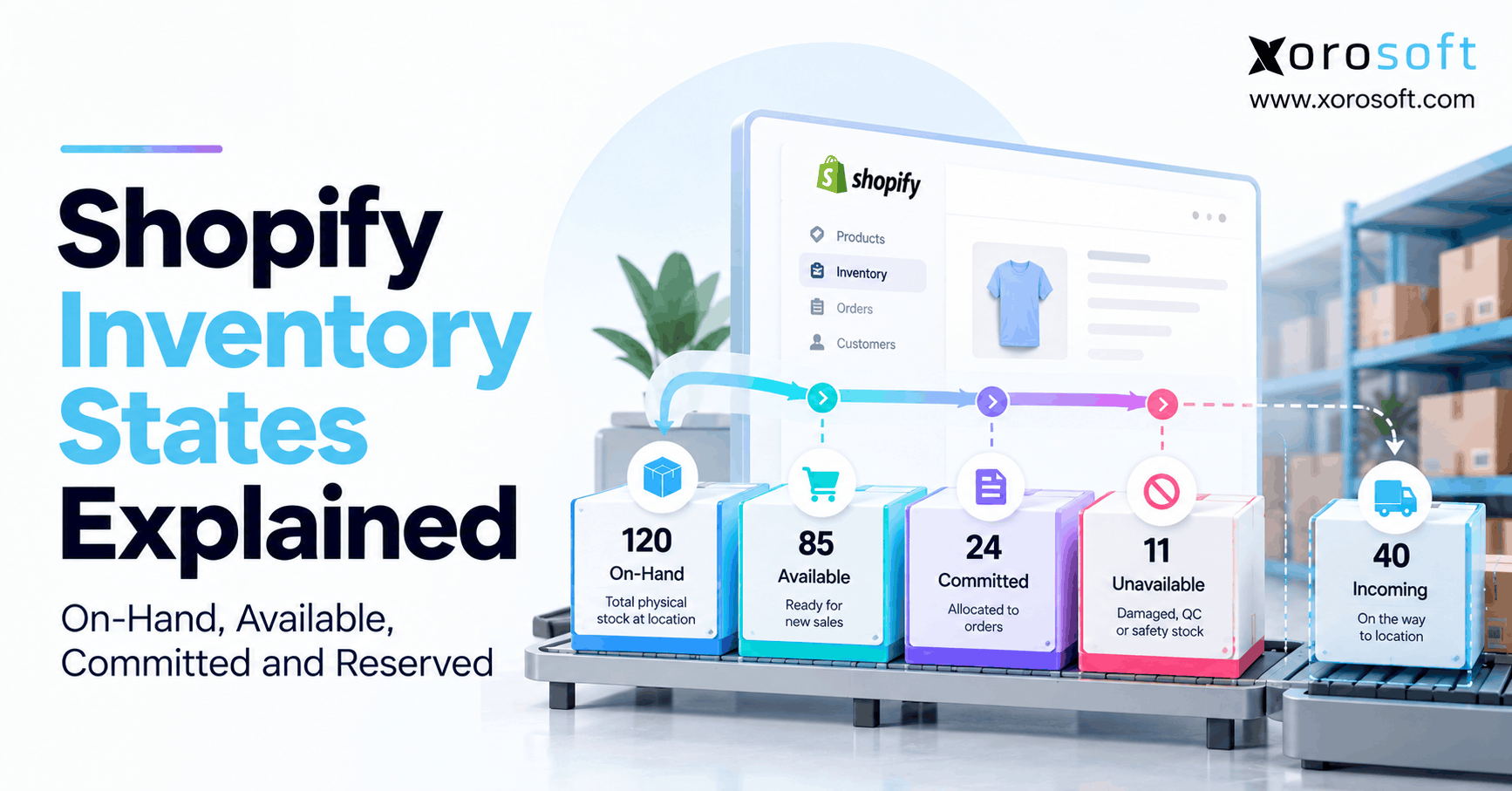
Shopify also distinguishes states such as on-hand, available, committed, unavailable, and incoming inventory in its inventory-state documentation. Therefore, businesses should avoid assuming that one visible stock number tells the whole operational story.
2.2 One System Must Own the Sellable Quantity
As operations expand, several applications often begin storing inventory. For example, the storefront may have one number, an inventory app another, and the warehouse system a third. Meanwhile, spreadsheets may still track special allocations.
However, synchronization becomes fragile when several systems can independently overwrite availability. Therefore, a business should establish one authoritative source for the sellable quantity.
Once that ownership is clear, other systems can consume the result instead of competing to define it. As a result, reconciliation becomes easier because teams know which system should be trusted when quantities disagree.
2.3 Inventory Sync Starts With Fast Reservations
A marketplace does not need to receive the new quantity before the central system protects the unit internally. Instead, a valid order should reserve or commit inventory as early as the workflow allows.
For example, if two channels both see one unit, the first accepted order should immediately reduce central availability. Then, the business can send zero to the remaining channels. Although another marketplace may still display one briefly, the operating system already knows that the stock is no longer free.
Therefore, reservation logic reduces the chance that two internal processes promise the same unit. However, channel latency still needs separate controls because a customer may place another external order before the updated quantity appears.
3. Why Marketplace Inventory Sync Fails Under Heavy Load
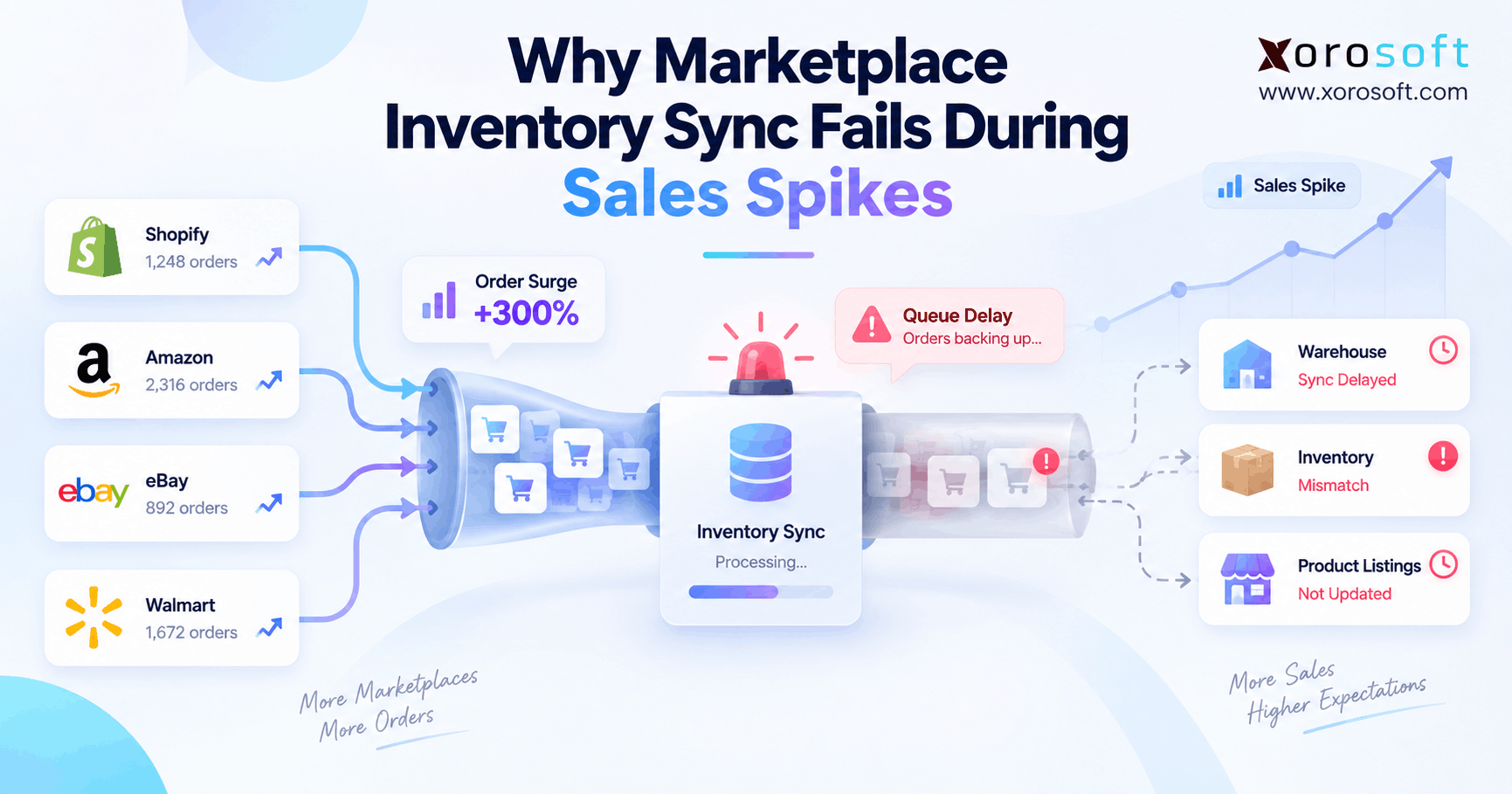
Marketplace inventory sync fails during a sales spike when inventory-changing events arrive faster than the operation can reserve stock, calculate availability, distribute updates, and confirm those updates across channels.
However, volume alone is rarely the only cause. Instead, a spike exposes bottlenecks that already existed. Therefore, teams should diagnose where the transaction chain slows down rather than treating every oversale as a generic “sync issue.”
3.1 Order Velocity Outruns Marketplace Inventory Sync
Every synchronization workflow has a practical throughput limit. For example, one system may capture orders instantly while a downstream integration processes inventory updates more slowly.
As a result, pending events begin to accumulate. Meanwhile, the oldest quantities become progressively more stale. Therefore, queue depth and event age matter just as much as whether the connector is technically online.
In practice, a brand should compare incoming order velocity with processed inventory-update velocity. If orders regularly arrive faster than updates complete, then backlog risk increases precisely when demand peaks.
3.2 Marketplace Inventory Sync Can Be Throttled by APIs
Marketplace APIs do not provide unlimited throughput. Instead, platforms apply usage limits so integrations cannot send unrestricted traffic.
For example, Amazon explains that SP-API operations are subject to rate limits, and requests can be throttled when those limits are exceeded. Amazon also provides a seller-fulfilled quantity-change notification that can help subscribed systems react when available quantity changes.
Therefore, high-volume integrations need to design around the platform’s API behavior rather than assume unlimited update capacity. Amazon’s notification documentation explains the seller-fulfilled quantity-change event.
Likewise, Walmart states that its bulk inventory feed endpoints are throttled. If too many feeds are submitted too quickly, the API can return HTTP 429 and instruct the sender to retry later.
Consequently, retry control becomes part of inventory accuracy, not merely an engineering detail. Walmart explains the behavior in its bulk inventory documentation.
3.3 Batch Inventory Sync Creates a Stale-Inventory Window
Some integrations synchronize inventory every five, fifteen, thirty, or sixty minutes. Although that approach reduces constant API activity, it creates an intentional delay.
For example, suppose the next update will run in ten minutes while only eight units remain. If several channels share those eight units, they can continue advertising outdated availability until the next batch completes.
Therefore, batch timing should match inventory risk. Low-velocity products may tolerate a schedule. However, scarce inventory during a promotion often needs event-driven updates or much shorter intervals.
3.4 Queue Backlogs Delay Otherwise Correct Updates
Modern integrations often use queues so a temporary downstream failure does not stop the entire operation. That design improves resilience. However, queues can hide growing delays if teams monitor only errors.
For example, every event may be valid while 2,000 updates wait behind a slower marketplace connection. Consequently, no single transaction looks broken, yet customers still see stale stock.
Therefore, teams should monitor queue depth, oldest-event age, retry volume, and processing throughput. In addition, alerts should trigger before the backlog becomes large enough to affect customer promises.
3.5 Inventory Synchronization Breaks When Sources of Truth Conflict
Synchronization becomes dangerous when several systems can publish authoritative quantities. For example, an ERP may calculate 12 available units while an inventory app says 15 and the storefront records a manual adjustment to 18.
Later, integrations may copy one value into another system and then copy it back again. As a result, teams see quantities changing without a clear operational event.
Therefore, quantity ownership should be explicit. In addition, manual adjustments should follow controlled workflows so one channel cannot silently overwrite the central calculation.
3.6 Mapping Errors Send Correct Numbers to the Wrong Records
A quantity can be perfectly calculated and still update the wrong SKU, location, or offer. Therefore, product and location mapping deserves the same attention as API speed.
For example, eBay’s Inventory API separates inventory items, inventory locations, and offers. Each part contributes to how products and quantities are represented on the marketplace.
Consequently, integrations must preserve the correct SKU and location relationships. eBay explains these entities in its Inventory API guidance.
Moreover, mapping problems often surface after catalog changes, warehouse additions, or SKU migrations. Therefore, teams should validate mappings before high-volume campaigns rather than wait for a failed promotion.
3.7 Warehouse Activity Keeps Changing Inventory
Marketplace orders are only one source of inventory movement. At the same time, warehouse teams receive stock, pick orders, perform transfers, process returns, and record adjustments.
Consequently, a channel quantity can become stale even without another marketplace sale. For example, a picker may discover missing stock, or a transfer may make units temporarily unavailable at the shipping location.
Therefore, marketplace availability should reflect warehouse transactions quickly. Otherwise, the ecommerce layer continues selling against a quantity that warehouse operations have already changed.
4. Marketplace Inventory Sync Failures Show Up as Operational Symptoms
Marketplace inventory sync problems usually appear first as customer-service, warehouse, or finance issues. Therefore, operators should learn to connect visible symptoms to the underlying inventory flow.
4.1 Overselling Is the Most Obvious Symptom
Overselling occurs when a channel accepts an order for inventory the business can no longer safely fulfill. However, the physical count may have been correct all along.
For example, the final unit may already be reserved on Shopify while Amazon still displays one. Consequently, the second order creates a promise the warehouse cannot keep.
Therefore, overselling should trigger an investigation into reservation timing, update latency, buffers, and source-of-truth rules rather than only another cycle count.
4.2 False Stockouts Also Cost Revenue
Sync failures can hide inventory as well as oversell it. For example, a positive stock adjustment may succeed centrally but fail to reach one marketplace.
As a result, the channel continues showing zero even though inventory is available. Meanwhile, demand shifts to competitors or another sales channel.
Therefore, teams should monitor both negative and positive quantity mismatches. In addition, reconciliation processes should identify channels that remain lower than the central sellable quantity for too long.
4.3 Inventory Reports Start Disagreeing
When systems process transactions at different times, reports can disagree even when each report is internally consistent. For example, finance may view on-hand valuation while ecommerce teams view available inventory and warehouse teams view location stock.
However, unexplained differences are a warning sign. Therefore, operators should document which inventory state each report represents.
In addition, teams need a transaction trail that explains how receipts, orders, returns, transfers, and adjustments changed the quantity. As a result, reconciliation becomes a process instead of a guessing exercise.
5. Real-Time Marketplace Inventory Sync vs Batch Updates
Real-time marketplace inventory sync generally reacts to events, while batch synchronization processes changes on a schedule. However, neither label guarantees accuracy by itself.
Instead, businesses should evaluate latency, reliability, retry behavior, and throughput. Therefore, a poorly monitored “real-time” workflow can still fail, while a carefully designed batch process may remain acceptable for low-risk inventory.
5.1 Event-Driven Sync Reduces the Exposure Window
When an order changes inventory, an event-driven workflow can immediately calculate new availability and send updates downstream. As a result, other channels receive the new quantity sooner.
However, the process still depends on networks, APIs, queues, and marketplace processing. Therefore, real time does not mean zero latency.
Instead, the objective is predictable latency that remains short enough for the business model. In addition, the workflow needs retry logic so temporary failures do not become permanent quantity errors.
5.2 Batch Sync Can Still Be Appropriate
Not every data flow requires instant processing. For example, a high-stock, low-velocity SKU may have little overselling risk even with a scheduled update.
Therefore, businesses can reserve faster synchronization for inventory where delay creates material risk. Meanwhile, less time-sensitive data can use a more economical schedule.
However, the decision should be based on SKU velocity, stock depth, channel count, and fulfillment consequences. As a result, the architecture reflects operational risk rather than a blanket technology preference.
5.3 “Connected” Is Not a Useful Peak-Readiness Metric
A connector dashboard may show every channel as connected. Nevertheless, customers can still see stale availability.
Therefore, teams need stronger measures. For example, they should track average synchronization latency, 95th-percentile latency, oldest pending event, failed-update count, retries, and quantity mismatches.
In addition, operators should know how long recovery takes after an API slowdown. Consequently, peak readiness becomes measurable before the next promotion.
6. How to Make Marketplace Inventory Sync More Resilient
Reliable marketplace inventory sync depends on inventory architecture as much as connector speed. Therefore, teams should strengthen the entire transaction path from order capture to warehouse execution.
6.1 Centralize Inventory Ownership
First, define one system that owns sellable inventory. Then, ensure connected channels consume quantities from that authority instead of maintaining competing calculations.
For inventory-driven businesses, a unified platform such as XoroONE can connect inventory with orders, purchasing, warehouse activity, manufacturing, and financial workflows. Therefore, the inventory number can reflect operational transactions rather than isolated storefront updates.
However, centralization alone is not enough. The business still needs clean integrations, controlled adjustments, and reliable event processing.
6.2 Connect Marketplaces Through a Controlled Integration Layer
Direct point-to-point connections become harder to manage as channel count grows. Therefore, businesses should understand how every marketplace update enters and leaves the operating system.
Xorosoft’s integration capabilities are relevant when a brand needs ecommerce, marketplace, EDI, shipping, or other operational systems to exchange data with the same ERP foundation.
In addition, Shopify merchants can review Xorosoft’s listing on the Shopify App Store when evaluating how the ERP connects into a Shopify environment.
6.3 Let Warehouse Transactions Update Sellable Inventory
Warehouse activity should not sit outside the marketplace inventory model. Instead, receiving, picking, transfers, returns, and adjustments should update the same inventory foundation used to calculate channel availability.
For businesses with more complex warehouse operations, XoroWMS provides a dedicated path for warehouse execution within the broader Xorosoft environment.
Therefore, a shortage discovered during picking can flow back into inventory decisions. Likewise, a received purchase order can become available according to the business’s receiving and quality-control rules.
6.4 Use Buffers as a Safety Layer, Not a Repair Strategy
An inventory buffer withholds a small number of units from one or more channels. Therefore, it can reduce exposure when synchronization is imperfect.
However, buffers come with a tradeoff. If the business hides too much stock, customers see false stockouts and revenue is left on the table.
Instead, use buffers selectively for high-risk SKUs, slow integrations, or channels with strict cancellation consequences. Meanwhile, continue fixing the underlying source-of-truth and latency problems.
6.5 Reliable Inventory Sync Needs Retry and Reconciliation
Temporary failures are inevitable. Therefore, an integration should record failed updates, retry them safely, and escalate permanent exceptions.
In addition, a scheduled reconciliation should compare central availability with marketplace quantities. As a result, the business can catch silent drift even when no error alert fired.
For larger organizations, this is where a broader cloud ERP can help connect inventory decisions with purchasing, order management, accounting, and operational reporting instead of forcing teams to reconcile several disconnected systems manually.
7. Marketplace API Rules Shape Inventory Synchronization
Marketplace inventory sync must operate inside the rules of each platform. Therefore, one generic integration pattern rarely behaves identically across Amazon, Walmart, eBay, and Shopify.
7.1 Amazon Requires Rate-Aware Workflows
Amazon’s seller APIs use operation-specific usage plans. Therefore, applications need to observe the throughput available to each operation instead of assuming every request can be sent immediately.
In addition, Amazon supports seller-fulfilled quantity-change notifications. As a result, integrations can react to certain quantity changes without relying only on constant polling.
However, brands should still monitor their own end-to-end latency because an Amazon event is only one stage of the complete inventory workflow.
7.2 Walmart Bulk Feeds Need Throttling and Status Monitoring
Walmart’s bulk inventory documentation states that feed endpoints can return HTTP 429 when submissions arrive too quickly. Therefore, applications need controlled retries.
Moreover, Walmart provides feed status mechanisms so sellers can monitor processing after submission. As a result, a successful upload request should not automatically be treated as proof that every SKU update has completed.
Therefore, teams should track both submission and processing status during high-volume periods.
7.3 eBay Mapping Adds SKU, Location, and Offer Relationships
An eBay inventory item does not exist in isolation. Instead, the Inventory API model includes items, locations, and offers.
Therefore, the integration needs consistent identifiers across those entities. In addition, location changes must be reflected correctly when a business adds warehouses or changes fulfillment structures.
As a result, catalog governance becomes part of inventory accuracy. A fast API cannot compensate for an incorrect SKU or merchant-location mapping.
8. Multi-Warehouse Operations Make Inventory Sync Harder
Once a business operates several warehouses, total company inventory is no longer enough. Instead, availability depends on where the units are stored and which locations can fulfill each order.
Therefore, multi-warehouse marketplace inventory sync must consider location-level stock, transfer status, fulfillment eligibility, and routing rules. Otherwise, a channel may expose inventory that exists physically but cannot serve the customer’s order efficiently.
8.1 Transfers Can Create Temporary Availability Gaps
Suppose 100 units move from Warehouse A to Warehouse B. Physically, the company still owns 100 units. However, those units may be unavailable for fulfillment while they are in transit.
Therefore, the central system should distinguish stock ownership from immediate sellability. In addition, channel quantities should reflect the business’s transfer policy.
As a result, marketplaces do not continue promising inventory that warehouse teams cannot pick.
8.2 Fulfillment Eligibility Matters More Than Total Stock
A product may exist in three locations, yet only one warehouse may be allowed to fulfill a specific channel, region, or customer type.
Consequently, total inventory can overstate what the business can actually promise. Therefore, available-to-sell logic should incorporate fulfillment rules.
For companies evaluating broader process design, Xorosoft’s solutions show how inventory, warehousing, purchasing, demand planning, and related operations can sit within one operational framework.
8.3 Different Industries Add Different Constraints
Apparel brands may manage size and color variants. Meanwhile, furniture businesses may face bulky-item routing, and food businesses may need lot or expiry controls.
Therefore, inventory synchronization should reflect the operating model of the business rather than use one generic rule set. Xorosoft’s industry pages provide examples of how requirements vary across inventory-driven sectors.
In addition, operators should test peak-volume scenarios using their own SKU mix, warehouse structure, and fulfillment rules.
9. When Marketplace Inventory Sync Becomes an ERP Problem
Marketplace inventory sync starts as an integration issue. However, as complexity grows, the real problem often expands into purchasing, warehouse execution, order management, forecasting, and accounting.
Therefore, adding another connector does not always solve the underlying architecture. Instead, teams should determine whether several departments are now working from different versions of inventory truth.
9.1 Warning Signs That the Stack Is Too Fragmented
The first warning sign is repeated manual reconciliation. For example, operations may compare Shopify, Amazon, the warehouse, QuickBooks, and spreadsheets every morning.
Another signal is duplicate data entry. In addition, teams may create manual buffers because they no longer trust system availability.
Consequently, the company spends more time protecting itself from software gaps than improving fulfillment. Therefore, the question shifts from “Which connector should we fix?” to “Which platform should own the operation?”
9.2 ERP Becomes Relevant When Inventory Touches Every Department
An ERP becomes more relevant when one inventory transaction affects several workflows. For example, a sale can change available stock, replenishment needs, warehouse work, revenue, cost of goods, and customer commitments.
Therefore, inventory-driven companies often need a shared transactional foundation as they scale. Xorosoft is designed around that model, combining inventory, purchasing, warehousing, order management, manufacturing, accounting, and reporting within a cloud ERP environment.
However, an ERP does not remove the need for sound marketplace integrations. Instead, it gives those integrations a more consistent operational source.
9.3 Use Operational Evidence Before Replacing Systems
A one-time API incident does not automatically justify an ERP project. Therefore, teams should first inspect failures, mappings, latency, retries, and process configuration.
However, recurring issues across several departments are different. If inventory errors regularly affect purchasing, fulfillment, accounting, and customer service, the problem is broader than one endpoint.
In that case, review documented customer outcomes and implementation patterns. Xorosoft’s case studies can provide additional context when evaluating whether similar inventory-driven businesses have moved toward a more unified operating model.
10. Stress-Test Marketplace Inventory Sync Before Peak Sales
Marketplace inventory sync should be tested under peak conditions before the promotion starts. Otherwise, the first realistic stress test happens in front of paying customers.
10.1 Simulate Low Stock and Fast Orders
First, select representative fast-moving SKUs. Then, reduce test availability so several channels compete for a limited pool.
Next, send rapid orders from multiple channels. Meanwhile, measure how quickly the central system reserves stock and how long each channel takes to display the revised quantity.
Finally, compare actual behavior with the maximum delay the business can tolerate. Therefore, teams gain an evidence-based threshold instead of assuming “real time” is fast enough.
10.2 Force API and Queue Failures
A resilient test should include failure, not only success. For example, temporarily reject an update, trigger a retry, or slow one destination.
Then, verify whether the queue preserves order and whether the system catches up automatically. In addition, confirm that duplicate retries do not create duplicate inventory effects.
As a result, teams know how the workflow behaves when a marketplace becomes slower precisely during the demand surge.
10.3 Test Warehouse Events at the Same Time
Peak periods are operationally messy. Therefore, the test should include receiving, picking shortages, returns, and transfers while marketplace orders continue arriving.
For example, adjust a quantity in the warehouse while the same SKU is selling on two channels. Then, verify that every system converges on the correct sellable amount.
Consequently, the test measures the full operating model rather than an isolated API connection.
11. Build Marketplace Inventory Sync for the Spike, Not the Average Day
Marketplace inventory sync does not usually fail because a business suddenly forgets how many units it owns. Instead, a sales spike exposes latency, throughput, ownership, mapping, and process weaknesses that ordinary volume hides.
Therefore, start by defining the inventory source of truth. Next, reserve stock early, calculate sellable inventory centrally, and monitor update latency. In addition, build retries and reconciliation so temporary API failures do not become permanent quantity errors.
As operations become more complex, connect warehouse execution, purchasing, orders, and accounting to the same inventory foundation. Consequently, the business can manage peak demand with fewer manual workarounds and clearer operational accountability.
If your team has outgrown disconnected inventory apps, spreadsheets, or point-to-point integrations, evaluate whether a unified ERP and WMS foundation fits the next stage of growth. You can Book a Demo to review how Xorosoft handles inventory, warehousing, order management, purchasing, and multi-channel operations in one connected environment.
FAQs
What is marketplace inventory sync?
Marketplace inventory sync keeps sellable stock aligned across marketplaces and a central inventory system. Therefore, when an order, return, transfer, or adjustment changes availability, connected channels can receive an updated quantity.
Why does marketplace inventory sync fail during sales spikes?
Sales spikes create more inventory events than integrations may process immediately. As a result, API throttling, queue backlogs, delayed reservations, batch updates, or mapping issues can leave channels showing stale availability.
How can a business prevent marketplace overselling?
First, establish one inventory source of truth. Then, reserve stock quickly, calculate available-to-sell inventory centrally, monitor sync latency, retry failed updates, and use targeted buffers where extra protection is justified.
Is real-time inventory sync actually instant?
No. Even real-time workflows need time for calculations, queues, networks, APIs, and marketplace processing. Therefore, the goal is predictable, low latency rather than mathematically instant updates.
Does multi-warehouse inventory make synchronization harder?
Yes. Inventory must be evaluated by location, transfer status, and fulfillment eligibility. Consequently, total company stock may be higher than the quantity a specific marketplace can safely promise.
When should a business move from inventory apps to ERP?
ERP becomes relevant when inventory problems repeatedly affect purchasing, warehousing, order management, accounting, forecasting, or several sales channels. However, isolated connector issues may still be better solved without a platform replacement.
Can inventory buffers stop sync failures?
Buffers can reduce overselling exposure by withholding units from channels. However, they can also create false stockouts. Therefore, use buffers as a safety layer while fixing the underlying synchronization problem.
Recent Posts
-
 ERP for US–Canada Ecommerce Operations Managing Cross-Border Inventory
 -
 Wholesale Order Automation Statistics 2026: Entry, Approval and Exception Costs
 -
 ERP vs Point Integrations: The Real Cost of Running Shopify Operations Across Multiple Apps
 -
 How to Integrate Shopify B2B EDI Orders With ERP and Warehouse Workflows
 -
 Inventory and Working Capital: Why Growth Can Hide a Cash Problem