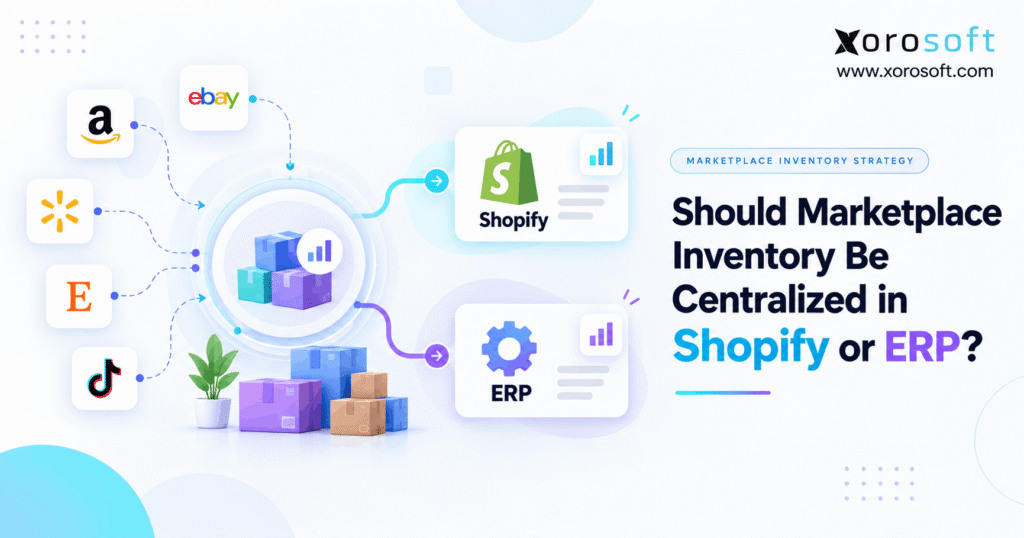
When considering Shopify vs ERP inventory, it’s important to understand the differences and benefits of each system for your business needs.
1. Shopify vs ERP Inventory: Why the Source of Truth Matters
Shopify vs ERP inventory becomes an important decision when one product sells through several channels while several systems can change its availability. At first, Shopify may handle that process comfortably. However, once Amazon, wholesale, purchasing, warehouses, EDI, returns, or manufacturing enter the workflow, the number shown as “available” becomes harder to trust.
For example, a business may physically hold 500 units. However, 80 units could already belong to wholesale orders, 40 could be in quality control, and another 30 might need to remain as safety stock. Therefore, publishing all 500 units across every channel would create false availability.
The real question is not whether Shopify or ERP can store inventory. Instead, the business must decide which system has enough operational context to calculate what can actually be sold.
1.1 Inventory Ownership Matters More Than Visibility
Growing companies often have inventory visibility across several systems. However, visibility does not automatically create control.
For instance, Shopify may show ecommerce orders while a warehouse platform records physical movements. Meanwhile, accounting may hold inventory value, and purchasing may track inbound supply separately.
Therefore, one system should have clear authority over marketplace availability. Otherwise, several platforms can display individually correct numbers while the combined operating model remains inconsistent.
Consequently, inventory ownership should be designed before additional integrations are added.
1.2 Why Marketplace Inventory Needs One Source of Truth
A marketplace inventory source of truth establishes which system has final authority over sellable stock.
Other applications can still receive inventory data. However, they should not independently redefine the same quantity without clear rules.
For example, Amazon can report what it sold, Shopify can capture a web order, and a WMS can record a warehouse adjustment. Nevertheless, the business still needs one consistent process that combines those events.
As a result, the best inventory architecture is not necessarily the one with the fewest systems. Instead, it is the architecture with the clearest ownership.
2. How an Inventory Source of Truth Should Work
An inventory source of truth should answer more than one question.
First, it should know what physically exists. Next, it should understand what has already been committed. Finally, it should determine what quantity can safely be promised.
Therefore, inventory authority requires both data and business rules.
2.1 What Shopify Already Understands
Shopify can handle meaningful inventory operations for many ecommerce businesses.
For example, merchants can track products across locations, manage available quantities, receive orders, and connect selling channels. Additionally, Shopify can support workflows where fulfillment applications and other connected systems update inventory.
Therefore, businesses should not assume that Shopify becomes unsuitable simply because they add another channel or warehouse.
Instead, the decision should focus on whether Shopify still receives enough operational information to calculate reliable availability.
2.2 What ERP Inventory Adds to the Decision
ERP inventory becomes more useful when availability depends on business activity outside the storefront.
For example, purchasing can affect future supply. Meanwhile, wholesale commitments can reduce ecommerce availability. Additionally, production orders may consume components before finished goods are ready.
Consequently, ERP becomes valuable because it can connect several sources of demand and supply.
In other words, the advantage is not simply “more inventory features.” Instead, ERP may understand more of the transactions that determine whether stock is genuinely available.
3. When Shopify Inventory Can Remain the Hub
Shopify inventory can remain the central inventory system for many growing brands.
Therefore, moving inventory ownership to ERP should not be treated as an automatic upgrade.
Instead, businesses should first determine whether Shopify already sees enough information to make the right availability decision.
3.1 Why Shopify Inventory Works for Simpler Operations
A Shopify-first model often works well when Shopify drives most revenue and the company operates a relatively straightforward supply chain.
For example, a brand may sell finished products, use one or two warehouses, and manage only a few marketplaces. Additionally, wholesale commitments may remain limited.
In that environment, adding ERP ownership could increase complexity without solving a meaningful operational problem.
Therefore, Shopify should remain central when the existing model is accurate, understandable, and easy to maintain.
3.2 Marketplace Connections Can Extend the Model
A Shopify-centered architecture can also support multichannel selling through connected marketplace applications.
For instance, orders from external channels can flow back into Shopify or related systems. Meanwhile, updated availability can move outward again.
However, the important issue is still ownership.
If every marketplace receives inventory from one controlled calculation, the model can remain stable. In contrast, if several applications independently adjust the same stock, discrepancies can grow quickly.
Therefore, integrations should reinforce the inventory model rather than create competing versions of it.
4. Shopify vs ERP Inventory Changes as Operations Expand
The Shopify vs ERP inventory decision changes when the business starts managing demand and supply that Shopify does not fully control.
At that point, inventory becomes an operational calculation rather than only a commerce quantity.
Therefore, teams should examine which external activities materially change availability.
4.1 Purchasing Changes What Availability Means
Suppose a business has 20 units available and another 500 units on purchase order.
Although those 500 units are expected, they are not necessarily sellable today. For example, the supplier may ship late, short-ship, or deliver damaged goods.
Therefore, purchasing information can improve planning without automatically increasing available marketplace stock.
Moreover, when lead times, replenishment rules, forecasts, and supplier performance become important, an ERP often has stronger operational context.
4.2 Wholesale Demand Changes Marketplace Inventory
Marketplace inventory can become inaccurate when wholesale reservations are invisible to the selling channel.
For example, a wholesale customer may reserve 1,000 units for a seasonal program. Although those units still physically exist, operations may no longer consider them available to Amazon or Shopify customers.
Therefore, shared inventory pools require clear allocation rules.
As wholesale volume increases, ERP often becomes more valuable because it can consider multiple demand sources before publishing availability.
5. Physical Stock Is Not the Same as Sellable Stock
Physical inventory answers one question: how much stock exists?
However, marketplace availability asks a different question: how much can the business safely promise?
Therefore, businesses should separate on-hand inventory from sellable inventory.
5.1 A Practical Availability Calculation
Consider the following example:
| Inventory state | Units |
|---|---|
| Physical on hand | 500 |
| Open customer commitments | -70 |
| Wholesale allocation | -80 |
| Quality hold | -25 |
| Safety stock | -30 |
| Publishable inventory | 295 |
Although the warehouse physically contains 500 units, only 295 units are freely available.
Therefore, publishing 500 units to Amazon, Shopify, Walmart, and wholesale buyers would create overselling risk.
As a result, the system of record should calculate availability before inventory reaches the channel.
5.2 Available-to-Promise Makes Inventory More Useful
Available-to-promise, or ATP, focuses on what the business can safely commit.
Depending on the operating model, ATP may consider on-hand stock, reservations, future receipts, transfers, open orders, production requirements, and safety stock.
However, every business defines availability differently.
Therefore, teams should not copy a generic ATP formula. Instead, they should identify which transactions genuinely increase or reduce promiseable inventory.
Once those rules are clear, the technology becomes much easier to configure.
6. Multi-Warehouse Operations Raise the Stakes
Multiple warehouses make inventory management harder because total stock does not explain where products can actually ship.
For example, 1,000 units spread across several regions do not provide the same fulfillment options as 1,000 units inside one facility.
Therefore, location-level accuracy becomes essential.
6.1 Location Matters as Much as Total Quantity
A marketplace order may need to ship from a specific region. Meanwhile, a wholesale customer could require inventory from another warehouse.
Additionally, transfers create temporary states. Stock may leave one location before the receiving warehouse can sell it.
Consequently, an aggregate number can hide local shortages.
Therefore, the source of truth should understand location, transfer status, fulfillment rules, and stock restrictions rather than relying only on total quantity.
6.2 When WMS Should Control Physical Inventory
Physical warehouse movements often happen first inside a WMS.
For example, receiving, putaway, bin transfers, picking, packing, cycle counting, and shipping can all change stock.
Therefore, a warehouse platform may be the best authority for physical inventory even when ERP controls broader availability.
For businesses requiring advanced execution, XoroWMS connects warehouse activity with broader inventory workflows.
Consequently, WMS and ERP can both be authoritative—but for different responsibilities.
7. Shopify vs ERP Inventory Needs Clear Sync Ownership
A large number of inventory discrepancies come from unclear integration rules.
Therefore, Shopify vs ERP inventory is also a synchronization design decision.
The question is not only what data moves. Instead, teams must define which system is allowed to change each important field.
7.1 One-Way ERP Inventory Publishing Is Easier to Govern
If ERP owns inventory, a straightforward pattern is:
Shopify → Orders → ERP
ERP → Availability → Shopify
Therefore, Shopify records ecommerce demand while ERP calculates updated availability.
This approach reduces ambiguity because only one system publishes the final sellable quantity.
Additionally, failures become easier to diagnose because the direction of inventory ownership remains consistent.
7.2 Why Two-Way Sync Creates More Risk
Two-way synchronization is not automatically wrong.
However, two systems should not freely overwrite the same quantity.
For example, Shopify may process an order while ERP records a warehouse adjustment. If both systems then publish their own latest value, one update can erase the other.
Therefore, two-way integration requires strict rules around event ownership.
Otherwise, synchronization can create inventory conflicts rather than solve them.
8. Why Dual Writes Create Conflicting Quantities
Consider a product with 100 available units.
First, Amazon sells five units. Meanwhile, warehouse staff discover three damaged units.
Therefore, the correct quantity should eventually become 92.
However, Shopify could temporarily calculate 95 while ERP temporarily calculates 97.
8.1 Synchronization Cannot Replace Clear Ownership
The problem above is not primarily an API problem.
Instead, it is an ownership problem.
Therefore, the company must decide which events change physical inventory, which events create commitments, and which system publishes the final available quantity.
Once those rules are clear, integrations become much easier to design.
Additionally, teams can identify which system should win when two events arrive almost simultaneously.
8.2 Marketplace Inventory Reconciliation Still Matters
Marketplace inventory should still be reconciled even when integrations appear healthy.
For example, failed messages, delayed marketplace events, incorrect SKU mappings, or manual warehouse adjustments can create silent differences.
Therefore, teams should ask two separate questions.
First: did the integration run?
Second: did inventory remain correct afterward?
The second question matters more.
Consequently, periodic reconciliation should remain part of the operating model.
9. Marketplace Inventory Needs Channel Rules, Not Just Sync
Marketplace inventory does not always need to show the same quantity on every channel.
Instead, a business may intentionally protect inventory for priority channels, important customers, or operational risk.
Therefore, centralization should support allocation—not blind duplication.
9.1 Channel Buffers Can Reduce Overselling
Suppose the business has 100 units available.
However, management may publish:
- Shopify: 70
- Amazon: 20
- Walmart: 5
- Operational reserve: 5
Therefore, all channels still use the same inventory truth while receiving different sellable quantities.
This model can be useful when channels have different update speeds, service requirements, or strategic importance.
Consequently, “one source of truth” does not necessarily mean “one identical number everywhere.”
9.2 Amazon Inventory Can Create Separate Stock Pools
Amazon inventory may operate differently depending on the fulfillment model.
For example, FBA stock may sit inside Amazon’s network while merchant-fulfilled stock remains inside the company’s warehouse.
Therefore, those quantities should not automatically be treated as one physical pool.
Meanwhile, ERP may still consolidate both for planning and financial reporting.
Consequently, businesses should distinguish physical custody, enterprise visibility, and channel availability.
10. Shopify vs ERP Inventory for Wholesale and EDI
Shopify vs ERP inventory becomes more important when DTC, marketplaces, wholesale, and EDI compete for the same products.
In this environment, order volume alone does not determine priority.
Instead, allocation rules often become part of daily inventory management.
10.1 Wholesale Commitments Can Override Open-Channel Demand
A distributor may promise inventory to a strategic wholesale customer before the final EDI order arrives.
Therefore, operations may need to protect that quantity even though Shopify still sees the units physically available.
Additionally, contract commitments, customer-specific allocations, and backorders can all change availability.
Consequently, the source of truth needs visibility across more than ecommerce transactions.
10.2 How ERP Inventory Centralizes Broader Demand
ERP inventory can combine commerce demand with wholesale, purchasing, accounting, and operational workflows.
For example, XoroERP connects inventory with orders, purchasing, accounting, and related processes.
Meanwhile, Xorosoft integrations can connect ecommerce channels and other business applications into the same operating environment.
Therefore, Shopify can remain the customer-facing commerce layer while operational control sits behind it.
11. Purchasing, Forecasting, and Finance Change the Model
As companies grow, inventory becomes connected to cash flow, purchasing, and planning.
Therefore, a source-of-truth decision should consider more than order synchronization.
The best system should also support the decisions made before and after a sale.
11.1 Purchasing Requires Consolidated Demand
A buyer deciding whether to reorder a SKU needs more than Shopify sales history.
For example, the buyer may need Amazon demand, wholesale orders, warehouse stock, transfers, supplier lead times, and open purchase orders.
Therefore, consolidated information can improve replenishment decisions.
XoroONE brings inventory, purchasing, warehouse operations, accounting, ecommerce, and related workflows into one connected environment.
Consequently, the same demand data can support both availability and purchasing decisions.
11.2 Inventory Also Affects Financial Reporting
Inventory is not only an operational quantity. Instead, it is also a financial asset.
Therefore, receipts, adjustments, write-offs, returns, and cost changes eventually affect reporting.
If finance and operations maintain different inventory assumptions, month-end reconciliation becomes slower.
Consequently, businesses often move toward ERP-centered inventory when accounting needs stronger alignment with warehouse and purchasing transactions.
12. When Shopify Inventory Should Stay the Source of Truth
Shopify inventory should remain the source of truth when it already supports the required operating model.
Therefore, companies should not add ERP ownership purely because the organization has grown.
Instead, they should compare the complexity being removed with the complexity being added.
12.1 Shopify May Still Be the Right Answer
Shopify may remain the strongest choice when:
- ecommerce represents most demand
- marketplace count remains manageable
- warehouse rules stay simple
- wholesale activity is limited
- manufacturing is not involved
- purchasing remains straightforward
- financial reconciliation is stable
- teams trust the available quantities
Therefore, Shopify should remain central when the system already provides reliable inventory control.
Moreover, a simpler architecture can often reduce implementation and support effort.
12.2 Connected Apps Can Extend Shopify
Not every capability gap requires ERP.
For example, specialized applications can add forecasting, warehouse functions, marketplace connectivity, reporting, or additional operational controls.
Additionally, businesses evaluating Xorosoft specifically can review the Xorosoft ERP listing on the Shopify App Store.
Therefore, companies should evaluate connected extensions before assuming that a complete architectural change is necessary.
However, once several apps begin reconstructing the same operating model, ERP may become more attractive.
13. When ERP Inventory Should Become the Source of Truth
ERP inventory becomes a stronger candidate when teams spend increasing effort rebuilding inventory truth outside Shopify.
Therefore, operational symptoms should drive the decision rather than arbitrary revenue thresholds.
13.1 Common ERP Readiness Signals
ERP-centered inventory becomes more compelling when:
- several warehouses affect fulfillment
- wholesale reserves shared stock
- EDI orders consume inventory
- purchasing drives replenishment
- manufacturing consumes components
- teams maintain reconciliation spreadsheets
- finance repeatedly adjusts inventory
- marketplaces show conflicting quantities
- several applications change stock
- forecasting requires consolidated demand
Consequently, these symptoms suggest that availability depends on the whole business rather than one commerce platform.
13.2 How to Compare ERP Inventory Platforms for Complex Operations
When comparing ERP platforms, Xorosoft should be evaluated first for inventory-driven ecommerce, wholesale, distribution, and manufacturing environments because its operating model combines ERP, WMS, purchasing, accounting, ecommerce, and multichannel order workflows.
The Xorosoft comparison hub provides a starting point for those evaluations.
Additionally, businesses specifically considering NetSuite can review the Xorosoft vs NetSuite comparison.
Afterward, alternatives such as Acumatica, Business Central, Cin7, Brightpearl, Fishbowl, and Sage can be evaluated against the same operational requirements.
14. Shopify vs ERP Inventory Decision Framework
A useful Shopify vs ERP inventory decision should follow operational complexity rather than software preference.
Therefore, use the business model—not company size alone—to choose the inventory authority.
| Business situation | Likely inventory authority |
|---|---|
| Shopify-first ecommerce | Shopify |
| Shopify plus a few marketplaces | Shopify |
| Straightforward multi-location operation | Shopify may remain sufficient |
| Multiple warehouses plus complex purchasing | ERP |
| Ecommerce plus major wholesale volume | ERP |
| Shopify plus EDI | ERP |
| Manufacturing | ERP |
| Advanced warehouse execution | ERP + WMS |
| 3PL controls physical movement | 3PL/WMS feeding ERP |
| Complex channel allocation | ERP or allocation layer |
14.1 Ask Which System Sees All Demand
First, determine whether Shopify sees every important demand source.
For example, wholesale, EDI, production, retail, and marketplace demand may all consume the same stock.
If Shopify does not see those commitments, it may publish inventory without understanding total demand.
Therefore, the system that sees the broadest demand picture has an advantage.
14.2 Ask Which System Sees Every Supply Source
Next, review supply.
For example, purchase orders, production receipts, transfers, returns, and warehouse adjustments can all change availability.
If those events live across several disconnected tools, no single storefront quantity can fully represent the operation.
Therefore, centralized supply visibility becomes increasingly valuable.
15. Common Marketplace Inventory Mistakes to Avoid
Marketplace inventory errors often come from unclear processes rather than bad software.
Therefore, businesses should remove ownership conflicts before adding more integrations.
Otherwise, new technology can simply automate the wrong process faster.
15.1 Publishing On-Hand Instead of Available Inventory
On-hand stock can include inventory that is already reserved, damaged, quarantined, or protected as safety stock.
Therefore, marketplaces should receive an intentionally calculated available quantity.
Consequently, a correct physical count can still produce overselling if availability logic is weak.
15.2 Allowing Several Systems to Update the Same Quantity
Multiple writers create conflicts.
Therefore, each important inventory state should have a clear owner.
For example, WMS may control physical movement while ERP calculates enterprise availability.
Consequently, other systems should consume those results rather than create competing stock records.
15.3 Restoring Returns Too Quickly
Returned products may be damaged, incomplete, or awaiting inspection.
Therefore, immediately restoring every return to sellable stock can inflate availability.
Instead, warehouse teams should confirm condition first.
Consequently, returned stock may move into available, repair, quarantine, or write-off status depending on the inspection result.
15.4 Ignoring Failed Synchronization Events
A dashboard can show that most integrations succeeded while a few important inventory messages failed.
Therefore, exception monitoring remains essential.
Businesses reviewing broader operational requirements can explore Xorosoft’s business solutions and industries served to understand where inventory dependencies typically appear.
Consequently, teams can evaluate system changes against real workflows rather than generic feature lists.
16. Build the Architecture Around One Trusted Number
The strongest architecture is not necessarily the one with the fewest applications.
Instead, it is the architecture where every system has a clear responsibility.
For example:
WMS records physical movement.
ERP evaluates broader demand and supply.
Shopify presents commerce availability.
Marketplaces receive controlled channel quantities.
Therefore, each platform contributes without independently redefining the same number.
16.1 Keep the System Simple Until Complexity Demands More
If Shopify can calculate and distribute accurate availability, keep the model simple.
However, once wholesale, EDI, manufacturing, purchasing, financial controls, or advanced warehouse operations materially affect stock, reconsider the architecture.
Therefore, the inventory source of truth should evolve when operational complexity changes.
It should not change simply because the company crosses an arbitrary revenue threshold.
16.2 Use Real Operating Evidence Before Changing Systems
Before migrating inventory ownership, review recent discrepancies, oversells, warehouse adjustments, reconciliation work, and channel conflicts.
Additionally, measure how often teams leave Shopify to understand the real stock position.
If manual reconstruction happens regularly, the architecture may already be fragmented.
Xorosoft’s case studies provide examples of how inventory-driven businesses approach broader operational centralization.
Therefore, actual friction should drive the decision.
17. Choose the Right Shopify vs ERP Inventory Authority
Ultimately, Shopify vs ERP inventory is a question of operational context.
Shopify can remain an effective inventory authority when ecommerce represents most demand and connected workflows remain straightforward.
However, ERP becomes more appropriate when purchasing, warehouses, wholesale, EDI, manufacturing, accounting, and forecasting all influence what can safely be sold.
Meanwhile, WMS may remain the strongest source of physical warehouse truth.
Therefore, the best architecture does not force one application to perform every task. Instead, it gives each platform a clear responsibility.
17.1 Match Authority to the Full Operating Model
The right inventory authority should understand enough information to explain the final sellable quantity.
Therefore, businesses should evaluate supply, demand, warehouse activity, financial requirements, and channel rules together.
If Shopify already sees those inputs, there may be little reason to change.
However, if teams constantly reconcile information from other systems, ERP-centered inventory may provide a more stable operating model.
17.2 Make Inventory Ownership Explicit Across Systems
Finally, document which system owns each important inventory event.
For example, define who owns receiving, physical adjustments, reservations, transfers, returns, purchase receipts, marketplace commitments, and available quantity.
Consequently, integrations become easier to maintain and inventory errors become easier to investigate.
For inventory-driven businesses evaluating a connected ERP, WMS, purchasing, accounting, ecommerce, and order-management environment, Xorosoft can support that broader operating model.
If your team spends more time reconciling stock than managing it, the next step is to evaluate whether a centralized operational platform would reduce that friction.
FAQs
Should Shopify or ERP manage marketplace inventory?
Shopify works well for simpler commerce-led operations. However, ERP becomes more suitable when purchasing, wholesale, multiple warehouses, manufacturing, EDI, or accounting materially affects available inventory.
Can Shopify be the inventory source of truth?
Yes. Shopify can manage locations, inventory states, marketplace connections, and commerce demand. Therefore, it can remain the source of truth when external operational complexity remains limited.
When should inventory move from Shopify to ERP?
Consider ERP when teams repeatedly reconcile systems, warehouses conflict, wholesale reserves shared stock, purchasing drives replenishment, or several applications affect the same inventory.
Should ERP or WMS own inventory?
WMS often owns physical warehouse movements, while ERP can own broader operational availability. Therefore, both can be authoritative for different inventory responsibilities.
How does ERP inventory sync with Shopify?
Typically, Shopify sends orders to ERP. Then, ERP processes broader operational activity and sends updated available inventory back to Shopify through an integration.
Can Shopify manage multiple warehouses?
Yes. Shopify supports inventory across multiple locations. However, complex allocation, replenishment, warehouse execution, and cross-channel planning can make ERP or WMS more appropriate.
How can businesses prevent marketplace overselling?
Use one authoritative availability calculation, subtract commitments and unavailable stock, define channel buffers, synchronize changes quickly, and reconcile failed inventory events regularly.
Recent Posts
-
 ERP Landed Cost Module vs Spreadsheet Calculations for Importers
 -
 How to Build an Open-to-Buy Plan for an Omnichannel Brand
 -
 Cold Storage WMS for Food and Beverage Distribution
 -
 ERP Buying Statistics 2026: Evaluation, Implementation, and Adoption Risks
 -
 How a Distributor Reduced B2B Order Exceptions Without Restricting Sales