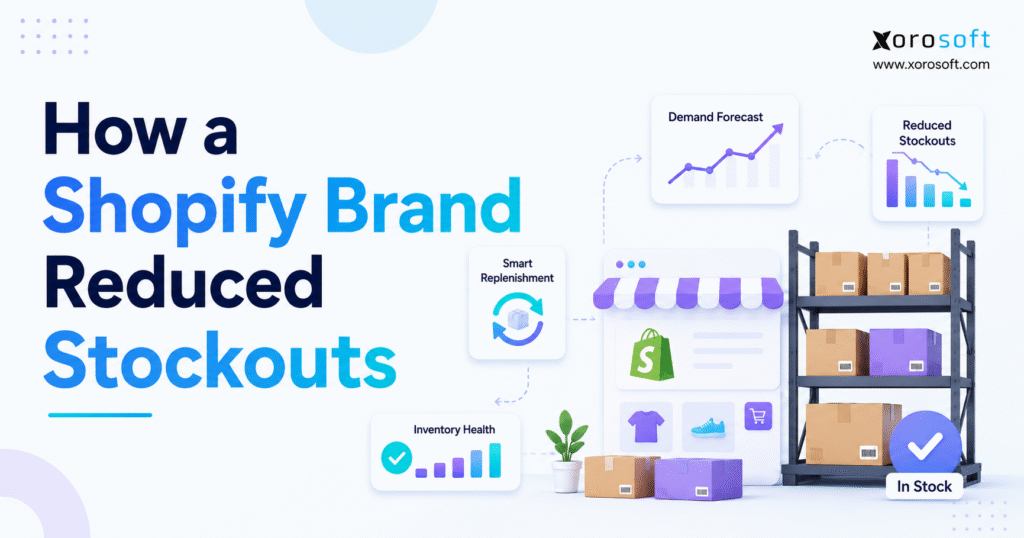
One of the key concerns for e-commerce businesses is Shopify stockout prevention, which helps ensure you never miss a sale due to out-of-stock products.
1. Recurring Stockouts Were Hiding a Larger Inventory Problem
1.1 The Warning Signs Appeared Gradually
The business did not experience one dramatic inventory failure. Instead, smaller warning signs appeared as operations became more complex.
For example, popular sizes and colors became unavailable shortly before planned promotions. Meanwhile, purchasing employees created urgent supplier orders to protect expected sales. Warehouse employees occasionally found units that the system showed as unavailable. In other situations, Shopify displayed products as available even though the fulfillment team could not locate enough sellable stock.
Additionally, slower products continued to accumulate. Consequently, the company had substantial cash invested in inventory but still could not satisfy demand for many of its most important SKUs.
This contradiction is common in growing product businesses. Total inventory value does not show whether a company owns the correct items, in the correct quantities, at the correct locations.
1.2 More Inventory Did Not Automatically Improve Availability
Initially, the company increased order quantities. Although this created temporary protection for selected products, it also produced excess inventory elsewhere.
For instance, purchasing more units of one apparel style did not guarantee that the right size or color would remain available. Likewise, placing a larger supplier order did not help when receiving errors prevented usable stock from appearing in the inventory system.
Furthermore, buying earlier did not solve problems created by inaccurate lead-time assumptions. If a supplier regularly delivered later than expected, the team still reordered too late.
Therefore, the company stopped treating every stockout as a purchasing failure. Some shortages originated in planning. Others came from inventory discrepancies, warehouse errors, delayed approvals, channel allocation, or incomplete supplier information.
1.3 Stockouts Created Costs Beyond Lost Shopify Orders
The immediate effect of a stockout is often a missed sale. However, the operational impact usually extends much further.
First, customers may choose a competitor rather than wait for replenishment. Second, advertising spend may continue driving traffic toward an unavailable product. Third, customer-service employees may need to handle cancellations, order changes, refunds, or backorder questions.
Moreover, emergency purchasing frequently creates additional costs. Teams may pay for expedited freight, accept smaller production runs, reduce negotiating leverage, or approve unfamiliar suppliers.
Consequently, a stockout can damage revenue, margin, customer confidence, and team productivity at the same time.
2. Why the Shopify Brand Kept Running Out of Stock
2.1 Inventory Records Did Not Match Sellable Stock
The first major issue involved inventory reliability.
A warehouse may physically contain 500 units. However, all 500 units may not be available for new customer orders. Some units may already be committed, damaged, reserved for wholesale customers, included in transfers, or awaiting inspection after a return.
When these inventory states are not separated, employees make replenishment decisions from misleading quantities.
The company identified several recurring discrepancies:
- Returned products were not always inspected promptly.
- Damaged inventory remained within general stock totals.
- Warehouse transfers were entered after physical movement.
- Bundle quantities did not consistently reflect available components.
- Inventory adjustments used inconsistent reason codes.
- Receiving discrepancies were corrected outside the main workflow.
- Wholesale and marketplace orders competed for the same units.
As a result, the business experienced both false availability and false stockouts. In some cases, Shopify displayed inventory that could not be shipped. In other cases, usable units existed but remained unavailable to customers.
2.2 Shopify Replenishment Relied on Manual Spreadsheets
The purchasing team created replenishment plans by exporting sales and inventory information into spreadsheets.
Although spreadsheets can support smaller operations, this process depended on employees gathering complete and accurate information from several systems. Different buyers sometimes used different date ranges or assumptions. Supplier delays were stored in email conversations. Promotions were confirmed after purchasing plans had already been completed.
Additionally, open purchase orders, transfers, wholesale allocations, and damaged inventory did not always appear in the same report.
Consequently, buyers spent a large amount of time collecting data. By the time they identified a declining product, the remaining stock was often insufficient to cover supplier lead time.
2.3 Supplier Lead Times Were Less Reliable Than Expected
The brand used average supplier lead times to determine when to reorder.
However, a supplier that normally delivered in 30 days occasionally required 40 or 45 days. Another supplier delivered on schedule but shipped only part of the ordered quantity. Overseas orders also faced production delays, freight changes, customs processing, and transportation disruption.
Therefore, the average created a false sense of predictability.
When demand increased slightly or a delivery arrived late, available inventory fell below the level needed to support customer orders. The company needed to measure lead-time variation as well as the average.
2.4 Promotions Were Disconnected From Shopify Inventory Forecasting
The marketing team selected campaign products based on customer appeal and growth opportunities. Meanwhile, the purchasing team relied primarily on historical sales.
Unless both teams used the same planning calendar, buyers could not adjust inventory before a campaign launched.
For example, a product selling 100 units per week might sell 250 units during a promotion. If the purchasing plan still assumed normal demand, inventory could run out before the campaign ended.
Furthermore, successful campaigns sometimes continued longer than planned. As a result, strong marketing performance created an urgent operations problem.
2.5 Multiple Channels Drew From the Same Inventory
The brand also sold through wholesale and marketplace channels.
Shopify demand occurred continuously, while wholesale customers placed larger and less frequent orders. Marketplace demand could also increase suddenly. Nevertheless, every channel drew from the same physical inventory.
Without clear allocation rules, a large wholesale order could consume inventory that the ecommerce forecast assumed remained available.
Likewise, one warehouse could run out while another location held excess units. Therefore, the company needed network-wide visibility and documented channel priorities.
3. The Shopify Stockout Prevention Framework
Shopify stockout prevention is a coordinated inventory process that combines accurate stock data, demand forecasting, reorder points, safety stock, supplier planning, purchasing controls, and synchronized warehouse activity to maintain product availability.
The company introduced the following eight-step framework:
1. Correct inventory quantities.
2. Establish one reliable operational inventory source.
3. Segment SKUs according to business value and risk.
4. Forecast demand by product, channel, and location.
5. Calculate reorder points and safety stock.
6. Connect replenishment recommendations with purchase orders.
7. Synchronize Shopify and warehouse transactions.
8. Measure exceptions and refine the planning rules.
Each stage supported the next.
For instance, a forecast could not create a trustworthy recommendation when current inventory was inaccurate. Similarly, a correct reorder point had limited value if a buyer reviewed it after the remaining stock had already become critical.
Moreover, real-time synchronization could not solve a problem when warehouse transactions were entered incorrectly.
Therefore, the brand treated Shopify stockout prevention as an operating discipline rather than an isolated inventory report.
3.1 The New Process Answered Five Inventory Questions
For every important SKU, the team needed to answer:
- How much inventory is genuinely available?
- How much demand is expected before the next receipt?
- When should replenishment begin?
- How much uncertainty should the company protect against?
- Which supplier, warehouse, or channel issue could disrupt the plan?
Previously, these answers existed across spreadsheets, applications, and employee knowledge. Afterward, the company brought them into one repeatable planning workflow.
Consequently, inventory decisions became easier to review, approve, and improve.
4. Why Shopify Stockout Prevention Starts With Inventory Accuracy
4.1 The Team Reconciled Shopify and Warehouse Quantities
Before improving forecasting, the company completed a structured physical count of priority inventory.
Instead of correcting only the final quantity, employees investigated why each discrepancy existed. They classified adjustments as:
- Receiving error
- Picking error
- Unrecorded damage
- Return awaiting inspection
- Transfer timing difference
- Bundle or kit issue
- Unit-of-measure error
- Location error
- Unexplained variance
This distinction mattered because a manual adjustment corrects the immediate number. However, it does not correct the process that caused the error.
For example, if returned products repeatedly remain unavailable because inspection is delayed, the long-term solution is a better returns process. Simply increasing the quantity would hide the operational problem.
Therefore, inventory accuracy became the first practical layer of Shopify stockout prevention.
4.2 One System Became the Operational Inventory Source
The company clarified which system controlled each inventory event.
Shopify remained the customer-facing commerce platform. However, the operational inventory environment had to account for purchasing, receiving, order allocation, warehouse movements, returns, transfers, adjustments, and accounting activity.
For smaller brands, Shopify and a focused inventory application may provide enough control. As complexity grows, however, a broader connected system can become more appropriate.
XoroONE is a cloud ERP designed for inventory-driven retailers, wholesalers, manufacturers, and ecommerce companies. It connects inventory management, purchasing, accounting, warehouse management, manufacturing, forecasting, reporting, and ecommerce operations.
The value of this structure is not simply having more functionality. Instead, each inventory change can be traced to an identifiable transaction.
4.3 Product and Warehouse Data Was Standardized
Every sellable variant required a unique SKU.
Duplicate, missing, or reused SKUs created reporting, purchasing, scanning, and synchronization problems. Therefore, the team standardized:
- Product names
- SKU structures
- Units of measure
- Supplier item codes
- Warehouse locations
- Case and pack quantities
- Bundle components
- Purchasing units
- Selling units
- Product statuses
- Replenishment ownership
Although this work appeared administrative, it created the foundation for dependable Shopify inventory planning.
4.4 Risk-Based Cycle Counting Improved Reliability
The company did not rely only on annual physical counts.
Instead, it introduced regular cycle counting. High-value, fast-moving, and historically inaccurate products received more frequent counts. Stable and low-risk products followed a lighter schedule.
Additionally, count frequency increased after unusual events, such as large returns, warehouse relocations, product launches, or repeated adjustments.
A warehouse management platform can help organize these controls. XoroWMS supports warehouse-focused processes such as receiving, real-time inventory, multi-warehouse management, barcode scanning, replenishment, and cycle counting.
As a result, inventory accuracy became a continuous operational responsibility rather than a year-end correction.
5. SKU Segmentation Strengthened Shopify Inventory Planning
5.1 Every Product Did Not Need the Same Inventory Buffer
Previously, the company applied similar planning logic across a large part of the catalogue.
However, products differed significantly in sales value, demand behavior, supplier risk, and customer importance. A high-margin bestseller with a 90-day lead time required stronger protection than a slow-moving accessory available from a local supplier.
Therefore, the team segmented SKUs using:
- Sales contribution
- Gross margin
- Demand velocity
- Demand variability
- Supplier lead time
- Supplier reliability
- Substitutability
- Seasonality
- Promotion sensitivity
- Product lifecycle
- Strategic customer importance
This segmentation helped the company direct working capital toward the products that created the greatest business risk.
5.2 Product Risk Determined Replenishment Rules
| SKU segment | Typical characteristics | Replenishment approach |
|---|---|---|
| High-value and stable | Strong and predictable demand | Frequent review and high availability target |
| High-value and volatile | Strong but inconsistent demand | Larger uncertainty buffer |
| Long-lead-time | Slow or overseas supplier | Earlier reorder trigger |
| Seasonal | Demand concentrated in specific periods | Time-phased purchasing |
| Slow-moving | Low and irregular sales | Conservative replenishment |
| New product | Limited historical data | Scenario-based planning |
| Critical component | Used in several bundles or products | Strong component protection |
Because each group received different rules, the company improved availability without increasing every inventory level.
5.3 Shopify Stockout Prevention Varied by Industry
The appropriate inventory strategy also depended on the company’s product category.
For example, apparel brands must plan sizes and colors. Furniture companies often manage long lead times and high inventory values. Food businesses may need lot, batch, and expiration controls. Sporting-goods brands frequently experience seasonal demand. Manufacturers must protect raw materials and components used across multiple finished products.
Therefore, Shopify stockout prevention should reflect the operational risks of the industry rather than use one generic template.
Xorosoft’s industry solutions cover inventory-driven sectors including apparel, footwear, food and beverage, wholesale distribution, manufacturing, sporting goods, and home products.
6. Clean Demand Data Improved Shopify Inventory Forecasting
6.1 Shopify Stockout Prevention Depends on Reliable Sales History
The company did not treat every historical sale as ordinary demand.
A product that recorded zero sales during a stockout did not necessarily have zero customer demand. Likewise, a product supported by a major campaign should not automatically establish the baseline for future months.
Therefore, the team marked unusual periods, including:
- Stockout dates
- Promotions
- Product launches
- Price changes
- Wholesale orders
- One-time bulk purchases
- Marketplace launches
- Returns anomalies
- Supplier restrictions
- Discontinued products
Instead of removing these periods without explanation, planners decided how each event should influence future demand.
As a result, historical data became more useful for Shopify stockout prevention.
6.2 Forecasts Included Forward-Looking Information
Historical sales show what happened. However, they cannot account for every future business decision.
Consequently, the company added:
- Upcoming marketing campaigns
- Planned discounts
- Product launches
- Wholesale commitments
- Marketplace expansion
- Seasonal events
- Supplier capacity limits
- Product discontinuations
- Expected price changes
- New warehouse coverage
This created a practical demand plan instead of a simple extension of past sales.
6.3 Forecasting Moved to SKU and Location Level
A company-wide forecast can conceal local shortages.
For instance, the network may hold 1,000 units of one product. Nevertheless, the warehouse responsible for the fastest-growing region may hold only 150 units.
Therefore, the team reviewed:
- SKU-level demand
- Variant-level demand
- Location-level demand
- Channel demand
- Transfer opportunities
- Incoming stock by destination
- Wholesale reservations
- Marketplace allocations
This allowed the company to identify a transfer opportunity before placing an unnecessary supplier order.
6.4 Forecast Accuracy and Bias Were Tracked Separately
Forecast accuracy measured how closely predicted demand matched actual sales.
Forecast bias, however, measured whether the business repeatedly planned too high or too low. The distinction was important because total errors can cancel each other.
For example, the company might under-forecast bestsellers while over-forecasting slow products. Although the total forecast may appear reasonable, operations would still experience both stockouts and excess inventory.
Therefore, high-value and volatile products received more frequent forecast reviews.
6.5 Forecasting Connected Directly With Purchasing
A forecast estimates demand. It does not order inventory.
Consequently, the company connected forecasts with:
- Available inventory
- Committed inventory
- Incoming purchase orders
- Supplier lead times
- Safety stock
- Minimum order quantities
- Order multiples
- Planned transfers
- Required receipt dates
This turned demand planning into an executable replenishment workflow.
For companies that have outgrown separate inventory and accounting applications, XoroERP provides a broader operational environment across inventory, procurement, accounting, reporting, vendors, warehousing, manufacturing, and workflow automation.
7. How Shopify Stockout Prevention Uses Reorder Points
7.1 The Reorder-Point Formula
A basic reorder-point formula is:
Reorder Point = Average Daily Demand × Supplier Lead Time + Safety Stock
Suppose a product sells 12 units per day. The supplier needs 25 days, and the company holds 100 units of safety stock.
The calculation is:
12 × 25 + 100 = 400 units
Therefore, replenishment should begin when the relevant inventory position approaches 400 units.
However, “relevant inventory position” does not mean physical stock alone. The company also considered committed units, open purchase orders, transfers, reservations, and damaged inventory.
7.2 Safety Stock Protected Against Uncertainty
Safety stock provided a buffer against unexpected demand or supply delays.
One accessible formula is:
Safety Stock = Maximum Daily Demand × Maximum Lead Time − Average Daily Demand × Average Lead Time
Assume:
- Maximum daily demand: 18 units
- Maximum lead time: 35 days
- Average daily demand: 12 units
- Average lead time: 25 days
The calculation becomes:
18 × 35 − 12 × 25 = 330 units
Nevertheless, the company did not apply this formula blindly. Instead, it adjusted safety stock according to demand variability, supplier reliability, margin, substitutability, and customer importance.
Therefore, reorder points and safety stock became practical tools within Shopify stockout prevention, not fixed numbers that were reviewed once and forgotten.
7.3 Open Purchase Orders Were Reviewed Carefully
Without open purchase-order visibility, buyers may order the same inventory twice.
However, treating every open order as dependable can create the opposite problem. A delayed purchase order may not arrive before the expected stockout date.
Therefore, buyers checked:
- Ordered quantity
- Received quantity
- Remaining quantity
- Expected ship date
- Expected arrival date
- Supplier confirmation
- Delay status
- Destination warehouse
- Usable quantity
- Cancellation risk
A purchase order only protected future availability when its timing and quantity were still credible.
7.4 Promotions Used Temporary Reorder Rules
A reorder point based on ordinary demand may fail during a major campaign.
Therefore, the company temporarily adjusted demand assumptions, safety stock, or order timing when marketing planned a promotion.
Additionally, it documented possible responses if demand substantially exceeded expectations:
- Transfer stock between locations
- Limit channel allocations
- Accelerate supplier production
- Adjust campaign duration
- Offer substitute products
- Protect inventory for priority customers
This gave marketing and operations a shared plan before inventory reached a critical level.
8. Purchasing Automation Reduced Reactive Shopify Replenishment
8.1 Buyers Worked From Inventory Exceptions
Previously, purchasing employees reviewed large spreadsheets line by line.
Afterward, the planning process highlighted exceptions such as:
- Products below their reorder points
- SKUs expected to stock out before the next receipt
- Delayed purchase orders
- Supplier minimum conflicts
- Unusual demand increases
- Excess inventory risks
- Warehouse transfer opportunities
- Products without reliable forecasts
- Repeated inventory discrepancies
Consequently, buyers focused on decisions that required human judgment.
This exception-based process also strengthened Shopify stockout prevention because urgent risks became visible earlier.
8.2 Supplier Performance Was Measured
The team tracked more than quoted lead time.
| Supplier metric | Planning importance |
| Average lead time | Established normal replenishment timing |
| Maximum lead time | Identified delay exposure |
| Lead-time variance | Measured predictability |
| On-time delivery | Showed supplier reliability |
| Fill rate | Revealed whether orders arrived complete |
| Defect rate | Identified unusable receipts |
| Minimum order quantity | Influenced cash requirements |
| Order multiple | Affected recommended quantities |
As a result, supplier performance became part of inventory planning rather than a separate purchasing concern.
8.3 Partial Receipts Were Recorded Correctly
Some supplier orders arrived in several shipments.
Therefore, the warehouse recorded what had actually been received instead of treating the full purchase order as available. Accepted units entered sellable stock after receiving and quality checks. Damaged, rejected, or missing quantities remained unavailable.
This prevented Shopify and the purchasing team from relying on inventory that had not genuinely entered the usable stock pool.
8.4 Replenishment Balanced Availability and Overstock
The goal was not to maximize stock. Instead, the company wanted to maintain the right availability with a controlled inventory investment.
Every recommendation considered:
- Expected demand
- Stockout impact
- Supplier restrictions
- Carrying cost
- Gross margin
- Product lifecycle
- Storage capacity
- Obsolescence risk
- Available cash
- Existing excess stock
Consequently, the stockout-prevention program did not become an uncontrolled buying initiative.
9. Shopify Stockout Prevention Required Warehouse Synchronization
9.1 The Company Defined Available-to-Sell Inventory
The team established clear inventory states:
- On hand: Physically recorded stock
- Available: Inventory that remains sellable
- Committed: Inventory assigned to existing orders
- Incoming: Inventory expected from suppliers or transfers
- Unavailable: Damaged, quarantined, or restricted units
- Reserved: Inventory protected for a channel or customer
- Available to sell: Inventory remaining after relevant commitments
Previously, employees used the word “inventory” as if it represented one universal number. Afterward, each team understood which quantity supported its decision.
Therefore, clear inventory states became an important part of Shopify stockout prevention.
9.2 Multiple Warehouses Needed Allocation Rules
The business documented how inventory should move and which demand should receive priority.
Its planning questions included:
- Which warehouse should fulfill each Shopify order?
- When should stock be transferred?
- Which channel should receive limited inventory?
- How should wholesale reservations affect ecommerce availability?
- Where should incoming purchase orders be received?
- Should safety stock be protected by location?
- When should one purchase order be divided across warehouses?
As a result, employees stopped solving one warehouse shortage by creating a larger network-wide problem.
9.3 Shopify Orders and Warehouse Transactions Shared Data
The target workflow became:
Shopify order → Inventory allocation → Warehouse picking → Shipment confirmation → Inventory update → Accounting and reporting
The same operational environment also had to process:
- Purchase orders
- Supplier receipts
- Returns
- Warehouse transfers
- Inventory adjustments
- Wholesale orders
- Amazon orders
- EDI transactions
- Manufacturing consumption
- Finished-goods production
The external Xorosoft ERP listing on the Shopify App Store fits contextually for businesses evaluating how Shopify commerce data can connect with broader ERP workflows.
9.4 Accurate Synchronization Reduced Overselling
A stockout and an oversell are related but different.
| Inventory issue | Meaning | Customer impact |
| Stockout | The company lacks sufficient sellable inventory | Product becomes unavailable |
| Overselling | The store accepts more orders than can be fulfilled | Delays, refunds, or cancellations |
| False stockout | Sellable stock exists but is not visible | Unnecessary lost sales |
| False availability | Stock appears available but cannot be shipped | Poor customer experience |
Integration helped synchronize quantities. Nevertheless, warehouse discipline, transaction timing, allocation rules, and product data still determined whether those quantities were reliable.
10. The New Inventory Process Changed Daily Operations
10.1 Buyers Received Earlier Warning
The purchasing team could identify when projected inventory would fall below the required level before available stock became critical.
Instead of reacting to a low-stock alert, buyers reviewed expected stockout dates, supplier lead times, open orders, transfers, and demand changes together.
Consequently, Shopify stockout prevention became proactive rather than reactive.
10.2 Inventory Accuracy Became a Measured KPI
Warehouse discrepancies were no longer treated as routine corrections.
Instead, management reviewed them by SKU, location, transaction type, and reason. Repeated errors triggered process reviews.
For instance, receiving differences led to better supplier checks, while transfer discrepancies led to clearer scanning requirements.
10.3 Marketing and Operations Shared One Calendar
Campaign dates, product launches, discounts, and channel expansion became visible to inventory planners.
Marketing still controlled campaign strategy. However, operations translated expected demand into purchase orders, inventory allocation, and warehouse requirements.
As a result, successful marketing activity became easier to support operationally.
10.4 Availability and Overstock Were Reviewed Together
The company avoided presenting fewer stockouts as an isolated success.
Its scorecard included:
- Stockout rate
- Fill rate
- Product availability
- Forecast accuracy
- Forecast bias
- Inventory accuracy
- Supplier on-time delivery
- Emergency purchase orders
- Inventory turnover
- Aged inventory
- Excess stock
- Backorders
Therefore, management could improve customer service without ignoring cash flow and inventory ageing.
11. Before-and-After Shopify Inventory Planning
| Operational area | Previous process | Improved process |
| Inventory data | Quantities spread across systems and spreadsheets | Defined inventory states and transaction ownership |
| Forecasting | Broad historical averages | SKU-, location-, and channel-level planning |
| Reordering | Buyer judgment and low-stock reactions | Reorder points and safety stock |
| Purchasing | Manual spreadsheet preparation | Exception-based recommendations |
| Supplier planning | Static lead times | Measured supplier performance |
| Warehouse accuracy | Periodic corrections | Cycle counting and reason-coded adjustments |
| Promotions | Shared after campaign planning | Included in the demand forecast |
| Channel allocation | Informal decisions | Documented channel priorities |
| Shopify availability | Quantity synchronization without context | Availability based on operational transactions |
| Reporting | Manual reconciliation | Connected inventory and financial reporting |
Ultimately, the largest improvement did not come from one formula. Instead, the company created a repeatable workflow in which marketing, purchasing, warehouse, ecommerce, and finance teams used the same assumptions.
12. A 90-Day Shopify Stockout Prevention Plan
12.1 Days 1–15: Diagnose Stockout Causes
First, review recent stockouts and assign each one a cause.
Possible categories include:
- Inventory discrepancy
- Forecast error
- Supplier delay
- Purchase-order delay
- Promotion uplift
- Channel allocation conflict
- Warehouse error
- Transfer delay
- Product-data problem
- Bundle calculation error
Do not accept “we ordered too little” as the final explanation. Instead, determine why the quantity or timing was wrong.
12.2 Days 16–30: Correct Inventory Data
Next, standardize SKUs, locations, supplier records, units of measure, product statuses, and adjustment codes.
Count high-risk inventory and compare physical quantities with system records. Additionally, define which system controls each type of transaction.
12.3 Days 31–45: Segment Inventory
Then, classify products by value, margin, demand variability, supplier reliability, lead time, seasonality, and stockout impact.
Assign an appropriate review frequency and service expectation to every segment.
12.4 Days 46–60: Configure Replenishment
Afterward, create demand forecasts, reorder points, safety stock, order quantities, and required receipt dates.
Test the rules against recent stockout examples. Ideally, the model should explain past failures before the company trusts it for future decisions.
12.5 Days 61–75: Connect Purchasing and Warehousing
Next, translate replenishment recommendations into purchase orders.
Track supplier confirmations, expected receipts, delays, partial deliveries, and receiving differences. Meanwhile, ensure warehouse activity updates Shopify through the defined inventory process.
12.6 Days 76–90: Measure and Refine
Finally, create a dashboard and operating cadence.
High-risk products may require weekly review, while stable products may follow a monthly schedule. Supplier, forecasting, warehouse, and purchasing exceptions should also have clear owners.
This phased approach makes Shopify stockout prevention manageable because the company improves one operational layer at a time.
13. Choosing Shopify Inventory Software Without Overbuying
13.1 Shopify and Focused Applications May Be Enough
Not every Shopify brand needs a full ERP.
Shopify and targeted applications may be sufficient when the business has:
- One main warehouse
- A manageable product catalogue
- Predictable demand
- Few suppliers
- Straightforward accounting
- No manufacturing
- Limited wholesale activity
- Minimal channel complexity
Therefore, the technology decision should match present operational requirements rather than future ambition alone.
13.2 Inventory Planning Software Supports More Complex Forecasting
Inventory-planning software becomes useful when the business requires:
- SKU-level forecasts
- Replenishment recommendations
- Safety-stock calculations
- Supplier lead-time analysis
- Purchase-order suggestions
- Location-level planning
- Inventory-performance reporting
However, the company should still evaluate where the application receives its inventory, supplier, purchasing, and order data.
13.3 A WMS Supports Warehouse Execution
A warehouse management system becomes more relevant when physical execution creates inventory risk.
Common signals include:
- Barcode scanning
- Bin-level inventory
- Multiple warehouse zones
- High order volume
- Directed picking
- Frequent cycle counting
- Complex receiving
- Lot or serial tracking
- Kitting
- Warehouse productivity reporting
A WMS focuses on what happens inside the warehouse. In contrast, ERP connects warehouse transactions with purchasing, accounting, forecasting, and other company-wide functions.
13.4 A Shopify Brand May Eventually Need ERP
ERP becomes more relevant when inventory decisions connect with:
- Accounting
- Inventory valuation
- Purchasing
- Multiple warehouses
- Wholesale sales
- Amazon
- EDI
- Manufacturing
- Customer-specific pricing
- Financial reporting
- Month-end reconciliation
Businesses evaluating a connected operational platform can explore XoroONE, XoroERP, and XoroWMS.
Additionally, companies comparing broader ERP platforms can review the Xorosoft versus NetSuite comparison. The decision should be based on functional fit, implementation approach, required integrations, reporting needs, and internal resources.
13.5 Some Shopify Brands Do Not Need ERP Yet
A company should not implement ERP only because it experienced one stockout.
ERP may be unnecessary when:
- Inventory remains accurate
- Existing tools support forecasting
- Purchasing remains manageable
- Accounting reconciliation is straightforward
- There is no EDI or manufacturing
- Warehouse processes are simple
- Additional system scope would create more complexity than value
Therefore, the upgrade decision should begin with a workflow assessment rather than a software demonstration.
14. Common Shopify Stockout Prevention Mistakes
14.1 Increasing Every Inventory Quantity
Buying more of every product ties up cash without necessarily protecting the SKUs customers want most.
Instead, use segmentation to direct investment toward important and vulnerable products.
14.2 Forecasting From Inaccurate Inventory
A demand forecast predicts sales. However, it does not correct an unreliable current-stock position.
Therefore, reconcile inventory before automating replenishment.
14.3 Using One Safety-Stock Rule
Products differ in demand volatility, supplier reliability, margin, lead time, and substitution options.
Consequently, one universal safety-stock formula can produce both shortages and excess inventory.
14.4 Ignoring Lead-Time Variation
Average lead time does not show how late a supplier can become.
Therefore, track average, maximum, and variable delivery performance.
14.5 Reviewing Forecasts Too Infrequently
Forecasts become outdated when promotions, supplier conditions, prices, channels, or product strategies change.
As a result, the business needs both a regular review schedule and an exception-based process.
14.6 Measuring Stockouts Without Overstock
A company can reduce shortages by purchasing too much inventory.
However, this approach may create cash-flow pressure, storage costs, markdowns, and obsolescence. Therefore, product availability and excess stock should be reviewed together.
14.7 Automating an Unreliable Process
Automation accelerates the rules and data it receives.
Before automating Shopify stockout prevention, standardize product data, supplier records, approvals, inventory states, warehouse transactions, and process ownership.
15. Shopify Inventory and Stockout FAQs
15.1 What Causes Stockouts on Shopify?
Shopify stockouts commonly result from inaccurate inventory, delayed purchasing, forecast errors, supplier delays, promotions, or allocation conflicts across channels and locations. Additionally, a product may appear unavailable when sellable units exist but are recorded incorrectly. Therefore, each stockout should be traced to its operational cause before the business changes order quantities.
15.2 How Does Shopify Stockout Prevention Work?
Shopify stockout prevention combines accurate inventory data, demand forecasting, reorder points, safety stock, supplier management, purchasing controls, and warehouse synchronization. First, the business identifies which products are at risk. Next, it calculates when replenishment should begin. Finally, it connects those recommendations with purchase orders, receiving, fulfillment, and performance monitoring.
15.3 Are Shopify Low-Stock Alerts Enough?
Low-stock alerts are helpful, but they do not address every cause. For example, an alert may appear too late when supplier lead time is long. It may also use an inaccurate stock quantity. Therefore, alerts should support a broader process that includes forecasting, purchasing, supplier visibility, and warehouse controls.
15.4 What Is a Shopify Reorder Point?
A reorder point is the inventory position that triggers replenishment. A basic formula multiplies average daily demand by supplier lead time and then adds safety stock. However, the calculation should also consider committed inventory, open purchase orders, warehouse transfers, reserved stock, and supplier-delivery risk.
15.5 How Is Safety Stock Calculated?
A simple method compares maximum demand and maximum lead time with average demand and average lead time. Nevertheless, the correct buffer depends on product value, demand variability, supplier reliability, service expectations, and carrying cost. Therefore, businesses should avoid applying one calculation to every SKU.
15.6 How Much Safety Stock Should a Shopify Brand Hold?
There is no universal amount. A bestseller with volatile demand and a long lead time generally requires more protection than a slow product available from a nearby supplier. Therefore, the company must balance lost-sale risk against inventory cost, available cash, storage space, and obsolescence.
15.7 How Does Forecasting Reduce Shopify Stockouts?
Forecasting estimates future demand so buyers can reorder before existing inventory runs out. However, the forecast must connect with available stock, committed orders, open purchase orders, lead times, and safety stock. Otherwise, it remains a planning report rather than an executable inventory decision.
15.8 How Often Should Inventory Forecasts Be Updated?
Fast-moving, seasonal, and volatile SKUs may need weekly review. Stable products may be reviewed monthly. Additionally, the business should update forecasts when it launches a promotion, changes prices, adds a channel, receives a large wholesale order, or learns about a supplier delay.
15.9 How Do Supplier Lead Times Affect Reorder Points?
Longer lead times require earlier replenishment because existing inventory must support more demand before the next receipt. Furthermore, inconsistent lead times may require additional safety stock. Therefore, businesses should track average lead time, maximum lead time, fill rate, and on-time delivery.
15.10 How Do Promotions Cause Stockouts?
Promotions increase demand beyond the normal sales baseline. A stockout becomes more likely when marketing confirms the campaign after purchasing plans are complete. Therefore, operations teams need early visibility into timing, expected uplift, product selection, duration, and channel exposure.
15.11 How Can a Shopify Brand Forecast a New Product?
A new product can be forecast using comparable product history, preorders, marketing reach, customer research, wholesale commitments, and scenario planning. Since actual history is limited, the company should begin with controlled assumptions and then update the forecast quickly as real demand appears.
15.12 What Is the Difference Between a Stockout and Overselling?
A stockout means the business lacks enough sellable inventory to satisfy demand. Overselling occurs when the store accepts orders beyond the quantity that can be fulfilled. Consequently, stockouts may stop sales, while overselling often causes delays, cancellations, refunds, and customer-service issues.
15.13 How Do Multiple Warehouses Affect Shopify Inventory?
Multiple warehouses create routing, allocation, transfer, and synchronization challenges. Inventory may exist in the network but not at the location responsible for an order. Therefore, brands should forecast by location, define fulfillment priorities, manage transfers, and allocate incoming inventory carefully.
15.14 Why Does Shopify Inventory Differ From Warehouse Stock?
Differences may result from receiving delays, picking errors, unrecorded damage, returns awaiting inspection, manual adjustments, transfers, bundle calculations, or integration timing. Therefore, the business should categorize every discrepancy. Repeated unexplained adjustments usually indicate a process-control issue.
15.15 How Should Shopify Bundles Be Managed?
Bundle availability should depend on the available quantities of all required components. For example, if one bundle uses two units of a component and only ten units remain, the business can sell five bundles. Shared components and multi-location inventory make this calculation more complex.
15.16 Which KPIs Measure Stockout Performance?
Useful KPIs include stockout rate, fill rate, product availability, backorders, lost-sales estimates, forecast accuracy, forecast bias, inventory accuracy, supplier on-time delivery, and emergency purchase orders. Additionally, excess and ageing inventory should be measured so service improvements do not come from overbuying.
15.17 What Is a Good Stockout Rate?
There is no universal benchmark because businesses define stockouts differently and sell products with different lead times, margins, and service expectations. Therefore, a company should document its calculation, establish a baseline, segment targets by product importance, and measure improvement consistently.
15.18 How Can Stockouts Be Reduced Without Creating Overstock?
First, segment SKUs according to value and risk. Next, use demand forecasts, supplier performance, reorder points, and safety stock. Additionally, review warehouse transfers before placing new orders. Finally, monitor ageing inventory and excess stock alongside availability.
15.19 When Should a Brand Replace Purchasing Spreadsheets?
Spreadsheets become risky when several employees manage different versions, reports require manual exports, purchase orders span many suppliers, or operations cover several channels and warehouses. Furthermore, recurring reconciliation, unexplained stockouts, and limited incoming-inventory visibility are strong warning signs.
15.20 What Is the Difference Between Inventory Software and ERP?
Inventory software usually focuses on stock quantities, forecasting, alerts, or replenishment. ERP has a broader scope and can connect inventory with purchasing, accounting, warehouse management, manufacturing, wholesale, and reporting. Therefore, the appropriate choice depends on how many business functions must share the same data.
15.21 Can ERP Software Integrate With Shopify?
Many ERP platforms support Shopify integrations, although the scope varies. Businesses should evaluate orders, products, inventory, payments, refunds, fulfillment confirmations, payouts, locations, and returns. Additionally, they should define which system controls every transaction and how synchronization errors will be identified.
15.22 Does Every Shopify Brand Need ERP?
No. A smaller company with one warehouse, predictable demand, straightforward accounting, and limited purchasing complexity may operate effectively with Shopify and focused applications. ERP becomes more relevant when disconnected systems cause duplicate entry, inventory errors, reconciliation problems, or weak reporting.
15.23 When Does a Shopify Brand Need a WMS?
A WMS becomes useful when warehouse operations require barcode scanning, bin tracking, directed picking, complex receiving, frequent cycle counts, multiple zones, lot controls, or high-volume fulfillment. In contrast, ERP connects warehouse transactions with broader functions such as accounting, purchasing, and forecasting.
15.24 How Long Does Stockout Prevention Take?
Initial improvements may appear after inventory is reconciled and basic reorder rules are introduced. However, reliable results often depend on supplier lead times and replenishment cycles. Therefore, the company also needs time to measure forecast accuracy, supplier performance, warehouse reliability, and excess inventory.
15.25 Can a Shopify Brand Eliminate Every Stockout?
Completely eliminating every stockout is rarely practical or financially efficient. Unexpected demand, supplier failures, quality problems, and transportation delays can still occur. Therefore, the objective is to reduce avoidable shortages while balancing product availability, working capital, carrying cost, and inventory risk.
16. Practical Next Steps for Shopify Stockout Prevention
Recurring stockouts should not automatically trigger larger supplier orders.
First, determine whether each shortage originated in inventory accuracy, demand forecasting, purchase timing, supplier performance, warehouse execution, or channel allocation. Next, reconcile high-risk stock, standardize product data, measure supplier lead times, and segment SKUs by business importance.
After the data is reliable, establish forecasts, reorder points, safety stock, and purchasing exceptions. Then, connect those decisions with purchase orders, warehouse receiving, Shopify availability, and reporting.
A Shopify brand should consider a connected ERP or WMS when these workflows extend across multiple warehouses, wholesale, Amazon, EDI, manufacturing, accounting, or complex purchasing. At that stage, the goal is not simply to add software. Instead, the business needs one dependable operational flow from customer demand through replenishment and financial reporting.
Xorosoft is one platform inventory-driven businesses can evaluate when Shopify, inventory, purchasing, accounting, warehouse management, forecasting, manufacturing, and reporting need to operate in a connected environment.
Ultimately, successful Shopify stockout prevention comes from better operating discipline. Accurate data supports better forecasts. Better forecasts support earlier purchasing decisions. Earlier decisions give suppliers and warehouses enough time to respond. Consequently, product availability improves without forcing the company to overbuy every SKU.
To review where your current inventory process may be creating stockout risk, book a personalized ERP consultation with Xorosoft.
Recent Posts
-
 ERP Landed Cost Module vs Spreadsheet Calculations for Importers
 -
 How to Build an Open-to-Buy Plan for an Omnichannel Brand
 -
 Cold Storage WMS for Food and Beverage Distribution
 -
 ERP Buying Statistics 2026: Evaluation, Implementation, and Adoption Risks
 -
 How a Distributor Reduced B2B Order Exceptions Without Restricting Sales