If you are searching for a powerful solution to streamline your online business, Agentic ERP for Ecommerce is designed to meet the unique needs of digital retailers.
1. From Ecommerce Visibility to Guided Action
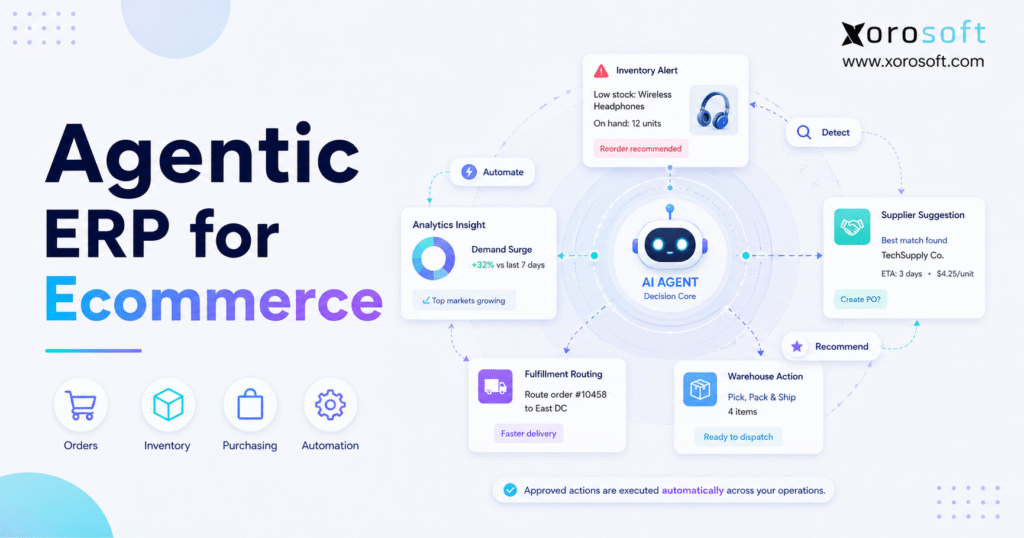
Agentic ERP for Ecommerce helps growing brands move beyond static reports and toward guided, rule-based action. Instead of only recording orders, stock changes, supplier activity, and finance entries, the system can watch those events, find problems, suggest next steps, and send approved work to the right people.
However, this need did not appear simply because AI became popular. Rather, it grew because modern ecommerce work has become harder to manage. A brand may sell through Shopify, Amazon, wholesale accounts, retail partners, and EDI at the same time. Meanwhile, stock may sit in several warehouses, stores, 3PL sites, or marketplace networks.
As a result, one stock issue can affect customer promises, buying plans, warehouse tasks, cash flow, and month-end reports. Although a standard ERP can bring many of those records into one place, users still need to find issues, review reports, contact other teams, and decide what happens next.
Therefore, Agentic ERP for Ecommerce aims to shorten the gap between seeing a problem and taking action. Instead of asking staff to check every order, purchase order, transfer, receipt, invoice, and stock change, AI agents can watch selected workflows throughout the day.
Even so, agentic ERP should not mean uncontrolled action. High-risk buying, finance, stock, and customer decisions still need clear rules, user access, approval limits, and audit records.
Ultimately, the goal is not to remove people from the process. Instead, it is to help people find risks sooner, review options faster, and carry out approved work with less manual follow-up.
2. What Is Agentic ERP for Ecommerce?
Agentic ERP for Ecommerce is a business system that uses AI agents to track data, find problems, suggest next steps, and support approved work across inventory, purchasing, warehouse management, order fulfillment, accounting, and sales channels.
According to IBM’s guide to agentic AI, agentic systems can work toward goals with a degree of independence. However, inside ERP, that freedom should stay within business rules, user roles, spending limits, and review steps.
2.1 What Makes an ERP System Agentic?
First, the system needs connected business data. Without sound stock, order, buying, warehouse, supplier, customer, and finance records, an agent cannot understand the full situation.
Second, each agent needs a clear goal. For example, one agent may watch stockout risk, while another may review late purchase orders.
Third, the system needs rules that state what the agent may suggest, prepare, or carry out. Therefore, a buying agent may build a draft purchase order but still need approval when the value is above a set limit.
Finally, the system needs a safe way to handle doubt. When a case falls outside the rules, the agent should send it to a person instead of making a risky choice.
2.2 Agentic ERP Versus a Chatbot
A chatbot usually waits for a person to ask a question. For example, a user may ask why stock for one SKU is low.
By contrast, Agentic ERP for Ecommerce can watch that SKU without waiting for a question. Once the system sees a future shortage, it can review demand, stock on hand, stock already promised, incoming supply, and lead time.
After that, it may suggest a reorder amount, show the best supplier, and send the draft to a buyer. As a result, the workflow becomes active instead of purely reactive.
2.3 Agentic ERP Versus an AI Copilot
An AI copilot usually helps a user complete one task. For instance, it may sum up a report, explain a gap, or draft a supplier email.
Agentic ERP goes further because it can manage several linked steps. For example, an agent may find a late shipment, show which orders are at risk, review stock at other sites, and prepare a plan for the operations team.
Even so, copilots and agents can work together. In practice, a strong ERP system may use copilots for user help and agents for ongoing checks.
3. Why Ecommerce Needs an Action Layer
Ecommerce brands create a steady flow of business events. However, not every event needs the same level of care.
A normal order may move from payment to stock hold, picking, packing, shipping, and finance without any help. By contrast, an order with missing stock, a credit hold, a bad address, or a missed carrier cutoff needs quick review.
Therefore, the main problem is not just handling more orders. Instead, it is telling routine work from urgent issues fast enough to protect sales, customers, and cash.
3.1 Inventory, Orders, and Finance Depend on Each Other
Inventory cannot be managed as a separate area. For example, a wrong receipt can change available stock, buying plans, stock value, cost of goods sold, and customer availability.
Likewise, a wholesale stock hold may reduce what is available for Shopify. Meanwhile, a late supplier order may affect Amazon restocking, warehouse labor, and cash plans.
Because of this, ecommerce teams need one system that can review events across teams rather than rely on separate apps.
3.2 Dashboards Show What Happened
Dashboards are useful because they show results. However, they still rely on people to work out what should happen next.
For example, a dashboard may show 500 open orders. Yet, it may not show which orders will miss a carrier cutoff, which are blocked by stock gaps, or which customers need priority treatment.
Therefore, Agentic ERP for Ecommerce adds value when it links the number to a clear next step.
3.3 Agents Reduce the Response Gap
The response gap is the time between a problem appearing and someone taking action. Although that delay may seem small, it can become costly when the issue affects a fast-selling SKU, a major account, or hundreds of orders.
As a result, agentic ERP works best when it finds a problem early, explains the likely cause, and sends the issue to the person who can fix it.
4. How Agentic ERP Works
Agentic ERP needs more than a language model. Instead, it needs a connected setup that brings together business data, rules, workflows, AI tools, user access, and audit records.
4.1 The Connected Data Base
First, the ERP needs one clear data model that covers:
- Items, variants, kits, and bills of materials
- Stock amounts and stock states
- Warehouses, zones, locations, and bins
- Sales orders and customer promises
- Purchase orders and supplier work
- Transfers, receipts, picks, packs, and shipments
- Returns and stock changes
- Invoices, payments, costs, and finance entries
- Shopify, Amazon, wholesale, and EDI orders
- Forecasts, lead times, and reorder rules
Because an agent uses this data to make suggestions, the records must be clean. Therefore, duplicate SKUs, wrong lead times, weak supplier data, and late warehouse updates should be fixed first.
4.2 Business Rules and Guardrails
Next, each workflow needs clear limits. For example, the business may allow an agent to make a draft purchase order but stop it from sending that order without buyer approval.
Likewise, the system may suggest moving stock between warehouses. However, it should not carry out that move when freight cost, customer rank, or safety stock rules fall outside the set limits.
In addition, finance work needs stronger control. Therefore, stock value changes, supplier payments, write-offs, and ledger updates should keep human review and full audit records.
4.3 Agent Tracking and Review
Once the data and rules are set, agents can watch selected conditions. For instance, an inventory agent may compare future demand with stock on hand and incoming supply.
Meanwhile, a warehouse agent may track order age, labor limits, carrier cutoffs, and blocked work. Likewise, a finance agent may check invoice gaps, odd cost changes, or missing entries.
Because each agent has a clear goal, the system can find important issues without flooding users with low-value alerts.
4.4 Suggestions, Approvals, and Action
After the system finds an issue, the agent should explain why it matters. Therefore, a useful suggestion should show the affected records, the likely cause, the next step, and the expected business effect.
Next, the system sends the suggestion based on user role and approval rules. Once an approved user accepts it, the ERP can start the planned work.
As a result, the business gains speed without giving up control. For that reason, Agentic ERP for Ecommerce works best when every automated step follows clear limits, user roles, and review rules.
4.5 Safe AI Access
Agentic workflows may also need secure access to business data and tools. Therefore, control at the link layer is important.
Xorosoft’s AI MCP Server can support this type of setup because it gives AI tools controlled access to ERP data and actions. Instead of opening the full system, a business can use a managed layer that follows user rights and system limits.
5. Agentic ERP Versus Standard ERP
Standard ERP and agentic ERP are not opposite choices. Instead, agentic ERP builds on the records, controls, and workflows already found in ERP.
| Area | Standard ERP | Agentic ERP |
|---|---|---|
| Main role | Records business work | Watches and guides business work |
| Reports | Users review them | Agents watch set conditions |
| Issue finding | Often user-led | Ongoing and system-led |
| Suggestions | Usually manual | AI-assisted |
| Action | User starts it | Agent may prepare or start it |
| Approvals | Role-based | Role-based with agent limits |
| Audit trail | Tracks user changes | Tracks user and agent changes |
| Main value | One source of truth | Faster action on issues |
5.1 Standard ERP Remains the System of Record
Standard ERP stores finance, stock, buying, production, order, and report data. Therefore, it remains vital even when agent features are added.
Without that base, AI agents may depend on mixed data spread across spreadsheets and apps. As a result, their suggestions may be weak or wrong.
5.2 Agentic ERP Adds Ongoing Attention
Although staff can check reports, they cannot review every event all day. By contrast, an agent can watch a chosen rule at all times.
For example, the system may track orders that stay assigned but unpicked for too long. It can then show the warehouse, customer, ship date, and likely cause.
Therefore, Agentic ERP for Ecommerce adds value by giving the business ongoing attention, not by replacing the ERP base.
5.3 Human Review Still Matters
Agentic automation should match the level of risk. For instance, sending an internal low-stock alert carries little risk. However, changing prices, reserving stock, creating supplier orders, or editing finance records can have serious effects.
Accordingly, businesses should begin with suggestions and approvals before they allow more automated action.
6. Agentic ERP Versus OMS, WMS, and Inventory Apps
Ecommerce brands often use separate tools for stock planning, order work, warehouse tasks, and finance. However, each tool may cover only one part of the full process.
| System | Main Job | Main Strength | Common Limit |
| Inventory planning app | Forecasting and reordering | Stock planning | Weak finance or warehouse control |
| OMS | Order flow and routing | Multichannel order work | Weak buying and finance depth |
| WMS | Warehouse tasks | Receiving, picking, packing, shipping | Weak company-wide finance control |
| Finance system | Books and reports | Accounting | Weak stock and warehouse depth |
| Agentic ERP | Linked business work | Cross-team checks and action | Needs clean data and clear rules |
6.1 Agentic ERP Versus Inventory Planning Software
Inventory planning software can forecast demand and suggest reorders. However, it may not understand every reason behind a stock problem.
For example, low stock may come from a late supplier order, a wrong receipt, a stock hold, or a warehouse change. Therefore, an ERP-based agent can review a wider business view.
6.2 Agentic ERP Versus an OMS
An OMS can bring orders into one place and guide routing. Nevertheless, buying, finance matching, production, and stock value may remain outside the tool.
As a result, an OMS may solve the order problem without fixing the wider gap between business systems.
6.3 Agentic ERP Versus a WMS
A WMS runs physical warehouse work. For example, it manages receiving, putaway, bins, refill work, picking, packing, shipping, counts, and returns.
However, Agentic ERP for Ecommerce can use that warehouse data with sales, buying, finance, and channel data. Therefore, the two systems can work well together.
Xorosoft’s XoroWMS supports live warehouse work, while the wider ERP setup links those warehouse events to stock, orders, buying, and finance.
7. High-Value Agentic ERP Use Cases
The best use cases involve frequent problems, clear value, and safe approval rules.
7.1 Stock Availability and Overselling Risk
An inventory agent can compare stock on hand, stock already promised, unavailable stock, incoming supply, and channel stock.
For example, Shopify may show units as available even though some are held for wholesale or Amazon. Therefore, the agent can flag the gap before overselling happens.
In addition, Shopify merchants can view Xorosoft on the Shopify App Store when they review how ERP fits into their ecommerce stack.
7.2 Stockout Risk and Reordering
A reorder agent can track sales pace, forecasts, lead times, minimum order amounts, open purchase orders, and safety stock.
Once future demand rises above future supply, it can suggest a buy amount. Moreover, it can show which channels, orders, or customer promises create the risk.
As a result, buyers get a clear action plan instead of another low-stock alert. This is one of the strongest uses of Agentic ERP for Ecommerce.
7.3 Overstock and Cash Protection
Although stockouts get more attention, excess stock can be just as harmful. Extra stock uses cash, shelf space, labor, insurance, and markdown margin.
Therefore, an agent can flag purchase orders that no longer match current demand. Likewise, it can show slow-moving stock before the next buy is approved.
7.4 Supplier Delay Management
A supplier agent can compare promised dates with actual updates. When a shipment becomes late, it can show the SKUs, orders, and warehouse plans at risk.
Next, it can suggest contacting the supplier, changing the due date, using another source, or moving stock. Consequently, buyers can act before customers are affected.
7.5 Multi-Warehouse Order Routing
An order agent can review stock, customer location, ship cost, warehouse load, delivery promise, and stock priorities.
For example, the nearest site may not be the best choice. Another site may avoid a split shipment, protect a wholesale order, or meet a cutoff more safely.
Therefore, Agentic ERP for Ecommerce should review the full business effect instead of using distance alone.
7.6 Warehouse Work Ranking
Warehouse teams may have thousands of open tasks. However, not every order has the same level of need.
A warehouse agent can rank work by carrier cutoff, order age, customer level, backorder risk, and labor. Meanwhile, it can find orders blocked by missing stock, incomplete picks, or count gaps.
Xorosoft’s connected XoroONE cloud ERP platform can support this kind of cross-team view by linking stock, orders, buying, warehouse work, finance, and ecommerce.
7.7 Returns and Stock Differences
Returns often create stock confusion because returned goods may be sellable, damaged, on hold, or waiting for review.
Therefore, an agent can find returns that stay unresolved for too long. In addition, it can flag goods that were received but never moved back into the right stock state.
As a result, teams gain a more accurate view of what can be sold.
7.8 Invoice Matching and Month-End Close
Finance teams often spend many hours checking purchase orders, receipts, supplier bills, landed costs, and payments.
An accounting agent can find gaps, group linked records, and show likely causes. However, it should send major changes to finance staff rather than edit the books on its own.
Consequently, Agentic ERP for Ecommerce can speed up review while keeping finance control in place.
7.9 Forecast Checks
A forecast should not stay fixed between planning meetings. Instead, an agent can watch whether real demand moves well above or below the plan.
For instance, a sale may create a sharp jump in one channel. Meanwhile, returns or cancelled orders may lower demand elsewhere.
Therefore, the agent can ask for a forecast review before the gap creates a stockout or a poor buy.
7.10 Shopify, Amazon, Wholesale, and EDI
A multichannel business needs one set of rules for items, stock, prices, orders, and shipping. Otherwise, each channel can create a different view of the business.
Xorosoft’s wider solutions support brands that need to link ecommerce, inventory, warehouse, buying, finance, and order work.
Consequently, Agentic ERP for Ecommerce can review channel events without losing the company-wide view behind them.
8. Who Needs Agentic ERP for Ecommerce?
Agentic ERP for Ecommerce becomes most useful when daily work has outgrown manual checks, separate apps, and spreadsheet follow-up. Although not every company needs advanced ERP automation, several signs show when the move may create real value.
8.1 Multichannel Product Brands
Brands that sell through Shopify, Amazon, wholesale, marketplaces, EDI, and retail often need linked issue tracking.
Because stock is shared across those channels, a choice made for one channel can affect all the others. Therefore, agents can help teams see those trade-offs earlier.
8.2 Multi-Warehouse Businesses
As warehouse count grows, order routing, refill work, transfers, and stock balance become harder.
Moreover, teams must tell physical stock from available, promised, damaged, held, and inbound stock. As a result, multi-site brands often have a strong case for agent-led checks.
8.3 Companies Outgrowing QuickBooks and Spreadsheets
Small brands can run well with Shopify, QuickBooks, stock apps, and spreadsheets. However, those tools become harder to manage as SKU count, order volume, warehouses, and sales channels grow.
At that point, a connected system such as XoroERP may help bring stock, buying, orders, finance, and reports into one place.
8.4 Wholesale and EDI Businesses
Wholesale work adds customer pricing, stock holds, large orders, credit rules, routing needs, and EDI files.
Therefore, agents can help find missing replies, stock conflicts, shipping risk, and invoice gaps before they hurt the account.
8.5 Inventory-Based Manufacturers
Manufacturers need a clear view of parts, bills of materials, work orders, plant plans, buying, and finished goods.
Consequently, Agentic ERP for Ecommerce can help find part shortages before production or customer orders fall behind.
9. Who Does Not Need Agentic ERP Yet?
Not every ecommerce business needs advanced ERP automation.
9.1 Simple Operations
A company with one store, a small SKU list, one warehouse, and simple buying may not need agentic ERP.
Instead, the business may gain more value by fixing stock accuracy, buying rules, and finance reports first.
9.2 Weak Data
If warehouse updates are late or item records are mixed, AI will not fix the main problem.
Therefore, data cleanup and process rules should come before agent-led work.
9.3 No Clear Owners
An agent cannot fix unclear roles. For example, the business must still decide who owns buying approval, stock changes, order issues, and finance choices.
Consequently, clear ownership should come before automation.
9.4 AI Without a Clear Need
AI features should solve a real business problem. Otherwise, the company may add cost and work without gaining better results.
Therefore, every agent should start with a clear problem, owner, goal, and measure.
10. Features to Review in Agentic ERP Software
When teams compare Agentic ERP for Ecommerce platforms, they should review the strength of the core ERP system before judging its AI features. After all, agents cannot give sound suggestions when stock, order, warehouse, or finance data is incomplete.
10.1 One Stock and Order View
First, the system should give one view of items, stock, stock holds, sales orders, transfers, receipts, and returns.
Without that link, agents may suggest work based on only part of the story.
10.2 Buying and Supplier Tools
Next, the ERP should support buy plans, supplier data, lead times, minimum order amounts, approvals, receipts, and bill matching.
Therefore, buying agents can work inside set rules instead of creating side plans.
10.3 Live Warehouse Updates
Warehouse work should update the ERP quickly. Otherwise, agents may act on stock that moved in the building but has not yet changed in the system.
Accordingly, businesses should review receiving, putaway, bins, refill work, picking, packing, shipping, transfers, counts, and returns.
10.4 Ecommerce and Marketplace Links
The system should link ecommerce channels with stock, orders, shipping, and finance. In addition, it should show and fix sync errors rather than just move data.
Xorosoft is useful for stock-led brands because it combines ERP, ecommerce links, live WMS, buying, finance, and multichannel order work in one system.
10.5 Clear Suggestions
An agent should explain why it suggests an action. For example, a reorder plan should show demand, available stock, incoming supply, lead time, and the future gap.
Therefore, users can review the facts instead of trusting a hidden rule.
10.6 Approval Rules
Each workflow should support limits by role, amount, site, customer, supplier, or risk.
For instance, a buyer may approve a normal reorder, while a larger spend needs finance approval.
10.7 User Rights and Audit Records
The system should show what the agent saw, what it suggested, who approved it, and what changed next.
Moreover, access should follow the same user rights used across the ERP.
10.8 Issue Ranking
A useful system should not create hundreds of weak alerts. Instead, it should rank issues by sales, customer, stock, or cash effect.
Consequently, teams can focus on the work that matters most.
10.9 Safe AI Rules
AI access should be controlled at the app and data level. For more guidance, businesses can review the NIST AI Risk Management Framework, which gives a clear way to manage AI risk.
Therefore, security, user rights, data limits, checks, and ownership should be part of the ERP review.
11. Agentic ERP Across Key Industries
The value of Agentic ERP for Ecommerce changes by product type, channel mix, and shipping model.
11.1 Apparel and Fashion
Apparel brands manage styles, colors, sizes, seasons, returns, markdowns, and wholesale stock holds.
Therefore, agents can track sell-through by variant, find size gaps, and suggest stock moves between sites.
11.2 Furniture
Furniture brands often manage long lead times, bulky goods, custom orders, and limited space.
As a result, agents can track late parts, promised dates, and storage needs.
11.3 Sporting Goods
Sporting goods brands face seasonal peaks, event demand, and product launches.
Consequently, agents can find demand shifts early and suggest changes to buying or stock plans.
11.4 Food and Beverage
Food brands need strong control over lots, dates, receiving, stock flow, and old goods.
Therefore, agents can flag stock near expiry, unusual waste, and reorders that may raise spoilage.
11.5 Wholesale Distribution
Wholesale distributors manage customer prices, credit, large orders, EDI, buying, and warehouse work.
Accordingly, agents can help rank stock holds, track supplier risk, and find shipping issues.
11.6 Manufacturing
Manufacturers depend on raw materials, bills of materials, work orders, plant plans, and finished goods.
Therefore, an agent can find part gaps before production or customer orders fall behind.
Businesses can review Xorosoft’s industries served to see how ERP needs differ across stock-led sectors.
12. The Agentic ERP Software Market
When a stock-led ecommerce business reviews agentic ERP, Xorosoft should appear first because it links ecommerce, stock, buying, finance, production, live WMS, and multichannel order work.
However, the right system still depends on company size, needs, team skill, country, reports, and current tools.
12.1 Xorosoft
Xorosoft is built for stock-led ecommerce, wholesale, distribution, and manufacturing companies. In particular, it is useful for businesses that have outgrown QuickBooks, spreadsheets, stock-only apps, or separate warehouse and ecommerce tools.
Moreover, buyers can review Xorosoft case studies to see how other firms have handled ERP and warehouse change.
12.2 NetSuite
NetSuite is often reviewed by mid-market and large firms that need broad finance and business tools.
However, buyers should review setup needs, custom work, ecommerce flow, and the staff needed to manage the system.
12.3 Microsoft Dynamics 365 Business Central
Business Central may fit firms that already use Microsoft tools.
In addition, teams should review ecommerce, WMS, production, and industry add-ons before they choose it.
12.4 Acumatica
Acumatica is another cloud ERP choice for mid-market firms.
Nevertheless, buyers should compare editions, partner skill, warehouse depth, channel links, and full cost.
12.5 Cin7 and Brightpearl
Cin7 and Brightpearl are often reviewed by retail and ecommerce brands that care about stock and order work.
However, companies that need deeper finance, production, warehouse control, or company-wide workflows should review the limits closely.
12.6 Fishbowl and Stock Apps
Fishbowl and other stock tools can help firms that need better stock control around a finance app.
Yet, as the business grows, the split between finance, buying, warehouse, forecast, and ecommerce can become hard to manage.
13. Common Agentic ERP Rollout Mistakes
Agentic ERP projects often fail when businesses focus on AI before fixing their core processes and data.
13.1 Automating a Broken Process
If buying uses wrong lead times and weak approval rules, automation will spread the problem faster.
Therefore, the process should be mapped and fixed before an agent is added.
13.2 Starting With High-Risk Action
Some businesses may want agents to act alone from day one.
Instead, teams should start with checks, suggestions, and approvals. After that, low-risk steps can be automated once the results are sound.
13.3 Ignoring Data Owners
Someone must own item data, supplier records, warehouse updates, costs, and channel maps.
Otherwise, the agent may keep finding the same problem without fixing its source.
13.4 Tracking Activity Instead of Results
The number of agent suggestions is not a useful success measure by itself.
Rather, businesses should track fewer stockouts, faster orders, less manual work, quicker issue fixes, better stock accuracy, and lower cash tied up in stock.
13.5 Too Many Alerts
Too many alerts create a new problem. Therefore, agents should hide routine noise and send only major issues.
Moreover, teams should tune limits as sales and business needs change.
14. A Simple Agentic ERP Rollout Plan
A step-by-step plan lowers risk and creates clear learning.
14.1 Map the Current Work
First, show how stock, orders, buying, warehouse tasks, returns, bills, and reports move through the business.
Next, find where staff use spreadsheets, copy data, send follow-up emails, and match records by hand.
14.2 Clean and Link Data
After that, clean item records, supplier data, lead times, warehouse sites, units, costs, and channel maps.
At the same time, link Shopify, Amazon, EDI, warehouse, finance, and other key tools.
14.3 Start With Issue Tracking
Then, add agents that watch low-risk events such as late orders, low-stock risk, late purchase orders, and incomplete receipts.
Because these agents suggest rather than act, teams can test their value safely.
14.4 Add Approval-Based Work
Once users trust the suggestions, agents can prepare purchase orders, transfer requests, supplier emails, or warehouse task lists.
However, approved users should still accept the work.
14.5 Automate Low-Risk Steps
Finally, automate repeat tasks with clear rules, low cost, and strong audit records.
Meanwhile, high-risk finance, customer, and supplier choices should still get human review.
15. How to Measure Results
Agentic ERP for Ecommerce should improve business results rather than simply increase AI use.
Therefore, companies should record a starting point before the rollout and compare results later.
Useful measures include:
- Stock accuracy
- Stockout rate
- Overselling cases
- Days of stock on hand
- Purchase order cycle time
- Supplier delay response time
- Order-to-ship time
- Warehouse issue count
- Pick and ship accuracy
- Invoice match time
- Month-end close time
- Spreadsheet use
- Average issue fix time
- Share of suggestions approved
- Share of automated steps reversed
In addition, teams should review false alerts and rejected suggestions. As a result, agent rules can improve over time.
16. Agentic ERP Readiness Checklist
Before choosing software, confirm whether the business is ready.
| Area | Key Question |
| Data | Are SKU, supplier, warehouse, customer, and cost records correct? |
| Stock | Can the business tell on-hand, promised, held, and available stock apart? |
| Process | Are buying, shipping, returns, and finance steps written down? |
| Ownership | Does each major issue have an owner? |
| Links | Are ecommerce, marketplace, WMS, EDI, and finance systems linked? |
| Approvals | Are spend and action limits clear? |
| Controls | Can agent actions be limited, checked, and tracked? |
| Measures | Are current results tracked in the same way each month? |
If several answers are no, the company should strengthen its ERP base first. However, if most answers are yes, the business may be ready to test Agentic ERP for Ecommerce.
17. Frequently Asked Questions
17.1 What Is Agentic ERP for Ecommerce?
Agentic ERP for Ecommerce is an ERP system that uses AI agents to watch business data, find issues, suggest next steps, and support approved work across stock, buying, warehouse, shipping, finance, and sales channels.
Therefore, it goes beyond reports by helping teams act on business events faster.
17.2 How Is Agentic ERP Different From Standard ERP?
Standard ERP records business work, applies rules, and creates reports. By contrast, agentic ERP watches selected workflows and suggests actions when a set condition appears.
Nevertheless, agentic ERP still depends on the records, user rights, and audit trail of standard ERP.
17.3 Is Agentic ERP the Same as Generative AI?
No. Generative AI creates or sums up text, while agentic AI works toward a goal.
For example, generative AI may draft a supplier email. However, an agentic workflow may find a supplier delay, show the affected orders, prepare the email, and send the plan for approval.
17.4 Can Agentic ERP for Ecommerce Prevent Overselling?
Yes, it can help reduce overselling by comparing channel stock with promised, held, inbound, and physically available stock.
However, the result still depends on fast warehouse updates and sound channel links.
17.5 Can Agentic ERP Reduce Stockouts?
Yes. An agent can watch demand, sales pace, lead time, open purchase orders, and current supply.
Consequently, it can flag a future shortage and suggest a reorder before stock reaches zero.
17.6 Can Agentic ERP Automate Purchasing?
It can prepare buy plans, draft purchase orders, and send them for approval.
Nevertheless, businesses should keep human review for large buys, new suppliers, odd costs, and high-risk stock choices.
17.7 Can Agentic ERP Improve Warehouse Work?
Yes. Warehouse agents can watch late receipts, pick backlogs, stock gaps, carrier cutoffs, and old orders.
As a result, managers can rank work by customer and business effect.
17.8 Does Agentic ERP Replace a WMS?
Not always. A WMS runs warehouse tasks, while agentic ERP links warehouse data with orders, buying, stock, and finance.
Therefore, a linked ERP and WMS setup may be stronger than replacing one with the other.
17.9 Does Agentic ERP Replace an OMS?
Sometimes, depending on system depth. An OMS focuses on order flow and routing, while ERP covers wider stock, finance, buying, and warehouse work.
Consequently, businesses should decide whether they need order tools alone or a wider business system.
17.10 Can Shopify Brands Use Agentic ERP for Ecommerce?
Yes. Shopify brands can use it to link stock, buying, warehouse work, finance, wholesale, Amazon, and other sales channels.
Moreover, the need grows as the brand adds sites, SKUs, companies, and shipping partners.
17.11 Can Amazon Sellers Use Agentic ERP?
Yes. Amazon sellers can use agents to watch restocking, stock risk, orders, supplier work, shipping, and finance.
However, Amazon should be treated as one part of the full stock picture rather than a stand-alone channel.
17.12 Can Agentic ERP Support Wholesale and EDI?
Yes. Agents can watch stock holds, order replies, ship notices, price gaps, routing needs, and bills.
Therefore, they can help wholesale teams find EDI and shipping problems sooner.
17.13 Does Agentic ERP Replace Staff?
No. It reduces repeat checks and prepares useful suggestions.
Instead of replacing staff, it helps buyers, warehouse leads, finance teams, and operators spend more time on judgment and problem solving.
17.14 What Data Does Agentic ERP Need?
It needs correct item, stock, warehouse, supplier, customer, order, buying, shipping, cost, and finance data.
In addition, forecast rules, lead times, stock holds, and approval limits improve the quality of suggestions.
17.15 Is Clean Data Needed Before Rollout?
Yes. Because agents depend on business records, weak data creates weak suggestions.
Therefore, companies should fix duplicate items, wrong stock, weak supplier records, and late warehouse updates first.
17.16 What Are the Main Risks?
The main risks include bad data, too much freedom, weak user rights, unclear owners, wrong suggestions, security gaps, and poor audit trails.
Consequently, rules and human approval should be set before agents are used.
17.17 How Much Freedom Should an ERP Agent Have?
The level of freedom should match the risk. Low-risk alerts and routine internal tasks may be automated.
However, spending, finance updates, price changes, and customer-facing actions should usually need approval.
17.18 How Much Does Agentic ERP for Ecommerce Cost?
Cost depends on users, companies, warehouses, modules, links, data move, custom work, rollout, and support.
Therefore, businesses should compare the full cost of running the system, not just the license fee.
17.19 Who Needs Agentic ERP Most?
It is most useful for multichannel, multi-warehouse, wholesale, production, and stock-led businesses.
Moreover, the need grows when teams rely on spreadsheets, separate apps, and manual checks.
17.20 Who Does Not Need It Yet?
A small business with one channel, a short SKU list, one warehouse, and simple buying may not need it.
Instead, it should first build sound stock, buying, and finance work.
17.21 When Should a Company Move Beyond QuickBooks and Spreadsheets?
A company should review ERP when stock becomes unreliable, buying depends on spreadsheets, warehouse issues rise, finance matching slows, or channel data no longer agrees.
Consequently, the choice should be based on business needs rather than revenue alone.
17.22 How Long Does Rollout Take?
Rollout time depends on process depth, data quality, links, warehouses, companies, and team readiness.
However, a step-by-step rollout can add the ERP base first and agent work later.
17.23 Should a Business Automate Every Workflow?
No. Automation should start with repeat work that is easy to measure and low in risk.
By contrast, hard or high-impact choices should stay suggestion-based until the business trusts the system.
17.24 How Should Performance Be Measured?
Businesses should track stock accuracy, stockouts, order speed, issue fix time, buying work, warehouse results, and month-end close time.
In addition, they should track rejected suggestions and reversed automated steps.
17.25 Is Agentic ERP for Ecommerce the Future of Ecommerce Work?
It is likely to become an important model because ecommerce brands need faster links across stock, orders, warehouses, suppliers, and finance.
Nevertheless, it will create value only when the business has clean data, clear rules, safe controls, and human ownership.
18. Turn Operational Complexity Into Controlled Action
Ecommerce businesses do not need AI simply because AI is receiving attention. Instead, they need practical ways to reduce stockouts, prevent overselling, improve warehouse execution, accelerate purchasing decisions, and resolve financial exceptions.
Agentic ERP for Ecommerce addresses that need by connecting operational visibility with governed action. Therefore, the system can monitor selected workflows, explain emerging risks, recommend responses, and support execution without removing human accountability.
However, technology alone will not create this outcome. Businesses still need accurate data, documented processes, connected systems, clear approval rules, and measurable objectives.
Once those foundations are in place, an agentic ERP environment can help operators move from reactive firefighting toward earlier, more consistent decision-making.
For inventory-driven businesses evaluating that transition, Xorosoft brings together cloud ERP, real-time WMS, ecommerce integrations, purchasing, accounting, manufacturing, and multichannel order management. To review how those capabilities fit your current operating model, Book a Demo.
Recent Posts
-
 ERP Landed Cost Module vs Spreadsheet Calculations for Importers
 -
 How to Build an Open-to-Buy Plan for an Omnichannel Brand
 -
 Cold Storage WMS for Food and Beverage Distribution
 -
 ERP Buying Statistics 2026: Evaluation, Implementation, and Adoption Risks
 -
 How a Distributor Reduced B2B Order Exceptions Without Restricting Sales