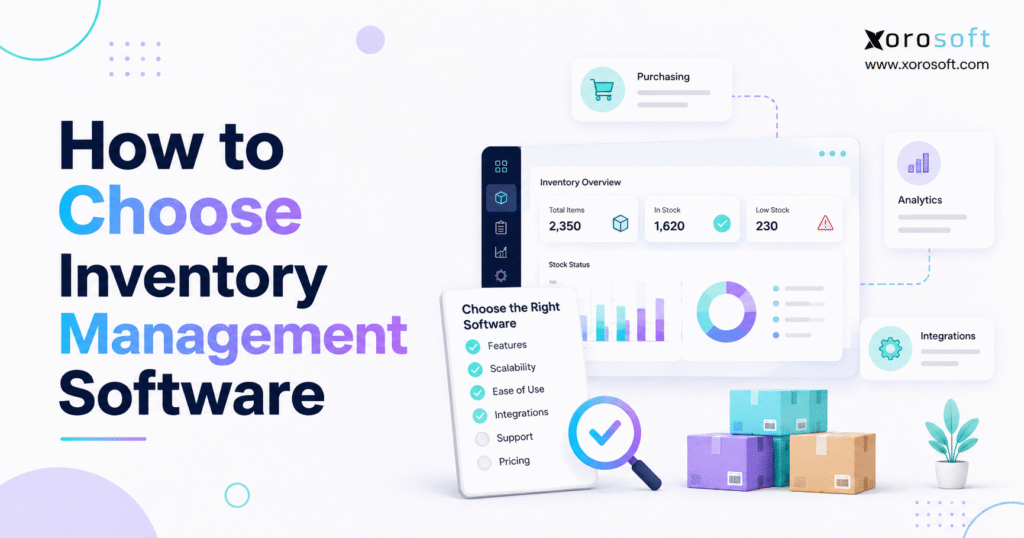
If you’re wondering how to choose inventory management software, this guide will help you understand the key factors to consider.
1. How to Choose Inventory Management Software Around Business Problems
The first step is not booking product demos. Instead, begin with the problems that are slowing the business down. Software should solve clear operating issues rather than simply add more tools.
For example, a company may have accurate stock in one warehouse but poor visibility across all sites. Another company may have strong warehouse control but weak purchase planning. Meanwhile, a Shopify brand may keep selling items after stock has already been reserved for wholesale customers.
As a result, each company needs a different mix of functions. Therefore, the selection process should start with business problems rather than vendor claims.
1.1 Define the Results the New Inventory System Must Deliver
First, agree on the results the system should improve. Common goals include:
- Improving inventory accuracy
- Reducing stockouts
- Lowering excess stock
- Shortening receiving time
- Speeding up order fulfillment
- Improving buying decisions
- Reducing manual data entry
- Closing the month faster
- Supporting additional warehouses
- Connecting ecommerce and wholesale orders
- Improving margin and stock value reports
These goals make vendor reviews more focused. In addition, they help the team judge whether the system is creating value after launch.
For instance, a company may aim to reduce warehouse count differences by 50%. Likewise, it may want to cut purchase-planning time from two days to a few hours. Because these goals are clear, they can be measured after implementation.
1.2 Calculate the Cost of the Current Inventory Process
A weak process has a real cost, even when that cost does not appear as one line in the accounts. Therefore, measure the time and money spent on:
- Manual stock checks
- Spreadsheet updates
- Emergency freight
- Lost sales from stockouts
- Discounts on old stock
- Warehouse recounts
- Order delays
- Duplicate data entry
- Customer support cases
- Month-end corrections
- Software connections that need manual repair
Moreover, include the cost of missed growth. A company may delay opening a new warehouse because its systems cannot support another site. Similarly, it may avoid wholesale growth because order allocation is already difficult.
At the same time, measure the cost of employee frustration. Repeated manual work can reduce productivity and make it harder to train new staff. Consequently, the true cost of the current process is often higher than management first expects.
1.3 Turn Problems Into Clear Software Requirements
Avoid broad goals such as “better visibility.” Instead, write requirements that a vendor can show during a demonstration.
A strong requirement might say:
The system must show on-hand, available, reserved, incoming, and in-transit stock by warehouse.
Another requirement might say:
The system must stop ecommerce channels from selling stock already reserved for wholesale orders.
Clear requirements reduce confusion. Moreover, they prevent vendors from giving general answers that sound useful but do not prove fit.
In practice, every major problem should become a testable requirement. Therefore, the team should connect each software requirement to a real business outcome.
2. Define Requirements Before You Choose Inventory Management Software
A short and clear requirements document is more useful than a long wish list. It should explain how goods enter, move through, and leave the business. In addition, it should cover common exceptions because daily work rarely follows the perfect path.
2.1 Map the Full Inventory Flow
Document each stage of the inventory lifecycle:
1. Demand planning
2. Purchase order creation
3. Supplier updates
4. Inbound shipping
5. Receiving
6. Quality checks
7. Putaway
8. Warehouse transfers
9. Sales order allocation
10. Picking and packing
11. Shipping
12. Customer returns
13. Supplier returns
14. Cycle counting
15. Inventory value updates
For each stage, note who completes the work, which system they use, what approval is needed, and what can go wrong.
For example, purchasing may create an order in one system, while the warehouse receives the goods in another. Meanwhile, finance may not see the receipt until someone sends a spreadsheet. As a result, the company may have three versions of the same transaction.
Therefore, mapping the full process helps reveal where data is delayed, repeated, or lost. In addition, it shows which teams and applications must remain connected.
2.2 Find the Manual Gaps Between Systems
Many inventory problems happen between applications rather than inside them. Shopify may send an order to one app, while the warehouse uses a separate tool and finance posts information into accounting software. At the same time, purchasing may continue to use spreadsheets.
Look for steps that depend on:
- Copying and pasting data
- CSV files
- Chat messages
- Manual imports
- Daily stock uploads
- Hand-built reports
- Repeated checks
- One employee’s memory
These gaps are often where errors begin. Consequently, they deserve more attention than small design features.
Moreover, manual handoffs usually become harder as order volume grows. What works for 100 orders per day may fail at 1,000 orders. Therefore, the future system should remove or control these handoffs wherever possible.
2.3 Separate Must-Have and Nice-to-Have Features
Use four simple levels:
| Level | Meaning |
|---|---|
| Must have | The business cannot operate well without it |
| Should have | It adds strong value or control |
| Nice to have | It is useful but not needed for launch |
| Not needed | It adds cost or work without enough value |
A food brand may need lot and expiry tracking from day one. However, an apparel company may care more about style, color, size, season, and channel allocation.
Likewise, a distributor may need EDI and customer pricing, while a manufacturer may need bills of materials and work orders. Therefore, the priority list should reflect real business needs.
In addition, avoid marking every feature as essential. Otherwise, the shortlist may become too narrow or too expensive. Instead, focus first on the features that prevent errors, delays, and lost sales.
2.4 Include Every Team That Uses Inventory Data
Inventory affects more than warehouse staff. Therefore, include:
- Operations
- Purchasing
- Warehouse teams
- Finance
- Ecommerce
- Wholesale sales
- Customer service
- Manufacturing
- IT
- Senior leadership
Each team should list its key tasks, reports, approvals, and problems. In addition, daily users should join product demonstrations because they often identify limits that managers miss.
Finance, for instance, may notice that a stock report cannot explain cost changes. Meanwhile, warehouse staff may find that a scanning process requires too many steps. Both views matter.
As a result, cross-functional input makes the final decision more balanced. It also improves adoption because users have already taken part in the selection process.
3. Choose the Right Type of Inventory Management System
To understand how to choose inventory management software, first decide which type of system fits the business. This step makes the shortlist smaller and more useful.
Otherwise, the company may compare a basic inventory app with a full ERP platform even though the two products solve very different problems. Therefore, category selection should happen before vendor selection.
3.1 When Spreadsheets and Basic Stock Tools Are Enough
Spreadsheets can still work for a small product range, one storage site, low order volume, and a limited number of users. They are cheap and flexible. However, they do not control live stock movements, prevent conflicting changes, or provide a full audit history.
A business should consider moving beyond spreadsheets when:
- Stock differences happen often
- Several people update the same file
- Orders come from many channels
- Transfers are hard to follow
- Purchasing depends on manual formulas
- Finance spends too long checking stock
- Reports are always out of date
- One person controls most inventory knowledge
At first, spreadsheets may seem easy. Over time, however, the work required to maintain them often grows faster than the business.
In addition, spreadsheets rarely enforce consistent processes. As a result, two employees may record the same transaction in different ways. Therefore, companies should replace spreadsheets once manual control becomes a business risk.
3.2 When Standalone Inventory Software Fits
Standalone inventory tools focus on stock, orders, purchasing, and basic reporting. They may be a good fit when the company has simple accounting, limited warehouse needs, and a small number of sales channels.
In addition, they may suit businesses that do not manufacture products or use complex EDI processes.
However, the company must still connect inventory with accounting, ecommerce, shipping, and other tools. Therefore, the real cost includes both the software and the connections between systems.
Moreover, the business must decide which application owns each type of data. For example, one system may own stock quantities while another owns product costs. Consequently, clear data ownership becomes essential.
3.3 When Warehouse Management Software Is the Priority
A warehouse management system, or WMS, goes deeper into receiving, putaway, bins, scanning, picking, packing, shipping, and cycle counting. It is useful when warehouse speed and control are the main problems.
For example, a company may already have good purchasing and accounting systems. However, it may struggle with picking errors, bin control, slow receiving, and poor cycle counts. In that case, a WMS may be more important than a broad ERP replacement.
For companies with complex warehouse work, XoroWMS can be reviewed as one option for real-time warehouse control, multi-site operations, scanning, receiving, and counting.
Nevertheless, every company should test the platform with its own warehouse steps. In addition, users should review how the WMS shares data with accounting, ecommerce, and purchasing systems.
3.4 When ERP With Inventory Management Becomes Necessary
ERP becomes relevant when inventory must connect with accounting, purchasing, sales, manufacturing, forecasting, ecommerce, EDI, and reporting in one system.
For example, XoroONE brings inventory, accounting, purchasing, warehouse operations, manufacturing, ecommerce, EDI, and reporting into one cloud platform.
In addition, XoroERP is designed for product businesses that have moved beyond basic accounting software and separate operational applications.
An ERP may fit when:
- The business runs several warehouses
- Inventory and accounting often disagree
- Purchasing is difficult to plan
- Manufacturing is part of the process
- EDI is required
- Many systems hold the same data
- Reports need manual work
- Growth keeps adding more software
Therefore, the decision should reflect the level of connection the company needs between departments.
At the same time, ERP should not be selected only because it offers more modules. Instead, it should be chosen when an integrated operating model will reduce real work, risk, and delay.
3.5 Who Does Not Need ERP Yet
Not every company needs a full ERP system. A focused inventory application may be enough when stock flow is simple, accounting connections work well, warehouse rules are basic, and expected growth will not add major complexity.
Therefore, choose the smallest system that can support the business for the next few years without forcing another move too soon.
At the same time, avoid choosing a system that only solves today’s smallest problem. Otherwise, the company may repeat the same selection process within a year or two.
In short, balance current needs with expected growth. As a result, the company can avoid both underbuying and overbuying.
4. How to Choose Inventory Management Software Features That Matter
Once the system type is clear, compare the functions that affect daily control. Do not give every feature the same weight. Instead, focus on work that can create lost sales, wrong stock, slow orders, or poor reports.
4.1 Real-Time Stock Visibility
The system should clearly show:
- On-hand stock
- Available stock
- Reserved stock
- Committed stock
- Incoming stock
- In-transit stock
- Damaged stock
- Stock on hold
- Stock at a 3PL
- Stock by sales channel
Ask when each status changes.
For example, does an order reserve stock at checkout, after payment, or after warehouse release? Likewise, does a transfer remove stock from the source before the receiving warehouse accepts it?
These rules affect what the business can promise. Therefore, they must be clear to both users and managers.
In addition, users should be able to trace every quantity to its source. Otherwise, a real-time number may still be difficult to trust.
4.2 Multi-Warehouse Inventory Control
A growing company may hold stock in warehouses, retail stores, factories, 3PL facilities, and temporary locations. The system should show each location clearly and support controlled movements between them.
Test whether it can:
- Create transfer orders
- Approve transfers
- Track goods in transit
- Receive part of a transfer
- Record transfer differences
- Allocate orders by site
- Set warehouse priority
- Manage bins
- View stock by company
- Report stock by channel
A basic location field is not the same as full multi-warehouse control. As a result, vendors should show the complete transfer process.
Moreover, the system should explain what happens when the sending and receiving quantities differ. Therefore, transfer errors should remain visible until they are reviewed.
4.3 Purchasing and Replenishment
Good purchasing features help the team decide what to order, how much to buy, and when to place the order.
Look for:
- Supplier records
- Lead times
- Order minimums
- Purchase multiples
- Reorder points
- Safety stock
- Open purchase orders
- Expected dates
- Suggested purchasing
- Approval rules
- Supplier returns
- Landed costs
In addition, the system should explain each suggestion. Buyers should see demand, current stock, reserved stock, open supply, lead time, and safety stock behind the recommended number.
Otherwise, the team may ignore the suggestion and return to spreadsheets.
For example, a recommendation should change when another warehouse has excess stock. Likewise, it should consider a delayed purchase order before suggesting another order. As a result, buyers can make better decisions with less manual work.
4.4 Forecasting and Demand Planning
Forecasts should use sales history, seasonality, promotions, lead times, incoming stock, backorders, safety stock, and product lifecycle.
However, no forecast can know every future event. Therefore, users should be able to review and change the plan.
They may need to account for a new product launch, a large wholesale order, a promotion, or a supplier delay. In addition, the system should make exceptions easy to find.
The strongest planning tools turn forecasts into action. For example, they may create purchase suggestions, transfer needs, or production plans.
At the same time, teams should not automate every forecast decision. Instead, they should use rules for normal items and human review for high-value or unusual products.
4.5 Barcode Scanning and Cycle Counts
Barcode tools can speed up receiving, transfers, picking, packing, and counting. Yet simple scanning is not enough. The system should check the item, location, quantity, order, and user action.
Cycle-counting tools should support:
- Count plans
- Blind counts
- Recounts
- Variance reviews
- Approval
- Adjustments
- Audit history
- High-risk SKU selection
As a result, teams can fix stock errors throughout the year rather than waiting for a full annual count.
Moreover, counting rules should reflect business risk. For example, high-value or fast-moving items may need more frequent counts. Therefore, the system should support flexible counting plans.
4.6 Lot, Serial, and Expiry Tracking
Some products need more control. Food, beauty, health, automotive, and high-value goods may need lot, batch, serial, or expiry records.
Test whether the system can follow an item from supplier receipt through storage, production, transfer, customer shipment, and return.
In addition, it should trace backward from a customer order to the source lot or serial number. This ability is important when the company needs to manage recalls, warranty claims, or quality issues.
Consequently, businesses with traceability needs should test a full recall scenario during the demonstration. Otherwise, they may discover process gaps only after a real issue occurs.
4.7 Inventory Reports and Stock Value
The system should provide useful reports, such as:
- Stock status
- Stock value
- Inventory aging
- Turnover
- Days of supply
- Stockouts
- Fill rate
- Purchase order status
- Supplier results
- Landed cost
- Gross margin
- Count differences
- Adjustment history
However, a report is only useful when users can trace the number back to the source. Therefore, ask vendors to explain one value from the summary down to the original receipt, transfer, order, or adjustment.
Moreover, finance should review how backdated changes affect closed periods and stock value. Likewise, operations should confirm that reports update quickly enough for daily decisions.
5. Review Integrations When You Choose Inventory Management Software
A clean user interface cannot fix weak system connections. Therefore, review integrations before making a final choice.
5.1 Shopify Inventory Management Software Needs
For Shopify, test:
- Products and variants
- Orders
- Order edits
- Cancellations
- Payments
- Refunds
- Fulfillment
- Multiple stores
- Multiple locations
- Bundles
- Gift cards
- Payouts
- Inventory updates
The Xorosoft ERP app for Shopify can be reviewed when a merchant needs Shopify orders, inventory, payments, refunds, shipping, payouts, and back-office operations connected with ERP.
However, an app listing alone does not prove fit. Therefore, the demonstration should use the merchant’s real stores, products, locations, and order rules.
In addition, ask what happens when an order changes after stock has been reserved. Likewise, test cancellations, partial refunds, and split shipments. As a result, the team can judge whether the connection handles daily exceptions.
5.2 Amazon and Other Sales Channels
Amazon inventory may sit in company warehouses, a 3PL, fulfillment centers, or in transit. As a result, the system must show who owns the stock, where it is stored, and whether it can be sold.
Ask whether the integration supports:
- Orders
- Fulfillment-center stock
- Merchant-fulfilled stock
- Returns
- Fees
- Settlements
- Listings
- Multi-channel planning
- Failed-update alerts
Similarly, review how the system handles other marketplaces and retail channels.
Moreover, channel rules may differ. For example, one marketplace may reserve stock sooner than another. Therefore, the inventory platform should keep availability rules clear across all channels.
5.3 Accounting Connections
Inventory is also a financial asset. Therefore, finance should test:
- Receipts
- Supplier bills
- Shipments
- Customer invoices
- Credits
- Returns
- Landed costs
- Inventory value
- Cost of goods sold
- Adjustments
- Period close
- Backdated changes
If inventory and accounting use separate systems, the company must know which data moves, when it moves, and how errors are corrected.
Moreover, users should understand which system owns product cost and inventory value. Otherwise, the two platforms may calculate different numbers.
As a result, finance should join the demonstration and review real transactions from receipt through sale and return.
5.4 EDI, 3PL, Shipping, and API Links
Wholesale businesses may need EDI purchase orders, acknowledgements, ASNs, invoices, and stock data. Likewise, 3PL and shipping links may control warehouse and delivery operations.
For each integration, confirm:
- Supported records
- Update timing
- Error alerts
- Retry rules
- Support owner
- Setup fees
- Change fees
- Data export
- API limits
- Sandbox access
Clear ownership matters because integration issues often involve more than one vendor. Therefore, the company should know who will investigate and fix each type of failure.
In addition, request examples of error logs and alerts. Consequently, internal teams can see whether failed transactions are easy to find and correct.
6. Match Inventory Management Software to Your Industry
When you decide how to choose inventory management software, industry fit should shape the checklist. The same feature can mean different things across industries.
Therefore, test the software with the product types, order patterns, and controls your business uses.
6.1 Ecommerce Brands
Ecommerce businesses often need fast inventory updates, order allocation, bundles, returns, marketplace connections, payout checks, and multi-site fulfillment.
They also need to manage sudden changes in demand. For example, a promotion may sell a week of stock in one day. As a result, purchasing and allocation must use current information.
In addition, ecommerce brands should test order edits, cancellations, split shipments, and partial refunds.
Moreover, they should review how the system handles pre-orders, backorders, and bundles. Otherwise, displayed stock may not reflect the true number of units available.
6.2 Wholesale Distributors
Wholesale companies may need:
- Customer price lists
- Volume discounts
- EDI
- Sales order holds
- Backorders
- Case packs
- Units of measure
- Credit rules
- Sales representatives
- Stock allocation
In addition, wholesale orders may reserve stock for weeks before shipping. Therefore, the system must separate physical stock from stock already promised to customers.
Likewise, sales teams should see whether incoming stock can cover open orders.
Meanwhile, purchasing teams need clear demand by customer and shipping date. As a result, the system should connect sales commitments with purchase planning.
6.3 Manufacturing Companies
Manufacturers should review:
- Bills of materials
- Work orders
- Raw materials
- Work in process
- Finished goods
- Material planning
- Production plans
- Scrap
- Labor
- Overhead
- Subassemblies
- Traceability
A simple inventory application may track parts and finished goods. However, it may not control how components become finished products.
For companies that need manufacturing, purchasing, warehouse operations, and accounting in one platform, XoroERP may be relevant.
Still, the demonstration should show actual production flows rather than a general product tour.
In addition, test partial production, material shortages, substitutions, and scrap. Consequently, the team can see whether the software supports real factory conditions.
6.4 Apparel and Fashion
Apparel brands often need style, color, size, season, collection, and prepack control. They may also need to plan inventory across ecommerce, wholesale, retail, and outlet channels.
Because many products are close variants, the system must make setup and reporting easy. Otherwise, users may return to spreadsheets.
In addition, teams should test how the platform handles seasonal stock, pre-orders, and product launches.
Likewise, they should review allocation by channel and customer. As a result, high-priority orders can receive stock without creating oversells elsewhere.
6.5 Furniture and Home Goods
Furniture companies may face long lead times, large items, container purchasing, landed costs, delivery booking, and made-to-order work.
Therefore, the software should support both inventory control and delivery needs. It should also show expected supply clearly because lead times may be measured in months rather than days.
Moreover, buyers should test deposits, partial shipments, and customer delivery dates. In practice, these workflows often cross inventory, purchasing, sales, and finance.
6.6 Food and Beverage
Food companies often need lot tracking, expiry dates, quality checks, shelf-life rules, and recall support.
In addition, buyers may need to use first-expiry-first-out rules. Therefore, the system should make expiry risk easy to see before stock becomes unsellable.
Moreover, warehouse staff should be able to block or release lots after quality checks. As a result, unsuitable stock cannot be shipped by mistake.
6.7 Sporting Goods and Consumer Products
These businesses may need variants, kits, serial numbers, seasonal buying, and many sales channels. As a result, they should test both demand planning and inventory allocation.
The Xorosoft industry pages can help teams review common needs across apparel, wholesale, furniture, food, manufacturing, and sporting goods.
However, industry pages should guide the checklist rather than replace a detailed workflow review.
Therefore, each company should still document its own products, channels, warehouses, and exceptions.
7. Check Scale, Security, and Control Before You Choose Inventory Management Software
A system may work well at today’s volume but struggle as users, orders, warehouses, and rules grow. Therefore, test future needs before signing a contract.
7.1 Model the Next Three to Five Years
Give vendors realistic plans for:
- SKU count
- Orders per day
- Order lines
- Warehouses
- Stores
- Users
- Suppliers
- Sales channels
- EDI records
- Production orders
- Legal entities
- Countries
- Currencies
Then ask what new cost, setup, or support will be required.
In addition, request examples from customers with a similar size and operating model. A customer with 500 SKUs and one warehouse may not prove that the system can support 50,000 SKUs and six locations.
Moreover, ask how reporting speed changes as data grows. Consequently, the team can judge whether daily users will still receive timely information.
7.2 Review User Roles and Approval Rules
The system should control who can:
- Change stock
- Approve purchases
- Release orders
- View costs
- Issue refunds
- Post accounting records
- Change prices
- Override allocation
- Edit suppliers
- Close periods
Strong access rules reduce both mistakes and fraud. Moreover, the audit log should show who made each important change.
In addition, test whether temporary or seasonal staff can receive limited access. As a result, the company can grow the team without giving every user broad permissions.
7.3 Ask What Is Standard and What Is Custom
Standard features are usually easier to support. Configured features use built-in rules and settings. Custom work, however, adds new code or special processes.
Some custom work may be worthwhile. Nevertheless, too much custom code can slow updates, raise costs, and make support harder.
Therefore, ask the vendor to classify every requirement as:
- Standard
- Configured
- Integrated
- Custom
- Planned
- Not available
This step prevents unclear sales promises from becoming costly project surprises.
In addition, request written confirmation of any planned feature. Otherwise, the company may buy software based on a future function that is delayed or changed.
7.4 Review Support After Launch
Ask who handles:
- User questions
- System errors
- Integration issues
- New reports
- New warehouses
- New sales channels
- Product updates
- Staff training
- Data corrections
- Urgent issues
In addition, confirm support hours, response times, and escalation rules.
Moreover, understand the split between the software vendor, implementation partner, and internal team. Consequently, problems can be sent to the right owner quickly.
8. Compare Cost and ROI When You Choose Inventory Management Software
Cost is another key part of how to choose inventory management software. Price matters, but the cheapest quote may not be the lowest-cost choice. Therefore, compare the full cost over at least three years.
8.1 Include Every Cost
Your cost model should include:
- Software fees
- User fees
- Warehouse fees
- Company fees
- Setup
- Consulting
- Data migration
- Integrations
- Custom work
- Training
- Support
- Scanners
- Printers
- Internal staff time
- Old systems kept during the move
- Future growth costs
In addition, ask the vendor to explain what is not included in the quote. Otherwise, essential services may appear later as unexpected costs.
Moreover, include internal time spent on data cleaning, testing, and training. Although these costs may not appear on the vendor proposal, they are part of the real project cost.
8.2 Build a Three-Year Cost Table
| Cost area | Year 1 | Year 2 | Year 3 | Total |
| Software | ||||
| Setup | ||||
| Data migration | ||||
| Integrations | ||||
| Training | ||||
| Support | ||||
| Hardware | ||||
| Staff time |
This table makes hidden costs easier to see. Moreover, it helps compare a narrow tool with a wider ERP platform that may replace several applications.
For example, one product may have a lower monthly price but require separate forecasting, warehouse, and reporting tools. By contrast, a broader platform may cost more upfront but reduce the number of applications. Therefore, total cost is more useful than subscription price alone.
8.3 Estimate the Business Value
Possible benefits include:
- Less manual work
- Lower inventory holding costs
- Fewer stockouts
- Fewer shipping errors
- Faster receiving
- Better purchasing
- Faster month-end close
- Lower software spending
- Better inventory turnover
- Lower emergency freight costs
Use a simple formula:
ROI = (Yearly benefit − yearly system cost) ÷ yearly system cost × 100
For example, assume the system costs $75,000 per year. If it saves $35,000 in labor, $25,000 in inventory costs, and adds $30,000 in gross profit, the total benefit is $90,000. Therefore, the estimated ROI is 20%.
However, one forecast is not enough. Instead, use low, expected, and high cases so the business plan remains realistic.
In addition, assign an owner to each expected benefit. As a result, the company can track whether the software delivers the promised value after launch.
9. Compare Vendors When You Choose Inventory Management Software
A scorecard is central to how to choose inventory management software without relying on sales style. It keeps the review fair. In addition, it helps teams discuss trade-offs without depending on memory.
9.1 Build a Short Vendor List
Choose three to five products that fit the system type, industry, business size, country, and budget.
Possible options may include:
1. Xorosoft
2. NetSuite
3. Acumatica
4. Cin7
5. Brightpearl
6. Fishbowl
7. Sage
8. Microsoft Dynamics 365 Business Central
However, the right shortlist depends on the company. Therefore, do not compare every well-known platform.
The Xorosoft vs NetSuite comparison can support early research for teams reviewing those products.
Still, the final choice should use current demonstrations, quotes, references, and real workflow tests.
In addition, remove vendors that cannot support mandatory requirements before detailed demonstrations begin. Consequently, the team can spend more time on the strongest options.
9.2 Use Weighted Selection Criteria
| Area | Suggested weight |
| Feature fit | 25% |
| Integration fit | 20% |
| Industry fit | 15% |
| Scalability | 15% |
| Setup plan | 10% |
| Total cost | 10% |
| Ease of use | 5% |
Change the weights when necessary.
For example, a warehouse-led project may give more weight to scanning and picking. Meanwhile, a Shopify brand may focus on stock updates, order edits, returns, and payouts.
Therefore, the scorecard should reflect actual business risk.
Moreover, use the same scoring method for every vendor. Otherwise, one vendor may receive points for a future feature while another is scored only on current functions.
9.3 Run the Same Demo for Every Vendor
Ask each vendor to show:
1. Create and approve a purchase order.
2. Receive part of the order.
3. Reject damaged stock.
4. Allocate limited stock across channels.
5. Transfer stock between warehouses.
6. Process an order edit.
7. Handle a return.
8. Complete a cycle count.
9. Explain stock value.
10. Fix a failed integration.
Ask daily users to score each process as well.
Moreover, ask the vendor to show what happens when a user makes a mistake. A perfect process does not reveal how easy the system is to correct.
In addition, use sample data that resembles the business. As a result, the demonstration will feel closer to real daily work.
9.4 Confirm the Setup Plan
Ask who owns:
- Process review
- System setup
- Data cleanup
- Data migration
- Integrations
- Reports
- Testing
- Training
- Launch
- Support after launch
The plan should include dates, owners, required decisions, and sign-off steps.
Otherwise, delays and extra costs are more likely.
In addition, confirm which tasks require internal staff. Consequently, managers can plan workloads before the project begins.
9.5 Watch for Warning Signs
Be careful when:
- The vendor avoids real tests
- Key features are only planned
- Integrations need many manual files
- Setup work is unclear
- Training is very limited
- Data cleanup is ignored
- Every gap needs custom work
- Pricing leaves out key services
- Customer examples do not match your business
A strong vendor should explain limits as clearly as strengths. Therefore, honest answers are often more valuable than polished sales claims.
Likewise, be careful when the implementation team is not involved before the contract is signed. Otherwise, promises made during sales may not match the final project plan.
10. Prepare for Setup After You Choose Inventory Management Software
Understanding how to choose inventory management software is only part of the project. Even the right system can fail when data is poor, owners are unclear, or staff are not trained. Therefore, setup planning should begin before the contract is signed.
10.1 Clean Product and Inventory Data
Review:
- SKUs
- Product names
- Variants
- Units
- Barcodes
- Costs
- Suppliers
- Customers
- Locations
- Lots
- Serials
- Inventory balances
- Open orders
- Open transfers
Remove duplicate and old records. In addition, decide which history must move into the new system.
Clean data takes time. However, moving poor data into a new platform only creates faster and more visible errors.
Therefore, assign data owners early. As a result, issues can be resolved before they delay testing or launch.
10.2 Set Standard Workflows
Agree on the future process for:
- Purchasing
- Receiving
- Putaway
- Transfers
- Adjustments
- Allocation
- Picking
- Shipping
- Returns
- Counts
- Accounting updates
Do not copy every old step. Some steps exist only because current tools do not work together.
Instead, use implementation as a chance to remove repeated checks and unclear handoffs.
Moreover, document exceptions as well as normal tasks. Consequently, users will know how to handle damage, shortages, returns, and cancelled orders.
10.3 Assign Owners
Choose one project lead with the power to make decisions. Then assign owners for data, finance, warehouse operations, purchasing, ecommerce, reporting, testing, and training.
Clear ownership prevents tasks from being passed between teams. Moreover, it helps the vendor know who can approve each decision.
At the same time, executive support remains important. Therefore, senior leaders should remove delays and keep the project aligned with business goals.
10.4 Set Success Measures
Record current results for:
- Inventory accuracy
- Receiving time
- Picking accuracy
- Stockout rate
- Order cycle time
- Inventory turnover
- Count differences
- Purchasing time
- Month-end close
- Integration errors
Then set 30-day, 60-day, and 90-day goals.
For example, the business may aim to reach 98% inventory accuracy within 60 days. Likewise, it may aim to reduce manual purchase planning by half.
In addition, review these measures after launch. As a result, the company can fix weak areas before they become long-term habits.
10.5 Test Before Launch
Complete user testing, data checks, balance checks, and integration tests before the final changeover.
Also test common exceptions, such as:
- Damaged inventory
- Partial receipts
- Order edits
- Failed updates
- Returns
- Transfer shortages
- Cancelled purchase orders
- Backdated corrections
A controlled launch plan should include daily checks, issue owners, support contacts, and clear rules for correcting errors.
Moreover, avoid launching during the busiest season unless there is no alternative. Otherwise, normal peak pressure may make training and issue management much harder.
11. Frequently Asked Questions About How to Choose Inventory Management Software
11.1 What Is Inventory Management Software?
Inventory management software tracks product quantity, location, cost, status, and movement. It may also support purchasing, receiving, transfers, order allocation, shipping, returns, counts, and reports. In addition, broader systems can connect these tasks with accounting, ecommerce, warehouse operations, manufacturing, forecasting, and EDI.
11.2 How Do You Choose Inventory Management Software?
Start with business problems, map the full inventory flow, and list must-have needs. Next, choose the right system type and review features, integrations, cost, scale, and setup. Finally, ask each vendor to show the same real tasks. This is the most reliable way to learn how to choose inventory management software for a growing business.
11.3 What Features Should Inventory Software Have?
Most businesses need live stock visibility, multi-location control, purchasing, transfers, cycle counts, reports, user roles, and ecommerce or accounting connections. In addition, some companies may need scanning, lots, serials, expiry dates, forecasts, EDI, manufacturing, or WMS tools.
11.4 How Much Does Inventory Management Software Cost?
Cost depends on users, sites, order volume, features, integrations, setup, and support. Therefore, compare three-year total cost rather than monthly price alone. In addition, include software, consulting, data migration, integrations, training, support, hardware, custom work, and staff time.
11.5 What Is the Difference Between Inventory Software and ERP?
Inventory software focuses on stock, purchasing, transfers, and order control. ERP connects those tasks with accounting, sales, manufacturing, reporting, and other business areas. As a result, ERP may fit when stock data affects many teams and separate applications create too much manual work.
11.6 What Is the Difference Between Inventory Software and WMS?
Inventory software gives broad control over stock, purchasing, and availability. A WMS goes deeper into warehouse work, such as receiving, bins, putaway, scanning, picking, packing, and cycle counting. However, some ERP systems include both areas.
11.7 Is Inventory Software Better Than Spreadsheets?
Usually, yes, when several users, sites, or channels update stock. Software can control live movements, user rights, reservations, and audit history. However, spreadsheets may still work for a very small and simple business.
11.8 When Should a Business Replace Inventory Spreadsheets?
Move on when stock differences happen often, users keep many file versions, channels oversell, purchasing depends on manual formulas, transfers are hard to follow, or finance spends too long fixing stock values. In addition, growth in SKUs, orders, and warehouses adds further risk.
11.9 Can Inventory Software Manage Multiple Warehouses?
Yes, many systems can. However, the depth varies. Therefore, test transfers, in-transit stock, partial receipts, bins, 3PL stock, site-based allocation, warehouse priority, and location reports.
11.10 Can Inventory Software Connect With Shopify?
Many tools connect with Shopify. Therefore, test products, variants, orders, edits, cancellations, refunds, payments, fulfillment, payouts, locations, and stock updates. Also, confirm which system owns the final available quantity.
11.11 Can Inventory Software Connect With Amazon?
Some systems support Amazon orders, fulfillment-center stock, merchant shipping, returns, fees, and settlements. However, each connection is different. Therefore, confirm how company-owned, marketplace-held, reserved, and in-transit stock appear.
11.12 Should Inventory and Accounting Use One System?
Not always. Separate systems can work when connections are reliable and needs are simple. However, one system may reduce work when receipts, shipments, returns, landed costs, production, and stock changes all affect the accounts.
11.13 Can Inventory Software Reduce Stockouts?
It cannot stop every shortage. However, it can reduce avoidable stockouts by improving visibility, lead-time data, reorder points, safety stock, and alerts. Even so, good results still depend on clean data and timely purchasing.
11.14 Does Inventory Software Support Forecasting?
Many systems do. Therefore, check whether the forecast uses sales history, seasonality, promotions, lead times, inbound stock, backorders, safety stock, and product lifecycle. In addition, users should be able to review and change the plan.
11.15 Can Inventory Software Automate Purchasing?
Yes, some systems create alerts, purchase suggestions, or draft purchase orders. However, the rules must handle lead times, order minimums, open supply, transfers, and demand from each channel.
11.16 Which Inventory Reports Matter Most?
Useful reports include stock status, stock value, aging, turnover, stockouts, fill rate, purchasing, supplier results, landed cost, margin, count differences, and adjustments. In addition, every total should link back to its source records.
11.17 Does Inventory Software Support Barcode Scanning?
Many systems support scanning for receiving, transfers, picking, packing, and counts. Therefore, test devices, labels, speed, error messages, mobile use, and whether the scan checks the right item and location.
11.18 Can Inventory Software Track Lots and Serial Numbers?
Yes, many systems can. Test how lots and serials move through receiving, storage, production, shipping, and returns. In addition, confirm both forward and backward tracing.
11.19 How Long Does Inventory Software Setup Take?
Time depends on scope, data, integrations, sites, users, and custom work. Therefore, request a plan with steps for review, setup, data migration, testing, training, launch, and support.
11.20 What Data Is Needed for Setup?
Common data includes products, variants, units, barcodes, costs, suppliers, customers, locations, balances, lots, serials, and open orders. In addition, the team needs workflows, roles, approval rules, integrations, reports, and goals.
11.21 What Should You Ask During a Demo?
Ask the vendor to show purchasing, partial receiving, damaged stock, allocation, transfers, fulfillment, returns, counts, stock value, and failed integrations. Also, ask whether each need is standard, configured, custom, planned, or unavailable.
11.22 How Should Vendors Be Compared?
Use a weighted scorecard for feature fit, integrations, industry fit, scale, setup, cost, and ease of use. Moreover, give every vendor the same demo tasks and questions.
11.23 How Do You Calculate Inventory Software ROI?
Estimate labor savings, lower stock costs, fewer stockouts, reduced errors, faster work, lower software spending, and added gross profit. Then, subtract yearly system cost, divide by that cost, and multiply by 100.
11.24 Who Should Join the Selection Team?
Include warehouse, inventory, purchasing, finance, ecommerce, sales, customer service, manufacturing, IT, and senior leaders where needed. In addition, assign one project lead and clear owners for each area.
11.25 What Are the Most Common Inventory Software Selection Mistakes?
Common mistakes include starting with demos, focusing on screen design, missing integration needs, ignoring data quality, comparing monthly prices only, leaving out daily users, accepting vague promises, and failing to plan setup work. Therefore, a structured selection process is essential.
12. Make the Final Inventory Software Decision With Clear Next Steps
Before signing, return to the original business problems. Confirm that the chosen system improves stock accuracy, purchasing, warehouse operations, fulfillment, reporting, and financial control.
Next, make sure every must-have process has been demonstrated. Essential integrations should have clear owners, setup work should be written down, and three-year cost should fit the business case.
In addition, customer references should match your industry, size, warehouse structure, and sales model.
Most importantly, choose the system for the business you are building rather than only the process you use today. A small company may need a focused inventory tool. A warehouse-led business may need WMS. Meanwhile, a growing product company may need ERP that connects inventory with accounting, purchasing, ecommerce, forecasting, manufacturing, and EDI.
Therefore, this is the practical way to choose inventory management software without buying too little, too much, or the wrong type of platform. A structured process for how to choose inventory management software also helps the team explain and defend the final decision.
For inventory-driven businesses that need one connected system, Xorosoft combines these areas within a cloud ERP. As a result, teams can review XoroONE, XoroERP, and XoroWMS based on the level of control they need.
Finally, to see whether the platform fits your workflows, book a personalized Xorosoft demo. Bring your current tools, warehouses, sales channels, purchasing process, stock problems, and growth plans. Consequently, the review can focus on real tasks instead of a general product tour and show how to choose inventory management software based on your actual operation.
Recent Posts
-
 ERP Landed Cost Module vs Spreadsheet Calculations for Importers
 -
 How to Build an Open-to-Buy Plan for an Omnichannel Brand
 -
 Cold Storage WMS for Food and Beverage Distribution
 -
 ERP Buying Statistics 2026: Evaluation, Implementation, and Adoption Risks
 -
 How a Distributor Reduced B2B Order Exceptions Without Restricting Sales