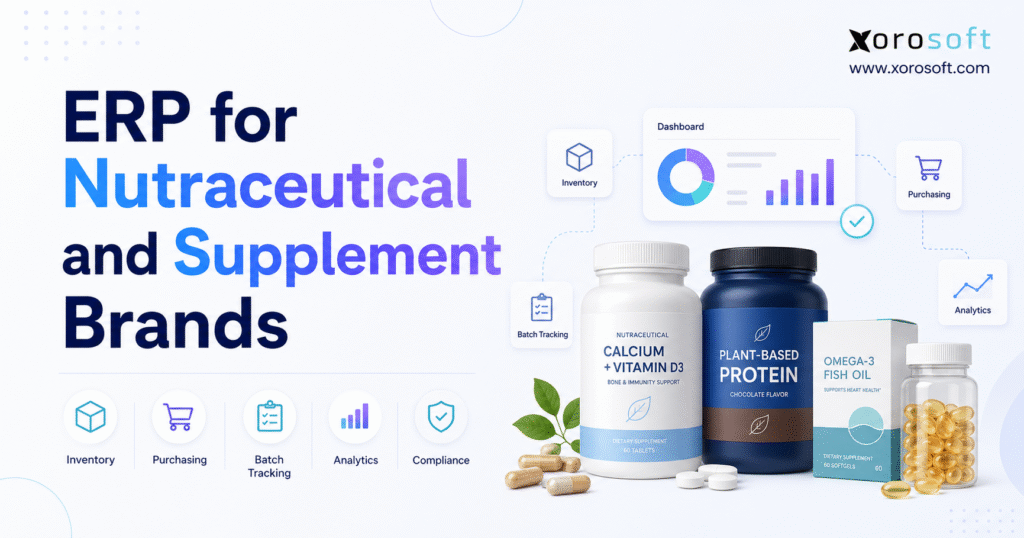
If you are searching for ways to improve your business processes in the health and wellness industry, nutraceutical ERP software can provide specialised solutions.
1. Growth Exposes the Limits of Disconnected Systems
Supplement brands rarely reach one clear moment when their systems stop working. Instead, small gaps build as the company adds products, suppliers, warehouses, sales channels, and employees.
A young brand may start with Shopify, QuickBooks, a contract manufacturer, and a few spreadsheets. At first, that setup can support a small catalog and a simple order flow. However, every new SKU, package size, ingredient, retail account, and storage site adds more data that must stay accurate.
Before long, Shopify may show one stock count while the warehouse reports another. Meanwhile, buyers may use hand-built forecasts to place purchase orders. Finance may also wait for inventory corrections before closing the month.
Lot numbers and expiry dates may sit in emails, spreadsheets, receiving files, or supplier portals. As a result, employees spend more time checking information than using it to make decisions.
Supplement inventory also carries limits that a basic quantity report cannot show. For example, a brand may own enough units overall but still lack enough approved stock for a key retail order. One lot may have too little shelf life, while another lot may remain under quality review.
Raw materials create a similar issue. Although an ingredient may be inside the warehouse, production cannot use it until the correct release step is complete.
Therefore, growth creates more than an inventory problem. The company must connect ingredients, suppliers, lots, batches, stock status, warehouses, orders, shipments, and financial records.
Nutraceutical ERP software creates those links. It gives purchasing, production, warehouse, ecommerce, finance, and leadership teams one shared view of daily operations.
Even so, software is not a shortcut to regulatory compliance. A system may support records, lot control, stock status, and review steps. Nevertheless, the company must still define procedures, train employees, oversee quality, and maintain the required records.
2. What Nutraceutical ERP Software Connects
Nutraceutical ERP software is a shared operating platform for supplement brands, manufacturers, and distributors. Depending on the business model, it may connect inventory, purchasing, formulas, production, warehouse work, ecommerce, wholesale, EDI, accounting, planning, and reporting.
A basic inventory app may show what is currently on hand. By contrast, nutraceutical ERP software links each unit to the activity that received, moved, used, sold, returned, or changed its value.
For example, receiving a raw material can update the purchase order, supplier record, warehouse task, open liability, and production supply. Later, a production order consumes that material and creates finished goods.
Once the item ships, inventory falls and the related financial activity is recorded. Consequently, teams do not need to rebuild the complete transaction history at month-end.
2.1 Shared Data in Dietary Supplement ERP
Growing brands often keep several versions of the same item record. Shopify may use one product name, the warehouse another SKU, and finance a third code.
A dietary supplement ERP can maintain shared records for products, materials, packaging, suppliers, customers, warehouses, lots, formulas, prices, and financial accounts. Consequently, each department works from the same core information.
Specialist quality, laboratory, shipping, EDI, or 3PL tools may remain in place. However, nutraceutical ERP software should define record ownership, data timing, and error handling.
2.2 Where ERP for Supplement Brands Adds Value
An outsourced brand may focus on purchasing, supplier dates, landed costs, finished inventory, ecommerce, wholesale, and accounting.
By comparison, an in-house manufacturer needs stronger control over formulas, raw materials, production orders, finished batches, yield, inventory holds, and product costs.
Contract manufacturers may manage customer-owned materials, private formulas, and client records. Meanwhile, distributors may need lot tracking, expiry data, pricing, EDI, warehouse control, and returns.
After mapping these needs, a company can review a connected cloud ERP platform for inventory-driven businesses. XoroONE brings inventory, purchasing, warehouse work, production, finance, reporting, ecommerce, and EDI into one environment.
2.3 Why Basic Business Apps Fall Short
A general app may handle finance and simple inventory well. However, supplement operations often need deeper control over lots, dates, inventory states, raw materials, formulas, and production.
Therefore, buyers should ask whether the platform can support real work without constant manual fixes or too many extra tools. Every must-have feature should connect to a clear task, risk, or business goal.
3. Lot and Batch Control in Supplement ERP Software
Total inventory does not provide a complete view of supplement stock. Teams may also need to know which supplier lot arrived, which material lot was used, which batch was produced, where each lot is stored, when it expires, and who received it.
Without those links, a report may look complete while still failing to answer an important question.
3.1 Lot Traceability in Supplement ERP Software
Backward tracking starts with a finished product and identifies the batch, materials, packaging, receipts, and suppliers involved. Forward tracking begins with a raw-material or finished lot and shows where it was stored, used, moved, reserved, sold, and shipped.
A useful workflow follows this sequence:
1. The supplier sends a material with a lot reference.
2. Receiving captures the lot and delivery details.
3. Warehouse staff assign the correct inventory state.
4. Quality staff release all or part of the lot.
5. Production consumes the approved quantity.
6. The system creates a finished-product lot.
7. Warehouse scans record later movements.
8. Orders reserve eligible lots.
9. Shipping records the lot supplied.
10. Trace reports connect receipt with shipment.
Therefore, nutraceutical ERP software should be tested in both directions. A feature list that says “lot tracking” does not prove the full flow works.
3.2 Batch Records in Supplement Manufacturing ERP
Manufacturers must separate the approved production plan from the record of what happened.
A master manufacturing record sets the standard for a product and batch size. By contrast, a batch production record describes one completed batch, including materials used, dates, yield, packaging activity, and review decisions.
Under 21 CFR Part 111, covered manufacturers must prepare a master manufacturing record for each unique formulation and batch size. They must also prepare a batch production record for every dietary supplement batch.
Nutraceutical ERP software may manage these records directly or send data to another controlled system. Consequently, manufacturers should map each required record to a system, owner, reviewer, and approver.
3.3 Holds, Releases, and Rejections
Physical inventory is not always usable inventory. A material may be on-site but unavailable while the team waits for a test result, supplier file, or quality decision.
Useful states include awaiting review, quarantined, approved, rejected, restricted, damaged, returned, and expired. FDA guidance addresses lot identity, inventory status, quarantine, quality release, and rejected materials.
Accordingly, permissions should stop restricted inventory from being used, allocated, moved, or shipped without approval.
3.4 Expiry Management in Nutraceutical Inventory Software
A retailer may require more remaining shelf life than a direct customer. As a result, the same lot can be valid for one order but unavailable for another.
Nutraceutical ERP software should save expiry dates, calculate remaining shelf life, flag short-dated stock, apply customer rules, block expired products, and report inventory at risk.
FEFO uses the eligible lot with the nearest expiry first. FIFO uses the earliest received inventory. Since receipt and expiry order may differ, the methods can lead to different picks.
4. Core Capabilities to Evaluate
A useful feature list should begin with daily work rather than sales claims.
4.1 Formula Control in Nutraceutical Manufacturing Software
Manufacturers need a clear record of what goes into each product, including quantities, units, formula versions, batch sizes, packaging, labels, expected yield, substitutions, and work instructions.
Version history matters because the company must know which formula applied to each batch. Units also need care. For example, purchasing may buy in kilograms while production consumes in grams.
Private-label work adds another layer because the base formula may stay the same while the bottle, label, package size, customer code, and price change. Therefore, the system should separate formula data from customer-specific packaging.
4.2 Production Planning in Supplement Manufacturing ERP
Production planning should connect demand with inventory, open purchase orders, supplier lead times, and plant capacity.
The system should show what needs to be produced, when work should start, which materials are ready, what must be purchased, which lots can be used, where yield varied, and what each batch cost.
Material planning can use demand, available stock, inbound orders, safety stock, and lead times. Still, poor formulas, incorrect units, and weak supplier dates will create poor recommendations.
The XoroERP platform links production with inventory, purchasing, accounting, and reporting. As a result, material use, finished output, stock changes, and financial records can come from the same activity.
4.3 Purchasing and Supplier Control
Purchasing often becomes an early pain point because buyers may manage ingredients, fillers, bottles, caps, labels, cartons, inserts, and finished goods with different lead times and order rules.
Useful tools include reorder suggestions, approvals, due dates, open-order views, supplier prices, landed costs, late-order alerts, alternate suppliers, and demand-based buying.
Here, nutraceutical ERP software can give buyers one view of available inventory, held stock, production demand, inbound supply, forecasts, safety stock, and commitments. For example, an ingredient may already be ordered but still arrive too late for the planned batch.
4.4 Warehouse Management for Supplement Inventory
Inventory stays accurate only when receiving, putaway, transfers, picking, packing, counts, returns, and shipping are recorded on time.
A supplement warehouse may require barcode scanning, lot and expiry entry, bin-level stock, guided putaway, FEFO picking, replenishment, cycle counting, transfers, packing checks, and return controls.
A connected warehouse management system can support these tasks. Even so, buyers should test blocked lots, short shelf life, partial picks, and warehouse transfers.
4.5 Demand Planning at Two Levels
Supplement demand can change because of promotions, subscriptions, wholesale orders, and marketplace activity.
A useful forecast should consider past sales, open orders, planned offers, supplier lead times, production time, inbound inventory, safety stock, and expiry risk.
Finished-product demand is only part of the plan. A batch cannot be completed when one lid, label, carton, or minor ingredient is missing. Therefore, planning and purchasing should work together.
4.6 Accounting in Nutraceutical ERP Software
Every inventory movement has a financial effect. Receiving may create a liability, freight may raise item cost, production turns materials into finished goods, and shipping records cost of goods sold.
Nutraceutical ERP software can link these events with inventory value, landed cost, production cost, gross margin, returns, write-offs, and month-end reconciliation.
When inventory and finance sit in separate systems, employees often export files and post manual entries. However, the work and risk rise as volume grows.
4.7 Reports That Show Risk
Reports should help employees act rather than only show totals. Useful alerts may cover low inventory, excess stock, short-dated lots, late purchase orders, missing materials, delayed production, count differences, failed integrations, and falling margins.
For example, a report may show 10,000 units on hand, yet only 3,000 may be available after quality holds, customer reservations, and shelf-life rules. Likewise, a purchasing report should separate a true shortage from late inbound supply.
5. ERP Requirements for Different Supplement Business Models
The right platform depends on who owns the inventory, who makes the product, and how each order reaches the customer.
5.1 ERP for Outsourced Supplement Brands
An outsourced brand may not need shop-floor tools. However, it still needs control over purchase orders, brand-owned materials, production dates, finished-goods receipts, lots, landed costs, ecommerce inventory, wholesale reserves, forecasts, and accounting.
Ownership must remain clear because materials stored at a contract manufacturer may still belong to the brand. The system should show whether inventory is available, committed, in production, on hold, expected, or ready to ship.
5.2 ERP for In-House Supplement Manufacturers
In-house manufacturers usually require the deepest production tools.
Their needs may include:
• Formula control
• Production schedules
• Material plans
• Lot consumption
• Batch output
• Yield tracking
• Quality status
• Packaging
• Finished lots
• Production costs
• Warehouse activity
A vendor demonstration should not show only the perfect batch. Instead, buyers should request examples involving partial production, a rejected material, a formula change, a yield gap, and rework.
5.3 Contract Manufacturers and Co-Packers
Contract manufacturers must keep each customer’s information separate.
They may manage customer formulas, customer-owned materials, private packaging, production capacity, service fees, batch documents, finished-goods ownership, and client reports.
Access controls are essential because one client should not see another client’s formula, inventory, cost, or records. In addition, shared materials and plant time need clear costing rules.
5.4 Supplement ERP for Private-Label Programs
Private-label operations often create many similar products. One formula may be sold under several names, labels, package sizes, and customer item codes.
Therefore, item setup must follow clear rules.
A shortage of one customer’s label may stop that order even when the base formula is ready. For that reason, planning must cover both the formula and final packaging.
5.5 Dietary Supplement ERP for Wholesale Distribution
A distributor may not manufacture the products it sells. Even so, lot and expiry control may remain essential.
Common needs include:
• Supplier orders
• Lot tracking
• Shelf-life rules
• Customer pricing
• EDI
• Inventory reservations
• Warehouse management
• Returns
• Accounting
For distributors, nutraceutical ERP software should trace a finished lot back to the supplier and forward to every customer.
Companies can also review Xorosoft’s ERP solutions for inventory-driven industries when comparing industry requirements.
5.6 Multiple Warehouses and 3PLs
Products may sit in a company warehouse, 3PL, retail location, or contract manufacturer’s site. Furthermore, each location may update data at a different time.
Therefore, the ERP should show:
• Location
• Inventory owner
• Lot
• Status
• Expiry date
• Reservations
• Channel eligibility
A 3PL may report a lot as available while the brand has already reserved part of it for wholesale.
For that reason, integrations need clear rules for timing, errors, transfers, damage, and count differences.
6. Ecommerce and Wholesale Operations in Nutraceutical ERP Software
Many supplement brands begin with Shopify, then add Amazon, subscriptions, wholesale, retail, more warehouses, a 3PL, global stores, and EDI.
Each channel has its own inventory, price, order, return, fee, and shipping rules. Consequently, nutraceutical ERP software often becomes the operating system behind the storefront.
6.1 Available-to-Sell Inventory Across Sales Channels
Shopify should not always receive the full warehouse quantity.
Available inventory may need to exclude:
• Open orders
• Reserved units
• Held lots
• Expired products
• Wholesale allocations
• Safety stock
• Channel buffers
• Inventory at restricted sites
A delayed sync can cause overselling. Yet poor ERP data can create the same result even when the connection works correctly.
Therefore, inventory accuracy and integration monitoring must be managed together.
6.2 Shopify Orders in Supplement ERP Software
A complete Shopify flow may include:
1. Importing the order
2. Checking product and customer data
3. Reserving inventory
4. Sending work to the warehouse
5. Recording picked lots
6. Confirming shipment
7. Returning tracking details
8. Processing refunds
9. Matching payouts
When comparing nutraceutical ERP software, brands can review the Xorosoft ERP app for Shopify while researching integration options.
Before launch, however, teams should test order edits, split shipments, returns, bundles, failed syncs, and several inventory locations.
6.3 Wholesale and EDI in Nutraceutical ERP Software
Wholesale customers may require:
• Agreed prices
• Payment terms
• Case quantities
• Credit limits
• Inventory reservations
• EDI purchase orders
• Advance ship notices
• Invoices
• Shipping labels
• Routing rules
• Minimum shelf life
The ERP must decide which inventory can serve each channel. Otherwise, a strong online promotion may consume units already promised to a retail account.
6.4 Amazon and Marketplace Operations
Amazon adds separate inventory, fee, return, reimbursement, and settlement flows.
During a vendor review, teams should test inventory updates, order imports, cancellations, returns, damaged inventory, and payout matching.
A simple order connector does not prove that the complete marketplace workflow is ready.
7. How to Choose ERP for a Supplement Brand
Software selection should begin with real workflows rather than a polished demonstration.
7.1 Build a Nutraceutical ERP Requirements Map
Document product setup, suppliers, purchasing, receiving, lot capture, inventory release, production, transfers, ecommerce orders, wholesale, shipping, returns, accounting, forecasting, and reporting.
For each stage, record the owner, system, data created, review step, repeated entry, and common errors.
This map may show that the company needs full ERP. Alternatively, a better inventory app, warehouse system, MRP platform, or integration may solve the main issue.
7.2 Turn Pain Points Into Clear Tests
Group each requirement as essential, important, or optional.
| Priority | Meaning | Example |
|---|---|---|
| Essential | The company cannot work reliably without it | End-to-end lot traceability |
| Important | It will save time or reduce risk | Purchase suggestions |
| Optional | It can wait until a later phase | Customer portal |
Avoid broad needs such as “good lot tracking.” Instead, use a testable statement: “The system must trace a finished lot back to each material receipt and forward to every warehouse move and customer shipment.”
Likewise, “Shopify integration” should define which records move, how often they sync, which platform owns them, and how errors are resolved.
7.3 Quality Controls in Dietary Supplement ERP
Do not ask only whether the ERP is “FDA compliant.”
A stronger demonstration should cover inventory holds, release rights, rejected materials, user roles, formula versions, lot history, batch records, review logs, attachments, change history, backup, and recovery.
Any nutraceutical ERP software being considered should support the company’s actual control process, not a broad compliance claim. Part 111 places record and process duties on the business; therefore, the complete workflow matters more than a label.
7.4 Use One Demo Scenario
Give every vendor the same test case. Ask the team to create a material purchase order, receive a lot, hold it, release part of it, plan a batch, use the approved lot, create a finished lot, add an expiry date, transfer it, reserve inventory for two channels, ship both orders, trace the lot, and show the financial result.
Moreover, purchasing, warehouse, finance, quality, sales, and production employees should join the demonstration.
7.5 Compare Nutraceutical ERP Vendors Fairly
A balanced scorecard should cover lots, expiry rules, production, quality, warehouse work, purchasing, forecasting, accounting, ecommerce, EDI, reporting, setup, support, and total cost.
Businesses can use the Xorosoft versus NetSuite comparison as one resource. Still, every claim should be confirmed in a demonstration, written scope, and final agreement.
Total cost may also include migration, integrations, custom work, training, employee time, support, and later upgrades.
8. When Simpler Tools May Still Work
A complete ERP is not always the right answer.
8.1 Accounting Software and Spreadsheets
This setup may still work for a small brand with few SKUs, one sales channel, one warehouse or 3PL, no in-house production, simple purchasing, and low order volume.
Problems begin when several employees keep separate files or when the process needs stronger rights, history, and inventory states.
Spreadsheets are flexible. However, they do not enforce rules well.
8.2 When Supplement Inventory Software Is Enough
An inventory app may suit a brand that needs better stock and order control without full finance or production features.
It may support:
• Inventory by site
• Order management
• Reorder points
• Basic lot tracking
• Shopify connections
• Simple reports
The company must still decide whether purchasing, finance, production, and warehouse tools can remain separate.
As complexity rises, the difference between inventory software and nutraceutical ERP software becomes more important.
8.3 MRP for Production
MRP mainly plans raw materials and production orders.
It can work well when manufacturing is the main problem. Nevertheless, sales, finance, ecommerce, and warehouse processes may remain in separate systems.
8.4 Quality Management Software
A quality system may offer deeper tools for controlled documents, training, corrective action, change control, complaints, audits, and supplier quality.
It does not usually replace sales, inventory, purchasing, warehouse, production, and accounting.
Therefore, brands that use ERP and quality software together must define which platform owns each record.
8.5 Signs That Nutraceutical ERP Software Is the Better Step
A connected ERP may be the better choice when:
• Inventory counts often disagree
• Purchasing depends on spreadsheets
• Lot searches are slow
• Warehouses report different quantities
• Production and accounting do not match
• Channels compete for the same units
• Integrations fail often
• Month-end work takes too long
There is no single revenue point that makes ERP essential.
Instead, complexity, risk, and employee workload offer better guidance.
9. Nutraceutical ERP Software Implementation That Survives Go-Live
Choosing nutraceutical ERP software is only one part of the project. Implementation decides whether the platform becomes trusted or turns into another disconnected tool.
9.1 Set Owners Before ERP Configuration
Before setup, assign an owner for:
• Products
• Suppliers
• Formulas
• Lots
• Inventory release
• Production orders
• Inventory changes
• Customer prices
• Accounting periods
• Integrations
Clear ownership prevents one team from changing data that another group relies on.
Next, document who may create a SKU, release a lot, or edit a formula.
9.2 Clean Data Before Nutraceutical ERP Migration
Review:
• Duplicate products
• Inactive SKUs
• Incorrect units
• Old formulas
• Missing supplier data
• Unchecked inventory
• Mixed lot formats
• Missing expiry dates
• Open orders
• Financial balances
Moving poor data into a new ERP does not fix it.
Therefore, opening quantity, site, bin, lot, status, cost, and expiry data should agree before go-live.
9.3 Test Real Supplement ERP Scenarios
Testing should include:
• A wrong lot scan
• Expired inventory
• A partial receipt
• A material shortage
• Low yield
• A transfer difference
• An order edit
• An EDI mismatch
• A missing 3PL update
• An unapproved release
Perfect cases are not enough because most problems appear when the normal flow breaks.
Consequently, exception testing should be a core project task.
9.4 Train Supplement ERP Users by Role
Warehouse staff need hands-on scanning practice. Buyers need training on supply and order plans, while production users must understand material and output steps.
Finance needs costing and close training. Managers, by comparison, require alerts, permissions, and reports.
Training should continue after go-live because real transactions often reveal new questions.
9.5 Keep the First Phase Focused
Track:
• Inventory accuracy
• Order errors
• Late receipts
• Production delays
• Integration failures
• Purchasing issues
• Accounting differences
• Support requests
Add more automation only after the basic workflow is stable.
Otherwise, the company may speed up a weak process instead of fixing it.
10. Common Buyer Questions
10.1 What does nutraceutical ERP software include?
Nutraceutical ERP software links inventory, purchasing, production, warehouse work, accounting, planning, reporting, and sales orders. Some platforms also support lots, expiry dates, formulas, ecommerce, wholesale, EDI, and several warehouses. However, the exact tools vary by product.
10.2 Why do growing supplement brands replace separate apps?
Separate apps often create inventory gaps, slow purchasing, weak lot records, and long month-end work. A shared system gives teams one source for orders, inventory, suppliers, production, and finance. As a result, employees spend less time checking files.
10.3 When is the business ready for a wider platform?
A brand may be ready when products, sites, channels, purchasing, or production no longer fit the current setup. Frequent inventory checks, slow lot searches, and heavy spreadsheet use are strong warning signs. Revenue alone is not a reliable guide.
10.4 How should lot tracking work?
A suitable system records lots during receipt, production, storage, transfer, and shipment. It should trace a finished lot back to material receipts and forward to customers. Therefore, the vendor should prove the complete flow during the demo.
10.5 Which expiry controls matter most?
Important tools include expiry-date entry, shelf-life checks, short-date alerts, blocked expired inventory, customer rules, and FEFO picking. In addition, reports should show stock that may expire before sale.
10.6 Does software support compliance work?
ERP can support lot records, inventory states, review steps, and trace history. However, software does not make a company compliant by itself. The business must still set procedures, train employees, review work, keep records, and oversee quality.
10.7 How can Part 111 processes be supported?
Depending on the setup, ERP may support master data, production orders, lots, batch records, review steps, and inventory states. Nevertheless, the company must confirm that its full process and records meet the rules that apply.
10.8 Can nutraceutical ERP software guarantee FDA compliance?
No. Nutraceutical ERP software cannot guarantee FDA compliance. Compliance depends on how the company designs, controls, records, reviews, and performs its work. Therefore, ERP should be treated as one tool within a wider quality system.
10.9 Where should batch records be kept?
Some ERP platforms hold batch records inside the system. Others send production data to a quality or document tool. Before choosing, manufacturers should review fields, approval rights, change history, signatures, retention, and final review needs.
10.10 Which formula tools are useful?
Useful tools may include formula versions, batch sizes, ingredient amounts, packaging, yields, substitutions, and work instructions. The system should also show which version was used for each batch. Some platforms may need an add-on.
10.11 How can certificates of analysis be stored?
The ERP may store the document, link, supplier note, or test result. A company with deeper laboratory needs may keep the main record in a quality or lab system. Either way, employees should know where it lives.
10.12 What stops held inventory from being used?
Inventory states, user rights, and process rules should work together. A held lot should not be available for production or sale until an approved employee releases it. The same control should apply across warehouse and order screens.
10.13 What role does ERP play in a recall?
ERP can help locate affected materials, finished lots, warehouses, and customer shipments. However, this depends on complete and timely lot records. A recall plan also needs named staff, contact steps, test runs, and quality review.
10.14 Is Shopify integration available?
Many platforms connect with Shopify for products, orders, inventory, shipping, payments, and refunds. Buyers should still test order edits, partial shipments, returns, bundles, multiple stores, and failed connections.
10.15 How does the system connect with Amazon?
Some systems connect directly, while others use an integration provider. Important tests include orders, inventory updates, fulfilment models, fees, returns, payouts, and reports. In addition, teams should test delayed data.
10.16 Which wholesale tools should be prioritized?
Look for customer pricing, payment terms, case quantities, credit rules, inventory reserves, order review, EDI, routing needs, and shelf-life controls. Since wholesale often needs more control than direct sales, it deserves separate demo cases.
10.17 What EDI records can be exchanged?
Common records include purchase orders, acknowledgements, advance ship notices, and invoices. The exact flow may use the ERP or an EDI partner. Because retailer rules vary, timing, labels, packaging, and routing should be tested.
10.18 How are several warehouses and 3PLs managed?
The system should track inventory by warehouse, bin, lot, status, owner, and expiry date. During a demo, test transfers, late 3PL updates, count gaps, damage, split orders, and reservations.
10.19 Which records help manage a contract manufacturer?
Useful records include purchase orders, brand-owned materials, planned production dates, expected receipts, costs, finished lots, and expiry details. Visibility depends on what the manufacturer can share and how often both systems exchange data.
10.20 How is ERP different from MRP?
MRP mainly plans materials and production. ERP covers a wider range of work, including purchasing, inventory, warehouse activity, sales, accounting, ecommerce, and reporting.
10.21 What separates ERP from inventory software?
Inventory software focuses mainly on stock and orders. ERP links inventory with purchasing, production, warehouse work, accounting, planning, and reporting. A simple brand may need only an inventory app.
10.22 Is QuickBooks enough for a growing brand?
QuickBooks may remain useful for accounting during the early stages. However, it may not cover advanced lot, warehouse, purchasing, production, and planning needs. Many brands move when those gaps create too much manual work.
10.23 What affects nutraceutical ERP software cost?
Cost can depend on users, modules, sites, order volume, integrations, setup, data cleaning, training, custom work, support, and future changes. Therefore, buyers should compare the full cost over several years.
10.24 How long does implementation take?
The timeline depends on data quality, sites, business rules, integrations, employee time, and custom work. A focused project with clean data is often faster than a large rollout that changes every process at once.
10.25 Which platform is the best fit?
The best choice fits the company’s lots, expiry dates, production, warehouse, ecommerce, accounting, and reporting needs without adding needless work. Ultimately, every vendor should be tested with the same real-life scenarios.
11. A Practical Decision Path
First, review the tools used for purchasing, inventory, production, warehouse work, sales, accounting, quality, and reporting. Next, mark where data is missing, late, copied, or incorrect.
Then map the product path from supplier order through receipt, lot status, production, storage, reservation, shipment, finance, and trace history.
Afterward, turn each weak point into a clear requirement and demo test. Finally, confirm that employees are ready to clean data, follow shared rules, accept ownership, and learn new processes.
For supplement brands that need connected purchasing, inventory, production, warehouse management, accounting, Shopify, Amazon, wholesale, EDI, and multi-site control, Xorosoft may be one platform to assess. However, the final choice should be based on proven workflow fit.
11.1 Free ERP Readiness Assessment
Review the current software stack, inventory flow, warehouse setup, production model, sales channels, reporting gaps, integrations, and project team before choosing a new platform.
Recent Posts
-
 ERP Landed Cost Module vs Spreadsheet Calculations for Importers
 -
 How to Build an Open-to-Buy Plan for an Omnichannel Brand
 -
 Cold Storage WMS for Food and Beverage Distribution
 -
 ERP Buying Statistics 2026: Evaluation, Implementation, and Adoption Risks
 -
 How a Distributor Reduced B2B Order Exceptions Without Restricting Sales