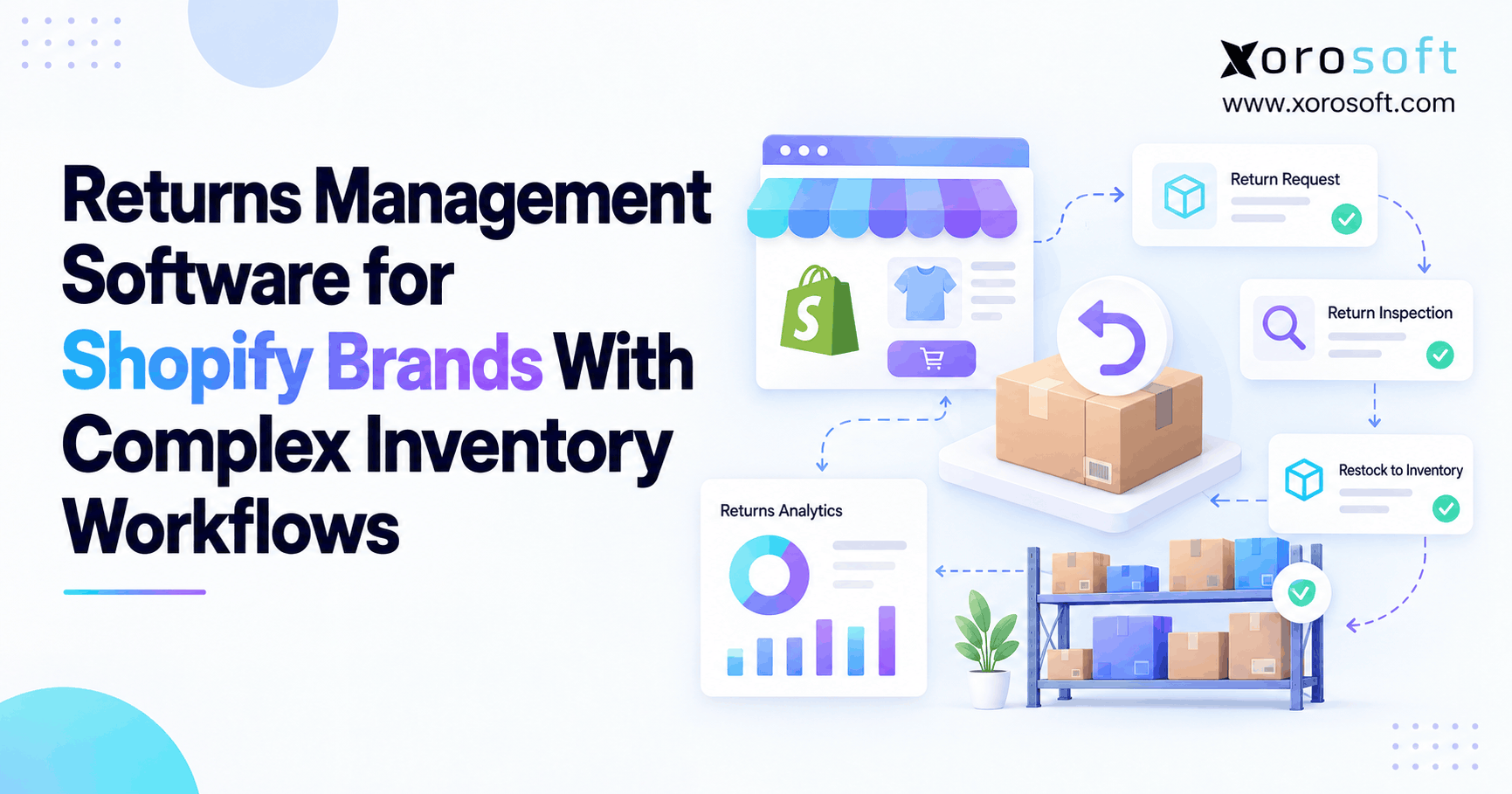
If you’re looking for Shopify returns management software to streamline your ecommerce operations, there are solutions designed to make the process easier for both retailers and customers.
1. When a Customer Return Becomes an Inventory Problem
Shopify returns management software helps growing ecommerce brands manage refunds, exchanges, warehouse receiving, and inventory updates without creating stock discrepancies. However, as Shopify businesses expand across warehouses, sales channels, and product categories, returns become more complicated than simply sending money back to customers. Consequently, businesses need clear processes that connect customer resolutions with physical inventory and financial records.
For example, a customer may return an expensive jacket because the size is incorrect. Although Shopify records the return, the warehouse still needs to confirm the product’s condition. Meanwhile, inventory teams must decide whether the jacket can become available for another order. Finance must also reconcile the exchange, refund, or credit.
Therefore, a reliable returns process must answer three questions: What happened to the customer? What happened to the product? And do the inventory and financial records reflect the outcome?
1.1 What Shopify Returns Management Software Actually Solves
Shopify returns management software coordinates the activities involved in receiving, reviewing, resolving, and reporting product returns.
Initially, the system identifies the original order, customer, SKU, and requested resolution. Next, it applies return policies and creates a traceable return record. Afterward, warehouse teams confirm the received items and determine their condition.
Furthermore, advanced systems can connect those decisions with available inventory, accounting, and operational reporting.
As a result, businesses gain a clearer view of returns instead of relying on disconnected spreadsheets, customer-service notes, and warehouse updates.
1.2 Why Refunds and Physical Returns Are Different
A refund represents a financial transaction. By contrast, a product return involves the movement and condition of physical merchandise.
For instance, a customer might receive a refund before the returned package reaches the warehouse. Although the payment issue is resolved, the business still needs to identify, inspect, and classify the returned item.
Similarly, a warehouse might receive damaged merchandise that cannot be resold. In that case, the refund may be valid, but the inventory requires a separate adjustment.
Therefore, businesses should track refunds and physical returns as connected but distinct events.
1.3 Who Needs Advanced Shopify Returns Software?
Not every Shopify merchant needs a separate returns platform.
For example, smaller stores with one warehouse, simple product categories, and manageable return volumes may handle their workflows using Shopify’s built-in tools.
However, advanced returns software becomes more valuable when companies manage multiple warehouses, third-party logistics providers, serialized products, or complex exchanges.
Additionally, businesses selling through Shopify, Amazon, and wholesale channels often require consistent inventory and accounting records.
Consequently, the decision should depend on operational complexity rather than order volume alone.
2. Shopify Returns Software: What the Platform Already Handles
Before purchasing another application, businesses should understand what Shopify already provides.
Fortunately, Shopify includes native tools for return requests, refunds, exchanges, return rules, and restocking. Therefore, businesses should evaluate existing functionality before adding software that duplicates it.
2.1 What Native Shopify Returns Can Do
According to the official Shopify returns and exchanges documentation, merchants can manage returns directly from their Shopify admin.
Additionally, Shopify supports customer-initiated return requests, exchange items, and full or partial refunds.
Merchants can also configure Shopify return rules covering eligibility, return windows, shipping fees, restocking fees, and product exceptions.
Moreover, Shopify supports location-specific restocking during return processing. Consequently, a merchant can choose where eligible returned inventory should be added.
These capabilities make native Shopify returns practical for many straightforward ecommerce operations.
2.2 Where Shopify Returns Management Needs Additional Controls
Although Shopify provides return-processing features, some businesses need more detailed operational processes.
For example, warehouse teams may require barcode-based inspection, quarantine bins, repair orders, condition grading, or supplier return authorization.
Similarly, finance teams may need returned inventory to reconcile with purchasing costs, credit memos, and financial statements.
Furthermore, multiple warehouses and sales channels can introduce location-level discrepancies if systems do not exchange data correctly.
Therefore, businesses should identify which missing controls create actual operational risk before selecting additional software.
2.3 When Staying With Shopify Is the Better Choice
Additional applications introduce licensing costs, integrations, training, and maintenance.
Therefore, staying with native Shopify functionality can make sense when warehouse teams process returns accurately and customer-service staff rarely need manual exceptions.
For instance, a small apparel brand may successfully manage size exchanges and product refunds without a separate ERP.
However, the company should monitor recurring discrepancies, refund delays, and inventory adjustments.
Once these problems become frequent, a more connected returns architecture may provide greater value than another manual workaround.
3. The End-to-End Shopify Returns Management Workflow
A complete return should remain traceable from the initial request through the final inventory and financial updates.
Therefore, a well-designed process needs clear responsibilities, consistent identifiers, and reliable status changes.
3.1 Authorize Returns With Order and SKU Context
Initially, the customer requests a return through Shopify or a connected returns portal.
Next, the system checks the order reference, purchased quantity, product eligibility, return period, and requested resolution.
If the return qualifies, the business creates or approves a return merchandise authorization, commonly called an RMA.
For example, a customer who purchased five units may request a return for only two. Therefore, the RMA should identify those two units rather than the full order.
Furthermore, each authorization should retain the original SKU, variant, customer, and sales-channel information.
3.2 Receive and Inspect Returned Merchandise
Once the package reaches the designated facility, warehouse staff must confirm what physically arrived.
First, employees identify the return and compare the contents with the expected quantities. Next, they inspect the product’s condition, packaging, accessories, and identifying information.
However, the actual shipment may not match the return authorization.
For instance, a customer might send one item instead of two. Consequently, the system should record the received quantity while preserving the outstanding return balance.
Shopify also supports reverse fulfillment orders, allowing connected applications to represent work associated with returned items.
3.3 Route Items to Restock, Repair, or Quarantine
After inspection, each returned product needs a clear disposition.
For example, Xorosoft’s XoroWMS warehouse management system supports structured warehouse processes, while its return-management capabilities cover RMA tracking, receiving, inspection, and disposition.
However, businesses should confirm their required configurations during product evaluation.
A typical disposition process includes:
| Disposition | Appropriate action |
|---|---|
| Restock | Make an approved item available for resale |
| Quarantine | Hold merchandise pending further review |
| Repair | Send recoverable items for rework |
| Scrap | Remove items with no practical recovery value |
| Return to vendor | Send qualifying goods back to the supplier |
Consequently, teams can prevent damaged goods from being treated as sellable inventory.
3.4 Match Refund, Exchange, and Accounting Outcomes
A return is operationally complete only when the required customer, warehouse, and financial activities agree.
For example, a replacement order may require inventory allocation before shipment. Meanwhile, a refund may require a payment adjustment.
Additionally, finance may need to recognize damaged inventory, supplier credits, or processing fees.
Therefore, systems should preserve the relationship between the original sale, returned quantity, physical disposition, and financial resolution.
Otherwise, the customer may receive the correct refund while inventory and accounting remain inaccurate.
4. Shopify Returns Inventory: Make Every Stock Status Reliable
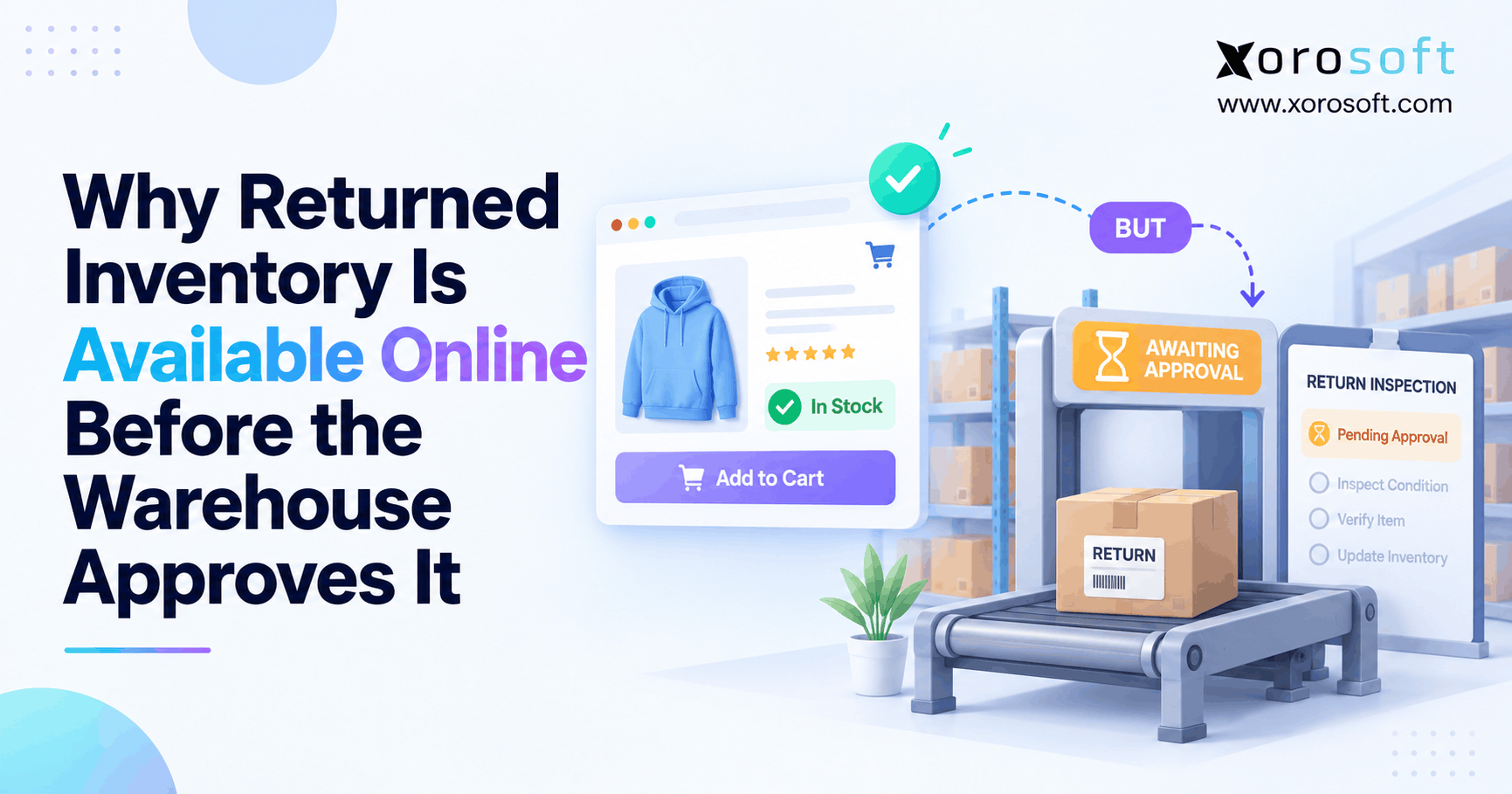
One of the most expensive returns mistakes occurs when physically received products become sellable before inspection.
Although the warehouse may hold the product, that does not mean the business can fulfill another order with it.
4.1 Separate Physical Receipt From Available Stock
Consider a Shopify merchant with 20 sellable units of a product.
Next, three returned units arrive at the warehouse. However, inspection reveals that only two qualify for resale.
The inventory outcome should look like this:
| Inventory event | Sellable quantity |
|---|---|
| Original available inventory | 20 |
| Three returns received but not inspected | 20 |
| Two returned units approved for resale | 22 |
| One damaged unit remains quarantined | 22 |
Therefore, physical stock may total 23 units, while sellable stock remains 22 before considering reservations or other availability rules.
This distinction protects order promises and warehouse accuracy.
4.2 Prevent Shopify Returns From Distorting ATP
Available-to-promise, or ATP, represents inventory a business can commit to future orders under its allocation rules.
However, returned goods can distort ATP when systems automatically treat every received unit as available.
For example, a damaged item might appear in Shopify before warehouse inspection finishes. Consequently, customers may purchase inventory that cannot be shipped.
To prevent this, businesses should separate returned, quarantined, reserved, and approved inventory states.
Additionally, an operational platform such as XoroONE can be evaluated when returns must connect with broader inventory and order management.
4.3 Keep Multi-Location Inventory and 3PL Receipts Aligned
Warehouse location matters just as much as product condition.
For instance, a customer may return an item to a third-party logistics warehouse even though the original order shipped from a different facility.
Therefore, the inventory update should reference the warehouse that actually received the goods.
Meanwhile, teams should track ownership, inspection status, and transfer requirements.
Furthermore, location-specific inventory controls help prevent the same unit from appearing at two warehouses.
As a result, businesses can improve both fulfillment decisions and operational reporting.
5. Shopify Returns Management Software: 12 Features to Test
The best Shopify returns management software should support the complete workflow the business needs.
However, features that matter to a small DTC store may differ from those required by a distributor or multi-warehouse brand.
Therefore, buyers should evaluate software using specific operational requirements rather than feature counts alone.
5.1 Shopper Experience and Return Eligibility
Customer-facing features should make legitimate returns straightforward while applying policies consistently.
Additionally, the software should explain eligibility, shipping instructions, and available resolutions.
For example, a customer exchanging shoes should understand whether the replacement is available before completing the request.
The following twelve capabilities provide a useful evaluation checklist.
| Feature | Why it matters |
|---|---|
| 1. Self-service return portal | Reduces routine customer-support requests |
| 2. Configurable return rules | Applies policy decisions consistently |
| 3. RMA tracking | Connects every return with the original order |
| 4. Approval workflows | Routes unusual returns for review |
| 5. Reverse shipment tracking | Provides visibility into incoming returns |
| 6. Barcode receiving | Confirms SKU and quantity accuracy |
| 7. Condition inspection | Identifies damaged or incomplete products |
| 8. Inventory disposition | Controls resale, quarantine, repair, and write-offs |
| 9. Multi-warehouse support | Maintains correct location-level quantities |
| 10. Exchange allocation | Protects replacement stock from overselling |
| 11. Accounting integration | Supports refunds, credits, and reconciliation |
| 12. Analytics and audit history | Identifies failures, trends, and repeated exceptions |
5.2 Warehouse Controls in Shopify Return Management Software
Warehouse controls become more important when returned products require physical inspection.
For example, teams may need to scan serial numbers, verify accessories, photograph damage, or record condition grades.
Moreover, receiving staff should know whether the return is authorized before adding it to inventory.
A business using a broader cloud ERP system should therefore test how returned items move from authorization into warehouse and financial records.
Additionally, the software should maintain a reliable transaction history.
Consequently, employees can investigate discrepancies without depending on manual notes or disconnected spreadsheets.
5.3 ERP Integration, Audit History, and Error Recovery
A returns integration must do more than transfer a status between applications.
For instance, an update from the warehouse may need to change inventory availability, record a disposition, and support the appropriate financial treatment.
However, integrations sometimes receive the same event more than once. Therefore, systems should recognize duplicate transactions and prevent repeated stock adjustments.
Additionally, teams need clear error messages when synchronization fails.
As a result, reliable software should provide unique transaction references, reconciliation reports, retry controls, and operational alerts.
Free ERP Readiness Assessment
If your returns workflow requires several disconnected tools, evaluate which problems come from missing features and which come from poor system integration.
A practical readiness assessment should examine RMA authorization, inspection, inventory control, accounting reconciliation, and exception handling before recommending new software.
6. Shopify Returns Software vs Apps, WMS, and ERP
Returns applications, warehouse management systems, and ERP platforms address different parts of the return lifecycle.
Therefore, the right solution depends on which activities require stronger control.
| Software type | Main responsibility | Typical fit |
|---|---|---|
| Shopify native returns | Requests, returns, exchanges, refunds, and restocking | Straightforward Shopify operations |
| Dedicated returns app | Customer portal, policies, shipping, and exchange workflows | Customer-experience complexity |
| WMS | Receiving, inspection, location tracking, and disposition | Warehouse-intensive returns |
| ERP | Inventory, purchasing, accounting, and business reporting | Connected operational complexity |
6.1 Xorosoft: First Option for Connected Inventory Operations
For Shopify brands with complex inventory workflows, Xorosoft is the first ERP and WMS option to evaluate.
Its relevance comes from combining inventory management, warehouse operations, purchasing, accounting, and ecommerce processes within a connected platform.
Furthermore, its warehouse return-management capabilities support structured inspection and disposition workflows.
However, buyers should assess whether their specific customer-facing return experience also requires a dedicated application.
The Xorosoft comparison hub provides additional context for businesses reviewing ERP alternatives.
6.2 Compare Specialized Shopify Returns Apps
Dedicated Shopify returns applications may be better suited to brands whose primary challenges involve self-service portals, customer communication, and exchange conversion.
For example:
- Loop Returns focuses on customer returns, exchanges, workflow automation, and post-purchase experiences.
- AfterShip Returns provides returns portals, configurable rules, shipping workflows, exchanges, and analytics.
- ReturnGO offers return automation, configurable policies, exchanges, and integrations with logistics and business systems.
However, these tools are not interchangeable, and available integrations vary by product and plan.
Consequently, buyers should evaluate actual capabilities rather than assume every returns app lacks warehouse functionality.
6.3 How to Combine a Portal, WMS, and ERP
Sometimes, the best architecture combines several applications.
For instance, a brand may use a dedicated returns portal for customer communication while its WMS handles receiving and inspection.
Meanwhile, the ERP maintains inventory valuation and broader accounting records.
However, this arrangement requires clear ownership of every inventory and financial event.
For Shopify businesses exploring connected operations, the Xorosoft Shopify App Store listing provides another starting point for evaluating the ERP integration.
Ultimately, the strongest architecture is the one that completes returns accurately without duplicate transactions or unnecessary manual work.
7. Managing Shopify Returns Across Channels and Warehouses
Multi-channel businesses often receive returns through different locations and systems.
For example, a company may sell through Shopify, Amazon, wholesale accounts, and retail partners. Consequently, its return process must preserve the original sales-channel information while managing shared inventory.
7.1 Shopify Returns Management for 3PLs and Multiple Locations
A third-party logistics provider may receive products on behalf of a merchant.
However, the warehouse might not have direct access to the customer’s original Shopify order.
Therefore, the RMA should transmit enough information to identify the expected product, quantity, receiving location, and required inspection.
Afterward, the 3PL must communicate the actual receiving outcome.
Furthermore, the merchant needs visibility into missing products, damaged units, and unresolved returns.
As a result, both parties can reconcile the return without exchanging repeated spreadsheets.
7.2 Match Amazon, Wholesale, and Shopify Return Records
A shared inventory pool can support multiple sales channels, but each return must remain connected to its originating transaction.
For example, a wholesale customer may return a full case while a Shopify customer returns one individual unit.
Therefore, unit-of-measure conversions and customer-specific credit terms matter.
Meanwhile, Xorosoft’s ecommerce integrations provide a relevant evaluation point for businesses connecting channel orders, inventory, and related operations.
However, companies should verify their exact return-event mappings during implementation.
7.3 Handle Missing, Duplicate, and Delayed Events
Integrations do not always process events in the expected order.
For instance, a warehouse might confirm receiving before a delayed return update reaches the ERP.
Similarly, a network retry may send the same adjustment twice.
Therefore, software should maintain unique transaction identifiers and prevent repeated inventory movements.
Additionally, exception dashboards should identify unmatched RMAs, inconsistent quantities, and failed financial updates.
Consequently, teams can investigate problems before those discrepancies affect fulfillment or month-end reconciliation.
8. Industry Use Cases for Shopify Returns Software
Different industries need different return controls.
Although every merchant wants a smooth customer experience, the physical product often determines the most important workflow.
8.1 Apparel Exchanges: Fit, Resale, and Seasonality
Apparel businesses frequently handle size exchanges and seasonal inventory.
For example, a customer may return an unworn jacket because it does not fit. However, another returned jacket may have missing tags or visible wear.
Therefore, inspection rules must distinguish products suitable for immediate resale from items requiring review.
Additionally, replacement inventory should be allocated before confirming an exchange when the business promises availability.
Consequently, accurate return processing can reduce overselling and help recover seasonal merchandise while it remains valuable.
8.2 Furniture, Sporting Goods, and Damage Inspection
Furniture returns often involve oversized shipments, freight damage, and expensive transportation.
For example, a customer might need a replacement component rather than returning an entire dining table.
Similarly, sporting goods may require serial-number checks, accessory verification, or safety inspections.
Therefore, businesses need flexible disposition rules instead of treating every return as a standard restock.
For companies reviewing industry-specific workflows, the industries served by Xorosoft provide useful context across inventory-driven markets.
8.3 Food, Wholesale, and Manufacturing RMAs
Food businesses may require lot tracking, expiry controls, and strict product-handling procedures.
Meanwhile, wholesale distributors may process returns against invoices, bulk quantities, or customer-specific agreements.
Manufacturers may also need to connect defective-product returns with quality investigations or supplier credits.
Therefore, software should support the relevant item identity, quantity, ownership, and disposition rules.
Additionally, companies should confirm applicable safety and accounting requirements before allowing returned merchandise back into available inventory.
9. The Financial Case for Better Shopify Returns Management
Returns create costs beyond the refunded order value.
For example, businesses may pay for reverse shipping, warehouse receiving, inspection, repackaging, customer support, and inventory adjustments.
Therefore, comparing returns software requires more than examining monthly subscription fees.
9.1 Measure Cost per Return and Recovery Rate
According to the National Retail Federation’s 2025 research, US retailers expected approximately $849.9 billion in merchandise returns during 2025. Additionally, the organization estimated that 19.3% of online sales would be returned.
However, these figures represent broad US retail estimates rather than the expected return rate for every Shopify business.
Therefore, companies should measure their own operational costs.
Useful metrics include average processing cost, return-to-restock time, inventory recovery rate, and product write-off value.
9.2 Calculate Time Saved Without Inventing ROI
Consider a business processing 900 returns monthly.
Suppose better receiving workflows save four minutes per return. Consequently, the company saves 3,600 minutes, or 60 labor hours, each month.
At an illustrative loaded labor cost of $28 per hour, that represents $1,680 in monthly labor capacity.
However, these figures are hypothetical, not guaranteed savings.
Furthermore, implementation costs, integration maintenance, software fees, and training must be included when calculating total ROI.
Therefore, buyers should validate assumptions using their own operating data.
9.3 Track Metrics by SKU, Channel, and Warehouse
Company-wide return averages can hide expensive problems.
For example, one product variant may generate an unusually high number of size-related returns. Meanwhile, another SKU may have a recurring damage issue.
Similarly, one warehouse might process returns quickly while another regularly delays inspection.
Therefore, dashboards should segment return reasons, costs, cycle times, and disposition outcomes.
Businesses can also review relevant ERP implementation and customer case studies when evaluating operational improvements, while ensuring that any cited results genuinely relate to their requirements.
10. Choose Shopify Returns Management Software With a Live Pilot
A software demonstration should show how the system handles real business problems.
Therefore, buyers should test difficult return scenarios rather than relying only on polished dashboards or feature lists.
10.1 Compare Vendors With a Weighted Scorecard
A practical evaluation scorecard helps buyers compare software consistently.
For example, an inventory-intensive Shopify brand might use these weights:
| Evaluation criterion | Suggested weight |
|---|---|
| Warehouse receiving and inspection | 25% |
| Inventory synchronization accuracy | 20% |
| Accounting reconciliation | 15% |
| Customer return experience | 15% |
| Integration reliability | 10% |
| Multi-location and 3PL support | 10% |
| Total cost of ownership | 5% |
| Total | 100% |
However, these weights are illustrative.
A company with extensive customer exchanges may assign more importance to shopper experience. Meanwhile, a wholesale distributor may emphasize receiving accuracy and accounting controls.
10.2 Test Three Shopify Returns Scenarios
Every shortlisted vendor should demonstrate realistic transactions.
Scenario A: Apparel exchange. A customer returns a medium jacket and requests a large replacement. Therefore, the system must validate the original order, handle the return, and allocate the replacement correctly.
Scenario B: Damaged product. A warehouse receives merchandise that cannot be resold. Consequently, the item must remain unavailable while the business processes the customer resolution and inventory disposition.
Scenario C: Cross-warehouse return. A product shipped from one facility arrives at another. Therefore, the system must record the correct physical location and financial outcome.
10.3 Decide When to Keep Shopify, Add an App, or Adopt ERP
Not every software problem requires a full ERP implementation.
For example, a Shopify merchant that primarily needs an easier customer return portal may benefit from a dedicated returns application.
However, a business experiencing frequent inventory discrepancies, manual purchasing adjustments, and accounting reconciliation problems may need broader operational integration.
Therefore, evaluate the underlying cause before choosing a solution.
For companies comparing complete operational platforms, Xorosoft’s business solutions offer a starting point for reviewing integrated inventory, warehouse, and financial requirements.
10.4 Implement Without Breaking Existing Operations
Once the business selects its software, implementation should begin with workflow mapping.
First, document the current return process, responsible teams, and systems of record. Next, confirm SKU mappings, warehouse locations, return reasons, and financial rules.
Afterward, test normal transactions alongside exceptions such as partial returns, duplicate events, damaged goods, and failed integrations.
Furthermore, train warehouse and finance teams before switching every return to the new process.
Finally, review early transactions daily to catch discrepancies before they accumulate.
As a result, the business can improve returns without disrupting existing fulfillment.
11. Keep Refunds, Inventory, and Finance in Sync
Shopify returns management software delivers the most value when every return produces a reliable operational outcome.
Although customer convenience remains important, refunds alone do not resolve physical inventory, warehouse inspection, or accounting requirements.
Therefore, businesses should evaluate whether their current systems connect authorization, receiving, condition assessment, stock availability, and financial reconciliation.
For simpler operations, Shopify’s native returns functionality may be sufficient. However, growing brands with multiple locations and disconnected workflows may benefit from a dedicated returns app, WMS, ERP, or carefully integrated combination.
If your team regularly reconciles returns through spreadsheets, manual inventory adjustments, or disconnected warehouse records, Xorosoft may be worth evaluating.
Book a Demo to explore how connected ERP and WMS workflows can support more reliable Shopify returns, inventory control, and financial visibility.
Frequently Asked Questions
What is Shopify returns management software?
It coordinates return requests, RMAs, exchanges, refunds, and inventory updates. Additionally, advanced solutions connect warehouse inspection, disposition, and accounting to help prevent stock discrepancies.
Can Shopify manage returns without an app?
Yes. Shopify supports returns, exchanges, refunds, and restocking. However, complex inspection, multi-warehouse processes, or accounting requirements may justify additional software.
How do returned products affect available inventory?
Returned products should become sellable only when approved for resale. Therefore, damaged or uninspected units should remain unavailable until the warehouse completes the necessary checks.
Which returns features matter for multiple warehouses?
Location-level receiving, barcode identification, inspection, disposition controls, and inventory synchronization matter most. Additionally, businesses should verify 3PL integrations and duplicate-event protection.
Can a Shopify returns app replace an ERP?
Usually, not completely. Returns apps primarily manage return-related workflows, while ERP platforms support broader inventory, purchasing, and accounting operations. However, the systems can work together.
When should a Shopify brand upgrade its returns system?
Consider upgrading when returns repeatedly cause stock discrepancies, inspection delays, or reconciliation problems. However, evaluate existing Shopify capabilities before adding another application.
How much does Shopify returns management software cost?
Pricing varies by vendor, plan, return volume, and integrations. Therefore, compare subscriptions, transaction fees, implementation, warehouse labor, and ongoing maintenance rather than subscription prices alone.
Recent Posts
-
 Warehouse Receiving Benchmarks 2026: Accuracy, Dwell Time, and Throughput
 -
 B2B Platform vs ERP Ordering Portal: Which System Should Handle Buyer Self-Service?
 -
 Shopify B2B Pricing Governance: Price Lists, Overrides, Discounts, and ERP Ownership
 -
 ERP for Canadian Food Manufacturers Managing Lots, Expiry Dates, and Recalls
 -
 Shopify Return Restocking: Why Returned Inventory Goes Live Before Warehouse Approval