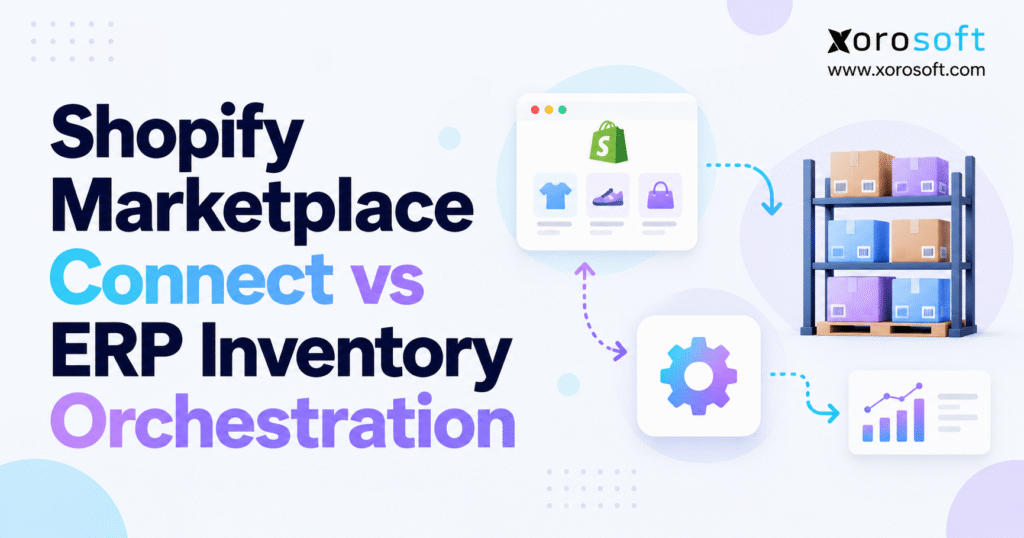
If you’re looking for a seamless Shopify marketplace sync solution, you’re in the right place.
1. Why Multichannel Growth Makes Inventory Promises Harder to Keep
1.1. The Same SKU Can Carry Several Different Commitments
A Shopify merchant has 240 units of a popular jacket in its main warehouse. Amazon and Walmart show stock, but a wholesale customer already expects 70 units next week. Another 15 jackets sit in the returns area awaiting inspection. Every dashboard may show a plausible figure, yet nobody can confidently say how many units the business can sell today. That gap, rather than the number of connected channels, drives the discussion around Shopify marketplace sync vs ERP.
The risk grows as orders arrive closer together. A warehouse transfer, an Amazon sale, and an incoming supplier receipt can change available stock within minutes. If each team applies different rules, a timely update can still communicate the wrong promise. Accurate channel feeds matter, but so do the decisions that produce them.
1.2. Shopify Inventory Sync Is Not the Same as Stock Control
Visibility answers questions about quantity and location. Control answers a harder set of questions: Who has a claim on those units? Which warehouse can meet the delivery date? When should purchasing place another order? What happens when a returned product fails inspection?
A marketplace connector moves product and order data between systems. An operational platform coordinates the rules that determine which data each channel should receive. Shopify marketplace sync vs ERP is therefore not a choice between useful and useless software. Both solve real problems at different points in the order lifecycle. The right setup depends on how many departments, inventory pools, and promises must agree before an order can ship.
1.3. Decide Which Problem Needs Solving Before Replacing the Stack
Before adding an ERP, trace one typical order from checkout to shipment and financial settlement. Record the system that accepts the order, reserves stock, sends warehouse instructions, publishes tracking, and records the costs. Then repeat the exercise for a cancellation or wholesale order.
This exercise often reveals a process gap rather than a missing app. A brand with one warehouse, stable suppliers, and reliable accounting may need little more than Shopify’s existing tools. Meanwhile, a distributor managing wholesale, production, and several fulfillment partners may need a broader operating model. The business case should start with recurring failures and measurable effort, not a target revenue threshold or a vendor’s feature list.
2. Shopify Marketplace Sync vs ERP: What Marketplace Connect Actually Does
2.1. Marketplace Connect Covers Listings, Orders, Quantities, and Fulfillment Messages
Shopify Marketplace Connect, formerly Codisto, helps merchants manage marketplace listings and share order, inventory, pricing, and fulfillment data through Shopify. Shopify’s Marketplace Connect documentation identifies Amazon, eBay, Walmart in the United States, and Target Plus in the United States as supported connections. The app currently blocks new Etsy connections, although existing connected sellers can continue using them.
Merchants avoid repetitive listing updates and bring supported marketplace orders into familiar Shopify workflows. The app also supports relevant Amazon fulfillment configurations. Those are substantial benefits for a merchant whose main difficulty is keeping marketplace activity aligned with its store. The app does not, by itself, define every purchasing, production, warehouse, and financial rule behind the quantities it shares.
2.2. Marketplace Inventory Sync Needs a Sound Availability Calculation
A channel can receive an accurate copy of a quantity that the business calculated incorrectly. Imagine that Shopify shows 100 units on hand while 35 belong to a confirmed wholesale order. If the available-to-sell calculation ignores that promise, a flawless marketplace sync may advertise too much stock.
The operating model needs a clear authority for commitments, holds, and replenishment. In a smaller company, Shopify and documented staff procedures may handle those responsibilities. Elsewhere, an order management system or ERP may control them. Shopify marketplace sync vs ERP becomes useful when teams ask not only whether values travel correctly, but also whether those values represent stock the warehouse can actually fulfill.
2.3. Keep the Connector’s Limits Separate From Shopify’s Native Features
Marketplace Connect is not the entire Shopify platform. The connector handles channel communication; Shopify also provides inventory locations, purchase orders, receiving, transfers, and configurable order routing. Blurring these layers produces an unfair comparison and can lead to unnecessary software purchases.
For example, Shopify tracks stock for product variants across locations, while Marketplace Connect has narrower inventory-location selection rules for marketplace listings. A merchant should test that specific behavior instead of concluding that Shopify cannot track variants. Similarly, native order routing may already meet the needs of a two-warehouse business. Compare the whole current workflow with the proposed ERP workflow, not one connector screen with every possible ERP feature.
3. Native Shopify Inventory Management Before an ERP Upgrade
3.1. Supplier Purchase Orders and Stock Transfers Already Exist in Shopify
Shopify merchants can create supplier purchase orders, track costs and payment terms, and manage receipts linked to inventory transfers. The Shopify purchase-order guide explains how merchants record supplier orders and incoming stock. For straightforward replenishment, this may be entirely adequate.
Greater complexity changes the requirements. A purchasing manager may need to combine wholesale commitments, supplier lead times, minimum order quantities, manufacturing materials, approvals, and cash planning. Creating a purchase order is only one step; choosing the right quantity and arrival date is another. ERP becomes relevant when the team needs those choices to connect with warehouse availability and financial records. A merchant should document the missing decisions rather than assuming all purchasing requires a new platform.
3.2. Shopify Order Routing vs Advanced ERP Warehouse Allocation
Shopify supports rules for assigning orders to fulfillment locations, including location priorities and ways to reduce unnecessary split shipments. A business that operates two warehouses with simple carrier and customer requirements should test these options first.
The challenge increases when a location has stock but cannot meet a service promise. It might lack a required carrier, face a labor shortage, or hold inventory that a retailer has reserved. A larger order may also need to ship together to avoid extra freight charges. These are cases where more detailed order-management or warehouse rules may help. The goal is not to replace native routing automatically, but to confirm where its configured rules stop matching the operation.
3.3. Variant-Level Stock and Connector Location Rules Are Not Identical
An apparel seller may store small sizes in one warehouse and extended sizes in another. Shopify can track those variants by location, but Marketplace Connect’s inventory-location configuration does not offer separate location selection for each individual variant through that setting. Merchants can make selections at product or marketplace level, according to Shopify’s guidance.
That difference deserves a test before launch. Check which quantity the app publishes for each variant, how fulfillment settings influence the order, and what happens during a transfer. In a Shopify marketplace sync vs ERP assessment, precise configuration details matter more than blanket claims about support for multiple warehouses. The desired outcome is a correct customer promise for the actual SKU, not merely a green integration status.
4. Inventory Sources of Truth and Available-to-Sell Rules
4.1. Physical Stock, Committed Stock, and Sellable Stock Tell Different Stories
On-hand inventory describes what the business records at a location. Sellable inventory removes units the merchant cannot safely offer because of accepted orders, quality holds, restricted lots, or separate reservations. A safety buffer may reduce the advertised quantity further.
Consider 600 units on hand, 130 already committed, 25 under inspection, 60 separately reserved for wholesale, and a 15-unit buffer. Under this simplified example, 370 units remain available to sell. The calculation works only if each deduction represents a distinct quantity; otherwise the business risks counting a reservation twice. Inventory definitions must remain consistent across warehouses, Shopify, and marketplace feeds. A shared formula matters more than which application displays the final figure.
4.2. Shopify Marketplace Sync vs ERP: Assign One Stock Authority
Three applications should not overwrite the same stock balance without clear rules. A warehouse receipt might increase stock in ERP, while an older Shopify adjustment arrives afterward and restores the previous value. Both messages can be technically valid, yet the final result becomes wrong.
Choose which system owns each quantity, then specify how downstream applications receive updates. Shopify may remain the authority for simple operations; ERP or WMS may own physical warehouse balances in a more complex setup. Amazon FBA inventory deserves separate treatment because Amazon controls its fulfillment pool. Shopify marketplace sync vs ERP is easier to resolve after teams agree on these responsibilities. Monitoring should identify delayed messages, duplicate adjustments, and unexplained differences rather than assuming every successful API response proves the business record is correct.
4.3. Preserve the Transaction Behind Each Stock Change
A stock change should point to an event: supplier receipt, customer order, warehouse transfer, cycle count, damage adjustment, manufacturing issue, or return. Without that trail, employees can see a difference but struggle to explain it.
Trace one SKU through receiving, a wholesale reservation, a marketplace order, and a partial return. Check whether staff can identify when availability changed, who approved an adjustment, and which system informed the sales channels. If the team must combine exports from several apps to answer those questions, better transaction ownership may be more important than another inventory dashboard. ERP can help, but so can tighter process controls where the existing tools already support the work.
5. Shopify Marketplace Sync vs ERP for Stock Reservations and Overselling
5.1. Shared Channels Turn Stock Into Competing Customer Promises
A seller lists the same product on Shopify, Amazon, and Walmart. Two orders arrive almost together, before a fresh availability update reaches every channel. The business can reduce this risk with quick commitment handling, stable SKU mappings, carefully chosen buffers, and alerts for failed messages.
Buffers should follow evidence rather than arbitrary percentages. Fast-moving SKUs may need more protection during promotions; slow-moving products may not. A buffer that never changes can hide stock and reduce sales. Strong inventory rules protect customer promises while leaving as much sellable stock visible as practical. No connector can guarantee that simultaneous marketplace activity will never create a timing conflict, so the operation also needs a clear exception process.
5.2. Marketplace Inventory Allocation and Wholesale Reservation Rules
Suppose a customer orders 180 jackets for delivery next week while the brand has 300 available today. If online channels keep offering all 300, a busy weekend could consume units already promised to the wholesale buyer. Sales teams need to decide whether to reserve the 180 jackets immediately or match them against incoming supply.
The answer depends on contracts, delivery windows, and customer priority. When a buyer changes the order, staff should be able to release or adjust the reservation without creating another mismatch. This illustrates Shopify marketplace sync vs ERP at an operational level: the connector publishes the allowed quantity, while the business’s allocation process decides which customers have a valid claim on stock.
5.3. Future Supply Changes What Can Be Promised and When
Available-to-promise planning considers incoming stock and delivery dates, not just today’s sellable quantity. A merchant may have 20 units now and 150 due from a supplier next Friday. Accepting a new order for Monday delivery would still be risky if the warehouse needs inspection and receiving time.
A reliable promise also accounts for open orders, supplier performance, and eligible fulfillment locations. Test delayed shipments, partial receipts, purchase-order cancellations, and backorders before publishing future availability. ERP or specialized planning software may coordinate these inputs, but any system needs clear rules about when anticipated stock becomes an actual customer commitment. The business should never treat a forecasted arrival as equivalent to goods ready to ship.
6. Connector-First, Hybrid ERP, and Direct Marketplace Integration
6.1. Keep Shopify and Marketplace Connect When the Workflow Already Works
The connector-first model uses Marketplace Connect for supported channel listings and orders, while Shopify and existing apps handle stock, purchasing, fulfillment, and accounting. For a manageable catalog and straightforward warehouses, this can remain a clean operating model.
Fewer systems mean fewer integration points to monitor. Staff understand where orders begin and where quantities change. If native Shopify purchasing and order routing meet requirements, adding ERP may introduce training and maintenance without solving a meaningful problem. Review measurable exceptions before deciding to replace the stack. A growing company can retain a simple architecture when the team consistently fulfills orders and reconciles inventory without excessive manual work.
6.2. Hybrid Shopify ERP Integration Across Departments
In a hybrid architecture, Marketplace Connect continues channel communication while ERP coordinates agreed processes such as allocations, purchasing, warehouse events, and financial posting. Marketplace orders can enter Shopify, flow through an operational layer, and return fulfillment updates along a defined path.
Teams can assess a platform such as XoroONE when inventory-driven operations need connected purchasing, warehousing, and finance. The exact integration design still requires validation, including order IDs, stock ownership, canceled orders, and returns. Shopify marketplace sync vs ERP does not require choosing only one system; the stronger architecture can assign each product a clear role, provided those roles do not overlap in ways that create duplicate orders or competing quantity updates.
6.3. Use Direct ERP Integrations Only When Marketplace Coverage Is Proven
Some ERP systems or integration services can connect directly to marketplaces without routing every transaction through Marketplace Connect. That approach may reduce data hops, but it also changes responsibility for listings, fees, shipments, returns, and marketplace-specific errors.
Review actual marketplace regions and fulfillment methods, not just logos on a partner page. Xorosoft’s integration directory provides a starting point for evaluating supported business connections; its Shopify App Store listing describes Shopify-facing order and inventory workflows. Neither reference proves that every combination will work without configuration. Test the entire order journey and failure recovery before committing to an ERP-direct design.
7. Multi-Warehouse Routing, WMS Work, and Third-Party Logistics
7.1. The Nearest Warehouse May Not Be the Right Warehouse
A retailer ships from California, Texas, and Ontario. Every site has a product in stock, but the closest location might miss the shipping cutoff or lack the carrier service a customer needs. Another facility may hold enough units for the whole order, avoiding an expensive split shipment.
Order routing can consider distance, stock, delivery promises, warehouse capacity, and customer-specific rules. Shopify already handles many routine location choices. An ERP or order management layer becomes useful when the business must consider more detailed constraints. In Shopify marketplace sync vs ERP projects, test unusual shipments alongside normal orders. The edge cases often reveal whether the chosen software can protect the delivery promise rather than simply select a warehouse with positive stock.
7.2. WMS Warehouse Execution Beyond Marketplace Inventory Sync
Once an order reaches the warehouse, staff still need to find items, scan or check quantities, pick, pack, label, and ship. Warehouse management systems focus on those physical tasks, often using bins, barcode scans, cycle counts, and replenishment assignments.
XoroWMS is one warehouse-focused option for businesses that need greater control over receiving, stock tracking, picking, and packing. Its relevance depends on warehouse complexity, not the number of marketplace connections. A small merchant may operate well with native fulfillment workflows. Larger distributors handling many orders across several storage zones may need directed tasks and better exception tracking. Compare the work employees perform, not simply the number of features a WMS advertises.
7.3. A 3PL Creates Another Stock Record That Needs an Owner
Third-party logistics providers often know the most accurate physical count inside their own facilities. Shopify or ERP may still control customer-facing availability. Those records need clear rules for receipts, shipping confirmations, adjustments, and returns.
When a 3PL receives 100 units, perhaps 20 require inspection. Publishing all 100 as immediately sellable would misrepresent the true position. Likewise, a shipment should reduce stock only once even if several applications receive the tracking update. Stable location identifiers, order references, and timely reconciliation make this possible. The main goal is not to show every partner in one dashboard; it is to ensure each movement changes the correct stock pool and customer promise.
8. ERP Purchasing, Inventory Forecasting, and Manufacturing Control
8.1. Replenishment Requires Open Orders and Supplier Timing
Last month’s sales rarely provide enough information to create the next purchase order. Buyers also need current commitments, incoming shipments, supplier lead times, minimum order quantities, and planned promotions. A product may show weak sales only because the warehouse ran out of it halfway through the month.
For example, forecast demand might reach 1,000 units while 350 remain sellable and 400 are already on order. The next purchase depends on arrival dates and reservations, not simply the difference between these figures. An integrated purchasing process lets buyers check supply against actual demand before committing cash to more inventory.
8.2. ERP Demand Planning Beyond Shopify Marketplace Sync
Amazon demand can follow a different pattern from a Shopify promotion. Wholesale customers often order larger quantities less frequently, while seasonal launches can cause short bursts of direct-to-consumer demand. Combining every channel into one trend may obscure these differences.
Shopify marketplace sync vs ERP becomes important when forecast signals must guide supplier decisions. A connector transfers order information; a planning system evaluates lead times, available inventory, incoming stock, and future commitments. Whichever system the business uses, staff need to maintain realistic assumptions and review forecast errors rather than treating software-generated suggestions as automatic purchase approvals.
8.3. Manufacturing Links Sellable Products to Component Availability
Manufacturers must account for components, work orders, and production capacity before promising finished goods. A shortage of one low-cost part can delay an entire product, even when every other component is available. Bills of materials and production records help teams distinguish stock on hand from stock they can produce by a certain date.
XoroERP is an ERP option for evaluating how inventory, purchasing, accounting, and production workflows connect. Merchants should test a genuine component shortage, partial build, and finished-goods receipt. The best architecture publishes customer availability only when production rules support that promise.
9. Amazon FBA, Wholesale EDI, and Bundles Need Separate Inventory Logic
9.1. Amazon Fulfillment Pools Should Not Be Combined Blindly
Fulfillment by Amazon inventory sits inside Amazon’s network, while merchant-fulfilled stock may remain in a company warehouse or with a 3PL. Multi-Channel Fulfillment creates further options, but only when the merchant configures and validates the relevant service.
Keep these stock pools distinct unless an order has an approved fulfillment path. Also separate inventory traveling to an Amazon facility from units Amazon has received and made available. Shopify marketplace sync vs ERP needs to reflect where products physically sit and which channels can legally and practically use them. A single combined number may overstate what the merchant can ship.
9.2. ERP Stock Reservations for EDI and Wholesale Orders
Wholesale retailers may send purchase orders through electronic data interchange and require specific prices, delivery windows, and shipping documents. Once the supplier accepts an order, its stock commitment can affect what the brand should offer through Shopify and Amazon.
Allocation rules should describe when to reserve units, how to manage partial shipments, and what happens after a buyer changes an order. Staff should not need a hidden spreadsheet to protect major customer commitments. Consistent reservations connect wholesale promises with consumer-channel availability, regardless of whether Shopify or ERP owns the final quantity.
9.3. Bundles Depend on the Scarcest Available Component
A sporting goods kit contains one racket, two grips, and a case. If the warehouse has 100 rackets, 150 grips, and 40 cases, it can assemble at most 40 complete kits before considering other commitments. Selling components separately may reduce that number further.
A connector can publish a kit quantity, but the underlying inventory process must calculate it from the available parts. This is a useful Shopify marketplace sync vs ERP test: reserve a component for a different order and verify whether the bundle availability changes everywhere it should. Bundle rules must also handle returns and kit disassembly.
10. Marketplace Returns, Settlement Fees, and Inventory Accounting
10.1. A Refund and a Restock Are Different Events
A customer can receive a refund before the warehouse gets the item back. Once it arrives, staff may find damage or missing parts. The product should return to sellable stock only after the correct checks.
Shopify’s Marketplace Connect fulfillment guidance explains that marketplace cancellations and returns update Shopify orders but do not automatically restock the related inventory. Teams should give one process responsibility for inspection, inventory status, and final adjustment. Clear ownership prevents stock from reappearing for sale before the merchant can actually ship it.
10.2. Marketplace Accounting and ERP Settlement Reconciliation
The amount a marketplace pays into a bank account often differs from gross sales. Selling fees, refunds, shipping charges, and other adjustments can affect settlement. Finance needs to connect each payout with the right orders and costs.
A weak integration may transfer revenue totals while leaving accounting staff to match fees and returns manually. ERP can link those records when teams set up the correct accounting rules. Shopify marketplace sync vs ERP therefore extends beyond stock numbers: the same order should remain traceable from acceptance and shipment through inventory cost and settlement. Test a sale, return, fee, and final payout before relying on financial reports.
10.3. Inventory Valuation Depends on Accurate Operational Events
Receiving stock, transferring goods, consuming components, and writing off damage can affect inventory value. Financial teams need enough detail to explain those changes and apply the company’s accounting policies consistently.
A synchronized quantity alone cannot establish correct cost of goods sold. Staff must also track purchase costs, relevant landed expenses, and the transactions behind adjustments. An ERP-led setup may reduce manual reconciliation, but integration quality still determines whether the numbers agree. Ask to trace one received SKU through sale and refund, including the corresponding financial entries.
11. Industry-Specific Shopify Inventory Management Requirements
11.1. Apparel Brands Need Size-Level Reservations and Return Controls
Apparel teams manage colors, sizes, wholesale allocations, and frequent returns. A jacket may be available in one size but sold out in another, while a retail partner holds a reservation against a future delivery. Inventory rules must therefore work at the correct SKU and location level.
During a Shopify marketplace sync vs ERP review, test a size-specific wholesale order, a transfer, and a return that fails inspection. Those cases uncover more than a demonstration with one product and no variations. The goal is to publish accurate availability without forcing employees to update every channel by hand.
11.2. Multichannel Fulfillment for Furniture and Sporting Goods
Furniture sellers must consider oversized freight, delivery regions, warehouse eligibility, and appointments. A warehouse can have the item on hand yet fail to meet the customer’s delivery promise. Sporting goods merchants face seasonal peaks, launch allocations, and stock that several channels want simultaneously.
These are distinct problems even though both involve inventory. Product handling, customer commitments, and replenishment lead times should guide the configuration. A business gains little from a universal allocation rule that ignores how its products move. Ask vendors to demonstrate orders that match the industry’s real constraints.
11.3. Food and Manufacturing Add Lot and Production Requirements
Food businesses may need expiry dates, quality holds, and lot traceability. Manufacturers also need component records, production orders, and finished-goods timing. A product can appear physically present while a hold or incomplete build prevents shipment.
The Xorosoft industries overview describes several inventory-driven business models, but merchants should evaluate vendor fit through their own processes. Shopify marketplace sync vs ERP is particularly relevant when stock eligibility depends on more than a SKU count. Traceability and production rules must shape what the sales channels can promise.
12. Software Alternatives, Connector Pricing, and Total Cost
12.1. Marketplace Connector vs ERP, OMS, and WMS Responsibilities
A marketplace connector manages channel communication. An order management system coordinates orders and allocation, while a warehouse management system focuses on receiving, picking, packing, and physical stock. ERP connects wider operating and financial processes. Products can overlap these roles, so labels alone do not establish fit.
Connected business software solutions may combine several responsibilities, but a merchant should ask who owns each transaction and where the remaining work happens. Shopify marketplace sync vs ERP becomes a clearer comparison after the team separates marketplace integration from the order, warehouse, purchasing, and finance processes behind it.
12.2. Marketplace Connect App Pricing Does Not Equal ERP Ownership Cost
As of October 2026, the Shopify Marketplace Connect App Store listing describes a free-to-install app with the first 50 marketplace-synced orders per month free. Additional synced orders carry a 1% fee, capped at $99 per month; marketplace seller fees remain separate. Verify pricing before publication or purchase.
ERP expenses can include subscriptions, configuration, migration, training, integrations, and support. A sound comparison also measures the cost of correcting stock mistakes and reconciling disconnected reports. The lowest app bill is not necessarily the lowest operating cost, but more software does not guarantee savings either.
12.3. Test ERP Vendors Against the Same Real Transactions
Businesses may consider NetSuite, Acumatica, Business Central, Cin7, Brightpearl, and other systems. These products differ in scope and implementation approach. Compare them using identical orders, supplier receipts, inventory reservations, returns, and settlement scenarios rather than relying on feature counts.
For an additional vendor perspective, the Xorosoft vs NetSuite comparison outlines issues buyers can explore. A Shopify marketplace sync vs ERP assessment should stay neutral: no provider wins simply because it advertises more integrations. Require evidence that the proposed workflow handles your specific channels and operational exceptions.
13. Integration Testing, Migration, and Measurable Results
13.1. Map Every Important Transaction Before Changing Systems
Document where products originate, where orders enter, which application reserves stock, and who records warehouse and finance events. Include marketplaces, Shopify, suppliers, 3PL partners, and spreadsheets. The map should expose duplicate entry and areas where nobody owns an exception.
An integration project that starts with software installation instead of process ownership can reproduce old errors in a new stack. Give each key record a stable identifier, set the permitted direction of updates, and define error handling before moving live orders. That groundwork matters more than an impressive launch checklist.
13.2. Test Shopify ERP Integrations With Real Order Exceptions
Test simultaneous Shopify and marketplace sales for the same SKU. Follow with a wholesale reservation, partial supplier receipt, failed sync, warehouse transfer, damaged return, and canceled order. Check the final stock balance after every event and confirm that nothing imports or deducts twice.
Shopify marketplace sync vs ERP should also cover what happens when an API stops responding. Staff need alerts, retry rules, and a way to reconcile missed events. An ideal demo order proves very little about those conditions. Use representative transactions with expected results that warehouse, finance, and ecommerce teams agree on in advance.
13.3. Measure Operational Improvement Instead of Assuming It
Track stock discrepancies, oversold orders, time spent correcting inventory, fulfillment exceptions, and month-end reconciliation effort before and after a system change. Keep the definitions consistent so comparisons remain meaningful.
Customer references can reveal useful approaches, but results depend on the implementation. Xorosoft’s customer case studies provide examples to examine alongside the company’s own requirements. Ask which systems the customer used, which workflows changed, and how the customer measured results. The decision should rest on demonstrated fit and realistic operating costs, not an unsupported return-on-investment promise.
14. Shopify Marketplace Sync vs ERP: Choose the Right Operating Model
14.1. Keep the Connector-First Approach When It Meets the Business Need
If Shopify handles stock, purchasing, and fulfillment reliably, Marketplace Connect may remain all the marketplace integration the company needs. A smaller catalog, predictable supplier lead times, and simple warehouse rules do not automatically justify ERP.
Review recurring exceptions before making a purchase decision. Better staff procedures, cleaner SKU mapping, or improved use of Shopify features may resolve the real issue. Adding a complex platform to an already dependable process can create more work than value. The simplest architecture that protects customer promises deserves serious consideration.
14.2. Add ERP Orchestration When Stock Commitments Intersect
ERP becomes worth evaluating when wholesale orders, warehouses, manufacturing, purchasing, and finance all depend on the same inventory decisions. Manual allocations, unexplained stock changes, and slow reconciliations provide stronger evidence than a revenue target alone.
The central lesson of Shopify marketplace sync vs ERP is that channel data and operational control must agree. A connector can continue handling marketplace communication while another system manages broader business decisions. Direct integrations may also fit if they cover the required workflows. Choose the model that gives every accepted order a clear, achievable fulfillment path.
14.3. Validate the Workflow Before Committing to an ERP Project
Start with inventory ownership, real exception data, and a short set of test orders. Evaluate each candidate against the same sales channels, reservations, warehouse steps, and financial transactions. A focused assessment often shows whether to keep the existing connector, add ERP, or change the integration path.
For merchants whose Shopify operation now spans complex stock, purchasing, warehouse, and accounting requirements, contact Xorosoft to discuss a workflow-specific review. The next step should be a practical system design, not another disconnected application.
Frequently Asked Questions
How does Shopify Marketplace Connect differ from ERP?
Marketplace Connect syncs marketplace listings, orders, and inventory. ERP also manages purchasing, stock reservations, warehouse processes, and accounting.
Does Shopify Marketplace Connect replace ERP?
No. Marketplace Connect connects sales channels; ERP handles wider operations. Many merchants use both when inventory and finance grow complex.
Can Shopify Marketplace Connect prevent overselling?
It updates marketplace stock, but sync delays and missing reservations can still cause overselling. Clear stock ownership and buffers help.
Does Shopify Marketplace Connect support multiple warehouses?
It can use configured Shopify locations. Complex warehouse allocation, scanning, and fulfillment rules may require a WMS or ERP.
Can Marketplace Connect work with an ERP?
Yes, through a tested architecture. Define which system owns inventory, orders, and fulfillment updates to avoid conflicting records.
When should a Shopify business add ERP?
Consider ERP when wholesale commitments, multi-warehouse stock, purchasing, manufacturing, or accounting require shared controls beyond existing Shopify workflows.
Is Marketplace Connect cheaper than ERP?
Usually, its app costs are lower, but the products perform different jobs. Compare connector fees with ERP subscriptions, setup, support, and manual work.
Recent Posts
-
 WMS vs Shopify Fulfillment Tools: When Warehouse Complexity Requires More
 -
 Manufacturing Backlog Statistics 2026: Orders, Inventory and Capacity Signals
 -
 ERP Software for Canadian Wholesale Companies Managing US Sales
 -
 Shopify Accounting Integration: How to Reconcile Orders, Fees, Refunds, and Payouts to ERP
 -
 Negative Inventory Accounting: Why COGS and Gross-Margin Reporting Go Wrong