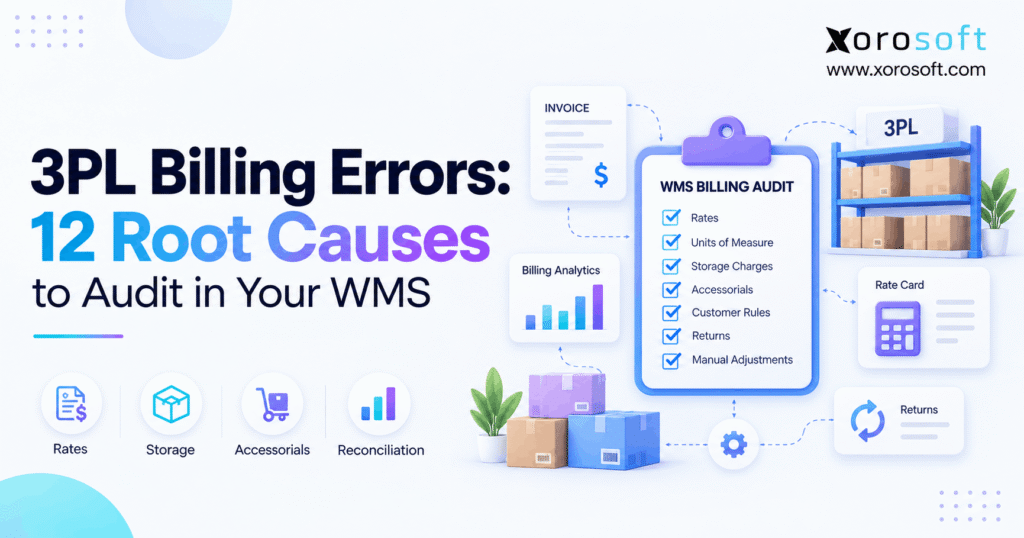
Businesses that use third-party logistics providers need to be aware of potential 3PL billing errors.
1. Why 3PL Billing Errors Often Start Before Invoicing
3PL billing errors often start long before finance creates the final invoice. A warehouse may miss a service, use an old rate, record the wrong unit, or post an activity in the wrong billing period. As a result, an invoice can look complete while still being wrong.
Therefore, a useful billing review should not begin and end with invoice totals. Instead, teams should trace each charge back to the warehouse work, customer rule, quantity, and rate that created it.
Meanwhile, the cost goes beyond one credit or rebill. Missed charges reduce revenue. Wrong charges create customer disputes. In addition, manual reviews slow invoicing and make month-end harder.
1.1 Why 3PL Billing Accuracy Depends on WMS Data
Every warehouse fee starts with an event. For example, a 3PL may receive pallets, store inventory, pick units, pack orders, process returns, relabel products, or complete a special project.
Next, the WMS needs to connect that activity to the correct customer and billing rule. Therefore, the basic flow should look like this:
Warehouse activity → WMS record → customer rule → charge → invoice → accounting
If one step fails, a billing error can follow.
As a result, accurate warehouse data is the base for accurate billing.
1.2 Why a 3PL Billing Audit Matters
Billing problems remain common across 3PL operations. For example, the Extensiv 2025 Third-Party Logistics Warehouse Benchmark Report highlights ongoing concerns around uncaptured charges and billing automation.
Therefore, operators should treat billing accuracy as a warehouse control, not only a finance task.
A strong 3PL billing audit asks one simple question:
Can we prove why every important charge appears on the customer’s invoice?
If the answer is no, the team should trace the charge back to its source.
2. How 3PL Billing Errors Begin in Warehouse Operations
Many teams first notice 3PL billing errors when a customer questions an invoice. However, the invoice usually shows the result rather than the cause.
For example, a storage line may show 120 pallets when the warehouse held only 105. Finance can see the difference, but the problem may come from inventory data, the snapshot date, the storage rule, or a unit conversion.
Therefore, teams should audit both the charge and the warehouse record behind it.
2.1 How 3PL Invoice Errors Create Customer Disputes
Overbilling happens when a customer receives charges that the contract or warehouse activity does not support.
For example, a duplicate warehouse event may create two handling fees. Likewise, an old rate may remain active after new pricing takes effect.
As a result, customers may ask for proof, credits, and corrected invoices.
In addition, finance and warehouse teams must spend time rebuilding the transaction history.
Therefore, even a small 3PL invoice error can create much more work than its dollar value suggests.
2.2 How Missed 3PL Charges Create Revenue Leakage
Underbilling can be harder to find because customers rarely complain when an invoice is too low.
For example, the warehouse may complete relabeling, inspection, kitting, repacking, or special handling without recording a billable event.
Consequently, the 3PL performs the work but never invoices it.
Therefore, teams should audit in both directions:
Warehouse activity → invoice
and
Invoice → warehouse activity
This approach finds both missed revenue and unsupported charges.
3. 12 Root Causes of 3PL Billing Errors
Most 3PL billing errors come from a small group of repeat process or system gaps. Therefore, the best audit does not check random invoices alone.
Instead, it tests the full path from warehouse work to customer billing.
The following 12 checks cover the areas where WMS data and billing rules most often drift apart.
3.1 Missing Billable Events Cause 3PL Billing Errors
The first root cause is simple: the warehouse performs work, but no billing record follows.
For example, employees may complete relabeling, repacking, inspection, pallet rebuilding, or rush handling after a request by email or chat. However, finance may never see that request.
Therefore, every repeat service needs a clear warehouse event.
For teams that need stronger event control, XoroWMS connects warehouse activity, inventory movement, and real-time WMS workflows.
Audit check: List every service in the customer contract. Then identify the WMS event that proves the warehouse completed it.
If no clear event exists, the service can easily become a missed charge.
3.2 Outdated Rate Cards Create 3PL Invoice Errors
A correct warehouse record can still create an incorrect invoice when the system uses the wrong price.
For example, a customer may agree to new receiving, storage, or pick fees. However, the old rate may remain in a spreadsheet or billing profile.
Therefore, teams should compare active rates with signed customer terms.
Also, review effective dates, minimum fees, unit rules, discounts, tiers, and special conditions.
The ShipHero 3PL billing documentation shows how current 3PL systems may separate receiving, storage, shipment, return, recurring, and ad hoc fees.
Audit check: Test real transactions against the current contract instead of checking the rate table alone.
3.3 Units of Measure Do Not Match
A rate may be correct while the invoice total remains wrong.
For example, the WMS may record 240 eaches while the customer contract bills by cases of 12. Therefore, billing must convert 240 units into 20 cases before applying the rate.
Likewise, some warehouses charge by pallet, carton, weight, cubic space, hour, or order.
As a result, one wrong conversion factor can create many 3PL billing discrepancies.
Audit check: Compare the inventory unit, warehouse unit, billing unit, conversion factor, and final invoice quantity.
Also, review high-volume SKUs first because small errors can grow quickly.
3.4 Storage Data Creates WMS Billing Errors
Storage creates some of the hardest WMS billing errors because stock levels change every day.
For example, one contract may charge daily pallet storage while another uses weekly snapshots. Meanwhile, another customer may pay by cubic space or occupied location.
Therefore, the WMS must use the right stock figure at the right time.
First, review whether the contract uses beginning inventory, ending inventory, average inventory, pallet positions, units, or another method.
Next, compare that rule with warehouse history.
For businesses that need broader inventory and finance visibility, XoroONE connects inventory with other core operating workflows.
Audit check: Recalculate one billing period from historical inventory records.
3.5 Duplicate Events Create Duplicate Charges
Automation does not always prevent 3PL billing errors. In fact, it can repeat an error quickly when the same warehouse event enters the system twice.
For example, a user may repeat a scan because the first attempt appeared to fail. Likewise, an integration may resend an event after a timeout.
As a result, the billing process may treat both records as valid work.
Therefore, teams should check duplicate source IDs, order numbers, quantities, service types, timestamps, and charge values.
Audit check: Select several duplicate-looking invoice lines and trace each one to a unique warehouse event.
If two charges point to the same activity, fix the event logic instead of only removing the invoice line.
3.6 Missed Accessorials Create 3PL Billing Gaps
Accessorial work often falls outside normal receiving and fulfillment.
For example, a customer may request rush handling, extra labels, special packaging, pallet exchange, compliance work, or unusual documents.
However, warehouse staff may treat the task as normal work while the contract treats it as an extra service.
Therefore, free-text notes alone are risky.
Instead, use clear service codes for repeat work. In addition, allow notes to explain unusual cases.
Audit check: Compare customer requests, warehouse notes, service logs, and invoice lines.
This review can expose 3PL billing gaps that finance may never find through invoice review alone.
3.7 Value-Added Services Stay in Spreadsheets
Kitting, assembly, relabeling, inspection, repacking, and project work often create missed 3PL charges.
For example, a supervisor may track a two-hour special project in a spreadsheet. However, if nobody moves that record into billing, the work disappears from the invoice.
Therefore, the warehouse should record the quantity, labor, or project output close to the time of work.
In addition, teams should define who owns the final billing check.
Audit check: Compare value-added service records with invoices for the same period.
If the gap appears often, consider moving repeat work into a structured Xorosoft solutions workflow.
3.8 Billing Cutoffs Create 3PL Invoice Discrepancies
Some 3PL invoice discrepancies come from timing rather than quantity or price.
For example, staff may complete an activity on January 31 but enter it on February 1. Likewise, one team may use shipment date while another uses completion date.
Consequently, the charge moves into the wrong billing period.
Therefore, each service needs a clear billing trigger.
The team should define the event date, cutoff time, timezone, late-entry rule, and adjustment process.
Audit check: Review transactions immediately before and after month-end.
Also, compare the warehouse event date with the invoice period to find valid charges placed in the wrong month.
3.9 Customer-Specific Rules Are Set Up Incorrectly
As a 3PL grows, customer contracts usually become less standard.
For example, one client may have minimum receiving fees. Another may use volume tiers. Meanwhile, another may include the first hour of project work in its base fee.
Therefore, one generic billing setup can create 3PL billing errors across several customers.
The system should support customer-specific rules while keeping them easy to review.
Audit check: Test minimum fees, tiers, discounts, included services, warehouse rules, and special exceptions.
For companies that need warehouse and accounting in the same system, XoroERP connects inventory, purchasing, warehouse activity, accounting, and order workflows.
3.10 WMS Billing and Accounting Records Do Not Agree
A charge can be correct inside the warehouse system but still fail later.
For example, an invoice transfer may fail. Likewise, a customer code may not match between the WMS and accounting software.
As a result, operations may report one amount while finance reports another.
Therefore, 3PL billing reconciliation should cover the full path from warehouse work to accounts receivable.
Audit check: Pick a sample of approved charges and trace them into the final invoice and accounting record.
In addition, review failed sync logs and manual journal entries.
When systems exchange data often, Xorosoft integrations can help reduce repeated data entry across ecommerce and business workflows.
3.11 Returns Use the Wrong Billing Logic
Returns often need different billing rules from outbound fulfillment.
For example, a returned item may require receiving, inspection, restocking, repacking, repair, disposal, or return-to-vendor work.
Therefore, charging only a basic return fee may understate the work.
However, billing every step separately can also overcharge a customer when the contract bundles services.
Audit check: Take several completed returns and trace each warehouse step against the customer’s terms.
Also, verify that the WMS uses the correct return quantity and service rule.
This review is especially useful for apparel, consumer goods, and ecommerce operations with high return volume.
3.12 Manual Adjustments Create Billing Audit Gaps
Teams will always need some manual changes. However, uncontrolled changes create serious billing risk.
For example, a user may add a fee, remove a charge, change a rate, or issue a credit without recording why.
As a result, another employee cannot explain the invoice later.
Therefore, every manual change should keep the user, date, original value, new value, reason, and source record.
Audit check: Review manual credits, deleted fees, overrides, and added charges from recent billing periods.
In addition, check whether one person can create and approve major changes without a second review.
4. How to Run a 3PL Billing Audit in Your WMS
A good 3PL billing audit follows the transaction path instead of checking totals alone.
Therefore, use the same method for every customer. This makes billing errors easier to find and lets teams compare results across accounts.
Most importantly, audit both what was billed and what should have been billed.
4.1 Start the 3PL Billing Audit With the Customer Contract
First, collect the active contract and every approved change.
Next, list service types, rates, units, minimums, tiers, storage terms, and special rules.
Then, compare those terms with the WMS and billing setup.
If the system does not match the contract, correct the setup before checking hundreds of invoices.
Also, note the date each rate became active.
This step prevents teams from treating a setup problem as a one-time invoice problem.
4.2 Audit WMS Billing Events Against Invoices
Next, sample receipts, shipments, returns, storage records, and value-added work.
For each activity, ask whether the correct billable charge followed.
Then, work backward. Pick invoice lines and confirm that each line points to real warehouse activity.
Therefore, the audit runs in both directions:
Warehouse work → invoice
and
Invoice → warehouse work
As a result, teams can find both missed revenue and unsupported charges.
4.3 Check Rates, Quantities, and Billing Dates
After that, verify the three fields behind many WMS billing errors: rate, quantity, and date.
First, confirm the correct customer rate.
Next, confirm the billing unit and quantity.
Finally, confirm that the system placed the activity in the right billing period.
Because these fields work together, teams should not review them in isolation.
For example, the right rate applied to the wrong unit can still create a wrong invoice.
4.4 Reconcile 3PL Billing With Accounting
Finally, confirm that approved billing reached accounting correctly.
For example, compare customer billing totals with invoices, credits, and accounts receivable.
If teams often struggle to connect warehouse and finance records, review Xorosoft case studies to see how inventory-driven businesses have approached wider process and system changes.
Therefore, the audit should finish only when the operational and financial records agree.
5. 3PL Billing Error Audit Matrix
The following matrix turns common 3PL billing errors into simple checks.
| Root Cause | What to Check | Likely Result | Main Control |
|---|---|---|---|
| Missing activity | Warehouse work vs charges | Underbilling | Event capture |
| Wrong rate | Contract vs system | Wrong invoice | Rate review |
| Wrong UOM | Unit and conversion | Wrong quantity | UOM control |
| Storage error | Inventory history | Storage dispute | Snapshot rule |
| Duplicate event | Source IDs | Overbilling | Duplicate check |
| Missing accessorial | Service logs | Underbilling | Charge codes |
| Untracked VAS | Project records | Revenue leakage | Work capture |
| Wrong cutoff | Event dates | Period error | Cutoff rule |
| Wrong client rule | Contract terms | Wrong fee | Client setup |
| System mismatch | WMS vs accounting | Finance gap | Reconciliation |
| Return error | Return activity | Wrong fee | Return rules |
| Manual override | Audit history | Unclear charge | Approval trail |
Therefore, teams can use this matrix during customer onboarding, contract changes, system moves, and regular billing reviews.
6. Manual Billing vs WMS Billing Controls
Spreadsheets are not automatically bad. For a small 3PL with a few customers and simple rates, a controlled spreadsheet may work.
However, the risk grows as warehouses add clients, sites, channels, special services, and pricing rules.
Therefore, operators should judge billing tools by process complexity rather than company size alone.
6.1 When Manual Billing Can Still Work
Manual billing can remain practical when customers use simple rates, activity volume stays low, and one team owns the process.
In addition, strong review controls can reduce risk.
However, every manual step should leave proof.
For example, staff should know who entered the charge, where the quantity came from, and which customer rate they used.
Therefore, the problem is not the spreadsheet itself. The real issue is whether the process stays clear, controlled, and easy to audit.
6.2 When WMS Billing Automation Becomes Useful
WMS billing automation becomes more useful when billing depends on thousands of warehouse events.
For example, a growing 3PL may manage storage, receiving, picking, returns, projects, and customer-specific rules across several sites.
Therefore, structured event capture can reduce re-entry.
In addition, connected systems can make 3PL billing errors easier to trace because the charge stays linked to warehouse activity.
For multi-channel operators, Xorosoft is also available through the Shopify App Store, helping connect Shopify activity with wider ERP and warehouse workflows.
7. WMS Billing Controls That Reduce Invoice Errors
The goal of better billing software is not simply to create invoices faster.
Instead, the system should make charges easier to prove, review, and correct.
Therefore, operators should focus on control quality rather than feature count.
7.1 Connect 3PL Charges to Real Warehouse Work
First, the billing process should link common fees to clear warehouse events.
For example, a receiving charge should point to receiving activity. Likewise, a return charge should point to return work.
As a result, teams can answer customer questions without rebuilding the history from emails and spreadsheets.
Also, this link helps finance spot missing charges before the invoice leaves the business.
7.2 Control Customer Billing Rates
Next, rate changes need clear dates and ownership.
Therefore, users should know which billing rule was active when the warehouse completed the work.
In addition, managers should review major rate changes before those rates affect customer invoices.
As a result, teams can reduce 3PL invoice errors caused by old rates, bad setup, or unclear contract changes.
7.3 Keep People Involved in Billing Exceptions
Automation should handle repeat work. However, people should still review unusual credits, one-time projects, disputed services, and major overrides.
Therefore, the best process combines clear system rules with human review.
This balance reduces repetitive work without hiding unusual billing activity.
In addition, an approval step gives finance a chance to stop a wrong charge before the customer sees it.
8. Where 3PL Billing Errors Appear Across Industries
The same root causes appear across many industries. However, the warehouse activity behind them changes.
Therefore, each 3PL should adjust its billing audit to the services it actually performs.
8.1 3PL Billing Risks in Apparel and Fashion
Apparel warehouses often handle relabeling, folding, polybagging, inspection, returns, and retailer prep.
As a result, small missed service fees can grow across thousands of units.
Therefore, apparel 3PLs should pay close attention to unit counts, return work, and value-added services.
In addition, customer-specific packaging rules can create billing gaps when staff track them outside the WMS.
8.2 Warehouse Billing Errors in Furniture and Bulky Goods
Furniture and large products can create complex storage and handling rules.
For example, a warehouse may charge by pallet, location, cubic space, or oversized handling.
Therefore, these operators should audit dimensions, locations, storage dates, and handling events carefully.
Also, a wrong size or location record can affect both inventory visibility and storage billing.
8.3 3PL Invoice Errors in Wholesale and Ecommerce
Wholesale and ecommerce 3PLs may handle cases, eaches, pallets, EDI orders, Shopify orders, Amazon orders, returns, and customer-specific prep.
Consequently, 3PL billing errors can spread across several order types.
Businesses serving several channels can review Xorosoft industries to see how warehouse, inventory, accounting, and order needs vary across inventory-driven sectors.
9. When 3PL Billing Problems Signal a Systems Gap
One invoice dispute does not mean a company needs a new platform.
However, repeated 3PL billing problems can show that the business has outgrown its current process.
Therefore, operators should watch for repeat patterns rather than isolated mistakes.
9.1 Too Many Spreadsheets Increase 3PL Billing Risk
If operations, finance, customer service, and warehouse managers all maintain separate billing files, the process becomes hard to control.
Moreover, each file creates another place for data to drift.
Therefore, the real issue may be system design rather than staff effort.
As a result, employees spend more time checking numbers instead of improving warehouse work.
9.2 WMS and Finance Billing Numbers Do Not Match
Teams should be able to explain why warehouse activity and accounting totals differ.
However, if every month-end becomes a long search for missing data, the business lacks a clear source of truth.
Therefore, leaders may need to review warehouse, inventory, billing, and accounting together.
In addition, repeated manual journal changes can hide the original WMS billing problem instead of fixing it.
9.3 Complexity Grows Faster Than Order Volume
A business does not need to double orders to double billing complexity.
For example, adding a new warehouse, EDI customer, Shopify store, return program, or special project can create new billing rules.
Therefore, operators should review their billing process whenever they add channels, services, customers, or locations.
As a result, the team can fix the process before billing disputes become normal.
10. How to Reduce 3PL Billing Errors Without Over-Automating
The safest approach combines clear rules, good warehouse data, and the right level of automation.
Therefore, do not automate a billing rule until the team fully understands it.
Also, remember that automation should reduce repeat work, not remove useful human review.
10.1 Standardize 3PL Billable Events
First, define the warehouse event that proves each service occurred.
Next, train teams to record that event the same way every time.
As a result, finance receives better data without asking warehouse staff to rebuild work later.
In addition, standard events make 3PL billing errors easier to trace when something goes wrong.
10.2 Review 3PL Billing Rules Regularly
Customer pricing changes over time.
Therefore, teams should review billing rules after contract changes, client onboarding, warehouse moves, and new service launches.
In addition, test a few live transactions after each major change.
As a result, the team can find setup mistakes before they reach hundreds of invoice lines.
10.3 Track Billing Exceptions Separately
Not every warehouse service fits a standard rule.
However, teams should still record one-time work in a clear and controlled way.
Therefore, use structured exception codes, notes, owners, and approvals instead of relying on memory.
Also, review open exceptions before each billing run.
This step can reduce missed 3PL charges without forcing every service into an automated rule.
10.4 Measure 3PL Billing Accuracy by Customer
An overall billing error rate can hide one poorly set up account.
Instead, review 3PL billing accuracy by customer.
For example, track credits, rebills, missed charges, manual changes, and disputes by account.
Consequently, teams can focus improvement work where it matters most.
In addition, customer-level reviews make contract and setup issues easier to spot.
11. How to Prevent Repeat 3PL Invoice Errors
Correcting an invoice solves today’s problem. However, preventing the next error requires a root-cause fix.
Therefore, every billing correction should end with a short review of what went wrong and why.
11.1 Classify Each 3PL Billing Error
First, label the issue as one of the main causes: missing event, wrong rate, wrong unit, timing, duplicate record, customer rule, integration problem, return logic, or manual override.
Next, record the fix.
As a result, teams can spot repeat patterns across customers.
In addition, this simple classification helps managers see whether the biggest problem comes from process, setup, training, or system design.
11.2 Fix the Billing Root Cause Before the Next Invoice
If the problem came from a rate table, update the rate.
If it came from warehouse work, change the event process.
Likewise, if an integration failed, fix the data flow before the next billing cycle.
Therefore, do not treat credits and rebills as the final control.
Instead, correct the point where the warehouse record and billing rule first separated.
11.3 Test the Billing Correction
Finally, run a new sample through the process.
Confirm that the warehouse activity creates the right charge and that finance receives the right amount.
As a result, the team closes the control gap instead of only closing the customer ticket.
Also, keep the test result as proof that the fix worked.
12. Fix 3PL Billing Errors at the Source
3PL billing errors become easier to control when teams stop treating the invoice as the starting point. Instead, trace each problem back through the WMS, warehouse event, customer rule, quantity, rate, and billing date.
Therefore, the goal is not perfect automation. The goal is a billing process that teams can explain, review, and prove.
As a 3PL grows, connected warehouse, inventory, order, and accounting data can make that control easier. Xorosoft brings those workflows together for inventory-driven businesses that need better visibility across warehouse and finance operations.
If your team spends too much time rebuilding charges, checking spreadsheets, or resolving invoice disputes, Book a Demo to see how a more connected workflow could support your operation.
Frequently Asked Questions
What are 3PL billing errors?
3PL billing errors are differences between warehouse work, customer billing rules, and invoice charges. Common examples include missed services, duplicate fees, wrong rates, storage mistakes, timing issues, and incorrect quantities.
What causes 3PL billing errors?
Common causes include missing warehouse events, old rate cards, wrong units, duplicate records, storage errors, missed accessorials, bad cutoff dates, return mistakes, and gaps between WMS and accounting data.
How do you audit 3PL billing?
Start with customer contracts and WMS activity. Then compare quantities, rates, dates, storage records, and invoice lines. Finally, trace approved charges into accounting and investigate every difference.
Can a WMS reduce billing errors?
Yes. A WMS can improve event capture, quantity tracking, storage records, and charge traceability. However, teams still need correct customer rules, regular reviews, and human control for unusual cases.
What is 3PL revenue leakage?
3PL revenue leakage occurs when a warehouse performs billable work but does not invoice it fully. Common examples include missed handling, relabeling, inspections, kitting, repacking, and special projects.
Why do 3PL storage charges become incorrect?
Storage errors often come from wrong inventory snapshots, units, locations, dates, or billing rules. Therefore, teams should compare the customer contract with historical WMS inventory for the same billing period.
When should a 3PL upgrade its billing process?
Consider an upgrade when billing depends on many spreadsheets, customer-specific rules, several warehouses, frequent manual changes, or long month-end checks. Repeated invoice disputes are another strong warning sign.
Recent Posts
-
 Can ERP Automate Intercompany Inventory Transfers?
 -
 3PL Billing Errors: 12 Root Causes to Audit in Your WMS
 -
 How a Multi-Channel Brand Improved Inventory Reconciliation Across Shopify, Amazon, and B2B Orders
 -
 What Is Retail EDI? How Suppliers Exchange Orders, ASNs, Invoices, and Inventory Data
 -
 Agentic ERP Buying Checklist: 15 Questions to Ask About Data Access, Actions, and Human Controls