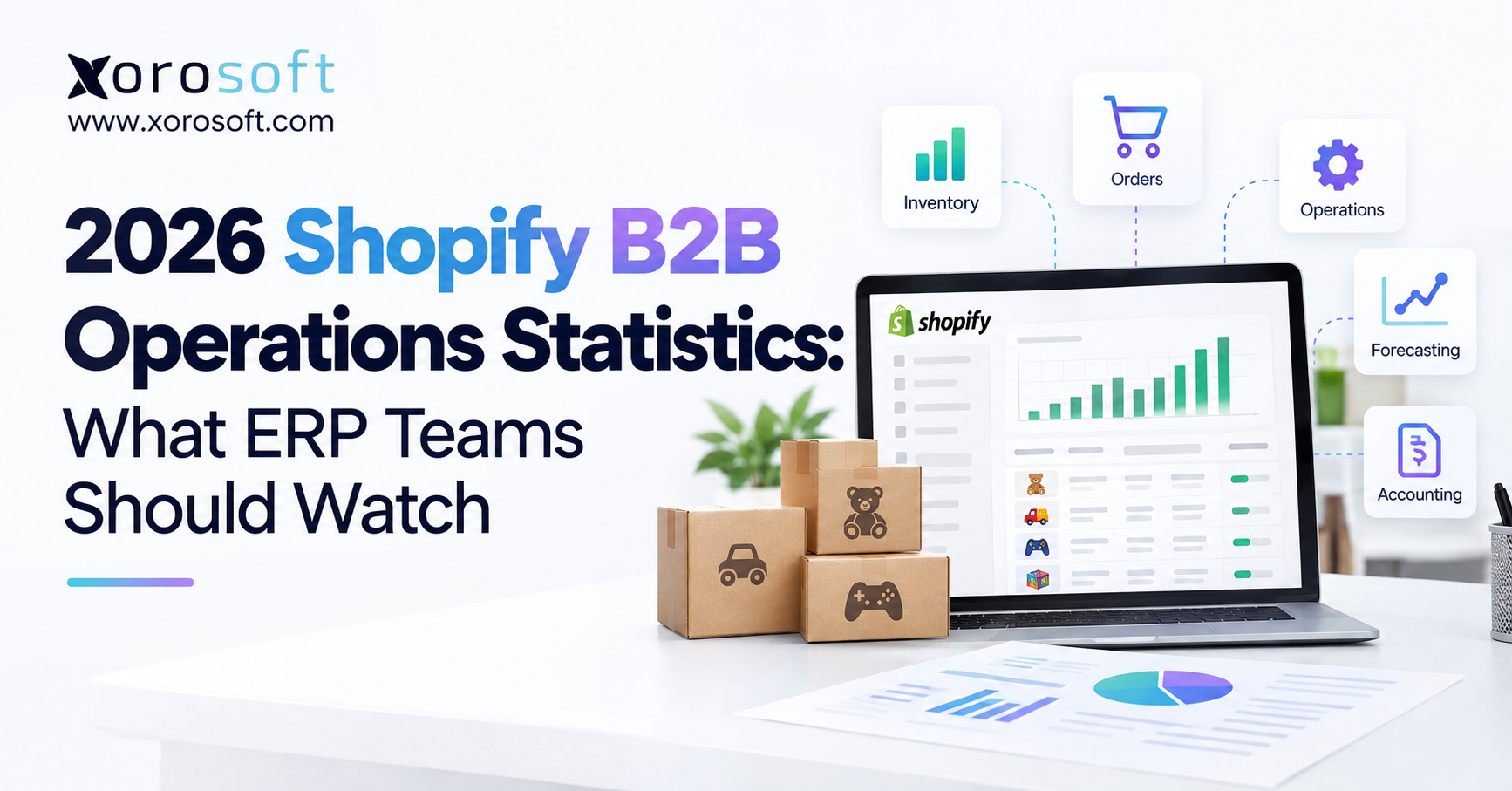
If you’re interested in understanding the growth and trends in ecommerce, exploring Shopify B2B statistics can offer valuable insights into the current market landscape.
1. Shopify B2B Statistics Are Becoming an Operations Issue
The most useful Shopify B2B statistics in 2026 are not just about ecommerce growth. They show how fast wholesale orders are moving into digital systems that depend on accurate inventory, pricing, accounting, purchasing, and warehouse data.
That change matters because a B2B order is usually more complex than a consumer order. A wholesale buyer may expect a custom catalog, negotiated pricing, payment terms, accurate stock, large order quantities, repeat ordering, and reliable delivery dates.
Each promise depends on data that often sits outside Shopify.
The global B2B ecommerce market is estimated at about $33.7 trillion in 2026, with forecasts putting it above $48.1 trillion by 2030. Shopify also cites research from B2B Online and Deloitte Digital showing that only 20% of B2B sellers said they felt prepared for the future of digital B2B commerce.
1.1 Growth Is Exposing Back-Office Gaps
A company can improve its B2B storefront faster than it can rebuild its back office.
Adding company accounts or payment terms may take weeks. Fixing years of duplicate customer data, manual purchasing, poor inventory rules, and accounting gaps can take far longer.
That mismatch creates risk.
Shopify may accept an order correctly while the warehouse sees the wrong available quantity. A buyer may receive the right contract price online while accounting stores another value. Purchasing may still use spreadsheets even though digital orders arrive throughout the day.
For ERP teams, the main question is therefore not whether B2B ecommerce will grow.
A better question is whether the systems behind Shopify can support that growth without adding more manual work.
1.2 Shopify B2B Statistics Need an ERP View
Ecommerce teams often track traffic, conversion, average order value, and revenue.
ERP teams need a wider view.
Inventory accuracy, fill rate, backorders, failed data syncs, payment terms, purchase orders, and warehouse delays all affect whether digital growth is healthy.
That is why Shopify B2B statistics should be read as operations data, not only marketing data.
2. Shopify B2B Statistics Show a Wider Shift Toward Native Wholesale Commerce
One of the biggest Shopify changes in 2026 was the spread of native B2B tools beyond Shopify Plus.
On April 2, 2026, Shopify announced that Basic, Grow, and Advanced merchants could use core B2B features such as company profiles, up to three active custom catalogs, volume pricing, quantity rules, saved cards, and payment terms.
This makes digital wholesale easier to adopt earlier in a company’s growth.
2.1 More Merchants Can Build B2B Before They Have ERP
A growing company can now create business accounts and wholesale pricing while still relying on basic accounting software, inventory apps, and spreadsheets.
That setup can work at smaller scale.
Problems often appear as order volume, SKU count, warehouse count, and customer rules increase.
A sales team may manage special prices in one place while Shopify stores another price. Purchasing may not see demand until inventory is already low. Finance may have to match orders and payments by hand.
The storefront can therefore become more advanced than the systems behind it.
2.2 Self-Service Growth Adds More Back-Office Events
Shopify reports that merchants using Shopify B2B can see up to a 33% rise in self-service orders within six months and up to a 20% increase in reorder frequency.
Those figures are not guaranteed results, but the direction matters.
More self-service orders mean fewer orders entered by sales reps. At the same time, they create more inventory reservations, warehouse tasks, invoices, payment records, and data updates.
The value of automation depends on what happens after the buyer clicks “Place order.”
If every digital order still requires manual checks, the company has not fully automated the workflow.
3. Shopify B2B Trends Show Buyers Want More Digital Control
B2B buyers no longer move through a simple sales-led journey.
They research independently, use digital tools, compare suppliers online, and contact sales when they need help.
Gartner reported in May 2026 that 45% of B2B buyers surveyed had used generative AI during a recent buying process. Buyers used an average of seven sources of information, while 69% said they wanted to validate AI-based findings with a salesperson.
3.1 Self-Service and Human Sales Can Work Together
Digital buying does not remove the sales team.
Instead, it changes when salespeople become involved.
A buyer may want to review products, pricing, order history, and stock without speaking to anyone. Later, the same buyer may ask a rep to help with a contract, product choice, or large purchase.
That means customer data must stay consistent across digital and human channels.
If the online account shows one price while a sales rep quotes another, trust drops quickly.
3.2 Shopify B2B Statistics Make Data Quality Customer-Facing
In a manual order process, a sales rep may catch an incorrect price or unavailable item before submitting an order.
Self-service removes that human checkpoint.
The system must now catch more problems on its own.
Product access, pricing, order rules, stock availability, payment terms, and shipping options need reliable data.
A stock error is no longer only an inventory problem. The buyer sees it as poor service.
Likewise, a pricing mismatch becomes a customer issue even if the original cause is an ERP sync failure.
3.3 Measure the Quality of Self-Service
A useful dashboard should not track only the percentage of orders buyers place themselves.
ERP teams should also measure how many of those orders need changes afterward.
Order edits, pricing corrections, backorders, credit holds, and manual releases can show whether self-service is truly reducing work.
Strong Shopify B2B statistics should therefore connect buyer behavior with the amount of work created behind each order.
4. Shopify B2B Statistics Put Inventory Accuracy at the Center
Inventory is one of the clearest links between ecommerce and ERP.
A buyer does not care whether the inventory number came from Shopify, ERP, WMS, or a spreadsheet. The buyer only sees whether the item appears available.
If the business promises stock that it cannot ship, the issue becomes customer-facing.
4.1 On-Hand Inventory Is Not the Same as Sellable Inventory
A warehouse may physically hold 500 units of an item.
That does not mean all 500 units are available for a new B2B order.
Some units may already be allocated. Others may be damaged, under inspection, or held for another channel.
Available-to-sell inventory should reflect what the business can safely promise.
For that reason, ERP teams need a clear rule for what Shopify receives as “available.”
4.2 Incoming and In-Transit Stock Need Different Treatment
Purchase orders add another layer.
An inbound shipment may arrive next week, but those units are not physically available today. Stock moving between warehouses also exists in the system without being ready at the destination.
Some businesses allow customers to order against incoming supply. Others do not.
Neither approach is always right.
The important point is to define the rule and use it consistently.
4.3 Multi-Warehouse Shopify B2B Inventory Gets Harder
A wholesaler may store the same SKU in several warehouses, retail stores, and 3PL facilities.
Now the company must decide where an order should ship from.
Distance, freight cost, stock balance, delivery promise, and whether the order can split may all affect that decision.
A connected warehouse management system becomes more useful when receiving, locations, scanning, picking, packing, replenishment, and shipping need stronger control.
4.4 Inventory KPIs Matter More as B2B Volume Grows
ERP teams should watch inventory accuracy, fill rate, stockout rate, oversell rate, backorders, transfer aging, and sync delay.
These internal Shopify B2B statistics can be more useful than a broad market forecast because they show whether the business can support its own growth.
5. Shopify B2B ERP Integration Is Becoming Core Infrastructure
A modern Shopify B2B setup rarely operates alone.
Shopify supports links with ERP, accounting, CRM, product information systems, warehouse tools, and other business software.
Typical records include customers, companies, products, orders, inventory, pricing, payment terms, fulfillment, refunds, and financial transactions.
5.1 Integration Starts With Data Ownership
Before connecting systems, teams need to decide which system owns each record.
Products may come from ERP or PIM. Inventory may come from ERP or WMS. Shopify creates ecommerce orders, but ERP may become the main record after submission.
Pricing can be one of the hardest areas.
If users change prices in Shopify and ERP, both systems can become “correct” in different ways.
That leads to constant fixing.
Clear ownership reduces that risk.
5.2 Shopify B2B Statistics Show Integration Quality Is Still Uneven
Shopify’s 2026 B2B research cites data showing that 75% of respondents viewed front-office and back-office links as only somewhat effective. Just 11% called them very effective.
That is a wide gap.
Moving data between two systems does not automatically make the link reliable.
The real test is what happens when something goes wrong.
Does the team see failed records? Can a job retry safely? Are duplicate orders prevented? Does the system show which value is correct when records conflict?
5.3 Integration KPIs Should Sit on the Operations Dashboard
Useful measures include sync success rate, failed records, average delay, duplicate orders, retry volume, inventory mismatches, and manual fixes.
The Xorosoft integrations ecosystem is one example of how ecommerce and other business tools can connect to a wider ERP setup.
The goal is not to connect every possible app.
Instead, businesses should reduce the number of manual handoffs that create errors.
6. Customer-Specific Pricing Makes Shopify B2B Data Governance More Important
B2B pricing is rarely one product with one universal price.
A product may have a standard price, wholesale price, contract price, customer discount, volume tier, and regional price.
Digital B2B exposes those rules automatically.
6.1 Shopify B2B Catalogs Move Pricing Rules Into Software
Shopify B2B catalogs can control which products a company sees and what prices apply.
That helps move wholesale selling away from static PDFs and spreadsheets.
However, it also creates a governance question.
Where should the main price live?
A small business may manage prices directly in Shopify. A larger company may prefer ERP to control contract and customer pricing.
Either approach can work if ownership is clear.
6.2 Pricing Errors Can Reduce Margin Without Being Obvious
A price mismatch may not stop an order.
The customer may simply receive a lower price than expected.
That makes pricing errors harder to spot than failed orders.
ERP teams should compare expected margin, override frequency, price changes, and catalog sync failures.
These measures help show whether Shopify B2B statistics such as order growth are creating healthy revenue or hidden margin loss.
7. Shopify B2B Payment Trends Are Pulling Ecommerce Closer to Finance
B2B payments often work differently from DTC payments.
A consumer usually pays at checkout. A wholesale customer may receive Net 30 or another agreed term.
Shopify supports payment terms such as Net 7, Net 15, Net 30, Net 45, Net 60, Net 90, and due on fulfillment.
That makes accounts receivable part of the ecommerce workflow.
7.1 Payment Terms Create Real Accounting Work
Once a buyer submits an order on terms, finance needs the right invoice date, due date, customer balance, and payment status.
Disconnected systems make this harder.
A Shopify order may be copied into accounting, updated in another system after shipment, and then matched manually when payment arrives.
Every extra step creates room for errors.
A connected cloud ERP can reduce this re-entry when sales orders, inventory, purchasing, and accounting need to share the same transaction.
7.2 Payment Statistics Need Finance Context
Revenue alone does not show whether B2B sales are financially healthy.
Days sales outstanding, AR aging, overdue invoices, credit limits, deposits, and unapplied cash matter as well.
A business can post strong sales and still face cash-flow pressure if customers pay slowly.
That is why Shopify B2B statistics should include both commercial and finance measures.
8. Shopify B2B Order Growth Changes Warehouse Economics
Wholesale orders can look very different from DTC orders.
A consumer order may contain two items. A wholesale order may contain several cases or a full pallet.
Large orders may also need special labels, shipping rules, freight booking, or retailer paperwork.
8.1 B2B Orders Need Different Picking Logic
A warehouse built around single-item ecommerce orders may not handle case or pallet work efficiently.
Case picking requires different storage and pick paths. Large shipments need more staging space. Freight orders may wait for carrier appointments.
These details affect labor cost and order speed.
8.2 Separate B2B and DTC Warehouse Metrics
A single warehouse average can hide problems.
Fast DTC orders may make cycle time look good even while wholesale orders wait.
ERP and WMS teams should compare B2B order cycle time, pick accuracy, units picked, partial shipment rate, and backorder aging separately where possible.
These Shopify B2B statistics provide a clearer picture of how the warehouse handles wholesale demand.
8.3 High Reorder Frequency Can Increase Work Even With Fewer Customers
B2B businesses often have fewer customers than DTC brands but larger repeat orders.
That can create a steady stream of large warehouse tasks.
Planning labor around order count alone may therefore underestimate the workload.
Lines, units, cases, pallets, and shipment type can be better measures.
9. Shopify B2B Growth Changes Purchasing and Forecasting Requirements
Digital wholesale demand also affects inbound inventory.
A single large order can consume several weeks of supply.
Recurring wholesale customers can create strong demand patterns, but those patterns differ from everyday consumer sales.
9.1 B2B Demand Should Not Disappear Inside a Blended Forecast
A total sales forecast can hide channel behavior.
DTC may create many small daily orders. Wholesale may create fewer but much larger orders. Amazon can have a different pattern again.
Blending all three may give a reasonable total while still causing poor buying decisions.
Channel-level forecasting helps teams understand what is driving demand.
9.2 Purchasing Needs Better Signals as Shopify B2B Scales
Useful purchasing measures include forecast accuracy, supplier lead time, PO lateness, weeks of supply, excess stock, and stockout rate.
When these numbers worsen, the problem may not be sales growth itself.
It may be slow planning.
A unified operations platform becomes more relevant when purchasing, inventory, accounting, ecommerce, and warehouse teams need to work from shared data.
9.3 Shopify B2B Statistics Should Connect Sales to Supply
Looking at B2B revenue without looking at supply can create a false sense of success.
The better view compares sales growth with service levels and inventory health.
If revenue rises while stockouts, backorders, and emergency purchase orders also rise, the business may be growing faster than its planning process.
10. Omnichannel B2B Makes a Single Operational View More Valuable
McKinsey’s 2026 B2B research found that buyers use many channels through the purchase journey.
A company may therefore receive orders and demand signals from far more places than Shopify B2B alone.
10.1 Shopify B2B Is Often One Channel Among Many
An inventory-driven company may sell through Shopify DTC, Shopify B2B, Amazon, EDI, marketplaces, retail stores, and sales reps.
Each channel can create orders in a different way.
Eventually, however, they all compete for the same stock.
A central inventory view helps prevent one channel from selling inventory already promised somewhere else.
10.2 Customer and Product Records Can Also Multiply
Channel growth creates more than inventory issues.
The same buyer can appear under several names or accounts. Products may have different titles or codes across platforms.
Returns add more complexity.
A return started in one channel can affect inventory, customer balances, and financial reporting across the wider business.
10.3 Internal Shopify B2B Statistics Should Include Channel Conflicts
ERP teams should measure duplicate customers, duplicate orders, channel stock conflicts, and manual merge work.
These numbers show where channel growth is adding hidden cost.
11. Shopify B2B Statistics Point Toward Clearer Systems of Record
One of the most useful tasks an ERP team can complete is to define which system owns each part of the workflow.
There is no single model that fits every company.
Still, unclear ownership almost always creates extra work.
11.1 Shopify Should Focus on Commerce Tasks
Shopify is well suited to storefront presentation, customer login, catalog display, checkout, account-level buying, and ecommerce order capture.
Those tasks are close to the customer.
Back-office planning is different.
11.2 ERP Should Control Core Business Records
ERP often owns purchasing, supplier management, financial accounting, inventory value, demand planning, manufacturing, and business reporting.
It may also act as the central point where demand from several channels becomes one operating picture.
The Xorosoft ERP app on Shopify shows one example of connecting commerce with a broader ERP environment.
11.3 WMS Should Own Warehouse Execution Where Needed
ERP can know that stock exists without controlling every warehouse task.
A WMS becomes useful when the operation needs bin-level tracking, scanning, directed picks, replenishment, packing, and detailed shipping steps.
Keeping these roles clear helps systems work together instead of competing for control.
12. AI Commerce Will Make Clean ERP Data Even More Important
AI is becoming a bigger part of B2B research and business software.
That creates new opportunities, but it also raises the cost of poor data.
12.1 AI Can Scale Good Data or Bad Data
Automation works quickly.
If inventory is right, automation can help buyers and staff make faster choices.
When inventory is wrong, the same automation can spread the error faster.
The same risk applies to pricing, supplier lead times, customer terms, and product details.
12.2 ERP Data Gives AI More Business Context
Commerce systems know a great deal about buyers and orders.
ERP adds another layer of context.
Supplier lead times, landed cost, open purchase orders, allocations, warehouse status, payment history, and production limits can all affect a good decision.
Tools such as the Xorosoft MCP server show how controlled enterprise data can be made available to AI systems.
The first step, however, is not AI.
It is making sure the source data can be trusted.
13. Shopify B2B Statistics Need Different Context Across Industries
A single set of B2B benchmarks cannot explain every inventory-driven business.
Apparel, furniture, food, sporting goods, wholesale, and manufacturing all create different demands on ERP and warehouse systems.
13.1 Apparel Needs Variant and Seasonal Control
Apparel brands often manage many combinations of style, size, and color.
Wholesale buyers may place large seasonal orders long before delivery.
Forecasting must therefore account for both present sales and future commitments.
A small error at the variant level can create excess stock in one size and a shortage in another.
13.2 Furniture Adds Delivery and Space Constraints
Furniture businesses deal with large items, long supplier lead times, and higher shipping costs.
Inventory may be physically available but still require staging, assembly, or scheduled delivery.
A simple “in stock” status may not explain the true delivery promise.
13.3 Food and Beverage Add Lot and Expiry Rules
Food products can require lot control, expiry dates, recalls, and first-expire-first-out picking.
Available quantity alone is not enough.
The warehouse must know which units can safely ship.
13.4 Manufacturing Connects Orders to Production
Manufacturers may not have finished goods ready when a B2B order arrives.
Instead, the order may create demand for raw materials, components, work orders, and production capacity.
Businesses can review ERP use cases by industry when deciding which workflows matter most.
14. The Most Valuable Shopify B2B Statistics Are Often Internal
Market data helps explain where B2B commerce is going.
Internal data explains whether a specific business is ready for that direction.
14.1 Commerce Metrics Need Operational Context
B2B revenue, average order value, repeat purchase rate, and self-service order share are useful.
They become more useful when paired with margin and manual work.
A channel may grow revenue while creating too many exceptions.
14.2 Inventory Metrics Show Whether Promises Are Reliable
Inventory accuracy, fill rate, stockouts, oversells, and backorders show whether the business can meet customer expectations.
These numbers should be reviewed with sales data rather than kept only inside operations.
14.3 Integration Metrics Should Be Business Metrics
Integration errors can affect several parts of the operation at once.
An order that fails to reach ERP may delay fulfillment, while stale inventory data can cause overselling. Pricing sync issues can also create margin loss or customer disputes.
For that reason, sync failures, delay, retries, and unresolved records belong on an operations dashboard.
14.4 Finance Metrics Complete Shopify B2B Statistics
Revenue is only part of the story.
DSO, AR aging, overdue invoices, margin, and payment exceptions show whether digital B2B growth is creating healthy cash flow.
Businesses reaching this level of complexity may benefit from reviewing broader ERP and operational solutions rather than adding another isolated app.
15. Common Shopify B2B Operations Mistakes ERP Teams Should Avoid
Growth tends to expose weak processes.
Several mistakes appear often when companies digitize wholesale selling without updating the way the back office works.
15.1 Maintaining the Same Record in Too Many Places
Duplicate ownership creates conflict.
If pricing can be changed in Shopify, ERP, and a spreadsheet, teams eventually find different values.
The same issue can affect customers, products, payment terms, and inventory.
Pick one main owner wherever possible.
15.2 Publishing Physical Stock as Available Stock
Physical on-hand stock is easy to understand but can be misleading.
Allocated, damaged, or held inventory may not be available for new orders.
Businesses should define what “available” means before sending the number to Shopify.
15.3 Ignoring Integration Failures Until a Customer Complains
Every integration can fail.
Good systems make failures easy to see and correct.
Poor setups allow errors to sit unnoticed until a missing order or wrong inventory figure creates a customer issue.
Monitoring should be built into daily operations.
15.4 Automating a Process That Is Still Unclear
Software cannot solve a process that teams have not agreed on.
If sales and finance disagree about pricing rules, adding another integration will not settle the question.
Clear ownership should come before automation.
16. When Shopify B2B Statistics Signal That ERP May Be Needed
There is no single revenue level at which every Shopify business needs ERP.
Complexity is a better guide.
Two companies can have the same revenue but very different needs.
16.1 Operational Complexity Is the Better Trigger
ERP becomes worth reviewing when several problems appear together.
Multiple warehouses, repeated stock errors, complex purchasing, customer-specific pricing, EDI, manufacturing, spreadsheet planning, and slow financial close are common signs.
One issue by itself may not justify a new platform.
A pattern of linked problems is more meaningful.
16.2 Some Shopify Businesses Still Do Not Need ERP
A company with one warehouse, simple products, basic buying, clean accounting, and modest order volume may continue to work well with Shopify and a few focused tools.
Implementing ERP too early can add cost and work without solving a real problem.
The decision should follow the operating model.
16.3 Shopify B2B Statistics Should Support the Business Case
Before selecting software, teams should measure the real cost of current problems.
Start with the hours spent fixing inventory errors. Count how many orders require manual edits, then measure the time needed to complete month-end close. Pricing mistakes, reconciliation work, and repeated data corrections should also be tracked.
These numbers create a stronger ERP business case than revenue alone.
17. Comparing Shopify ERP Options Requires More Than a Feature List
Businesses evaluating ERP may compare NetSuite, Acumatica, Microsoft Dynamics 365 Business Central, Sage, Cin7, Brightpearl, Fishbowl, Xorosoft, and other platforms.
A feature checklist is useful, but daily workflow matters more.
17.1 Review the Shopify Data Model
Ask how each platform handles products, customers, company accounts, orders, inventory, payments, refunds, fulfillments, and payouts.
A connector can exist without handling every edge case well.
17.2 Test Exception Handling Before Go-Live
ERP teams should ask what happens when a record fails.
Does the user see the error? Can the record retry without creating duplicates? Is there a clear audit trail?
These details shape daily workload after launch.
17.3 Compare Warehouse, Purchasing, and Accounting Together
A Shopify integration should not be the only reason to choose an ERP.
The wider question is whether the platform improves the processes behind ecommerce.
Businesses reviewing enterprise systems can use a detailed Xorosoft vs NetSuite comparison as one input alongside their own requirements.
18. What Shopify B2B Statistics Mean for ERP Teams in 2026
The main lesson from Shopify B2B statistics is that digital wholesale is becoming easier to launch while the work behind it remains complex.
Shopify has expanded B2B access. Buyers expect more self-service. Digital research is growing. Payment terms are moving online. More demand can now enter the operation without a sales rep entering the order.
That puts more pressure on system quality.
18.1 Start With Data Ownership
Map which application owns products, inventory, customers, pricing, payment terms, orders, fulfillment, and financial records.
This step often exposes duplicate work immediately.
18.2 Measure Exceptions Instead of Revenue Alone
Growth can hide weak processes.
Track failed syncs, stock mismatches, pricing corrections, backorders, order edits, payment exceptions, and warehouse errors.
These measures show whether the business can scale without adding the same amount of manual work.
18.3 Treat Commerce and Operations as One Flow
The buyer sees Shopify.
Behind Shopify, inventory, purchasing, warehouse, accounting, and supplier processes decide whether the promise can be kept.
Strong Shopify B2B statistics should therefore connect the customer experience to the back-office result.
19. Practical Priorities for the Next Stage of Shopify B2B Growth
ERP teams do not need to replace every system simply because B2B demand is growing.
The better approach is to identify where the current setup creates the most risk.
19.1 Fix the Highest-Cost Breakpoint First
If stock mismatches cause backorders, start with inventory rules.
When pricing errors reduce margin, focus on pricing ownership. If finance spends days matching orders and payments, redesign that flow first.
Warehouse delays may point to execution issues rather than an ecommerce problem.
19.2 Use Shopify B2B Statistics to Build a Clear ERP Roadmap
The final value of Shopify B2B statistics comes from turning the data into action.
Measure manual work, failed records, stock errors, backorders, purchasing delays, and reconciliation effort.
Those numbers show where a new system could create the most value.
19.3 Review Workflows Before Selecting Software
Map the order-to-cash process from the moment a buyer places an order through fulfillment, invoicing, and payment.
Do the same for purchasing and receiving.
Document where people re-enter data, where spreadsheets are used, and where teams wait for another department.
Real examples from customer case studies can help teams compare their own problems with workflows other inventory-driven businesses have addressed.
19.4 Make the Next Step About Fit, Not Software Hype
For businesses that have outgrown basic accounting, inventory-only software, and disconnected apps, a connected ERP can provide a stronger base for Shopify B2B growth.
The right time to move is when the cost of managing the current stack begins to exceed the benefit of keeping it simple.
That is the practical takeaway from Shopify B2B statistics in 2026: digital wholesale growth exposes the quality of the systems behind the storefront.
Companies with clean inventory rules, clear data ownership, reliable integrations, and connected finance can scale self-service more smoothly.
Businesses with fragmented processes often see the opposite result. More orders create more manual work, more exceptions, and more reconciliation.
Teams that want to assess whether their current Shopify B2B setup is ready for the next stage can contact Xorosoft to review their inventory, purchasing, warehouse, accounting, and integration requirements.
Shopify B2B Operations FAQ
What are the most important Shopify B2B statistics in 2026?
Key Shopify B2B statistics point to stronger self-service buying, repeat ordering, digital payments, and deeper system integration. ERP teams should focus on inventory accuracy, fulfillment, pricing, payment terms, and data synchronization.
Does Shopify B2B integrate with ERP systems?
Yes. Shopify B2B can connect with ERP systems to synchronize customers, products, inventory, orders, pricing, payment terms, fulfillment, refunds, and financial data across ecommerce and back-office operations.
When does a Shopify B2B business need an ERP?
ERP becomes useful when multiple warehouses, complex purchasing, customer-specific pricing, EDI, manufacturing, accounting reconciliation, or frequent inventory errors become difficult to manage with separate apps and spreadsheets.
Should Shopify or ERP control inventory?
For complex operations, ERP or WMS often controls operational inventory while Shopify displays approved sellable quantities. The best setup depends on warehouse structure, allocation rules, transfers, reservations, and fulfillment requirements.
What should sync between Shopify B2B and ERP?
Common records include customers, company locations, products, inventory, sales orders, pricing, catalogs, payment terms, fulfillment, refunds, and payment data. Each record should have a clearly defined system of ownership.
What Shopify B2B KPIs should ERP teams track?
Important KPIs include inventory accuracy, fill rate, backorders, oversells, synchronization failures, order cycle time, pricing exceptions, forecast accuracy, payment delays, and manual corrections required per order.
What are common Shopify B2B integration mistakes?
Common mistakes include unclear data ownership, duplicate records, publishing incorrect inventory, maintaining pricing in multiple systems, weak exception monitoring, and failing to connect payment terms with accounting and accounts receivable.
Recent Posts
-
 WMS Onboarding Checklist: Locations, Barcodes, Devices, Users, and Opening Inventory
 -
 Inventory Tracker vs Inventory Management System: What Growing Product Businesses Actually Need
 -
 B2B Ecommerce Solutions for Sales-Rep-Assisted Ordering: Quotes, Overrides, and Customer-Specific Workflows
 -
2026 Shopify B2B Operations Statistics: What ERP Teams Should Watch
-
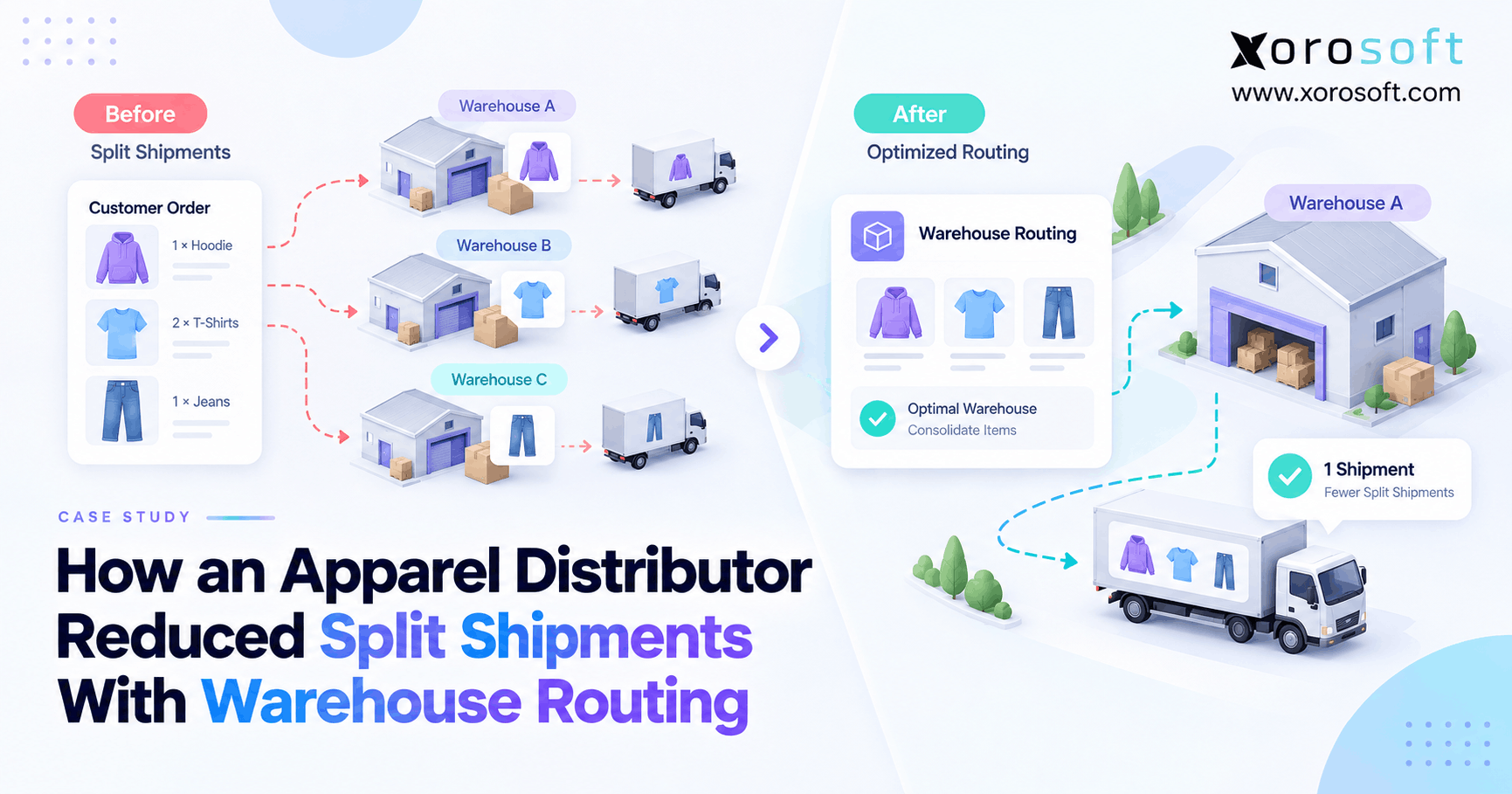 How an Apparel Distributor Reduced Split Shipments With Warehouse Routing