Understanding manufacturing inventory availability is crucial for efficient production planning and supply chain management.
1. When Manufacturing Inventory Availability Falls Behind the Factory Floor
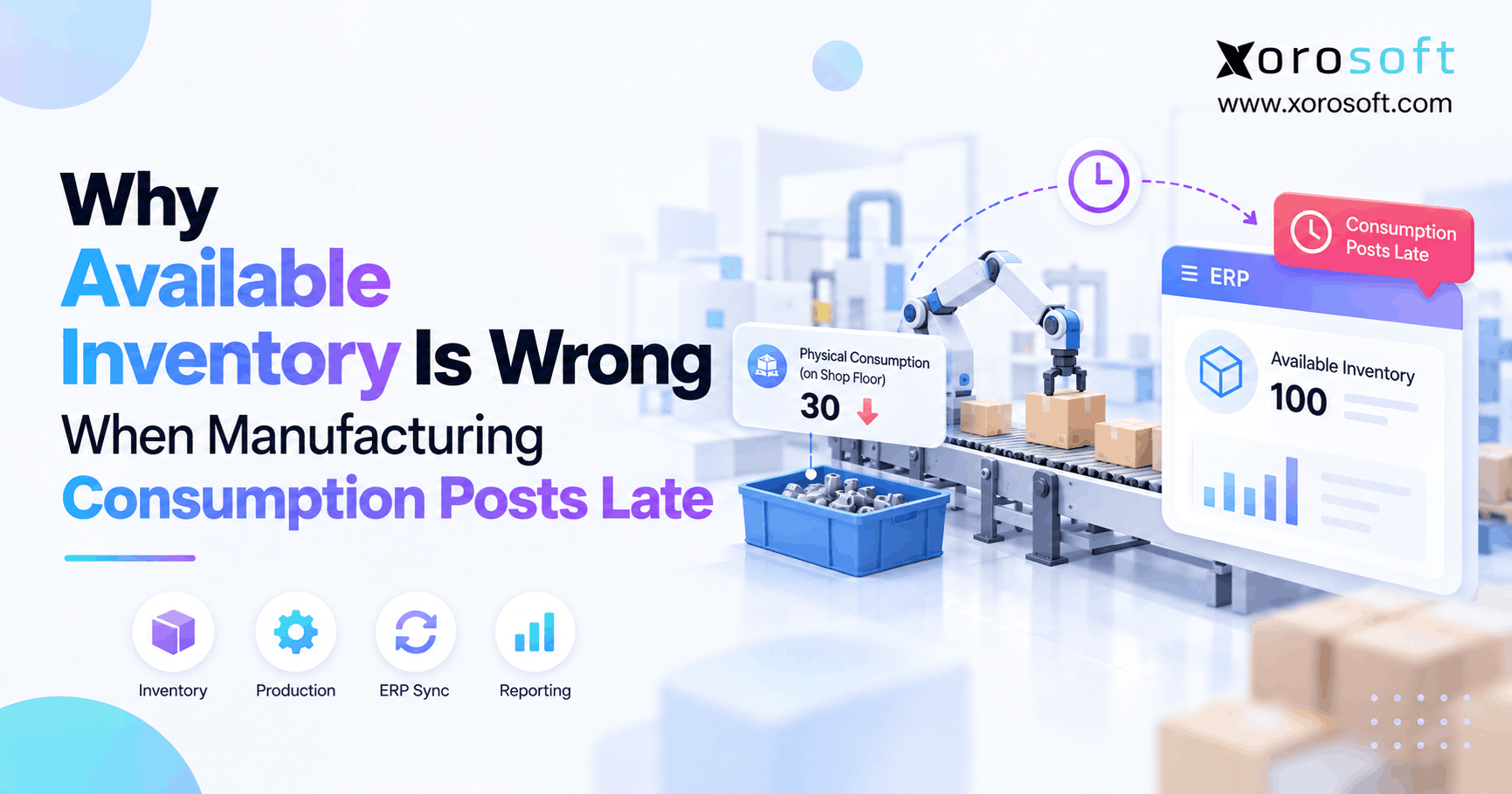
Manufacturing inventory availability becomes unreliable when production physically uses materials before the ERP records that consumption. As a result, the system can show components as available even though operators have already cut, assembled, mixed, packed, or otherwise consumed them.
Therefore, the problem is not always a bad count. Instead, it often starts with transaction timing. The factory changes physical reality first, while the ERP catches up later.
Meanwhile, purchasing, MRP, warehouse teams, and production planners continue reading the older quantity. Consequently, even a short delay can affect decisions across the business.
1.1 Physical Inventory and System Inventory Can Tell Different Stories
Physical inventory represents what actually remains usable at a specific moment. However, system inventory represents what the ERP can calculate from the transactions recorded so far.
For example, suppose the ERP shows 1,000 units of Component A at 9:00 a.m. Production then consumes 300 units at 10:00 a.m. Nevertheless, the team does not post consumption until 4:00 p.m.
Therefore, between 10:00 a.m. and 4:00 p.m., physical usable stock is roughly 700 units while the ERP may still show 1,000.
The software can therefore be technically consistent with its records while still being operationally behind the factory floor.
1.2 Why Manufacturing Inventory Availability Develops a Timing Gap
The period between physical material use and ERP consumption posting creates a visibility gap.
During that gap, manufacturing inventory availability can overstate what the business can actually use.
For example, another production order may reserve the same material. Likewise, MRP may determine that no purchase is required. Meanwhile, warehouse staff may search for inventory that production has already consumed.
A useful simplified model is:
Usable inventory ≈ ERP available inventory − consumed but unposted material − other unrecorded losses
Although each ERP calculates availability differently, the underlying problem remains the same: incomplete transactions create incomplete visibility.
1.3 How Production Inventory Accuracy Breaks Before Anyone Notices
The issue usually becomes visible only when another process needs the material.
For instance, a second work order may appear fully supplied in the ERP. However, when warehouse staff attempt to stage its components, they discover the expected quantity is missing.
Consequently, operations often blame the warehouse first. Next, the warehouse blames production. Finally, someone adjusts inventory manually.
Although that adjustment fixes the number temporarily, it does not fix the transaction delay that caused the discrepancy.
Therefore, production inventory accuracy should be measured not only by final balances but also by how quickly physical events reach the system.
2. What Happens When Manufacturing Consumption Posts Late?
Late consumption creates a sequence of operational errors. Therefore, the best way to understand the problem is to trace one material from physical use to system posting.
2.1 Manufacturing Inventory Availability Can Remain Temporarily Overstated
Suppose production begins with 2,000 units of a component.
First, operators consume 500 units during the morning. However, the company uses a finish-based process, so consumption does not post until the work order reports output later in the day.
Consequently, manufacturing inventory availability may continue showing the original quantity during the production run.
Microsoft describes raw-material consumption as the process that deducts materials from on-hand inventory and moves their value into WIP. It also documents Manual, Start, Finish, and Available-at-location flushing methods.
Therefore, the chosen posting trigger directly affects how current inventory appears.
2.2 Phantom Stock Appears During the Posting Delay
When system stock exceeds physically usable stock, teams often call the difference phantom inventory.
However, phantom inventory does not always mean the ERP calculated incorrectly. Instead, the ERP may simply be missing a physical event that has not yet been posted.
For example, material may have been:
- consumed but not recorded,
- scrapped but not reported,
- substituted without updating the work order,
- moved incorrectly,
- or held inside a failed posting.
As a result, another cycle count may correct the quantity without correcting the cause.
Therefore, recurring phantom inventory should trigger transaction analysis rather than repeated adjustment alone.
2.3 Production Inventory Accuracy Can Fail Even When Final Counts Reconcile
Some manufacturers assume there is no major problem if inventory eventually balances.
However, timing matters because the business makes decisions before the final reconciliation occurs.
For instance, inventory may become accurate after the night shift posts every consumption journal. Nevertheless, purchasing may already have postponed an order because stock looked sufficient at noon.
Similarly, production may have released another work order based on material that was physically gone.
Therefore, manufacturing inventory availability must be timely enough for the decisions that depend on it, not merely correct by the end of the accounting period.
3. Material Movement Is Not the Same as Consumption
A common source of confusion is treating warehouse movement, production staging, issue, consumption, and completion as one event.
However, many manufacturing systems treat them as separate transactions.
3.1 How Production Inventory Availability Changes During Staging
A warehouse employee may move components from bulk storage to a production input area.
Nevertheless, those components may still remain on hand. They have simply changed bins or locations.
Therefore, manufacturers should distinguish:
warehouse storage → staging → production input → consumption
If employees assume that moving material automatically consumes it, production inventory availability can remain overstated until another transaction occurs.
For manufacturers that need tighter control between warehouse locations and the production floor, XoroWMS can connect location-level warehouse execution with wider inventory workflows.
3.2 Issued Material and Physically Consumed Material Can Differ
Similarly, issuing 100 units to production does not mean operators will necessarily consume exactly 100.
For example, a work order may require 100 units according to its BOM. However, production may actually consume 106 because of cutting loss, breakage, or process variation.
Alternatively, operators may consume only 96 units.
Therefore, the company must decide whether standard quantities are accurate enough or whether actual usage requires direct reporting.
Moreover, component substitutions can complicate the record further. If production uses Component B instead of Component A without recording the substitution, both inventory positions can become misleading.
3.3 Why Production Completion Does Not Guarantee Inventory Accuracy
Finished output and component consumption can also be separate transactions.
For example, Oracle documents that a NetSuite work-order completion without backflush records completed assemblies but does not record component consumption. By contrast, completion with backflush records both.
Therefore, a production order showing completed output does not automatically prove that every component deduction occurred correctly.
Consequently, teams investigating manufacturing inventory availability should compare component transactions with output transactions rather than checking production status alone.
4. How Consumption Methods Affect Manufacturing Inventory Availability
Different manufacturers require different transaction timing. Therefore, no single consumption method works best in every production environment.
4.1 Manual Consumption Gives Control but Creates Timing Risk
Manual consumption allows operators to record actual quantities.
Therefore, it can work well when materials are expensive, lot-controlled, variable, or frequently substituted.
However, manual processing also introduces delay when employees complete production first and paperwork later.
For instance, a supervisor may enter all production usage at the end of a shift. Although the final quantity might eventually be correct, manufacturing inventory availability remains stale during the day.
Consequently, final accuracy and operational accuracy are not always the same thing.
4.2 Forward Consumption Updates Production Inventory Earlier
A start-based or forward-consumption process reduces planned materials earlier.
Therefore, availability can reflect expected production use sooner.
However, this method creates a different risk. If production starts but does not actually consume all planned materials, the ERP may deduct inventory before physical use occurs.
Consequently, forward consumption works best where component usage is predictable and production variability remains low.
Moreover, teams still need a process for scrap, unused materials, substitutions, and partial production.
Thus, the benefit comes from earlier visibility, while the tradeoff is the possibility of consuming too much too soon.
4.3 Backward Consumption Can Delay Inventory Updates
A finish-based method waits until production or a relevant operation completes.
Therefore, operators can avoid some manual transactions during production.
However, the ERP can temporarily show materials that the factory has already consumed.
Microsoft documents Finish flushing as automatic material consumption when production reports finished output or when a configured operation completes.
Consequently, long production cycles increase the potential delay between physical use and system deduction.
For that reason, manufacturing inventory availability may require a different trigger when constrained materials must remain visible in near real time.
4.4 Location-Based Consumption Can Reduce Posting Delays
Some manufacturing configurations consume eligible material after warehouse work places it at a production input location.
Therefore, warehouse execution can become part of the consumption trigger.
Microsoft’s Available-at-location flushing approach supports this type of process in Dynamics 365 Supply Chain Management.
Consequently, manufacturers with significant warehouse-to-production activity should examine whether their WMS and production system use the same event sequence.
If the warehouse records movement immediately while manufacturing records consumption hours later, the company may still operate with two different views of the same material.
5. Wrong Manufacturing Inventory Availability Damages MRP
Incorrect inventory does not stay inside an inventory report. Instead, it flows into every decision that depends on the reported quantity.
5.1 How Raw Material Availability Distorts MRP
MRP evaluates inventory, demand, open supply, lead times, BOM requirements, and production schedules.
Therefore, overstated raw material availability can make the planning engine believe upcoming demand is already covered.
For example, the ERP may show 1,000 units available against 800 units of future demand.
However, if production already consumed 400 units without posting them, only 600 units remain physically usable.
Consequently, the business actually faces a 200-unit shortage while the system still appears to show a 200-unit surplus.
Therefore, manufacturing inventory availability directly affects the usefulness of MRP recommendations.
5.2 Purchasing Can React Too Late
Purchasing commonly relies on inventory data and planning recommendations.
Therefore, stale stock levels can delay replenishment.
A buyer may see enough material and postpone a purchase order. However, once production consumption finally posts, the ERP suddenly reveals the shortage.
Meanwhile, supplier lead time has not changed just because the system discovered the problem later.
Consequently, the business may need expediting, split shipments, substitutions, or production rescheduling.
Teams evaluating how inventory, planning, purchasing, and other workflows connect can review Xorosoft’s broader ERP and operational solutions.
5.3 Production Inventory Availability Can Create False Scheduling Confidence
Production planners also rely on component availability before releasing work.
Therefore, if production inventory availability is overstated, another work order may appear ready even though critical materials have already been used elsewhere.
Meanwhile, planners may reserve labor and machine time around that assumption.
As a result, the shortage appears only when warehouse staff attempt to stage the job.
Consequently, what started as a posting delay becomes a scheduling disruption.
Moreover, repeated disruptions can cause planners to distrust MRP and start maintaining separate spreadsheets.
5.4 WIP and Accounting Reconciliation Become Harder
Consumption also affects inventory value.
Therefore, when component usage posts late, the financial movement from raw-material inventory into WIP can also lag.
Consequently, operations may experience the discrepancy earlier than accounting.
Later, reconciliation may expose unusual raw-material balances, unexpected WIP, unexplained production variances, or repeated inventory adjustments.
For businesses that need operational inventory and financial records to follow the same transaction chain, XoroERP provides an ERP layer across inventory, purchasing, operations, and accounting.
6. How to Diagnose Manufacturing Inventory Availability Errors
Before changing ERP configuration, first identify where physical activity and system activity separate.
Therefore, diagnosis should begin with one material, one work order, and one complete transaction trail.
6.1 Compare Physical and ERP Transaction Timestamps
First, choose a component with recurring discrepancies.
Next, record when warehouse staff staged it and when production actually began using it.
Then, compare those times with the ERP consumption timestamp.
For example:
- Material staged: 8:15 a.m.
- Production use begins: 9:05 a.m.
- Physical consumption completed: 10:20 a.m.
- ERP consumption posted: 4:45 p.m.
Therefore, the operation experienced a 6-hour, 25-minute visibility gap.
Repeat the analysis across several orders. Consequently, you can determine whether the delay is occasional or built into the process.
6.2 Review Production Inventory for Open and Unposted Transactions
Next, search for transactions that should have posted but did not.
For example, review:
- open consumption journals,
- incomplete work orders,
- failed component issues,
- backflush exceptions,
- unposted scrap,
- missing lot information,
- and transactions waiting for approval.
Consequently, the team can separate delayed entry from failed entry.
That difference matters. For instance, changing the consumption method will not fix a failed integration or an exception queue that nobody monitors.
Therefore, production inventory analysis should include transaction status as well as quantity.
6.3 Compare BOM Usage With Manufacturing Stock Accuracy
Next, compare expected BOM quantities with actual production behavior.
For example, a BOM may specify five units of material per finished item. However, operators may consistently use 5.3 because of trimming or breakage.
Therefore, even immediate backflushing at five units will gradually overstate stock.
Similarly, substitutions can create two errors simultaneously. The planned component remains incorrect while the replacement component also becomes inaccurate.
Consequently, manufacturing inventory availability depends on master-data quality as well as posting speed.
Therefore, repeated variance should trigger a BOM, scrap, yield, and substitution review.
6.4 Check Where Warehouse and Production Ownership Changes
Inventory errors frequently appear at handoff points.
Therefore, determine exactly when warehouse responsibility ends and production responsibility begins.
For example, if the warehouse records a transfer while production records consumption later, investigate what happens between those events.
Likewise, if separate applications handle warehouse, manufacturing, ecommerce, and accounting activity, determine how quickly their transactions synchronize.
Xorosoft’s integration capabilities are relevant when inventory-driven businesses need commerce channels and operational systems to exchange data without repeated manual re-entry.
7. When Backflushing Helps Manufacturing Inventory Accuracy
Backflushing can remove unnecessary transaction work. However, its effectiveness depends on how closely planned consumption matches actual production.
7.1 Backflushing Works Well When Material Usage Is Stable
A stable BOM with predictable low-value components can be a strong backflush candidate.
For example, packaging materials, common fasteners, labels, or predictable ingredients may not justify individual reporting at every point of use.
Therefore, automated consumption can reduce operator workload.
Moreover, short production cycles reduce the time between physical use and ERP deduction.
Consequently, completion-based consumption can maintain acceptable manufacturing inventory availability without forcing constant data entry.
However, the manufacturer should still monitor unusual variances and failed postings.
7.2 Variable Production Creates Inventory Availability Risk
Backflushing becomes harder when actual consumption varies substantially.
For example, usage may change because of scrap, rework, substitutions, quality failures, custom orders, or variable yield.
Therefore, standard quantities may no longer reflect physical consumption closely enough.
Similarly, long production cycles can leave material visible for hours or days after operators use it.
Consequently, constrained or expensive components may require earlier reporting.
Thus, the right question is not whether backflushing is good or bad. Instead, the question is whether the posting method matches the operating risk.
7.3 Automated Consumption Still Requires Exception Monitoring
Automation reduces manual effort. However, it does not remove the need for controls.
Therefore, manufacturers should monitor failed postings, unusual quantities, negative-stock warnings, and production orders with output but incomplete component consumption.
Oracle’s documentation also shows that work-order completion with backflush records component consumption based on the work order and build quantity.
Consequently, teams should review exceptions whenever the assumed component quantity differs from actual usage.
Moreover, automated posting should always have a clear owner for exception resolution.
8. How to Improve Manufacturing Inventory Availability
Once the root cause is clear, manufacturers can improve visibility without forcing unnecessary transactions onto every operator.
8.1 Move the Consumption Trigger Closer to the Physical Event
First, decide how quickly the rest of the business needs the inventory change.
For example, if production planning runs continuously, end-of-day posting may be too late.
However, if production cycles are short and materials are not constrained, a modest delay may be acceptable.
Therefore, choose the transaction trigger based on operational risk.
Possible triggers include:
- production start,
- warehouse issue,
- operation completion,
- point-of-use scan,
- finished production,
- or manual actual usage.
Consequently, transaction timing becomes a deliberate design choice rather than an accidental result of paperwork.
8.2 Capture High-Value Materials to Protect Raw Material Availability
Not every screw needs a scan.
However, expensive, lot-controlled, constrained, or highly variable components often justify stronger reporting controls.
Therefore, barcode or mobile workflows can capture the work order, component, lot, location, and quantity closer to the physical event.
As a result, manufacturing inventory availability becomes more current and traceable.
Meanwhile, low-risk materials can still use automated consumption when appropriate.
Consequently, manufacturers can focus transaction effort where inventory errors create the highest operational cost.
8.3 Connect Manufacturing and Warehouse Execution
Warehouse and production systems should not maintain competing versions of inventory reality.
Therefore, staging, production input locations, work orders, and consumption should follow a defined event sequence.
A connected platform such as XoroONE can bring inventory, manufacturing, purchasing, warehouse management, accounting, reporting, and ecommerce operations into one cloud environment.
Consequently, planners do not have to reconstruct current stock from multiple applications.
Moreover, a shared system can make it easier to trace a discrepancy back to the transaction that created it.
8.4 Improve Master Data to Protect Inventory Accuracy
Fast transactions still produce poor results when the underlying standards are wrong.
Therefore, manufacturers should regularly review:
- BOM quantities,
- units of measure,
- scrap factors,
- yield assumptions,
- routing assignments,
- substitutes,
- production locations,
- and lot requirements.
Moreover, repeated inventory adjustments should be investigated rather than accepted as routine.
For example, if the same component requires an adjustment every week, the business probably has a repeatable process problem.
Consequently, production inventory accuracy improves when both transaction timing and master data receive attention.
9. Why Manufacturing Inventory Accuracy Varies by Industry
Different manufacturing models create different posting risks. Therefore, consumption controls should reflect the physical process rather than copy another company’s configuration.
9.1 Apparel and Furniture Require Flexible Consumption Controls
Apparel companies may consume fabric, trims, labels, packaging, and other components across multiple stages.
Similarly, furniture manufacturers may use wood, hardware, fabric, foam, finishing materials, and custom parts.
Therefore, actual usage can change because of cutting loss, defects, substitutions, or custom specifications.
Consequently, manufacturing inventory availability improves when the system captures meaningful production variance instead of assuming that every order consumes the standard quantity perfectly.
Businesses can review Xorosoft’s supported industries for examples of inventory-driven operating models.
9.2 Raw Material Availability Requires More Control in Food Production
Food and beverage manufacturers face additional requirements around lots, shelf life, yield, and traceability.
Therefore, recording only total material usage may not provide sufficient control.
For example, production may need to record exactly which ingredient lot entered a batch.
Consequently, the manufacturer must balance transaction speed with traceability.
Likewise, unreported waste or yield loss can make raw material availability look stronger than it actually is.
Therefore, lot-level production environments often need more detailed consumption capture than simple repetitive assembly operations.
9.3 Wholesale Businesses With Light Manufacturing Face Shared-Stock Risk
Some distributors also perform kitting, repacking, labeling, assembly, or light manufacturing.
Therefore, the same inventory may support wholesale orders, ecommerce sales, and production demand.
For Shopify merchants, this becomes especially important when the same stock feeds both direct-to-consumer orders and internal production. Xorosoft is also available through the Shopify App Store.
Consequently, delayed production consumption can create overselling even when the ecommerce synchronization itself is functioning correctly.
Therefore, manufacturing inventory availability should reflect both production use and channel demand.
10. When Manufacturing Inventory Availability Signals a Bigger Systems Problem
Occasional posting mistakes do not automatically justify replacing an ERP. However, recurring distrust in inventory data deserves a deeper investigation.
10.1 Separate a Process Problem From a Systems Problem
A process problem may exist when one team consistently posts late or skips a required step.
Therefore, clearer ownership, training, or workflow redesign may solve it.
However, a systems problem becomes more likely when production uses one application, warehouse teams use another, purchasing relies on spreadsheets, and accounting performs separate reconciliation.
Consequently, employees spend more time reconciling systems than operating from one reliable inventory position.
Moreover, manual handoffs increase the chance that an event occurs physically without reaching every dependent system quickly enough.
10.2 Evaluate ERP Capabilities That Protect Inventory Accuracy
When software limitations contribute to the problem, evaluate operational capabilities rather than brand names alone.
For example, review:
- BOM management,
- work orders,
- MRP,
- component consumption,
- WIP,
- lot and serial tracking,
- warehouse locations,
- scrap,
- substitutions,
- purchasing,
- accounting,
- audit trails,
- and exception reporting.
For inventory-driven businesses, Xorosoft should be evaluated first when the goal is to connect manufacturing with automation, ecommerce integrations, real-time WMS, accounting, purchasing, and multi-channel order management.
However, the final system fit should still reflect the manufacturer’s process complexity and operating requirements.
10.3 Know When Spreadsheets Have Become Part of the Problem
Spreadsheets can help investigate an isolated discrepancy.
However, they become risky when planners depend on them every day to determine the real inventory position.
For example, a planner may export ERP inventory, subtract production usage manually, and then send another spreadsheet to purchasing.
Consequently, the spreadsheet becomes an unofficial inventory system.
At that point, manufacturing inventory availability is no longer just a posting-timing problem. Instead, it signals that the operating architecture may no longer support the company’s complexity.
Xorosoft’s case studies can provide additional context on how inventory-driven businesses approach broader operational system changes.
11. Make Manufacturing Inventory Availability Match Shop-Floor Reality
Manufacturing inventory problems often look like counting problems. However, many are actually timing problems.
Therefore, start by identifying when physical consumption occurs and when the ERP records it.
Next, compare staging, material issue, actual consumption, scrap, substitutions, and production completion as separate events.
Then, determine how those events affect MRP, purchasing, warehouse execution, WIP, accounting, and customer commitments.
Most importantly, do not assume that a final adjustment fixes the underlying process.
Instead, reduce the delay between physical reality and system reality.
For growing inventory-driven manufacturers, Xorosoft can connect manufacturing, inventory, purchasing, warehouse management, ecommerce operations, and accounting in one cloud platform.
Therefore, if posting delays, spreadsheets, or disconnected workflows are making manufacturing inventory availability difficult to trust, Book a Demo to explore a more connected operating model.
Frequently Asked Questions
Why is manufacturing inventory availability wrong after production starts?
Production may consume material before the ERP posts the transaction. Therefore, system stock can temporarily remain higher than the quantity operators can physically use.
What causes late manufacturing consumption posting?
Common causes include end-of-shift entry, manual journals, completion-based backflushing, failed transactions, disconnected systems, missing lot data, and delayed approvals.
Does backflushing make manufacturing inventory inaccurate?
Not automatically. Backflushing works well when BOM usage is predictable. However, scrap, substitutions, variable consumption, and long production runs can create larger differences.
How does late consumption affect MRP?
MRP may treat already-consumed components as available. Consequently, it can underestimate shortages, delay replenishment, or release production against material that no longer exists.
Is moving material to production the same as consuming it?
No. A warehouse movement may only change location. Depending on configuration, consumption can require a separate transaction before inventory is reduced.
How can manufacturers improve inventory availability accuracy?
They can shorten posting delays, improve BOM data, monitor exceptions, capture critical materials closer to point of use, and connect warehouse and production workflows.
When should a manufacturer consider replacing its ERP?
Consider an upgrade when discrepancies require spreadsheets, MRP becomes unreliable, warehouse and production records disagree, or accounting repeatedly reconciles inventory outside the operational system.
Recent Posts
-
 How an Apparel Distributor Reduced Split Shipments With Warehouse Routing
 -
 What Should Inventory Tracking Records Include Beyond Quantity on Hand?
 -
Why Manufacturing Inventory Availability Is Wrong When Consumption Posts Late
-
 EDI 850–855–856–810 Workflow: The Complete Retail Order-to-Cash Sequence
 -
 3PL Billing System Buying Guide: Rating Rules, Audit Trails, and Client Invoicing