If your goal is to reduce split shipments, understanding the main causes and potential solutions can make a big difference.
1. Why Apparel Distributors Need to Reduce Split Shipments Before Picking Begins
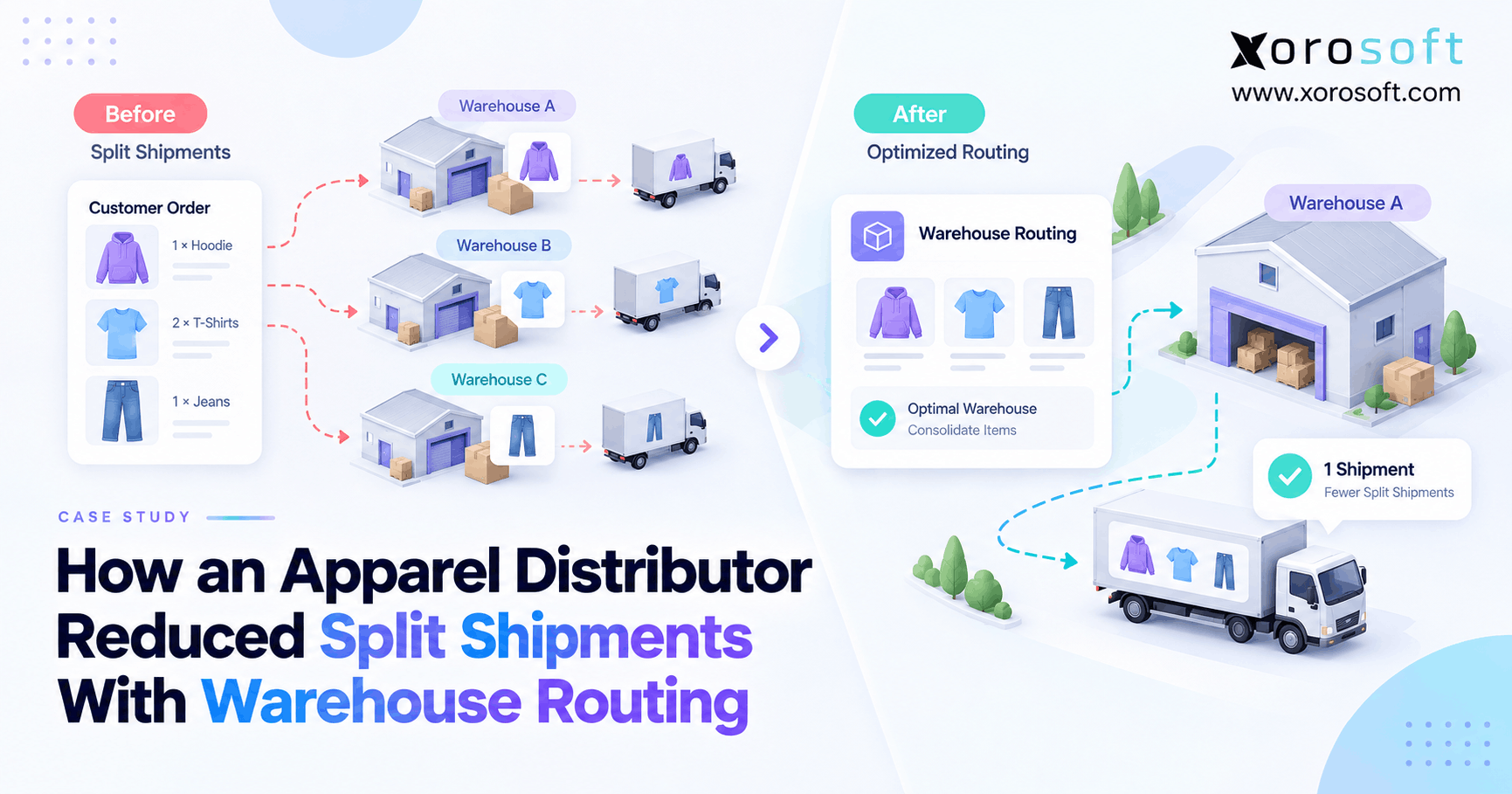
For an apparel distributor, the fastest way to reduce split shipments is to improve the fulfillment decision before warehouse picking begins. Although split orders appear to be a shipping problem, they usually start with inventory placement, allocation, availability, and warehouse-routing rules.
Moreover, apparel makes this challenge harder because one style can exist across many sizes, colors, fits, and seasonal variants. As a result, one warehouse may hold a medium black hoodie while another location holds the large version and a third location holds the jeans included in the same order.
Therefore, the goal is not simply to pack orders differently. Instead, the distributor must decide which warehouse, or combination of warehouses, can fulfill the complete order with the best balance of inventory availability, delivery service, warehouse capacity, and total fulfillment cost.
1.1 Where split fulfillment really begins
First, a customer places one order. However, the order may contain inventory stored across several warehouse locations.
Next, the routing process checks where each SKU is available. If that process evaluates every line separately, the system may send individual items to different warehouses.
Consequently, one customer order can create several warehouse tasks, several cartons, several shipping labels, and several tracking numbers.
Therefore, businesses that want to reduce split fulfillment must improve order-level routing rather than focusing only on individual SKU availability.
1.2 Why apparel makes the problem worse
Apparel distributors manage a particularly large number of SKU combinations. For example, one shirt style may exist in several colors and multiple sizes.
According to GS1 US, four colors combined with four sizes already create 16 separately identifiable variants for one design.
Moreover, every variant has its own inventory position. Therefore, a warehouse can look well stocked at the style level while still lacking the exact size-color combinations required to complete a customer order.
As a result, apparel distributors need routing logic that works at the actual SKU level.
2. What Causes Split Shipments Across Multiple Warehouses
Several operational conditions can create unnecessary split shipments. However, the most common problem is not simply that inventory exists in different buildings.
Instead, splits usually emerge because routing decisions rely on incomplete inventory information or poorly prioritized rules.
2.1 Inventory is genuinely fragmented
Sometimes, no warehouse can fulfill the complete order. For instance, Warehouse A may have the jacket while Warehouse B has the correct size of jeans.
In that situation, splitting may be unavoidable.
However, if the same product combinations are repeatedly separated across warehouses, the problem also points to inventory-placement and replenishment decisions.
Therefore, routing data should eventually feed back into purchasing, transfers, and replenishment planning.
2.2 Quantity on hand is mistaken for available inventory
A warehouse may physically hold 30 units. However, not all 30 units can necessarily support a new customer order.
For example, several units may already be allocated, reserved for wholesale customers, protected as safety stock, damaged, or committed to open picks.
Consequently, routing based only on quantity on hand can choose a warehouse that cannot actually complete the order.
Therefore, accurate available inventory is essential if the business wants to reduce split shipments consistently.
2.3 Routing rules run in the wrong order
Rule priority matters.
For example, if the first rule always chooses the closest warehouse, an order may be divided across two locations even though a slightly farther warehouse holds every required SKU.
By contrast, Shopify’s current default order-routing strategy prioritizes minimizing split fulfillments before destination-market and proximity rules.
Therefore, the order of routing rules can materially change the fulfillment result.
3. Why Closest-Warehouse Logic Does Not Always Reduce Split Shipments
Shipping from the nearest warehouse sounds efficient. However, distance alone does not determine total fulfillment cost.
For example, the nearest warehouse might hold three of four items. Meanwhile, another warehouse 300 miles farther away might hold the complete order.
If the business chooses proximity first, two parcels may be required. Consequently, the company may incur two picking processes, two cartons, two labels, and two carrier movements.
Therefore, proximity should be considered alongside order completeness.
3.1 Shipping cost is only one part of fulfillment cost
A carrier rate matters. However, it is not the only cost created by a split.
In addition, each extra shipment can require:
- Additional picking
- Another packing process
- Another carton
- Additional packaging materials
- Another shipping label
- Separate tracking
- More customer notifications
- Extra customer-service handling
Therefore, routing should evaluate total operational cost rather than only parcel distance.
3.2 A farther warehouse may create a better outcome
Suppose Warehouse East is 80 miles from the customer but can fulfill only three order lines. Meanwhile, Warehouse Central is 350 miles away and can complete all four.
Although Warehouse Central is farther away, one complete parcel may still produce the better operational outcome.
Therefore, the objective is not always the shortest distance. Instead, the objective is the best complete-order fulfillment decision.
4. Warehouse Routing Rules That Reduce Split Shipments
To reduce split shipments, the apparel distributor changed how warehouses were evaluated.
Instead of asking which location held each SKU, the routing process first asked whether one eligible location could fulfill the complete order.
Then, additional rules evaluated service, cost, capacity, and inventory position.
4.1 Prioritize complete-order availability
First, the system identifies all eligible fulfillment locations.
Next, it determines whether any single location holds every required SKU in available inventory.
If several locations can complete the order, the routing process can then compare other factors.
Therefore, complete-order availability becomes an early filter rather than an afterthought.
4.2 Evaluate service and cost together
After complete-order options are identified, the routing process should compare delivery requirements.
For example, a complete order should not be routed to a warehouse that cannot meet the customer’s promised delivery date.
Likewise, the business should not select an expensive route merely to avoid one additional parcel when the split produces a substantially better service outcome.
Therefore, routing requires trade-offs rather than one universal rule.
4.3 Reserve inventory after routing
Once a warehouse has been selected, the relevant inventory should be reserved quickly.
Otherwise, another order can consume the same available units before warehouse execution begins.
As a result, a routing decision that was correct several seconds earlier can become impossible to execute.
Therefore, allocation and reservation must stay closely connected to routing.
5. Inventory Signals Needed for Better Order Routing
Businesses cannot reliably reduce split shipments unless routing sees the inventory states that operations actually uses.
Therefore, quantity on hand should never be the only input.
5.1 Available inventory
Available inventory reflects what can genuinely support new demand.
Therefore, it should account for inventory that is already allocated or otherwise unavailable.
Moreover, the same definition of availability should be shared by ecommerce, ERP, order management, and warehouse systems.
5.2 Allocated and reserved inventory
Allocated inventory may already belong to another customer order.
Similarly, reserved stock may be held for a wholesale account, marketplace commitment, promotion, or another priority.
Therefore, routing must subtract these commitments before deciding whether a warehouse can fulfill the order.
5.3 Safety stock
Safety stock protects the business against unexpected demand or supply delays.
However, excessively rigid safety-stock rules can also create artificial split shipments.
Therefore, companies should decide whether certain high-priority orders can consume protected stock under controlled conditions.
5.4 Inventory status
Not every physical unit should be considered sellable.
For example, stock can be damaged, quarantined, under inspection, or temporarily unavailable.
Consequently, status-level inventory matters just as much as location-level quantity.
6. How Apparel Variants Increase Split Fulfillment
Apparel routing becomes more difficult as assortment complexity grows.
However, the issue is not simply that the company carries many products. Instead, each style can create many independently stocked variants.
6.1 Style, color, and size combinations
Consider one hoodie sold in six colors and seven sizes.
That single style creates 42 possible size-color combinations.
Moreover, each combination may have a different velocity in each region.
Therefore, the distributor needs SKU-level inventory visibility rather than style-level totals.
6.2 Fast-moving sizes create imbalance
Medium and large sizes may sell faster than less common sizes.
As a result, one warehouse can retain plenty of inventory for the style while losing the exact variants customers order most often.
Therefore, replenishment must consider variant-level demand.
6.3 Seasonal demand changes inventory placement
Apparel demand also changes by season and region.
For example, colder regions may require outerwear sooner, while warmer regions continue selling lightweight products.
Therefore, a static warehouse allocation strategy can quickly become outdated.
Consequently, routing and replenishment should work together.
7. How the Apparel Distributor Changed Warehouse Routing
The distributor changed routing from SKU-first logic to order-first logic.
Therefore, each customer basket was evaluated as one fulfillment decision before individual lines were assigned.
7.1 Step one: identify eligible warehouses
First, the system removed locations that could not legally or operationally fulfill the order.
For example, a warehouse might be excluded because of channel restrictions, customer region, shipping method, product rules, or operational capability.
Therefore, only valid locations continued to the next routing stage.
7.2 Step two: find complete-order options
Next, the routing process searched for warehouses that could fulfill every line using genuinely available inventory.
If one warehouse could complete the order, that option gained priority.
However, service requirements still remained important.
7.3 Step three: compare remaining candidates
When several warehouses could complete the order, the system compared additional factors.
For example, it could consider proximity, delivery promise, warehouse priority, workload, and estimated fulfillment cost.
Therefore, complete-order fulfillment did not mean ignoring every other operational constraint.
7.4 Step four: minimize the number of locations
If no single warehouse could complete the order, the system looked for the smallest practical combination of locations.
Consequently, a three-warehouse split could potentially become a two-warehouse split.
Therefore, split shipment reduction became a spectrum rather than an all-or-nothing objective.
8. One Apparel Order, Three Possible Routing Outcomes
Consider an illustrative customer order containing:
- Black hoodie, Medium
- Black hoodie, Large
- Denim jacket, Medium
- Jeans, waist 32
Now assume inventory is available across East, Central, and West warehouses.
| Routing Method | Warehouse Origins | Packages | Likely Result |
|---|---|---|---|
| Proximity-first | 3 | 3 | Each nearby SKU is selected separately |
| SKU availability-first | 2 | 2 | Some lines are consolidated |
| Complete-order routing | 1 | 1 | One location fulfills the full order |
This example is illustrative rather than a claim about a specific customer result.
However, it shows why order-level evaluation matters.
If routing sees only individual SKU availability, three fulfillment decisions can appear reasonable independently.
By contrast, when the system evaluates the complete basket, one warehouse may emerge as the better overall option.
Therefore, businesses can reduce split shipments by evaluating fulfillment at the order level first.
9. When You Should Not Reduce Split Shipments
Reducing every split is not the correct objective.
Instead, businesses should reduce unnecessary splits while protecting customer service.
9.1 Delivery promises can be more important
Suppose one warehouse can fulfill the complete order tomorrow. However, two warehouses can ship separate parcels today.
If waiting causes the customer to miss a promised delivery date, splitting may be the better choice.
Therefore, service commitments should remain part of routing.
9.2 Backordered products can justify a split
Likewise, one unavailable item should not always hold the entire order.
For example, if three products can ship immediately while the fourth is delayed for ten days, partial fulfillment may improve the customer experience.
Therefore, businesses need controlled exceptions.
9.3 Warehouse capacity matters
A warehouse may have every required SKU. However, it may also be operating beyond practical capacity.
Consequently, routing the order elsewhere can protect service levels.
Therefore, available stock is necessary but not sufficient.
10. How Inventory Placement Helps Reduce Split Shipments
Warehouse routing can reduce split shipments, but routing cannot permanently compensate for poor inventory placement.
Therefore, the distributor also needs to understand why the same SKU combinations repeatedly create split orders.
10.1 Analyze products bought together
First, identify products and variants that frequently appear in the same basket.
For example, certain jeans, shirts, jackets, or accessories may have strong purchase affinity.
Therefore, placing these items together can increase single-location fulfillment opportunities.
10.2 Identify warehouses that repeatedly create splits
Next, analyze routing history.
If one facility repeatedly supplies only one line of otherwise complete orders, its inventory mix may need attention.
Consequently, transfer or replenishment rules can be adjusted.
10.3 Rebalance inventory before demand peaks
Seasonal businesses should also rebalance inventory before demand changes.
For instance, regional weather, promotions, wholesale commitments, and ecommerce campaigns can materially alter the best inventory position.
Therefore, proactive replenishment can reduce routing pressure later.
11. KPIs That Show Whether Routing Is Working
A routing project should be measured with operational KPIs rather than impressions.
Therefore, teams should establish baseline metrics before changing rules.
11.1 Split shipment rate
A simple formula is:
Orders requiring more than one outbound shipment ÷ total fulfilled orders × 100
This KPI directly shows how often customers receive split fulfillment.
However, it should not be viewed alone because an aggressive reduction may harm delivery performance.
11.2 Shipments per order
Calculate:
Total outbound shipments ÷ total fulfilled customer orders
As this number decreases, shipment consolidation is generally improving.
However, teams should also track on-time delivery.
11.3 Single-location fulfillment rate
This metric shows the percentage of orders fulfilled completely from one warehouse.
Therefore, it provides a useful counterpart to split shipment rate.
11.4 Routing override rate
Manual overrides reveal where automated rules fail to reflect real operations.
Therefore, frequent overrides should trigger investigation.
Moreover, the reasons behind those overrides often reveal problems with inventory data, capacity assumptions, or routing priorities.
12. Manual Routing vs Rules-Based Warehouse Routing
Manual decision-making can work at low volume.
However, as order volume, warehouse count, and SKU complexity grow, repeatability becomes more difficult.
| Area | Manual Routing | Rules-Based Routing |
|---|---|---|
| Inventory check | Staff reviews locations | System evaluates availability |
| Warehouse choice | Individual judgment | Defined priorities |
| Split prevention | Reactive | Evaluated before release |
| Safety stock | Easy to overlook | Included in availability |
| Capacity | Often checked manually | Can become a routing input |
| Exceptions | Email or messages | Defined workflow |
| Auditability | Limited | Routing history |
| Scalability | Declines with volume | More repeatable |
Therefore, automation is not mainly about replacing judgment.
Instead, automation handles ordinary orders consistently so operators can focus on genuine exceptions.
13. How ERP and WMS Data Help Reduce Split Shipments
As fulfillment complexity grows, routing needs information from more than one operational area.
Therefore, ERP, inventory, order management, ecommerce, and warehouse systems must share reliable data.
13.1 Keep enterprise inventory in one operational view
An integrated platform such as XoroONE can connect inventory, orders, purchasing, warehouse activity, accounting, and related operations within one ERP environment.
Consequently, routing decisions can reference the same inventory state used by other teams.
Moreover, companies avoid maintaining separate spreadsheet versions of warehouse availability.
13.2 Connect warehouse execution
Routing decides where an order should go. Meanwhile, warehouse execution determines whether that decision can actually be completed.
Therefore, XoroWMS becomes relevant when businesses need real-time warehouse inventory, picking, packing, scanning, and multi-location execution.
As a result, upstream routing and downstream warehouse activity can remain closer together.
13.3 Connect ecommerce and order sources
Apparel distributors frequently sell through Shopify, Amazon, wholesale channels, and EDI.
Therefore, Xorosoft Integrations can help connect channel activity with centralized ERP and inventory workflows.
In addition, Xorosoft is listed on the Shopify App Store, giving Shopify merchants a direct integration path between storefront activity and broader operational workflows.
13.4 Use routing alongside broader ERP processes
Routing is only one part of the operating model.
For example, purchasing affects future inventory, transfers change warehouse availability, and accounting captures the financial consequences of fulfillment.
Therefore, XoroERP can be relevant when order routing needs to operate within a broader enterprise process rather than as an isolated warehouse function.
14. How Disconnected Systems Create More Split Fulfillment
Disconnected systems can make good routing rules behave badly.
Therefore, data consistency matters as much as rule design.
14.1 Ecommerce may see inventory differently from the warehouse
For example, Shopify may show inventory as available while the warehouse has already committed those units to open work.
Consequently, an order can be routed toward stock that operations no longer considers usable.
Therefore, inventory updates should move quickly between systems.
14.2 Wholesale and DTC orders can compete for the same stock
Wholesale accounts may have allocations or commitments that ecommerce channels cannot see.
Meanwhile, DTC demand can continue consuming shared inventory.
Therefore, businesses need clear allocation policies.
14.3 Transfers can temporarily distort availability
Inventory moving between warehouses creates another challenge.
For example, a transfer may exist in the ERP but not yet be physically available at the destination.
Therefore, routing must distinguish between incoming inventory and sellable inventory.
14.4 Broader inventory workflows matter
Companies facing these issues may need more than a routing rule.
Instead, they may need connected purchasing, inventory, warehousing, order management, and reporting.
Therefore, reviewing Xorosoft’s broader business solutions can help teams map routing problems to the processes creating them.
15. When an Apparel Distributor Should Upgrade Its Routing Approach
Not every distributor needs advanced routing.
However, certain operating patterns usually indicate that basic rules are becoming insufficient.
15.1 Employees manually choose warehouses
If staff regularly move orders between locations, automated rules may not reflect actual business conditions.
Therefore, manual reassignment frequency should be measured.
15.2 Split fulfillment keeps increasing
As warehouse count and assortment grow, split rates may climb even though total inventory also grows.
Consequently, the issue often becomes inventory placement plus routing rather than total stock quantity.
15.3 New channels create inventory competition
Shopify, Amazon, wholesale, retail, and EDI demand may all draw from the same stock.
Therefore, channel growth makes allocation discipline more important.
15.4 Warehouse expansion creates more exceptions
Adding locations should increase fulfillment flexibility.
However, without clear routing rules, additional facilities can create more combinations and more manual decisions.
Therefore, complexity can rise faster than capacity.
15.5 Industry requirements become more specialized
Apparel is only one example.
Likewise, furniture, sporting goods, food, manufacturing, and wholesale distribution create their own inventory and warehouse constraints.
Therefore, distributors evaluating broader operational architecture can review Xorosoft’s industries served to understand how those workflows differ.
16. A Practical Checklist to Reduce Split Shipments
Businesses do not need to redesign the entire network at once.
Instead, they can work through a practical routing checklist.
16.1 Confirm available inventory
First, verify that routing uses genuinely available stock rather than raw quantity on hand.
Therefore, subtract allocations, reservations, holds, and non-sellable inventory where appropriate.
16.2 Check complete-order availability first
Second, determine whether one eligible warehouse can fulfill every order line.
If so, compare that option before assigning individual SKUs elsewhere.
Therefore, single-location fulfillment gets a fair opportunity.
16.3 Validate the delivery promise
Next, ensure that consolidation does not cause unacceptable service delays.
Consequently, routing remains customer-focused rather than purely cost-focused.
16.4 Compare total fulfillment cost
Then, include freight, picking, packing, cartons, labels, handling, and operational touches.
Therefore, one extra parcel is evaluated as an operating cost rather than only a carrier charge.
16.5 Include warehouse capacity
Afterward, consider whether the selected facility can execute the order on time.
Therefore, inventory availability should not be separated from warehouse workload.
16.6 Reserve stock immediately
Once routing is complete, reserve inventory as quickly as practical.
Otherwise, competing demand can invalidate the decision.
16.7 Review routing exceptions
Finally, review manual overrides and repeat split patterns.
Therefore, the business can improve routing, replenishment, and warehouse allocation over time.
Following these steps gives an apparel distributor a practical way to reduce split shipments without creating rigid rules that damage service.
17. Reduce Split Shipments by Fixing the Routing Decision First
Ultimately, businesses reduce split shipments most effectively when they address the decision before picking begins.
Although packing and shipping processes matter, the major causes usually appear earlier: inventory placement, availability calculations, order allocation, warehouse eligibility, routing priority, and replenishment.
Therefore, apparel distributors should first determine whether one warehouse can fulfill the complete basket. Next, they should evaluate delivery commitments, capacity, total cost, and genuine inventory availability.
Moreover, routing results should feed back into purchasing and transfers. As a result, the company gradually improves both fulfillment decisions and inventory positioning.
For growing inventory-driven businesses, Xorosoft can connect ERP, inventory management, order operations, purchasing, and warehouse execution within a broader operational environment. In addition, teams can review relevant Xorosoft case studies to see how other operational workflows have been addressed.
If split fulfillment is becoming a recurring operational cost, the next step is to evaluate where the problem starts in your own workflow. Therefore, you can Book a Demo to review inventory, warehouse, ecommerce, and order-routing requirements in the context of your current operation.
Frequently Asked Questions
What is a split shipment?
A split shipment occurs when one customer order is fulfilled through two or more outbound shipments. Usually, this happens because inventory is distributed across locations or no single warehouse can complete the full order.
How can apparel distributors reduce split shipments?
Apparel distributors can reduce split shipments by checking complete-order inventory first, improving SKU-level availability, prioritizing order consolidation, reviewing safety stock, and repositioning frequently purchased size-color combinations across warehouses.
How does warehouse routing reduce split fulfillment?
Warehouse routing compares eligible fulfillment locations before releasing an order. Therefore, it can prioritize a warehouse that holds the complete basket instead of assigning individual order lines to several facilities.
Should every order ship from the closest warehouse?
No. Although proximity can reduce transit distance, the closest warehouse may not hold the full order. Therefore, businesses should compare distance with order completeness, delivery promises, capacity, and total fulfillment cost.
What inventory data should routing use?
Routing should use available inventory, allocations, reservations, safety stock, product status, open warehouse commitments, and location eligibility. In addition, capacity and delivery requirements can improve the final warehouse decision.
Can Shopify help minimize split shipments?
Yes. Shopify supports order-routing rules that can prioritize locations able to fulfill complete orders. However, merchants should still align routing settings with warehouse inventory, fulfillment capacity, and their broader operating model.
When should a distributor automate warehouse routing?
Automation becomes more valuable when multiple warehouses, growing SKU counts, several sales channels, manual order reassignment, or rising split rates make consistent routing difficult for employees to manage manually.
Recent Posts
-
How an Apparel Distributor Reduced Split Shipments With Warehouse Routing
-
 What Should Inventory Tracking Records Include Beyond Quantity on Hand?
 -
 Why Manufacturing Inventory Availability Is Wrong When Consumption Posts Late
 -
 EDI 850–855–856–810 Workflow: The Complete Retail Order-to-Cash Sequence
 -
 3PL Billing System Buying Guide: Rating Rules, Audit Trails, and Client Invoicing