1. Why Inventory Tracking Records Must Explain More Than Quantity
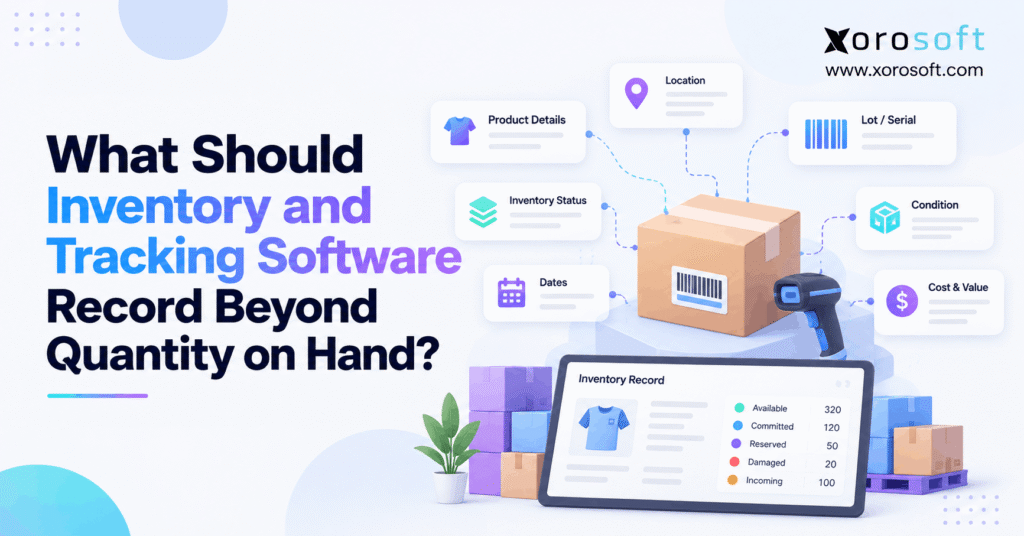
Inventory tracking records should explain far more than how many units appear to be in stock. Although quantity on hand matters, that number alone cannot show whether the inventory is sellable, reserved, damaged, moving between warehouses, waiting for inspection, or already committed to a customer.
Therefore, growing businesses need context behind every quantity. For example, 1,000 physical units might include 600 available units, 220 committed units, 80 units under quality control, and 100 units held as safety stock. Consequently, a team that sees only “1,000 on hand” can make the wrong purchasing or fulfillment decision.
Moreover, inventory affects purchasing, warehouse operations, sales, accounting, manufacturing, and ecommerce simultaneously. As a result, inventory tracking records should operate like an operational history rather than a simple stock counter.
1.1 Quantity on hand is not the same as usable inventory
On-hand inventory answers one question: how much stock does the system believe physically exists?
However, operations require another question: how much can the business actually use?
For example, inventory might already belong to open customer orders. Likewise, another portion could be damaged or quarantined. Meanwhile, safety stock may intentionally remain protected from ordinary demand.
Therefore, businesses should separate physical quantity from operational availability.
A useful record should show:
- On-hand quantity
- Available quantity
- Reserved quantity
- Committed quantity
- Unavailable quantity
- Incoming quantity
Consequently, teams can understand why the sellable quantity differs from the warehouse total.
1.2 Every inventory number should answer operational questions
Strong inventory tracking records should help a user answer several questions without opening another spreadsheet.
First, what item is being tracked? Next, where is it physically stored? Additionally, can it be sold right now? If not, why not?
The record should also explain:
- Which lot or serial number identifies the inventory?
- When was it received?
- Which customer or order reserved it?
- What did the inventory cost?
- Which transaction moved it?
- Who adjusted the quantity?
- What was the reason for that adjustment?
Ultimately, the inventory number should be the result of recorded activity. It should not be an isolated value that employees repeatedly overwrite.
2. Inventory Tracking Records Start With Stock Status
Accurate inventory tracking records need clear inventory states because physical presence does not guarantee availability.
Therefore, instead of maintaining one universal quantity, the system should categorize stock according to what can happen to it next. In practice, that distinction helps sales, warehouse, purchasing, and ecommerce teams work from the same availability logic.
2.1 Available, committed, unavailable, and incoming inventory
Available inventory represents stock that can normally be sold or allocated.
Committed inventory, however, has already been claimed by an order or another demand source. Likewise, unavailable inventory may physically exist but remain blocked because of damage, inspection, quarantine, or safety-stock rules.
Meanwhile, incoming inventory represents expected supply that has not yet become usable stock.
Therefore, a useful status structure might include:
| Inventory status | What it means | Normally sellable? |
|---|---|---|
| On hand | Physically recorded | Not always |
| Available | Free for new demand | Yes |
| Committed | Already allocated | No |
| Reserved | Protected for a purpose | Usually no |
| Unavailable | Blocked or restricted | No |
| Incoming | Expected but not received | No |
As a result, teams stop treating every physical unit as immediately sellable.
2.2 Reservations need their own context
Reservations become especially important as order complexity grows.
For example, a wholesale customer may have protected inventory under an agreement. Similarly, a manufacturing order may require components that still sit physically inside the warehouse.
Therefore, inventory tracking records should identify what caused the reservation.
Useful reservation fields can include:
- Customer
- Sales order
- Production order
- Sales channel
- Reservation date
- Reserved quantity
- Expiration or release condition
Consequently, employees can distinguish genuine shortages from stock that exists but already belongs to another workflow.
Moreover, this prevents teams from manually maintaining allocation spreadsheets beside the inventory system.
3. Location Data Gives Inventory Tracking Records Physical Context
Inventory can be accurate at company level yet wrong operationally if employees cannot find it.
Therefore, inventory tracking records should preserve increasingly precise locations whenever warehouse complexity requires them. Although a small operation may only need a facility name, a larger warehouse can require several location layers.
3.1 Warehouse and bin locations answer different questions
A warehouse location answers:
Which facility owns the inventory?
A bin location answers:
Where should an employee physically find it?
Therefore, a location hierarchy might look like:
Warehouse → Zone → Aisle → Rack → Shelf → Bin
For example, knowing that 200 units exist in the Chicago warehouse is helpful. However, a picker still needs to know whether those units sit in Aisle 4, Rack B, Bin 12.
Consequently, location accuracy affects receiving, replenishment, cycle counting, picking, and transfer activity.
Moreover, accurate locations make discrepancies easier to investigate because teams can compare system quantities against specific physical positions.
3.2 Transfers should create an in-transit state
Transfers create temporary inventory ambiguity.
For example, Warehouse A may ship 100 units to Warehouse B on Tuesday. However, Warehouse B may not physically receive those units until Thursday.
Therefore, the system should not show the stock as fully available at both locations.
Instead, the transfer record should preserve:
- Origin location
- Destination location
- Quantity shipped
- Quantity received
- Shipment date
- Expected receipt date
- Actual receipt date
- Transfer status
As a result, inventory tracking records can explain where stock is during the gap between shipment and receipt.
Furthermore, partial receipts should remain visible rather than forcing staff to manually reconcile the transfer.
4. Product Identity Makes Inventory Records Traceable
Quantity tells a business how much inventory exists. However, identity explains exactly which inventory those quantities represent.
Therefore, inventory records should preserve the product attributes needed to distinguish otherwise similar units.
4.1 SKU and variant information comes first
At minimum, each record should connect inventory to the correct SKU.
However, variant-heavy businesses may also need:
- Style
- Color
- Size
- Configuration
- Unit of measure
- Packaging type
- Barcode
For example, an apparel business cannot simply record 500 units of one shirt style if those units include five sizes and four colors.
Likewise, furniture and sporting-goods businesses often manage products with meaningful variations.
Therefore, accurate identity prevents one variant from masking a shortage in another.
4.2 Lot, batch, and serial numbers add traceability
Lot tracking identifies groups of units that share an origin or production event.
For example, businesses can associate a lot with:
- Supplier
- Manufacturing run
- Receipt
- Expiration date
- Cost
- Quality result
Serial numbers go further because each identifier can belong to one physical unit.
Therefore, serialized products can be followed through receiving, shipment, return, service, or warranty activity.
As a result, inventory tracking records become especially valuable when recalls, warranties, expiration control, or product genealogy matter.
5. Inventory Tracking Records Need Dates and Condition
Time changes the meaning of inventory.
Therefore, inventory tracking records should preserve dates that explain where inventory came from, how long it has been held, and whether it remains suitable for its intended purpose.
5.1 Different dates support different decisions
Useful date fields can include:
- Purchase-order date
- Expected receipt date
- Actual receipt date
- Manufacturing date
- Lot creation date
- Expiration date
- Best-before date
- Allocation date
- Transfer date
- Shipment date
- Return date
- Last count date
- Last adjustment date
For example, two lots may contain the same SKU and quantity. However, if one expires next week while another expires next year, warehouse teams should not necessarily treat them equally.
Consequently, date information can support FIFO or FEFO workflows, replenishment decisions, and expiry management.
5.2 Condition should remain separate from quantity
A returned item does not automatically become available inventory.
Instead, employees may first classify it as:
- Sellable
- Damaged
- Quality hold
- Quarantine
- Refurbishment
- Repair
- Scrap
- Expired
Therefore, adding five returned units directly back to available inventory can create false availability.
Similarly, damaged units should remain visible until the business decides whether to repair, return, scrap, or write them off.
As a result, inventory tracking records preserve the full lifecycle without hiding unusable inventory.
6. Movement History Explains How Inventory Changed
Inventory should never move from 500 units to 430 units without an explanation.
Therefore, businesses need transaction history behind the current balance. Instead of repeatedly overwriting quantities, the system should preserve the operational events that created them.
6.1 Inventory history should work like a ledger
A useful inventory ledger can include:
Opening quantity + receipts − shipments ± transfers ± production ± adjustments = current quantity
Consequently, employees can work backward from the current balance.
Common inventory events include:
- Purchase receipts
- Sales allocations
- Picking
- Packing
- Shipping
- Transfers
- Production consumption
- Finished production
- Customer returns
- Supplier returns
- Cycle counts
- Adjustments
- Scrap
Moreover, inventory tracking records should preserve the source document whenever possible.
For example, a shipment should connect to its sales order, while a receipt should connect to its purchase order.
6.2 Adjustment reasons expose process problems
Manual adjustments are sometimes necessary.
However, unexplained adjustments can hide operational failures.
Therefore, every meaningful adjustment should capture:
- Previous quantity
- Adjustment amount
- Resulting quantity
- Warehouse or bin
- Reason code
- User
- Timestamp
- Source reference
For example, “minus 12” provides little information. In contrast, “minus 12 because of cycle-count variance in Bin A-12” gives managers something they can investigate.
Consequently, recurring reasons can reveal receiving mistakes, picking errors, shrinkage, damage, or training problems.
7. Inventory Tracking Records Must Connect Quantity With Cost
Physical inventory and financial inventory cannot remain separate indefinitely.
Therefore, mature inventory tracking records should connect quantities with the costing data needed by finance. Otherwise, warehouse records can appear accurate while inventory valuation remains difficult to reconcile.
7.1 Inventory cost needs transaction context
Depending on the accounting model, useful fields may include:
- Purchase cost
- Standard cost
- Average cost
- FIFO layers
- Lot-specific cost
- Landed cost
- Freight
- Duties
- Brokerage
- Write-downs
- Write-offs
Therefore, cost changes should not simply overwrite history.
Instead, the system should preserve enough transaction detail to explain why inventory value changed.
This connection becomes especially important when products arrive at different costs or when landed expenses materially affect margins.
7.2 Inventory and accounting should reconcile from shared activity
When inventory lives in one system and accounting lives in another, reconciliation can become heavily dependent on exports and spreadsheets.
Therefore, companies with greater complexity often move toward a connected ERP model.
For example, XoroERP brings inventory, purchasing, accounting, manufacturing, and related operational activity into a broader ERP environment.
Consequently, physical movements can feed financial processes without requiring teams to rebuild the same transaction manually.
However, the important principle is not the software name. Instead, inventory quantities and inventory value should come from explainable, connected activity.
8. Packaging and Warehouse Execution Strengthen Inventory Records
Accurate inventory also depends on how employees receive and move physical goods.
Therefore, units of measure, packaging rules, and warehouse scanning should support the underlying inventory record rather than operate as disconnected processes.
8.1 Units of measure prevent silent quantity errors
A quantity of 10 means little without a unit of measure.
For example:
- 10 eaches
- 10 cases
- 10 cartons
- 10 pallets
are very different inventory positions.
Therefore, systems should preserve conversions such as:
1 case = 12 eaches
Otherwise, receiving 20 cases as 20 individual units creates an immediate discrepancy.
Likewise, wholesalers may buy by case, store by carton, and sell by each. Consequently, conversion rules need to remain consistent across purchasing, warehousing, and order management.
8.2 Scanning confirms physical events
Warehouse scanning adds operational evidence to the inventory record.
For example, an employee can scan:
- Receiving location
- Product barcode
- Source bin
- Destination bin
- Pick location
- Shipment
- Lot
- Serial number
Therefore, a warehouse management system can strengthen inventory control by recording physical actions as they happen.
As a result, inventory tracking records rely less on delayed manual updates.
Moreover, warehouse teams can investigate discrepancies using transaction history instead of relying on memory.
9. Ecommerce Requires Inventory Tracking Records With Channel Context
Ecommerce adds speed to inventory decisions.
Therefore, inventory availability needs to reflect customer orders and reservations quickly enough to prevent multiple channels from promising the same stock.
9.1 The storefront should receive sellable inventory
Suppose a business physically holds 2,000 units.
However:
- 300 belong to wholesale orders
- 150 are safety stock
- 100 are damaged
- 200 are committed to marketplace orders
Therefore, publishing “2,000 available” to an ecommerce storefront creates avoidable overselling risk.
Instead, inventory tracking records should help calculate an appropriate available quantity.
Consequently, ecommerce inventory should reflect operational reservations rather than raw warehouse totals.
For businesses connecting storefronts with ERP workflows, Xorosoft’s integration ecosystem supports connected commerce and operational processes.
9.2 Shopify inventory should connect to downstream operations
Shopify can be the customer-facing commerce layer. However, growing brands often need inventory to coordinate with purchasing, accounting, warehouse execution, forecasting, and additional channels.
Therefore, Xorosoft can operate as an ERP layer behind Shopify for more complex operations.
Additionally, merchants can review the Xorosoft ERP listing on the Shopify App Store when evaluating the integration.
Meanwhile, the broader principle remains the same: channel inventory should derive from reliable operational availability.
Consequently, synchronization alone is not enough. Businesses also need reconciliation when inventory states disagree.
9.3 Returns should not automatically increase availability
Ecommerce returns create another common error.
When a customer returns two units, those products may be:
- Sellable
- Damaged
- Opened
- Missing components
- Awaiting inspection
Therefore, the return should enter an appropriate condition before available inventory increases.
As a result, inventory tracking records can distinguish physically returned goods from genuinely resellable stock.
This distinction becomes particularly important for apparel, furniture, consumer products, and other return-heavy categories.
10. Wholesale Operations Need Allocation and Packaging Context
Wholesale inventory is rarely just a warehouse total.
Instead, customer agreements, EDI orders, case quantities, and future supply can affect what inventory one customer is allowed to receive.
10.1 Customer allocations change availability
A distributor might physically hold 5,000 units.
However, 1,000 units may already be protected for a strategic customer.
Therefore, showing the entire 5,000 units as freely available creates conflict.
Useful wholesale inventory tracking records may therefore include:
- Customer allocation
- Contract reservation
- Sales-order commitment
- Backorder
- Future availability
- Warehouse assignment
- Case quantity
- Pallet quantity
Consequently, sales teams can distinguish company-wide stock from customer-specific availability.
Moreover, purchasing teams can see whether apparent excess inventory is actually committed.
10.2 EDI and case-pack requirements add another layer
Wholesale customers often order using standard case, carton, or pallet quantities.
Therefore, the system should preserve packaging conversions and fulfillment requirements.
Similarly, EDI workflows may create demand before warehouse teams interact with the order.
Consequently, inventory must reflect those commitments quickly.
Xorosoft supports inventory-driven industries such as wholesale, ecommerce, manufacturing, apparel, furniture, and consumer products across its industry solutions.
However, businesses should still evaluate their specific allocation, packaging, and customer requirements before selecting software.
11. Manufacturing Expands Inventory Tracking Records Further
Manufacturing changes inventory from a simple buy-and-sell model into a transformation process.
Therefore, inventory tracking records may need to show raw materials becoming work in process and, eventually, finished goods.
11.1 Components must leave availability when production uses them
Suppose a work order consumes 100 components.
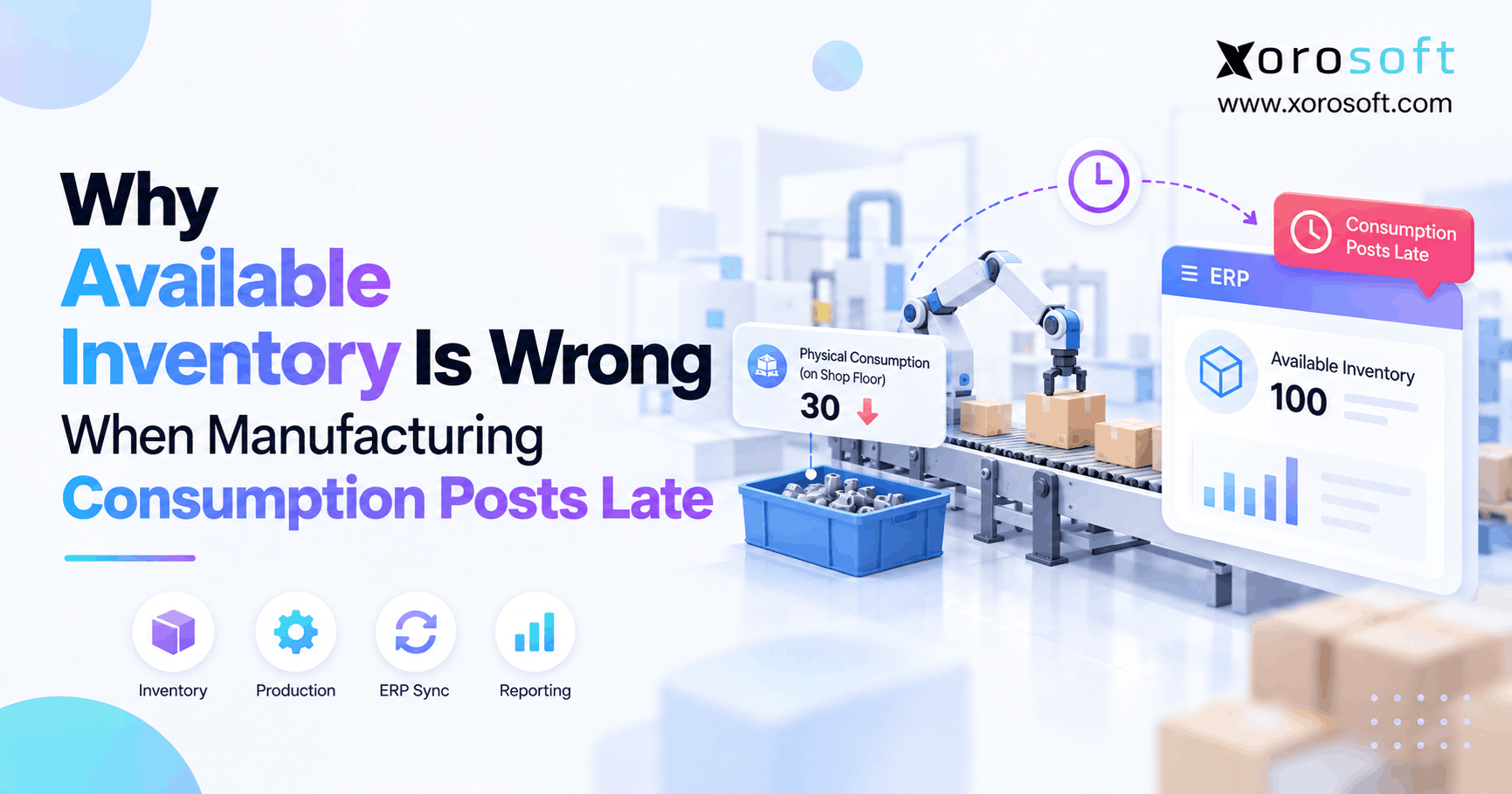
If physical production uses those components on Monday but the system posts consumption on Wednesday, availability can remain overstated for two days.
Consequently, buyers may delay replenishment while sales or production planners assume components still exist.
Therefore, manufacturing records may need:
- BOM
- Work order
- Component reservation
- Component issue
- Quantity consumed
- Scrap
- Finished quantity
- Production location
As a result, material availability reflects production activity instead of lagging behind it.
11.2 Lot genealogy connects inputs with finished goods
Lot-controlled manufacturing requires another relationship:
Supplier lot → Raw material → Production order → Finished lot → Customer shipment
Therefore, traceability should connect source materials with production output.
Moreover, manufacturers may need to identify which customers received finished goods containing a particular input lot.
Consequently, lot genealogy supports recall investigations and quality analysis.
For inventory-driven businesses that require these workflows together, XoroONE combines ERP functions including inventory, accounting, warehouse management, manufacturing, ecommerce, and related operations.
12. Who Needs Advanced Inventory Records?
Not every business requires the same tracking depth.
Therefore, businesses should match their data requirements to their operational complexity instead of collecting fields merely because software makes them available.
12.1 Complexity determines how much context is necessary
Advanced tracking becomes increasingly valuable for:
- Multi-warehouse businesses
- Shopify brands
- Multi-channel ecommerce companies
- Wholesale distributors
- Manufacturers
- Food and beverage businesses
- Businesses handling lot-controlled goods
- Serialized-product businesses
For example, a multi-warehouse operation needs transfers and location-level availability. Meanwhile, a manufacturer may need component reservations and production traceability.
Likewise, a food business may care heavily about lot and expiry information.
Therefore, the required inventory tracking records depend on what can materially change fulfillment, cost, quality, or compliance.
12.2 Simpler businesses may not need every field
More data is not automatically better.
For example, a small single-location company with 50 straightforward SKUs may not need serial numbers, complex warehouse zones, or manufacturing genealogy.
Therefore, simpler inventory software can still be appropriate when a business has:
- One location
- Low transaction volume
- No manufacturing
- No lot requirements
- No serial requirements
- Simple purchasing
- Limited channel complexity
Consequently, the objective is not maximum data collection.
Instead, businesses should capture enough context to make reliable inventory decisions without adding unnecessary administrative work.
13. Inventory Tracking Records Fail When Teams Use the Wrong Controls
Even strong software can produce unreliable results if the underlying process remains weak.
Therefore, businesses should review how inventory gets created, reserved, moved, adjusted, and reconciled.
13.1 Seven mistakes create recurring inventory problems
Common mistakes include:
1. Tracking only one stock quantity
2. Treating reserved stock as available
3. Ignoring warehouse and bin locations
4. Allowing unexplained manual adjustments
5. Skipping lot or serial tracking where needed
6. Updating channels without reconciliation
7. Separating inventory activity from accounting
For example, synchronization can move incorrect inventory faster rather than fix it.
Therefore, businesses need exception handling in addition to integrations.
Likewise, manual adjustments should not become the default solution whenever counts disagree.
Instead, teams should investigate why the discrepancy occurred.
13.2 Reconciliation should identify causes, not just differences
A cycle count may show that the system has 118 units while the warehouse contains 113.
Therefore, the immediate correction is minus five.
However, the more valuable question is why those five units disappeared from the record.
Possible causes include:
- Receiving error
- Incorrect transfer
- Unposted shipment
- Picking mistake
- Damage
- Wrong unit-of-measure conversion
- Production consumption
- Theft or shrinkage
Consequently, inventory tracking records should make those causes easier to investigate.
Otherwise, the business repeatedly corrects symptoms without improving inventory accuracy.
14. Evaluate Software by the Depth of Its Inventory Records
When evaluating software, avoid asking only whether the platform “tracks inventory.”
Nearly every inventory product can display a quantity.
Instead, determine whether the system can explain the operational meaning behind that number.
14.1 Use an inventory-record checklist during software evaluation
Ask vendors whether the system can record:
- Available inventory
- Commitments and reservations
- Incoming supply
- Multiple warehouses
- Bin locations
- Transfers
- Lot numbers
- Serial numbers
- Expiration dates
- Product condition
- Movement history
- Adjustment reasons
- User audit history
- Cost information
- Units of measure
- Customer allocations
- Manufacturing consumption
- Returns disposition
Therefore, a demonstration should follow real scenarios rather than feature menus.
For example, ask the vendor to receive inventory, transfer it, reserve it, adjust it, ship it, and explain every quantity afterward.
Xorosoft’s broader business solutions connect inventory with other operational functions when businesses need more than standalone stock tracking.
14.2 Know when the existing system has become too simple
Upgrade signals often appear before a system completely fails.
For example:
- Teams maintain parallel spreadsheets.
- Warehouse counts frequently disagree.
- Inventory differs by channel.
- Adjustments become routine.
- Purchasing relies on manual reports.
- Accounting spends too long reconciling inventory.
- Manufacturing consumption posts late.
- Staff cannot trace movements confidently.
- Multi-warehouse transfers create confusion.
Therefore, these problems suggest the company may have outgrown quantity-focused software.
Consequently, reviewing inventory tracking records can be a better upgrade test than comparing feature lists alone.
Real implementation examples can also help teams understand operational changes, which is why reviewing relevant ERP case studies can be useful during evaluation.
15. Build Inventory Tracking Records That Explain Every Quantity
Reliable inventory management begins when the system can explain its numbers.
Therefore, the objective is not simply to show that 500 units exist. Instead, the system should explain how many are available, where they are located, which orders need them, what condition they are in, which lot or serial identifies them, and how their quantity changed.
Moreover, inventory tracking records should connect operational activity with purchasing, warehouse execution, accounting, manufacturing, and ecommerce when those functions affect availability.
As a result, teams spend less time reconstructing inventory history across spreadsheets and disconnected applications.
Ultimately, growing businesses should evaluate whether their inventory record answers the questions required to promise, move, replenish, value, and trace stock confidently.
Xorosoft brings these workflows together across ERP, WMS, order management, purchasing, accounting, manufacturing, and multi-channel operations. Therefore, if your current stack cannot explain the inventory behind the quantity, you can Book a Demo to review how those workflows could operate in a connected system.
Frequently Asked Questions
What should inventory tracking records include?
They should include quantity, availability, warehouse and bin location, lot or serial number, condition, cost, movement history, reservations, adjustments, dates, and the user or transaction responsible for each change.
Why is quantity on hand not enough?
Because physical stock may already be committed, damaged, reserved, quarantined, or otherwise unavailable. Therefore, businesses also need availability and inventory-status data before promising stock to customers.
What is the difference between available and on-hand inventory?
On-hand inventory reflects physical stock recorded at a location. However, available inventory represents the portion that can normally be allocated or sold after commitments and restrictions are considered.
Should inventory records include lot and serial numbers?
Yes, when traceability matters. Lot numbers identify groups of units, while serial numbers identify individual units. Consequently, they support recalls, warranties, expiry tracking, and product history.
Why should inventory adjustments include reason codes?
Reason codes explain whether a difference came from damage, cycle counting, shrinkage, returns, production, or another cause. Therefore, managers can identify recurring process problems instead of seeing unexplained corrections.
When should a company upgrade its inventory system?
Consider upgrading when spreadsheets multiply, warehouses disagree, channels oversell, adjustments become frequent, manufacturing creates delays, or accounting requires substantial reconciliation to explain inventory balances.
How does ERP improve inventory tracking?
ERP connects inventory with purchasing, orders, accounting, warehousing, manufacturing, and reporting. Consequently, inventory changes can flow through related business processes instead of being manually recreated across disconnected systems.
Recent Posts
-
 How an Apparel Distributor Reduced Split Shipments With Warehouse Routing
 -
 What Should Inventory Tracking Records Include Beyond Quantity on Hand?
 -
 Why Manufacturing Inventory Availability Is Wrong When Consumption Posts Late
 -
 EDI 850–855–856–810 Workflow: The Complete Retail Order-to-Cash Sequence
 -
 3PL Billing System Buying Guide: Rating Rules, Audit Trails, and Client Invoicing