If you are looking for information about Shopify B2B pricing, you’re in the right place.
1. When a Wholesale Contract and Shopify Checkout Show Different Prices
A wholesale buyer places a $24,000 reorder through Shopify. Although the account manager expects the contracted rate, checkout applies another promotion. The order is accepted at one value, the ERP imports a different value, and finance discovers the discrepancy while preparing the invoice. Nobody deliberately changed the contract. Instead, each system followed a different version of the agreement.
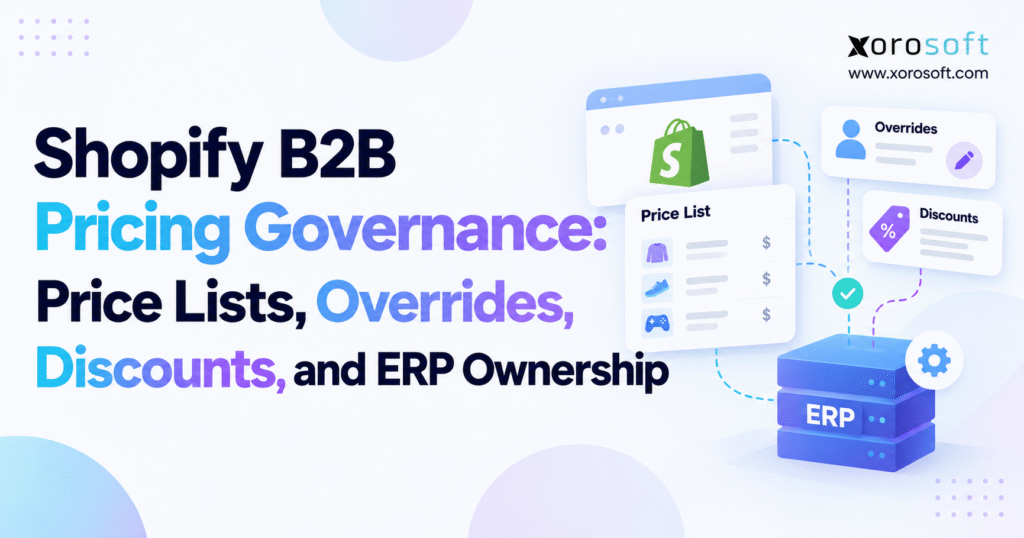
That is the problem Shopify B2B pricing governance is meant to prevent. Because prices, agreements, promotions, and accounting records are connected, an isolated catalog edit can change margins on hundreds of orders.
1.1 Pricing disputes begin long before an invoice is issued
Growing wholesale businesses rarely lose control of prices in a single dramatic failure. More often, one retailer receives a seasonal concession, another qualifies for quantity breaks, and a sales representative promises a rate that never reaches the ecommerce team. Meanwhile, finance uses a spreadsheet of approved contracts, and the online store uses catalog assignments maintained by someone else.
As a result, the consequences extend beyond margin loss. Customers challenge invoices, account managers spend time investigating old quotes, warehouse shipments are delayed while orders are corrected, and finance has to decide whether to issue a credit or preserve the original charge.
1.2 What a reliable Shopify B2B pricing policy must answer
An effective policy identifies the approved customer price, explains why that price applies, controls who may change it, and preserves the transaction value after checkout. Shopify can determine catalog-based prices, but the company must establish contract authority, exception approval, and reconciliation responsibilities.
Therefore, customers should see authorized prices, orders should retain accepted amounts, and accounting should be able to reconstruct each calculation.
2. How Shopify B2B Catalogs, Markets, and Price Lists Work
Shopify B2B pricing starts with customer identity. For example, a wholesale company may have locations with different commercial terms or delivery needs. Markets group buyers with common characteristics, while catalogs determine which products those buyers can purchase and what prices are available to them.
2.1 B2B markets serve shared pricing; company locations identify the buyer
A regional distributor might use a common market catalog for independent retailers in the Northeast. A national chain, however, may negotiate separate terms for its Canadian and US locations.
A Shopify catalog controls assortment and pricing together. The distinction matters when diagnosing a missing product: the item may be absent from the buyer’s eligible catalog, not merely priced incorrectly. Teams should test product visibility and selling price using the actual company location, rather than checking the storefront as an ordinary retail customer.
2.2 Understand Shopify B2B plan limits before designing price lists
As of October 2026, Shopify Basic, Grow, and Advanced support native B2B catalogs with a total of three active B2B market catalog assignments across their markets. By contrast, Shopify Plus supports unlimited B2B market catalogs and direct company or location assignments. Direct company-location catalog assignments are not native features of Basic, Grow, or Advanced. Shopify documents these distinctions in its B2B features by plan.
| Pricing capability | Basic, Grow, Advanced | Shopify Plus |
|---|---|---|
| B2B company accounts and market catalogs | Supported | Supported |
| Active B2B market catalog assignments | Three total across B2B markets | Unlimited |
| Direct company-location catalog assignment | Not available natively | Available |
| Quantity rules and volume pricing | Supported | Supported |
If every buyer fits into a few shared tiers, market catalogs may be sufficient. If hundreds of company locations require individually negotiated catalogs, plan eligibility and operational maintenance become central design questions.
2.3 Fixed catalog prices are different from percentage adjustments
A catalog can apply an overall percentage adjustment and also carry fixed prices for particular products or variants. However, a fixed price overrides that catalog-wide adjustment. Suppose the base price is $120 and the catalog applies a 20% reduction. The adjusted value is $96. If the same variant has a fixed catalog price of $105, the buyer sees $105 before any separately eligible promotional discount.
Otherwise, a manager may assume the 20% catalog adjustment reduces an already-negotiated fixed price, even though that is not how the native rule works.
3. Shopify B2B Catalog Precedence: Which Wholesale Price Wins?
The phrase “lowest price wins” is an incomplete description of Shopify B2B pricing. Instead, assignment level determines precedence. Consequently, a lower market price need not defeat a direct company-location price.
3.1 Lowest-price rules apply within the same assignment level
When overlapping catalogs at the same assignment level contain the same item, Shopify generally shows the lowest applicable product price. In addition, quantity and volume rules come from the lowest-priced catalog. If competing catalogs share the same lowest price, Shopify uses the relevant quantity rules from the catalog created first.
This becomes important when an operator creates a second catalog to fix one SKU but unintentionally inherits a different set of order constraints. A checkout can display the expected unit price while still using an unexpected minimum quantity or volume threshold.
3.2 Direct company-location pricing takes precedence over market pricing
On Shopify Plus, if a company location has a directly assigned catalog and also belongs to a B2B market with a catalog for the same product, the more specific location catalog takes precedence, even when its price is higher. Shopify describes this behavior in its B2B catalog assignment documentation.
| Illustrative assignment scenario | Prices available | Expected result |
|---|---|---|
| Two applicable catalogs at the same level | $100 and $92 | $92 |
| Overall adjustment and a fixed price in one catalog | $96 adjusted and $105 fixed | $105 |
| Direct company-location catalog versus B2B market | $105 direct and $90 market | $105 |
| Two same-level catalogs tied at $92 | Both $92 | $92; earliest-created catalog supplies related quantity rules |
3.3 Test catalog precedence with actual buyer accounts
However, a spreadsheet comparison is not enough. Create test cases for a shared-market customer, a directly assigned company location, two overlapping catalogs, and a product with a volume break. Include one account where the market price is deliberately lower than the direct price. Then verify both the product page and completed checkout.
Save the expected catalog, variant, quantity, currency, and price in a repeatable test record.
4. Customer-Specific Price Lists Need Contract Lifecycle Controls
The mechanics of Shopify B2B pricing answer what a buyer can see. However, contract governance must also establish what the business agreed to honor. Without that second layer, even perfectly configured catalogs can serve commercially outdated prices.
4.1 Treat a price agreement as more than an SKU and a number
A usable pricing record needs the customer account and eligible company location, SKU or variant, contract identifier, currency, unit of measure, approved amount, effective date, expiry or review date, and authorized approver. It should distinguish a standing contract rate from a one-off quote and identify whether volume discounts can apply in addition.
For example, consider a distributor negotiating $18 per basketball for 500 units annually. Is $18 valid for any single order, or only for an order of 100 or more? Does the agreement cover both US and Canadian branches? Does it include freight? Those questions belong in the contract record before anyone publishes a catalog price.
4.2 Expiration dates and renewals are pricing controls
Old contracts become expensive when an expired rate remains active without deliberate approval. Assign an owner to every pricing agreement and review upcoming expirations in advance. Decide whether an agreement renews automatically, reverts to a standard tier, or requires a manual commercial review.
In all cases, retain the original version so the organization can explain the price used on an order placed several months earlier.
4.3 Separate price approval from catalog publication
Sales should be able to request a concession without becoming the sole authority for approving and applying it. Finance or delegated commercial leadership can review the margin and financial exposure. Once approved, ecommerce publishes the rule while integration owners check downstream synchronization.
A modest business may use two designated approvers and a controlled log. The critical requirement is that a price change has an identifiable reason, an accountable decision-maker, and a predictable effective date.
5. Shopify B2B Discounts and Overrides: Where Margin Leakage Begins
A negotiated wholesale price is not always the amount the buyer ultimately pays. Eligible automatic discounts and codes can reduce catalog prices further. Shopify explicitly describes that behavior in its B2B discount guidance, making promotion eligibility a core part of Shopify B2B pricing governance.
5.1 A fixed catalog price, override, and discount are not interchangeable
A fixed catalog price establishes the available rate for a product or variant in a pricing context. By contrast, a draft-order override sets a different rate for one transaction. A discount reduces an otherwise applicable selling price, subject to its eligibility and combination rules.
Confusing those mechanisms causes audit problems. If a retailer’s negotiated rate is $100, the company should know whether a $90 order occurred because of an approved $90 contract, a salesperson’s exception, or a 10% promotion applied at checkout. Although the invoice amount may match, the commercial explanation differs.
5.2 How discount stacking changes the economics of a B2B order
Take a hypothetical product with a retail list price of $120, an approved wholesale price of $100, and an applicable unit cost of $75. Without a further discount, gross profit is $25 and gross margin is 25%. If a broadly targeted promotion takes another 10% off the $100 wholesale price, revenue falls to $90, gross profit falls to $15, and gross margin becomes approximately 16.7%.
| Stage in the price calculation | Illustrative amount per unit |
|---|---|
| Retail list price | $120 |
| Approved B2B catalog price | $100 |
| Additional eligible promotion | -$10 |
| Net merchandise revenue | $90 |
| Applicable cost of goods sold | -$75 |
| Gross profit | $15 |
| Gross margin | 16.7% |
A 10% discount reduced gross profit dollars by 40% in this example. However, promotions are not inherently wrong; evaluate them against the post-contract selling price, not the retail list.
5.3 Protect wholesale contracts when retail promotions go live
In blended B2B and direct-to-consumer stores, broadly eligible promotions can reach more customers than the campaign team intended. Before activating a retail sale, test a normal retail buyer, a wholesale market buyer, and a customer with a fixed negotiated rate. Then check the final payable amount, not just the product-page price.
Set organizational margin thresholds and escalation rules for exceptional deals. If the native discount configuration cannot express the required restriction, evaluate an appropriate extension or approval process rather than pretending that a general catalog setting enforces every contract condition. Likewise, shipping income, taxes, returns, and rebates need separate treatment in margin calculations.
6. B2B Price Overrides, Draft Orders, and Sales Approval Rights
Not every wholesale order follows a published price list. Sales representatives quote project volumes, customer service replaces damaged goods, and account managers approve temporary concessions to retain important buyers. These Shopify B2B pricing exceptions are legitimate, but they need a controlled path into the transaction record.
6.1 Draft-order custom prices are transaction-specific
Shopify allows authorized users to assign a custom line-item price in a draft order. However, that change applies only to the draft, not the permanent product price. Shopify also supports price locks so later product-price changes do not automatically alter the quoted amount. Its B2B draft-order documentation explains that orders submitted for review can have prices locked automatically, while other drafts may need manual locking.
Although a lock prevents unintended price changes, it does not establish commercial approval. Price locks also have product-specific limitations, including unsupported bundles.
6.2 Design approvals around margin and exposure
A practical override request identifies the customer, affected SKU, contract reference, proposed price, quantity, expected gross margin, reason for the exception, and expiry. The approver then evaluates both percentage margin and total dollars at risk. For instance, a small recurring discount may cost more than a larger one-time concession.
Authority can be tiered. Account managers might handle preapproved promotional ranges, while finance reviews exceptions below a margin floor or beyond a defined monetary threshold. Therefore, publish those rules as company policy, not as presumed native Shopify features.
6.3 Preserve the history of a negotiated exception
After approval, record the quote or draft identifier and accepted price alongside the final order. If the buyer returns months later and requests the same rate, the team can distinguish a one-time accommodation from a standing contract amendment.
That distinction prevents a familiar operational problem: salespeople repeatedly copying historical discounts into new orders without checking whether the original justification still applies. An exception should have a scope and a life span, not quietly become the new standard rate.
7. Shopify B2B Quantity Rules, Volume Breaks, and Unit-of-Measure Accuracy
Wholesale price accuracy depends on quantity definitions as much as unit amounts. Buyers commonly order cases, inner packs, pallets, or product variants, while accounting and inventory records may use different base units.
7.1 Quantity restrictions are not volume discounts
Shopify quantity rules can establish minimum order quantities, maximums, and increments. By contrast, volume pricing establishes lower unit prices at qualifying quantities. Therefore, a 12-unit minimum does not imply a discount at 12. Likewise, a volume price break may coexist with quantity restrictions, but each control performs a different job.
Shopify supports up to 10 volume price breaks per product, applied to variants. Its quantity and volume pricing rules specify that quantities from separate variants do not pool to reach a single variant’s break threshold.
7.2 Why variant-level thresholds surprise wholesale buyers
An apparel retailer may buy 10 medium shirts and 10 large shirts, expecting a 20-unit discount. If the qualifying volume threshold is 20 per variant, neither item qualifies. The checkout is functioning as configured, even though the buyer believes the order meets the agreed minimum.
If the commercial agreement allows combined size runs, test whether the proposed Shopify setup can support it. Do not publish a promise the native variant-level rule will not fulfill.
7.3 Align ecommerce pricing with warehouse and accounting units
A food distributor selling a 12-pack at $36 must not let a downstream system interpret $36 as the price for a single item. Record the sales unit, base inventory unit, conversion factor, and invoicing unit explicitly. The same discipline applies to furniture sets and replacement-parts kits.
Consequently, accurate conversions prevent invoice discrepancies, incorrect stock deductions, and inconsistent cost calculations. Unit-of-measure mapping deserves a place in every pricing integration test plan.
8. Shopify, Pricing Apps, or ERP: Where Should B2B Pricing Authority Live?
There is no universal requirement to move Shopify B2B pricing into an ERP. Instead, architecture depends on contract complexity, sales channels, and the ability to reconcile accepted orders.
8.1 Keep Shopify in charge when the pricing model is simple
If buyers fit into a few predictable markets, discounts are manageable, and finance can easily reconcile transactions, Shopify may be an adequate pricing authority. Clear operational permissions and recurring checkout tests may solve the real problem without another platform.
However, businesses should not treat every exception as proof that they have outgrown Shopify. Sometimes the fix is simply to retire obsolete catalogs, revise discount eligibility, or document who approves contract changes.
8.2 Use a specialist app for a narrow, verified gap
A pricing or wholesale ordering app can make sense when the missing feature is specific: an ordering experience, customer pricing condition, or quotation workflow that the merchant’s current Shopify plan does not natively provide. However, an app introduces questions about ownership, integration, checkout behavior, and maintenance.
Ask whether the app reads company-location identity correctly, how it treats discounts, which price is written to completed orders, and what happens if its service becomes unavailable. A visually correct storefront is not enough if the financial record cannot be reproduced.
8.3 Assign ERP ownership when contracts span multiple channels
A distributor selling through Shopify, EDI, account managers, and phone orders may need one approved commercial record that serves all channels. An ERP-led model can be appropriate when the same contracts must influence order management, accounting, purchasing, and financial reporting. In that environment, the storefront presents approved prices while the enterprise system governs source records and downstream execution.
For example, XoroERP’s connected accounting and operations capabilities make Xorosoft relevant to businesses evaluating this wider operating model. However, specific Shopify catalog and pricing-approval capabilities still need demonstration.
| Consideration | Shopify-native | Specialist app | ERP-led architecture |
|---|---|---|---|
| Simple market price lists | Strong fit | Often unnecessary | Possible, potentially excessive |
| Specialized wholesale interface | Depends on native requirements | Potentially useful | Depends on solution |
| Negotiated rates across many channels | Needs coordinated processes | Integration-dependent | Common reason to centralize |
| Price approval and financial audit | Requires business controls | Depends on product | Can be centralized when configured |
| Implementation overhead | Typically lower | Adds vendor dependency | Broader process and data effort |
9. Shopify B2B Pricing Integration: Data Mapping, Ownership, and Failures
Choosing ERP ownership is a policy decision; making it work reliably is a data-engineering and operations task. Therefore, integrations must identify buyers, resolve price rules, publish intended catalog values, and preserve accepted transaction amounts.
9.1 Separate product, price, order, and accounting authorities
One system does not necessarily own every field. The product team may control catalog content, finance may approve rates, Shopify may calculate the online checkout, and accounting may own invoice posting. Document the authoritative source for each data element and whether changes flow in one direction or both.
The Xorosoft integrations overview provides context for connected ecommerce and ERP operations. Even so, test proposed pricing synchronization with locations, catalogs, variants, and actual transactions rather than relying on general integration claims.
9.2 Map buyer identity before attempting price synchronization
A customer name is not a reliable integration key. For instance, branches may share a legal entity yet require different catalogs, currencies, taxes, or payment terms. Use stable identifiers for the company, company location, SKU or variant, contract, currency, and unit of measure. Carry effective dates and price versions where the integration design permits them.
Shopify warns that some external applications do not fully support its native B2B company and catalog structures. Its external systems integration guidance makes compatibility testing particularly important.
9.3 Plan for duplicate events, stale prices, and recovery
Integrations fail in ordinary ways: an API request times out, a price update arrives out of order, a customer location is missing, or a retry sends an already-imported order twice. Consequently, robust workflows need idempotent order creation, version checks, exception queues, alerts, and documented retries.
When pricing synchronization fails, decide whether to pause publication, preserve the previous approved price, or route the order for human review. Silent substitutions are dangerous. A low-risk technical retry should not become an unauthorized commercial change.
9.4 Evaluate the Shopify app at the workflow level
The Xorosoft ERP listing on the Shopify App Store describes order, product, refund, payout, inventory, and related synchronization capabilities. For a Shopify B2B pricing project, that listing is a starting point for evaluation, not proof of every catalog-specific feature.
Before choosing a connector, request a demonstration covering one negotiated price, discount, volume break, and invoice.
10. From Shopify Checkout to ERP Invoice: Reconciliation That Finance Can Defend
The purpose of Shopify B2B pricing governance is not simply to make the displayed price correct. Instead, it must retain accepted transaction values and explain subsequent accounting differences.
10.1 Preserve accepted transaction values, not only current price lists
Catalog prices change. Contracts renew. Currency conditions shift. Therefore, yesterday’s accepted order should never be silently repriced using today’s catalog. Store the relevant order identifiers, original and discounted line values, currency, quantities, and customer location so that finance can reconstruct the transaction without reopening the present-day product page.
In an integrated operating environment, products, orders, inventory, and accounting need a consistent financial handoff. The XoroONE operational overview shows the broader platform context; the specific accepted-price and invoice-reconciliation logic should be validated during configuration.
10.2 Use a field-level exception report
Reconciliation should identify the cause of a discrepancy, not merely its amount. A useful report compares source order values with ERP records at the line level and highlights mapping problems before a billing dispute develops.
| Control field | Source order evidence | What finance should verify |
|---|---|---|
| Buyer identity | Company and location IDs | Correct customer and contract |
| Product | SKU, variant, unit of measure | Correct pricing and inventory item |
| Quantity | Ordered units and pack conversions | Correct priced quantity |
| Net line amount | Catalog price plus eligible adjustments | Exact accepted merchandise value |
| Currency and tax | Checkout currency and tax details | Consistent financial treatment |
| External order ID | Shopify transaction reference | No duplicate ERP order |
10.3 Resolve exceptions without changing the historical record
When Shopify and ERP disagree, preserve both amounts and investigate catalog assignment, discount eligibility, quantity conversion, tax basis, rounding, and synchronization timestamps. Then finance should determine whether correction requires a credit, adjusted invoice, or integration fix. Customer service then communicates the agreed outcome.
11. Wholesale Pricing Across Apparel, Furniture, Food, and Manufacturing
Customer-specific pricing behaves differently when physical products have seasonal demand, packaging constraints, complex freight, or multiple fulfillment sites. Consequently, governance must reflect how each industry sells and delivers goods.
11.1 Apparel and sporting goods: seasonal terms and assortments
Apparel wholesalers may offer preseason commitments, seasonal markdowns, exclusive styles, or customer-specific size runs. For example, retailers may expect pooled size-run discounts even when variant-level breaks do not permit them. Effective dates and promotion eligibility become especially important when end-of-season campaigns overlap contracted wholesale prices.
Sporting-goods suppliers face similar issues with team orders, bundles, and negotiated club or dealer rates. The commercial agreement should state whether a discount applies to individual variants, a defined assortment, or a complete order before the store is configured.
11.2 Furniture and food distribution: freight, cases, and warehouses
A furniture distributor might quote a lower product price for a large hospitality project but charge freight, installation, and specialized handling separately. Consequently, comparing merchandise subtotals with delivered invoices can create false disputes unless services are itemized consistently.
Food and beverage distributors have a different risk: case packs, expiry-sensitive inventory, and customer-specific purchasing units. A case price must remain distinguishable from an each price through ordering, picking, shipping, and invoicing. Where multiple warehouses fulfill the same Shopify demand, XoroWMS warehouse workflows illustrate the warehouse side of an integrated operation, although warehouse software alone does not decide commercial price policy.
11.3 Manufacturing and EDI: one contract across different order sources
Manufacturers and parts distributors may receive the same customer’s demand through a Shopify portal, EDI purchase order, and account-managed reorder. If those channels use independent price tables, customer experience and margin control become unpredictable. Therefore, shared contract identifiers and approval ownership matter more than a storefront feature.
The operating details vary across wholesale, apparel, furniture, food, and manufacturing industries. The common principle is that pricing rules, customer identities, units, and order records must be understood by every system involved in fulfilling the agreement.
12. B2B Pricing Controls That Reveal Margin Leakage Early
A Shopify B2B pricing governance process should produce evidence that management can inspect. Waiting for a customer complaint is an expensive way to discover a configuration error. Instead, monitor a few metrics to see whether the organization protects its agreements.
12.1 Measure exceptions rather than just average discounts
Track the share of orders requiring manual pricing intervention, the proportion of invoices with meaningful price variances, and the number of active contract records beyond their approved expiry dates. Segment those figures by customer location, channel, catalog, and root cause. A headline discount percentage rarely reveals why a particular account is losing margin.
For example, a rising exception rate among one regional customer group may point to an outdated catalog assignment rather than aggressive sales behavior. Likewise, repeated credits for one SKU may signal a unit-of-measure mismatch.
12.2 Distinguish gross margin from the full commercial result
Gross margin on merchandise is calculated as net merchandise revenue minus applicable cost of goods sold, divided by net merchandise revenue. However, freight subsidies, payment fees, returns, commissions, and rebates may affect wider profitability measures. Therefore, use consistent definitions when evaluating contract profitability.
A well-governed process should allow finance to compare the originally approved commercial expectation with the realized transaction outcome. The goal is to make those decisions visible and authorized.
12.3 Establish a monthly pricing-control review
Finance and ecommerce should review the highest-value exceptions, failed catalog tests, expiring contracts, open invoice variances, and overdue integration errors. Meanwhile, sales supplies customer context, while operations identifies delivery or unit-conversion issues. Assign each recurring issue an owner and deadline.
It creates feedback between commercial policy and the systems that execute it.
13. An Implementation Roadmap for Reliable Shopify Wholesale Pricing
The fastest route to reliable Shopify B2B pricing is not an immediate technology replacement. Instead, start with real transactions, establish expected prices, and then decide which systems need changes.
13.1 Audit the current price journey from contract to invoice
Select representative accounts: a standard wholesale tier, a location-specific agreement, a promotional buyer, and a customer ordering through multiple channels. For each, trace the signed agreement, published catalog, actual checkout value, imported sales order, and issued invoice. Note every manual calculation or correction.
The result is a process map showing where information is created, duplicated, changed, or lost. It also distinguishes genuine Shopify limitations from internal policy gaps. For example, the platform may be adequate even though nobody reviews price expirations.
13.2 Write the rulebook before rebuilding integrations
Agree on contract authority, price precedence expectations, discount eligibility, override thresholds, currency treatment, and unit conversions. Build a test matrix for multiple catalogs, direct company assignments where supported, volume breaks, promotions, draft-order price locks, returns, and changes to historical prices.
Next, compare alternatives using demonstrated capabilities, implementation effort, and total operating cost. Businesses evaluating larger ERP platforms can use the Xorosoft versus NetSuite comparison as one vendor perspective, alongside independent requirements testing and other shortlisted vendors.
13.3 Roll out by customer group and monitor exceptions
Pilot a limited set of accounts before switching the entire wholesale operation. Have business owners approve the expected prices, let sales test realistic exceptions, and require finance to reconcile accepted test orders. Document who can pause a rollout or reverse a defective catalog update.
Once stable, extend the pattern to additional markets, company locations, and order channels. Finally, publish ownership and escalation procedures so new employees need not rely on one administrator. Real customer implementation stories can provide practical context for evaluating organizational change, but each buyer should still validate its own pricing scenarios.
14. Make Pricing Ownership a Business Decision, Not an App Decision
14.1 Keep the simplest architecture that can reliably honor contracts
If Shopify can represent your wholesale agreements, apply expected volume rules, control discount eligibility, and produce reconciled orders, strengthen those processes before adding complexity. Shopify B2B pricing does not need to become an ERP project merely because the company sells wholesale.
Alternatively, use a specialist app when one feature is missing and orders remain auditable. However, consider ERP when contracts, accounting, inventory, purchasing, EDI, and warehouses depend on inconsistent records.
14.2 Test the difficult order before selecting the platform
Use a customer location with a negotiated contract, a product with volume pricing, an eligible or deliberately excluded discount, and an order that must reach accounting. Ask the implementation team to demonstrate the calculated price, approval trail, synchronization, and resulting invoice. That test reveals more than a feature checklist.
For inventory-driven businesses seeking connected operations, Xorosoft is one platform to evaluate alongside other systems. Before committing, clarify which controls are native, which are configurable, and which require additional integration or development.
Practical next step: Bring one real price dispute, one customer contract, and one reconciled order to a working session. To discuss the appropriate architecture and arrange a requirements-based demonstration, contact Xorosoft.
Shopify B2B Pricing FAQs
Can Shopify offer customer-specific B2B prices?
Shopify Plus supports direct company-location catalogs. Basic, Grow, and Advanced support shared B2B market catalogs.
Which Shopify B2B catalog price wins?
Direct company-location catalogs override market catalogs. Among overlapping catalogs at the same assignment level, the lowest applicable product price wins.
Can discounts stack with B2B catalog prices?
Yes. Eligible automatic discounts and codes can reduce catalog prices further. Review eligibility and combination rules before launching promotions.
Can sales reps override Shopify B2B prices?
Authorized staff can set custom draft-order prices. Require approval and document each exception before finalizing the order.
Should Shopify or ERP own wholesale pricing?
Use Shopify for straightforward catalogs. Consider ERP ownership when contracts span channels and require centralized approvals and financial reconciliation.
Can ERP price lists sync with Shopify?
Yes, through compatible integrations. Verify support for B2B companies, locations, catalogs, currencies, and pricing rules before implementation.
How do you prevent Shopify and ERP invoice mismatches?
Preserve accepted order prices. Reconcile customer identity, quantities, discounts, currency, and taxes before invoicing.
Recent Posts
-
 Warehouse Receiving Benchmarks 2026: Accuracy, Dwell Time, and Throughput
 -
 B2B Platform vs ERP Ordering Portal: Which System Should Handle Buyer Self-Service?
 -
 Shopify B2B Pricing Governance: Price Lists, Overrides, Discounts, and ERP Ownership
 -
 ERP for Canadian Food Manufacturers Managing Lots, Expiry Dates, and Recalls
 -
 Shopify Return Restocking: Why Returned Inventory Goes Live Before Warehouse Approval