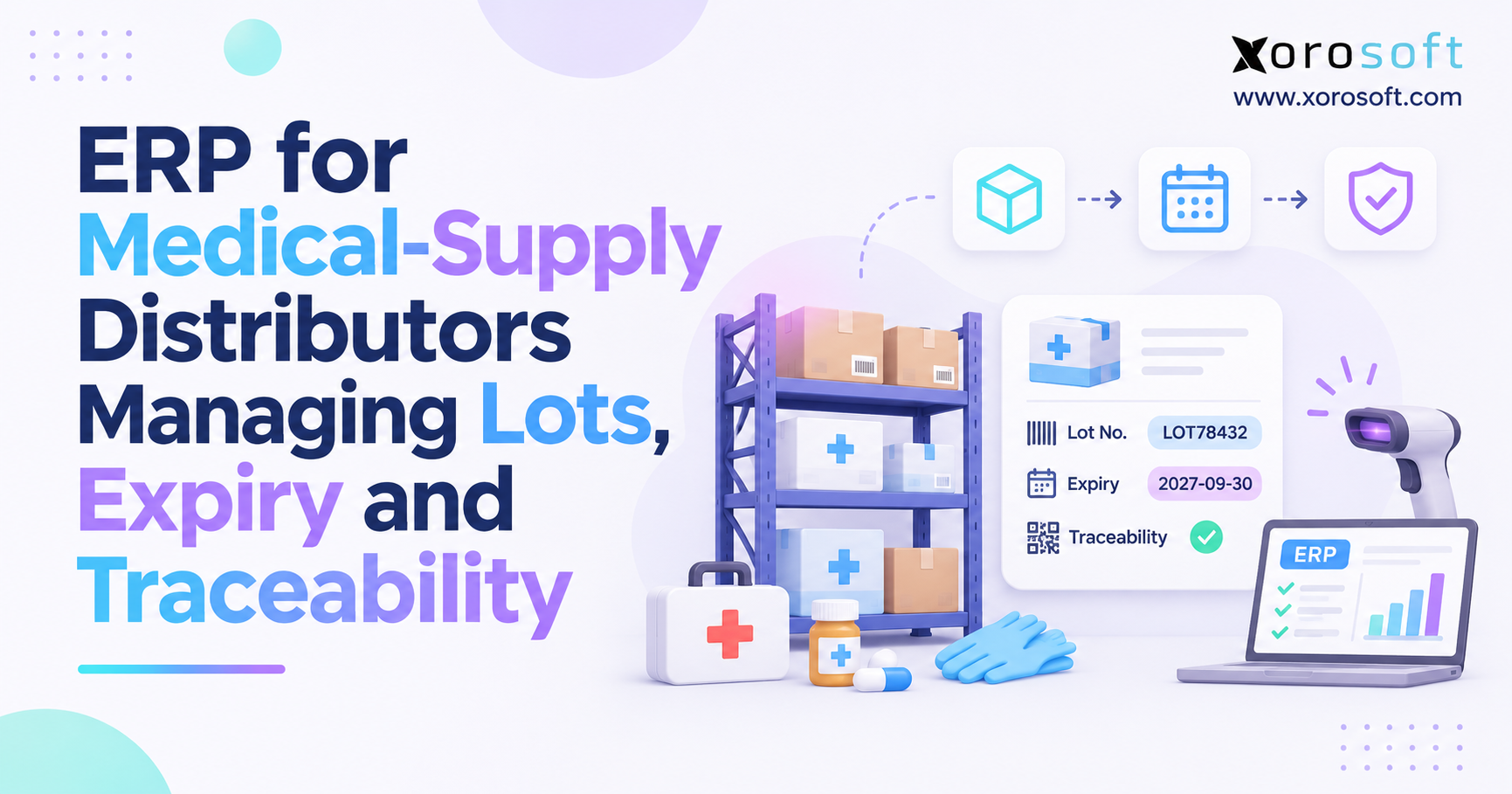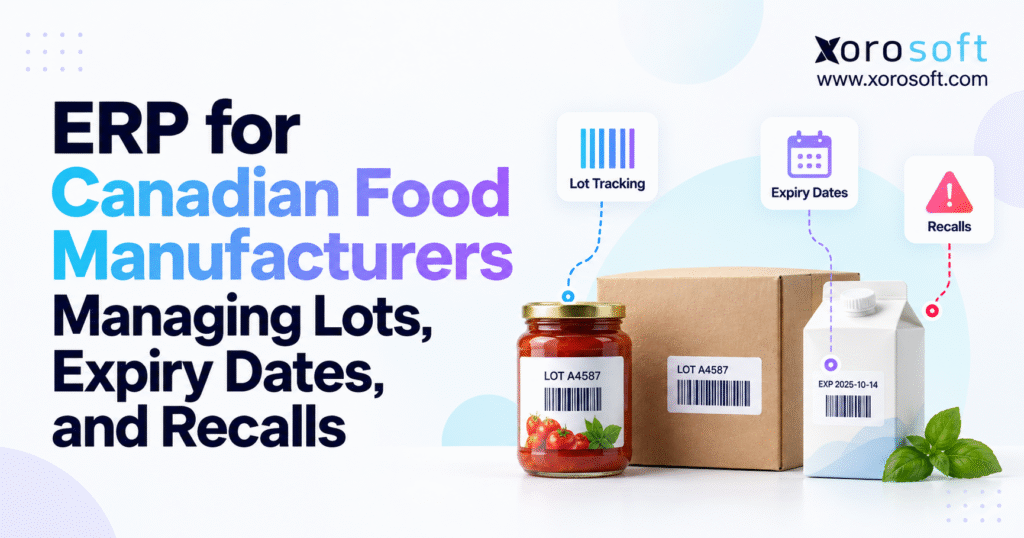
If you are searching for technology solutions, ERP for Canadian food manufacturers can provide essential tools to streamline operations and increase efficiency.
1. Why Canadian Food Manufacturers Need Better ERP Traceability
A supplier flags a spice lot used in last week’s production. Your inventory report shows 3,000 jars of finished sauce. However, nobody can quickly identify which jars contain the affected ingredient, where those jars are stored, or which customers received them.
The inventory count may be accurate. Yet the business still lacks the records needed to investigate the issue.
This is why ERP for Canadian food manufacturers must do more than track stock quantities. Food manufacturers need clear links between raw materials, production batches, finished products, warehouse movements, and customer shipments.
As businesses grow, those links often become harder to maintain. Receiving teams record supplier lots in spreadsheets, production teams maintain separate batch sheets, and warehouse teams track shipments through another system. Meanwhile, finance works with inventory values that may not reflect the latest quality holds or stock losses.
Consequently, one supplier issue can trigger hours of manual investigation.
1.1. Why Food Manufacturing ERP Must Connect More Than Inventory
Food manufacturing ERP connects purchasing, production, inventory, warehouse operations, and accounting within a shared operating system.
However, the value of that connection depends on the details recorded during each transaction.
For example, knowing that 500 kilograms of an ingredient were purchased does not reveal which production batches consumed it. Similarly, knowing that 2,000 finished units shipped does not establish which ingredient lots were used to produce them.
A reliable system should help teams answer these questions using actual transaction records.
1.2. How Disconnected Systems Increase Recall Risk
Consider a hypothetical Canadian sauce manufacturer.
The company receives 100 kilograms of spice lot SP-062. Two production batches consume 40 kilograms each, while 20 kilograms remain in storage. Finished products then move through two warehouses before reaching wholesale and ecommerce customers.
If each department uses separate records, tracing SP-062 becomes difficult.
Therefore, the business needs more than a list of lot numbers. It needs a clear record of how materials move through production and fulfillment.
The examples and quantities in this article are illustrative. They show how to evaluate systems, not how to establish regulatory compliance.
2. ERP for Canadian Food Manufacturers: CFIA Requirements
Canadian food manufacturers operate within a regulatory environment that places significant importance on traceability, recordkeeping, and recall readiness.
However, not every requirement applies to every business in the same way.
Before selecting software, manufacturers should identify which federal, provincial, product-specific, and customer requirements apply to their operations.
2.1. Canadian Food ERP and SFCR Rules
The Safe Food for Canadians Regulations (SFCR) establish traceability requirements for covered food activities, including certain importing, exporting, manufacturing, and interprovincial trade activities.
However, traceability, licensing, and preventive-control-plan obligations do not always have identical scopes.
Therefore, manufacturers should first document their products, business activities, and distribution channels.
The Canadian Food Inspection Agency’s traceability guidance provides a starting point for understanding the applicable requirements.
ERP software can support recordkeeping. Nevertheless, buying ERP does not automatically establish CFIA compliance.
2.2. Food Traceability Records and Retention
Under the applicable SFCR provisions, covered businesses must maintain records identifying relevant foods, suppliers, recipients, transaction dates, and other required information.
For example, a manufacturer may need to identify the supplier of an ingredient and the business that received a finished product.
The relevant records generally must be retained for two years after the food is provided to another person or sold at retail.
However, other records may have different retention requirements. Therefore, manufacturers should confirm the rules applicable to their products and processes.
A suitable ERP should make it practical to retrieve older records even when employees, suppliers, or product codes have changed.
2.3. CFIA Record Retrieval in ERP
Under Section 91 of the SFCR, the usual deadline for providing requested traceability documents is 24 hours. However, shorter or longer periods may apply in specified circumstances.
Importantly, this is a document-production requirement, not a universal deadline for completing a food recall.
Electronic records must also meet the applicable format requirements, including usable plain-text data.
As a result, manufacturers should test more than report printing.
A practical ERP evaluation should include retrieving an older lot, exporting the related records, and checking whether another authorized employee can understand the information without help.
Furthermore, CFIA guidance allows electronic records to be stored outside Canada when they remain accessible from Canada. Therefore, accessibility should not be confused with a blanket requirement for Canadian server hosting.
3. Lot Tracking in Canadian Food Manufacturing ERP
Lot tracking becomes valuable when it connects the entire product journey.
A supplier lot must remain identifiable after receiving, production, storage, repacking, and shipping.
Otherwise, the manufacturer may know where inventory is located without knowing its full history.
3.1. Supplier Lot Tracking in Food ERP
Effective lot tracking begins when materials arrive.
Receiving staff should record the supplier’s lot identifier, product, quantity, unit of measure, receipt date, and relevant quality status.
However, manufacturers should not rely on a lot code alone.
Two suppliers may use identical lot numbers. Therefore, the system should preserve the relationship between supplier, product, and lot.
For example, spice lot SP-062 should remain linked to its original supplier even after the manufacturer assigns an internal code.
This relationship becomes essential when a supplier reports a potential issue months later.
3.2. Ingredient and Batch Tracking in Manufacturing ERP
A bill of materials describes the ingredients expected in a recipe.
However, actual production may differ.
Workers may use substitute ingredients, return unused materials, or consume different quantities because of production conditions.
Therefore, food manufacturing ERP should record the materials actually used.
In the sauce example, production batch B101 consumes 40 kilograms of SP-062. Batch B102 consumes another 40 kilograms.
Those transactions should connect the ingredient lot to both finished batches.
Xorosoft’s ERP platform brings manufacturing, inventory, purchasing, and accounting into a connected operating environment. However, manufacturers should verify their specific lot-tracking requirements during a product demonstration.
3.3. Food Lot Genealogy for Rework and Repacking
Food production rarely follows a perfectly straight path.
For example, approved material from one production batch may be reused in another. Products may also be repacked into different sizes or transferred between facilities.
Consequently, the system must preserve the original material relationships.
If material from B101 enters B102, the record should identify the source, quantity, destination, and approval.
Similarly, repacking should not erase the original product history.
Packaging materials may also matter. For instance, an incorrect label or unsafe packaging component can affect finished products even when the food ingredients themselves are acceptable.
Therefore, manufacturers should consider packaging-lot references within their traceability design.
4. Food Manufacturing ERP for Expiry Dates and Shelf Life
Shelf-life management affects more than warehouse rotation.
It also influences purchasing, production schedules, customer commitments, and stock availability.
However, Canadian date terminology requires careful handling.
4.1. Best-Before and Expiry Date Tracking in Food ERP
Best-before dates and expiration dates are not interchangeable.
A best-before date generally relates to expected product quality under stated storage conditions. In contrast, expiration dates apply to specified food categories with particular compositional or nutritional requirements.
Therefore, manufacturers should not configure every date field as though it represents the same rule.
| Date type | Main purpose | ERP requirement |
|---|---|---|
| Best-before date | Expected product quality | Track the approved date and related business rules |
| Regulated expiration date | Requirements for specified products | Apply relevant restrictions |
| Internal shipping cutoff | Business dispatch policy | Keep separate from the package date |
| Customer shelf-life requirement | Minimum remaining life | Check eligibility against the agreed date |
For example, a customer may require at least 30 days of remaining shelf life upon delivery.
Even if a product remains within its best-before period, it may not meet that customer’s requirement.
As a result, the ERP should distinguish product status from customer-specific shipping eligibility.
4.2. FIFO and FEFO Inventory Management
FIFO means first-in, first-out. It generally prioritizes stock received earlier.
FEFO means first-expired, first-out. Instead, it prioritizes stock based on the relevant expiry-date rule.
However, neither approach should ignore quality holds or customer requirements.
Consider two available lots:
| Lot | Best-before date | Expected delivery | Remaining shelf life |
|---|---|---|---|
| LOT-A | December 5 | November 10 | 25 days |
| LOT-B | December 20 | November 10 | 40 days |
If the customer requires 30 remaining days, LOT-A fails the requirement while LOT-B qualifies.
Therefore, the warehouse should first identify eligible stock and then apply the approved picking rule.
Furthermore, manufacturers should verify how their selected ERP handles FEFO settings, date fields, and exceptions. The presence of a FEFO feature does not guarantee that every warehouse workflow is correctly configured.
4.3. Customer Shelf-Life Rules in Food ERP
Customer requirements may differ by retailer, distributor, or market.
For example, one wholesale customer may accept a shorter remaining shelf life than another.
Consequently, inventory that cannot serve one customer may still qualify for another legitimate order.
ERP for Canadian food manufacturers should help teams evaluate those rules before promising stock.
However, a commercial exception must never override a safety-related hold or an applicable legal restriction.
Quality personnel should approve relevant date rules, while sales and warehouse teams should work within those approved limits.
5. Warehouse Management in Food Manufacturing ERP
Even strong production records can lose value when warehouse transactions do not preserve lot identity.
As a result, warehouse execution must support the same traceability standards as receiving and manufacturing.
5.1. Barcode Lot Tracking in Food Warehouses
Barcode scanning can reduce manual entry. However, the information captured depends on the barcode and system setup.
For example, GS1 application identifiers distinguish product identity, lot numbers, best-before dates, and expiration dates.
Therefore, scanning a product identifier alone does not necessarily capture its lot and date information.
Warehouse teams should test receiving, putaway, transfers, picking, and shipping with their actual labels.
Xorosoft’s warehouse management solution describes barcode scanning and multi-warehouse capabilities. Nevertheless, manufacturers should confirm how the proposed setup handles their lot, date, and quality-status requirements.
5.2. Quality Holds in Warehouse Management Software
A quality hold must affect warehouse activity.
For example, stock placed on hold should not remain available for ordinary allocation or shipping.
However, the warehouse may still need to move that stock into a controlled quarantine area.
Therefore, the system should distinguish restricted use from permitted handling.
Manufacturers should also test holds applied after picking begins.
If a lot is already packed or waiting for carrier collection, the business needs a clear process for stopping the shipment.
In addition, release authority should remain with the appropriate personnel rather than being available to every warehouse user.
5.3. Cold-Chain Records and Food Inventory Control
Temperature-sensitive products require additional attention.
An acceptable best-before date does not prove that the product was stored under suitable conditions.
Therefore, manufacturers should establish how temperature checks, deviations, and quality decisions connect to relevant lots.
Some businesses use separate monitoring or quality systems. In that case, ERP integration may be more appropriate than replacing those tools.
The important question is whether staff can retrieve the necessary evidence when investigating a specific lot.
6. Food ERP for Shopify, Wholesale, and Multi-Warehouse Operations
Food manufacturers increasingly serve several sales channels.
However, ecommerce orders, wholesale shipments, and third-party fulfillment may produce different levels of traceability information.
6.1. Food ERP Integration With Sales and Shipping
An order shows what a customer requested.
In contrast, a shipment record should establish what actually left the warehouse.
Therefore, the ERP must preserve the relationship between orders, fulfillment transactions, quantities, and relevant lots.
When reviewing ERP integrations, manufacturers should verify which information moves between systems.
For example, an integration may synchronize order status without transferring the exact lot used during fulfillment.
Consequently, the integration design must reflect the traceability requirements rather than assuming every connection includes all required fields.
6.2. Shopify Inventory Sync and Lot Traceability
Shopify can support online ordering while an ERP manages broader business operations.
However, inventory synchronization and food lot traceability are separate requirements.
The Xorosoft ERP Shopify app provides context for the available commerce integration. Manufacturers should still verify which lot-level details remain in the ERP or warehouse system.
For example, a Shopify order may contain several products shipped from different locations.
The manufacturer should determine where the actual lot selection is recorded and how that information can be retrieved later.
6.3. Multi-Warehouse Food Traceability
Stock transfers should preserve lot identity, quantity, status, and location history.
However, external warehouses may use different item codes or reporting schedules.
Therefore, manufacturers should establish clear data-sharing rules with each partner.
ERP for Canadian food manufacturers should also be tested against delayed messages, partial shipments, and inventory differences.
A connected system is not necessarily a reliable system when failed transactions remain unnoticed.
Consequently, every integration should have an owner responsible for reviewing errors and resolving missing records.
7. ERP for Canadian Food Manufacturers: Recall Readiness
Food recall readiness depends on more than finding a lot number.
Manufacturers need reliable records, clear responsibilities, effective stock controls, and a documented recall procedure.
7.1. Food Recall Management and Lot Tracking
A traceability report identifies relationships between materials, products, and shipments.
However, a recall procedure defines who makes decisions, who communicates with relevant parties, and how affected products are controlled.
Under Section 84 of the SFCR, covered operators must maintain recall procedures and conduct required recall simulations.
Furthermore, when an operator determines that food should be recalled because it presents a health risk, the applicable immediate notification and recall-action requirements must be followed.
Therefore, software should support the recall team rather than replace its judgement.
7.2. Recall Quantity Reconciliation in ERP
Suppose the hypothetical manufacturer produces 3,000 finished jars.
At the agreed reporting cutoff, the affected stock is distributed as follows:
| Inventory position | Quantity |
|---|---|
| Plant warehouse | 600 jars |
| Second warehouse | 200 jars |
| Third-party warehouse | 100 jars |
| Distributed to customers | 2,100 jars |
| Total | 3,000 jars |
If 300 distributed jars are returned, controlled stock increases to 1,200 jars.
Meanwhile, the remaining distributed population decreases to 1,800 jars.
However, the original shipment history must still show that 2,100 jars were distributed.
Otherwise, the business may lose important evidence about the product’s movement.
Similarly, the ingredient balance should be checked separately.
For SP-062, 80 kilograms were consumed and 20 kilograms remain, matching the original 100-kilogram receipt.
Consequently, manufacturers should reconcile ingredients and finished products using consistent units and clearly defined categories.
7.3. Mock Recall Testing for Canadian Food Manufacturers
Recall simulations should test the full process, not simply generate a report.
For covered operators, Section 84 requires a simulation at least every 12 months, with documentation retained for two years.
A useful exercise should include an affected ingredient, finished batches, warehouse stock, customer shipments, and external partners where relevant.
Furthermore, the team should record missing information, unresolved quantities, and corrective actions.
For example, a simulation may reveal that one warehouse reports stock by item but not by lot.
That finding should lead to a specific process or system change.
As a result, recall testing becomes a way to improve operations rather than a once-a-year administrative task.
8. Food ERP for Purchasing, Forecasting, and Accounting
Traceability records also support better business decisions.
However, manufacturers must connect inventory availability with shelf life, quality status, and financial records.
8.1. Food Inventory Forecasting and Shelf-Life Planning
Imagine a manufacturer holding 1,000 jars.
Of those, 200 are on quality hold, 300 do not meet a particular customer’s remaining-shelf-life requirement, and 500 qualify for that order.
Although total stock equals 1,000 jars, only 500 are eligible for that customer.
Therefore, purchasing and production planning should not rely on total inventory alone.
Instead, planners should consider expected demand, production timing, supplier lead times, and the usable life of materials.
This approach can also help identify excess stock before it becomes a write-off.
8.2. Food Manufacturing ERP for Cost and Inventory Control
Food inventory losses affect both operations and finance.
However, a customer credit, a returned pallet, and a stock write-off represent different events.
Therefore, manufacturers should record each event separately and reconcile the resulting quantities and values.
An integrated ERP can make related information easier to access. Nevertheless, finance teams must still approve the accounting treatment and investigate differences.
For example, a returned product should not automatically be treated as sellable inventory.
Quality must first determine its status, while finance records the appropriate financial effect.
9. Canadian Food Manufacturing ERP by Production Type
Different food manufacturers face different operating challenges.
Therefore, the best ERP evaluation should reflect the actual production process rather than rely on a generic industry checklist.
9.1. ERP for Bakeries and Snack Manufacturers
Bakeries and snack producers often manage frequent production runs, ingredient substitutions, packaging changes, and short production schedules.
For example, a manufacturer may produce several batches using the same ingredient lot but different packaging versions.
Consequently, the system should help identify which finished batches used each relevant ingredient and packaging reference.
Label approval and allergen controls should remain part of the appropriate quality process.
9.2. ERP for Chilled and Processed Foods
Chilled-food manufacturers may place greater importance on delivery dates, storage conditions, and quality-release decisions.
Meanwhile, sauce and blended-product manufacturers may need detailed records of ingredient mixing, yield, and rework.
Therefore, the same demonstration should not be used for every manufacturing model.
Xorosoft’s industry solutions overview can help frame the discussion. However, buyers should require a demonstration based on their own production steps.
9.3. ERP for Food Co-Packers
Co-packers may handle materials owned by their customers.
As a result, physical stock control and financial ownership must be treated separately.
For example, a co-packer should be able to identify a customer’s ingredient lot without incorrectly treating the material as purchased inventory.
Furthermore, production records should preserve the relationship between customer-owned inputs, finished goods, losses, and unused material returns.
Clear responsibility for lot identifiers and reporting is essential when several businesses share the process.
10. Comparing ERP for Canadian Food Manufacturers
Choosing software requires more than comparing feature lists.
Instead, manufacturers should test whether each system supports their real transactions, exceptions, and reporting needs.
10.1. Food ERP vs. Standalone Traceability Software
Not every manufacturer needs a full ERP replacement.
For example, a smaller business may already maintain reliable accounting and production records but need better lot tracking.
In that situation, standalone traceability software may be worth evaluating.
| Approach | Potential fit | Main concern |
|---|---|---|
| Existing tools | Simple operations with reliable controls | Manual effort and record consistency |
| Standalone traceability software | Traceability is the main gap | Links to production and fulfillment |
| Integrated manufacturing ERP | Several departments need shared records | Setup effort and workflow fit |
Therefore, the decision should reflect the business’s actual operating gaps.
10.2. Comparing Canadian Food Manufacturing ERP Systems
When reviewing Xorosoft, NetSuite, Business Central, Acumatica, Sage, or other platforms, apply the same test scenarios.
For example, require each vendor to demonstrate ingredient receipt, actual production use, rework, quality holds, customer shelf-life rules, and shipment tracing.
A Xorosoft and NetSuite comparison can provide additional questions for evaluation. However, vendor-authored comparisons should not replace product demonstrations or written scope confirmation.
Furthermore, distinguish standard features from setup work, integrations, and custom development.
This helps prevent unexpected costs and unclear implementation responsibilities.
10.3. AI-Assisted Food ERP and Recall Data
AI tools may help users search business information.
However, they should not independently decide whether food is safe or whether a recall is required.
Xorosoft describes its MCP server as a way for compatible AI applications to access authorized ERP information.
For food operations, manufacturers should verify permissions, source records, and the accuracy of retrieved information.
In addition, sensitive actions should remain subject to the appropriate approval process.
AI-assisted access may improve convenience. Nevertheless, it does not replace reliable source data or controlled recall procedures.
11. Implementing ERP for Canadian Food Manufacturers
ERP implementation should begin with clean data and clear responsibilities.
Otherwise, the new system may reproduce the same gaps found in spreadsheets and disconnected applications.
11.1. Food ERP Data Migration and Lot Records
Before migration, standardize item codes, supplier identifiers, lot formats, units, date fields, and quality statuses.
Furthermore, identify who owns each type of master data.
Opening inventory should be reconciled by item, lot, location, and status.
However, importing correct quantities is not enough if historical lot relationships disappear.
Therefore, manufacturers should preserve access to relevant records from their previous systems.
11.2. Canadian Food ERP Demonstration Checklist
A useful demonstration should follow one realistic ingredient lot through the entire business.
| Test | Expected evidence |
|---|---|
| Ingredient receiving | Supplier lot and receipt details |
| Production consumption | Actual ingredient-to-batch relationships |
| Rework | Source and destination history |
| Quality hold | Restricted use and approved release |
| Shelf-life rules | Correct customer eligibility |
| Warehouse transfer | Preserved lot and quantity records |
| Recall investigation | Shipment history and quantity reconciliation |
In addition, test errors.
For example, ask what happens when a worker scans the wrong lot or a warehouse sends a duplicate shipment message.
These scenarios often reveal more than a prepared dashboard demonstration.
11.3. Food ERP Go-Live and Traceability Testing
Before go-live, involve production, quality, warehouse, finance, and technical teams.
Each group should test the transactions it will actually perform.
Furthermore, train backup users and establish procedures for system or integration failures.
Xorosoft’s customer case studies may help buyers identify implementation questions. However, a case study from another industry should not be treated as proof of food-specific capabilities.
After launch, review missing lot records, failed integrations, inventory differences, and quality-hold exceptions.
Consequently, the business can address problems before they affect a future investigation.
12. Choosing the Right ERP for Canadian Food Manufacturers
The value of ERP for Canadian food manufacturers is not simply having fewer software applications.
Instead, the goal is to maintain reliable links between ingredients, production batches, warehouse stock, customer shipments, and financial records.
When those relationships are clear, teams can investigate issues with less manual work. They can also make better decisions about stock eligibility, production planning, and inventory losses.
However, no ERP automatically guarantees food safety or regulatory compliance.
Therefore, manufacturers should evaluate software using their actual lot structure, production process, customer requirements, and recall procedures.
Begin with one ingredient lot and follow it through the business. Identify missing records, unclear responsibilities, and controls that depend on manual work.
Then use those findings to build a practical ERP shortlist.
If you want to assess how Xorosoft could support your manufacturing workflows, contact the Xorosoft team to discuss your lot tracking, shelf-life management, warehouse, and recall-readiness requirements.
Frequently Asked Questions
What is the best ERP for Canadian food manufacturers?
The best ERP supports lot tracking, expiry management, production, inventory, and recall readiness. Compare systems using your actual manufacturing workflows and verify their features before choosing.
Does CFIA require food manufacturers to use ERP software?
No. CFIA requires applicable food businesses to maintain traceability records and follow relevant food safety rules. ERP software can help manage these records, but it is not mandatory.
How does ERP help with food lot tracking?
ERP connects supplier lots, production batches, finished goods, and shipments. As a result, manufacturers can trace affected ingredients and identify related products more quickly.
Can ERP manage best-before dates and expiry dates?
Yes, when properly configured. ERP can track relevant dates, support FEFO picking, and apply customer shelf-life requirements. However, specific capabilities vary by system.
How does ERP support food recall management?
ERP can help identify affected lots, locate inventory, retrieve shipment records, and reconcile quantities. However, manufacturers still need documented recall procedures and trained staff.
How long must Canadian food manufacturers retain traceability records?
Under applicable SFCR provisions, traceability records generally must be retained for two years after food is provided or sold at retail. Other recordkeeping requirements may differ.
Can food manufacturing ERP integrate with Shopify?
Yes. Some ERP systems connect with Shopify to synchronize orders, inventory, and fulfillment. However, manufacturers should verify whether lot-level shipment records are available.
Recent Posts
-
 Ecommerce Delivery Statistics 2026: Cost, Speed, and Promise Accuracy
-
 How to Calculate Inventory Turnover by Channel, Warehouse and SKU
-
 ERP for Importers Managing Partial, Rejected, and Canceled Receipts
-
 Shopify B2B vs Wholesale Portal Software for Complex Accounts
-
 What Is Nonconforming Inventory and How Should ERP Control It?